
Chapter 8 · Free lesson
Bonding and molecular properties
The full lesson, free. For instant answer checking, hints and progress tracking, open the interactive version.
What you will study
- Lewis structures count outer electrons
- Formal charge and resonance
- Electron regions lead to molecular shape
- Bonding models: hybridization, sigma/pi bonds, and bond order
- Polarity and attractions between molecules
- Alkanes and simple organic molecules
By the end, you can…
- Count valence electrons and draw a simple Lewis structure.
- Use formal charge and resonance to choose the best Lewis structure.
- Find molecular shape from bonds and lone pairs.
- Use electron-region counts for introductory hybridization and distinguish sigma and pi bonds.
- Use bond polarity and shape to decide molecular polarity.
- Choose the strongest relevant intermolecular attraction.
- Draw Lewis structures and give bond angles for the first ten alkanes and a few simple organic molecules.
These are the skills to check, not just pages to finish. Use the section goals while studying, then try the chapter checks without hints.
Read the idea first. Then notice the clue, follow the route, and make a choice you can explain. You can return to the worked example if a practice question feels unfamiliar.
8.1 Lewis structures count outer electrons
A Lewis structure is a drawing of a molecule's outer (valence) electrons. Lines show shared pairs; dots show pairs that are not shared. It is the first step toward shape and polarity.
- Main-group valence electrons (Chapter 3); formula atom counts (Chapter 2).
Need a refresher? Open the table of contents and revisit that topic before starting.
- Lewis structure: valence electrons drawn as bonds and lone pairs.
- Lone pair: two electrons not used in a bond.
- Octet: eight electrons around an atom. Hydrogen needs only two.
- Some atoms have incomplete or expanded octets; check your course's exceptions.
| Step | What you do |
|---|---|
| 1 | Count valence electrons, adjusted for charge. |
| 2 | Connect atoms with single bonds. |
| 3 | Fill outer atoms' octets with lone pairs. |
| 4 | Put leftover electrons on the central atom. |
| 5 | Central octet short? Turn an outer lone pair into a multiple bond. |
- Count valence electrons, adjusted for any charge.
- Connect the atoms with single bonds.
- Fill the outer atoms' octets.
- Use multiple bonds if the central atom is short.
- Check the total against your starting count.
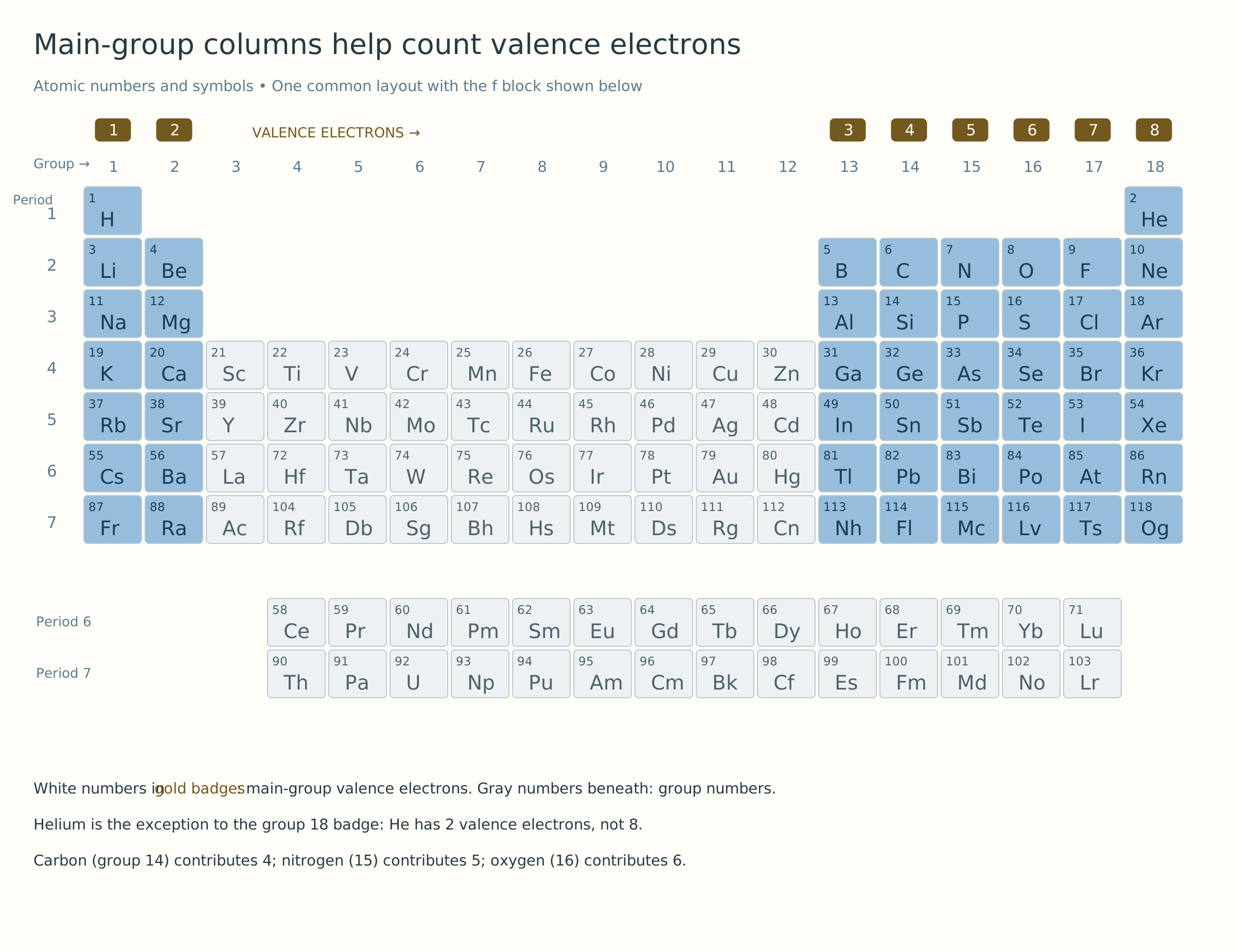
On the periodic table: The main-group column gives valence electrons: C (Group 14) 4, N (15) 5, O (16) 6, H (1) 1.
On the periodic table: Helium is the exception in Group 18: it has 2 valence electrons, not 8.
Build the usual Lewis structure for CO2.
- 1Count available valence electrons
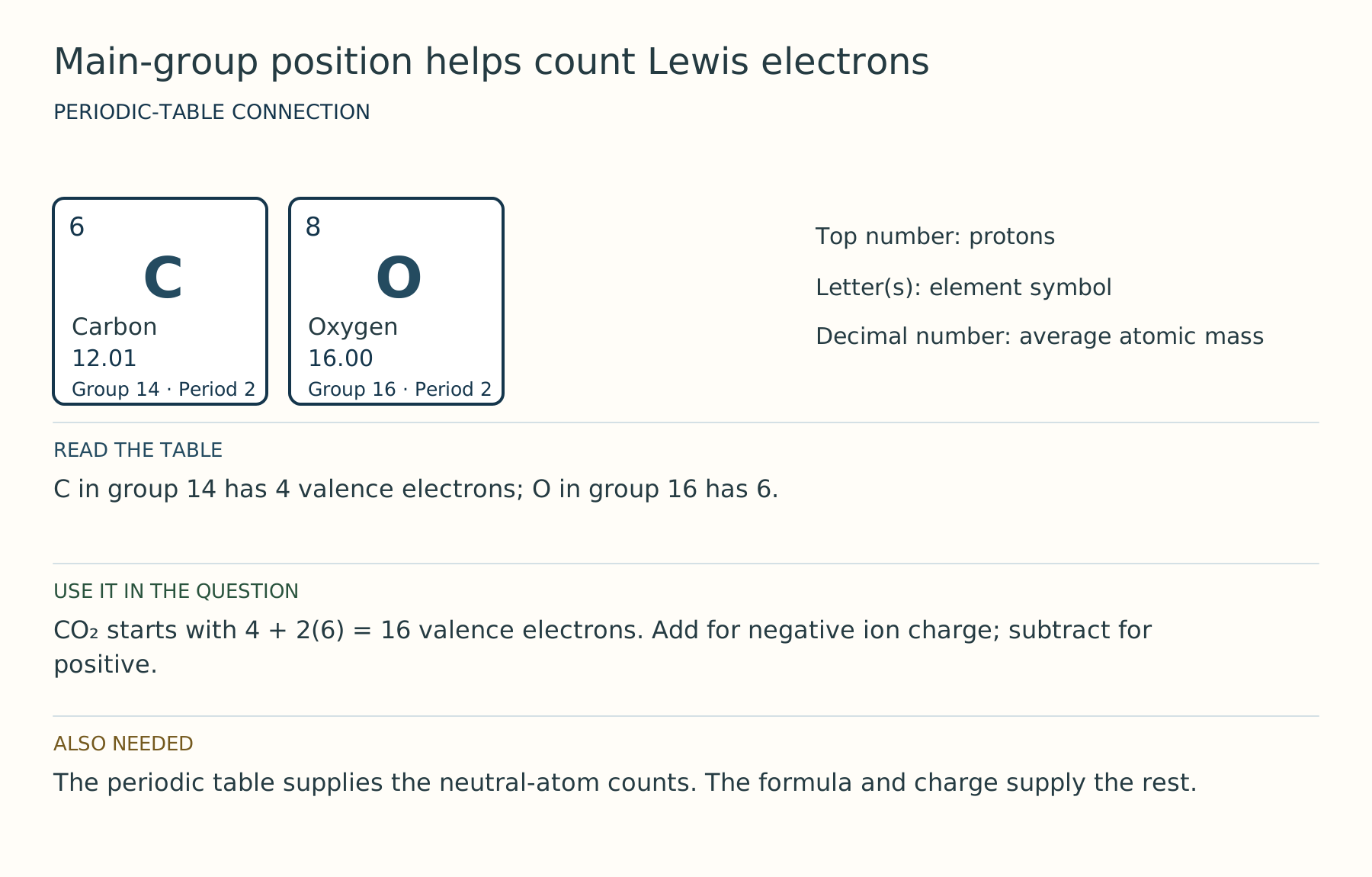
On the periodic table: C is in Group 14 (4 valence electrons); O is in Group 16 (6 each).
C + 2 O = 4 + 2(6) = 16 electrons - 2Connect the atoms
Carbon is the central atom. Two single bonds use four electrons.
- 3Complete the outer octets
The twelve remaining electrons go on the oxygens as 3 lone pairs each.
- 4Share a lone pair from each oxygen
Turn one lone pair on each O into an extra bonding pair. Carbon now has eight.
- 5Check the final budget
The structure uses exactly the electrons we started with.
Part Count Electrons Double bonds 2 8 Lone pairs 4 8 Total 16 - ✓Answer
O=C=O, with two lone pairs on each oxygen.
8.2 Formal charge and resonance
Formal charge is bookkeeping: it tells you how many electrons each atom “owns” in a Lewis structure. It helps you pick the best drawing and recognize resonance, when one drawing is not enough.
- Lewis structures and lone pairs (8.1).
- Electronegativity (3.4).
Need a refresher? Open the table of contents and revisit that topic before starting.
- Formal charges must add up to the overall charge of the species.
- Prefer structures with small formal charges (0 where possible).
- Put a negative formal charge on the more electronegative atom.
| Oxygen atom | V | N | B2 | FC |
|---|---|---|---|---|
| Central | 6 | 2 | 3 | +1 |
| End, double bond | 6 | 4 | 2 | 0 |
| End, single bond | 6 | 6 | 1 | −1 |
| Sum | 0 |
- Count each atom's owned electrons: lone-pair electrons plus half its bonding electrons.
- Subtract from the valence count to get formal charge.
- Check that the formal charges add up to the overall charge.
On the periodic table: The group gives V: N (Group 15) has 5, O (16) has 6, H has 1.
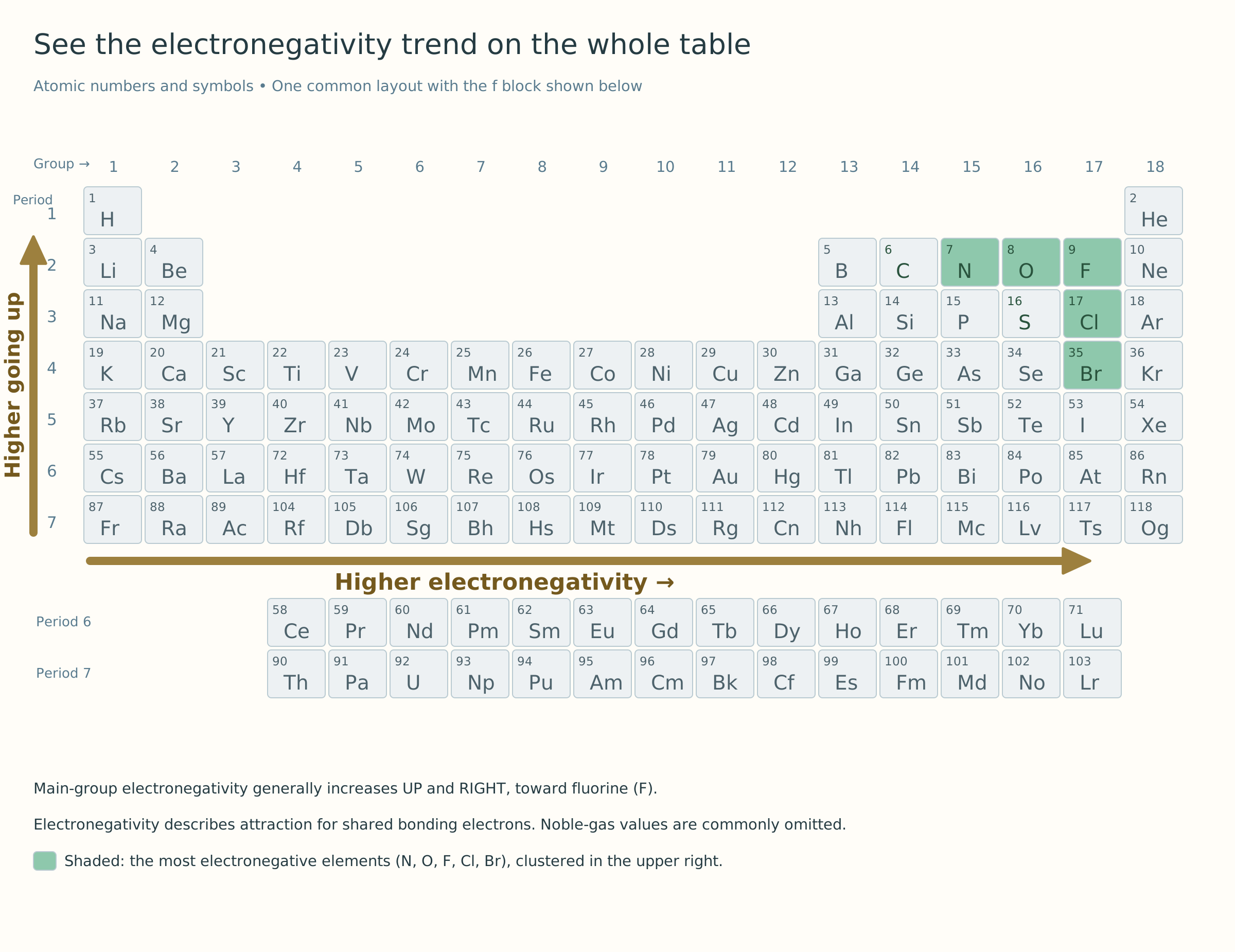
On the periodic table: Electronegativity generally increases up and to the right, toward fluorine (F). Compare positions to see which atom should carry negative charge.
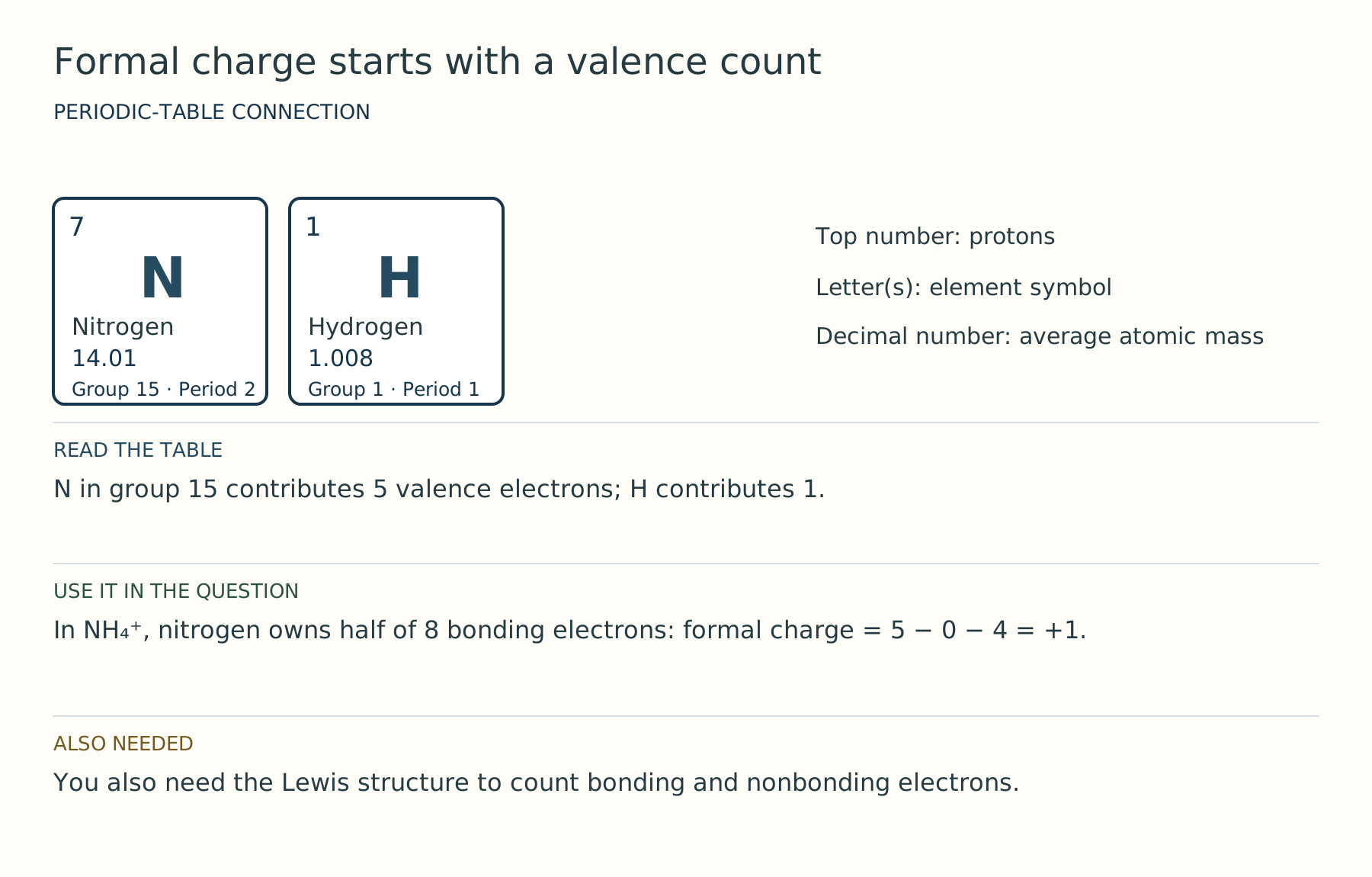
In NH4+, nitrogen has four single bonds and no lone pair. Find nitrogen's formal charge.
- 1Start with nitrogen's valence count
On the periodic table: N is in Group 15, so it has 5 valence electrons.
V = 5 - 2Count nonbonding electrons
Nitrogen has no lone pair here.
N = 0 - 3Assign half the bonding electrons
Bonding electrons are split equally between the two bonded atoms.
B2 = 4 bonds × 2 electrons2 = 4 - 4Subtract the assigned electrons
Nitrogen is assigned one fewer electron than a neutral N atom.
FC = 5 − 0 − 4 = +1 - ✓Answer
Nitrogen has formal charge +1.
8.3 Electron regions lead to molecular shape
Molecules are three-dimensional. Count the electron regions around a central atom, and you can predict how they spread out: that gives the shape.
- Lewis structures and lone pairs (8.1).
Need a refresher? Open the table of contents and revisit that topic before starting.
- Each bond is one region: single, double or triple.
- Each lone pair on the central atom is one region.
- VSEPR (valence-shell electron-pair repulsion): regions spread as far apart as possible.
| Regions | Lone pairs | Electron geometry | Molecular shape | Ideal angle | Example |
|---|---|---|---|---|---|
| 2 | 0 | Linear | Linear | 180° | CO2 |
| 3 | 0 | Trigonal planar | Trigonal planar | 120° | BF3 |
| 3 | 1 | Trigonal planar | Bent | < 120° | SO2 |
| 4 | 0 | Tetrahedral | Tetrahedral | 109.5° | CH4 |
| 4 | 1 | Tetrahedral | Trigonal pyramidal | < 109.5° | NH3 |
| 4 | 2 | Tetrahedral | Bent | ≈ 104.5° | H2O |
| 5 | 0 | Trigonal bipyramidal | Trigonal bipyramidal | 90°, 120° | PCl5 |
| 5 | 1 | Trigonal bipyramidal | Seesaw | < 90°, < 120° | SF4 |
| 5 | 2 | Trigonal bipyramidal | T-shaped | < 90° | ClF3 |
| 5 | 3 | Trigonal bipyramidal | Linear | 180° | XeF2 |
| 6 | 0 | Octahedral | Octahedral | 90° | SF6 |
| 6 | 1 | Octahedral | Square pyramidal | < 90° | BrF5 |
| 6 | 2 | Octahedral | Square planar | 90° | XeF4 |
Lone pairs push bonds a little closer, so angles shrink slightly below the ideal value.
- Draw the Lewis structure; pick the central atom.
- Count all its regions: bonds plus lone pairs.
- Separate lone pairs from bonded atoms.
- Name the geometry and shape.
On the periodic table: The group gives main-group valence electrons: C (14) 4, N (15) 5, O (16) 6, H 1. Helium has 2.
On the periodic table: The table builds the Lewis structure; it does not show the shape.
Use electron regions to find the shapes of CO2 and H2O.
- 1Count regions around C in CO2
O=C=O. Each double bond is one region.
Around C Regions C=O double bond 1 C=O double bond 1 Lone pairs 0 Total 2 - 2Name the CO2 shape
The O atoms sit on opposite sides of C.
2 regions, 0 lone pairs → linear, 180° - 3Count regions around O in H2O
Lone pairs affect the arrangement, so count them.
Around O Regions O–H bond 1 O–H bond 1 Lone pairs 2 Total 4 - 4Name the H2O shape
Geometry counts lone pairs; shape names only atoms.
Counts Name Electron geometry 4 regions Tetrahedral Molecular shape 2 bonded atoms Bent - ✓Answer
CO2 is linear; H2O is bent.
8.3a Bonding models: hybridization, sigma/pi bonds, and bond order
Lewis structures show where bonds are. Bonding models explain how they form: hybrid orbitals, sigma and pi bonds, and bond order. All three start from the Lewis structure.
- Electron regions and shapes (8.3).
- Resonance (8.2).
Need a refresher? Open the table of contents and revisit that topic before starting.
| Regions | Hybridization | Orbitals mixed | Arrangement | Example |
|---|---|---|---|---|
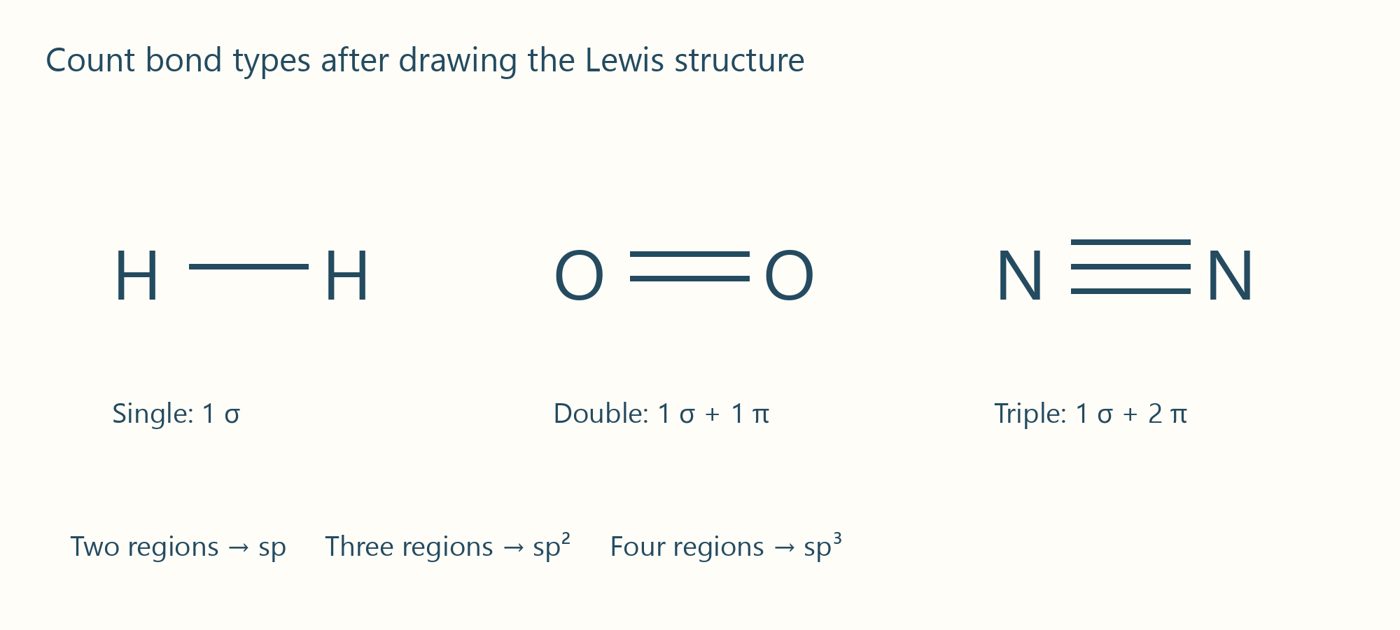
| 2 | sp | 1 s + 1 p | Linear, 180° | C in CO2 |
| 3 | sp2 | 1 s + 2 p | Trigonal planar, 120° | C in C2H4 |
| 4 | sp3 | 1 s + 3 p | Tetrahedral, 109.5° | C in CH4 |
| Bond | σ | π | Bond order |
|---|---|---|---|
| Single | 1 | 0 | 1 |
| Double | 1 | 1 | 2 |
| Triple | 1 | 2 | 3 |
- Same atom pair: higher bond order means a shorter, stronger bond.
- Resonance can give an average bond order between whole numbers. Ozone's two O–O bonds are each 1.5.
- Atoms with 5 or 6 regions (expanded octets, 8.3) sometimes get hybrid labels too. Those labels are simplified models.
- Atomic orbitals combine into new orbitals that spread over the whole molecule.
- Bonding orbitals hold electrons between the nuclei and hold the atoms together.
- Antibonding orbitals (marked with *) hold electrons that weaken the bond.
- Any unpaired electrons make a substance paramagnetic: pulled into a magnetic field. O2 is the classic example.
- Draw the Lewis structure.
- Count electron regions on the atom: 2 → sp, 3 → sp2, 4 → sp3.
- Count bonds: every bond has 1 σ; each extra line is 1 π.
- For MO bond order, subtract antibonding from bonding electrons and divide by 2.
On the periodic table: The group gives the valence electrons for the Lewis structure: C (Group 14) 4, O (Group 16) 6.
On the periodic table: The table does not show hybridization or bond types; those come from the Lewis structure.
Give the hybridization of carbon in CO2, and count its sigma and pi bonds.
- 1Count regions on carbon
Each double bond is one region. Carbon has no lone pairs.
Around C Regions C=O double bond 1 C=O double bond 1 Lone pairs 0 Total 2 - 2Match regions to hybridization
Two regions sit on opposite sides of carbon.
2 regions → sp, linear (180°) - 3Count sigma and pi bonds
Each C=O double bond has 1 σ and 1 π.
Bond σ π C=O 1 1 C=O 1 1 Total 2 2 - ✓Answer
Carbon is sp (linear). CO2 has 2 sigma and 2 pi bonds.
Section practice · 10 questions · tap to open
What this set is for: practicing the method from this section while it’s fresh. Every problem uses only what this section has taught.
Practice 1
A structure contains 1 double bond and no other bonds. Count sigma and pi bonds.
Give me a hint
Count the components of one double bond, then multiply.
Check the answer
Answer: 1 sigma and 1 pi
Explain the worked problem to me
What you know: The structure has 1 double bond and nothing else. What you want: The number of sigma and pi bonds.
- Recall what one double bond contains: 1 sigma bond (overlap along the line between the nuclei) plus 1 pi bond (overlap above and below that line).
- Multiply by the number of double bonds. Sigma: 1 × 1 = 1. Pi: 1 × 1 = 1.
- There are no other bonds to add, so the total is 1 sigma and 1 pi.
Check: Each double bond is 2 bonds in all, so the total is 1 × 2 = 2 bonds, and 1 sigma + 1 pi = 2.
Watch out: A double bond is not two sigma bonds. Only the first bond between two atoms is sigma; every extra bond is pi.
That’s right: 1 sigma and 1 pi
Practice 2
A structure contains 2 double bonds and no other bonds. Count sigma and pi bonds.
Give me a hint
Count the components of one double bond, then multiply.
Check the answer
Answer: 2 sigma and 2 pi
Explain the worked problem to me
What you know: The structure has 2 double bonds and nothing else. What you want: The number of sigma and pi bonds.
- Recall what one double bond contains: 1 sigma bond (overlap along the line between the nuclei) plus 1 pi bond (overlap above and below that line).
- Multiply by the number of double bonds. Sigma: 2 × 1 = 2. Pi: 2 × 1 = 2.
- There are no other bonds to add, so the total is 2 sigma and 2 pi.
Check: Each double bond is 2 bonds in all, so the total is 2 × 2 = 4 bonds, and 2 sigma + 2 pi = 4.
Watch out: A double bond is not two sigma bonds. Only the first bond between two atoms is sigma; every extra bond is pi.
That’s right: 2 sigma and 2 pi
Practice 3
A structure contains 3 double bonds and no other bonds. Count sigma and pi bonds.
Give me a hint
Count the components of one double bond, then multiply.
Check the answer
Answer: 3 sigma and 3 pi
Explain the worked problem to me
What you know: The structure has 3 double bonds and nothing else. What you want: The number of sigma and pi bonds.
- Recall what one double bond contains: 1 sigma bond (overlap along the line between the nuclei) plus 1 pi bond (overlap above and below that line).
- Multiply by the number of double bonds. Sigma: 3 × 1 = 3. Pi: 3 × 1 = 3.
- There are no other bonds to add, so the total is 3 sigma and 3 pi.
Check: Each double bond is 2 bonds in all, so the total is 3 × 2 = 6 bonds, and 3 sigma + 3 pi = 6.
Watch out: A double bond is not two sigma bonds. Only the first bond between two atoms is sigma; every extra bond is pi.
That’s right: 3 sigma and 3 pi
Practice 4
A structure contains 4 double bonds and no other bonds. Count sigma and pi bonds.
Give me a hint
Count the components of one double bond, then multiply.
Check the answer
Answer: 4 sigma and 4 pi
Explain the worked problem to me
What you know: The structure has 4 double bonds and nothing else. What you want: The number of sigma and pi bonds.
- Recall what one double bond contains: 1 sigma bond (overlap along the line between the nuclei) plus 1 pi bond (overlap above and below that line).
- Multiply by the number of double bonds. Sigma: 4 × 1 = 4. Pi: 4 × 1 = 4.
- There are no other bonds to add, so the total is 4 sigma and 4 pi.
Check: Each double bond is 2 bonds in all, so the total is 4 × 2 = 8 bonds, and 4 sigma + 4 pi = 8.
Watch out: A double bond is not two sigma bonds. Only the first bond between two atoms is sigma; every extra bond is pi.
That’s right: 4 sigma and 4 pi
Practice 5
A structure contains 5 double bonds and no other bonds. Count sigma and pi bonds.
Give me a hint
Count the components of one double bond, then multiply.
Check the answer
Answer: 5 sigma and 5 pi
Explain the worked problem to me
What you know: The structure has 5 double bonds and nothing else. What you want: The number of sigma and pi bonds.
- Recall what one double bond contains: 1 sigma bond (overlap along the line between the nuclei) plus 1 pi bond (overlap above and below that line).
- Multiply by the number of double bonds. Sigma: 5 × 1 = 5. Pi: 5 × 1 = 5.
- There are no other bonds to add, so the total is 5 sigma and 5 pi.
Check: Each double bond is 2 bonds in all, so the total is 5 × 2 = 10 bonds, and 5 sigma + 5 pi = 10.
Watch out: A double bond is not two sigma bonds. Only the first bond between two atoms is sigma; every extra bond is pi.
That’s right: 5 sigma and 5 pi
Practice 6
Two electron regions around carbon: introductory hybridization?
Give me a hint
2 regions → sp, 3 regions → sp2, 4 regions → sp3.
Check the answer
Answer: sp
Explain the worked problem to me
What you know: The atom has 2 electron regions. What you want: Its introductory hybridization label.
- Remember what counts as a region: each single, double, or triple bond is one region, and each lone pair is one region.
- Use the matching rule: 2 regions → sp, 3 regions → sp2, 4 regions → sp3.
- Two regions match sp.
Check: The label uses one s orbital and one p orbital, which makes 2 hybrid orbitals, one per region. The regions are arranged linearly, 180° apart.
Watch out: A double or triple bond still counts as only one region.
That’s right: sp
Practice 7
Three electron regions: hybridization?
Give me a hint
2 regions → sp, 3 regions → sp2, 4 regions → sp3.
Check the answer
Answer: sp2
Explain the worked problem to me
What you know: The atom has 3 electron regions. What you want: Its introductory hybridization label.
- Remember what counts as a region: each single, double, or triple bond is one region, and each lone pair is one region.
- Use the matching rule: 2 regions → sp, 3 regions → sp2, 4 regions → sp3.
- Three regions match sp2.
Check: The label uses one s orbital and two p orbitals, which makes 3 hybrid orbitals, one per region. The regions are arranged in a trigonal plane, 120° apart (the molecular shape is bent if one region is a lone pair).
Watch out: The superscript counts p orbitals, not electrons. And a double or triple bond still counts as only one region.
That’s right: sp2
Practice 8
Four electron regions: hybridization?
Give me a hint
2 regions → sp, 3 regions → sp2, 4 regions → sp3.
Check the answer
Answer: sp3
Explain the worked problem to me
What you know: The atom has 4 electron regions. What you want: Its introductory hybridization label.
- Remember what counts as a region: each single, double, or triple bond is one region, and each lone pair is one region.
- Use the matching rule: 2 regions → sp, 3 regions → sp2, 4 regions → sp3.
- Four regions match sp3.
Check: The label uses one s orbital and three p orbitals, which makes 4 hybrid orbitals, one per region. The regions are arranged tetrahedrally, 109.5° apart (lone pairs would make the molecular shape trigonal pyramidal or bent).
Watch out: The superscript counts p orbitals, not electrons. And a double or triple bond still counts as only one region.
That’s right: sp3
Practice 9
For the same atom pair, is a triple bond usually shorter than a single bond?
Give me a hint
A higher bond order holds the same two atoms closer together.
Check the answer
Answer: Yes
Explain the worked problem to me
What you know: Two bonds join the same pair of atoms; one is triple, one is single. What you want: Whether the triple bond is shorter.
- Find each bond order. A single bond has bond order 1. A triple bond has bond order 3.
- Apply the rule: for the same pair of atoms, higher bond order means more shared electrons pulling the nuclei together, so the bond is shorter and stronger.
- 3 is greater than 1, so the triple bond is shorter: Yes.
Why it matters: Bond order lets you rank bond length and strength without measuring anything.
Watch out: The rule only works for the same atom pair. A C≡C bond and an H–H bond cannot be compared this way.
That’s right: Yes
Practice 10
6 bonding electrons and 2 antibonding electrons: MO bond order?
Give me a hint
Bond order = (bonding electrons − antibonding electrons) ÷ 2.
Check the answer
Answer: 2
Explain the worked problem to me
What you know: 6 bonding electrons and 2 antibonding electrons. What you want: The molecular-orbital (MO) bond order.
- Write the formula: bond order = (bonding electrons − antibonding electrons) ÷ 2.
- Subtract first, because antibonding electrons cancel some of the bonding: 6 − 2 = 4.
- Divide by 2, because a bond is a pair of electrons: 4 ÷ 2 = 2.
Check: A bond order of 2 means a double bond, which fits 4 net bonding electrons (2 pairs).
Watch out: Do not forget to divide by 2. Answering 4 counts electrons, not bonds.
That’s right: 2
8.4 Polarity and attractions between molecules
Whether a molecule is polar depends on two things: its bonds and its shape. Polarity then decides how strongly molecules attract each other, which shows up in properties like boiling point.
- Electronegativity (Chapter 3) and molecular shape (8.3); bonds within a molecule are different from attractions between molecules.
Need a refresher? Open the table of contents and revisit that topic before starting.
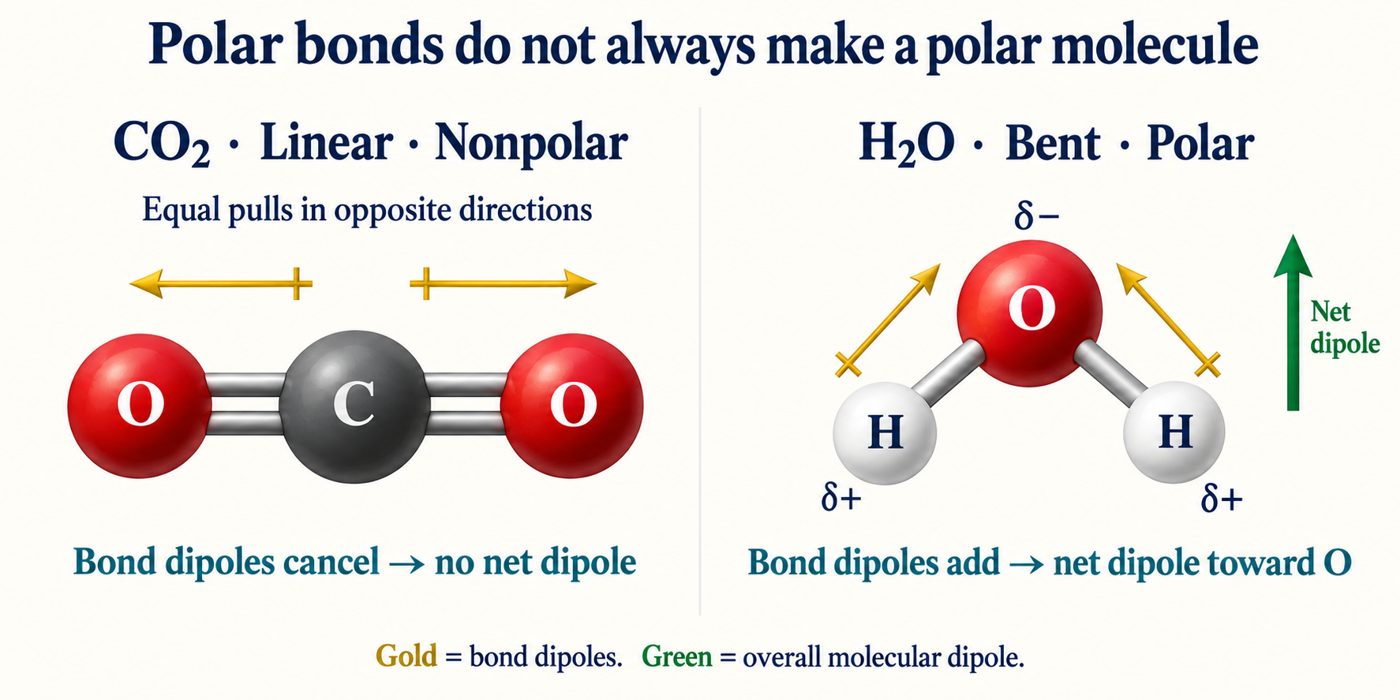
- Polar bond: electrons shared unevenly because one atom pulls harder (higher electronegativity).
- Polar molecule: the bond pulls do not cancel, leaving a net dipole (a positive end and a negative end).
- Shape decides whether the pulls cancel.
| Attraction | Who has it | Example |
|---|---|---|
| London dispersion | All atoms and molecules | CH4 |
| Dipole–dipole | Polar molecules | NH3, H2O |
| Hydrogen bonding | H bonded to N, O or F, attracted to a lone pair on N, O or F of a neighbor | NH3, H2O |
- Find each bond's polarity from electronegativity.
- Find the molecular shape.
- Decide whether the bond dipoles cancel.
- Compare the attractions between molecules.
On the periodic table: Electronegativity increases up and to the right, toward fluorine (F).
On the periodic table: O (Group 16) is right of C (Group 14), so O pulls harder in each C=O bond.
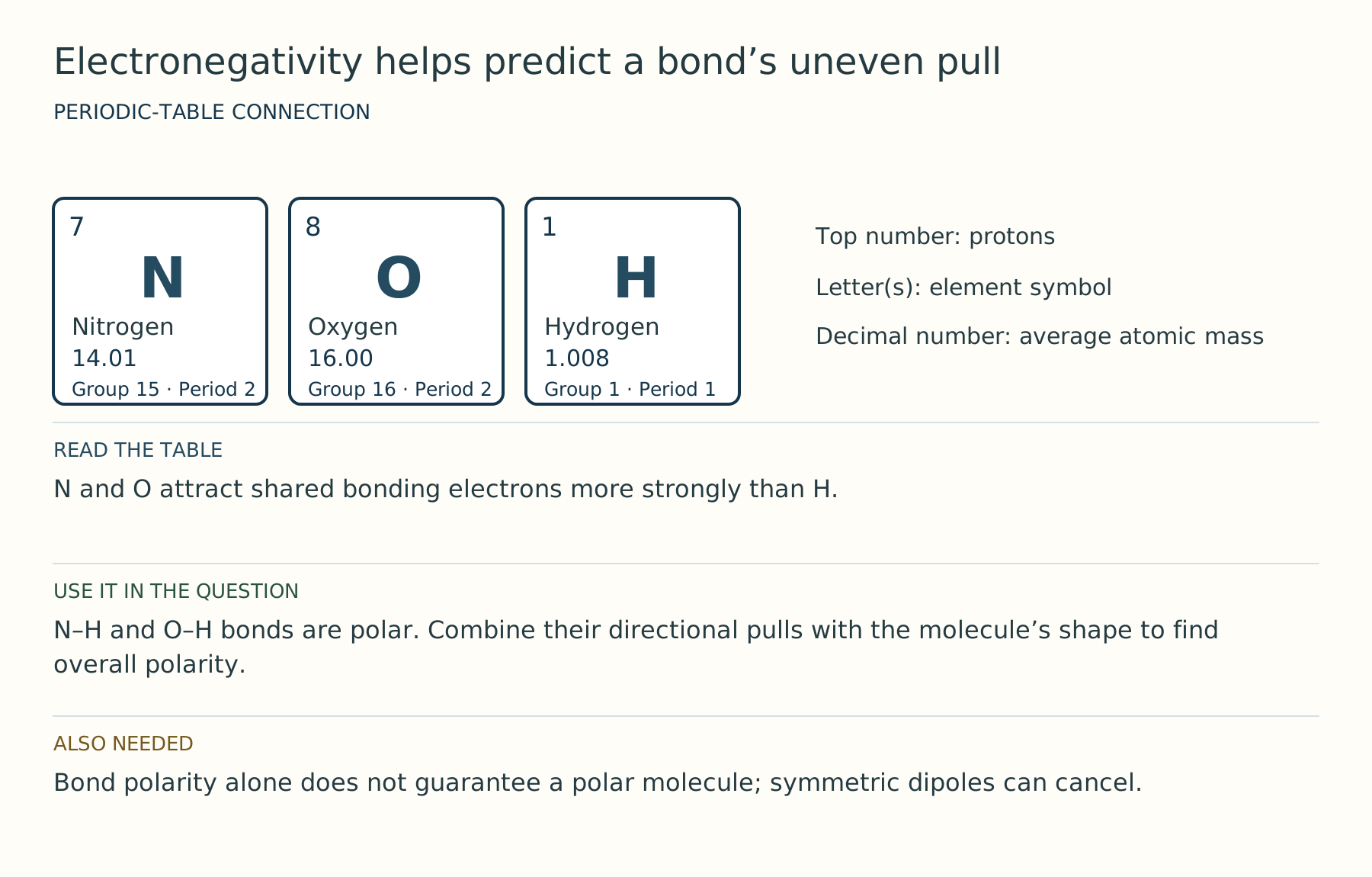
On the periodic table: N (Group 15) is more electronegative than H, so each N–H bond is polar.
On the periodic table: Molar masses come from the table: CH4 16.04, NH3 17.03, H2O 18.02 g/mol.
Why is CH4 nonpolar overall while NH3 is polar?
- 1Check methane's shape
Four identical outer atoms sit in a symmetric arrangement.
CH4: 4 bonds + 0 lone pairs → tetrahedral - 2Combine methane's dipoles
Equal pulls in symmetric directions balance each other.
4 equal bond dipoles, symmetric → net dipole = 0 - 3Check ammonia's shape
A lone pair takes the fourth region, so the H atoms are not arranged like methane's.
NH3: 3 bonds + 1 lone pair → trigonal pyramidal - 4Combine ammonia's dipoles
On the periodic table: N (Group 15, near the top right) is more electronegative than H, so each N–H bond is polar. The pyramid does not cancel them.
Polar bonds? Shape Dipoles cancel? Molecule CH4 Slightly Tetrahedral Yes Nonpolar NH3 Yes Trigonal pyramidal No Polar - ✓Answer
CH4 is nonpolar overall; NH3 is polar. Shape matters as well as bond polarity.
8.5 Alkanes and simple organic molecules
Organic molecules are built on carbon chains. Carbon always makes four bonds, so a few rules give the Lewis structure, formula and bond angles of simple organic molecules.
- Lewis structures (8.1).
- Electron regions, shapes, and bond angles (8.3).
Need a refresher? Open the table of contents and revisit that topic before starting.
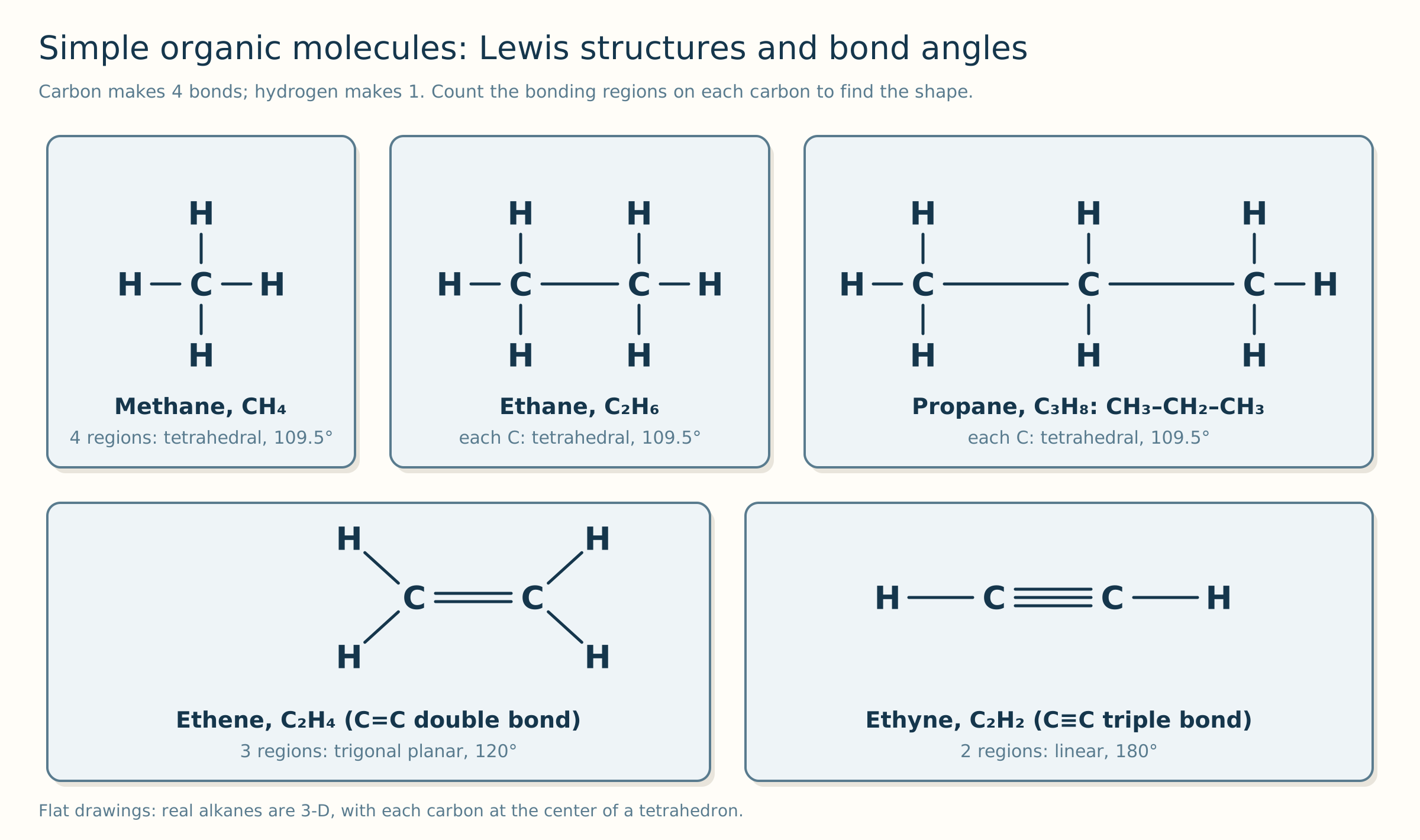
- Carbon has 4 valence electrons, so it forms 4 bonds. Hydrogen forms 1.
- Alkane: only carbon and hydrogen, joined by single bonds.
- The name's start gives the number of carbons; the ending “-ane” means all single bonds.
| Carbons | Name | Formula |
|---|---|---|
| 1 | methane | CH4 |
| 2 | ethane | C2H6 |
| 3 | propane | C3H8 |
| 4 | butane | C4H10 |
| 5 | pentane | C5H12 |
| 6 | hexane | C6H14 |
| 7 | heptane | C7H16 |
| 8 | octane | C8H18 |
| 9 | nonane | C9H20 |
| 10 | decane | C10H22 |
| Carbon has | Regions | Shape | Angle | Example |
|---|---|---|---|---|
| 4 single bonds | 4 | Tetrahedral | about 109.5° (H–C–H, C–C–C) | Alkanes, CH4 |
| 1 double + 2 single | 3 | Trigonal planar | about 120° | Ethene, C2H4 |
| 1 triple + 1 single | 2 | Linear | 180° | Ethyne, C2H2 |
- Count valence electrons: 4 per C, 1 per H.
- Connect the carbons in a chain.
- Add hydrogens so every carbon has 4 bonds.
- Count regions on each carbon and name the shape.
On the periodic table: Carbon is in Group 14 (4 valence electrons, 4 bonds) and hydrogen in Group 1 (1 valence electron, 1 bond).
Draw the Lewis structure of propane, C3H8, and give its bond angles.
- 1Count valence electrons
On the periodic table: C (Group 14) has 4; H (Group 1) has 1.
3(4) + 8(1) = 20 electrons - 2Connect the carbons
Carbons form the chain. Hydrogen makes only one bond, so it goes on the outside.
C–C–C - 3Add hydrogens
Give each carbon 4 bonds. Ten bonds use all 20 electrons.
10 bonds × 2 electrons = 20 electrons CH3–CH2–CH3 - 4Name the shape
Every carbon has 4 bonding regions and no lone pairs.
Each C Regions Lone pairs Shape Angle CH3–, –CH2–, –CH3 4 0 Tetrahedral about 109.5° - ✓Answer
CH3–CH2–CH3, with angles of about 109.5° at every carbon.
Section practice · 5 questions · tap to open
What this set is for: practicing the method from this section while it’s fresh. Every problem uses only what this section has taught.
Practice 1
What is the formula of heptane?
Give me a hint
Hepta- means 7. Use CnH2n+2.
Check the answer
Answer: C7H16
Explain the worked problem to me
What you know: Heptane is an alkane, and hepta- means 7 carbons. What you want: Its formula.
- Use the alkane formula CnH2n+2 with n = 7.
- Hydrogens: 2n + 2 = 2(7) + 2 = 14 + 2 = 16.
- So the formula is C7H16.
Check: Each end carbon holds 3 H and each of the 5 middle carbons holds 2 H: 3 + 3 + 5(2) = 16.
Watch out: Do the multiplying before adding 2. 2(7 + 2) = 18 is wrong.
That’s right: C7H16
Practice 2
An alkane has 5 carbons. Name it and give its formula.
Give me a hint
Pent- means 5. Use CnH2n+2.
Check the answer
Answer: Pentane, C5H12
Explain the worked problem to me
What you know: An alkane with 5 carbons. What you want: Its name and formula.
- Name it from the prefix: 5 carbons is pentane (penta- means 5).
- Use CnH2n+2 with n = 5. Hydrogens: 2(5) + 2 = 12.
- The answer is Pentane, C5H12.
Check: Two end carbons with 3 H each and three middle carbons with 2 H each: 3 + 3 + 3(2) = 12.
That’s right: Pentane, C5H12
Practice 3
What is the H–C–H bond angle in methane, CH4?
Give me a hint
Count the bonding regions on carbon.
Check the answer
Answer: About 109.5°
Explain the worked problem to me
What you know: CH4 has carbon bonded to 4 H atoms. What you want: The H–C–H bond angle.
- Count carbon's electron regions: 4 single bonds and no lone pairs, so 4 regions.
- Four regions spread as far apart as possible in 3D, giving a tetrahedral shape.
- The ideal tetrahedral angle is about 109.5°.
Check: All four regions are identical bonds with no lone pairs, so nothing squeezes the angle below 109.5°.
Watch out: A flat drawing on paper suggests 90°. Methane is 3D, so the angle is 109.5°.
That’s right: About 109.5°
Practice 4
Ethene, C2H4, has a C=C double bond. What is the shape around each carbon, and the H–C–H angle?
Give me a hint
A double bond counts as one region.
Check the answer
Answer: Trigonal planar, about 120°
Explain the worked problem to me
What you know: In C2H4 each carbon has a C=C double bond and two C–H bonds. What you want: The shape at each carbon and the H–C–H angle.
- Count regions on one carbon: the double bond counts as 1 region, plus 2 C–H bonds, giving 3 regions.
- Carbon has no lone pairs (4 bonds use all 4 valence electrons).
- Three regions with no lone pairs spread out in a flat triangle: Trigonal planar, about 120°.
Check: Bonds to carbon: 2 (double) + 1 + 1 = 4, so carbon's octet is complete.
Watch out: Do not count the double bond as 2 regions. That would give 4 regions and the wrong angle, 109.5°.
That’s right: Trigonal planar, about 120°
Practice 5
Methanol, CH3OH: how many lone pairs are on oxygen, and what is the shape at oxygen?
Give me a hint
Oxygen has 6 valence electrons and makes 2 bonds here.
Check the answer
Answer: 2 lone pairs; bent, a little less than 109.5°
Explain the worked problem to me
What you know: In CH3OH, oxygen bonds to C and to H. What you want: Oxygen's lone pairs and the shape at oxygen.
- Oxygen has 6 valence electrons. It uses 2 of them in its 2 bonds, leaving 6 − 2 = 4 electrons, which is 2 lone pairs.
- Count regions on O: 2 bonds + 2 lone pairs = 4 regions, arranged tetrahedrally.
- Only 2 of the 4 positions hold atoms, so the C–O–H shape is bent. Lone pairs push the bonds closer, so the angle shrinks: 2 lone pairs; bent, a little less than 109.5°.
Check: Oxygen's octet: 2 bonds × 2 + 2 lone pairs × 2 = 8 electrons. It matches water, which is also bent.
Watch out: Lone pairs set the angle but are not named in the shape. Do not call it tetrahedral.
That’s right: 2 lone pairs; bent, a little less than 109.5°
Mixed chapter review
Answer in your notebook before revealing help. Keep your first attempt separate from an answer corrected with help.
Mixed chapter review · 10 questions · tap to open
What this set is for: problems from every section of the chapter, mixed together and not labeled, the way a test asks them. Your job is to pick the right method yourself. Do this before the skill check.
Practice 1
Count the valence electrons for NO3−. Use H = 1, N = 5, O = 6 valence electrons.
Give me a hint
Add the valence electrons of every atom, then add 1 electron for the negative charge.
Check the answer
Answer: 24
Explain the worked problem to me
What you know: NO3− has 1 N, 3 O and a 1− charge. What you want: Total valence electrons.
- Add every atom's valence electrons: N gives 5; three O give 3 × 6 = 18. 5 + 18 = 23.
- The 1− charge means one extra electron: 23 + 1 = 24.
Check: Recount atom by atom: 5 (N) + 6 + 6 + 6 (three O) + 1 (charge) = 24.
Watch out: A negative charge adds electrons; a positive charge removes them. Subtracting here would give 22.
Your route: Add every atom’s valence count → Add for negative charge or subtract for positive.
On the periodic table: Nitrogen (N) is in Group 15, so it has 5 valence electrons. Oxygen (O) is in Group 16, so it has 6.
That’s right: 24
Practice 2
A central atom has one double bond, one single bond, and one lone pair. How many VSEPR electron regions does it have?
Give me a hint
Count each bond once, even a double bond, then add one region for each lone pair.
Check the answer
Answer: 3
Explain the worked problem to me
What you know: The central atom has 1 double bond, 1 single bond and 1 lone pair. What you want: The number of VSEPR electron regions.
- Count each bonded neighbor once, whatever the bond type: double bond = 1, single bond = 1. That is 2 regions.
- Add the lone pair as 1 more region: 2 + 1 = 3.
Check: 3 regions with 1 lone pair gives a bent shape, like the central O in O3.
Watch out: Counting the double bond as 2 gives 4, which is wrong. Regions count directions, not electron pairs in bonds.
Your route: Count each bonded group once → Add lone pairs.
That’s right: 3
Practice 3
A central atom has 6 bonding regions and no lone pairs. What is its ideal molecular shape?
Give me a hint
Bond-region and lone-pair counts are supplied.
Check the answer
Answer: Octahedral
Explain the worked problem to me
What you know: 6 bonding regions, 0 lone pairs. What you want: The molecular shape.
- Count regions: 6 bonds + 0 lone pairs = 6 regions.
- Six regions point to the corners of an octahedron (up, down, and four around the middle), neighboring corners 90° apart.
- With no lone pairs, every position holds an atom, so the molecular shape equals the electron arrangement: Octahedral.
Check: For 6 regions, the shapes are octahedral (0 lone pairs), square pyramidal (1) and square planar (2). Zero lone pairs picks octahedral.
Your route: Count regions → Verify no lone pairs → Name region arrangement.
That’s right: Octahedral
Practice 4
A central atom has 2 bonds and 3 lone pairs, all counted as separate regions. What molecular shape results?
Give me a hint
Both bond and lone-pair counts are given; each one is a separate region.
Check the answer
Answer: Linear
Explain the worked problem to me
What you know: 2 bonds and 3 lone pairs on the central atom. What you want: The molecular shape.
- Count regions: 2 + 3 = 5, so the regions form a trigonal bipyramid.
- Lone pairs take the middle ring (equatorial) positions first. All 3 middle positions fill with lone pairs.
- The 2 bonded atoms sit at the top and bottom, 180° apart. Naming only the atoms gives Linear.
Check: For 5 regions, 0, 1, 2 or 3 lone pairs give trigonal bipyramidal, seesaw, T-shaped or linear. 3 lone pairs → linear.
Watch out: 2 bonded atoms does not mean you can skip the region count. Here the lone pairs decide where the atoms go.
Your route: Count bonds plus lone pairs → Arrange regions → Name bonded-atom shape.
That’s right: Linear
Practice 5
Why is an ideal symmetric BeCl2 molecule nonpolar even though its bonds are polar?
Give me a hint
Molecular polarity is asked from a known shape.
Check the answer
Answer: Its bond dipoles cancel as vectors
Explain the worked problem to me
What you know: BeCl2 has two polar Be–Cl bonds. What you want: Why the molecule is still nonpolar.
- Find the shape: Be has 2 bonds and no lone pairs, so 2 regions, which is linear (180°).
- Each Be–Cl bond dipole points from Be toward Cl. The two dipoles are equal in size and point in exactly opposite directions.
- Equal, opposite pulls add to zero, like a balanced tug-of-war: Its bond dipoles cancel as vectors.
Why it matters: CO2 works the same way. A bent molecule like H2O cannot cancel, so it is polar.
Watch out: Polar bonds do not guarantee a polar molecule. Always check the shape.
Your route: Identify molecular symmetry → Add equal bond dipoles as vectors.
On the periodic table: Chlorine (Cl) in Group 17 is far to the right of beryllium (Be) in Group 2, so Cl is more electronegative and each Be–Cl bond is polar.
That’s right: Its bond dipoles cancel as vectors
YOUR PERIODIC-TABLE REFERENCE
Atomic number identifies proton count. The decimal mass is an average, not an isotope’s mass number. Use supplied rounded masses when a problem gives them.
Practice 6
Among CH3OH, CH4, H2S, and Ar, which pure substance can hydrogen-bond with its own particles?
Give me a hint
Look for an H bonded directly to N, O, or F.
Check the answer
Answer: CH3OH
Explain the worked problem to me
What you know: Four substances: CH3OH, CH4, H2S and Ar. What you want: Which can hydrogen-bond with itself.
- Look for an H bonded directly to N, O or F. CH4 has H only on C. H2S has H on S, which is not N, O or F. Ar has no H at all.
- CH3OH has an O–H bond, so it qualifies.
- Check for a partner: the O in a neighboring CH3OH has 2 lone pairs to accept that H. So the answer is CH3OH.
Check: Both conditions are met only by methanol: the H–O donor and the O lone-pair acceptor.
Watch out: The three H atoms in the CH3 group do not count. Only the H on O can hydrogen-bond.
Your route: Check H bonded to N O or F → Check lone-pair partner.
That’s right: CH3OH
YOUR PERIODIC-TABLE REFERENCE
Atomic number identifies proton count. The decimal mass is an average, not an isotope’s mass number. Use supplied rounded masses when a problem gives them.
Practice 7
In NH3, N has 2 nonbonding electrons and 6 bonding electrons. What is its formal charge? Use 5 valence electrons.
Give me a hint
Formal charge = valence − nonbonding electrons − half the bonding electrons.
Check the answer
Answer: 0
Explain the worked problem to me
What you know: N has 5 valence electrons, 2 nonbonding and 6 bonding electrons. What you want: N's formal charge.
- Use formal charge = valence − nonbonding − half of bonding.
- Half the bonding electrons: 6 ÷ 2 = 3, because each bond is shared with an H.
- Formal charge = 5 − 2 − 3 = 0.
Check: Each H is also 0 (1 − 0 − 1). The total 0 matches neutral NH3.
Watch out: Subtract only half of the bonding electrons. Subtracting all 6 gives −3.
Your route: Valence minus nonbonding minus half bonding.
On the periodic table: Nitrogen (N) is in Group 15, so it has 5 valence electrons.
That’s right: 0
Practice 8
Two proposed drawings of O3 are called resonance contributors. Which feature must stay unchanged?
Give me a hint
Alternative Lewis drawings are being compared.
Check the answer
Answer: The atom connections and total charge
Explain the worked problem to me
What you know: Two drawings of O3 are resonance contributors. What you want: What cannot change between them.
- Recall the rule: resonance drawings keep the same atom connections but place electrons differently.
- In O3, the double bond moves from the left O–O to the right O–O: one end O turns a lone pair into a bond pair, and the other end O turns a bond pair back into a lone pair. The O–O–O skeleton stays.
- The electrons are only moved, never added or removed, so the total charge stays too: The atom connections and total charge.
Check: Both O3 drawings use 3 × 6 = 18 valence electrons and have formal charges adding to 0.
Watch out: Moving an atom to a new position makes a different molecule, not a resonance form.
Your route: Keep atoms connected → Redistribute electrons.
That’s right: The atom connections and total charge
Practice 9
How many valence electrons are available for NH4+? N contributes 5 and each H contributes 1.
Give me a hint
Add the valence electrons of every atom, then subtract 1 electron for the positive charge.
Check the answer
Answer: 8
Explain the worked problem to me
What you know: NH4+ has 1 N, 4 H and a 1+ charge. What you want: Total valence electrons.
- Add the atoms: N gives 5; four H give 4 × 1 = 4. 5 + 4 = 9.
- The 1+ charge means one electron is missing: 9 − 1 = 8.
Check: 8 electrons make exactly 4 N–H bonds of 2 electrons each, with no lone pair left.
Watch out: Adding 1 for a positive charge gives 10. Positive means fewer electrons.
Your route: Add valence counts → Subtract positive charge.
On the periodic table: Nitrogen (N) is in Group 15, so it has 5 valence electrons. Hydrogen (H) is in Group 1, so it has 1.
That’s right: 8
Practice 10
A central atom has two double bonds and no lone pairs. How many electron regions surround it?
Give me a hint
Each double bond counts as one region; then add any lone pairs.
Check the answer
Answer: 2
Explain the worked problem to me
What you know: The central atom has 2 double bonds and 0 lone pairs. What you want: The number of electron regions.
- Count each bonded group once: each double bond is 1 region, so 2 double bonds give 2 regions.
- Add lone pairs: 2 + 0 = 2.
Check: This is the carbon in CO2 (O=C=O): 2 regions, linear, 180°.
Watch out: Counting each double bond as 2 gives 4 regions and a wrong tetrahedral shape.
Your route: Count each bonded group once → Add lone pairs.
That’s right: 2
Skill check: the chapter’s key skills
Try each fresh question without the worked examples. Record your first answer and whether you used a hint. Explain the route as well as the answer.
Skill check · 7 questions · tap to open
What this set is for: one question on each key skill from this chapter. Try each on your own, without hints, then mark how it went in the tracker below. A miss tells you which section to review.
Skill 1: Count valence electrons and draw a simple Lewis structure.
How many valence electrons in H2O? Describe its Lewis structure.
Give me a hint
Count valence electrons, draw bonds and lone pairs, then count electron regions around the central atom. Use those regions to identify shape.
Check the answer
2(1) + 6 = 8; two O–H bonds and two lone pairs on O.
On the periodic table: Hydrogen (H) is in Group 1, so it has 1 valence electron. Oxygen (O) is in Group 16, so it has 6.
Explain the worked problem to me
What you know: H2O has 2 H and 1 O. What you want: The valence electron count and the Lewis structure.
- Add valence electrons: 2 H × 1 = 2, plus O = 6. Total 2 + 6 = 8.
- Put O in the center (H can make only one bond). Draw two O–H single bonds: that uses 2 × 2 = 4 electrons.
- Place the remaining 8 − 4 = 4 electrons on O as 2 lone pairs. Result: 2(1) + 6 = 8; two O–H bonds and two lone pairs on O.
Check: O has 4 + 4 = 8 electrons (octet); each H has 2. 4 regions on O give a bent shape.
Watch out: Do not forget the lone pairs. Without them O would have only 4 electrons.
That’s right: 2(1) + 6 = 8; two O–H bonds and two lone pairs on O.
On the periodic table: Hydrogen (H) is in Group 1, so it has 1 valence electron. Oxygen (O) is in Group 16, so it has 6.
YOUR PERIODIC-TABLE REFERENCE
Atomic number identifies proton count. The decimal mass is an average, not an isotope’s mass number. Use supplied rounded masses when a problem gives them.
Skill 2: Find molecular shape from bonds and lone pairs.
Three bonds and one lone pair around the central atom: shape?
Give me a hint
Add the bonds and lone pairs to get the electron regions around the central atom. Then name only the positions of the bonded atoms.
Check the answer
Trigonal pyramidal; four electron regions.
Explain the worked problem to me
What you know: The central atom has 3 bonds and 1 lone pair. What you want: The molecular shape.
- Count regions: 3 bonds + 1 lone pair = 4 regions, arranged tetrahedrally.
- Atoms sit at only 3 of the 4 corners. The lone pair sits on top and pushes the 3 bonds down.
- Naming only the atom positions gives a pyramid with a triangle base: Trigonal pyramidal; four electron regions.
Check: NH3 fits this pattern: three N–H bonds and one lone pair on N make it trigonal pyramidal.
Watch out: Trigonal planar has 3 regions and no lone pair. One lone pair adds a 4th region and lifts the shape out of the plane.
That’s right: Trigonal pyramidal; four electron regions.
Skill 3: Use electron-region counts for introductory hybridization and distinguish sigma and pi bonds.
For CO2, give carbon’s hybridization and count the sigma and pi bonds.
Give me a hint
Count carbon’s electron regions (a double bond counts as one region). Every bond has one sigma bond; each double bond adds one pi bond.
Check the answer
CO2 carbon has two regions: sp, linear. It has two C=O double bonds, so the molecule contains 2 sigma and 2 pi bonds.
Explain the worked problem to me
What you know: CO2 is O=C=O. What you want: Carbon's hybridization and the sigma and pi bond counts.
- Count regions on C: 2 double bonds, no lone pairs, so 2 regions. Two regions → sp, linear.
- Each double bond has 1 sigma and 1 pi bond.
- Two double bonds: 2 × 1 = 2 sigma and 2 × 1 = 2 pi. Result: CO2 carbon has two regions: sp, linear. It has two C=O double bonds, so the molecule contains 2 sigma and 2 pi bonds.
Check: Carbon makes 2 + 2 = 4 bonds in all, and 2 sigma + 2 pi = 4.
Watch out: Count regions, not bonds, for hybridization. 4 bonds would wrongly suggest sp3.
That’s right: CO2 carbon has two regions: sp, linear. It has two C=O double bonds, so the molecule contains 2 sigma and 2 pi bonds.
YOUR PERIODIC-TABLE REFERENCE
Atomic number identifies proton count. The decimal mass is an average, not an isotope’s mass number. Use supplied rounded masses when a problem gives them.
Skill 4: Choose the strongest relevant intermolecular attraction.
Pure H2O: which strong intermolecular attraction applies?
Give me a hint
Look for H bonded directly to N, O, or F, and a lone pair on N, O, or F of a neighboring molecule.
Check the answer
Hydrogen bonding, because H is bonded to O.
Explain the worked problem to me
What you know: The substance is pure H2O. What you want: The strongest relevant intermolecular attraction.
- Check for H bonded to N, O or F: water has two O–H bonds, so yes.
- Check for a partner: the O on a neighboring water molecule has 2 lone pairs to accept the H.
- Both conditions are met, so the answer is Hydrogen bonding, because H is bonded to O.
Why it matters: Water also has dispersion and dipole–dipole attractions, but hydrogen bonding is the strongest of these, which explains water's high boiling point.
Watch out: A hydrogen bond is an attraction between molecules, not the O–H covalent bond inside one molecule.
That’s right: Hydrogen bonding, because H is bonded to O.
YOUR PERIODIC-TABLE REFERENCE
Atomic number identifies proton count. The decimal mass is an average, not an isotope’s mass number. Use supplied rounded masses when a problem gives them.
Skill 5: Use bond polarity and shape to decide molecular polarity.
CO2 has polar bonds and is linear/symmetric. Polar overall?
Give me a hint
Consider bond polarity and molecular shape together. Check whether the bond dipoles cancel.
Check the answer
No: its equal opposing bond dipoles cancel.
Explain the worked problem to me
What you know: CO2 has polar C=O bonds and a linear, symmetric shape. What you want: Whether the molecule is polar overall.
- Each C=O bond dipole points from C toward the more electronegative O.
- Linear means the two O atoms sit 180° apart, so the two dipoles point in opposite directions.
- The two bonds are identical, so the pulls are equal. Equal and opposite pulls cancel: No: its equal opposing bond dipoles cancel.
Why it matters: Compare bent H2O: its dipoles do not point in opposite directions, so they add to a net dipole and water is polar.
Watch out: Polar bonds alone do not make a polar molecule. Shape decides.
That’s right: No: its equal opposing bond dipoles cancel.
Skill 6: Draw Lewis structures and give bond angles for the first ten alkanes and a few simple organic molecules.
Give the formula of butane and its C–C–C bond angle.
Give me a hint
Four carbons; use CnH2n+2.
Check the answer
Answer: C4H10; about 109.5°
Explain the worked problem to me
What you know: Butane is an alkane with 4 carbons. What you want: Its formula and C–C–C angle.
- Use CnH2n+2 with n = 4. Hydrogens: 2(4) + 2 = 10.
- Each carbon has 4 single bonds and no lone pairs, so 4 regions: tetrahedral.
- Tetrahedral angle is about 109.5°, so the answer is C4H10; about 109.5°.
Check: End carbons hold 3 H each and middle carbons 2 H each: 3 + 3 + 2 + 2 = 10.
Watch out: The chain is drawn as a straight line on paper, but it is zigzag. The angle is 109.5°, not 180°.
That’s right: C4H10; about 109.5°
Skill 7: Use formal charge and resonance to choose the best Lewis structure.
Two Lewis structures for CO2 each have 16 valence electrons. (A) O=C=O with two lone pairs on each O. (B) O≡C–O with one lone pair on the triple-bonded O and three lone pairs on the single-bonded O. Find each atom’s formal charge and choose the better structure.
Give me a hint
For each atom, start from its valence count, subtract every lone-pair electron, then subtract half of its bonding electrons. A triple bond counts as 6 bonding electrons.
Check the answer
Structure A; every atom in A has formal charge 0, while B puts +1 and −1 on the two O atoms.
On the periodic table: Carbon (C) is in Group 14, so it has 4 valence electrons. Oxygen (O) is in Group 16, so it has 6.
Explain the worked problem to me
What you know: CO2 has 16 valence electrons. Structure A is O=C=O with two lone pairs on each O. Structure B is O≡C–O with one lone pair on the triple-bonded O and three lone pairs on the single-bonded O. What you want: The formal charges in each structure and the better structure.
- Use FC = V − N − B/2 for each atom, where V is valence electrons, N is nonbonding electrons and B is bonding electrons.
- Structure A: each O has FC = 6 − 4 − 4/2 = 0. Carbon has FC = 4 − 0 − 8/2 = 0.
- Structure B: the triple-bonded O has FC = 6 − 2 − 6/2 = +1. Carbon has FC = 4 − 0 − 8/2 = 0. The single-bonded O has FC = 6 − 6 − 2/2 = −1.
- Prefer the structure with the smallest formal charges. A has all zeros, so the answer is Structure A.
Check: The formal charges add to the overall charge in both structures: A gives 0 + 0 + 0 = 0, and B gives +1 + 0 + (−1) = 0. CO2 is neutral, so both totals fit.
Watch out: B and its mirror drawing O–C≡O keep the same atom connections and move only electrons, so they are resonance drawings of each other. Being a resonance drawing does not make B better. Its +1 sits on oxygen, a very electronegative atom, which is unfavorable.
That’s right: Structure A; every atom in A has formal charge 0, while B puts +1 and −1 on the two O atoms.
On the periodic table: Carbon (C) is in Group 14, so it has 4 valence electrons. Oxygen (O) is in Group 16, so it has 6.
YOUR PERIODIC-TABLE REFERENCE
Atomic number identifies proton count. The decimal mass is an average, not an isotope’s mass number. Use supplied rounded masses when a problem gives them.
What to do next
Mark each skill: “I can do it independently,” “I needed help,” or “I need another explanation.” Revisit the section with the same goal for any skill needing help, then try a different question. A successful first attempt is evidence of progress; one answer alone does not establish lasting mastery.
Final coming up?
Take the 70-question practice final
Modeled on standardized first-term general chemistry finals: 70 questions, 110 minutes. Timed or untimed. Full feedback on every question, plus your score by topic. The first 20 are free; the full final is $7.99 for 2 weeks.
Original ChemGem questions.