ChemGem

How to Draw and Count Simple Alkanes (Step-by-Step, with Practice)

Organic molecules are built on carbon chains. Carbon always makes four bonds, so a few rules give the Lewis structure, formula and bond angles of simple organic molecules.

Spot it, solve it, practice it: 4 steps, 1 worked example, 6 practice problems. Free, no account.

The route · 4 steps

  1. Count valence electrons: 4 per C, 1 per H.
  2. Connect the carbons in a chain.
  3. Add hydrogens so every carbon has 4 bonds.
  4. Count regions on each carbon and name the shape.
Spot it

How to recognize alkane questions

Look for alkane names ending in -ane, a carbon count, or a simple organic molecule with a question about formula or bond angle.

Example wording, with the clue words marked:

What is the formula of heptane?

Not sure it’s this type? Compare the neighbors:

Step-by-step

Worked example: alkane

The idea

The building rules
  • Carbon has 4 valence electrons, so it forms 4 bonds. Hydrogen forms 1.
  • Alkane: only carbon and hydrogen, joined by single bonds.
  • The name's start gives the number of carbons; the ending “-ane” means all single bonds.
Alkane formula
CnH2n+2
propane, n = 3: H = 2(3) + 2 = 8 → C3H8
The first ten alkanes
CarbonsNameFormula
1methaneCH4
2ethaneC2H6
3propaneC3H8
4butaneC4H10
5pentaneC5H12
6hexaneC6H14
7heptaneC7H16
8octaneC8H18
9nonaneC9H20
10decaneC10H22
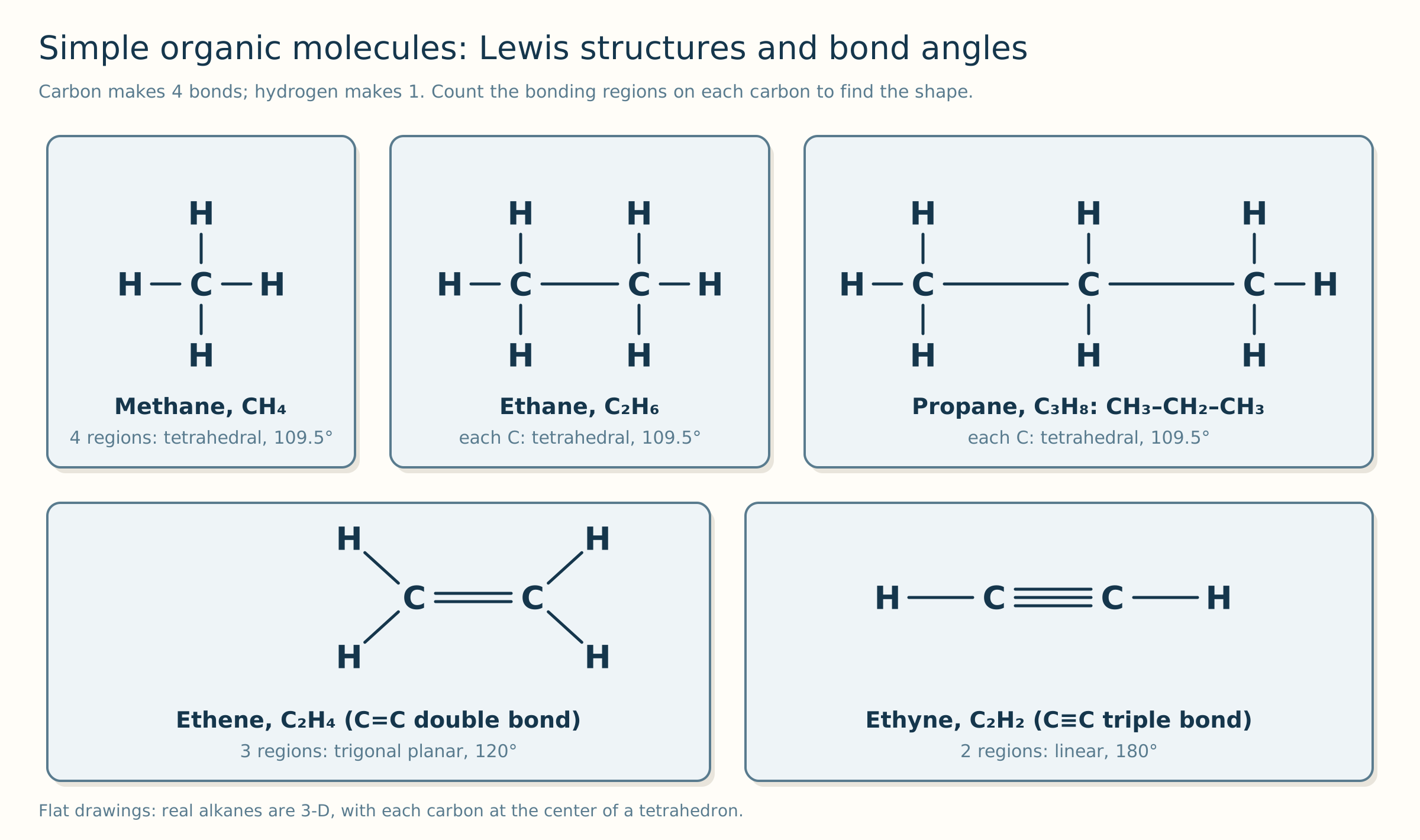
Lewis structures of methane, ethane and propane, each carbon with four single bonds and about 109.5 degree angles; ethene with a C=C double bond and 120 degree angles; ethyne with a C≡C triple bond and a 180 degree angle.
Four regions: about 109.5°. Three (a double bond): about 120°. Two (a triple bond): 180°.
Bonds on carbon set the shape
Carbon hasRegionsShapeAngleExample
4 single bonds4Tetrahedralabout 109.5° (H–C–H, C–C–C)Alkanes, CH4
1 double + 2 single3Trigonal planarabout 120°Ethene, C2H4
1 triple + 1 single2Linear180°Ethyne, C2H2

On the periodic table: On the periodic table, carbon is in Group 14 (4 valence electrons, 4 bonds) and hydrogen in Group 1 (1 valence electron, 1 bond).

Worked example · 4 steps

Draw the Lewis structure of propane, C3H8, and give its bond angles.

  1. 1
    Count valence electrons

    On the periodic table: C (Group 14) has 4; H (Group 1) has 1.

    3(4) + 8(1) = 20 electrons
  2. 2
    Connect the carbons

    Carbons form the chain. Hydrogen makes only one bond, so it goes on the outside.

    C–C–C
  3. 3
    Add hydrogens

    Give each carbon 4 bonds. Ten bonds use all 20 electrons.

    CCCHHHHHHHH2 C–C + 8 C–H = 10 bonds, no lone pairs
    10 bonds × 2 electrons = 20 electrons    CH3–CH2–CH3
  4. 4
    Name the shape

    Every carbon has 4 bonding regions and no lone pairs.

    Each CRegionsLone pairsShapeAngle
    CH3–, –CH2–, –CH340Tetrahedralabout 109.5°
  5. ✓
    Answer

    CH3–CH2–CH3, with angles of about 109.5° at every carbon.

Your turn

Alkane practice problems

Answer first, then check. Hints open one at a time; the answer and full solution open after you try.

Problem 1 of 6 · warm-up

What is the formula of heptane?

Hint 1 · the clue

Hepta- means 7. Use CnH2n+2.

Hint 2 · the next move

An alkane name ending in -ane is given and its formula is asked: read the carbon count, then use CnH2n+2.

Your path:

  1. Prefix hepta- tells the carbon count
  2. Hydrogens = 2n + 2
  3. Write the formula CnH2n+2
Answer

Answer: C7H16

Full worked solution

What you know: Heptane is an alkane, and hepta- means 7 carbons. What you want: Its formula.

  1. Use the alkane formula CnH2n+2 with n = 7.
  2. Hydrogens: 2n + 2 = 2(7) + 2 = 14 + 2 = 16.
  3. So the formula is C7H16.

Check: Each end carbon holds 3 H and each of the 5 middle carbons holds 2 H: 3 + 3 + 5(2) = 16.

Watch out: Do the multiplying before adding 2. 2(7 + 2) = 18 is wrong.

Answer: C7H16

Problem 2 of 6

An alkane has 5 carbons. Name it and give its formula.

Hint 1 · the clue

Pent- means 5. Use CnH2n+2.

Hint 2 · the next move

An alkane's carbon count is given and its name and formula are asked: match the prefix, then use CnH2n+2.

Your path:

  1. Match carbon count to its prefix name
  2. Hydrogens = 2n + 2
  3. Write the formula CnH2n+2
Answer

Answer: Pentane, C5H12

Full worked solution

What you know: An alkane with 5 carbons. What you want: Its name and formula.

  1. Name it from the prefix: 5 carbons is pentane (penta- means 5).
  2. Use CnH2n+2 with n = 5. Hydrogens: 2(5) + 2 = 12.
  3. The answer is Pentane, C5H12.

Check: Two end carbons with 3 H each and three middle carbons with 2 H each: 3 + 3 + 3(2) = 12.

Answer: Pentane, C5H12

Problem 3 of 6

What is the H–C–H bond angle in methane, CH4?

Hint 1 · the clue

Count the bonding regions on carbon.

Hint 2 · the next move

A bond angle in methane is asked: count carbon's electron regions to find the shape and its ideal angle.

Your path:

  1. Count regions: 4 bonds, no lone pairs
  2. Four regions → tetrahedral
  3. Use the ideal tetrahedral angle
Answer

Answer: About 109.5°

Full worked solution

What you know: CH4 has carbon bonded to 4 H atoms. What you want: The H–C–H bond angle.

  1. Count carbon's electron regions: 4 single bonds and no lone pairs, so 4 regions.
  2. Four regions spread as far apart as possible in 3D, giving a tetrahedral shape.
  3. The ideal tetrahedral angle is about 109.5°.

Check: All four regions are identical bonds with no lone pairs, so nothing squeezes the angle below 109.5°.

Watch out: A flat drawing on paper suggests 90°. Methane is 3D, so the angle is 109.5°.

Answer: About 109.5°

Problem 4 of 6

Ethene, C2H4, has a C=C double bond. What is the shape around each carbon, and the H–C–H angle?

Hint 1 · the clue

A double bond counts as one region.

Hint 2 · the next move

A C=C double bond and a shape and angle are asked: count regions on one carbon, with the double bond as one region.

Your path:

  1. Count regions on one carbon
  2. Double bond counts as one region
  3. Three regions → trigonal planar, about 120°
Answer

Answer: Trigonal planar, about 120°

Full worked solution

What you know: In C2H4 each carbon has a C=C double bond and two C–H bonds. What you want: The shape at each carbon and the H–C–H angle.

  1. Count regions on one carbon: the double bond counts as 1 region, plus 2 C–H bonds, giving 3 regions.
  2. Carbon has no lone pairs (4 bonds use all 4 valence electrons).
  3. Three regions with no lone pairs spread out in a flat triangle: Trigonal planar, about 120°.

Check: Bonds to carbon: 2 (double) + 1 + 1 = 4, so carbon's octet is complete.

Watch out: Do not count the double bond as 2 regions. That would give 4 regions and the wrong angle, 109.5°.

Answer: Trigonal planar, about 120°

Problem 5 of 6

Methanol, CH3OH: how many lone pairs are on oxygen, and what is the shape at oxygen?

Hint 1 · the clue

Oxygen has 6 valence electrons and makes 2 bonds here.

Hint 2 · the next move

Lone pairs and shape at oxygen are asked: count oxygen's leftover electrons, then its regions to find the shape.

Your path:

  1. O's 6 valence minus 2 bonding electrons
  2. Leftover electrons ÷ 2 = lone pairs
  3. Bonds + lone pairs = regions → bent
Answer

Answer: 2 lone pairs; bent, a little less than 109.5°

Full worked solution

What you know: In CH3OH, oxygen bonds to C and to H. What you want: Oxygen's lone pairs and the shape at oxygen.

  1. Oxygen has 6 valence electrons. It uses 2 of them in its 2 bonds, leaving 6 − 2 = 4 electrons, which is 2 lone pairs.
  2. Count regions on O: 2 bonds + 2 lone pairs = 4 regions, arranged tetrahedrally.
  3. Only 2 of the 4 positions hold atoms, so the C–O–H shape is bent. Lone pairs push the bonds closer, so the angle shrinks: 2 lone pairs; bent, a little less than 109.5°.

Check: Oxygen's octet: 2 bonds × 2 + 2 lone pairs × 2 = 8 electrons. It matches water, which is also bent.

Watch out: Lone pairs set the angle but are not named in the shape. Do not call it tetrahedral.

Answer: 2 lone pairs; bent, a little less than 109.5°

Problem 6 of 6

Give the formula of butane and its C–C–C bond angle.

Hint 1 · the clue

Four carbons; use CnH2n+2.

Hint 2 · the next move

An alkane name and a C–C–C bond angle are asked: use CnH2n+2, then count regions on carbon.

Your path:

  1. Prefix but- gives the carbon count
  2. Hydrogens = 2n + 2
  3. Four single bonds → tetrahedral angle
Answer

Answer: C4H10; about 109.5°

Full worked solution

What you know: Butane is an alkane with 4 carbons. What you want: Its formula and C–C–C angle.

  1. Use CnH2n+2 with n = 4. Hydrogens: 2(4) + 2 = 10.
  2. Each carbon has 4 single bonds and no lone pairs, so 4 regions: tetrahedral.
  3. Tetrahedral angle is about 109.5°, so the answer is C4H10; about 109.5°.

Check: End carbons hold 3 H each and middle carbons 2 H each: 3 + 3 + 2 + 2 = 10.

Watch out: The chain is drawn as a straight line on paper, but it is zigzag. The angle is 109.5°, not 180°.

Answer: C4H10; about 109.5°

Watch out

Common alkane mistakes