ChemGem

How to Find Hybridization and Sigma and Pi Bonds (Step-by-Step, with Practice)

Lewis structures show where bonds are. Bonding models explain how they form: hybrid orbitals, sigma and pi bonds, and bond order. All three start from the Lewis structure.

Spot it, solve it, practice it: 4 steps, 1 worked example, 11 practice problems. Free, no account.

The route · 4 steps

  1. Draw the Lewis structure.
  2. Count electron regions on the atom: 2 → sp, 3 → sp2, 4 → sp3.
  3. Count bonds: every bond has 1 σ; each extra line is 1 π.
  4. For MO bond order, subtract antibonding from bonding electrons and divide by 2.
Spot it

How to recognize hybridization questions

Look for "hybridization," "sigma and pi," double or triple bonds, bond length, or bonding and antibonding electrons for bond order.

Example wording, with the clue words marked:

A structure contains 1 double bond and no other bonds. Count sigma and pi bonds.

Not sure it’s this type? Compare the neighbors:

Step-by-step

Worked example: hybridization

The idea

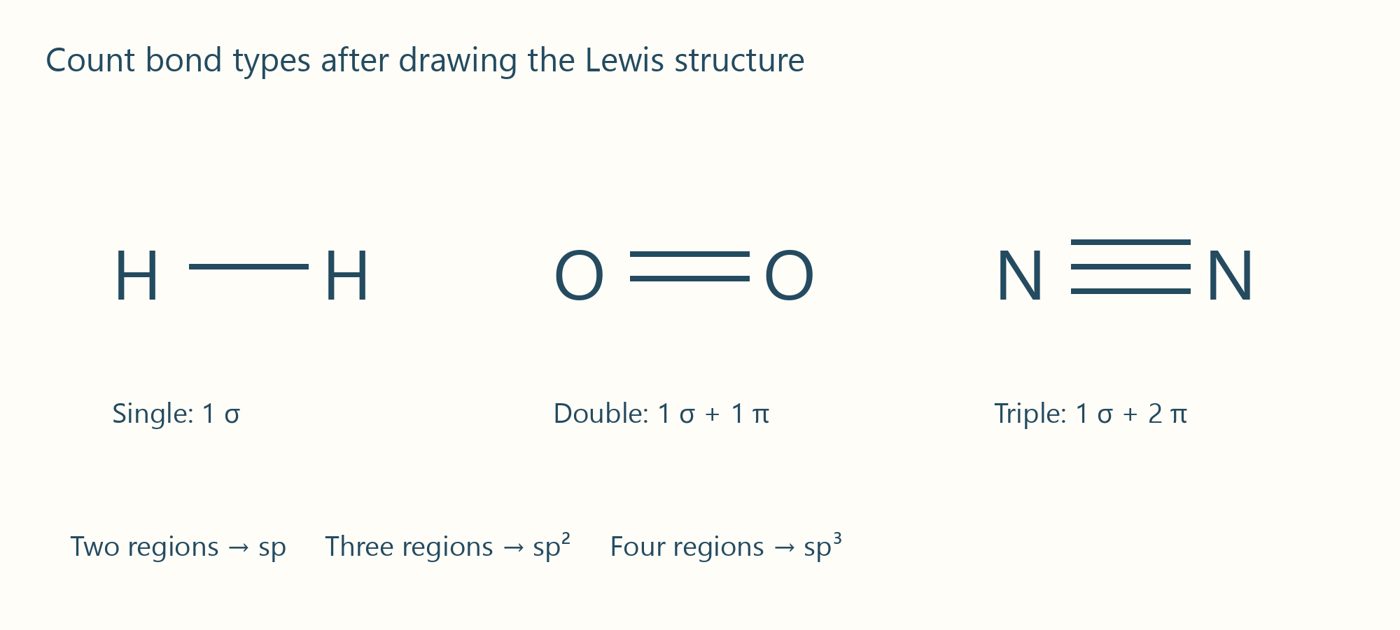
Three molecules drawn with bond lines: H–H labeled single, 1 σ; O=O labeled double, 1 σ + 1 π; and N≡N labeled triple, 1 σ + 2 π. Below: two electron regions give sp, three give sp², four give sp³.
Every bond has one σ part; each extra line is a π bond.
Electron regions set the hybridization
RegionsHybridizationOrbitals mixedArrangementExample
2sp1 s + 1 pLinear, 180°C in CO2
3sp21 s + 2 pTrigonal planar, 120°C in C2H4
4sp31 s + 3 pTetrahedral, 109.5°C in CH4
Each bond (single, double or triple) or lone pair is one region. The superscript counts p orbitals, not electrons.
Two ways orbitals overlap
Sigma (σ) bondOverlap lies ON the linejoining the nucleiPi (π) bondOverlap ABOVE and BELOW the lineTwo lobes, one π bond
Counting sigma and pi bonds
BondσπBond order
Single101
Double112
Triple123
Higher bond order: shorter bond (carbon–carbon)
C–C154 pmC=C134 pmC≡C120 pmTypical bond length (pm)
Approximate values. Compare the same atom pair only; atom size and surroundings also matter.
Bond order in practice
  • Same atom pair: higher bond order means a shorter, stronger bond.
  • Resonance can give an average bond order between whole numbers. Ozone's two O–O bonds are each 1.5.
  • Atoms with 5 or 6 regions (expanded octets, 8.3) sometimes get hybrid labels too. Those labels are simplified models.
Molecular orbital (MO) theory: a second model
  • Atomic orbitals combine into new orbitals that spread over the whole molecule.
  • Bonding orbitals hold electrons between the nuclei and hold the atoms together.
  • Antibonding orbitals (marked with *) hold electrons that weaken the bond.
  • Any unpaired electrons make a substance paramagnetic: pulled into a magnetic field. O2 is the classic example.
MO bond order
bond order = bonding electrons − antibonding electrons2
H2: 2 − 02 = 1, a single bond

On the periodic table: On the periodic table, the group gives the valence electrons for the Lewis structure: C (Group 14) 4, O (Group 16) 6.

On the periodic table: The table does not show hybridization or bond types; those come from the Lewis structure.

Worked example · 3 steps

Give the hybridization of carbon in CO2, and count its sigma and pi bonds.

OCOEach C=O: 1 σ + 1 π
  1. 1
    Count regions on carbon

    Each double bond is one region. Carbon has no lone pairs.

    Around CRegions
    C=O double bond1
    C=O double bond1
    Lone pairs0
    Total2
  2. 2
    Match regions to hybridization

    Two regions sit on opposite sides of carbon.

    2 regions → sp, linear (180°)
  3. 3
    Count sigma and pi bonds

    Each C=O double bond has 1 σ and 1 π.

    Bondσπ
    C=O11
    C=O11
    Total22
  4. ✓
    Answer

    Carbon is sp (linear). CO2 has 2 sigma and 2 pi bonds.

Your turn

Hybridization practice problems

Answer first, then check. Hints open one at a time; the answer and full solution open after you try.

Problem 1 of 11 · warm-up

A structure contains 1 double bond and no other bonds. Count sigma and pi bonds.

Hint 1 · the clue

Count the components of one double bond, then multiply.

Hint 2 · the next move

Only double bonds are listed and sigma and pi bonds are asked for: each double bond is one sigma plus one pi.

Your path:

  1. Recall: double bond = 1 sigma + 1 pi
  2. Multiply by the number of double bonds
Answer

Answer: 1 sigma and 1 pi

Full worked solution

What you know: The structure has 1 double bond and nothing else. What you want: The number of sigma and pi bonds.

  1. Recall what one double bond contains: 1 sigma bond (overlap along the line between the nuclei) plus 1 pi bond (overlap above and below that line).
  2. Multiply by the number of double bonds. Sigma: 1 × 1 = 1. Pi: 1 × 1 = 1.
  3. There are no other bonds to add, so the total is 1 sigma and 1 pi.

Check: Each double bond is 2 bonds in all, so the total is 1 × 2 = 2 bonds, and 1 sigma + 1 pi = 2.

Watch out: A double bond is not two sigma bonds. Only the first bond between two atoms is sigma; every extra bond is pi.

Answer: 1 sigma and 1 pi

Problem 2 of 11

A structure contains 2 double bonds and no other bonds. Count sigma and pi bonds.

Hint 1 · the clue

Count the components of one double bond, then multiply.

Hint 2 · the next move

Only double bonds are listed and sigma and pi bonds are asked for: each double bond is one sigma plus one pi.

Your path:

  1. Recall: double bond = 1 sigma + 1 pi
  2. Multiply by the number of double bonds
Answer

Answer: 2 sigma and 2 pi

Full worked solution

What you know: The structure has 2 double bonds and nothing else. What you want: The number of sigma and pi bonds.

  1. Recall what one double bond contains: 1 sigma bond (overlap along the line between the nuclei) plus 1 pi bond (overlap above and below that line).
  2. Multiply by the number of double bonds. Sigma: 2 × 1 = 2. Pi: 2 × 1 = 2.
  3. There are no other bonds to add, so the total is 2 sigma and 2 pi.

Check: Each double bond is 2 bonds in all, so the total is 2 × 2 = 4 bonds, and 2 sigma + 2 pi = 4.

Watch out: A double bond is not two sigma bonds. Only the first bond between two atoms is sigma; every extra bond is pi.

Answer: 2 sigma and 2 pi

Problem 3 of 11

A structure contains 3 double bonds and no other bonds. Count sigma and pi bonds.

Hint 1 · the clue

Count the components of one double bond, then multiply.

Hint 2 · the next move

Only double bonds are listed and sigma and pi bonds are asked for: each double bond is one sigma plus one pi.

Your path:

  1. Recall: double bond = 1 sigma + 1 pi
  2. Multiply by the number of double bonds
Answer

Answer: 3 sigma and 3 pi

Full worked solution

What you know: The structure has 3 double bonds and nothing else. What you want: The number of sigma and pi bonds.

  1. Recall what one double bond contains: 1 sigma bond (overlap along the line between the nuclei) plus 1 pi bond (overlap above and below that line).
  2. Multiply by the number of double bonds. Sigma: 3 × 1 = 3. Pi: 3 × 1 = 3.
  3. There are no other bonds to add, so the total is 3 sigma and 3 pi.

Check: Each double bond is 2 bonds in all, so the total is 3 × 2 = 6 bonds, and 3 sigma + 3 pi = 6.

Watch out: A double bond is not two sigma bonds. Only the first bond between two atoms is sigma; every extra bond is pi.

Answer: 3 sigma and 3 pi

Problem 4 of 11

A structure contains 4 double bonds and no other bonds. Count sigma and pi bonds.

Hint 1 · the clue

Count the components of one double bond, then multiply.

Hint 2 · the next move

Only double bonds are listed and sigma and pi bonds are asked for: each double bond is one sigma plus one pi.

Your path:

  1. Recall: double bond = 1 sigma + 1 pi
  2. Multiply by the number of double bonds
Answer

Answer: 4 sigma and 4 pi

Full worked solution

What you know: The structure has 4 double bonds and nothing else. What you want: The number of sigma and pi bonds.

  1. Recall what one double bond contains: 1 sigma bond (overlap along the line between the nuclei) plus 1 pi bond (overlap above and below that line).
  2. Multiply by the number of double bonds. Sigma: 4 × 1 = 4. Pi: 4 × 1 = 4.
  3. There are no other bonds to add, so the total is 4 sigma and 4 pi.

Check: Each double bond is 2 bonds in all, so the total is 4 × 2 = 8 bonds, and 4 sigma + 4 pi = 8.

Watch out: A double bond is not two sigma bonds. Only the first bond between two atoms is sigma; every extra bond is pi.

Answer: 4 sigma and 4 pi

Problem 5 of 11

A structure contains 5 double bonds and no other bonds. Count sigma and pi bonds.

Hint 1 · the clue

Count the components of one double bond, then multiply.

Hint 2 · the next move

Only double bonds are listed and sigma and pi bonds are asked for: each double bond is one sigma plus one pi.

Your path:

  1. Recall: double bond = 1 sigma + 1 pi
  2. Multiply by the number of double bonds
Answer

Answer: 5 sigma and 5 pi

Full worked solution

What you know: The structure has 5 double bonds and nothing else. What you want: The number of sigma and pi bonds.

  1. Recall what one double bond contains: 1 sigma bond (overlap along the line between the nuclei) plus 1 pi bond (overlap above and below that line).
  2. Multiply by the number of double bonds. Sigma: 5 × 1 = 5. Pi: 5 × 1 = 5.
  3. There are no other bonds to add, so the total is 5 sigma and 5 pi.

Check: Each double bond is 2 bonds in all, so the total is 5 × 2 = 10 bonds, and 5 sigma + 5 pi = 10.

Watch out: A double bond is not two sigma bonds. Only the first bond between two atoms is sigma; every extra bond is pi.

Answer: 5 sigma and 5 pi

Problem 6 of 11

Two electron regions around carbon: introductory hybridization?

Hint 1 · the clue

2 regions → sp, 3 regions → sp2, 4 regions → sp3.

Hint 2 · the next move

A number of electron regions is given and hybridization is asked for: match the region count to sp, sp2, or sp3.

Your path:

  1. Note the number of electron regions
  2. Match: 2 → sp, 3 → sp2, 4 → sp3
Answer

Answer: sp

Full worked solution

What you know: The atom has 2 electron regions. What you want: Its introductory hybridization label.

  1. Remember what counts as a region: each single, double, or triple bond is one region, and each lone pair is one region.
  2. Use the matching rule: 2 regions → sp, 3 regions → sp2, 4 regions → sp3.
  3. Two regions match sp.

Check: The label uses one s orbital and one p orbital, which makes 2 hybrid orbitals, one per region. The regions are arranged linearly, 180° apart.

Watch out: A double or triple bond still counts as only one region.

Answer: sp

Problem 7 of 11

Three electron regions: hybridization?

Hint 1 · the clue

2 regions → sp, 3 regions → sp2, 4 regions → sp3.

Hint 2 · the next move

A number of electron regions is given and hybridization is asked for: match the region count to sp, sp2, or sp3.

Your path:

  1. Note the number of electron regions
  2. Match: 2 → sp, 3 → sp2, 4 → sp3
Answer

Answer: sp2

Full worked solution

What you know: The atom has 3 electron regions. What you want: Its introductory hybridization label.

  1. Remember what counts as a region: each single, double, or triple bond is one region, and each lone pair is one region.
  2. Use the matching rule: 2 regions → sp, 3 regions → sp2, 4 regions → sp3.
  3. Three regions match sp2.

Check: The label uses one s orbital and two p orbitals, which makes 3 hybrid orbitals, one per region. The regions are arranged in a trigonal plane, 120° apart (the molecular shape is bent if one region is a lone pair).

Watch out: The superscript counts p orbitals, not electrons. And a double or triple bond still counts as only one region.

Answer: sp2

Problem 8 of 11

Four electron regions: hybridization?

Hint 1 · the clue

2 regions → sp, 3 regions → sp2, 4 regions → sp3.

Hint 2 · the next move

A number of electron regions is given and hybridization is asked for: match the region count to sp, sp2, or sp3.

Your path:

  1. Note the number of electron regions
  2. Match: 2 → sp, 3 → sp2, 4 → sp3
Answer

Answer: sp3

Full worked solution

What you know: The atom has 4 electron regions. What you want: Its introductory hybridization label.

  1. Remember what counts as a region: each single, double, or triple bond is one region, and each lone pair is one region.
  2. Use the matching rule: 2 regions → sp, 3 regions → sp2, 4 regions → sp3.
  3. Four regions match sp3.

Check: The label uses one s orbital and three p orbitals, which makes 4 hybrid orbitals, one per region. The regions are arranged tetrahedrally, 109.5° apart (lone pairs would make the molecular shape trigonal pyramidal or bent).

Watch out: The superscript counts p orbitals, not electrons. And a double or triple bond still counts as only one region.

Answer: sp3

Problem 9 of 11

For the same atom pair, is a triple bond usually shorter than a single bond?

Hint 1 · the clue

A higher bond order holds the same two atoms closer together.

Hint 2 · the next move

Bond length is compared for the same atom pair: compare bond orders, since higher bond order means a shorter bond.

Your path:

  1. Find bond orders: single 1, triple 3
  2. Higher bond order → shorter, stronger bond
Answer

Answer: Yes

Full worked solution

What you know: Two bonds join the same pair of atoms; one is triple, one is single. What you want: Whether the triple bond is shorter.

  1. Find each bond order. A single bond has bond order 1. A triple bond has bond order 3.
  2. Apply the rule: for the same pair of atoms, higher bond order means more shared electrons pulling the nuclei together, so the bond is shorter and stronger.
  3. 3 is greater than 1, so the triple bond is shorter: Yes.

Why it matters: Bond order lets you rank bond length and strength without measuring anything.

Watch out: The rule only works for the same atom pair. A C≡C bond and an H–H bond cannot be compared this way.

Answer: Yes

Problem 10 of 11

6 bonding electrons and 2 antibonding electrons: MO bond order?

Hint 1 · the clue

Bond order = (bonding electrons − antibonding electrons) ÷ 2.

Hint 2 · the next move

Bonding and antibonding electron counts are given and MO (molecular orbital) bond order is asked: use the bond-order formula.

Your path:

  1. Bond order = (bonding − antibonding) ÷ 2
  2. Subtract antibonding from bonding first
  3. Divide the difference by 2
Answer

Answer: 2

Full worked solution

What you know: 6 bonding electrons and 2 antibonding electrons. What you want: The molecular-orbital (MO) bond order.

  1. Write the formula: bond order = (bonding electrons − antibonding electrons) ÷ 2.
  2. Subtract first, because antibonding electrons cancel some of the bonding: 6 − 2 = 4.
  3. Divide by 2, because a bond is a pair of electrons: 4 ÷ 2 = 2.

Check: A bond order of 2 means a double bond, which fits 4 net bonding electrons (2 pairs).

Watch out: Do not forget to divide by 2. Answering 4 counts electrons, not bonds.

Answer: 2

Problem 11 of 11

For CO2, give carbon’s hybridization and count the sigma and pi bonds.

Hint 1 · the clue

Count carbon’s electron regions (a double bond counts as one region). Every bond has one sigma bond; each double bond adds one pi bond.

Hint 2 · the next move

Hybridization and sigma/pi counts are asked: count carbon's regions, then split each double bond into sigma and pi.

Your path:

  1. Count regions on carbon
  2. Two regions → sp
  3. Each double bond = 1 sigma + 1 pi
Answer

CO2 carbon has two regions: sp, linear. It has two C=O double bonds, so the molecule contains 2 sigma and 2 pi bonds.

Full worked solution

What you know: CO2 is O=C=O. What you want: Carbon's hybridization and the sigma and pi bond counts.

  1. Count regions on C: 2 double bonds, no lone pairs, so 2 regions. Two regions → sp, linear.
  2. Each double bond has 1 sigma and 1 pi bond.
  3. Two double bonds: 2 × 1 = 2 sigma and 2 × 1 = 2 pi. Result: CO2 carbon has two regions: sp, linear. It has two C=O double bonds, so the molecule contains 2 sigma and 2 pi bonds.

Check: Carbon makes 2 + 2 = 4 bonds in all, and 2 sigma + 2 pi = 4.

Watch out: Count regions, not bonds, for hybridization. 4 bonds would wrongly suggest sp3.

Answer: CO2 carbon has two regions: sp, linear. It has two C=O double bonds, so the molecule contains 2 sigma and 2 pi bonds.

YOUR PERIODIC-TABLE REFERENCE

6CCarbon12.01Group 14 · Period 2
8OOxygen16.00Group 16 · Period 2

Atomic number identifies proton count. The decimal mass is an average, not an isotope’s mass number. Use supplied rounded masses when a problem gives them.

Watch out

Common hybridization mistakes