ChemGem

How to Predict Molecular Shape with VSEPR (Step-by-Step, with Practice)

Molecules are three-dimensional. Count the electron regions around a central atom, and you can predict how they spread out: that gives the shape.

Spot it, solve it, practice it: 4 steps, 1 worked example, 5 practice problems. Free, no account.

The route · 4 steps

  1. Draw the Lewis structure; pick the central atom.
  2. Count all its regions: bonds plus lone pairs.
  3. Separate lone pairs from bonded atoms.
  4. Name the geometry and shape.
Spot it

How to recognize molecular shape questions

Look for bonds and lone pairs around a central atom, "electron regions," or a question asking for a molecule's shape.

Example wording, with the clue words marked:

A central atom has one double bond, one single bond, and one lone pair. How many VSEPR electron regions does it have?

Not sure it’s this type? Compare the neighbors:

Step-by-step

Worked example: molecular shape

The idea

What counts as one electron region
  • Each bond is one region: single, double or triple.
  • Each lone pair on the central atom is one region.
  • VSEPR (valence-shell electron-pair repulsion): regions spread as far apart as possible.
Two names for every molecule
Electron geometry
All regions, lone pairs included. Water: tetrahedral.
Molecular shape
Bonded atoms only; lone pairs push but are not named. Water: bent.
The six shapes you will meet most
XXALinear2 regions · 0 lone pairs180°XXXATrigonal planar3 regions · 0 lone pairs120°XXABent3 regions · 1 lone paira little under 120°XXXXATetrahedral4 regions · 0 lone pairs109.5°XXXATrigonal pyramidal4 regions · 1 lone paira little under 109.5°XXABent4 regions · 2 lone pairsabout 104.5° (water)
A = central atom, X = bonded atom, shaded lobe = lone pair. Wedge points toward you; dashes point away.
VSEPR: regions → electron geometry → shape → angle
RegionsLone pairsElectron geometryMolecular shapeIdeal angleExample
20LinearLinear180°CO2
30Trigonal planarTrigonal planar120°BF3
31Trigonal planarBent< 120°SO2
40TetrahedralTetrahedral109.5°CH4
41TetrahedralTrigonal pyramidal< 109.5°NH3
42TetrahedralBent≈ 104.5°H2O
50Trigonal bipyramidalTrigonal bipyramidal90°, 120°PCl5
51Trigonal bipyramidalSeesaw< 90°, < 120°SF4
52Trigonal bipyramidalT-shaped< 90°ClF3
53Trigonal bipyramidalLinear180°XeF2
60OctahedralOctahedral90°SF6
61OctahedralSquare pyramidal< 90°BrF5
62OctahedralSquare planar90°XeF4
5 regions: lone pairs take the middle-ring (equatorial) positions first.

Lone pairs push bonds a little closer, so angles shrink slightly below the ideal value.

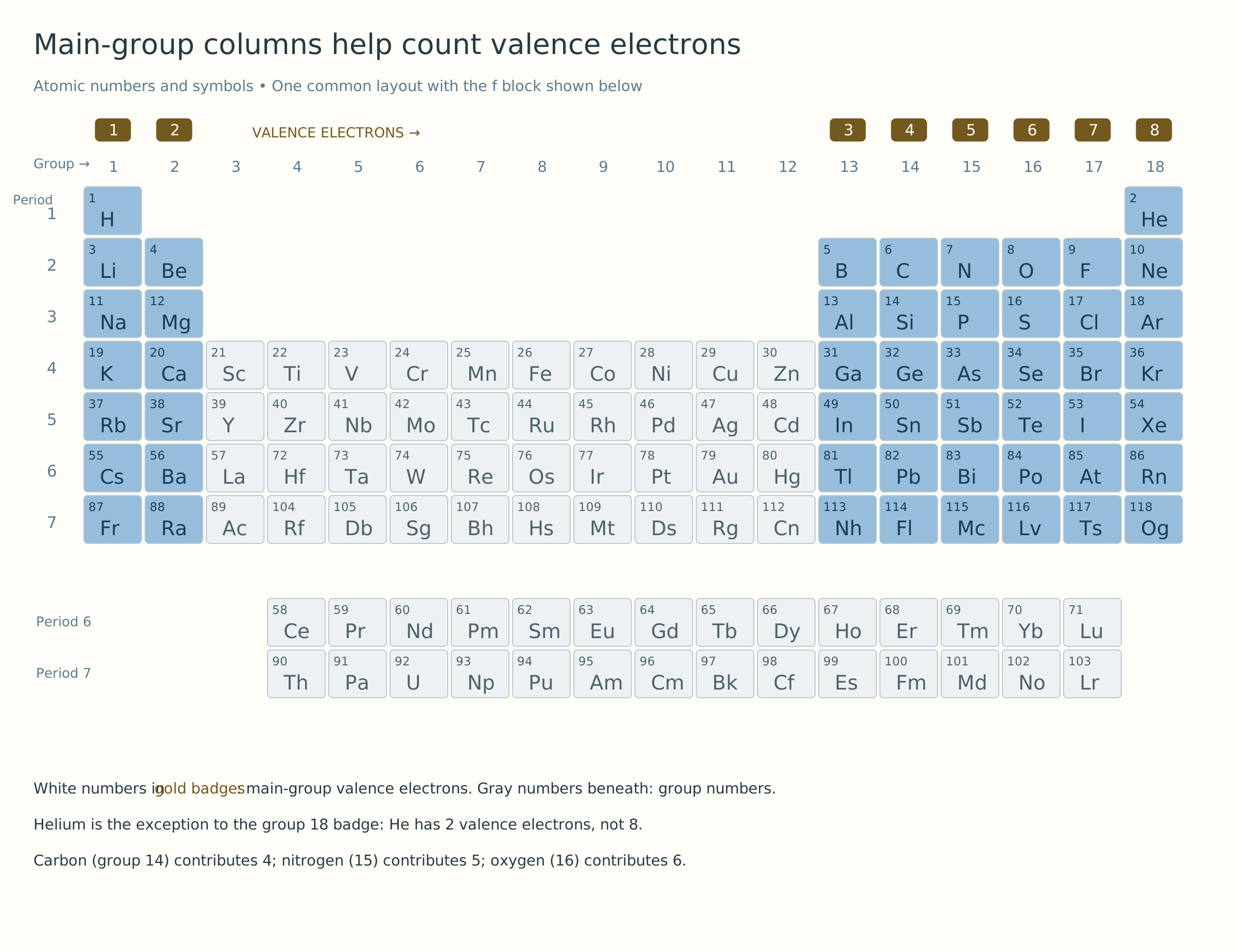
On the periodic table: On the periodic table, the group gives main-group valence electrons: C (14) 4, N (15) 5, O (16) 6, H 1. Helium has 2.

On the periodic table: The table builds the Lewis structure; it does not show the shape.

Worked example · 4 steps

Use electron regions to find the shapes of CO2 and H2O.

Main-group columns help count valence electrons. Gold badges give main-group valence electrons; gray numbers beneath are group numbers. Helium has 2 valence electrons, not 8. Carbon (group 14) contributes 4; nitrogen (15) contributes 5; oxygen (16) contributes 6.
Valence electrons for the Lewis structures: C 4, O 6, H 1.
  1. 1
    Count regions around C in CO2

    O=C=O. Each double bond is one region.

    Around CRegions
    C=O double bond1
    C=O double bond1
    Lone pairs0
    Total2
  2. 2
    Name the CO2 shape

    The O atoms sit on opposite sides of C.

    2 regions, 0 lone pairs → linear, 180°
  3. 3
    Count regions around O in H2O

    Lone pairs affect the arrangement, so count them.

    Around ORegions
    O–H bond1
    O–H bond1
    Lone pairs2
    Total4
  4. 4
    Name the H2O shape

    Geometry counts lone pairs; shape names only atoms.

    CountsName
    Electron geometry4 regionsTetrahedral
    Molecular shape2 bonded atomsBent
  5. ✓
    Answer

    CO2 is linear; H2O is bent.

Your turn

Molecular shape practice problems

Answer first, then check. Hints open one at a time; the answer and full solution open after you try.

Problem 1 of 5 · warm-up

A central atom has one double bond, one single bond, and one lone pair. How many VSEPR electron regions does it have?

Hint 1 · the clue

Count each bond once, even a double bond, then add one region for each lone pair.

Hint 2 · the next move

Bonds and a lone pair on a central atom are listed and VSEPR regions are asked: count each bond and lone pair once.

Your path:

  1. Each bond counts once, even double
  2. Add one region per lone pair
Answer

Answer: 3

Full worked solution

What you know: The central atom has 1 double bond, 1 single bond and 1 lone pair. What you want: The number of VSEPR electron regions.

  1. Count each bonded neighbor once, whatever the bond type: double bond = 1, single bond = 1. That is 2 regions.
  2. Add the lone pair as 1 more region: 2 + 1 = 3.

Check: 3 regions with 1 lone pair gives a bent shape, like the central O in O3.

Watch out: Counting the double bond as 2 gives 4, which is wrong. Regions count directions, not electron pairs in bonds.

Your route: Count each bonded group once → Add lone pairs.

Answer: 3

Problem 2 of 5

A central atom has 6 bonding regions and no lone pairs. What is its ideal molecular shape?

Hint 1 · the clue

Bond-region and lone-pair counts are supplied.

Hint 2 · the next move

Bonding regions and lone pairs on a central atom are given and shape is asked: match region count to its geometry.

Your path:

  1. Count regions: bonds + lone pairs
  2. Six regions → octahedral arrangement
  3. No lone pairs, so shape matches arrangement
Answer

Answer: Octahedral

Full worked solution

What you know: 6 bonding regions, 0 lone pairs. What you want: The molecular shape.

  1. Count regions: 6 bonds + 0 lone pairs = 6 regions.
  2. Six regions point to the corners of an octahedron (up, down, and four around the middle), neighboring corners 90° apart.
  3. With no lone pairs, every position holds an atom, so the molecular shape equals the electron arrangement: Octahedral.

Check: For 6 regions, the shapes are octahedral (0 lone pairs), square pyramidal (1) and square planar (2). Zero lone pairs picks octahedral.

Your route: Count regions → Verify no lone pairs → Name region arrangement.

Answer: Octahedral

Problem 3 of 5

A central atom has 2 bonds and 3 lone pairs, all counted as separate regions. What molecular shape results?

Hint 1 · the clue

Both bond and lone-pair counts are given; each one is a separate region.

Hint 2 · the next move

Bonds and lone pairs on a central atom are given and shape is asked: count regions, place lone pairs, then name atom positions.

Your path:

  1. Count regions: 5 → trigonal bipyramid
  2. Lone pairs take middle (equatorial) spots first
  3. Name shape from atom positions only
Answer

Answer: Linear

Full worked solution

What you know: 2 bonds and 3 lone pairs on the central atom. What you want: The molecular shape.

  1. Count regions: 2 + 3 = 5, so the regions form a trigonal bipyramid.
  2. Lone pairs take the middle ring (equatorial) positions first. All 3 middle positions fill with lone pairs.
  3. The 2 bonded atoms sit at the top and bottom, 180° apart. Naming only the atoms gives Linear.

Check: For 5 regions, 0, 1, 2 or 3 lone pairs give trigonal bipyramidal, seesaw, T-shaped or linear. 3 lone pairs → linear.

Watch out: 2 bonded atoms does not mean you can skip the region count. Here the lone pairs decide where the atoms go.

Your route: Count bonds plus lone pairs → Arrange regions → Name bonded-atom shape.

Answer: Linear

Problem 4 of 5

A central atom has two double bonds and no lone pairs. How many electron regions surround it?

Hint 1 · the clue

Each double bond counts as one region; then add any lone pairs.

Hint 2 · the next move

Double bonds and lone pairs on a central atom are given and electron regions are asked: each double bond counts once.

Your path:

  1. Each double bond counts as one region
  2. Add lone pairs (here none)
Answer

Answer: 2

Full worked solution

What you know: The central atom has 2 double bonds and 0 lone pairs. What you want: The number of electron regions.

  1. Count each bonded group once: each double bond is 1 region, so 2 double bonds give 2 regions.
  2. Add lone pairs: 2 + 0 = 2.

Check: This is the carbon in CO2 (O=C=O): 2 regions, linear, 180°.

Watch out: Counting each double bond as 2 gives 4 regions and a wrong tetrahedral shape.

Your route: Count each bonded group once → Add lone pairs.

Answer: 2

Problem 5 of 5

Three bonds and one lone pair around the central atom: shape?

Hint 1 · the clue

Add the bonds and lone pairs to get the electron regions around the central atom. Then name only the positions of the bonded atoms.

Hint 2 · the next move

Bonds and a lone pair on a central atom are given and shape is asked: count regions, then name only atom positions.

Your path:

  1. Count regions: bonds + lone pairs
  2. Four regions → tetrahedral arrangement
  3. Name shape from atoms only
Answer

Trigonal pyramidal; four electron regions.

Full worked solution

What you know: The central atom has 3 bonds and 1 lone pair. What you want: The molecular shape.

  1. Count regions: 3 bonds + 1 lone pair = 4 regions, arranged tetrahedrally.
  2. Atoms sit at only 3 of the 4 corners. The lone pair sits on top and pushes the 3 bonds down.
  3. Naming only the atom positions gives a pyramid with a triangle base: Trigonal pyramidal; four electron regions.

Check: NH3 fits this pattern: three N–H bonds and one lone pair on N make it trigonal pyramidal.

Watch out: Trigonal planar has 3 regions and no lone pair. One lone pair adds a 4th region and lifts the shape out of the plane.

Answer: Trigonal pyramidal; four electron regions.

Watch out

Common molecular shape mistakes