ChemGem

How to Calculate Formal Charge and Spot Resonance (Step-by-Step, with Practice)

Formal charge is bookkeeping: it tells you how many electrons each atom “owns” in a Lewis structure. It helps you pick the best drawing and recognize resonance, when one drawing is not enough.

Spot it, solve it, practice it: 3 steps, 1 worked example, 3 practice problems. Free, no account.

The route · 3 steps

  1. Count each atom's owned electrons: lone-pair electrons plus half its bonding electrons.
  2. Subtract from the valence count to get formal charge.
  3. Check that the formal charges add up to the overall charge.
Spot it

How to recognize formal charge questions

Look for "formal charge," counts of bonding and nonbonding electrons, or several drawings of one molecule called resonance structures.

Example wording, with the clue words marked:

In NH3, N has 2 nonbonding electrons and 6 bonding electrons. What is its formal charge? Use 5 valence electrons.

Not sure it’s this type? Compare the neighbors:

Step-by-step

Worked example: formal charge

The idea

Formal charge = valence − unshared − half of shared
FC = V − N − B2
V: the free atom's valence electrons. N: lone-pair (nonbonding) electrons. B: bonding electrons.
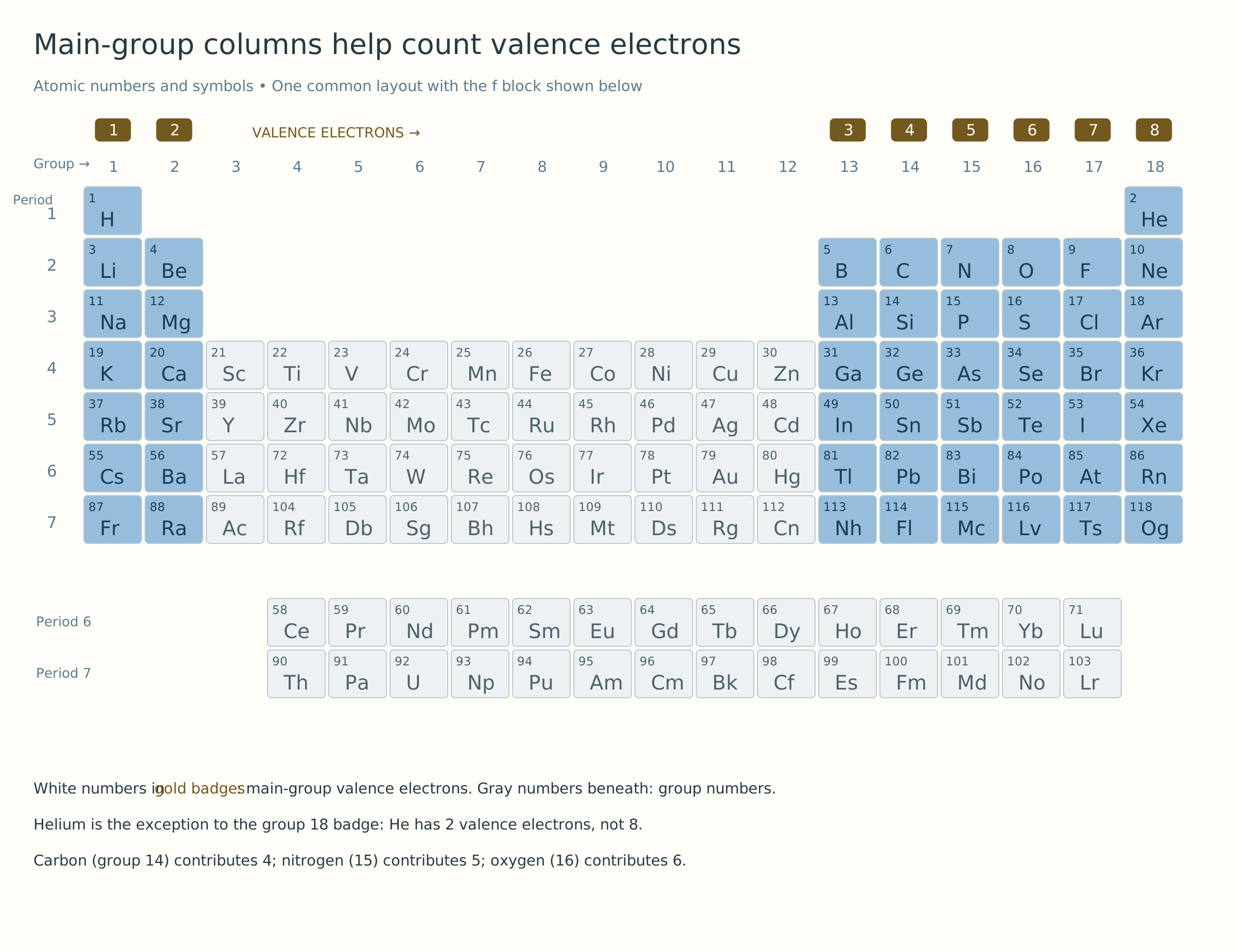
Main-group columns help count valence electrons. White numbers in gold badges: main-group valence electrons. Gray numbers beneath: group numbers. Helium is the exception to the group 18 badge: He has 2 valence electrons, not 8. Carbon (group 14) contributes 4; nitrogen (15) contributes 5; oxygen (16) contributes 6.
V comes from the gold badge above the atom's column.
Choosing the best structure
  • Formal charges must add up to the overall charge of the species.
  • Prefer structures with small formal charges (0 where possible).
  • Put a negative formal charge on the more electronegative atom.
Resonance: one molecule, two drawings
OOO+−OOO+−Same atoms in the same places; only the electrons move.
Ozone, O3. Gold marks show formal charges.
Formal charges in either ozone drawing
Oxygen atomVNB2FC
Central623+1
End, double bond6420
End, single bond661−1
Sum0
The sum matches ozone's overall charge of 0.
What resonance means
Not this
The molecule flips back and forth between drawings.
This
One real structure, a blend of the drawings. Both O–O bonds in O3 are identical.

On the periodic table: On the periodic table, the group gives V: N (Group 15) has 5, O (16) has 6, H has 1.

On the periodic table: On the periodic table, electronegativity generally increases up and to the right, toward fluorine (F). Compare positions to see which atom should carry negative charge.

Worked example · 4 steps

In NH4+, nitrogen has four single bonds and no lone pair. Find nitrogen's formal charge.

NHHHH+
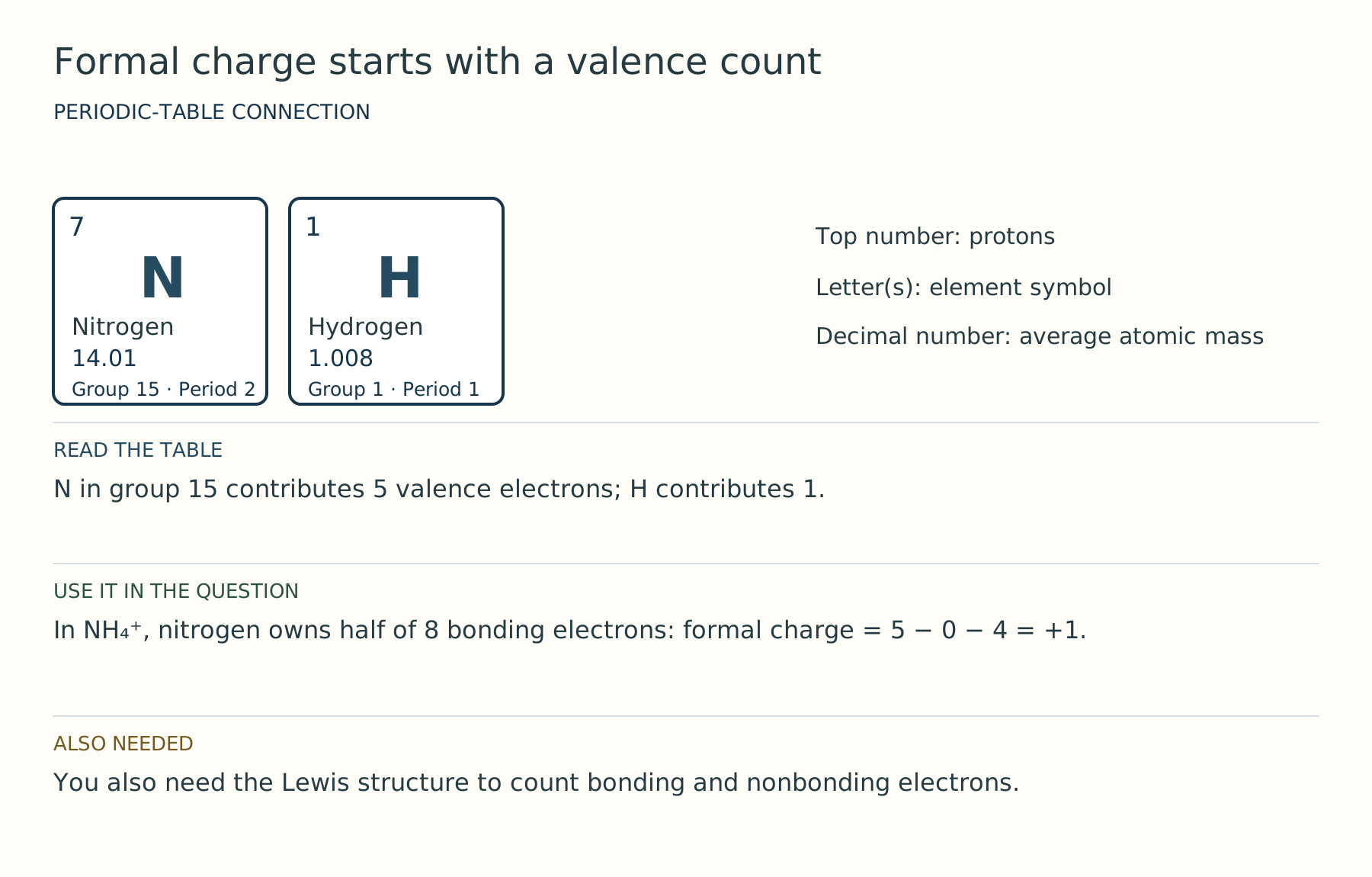
Formal charge starts with a valence count. N in group 15 contributes 5 valence electrons; H contributes 1. In NH₄⁺, nitrogen owns half of 8 bonding electrons: formal charge = 5 − 0 − 4 = +1. You also need the Lewis structure to count bonding and nonbonding electrons.
The table gives V; the Lewis structure gives N and B.
  1. 1
    Start with nitrogen's valence count

    On the periodic table: N is in Group 15, so it has 5 valence electrons.

    V = 5
  2. 2
    Count nonbonding electrons

    Nitrogen has no lone pair here.

    N = 0
  3. 3
    Assign half the bonding electrons

    Bonding electrons are split equally between the two bonded atoms.

    B2 = 4 bonds × 2 electrons2 = 4
  4. 4
    Subtract the assigned electrons

    Nitrogen is assigned one fewer electron than a neutral N atom.

    FC = 5 − 0 − 4 = +1
  5. ✓
    Answer

    Nitrogen has formal charge +1.

Your turn

Formal charge practice problems

Answer first, then check. Hints open one at a time; the answer and full solution open after you try.

Problem 1 of 3 · warm-up

In NH3, N has 2 nonbonding electrons and 6 bonding electrons. What is its formal charge? Use 5 valence electrons.

Hint 1 · the clue

Formal charge = valence − nonbonding electrons − half the bonding electrons.

Hint 2 · the next move

Nonbonding and bonding electron counts with valence electrons are given and formal charge is asked: use the formal-charge formula.

Your path:

  1. FC = valence − nonbonding − ½ bonding
  2. Halve the bonding electrons
  3. Subtract both from the valence count
Answer

Answer: 0

Full worked solution

What you know: N has 5 valence electrons, 2 nonbonding and 6 bonding electrons. What you want: N's formal charge.

  1. Use formal charge = valence − nonbonding − half of bonding.
  2. Half the bonding electrons: 6 ÷ 2 = 3, because each bond is shared with an H.
  3. Formal charge = 5 − 2 − 3 = 0.

Check: Each H is also 0 (1 − 0 − 1). The total 0 matches neutral NH3.

Watch out: Subtract only half of the bonding electrons. Subtracting all 6 gives −3.

Your route: Valence minus nonbonding minus half bonding.

On the periodic table: Nitrogen (N) is in Group 15, so it has 5 valence electrons.

Answer: 0

Problem 2 of 3

Two proposed drawings of O3 are called resonance contributors. Which feature must stay unchanged?

Hint 1 · the clue

Alternative Lewis drawings are being compared.

Hint 2 · the next move

"Resonance contributors" signals the rule: only electron placement changes, while atom connections and total charge stay the same.

Your path:

  1. Recall: resonance moves electrons only
  2. Atoms keep the same connections
  3. Total charge stays the same
Answer

Answer: The atom connections and total charge

Full worked solution

What you know: Two drawings of O3 are resonance contributors. What you want: What cannot change between them.

  1. Recall the rule: resonance drawings keep the same atom connections but place electrons differently.
  2. In O3, the double bond moves from the left O–O to the right O–O: one end O turns a lone pair into a bond pair, and the other end O turns a bond pair back into a lone pair. The O–O–O skeleton stays.
  3. The electrons are only moved, never added or removed, so the total charge stays too: The atom connections and total charge.

Check: Both O3 drawings use 3 × 6 = 18 valence electrons and have formal charges adding to 0.

Watch out: Moving an atom to a new position makes a different molecule, not a resonance form.

Your route: Keep atoms connected → Redistribute electrons.

Answer: The atom connections and total charge

Problem 3 of 3

Two Lewis structures for CO2 each have 16 valence electrons. (A) O=C=O with two lone pairs on each O. (B) O≡C–O with one lone pair on the triple-bonded O and three lone pairs on the single-bonded O. Find each atom’s formal charge and choose the better structure.

Hint 1 · the clue

For each atom, start from its valence count, subtract every lone-pair electron, then subtract half of its bonding electrons. A triple bond counts as 6 bonding electrons.

Hint 2 · the next move

Two Lewis structures and "formal charge" are given: compute each atom's formal charge, then prefer charges closest to zero.

Your path:

  1. FC = valence − nonbonding − ½ bonding
  2. Find FC for each atom in both
  3. Choose the structure with charges nearest zero
Answer

Structure A; every atom in A has formal charge 0, while B puts +1 and −1 on the two O atoms.

On the periodic table: Carbon (C) is in Group 14, so it has 4 valence electrons. Oxygen (O) is in Group 16, so it has 6.

Full worked solution

What you know: CO2 has 16 valence electrons. Structure A is O=C=O with two lone pairs on each O. Structure B is O≡C–O with one lone pair on the triple-bonded O and three lone pairs on the single-bonded O. What you want: The formal charges in each structure and the better structure.

  1. Use FC = V − N − B/2 for each atom, where V is valence electrons, N is nonbonding electrons and B is bonding electrons.
  2. Structure A: each O has FC = 6 − 4 − 4/2 = 0. Carbon has FC = 4 − 0 − 8/2 = 0.
  3. Structure B: the triple-bonded O has FC = 6 − 2 − 6/2 = +1. Carbon has FC = 4 − 0 − 8/2 = 0. The single-bonded O has FC = 6 − 6 − 2/2 = −1.
  4. Prefer the structure with the smallest formal charges. A has all zeros, so the answer is Structure A.

Check: The formal charges add to the overall charge in both structures: A gives 0 + 0 + 0 = 0, and B gives +1 + 0 + (−1) = 0. CO2 is neutral, so both totals fit.

Watch out: B and its mirror drawing O–C≡O keep the same atom connections and move only electrons, so they are resonance drawings of each other. Being a resonance drawing does not make B better. Its +1 sits on oxygen, a very electronegative atom, which is unfavorable.

Answer: Structure A; every atom in A has formal charge 0, while B puts +1 and −1 on the two O atoms.

On the periodic table: Carbon (C) is in Group 14, so it has 4 valence electrons. Oxygen (O) is in Group 16, so it has 6.

YOUR PERIODIC-TABLE REFERENCE

6CCarbon12.01Group 14 · Period 2
8OOxygen16.00Group 16 · Period 2

Atomic number identifies proton count. The decimal mass is an average, not an isotope’s mass number. Use supplied rounded masses when a problem gives them.

Watch out

Common formal charge mistakes