ChemGem

How to Draw Lewis Structures (Step-by-Step, with Practice)

A Lewis structure (also called a Lewis dot structure) is a drawing of a molecule's outer (valence) electrons. Lines show shared pairs; dots show pairs that are not shared. It is the first step toward shape and polarity.

Spot it, solve it, practice it: 5 steps, 1 worked example, 3 practice problems. Free, no account.

The route · 5 steps

  1. Count valence electrons, adjusted for any charge.
  2. Connect the atoms with single bonds.
  3. Fill the outer atoms' octets.
  4. Use multiple bonds if the central atom is short.
  5. Check the total against your starting count.
Spot it

How to recognize Lewis structure questions

Look for a formula or ion with a request to count valence electrons or draw its Lewis structure.

Example wording, with the clue words marked:

Count the valence electrons for NO3−. Use H = 1, N = 5, O = 6 valence electrons.

Not sure it’s this type? Compare the neighbors:

Step-by-step

Worked example: Lewis structure

The idea

Reading a Lewis structure
HOHbond = 2 shared electronslone pair (not in a bond)Around O: 2 bonds + 2 lone pairs= 8 electrons (an octet)Each H: 1 bond = 2 electrons
Water: 1 + 1 + 6 = 8 valence electrons, all shown.
Key words
  • Lewis structure: valence electrons drawn as bonds and lone pairs.
  • Lone pair: two electrons not used in a bond.
  • Octet: eight electrons around an atom. Hydrogen needs only two.
  • Some atoms have incomplete or expanded octets; check your course's exceptions.
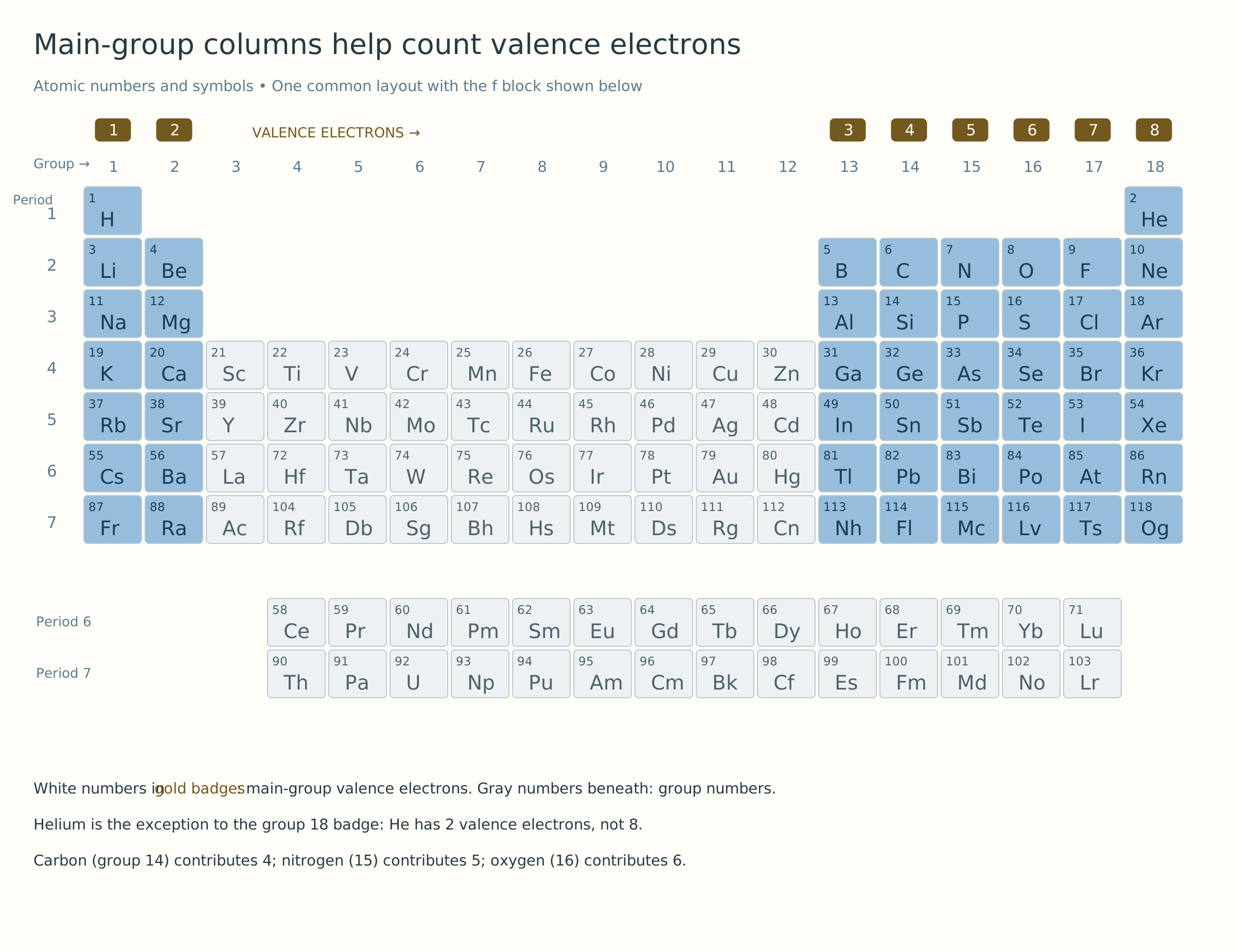
Main-group columns help count valence electrons. White numbers in gold badges: main-group valence electrons. Gray numbers beneath: group numbers. Helium is the exception to the group 18 badge: He has 2 valence electrons, not 8. Carbon (group 14) contributes 4; nitrogen (15) contributes 5; oxygen (16) contributes 6.
Gold badges: main-group valence electrons. Gray numbers: group numbers. Helium has 2.
Count the electron budget first
electrons = sum of valence electrons − (ion charge)
NH4+: 5 + 4(1) − 1 = 8    OH−: 6 + 1 + 1 = 8
Negative ion: add electrons. Positive ion: subtract them.
The build order
StepWhat you do
1Count valence electrons, adjusted for charge.
2Connect atoms with single bonds.
3Fill outer atoms' octets with lone pairs.
4Put leftover electrons on the central atom.
5Central octet short? Turn an outer lone pair into a multiple bond.
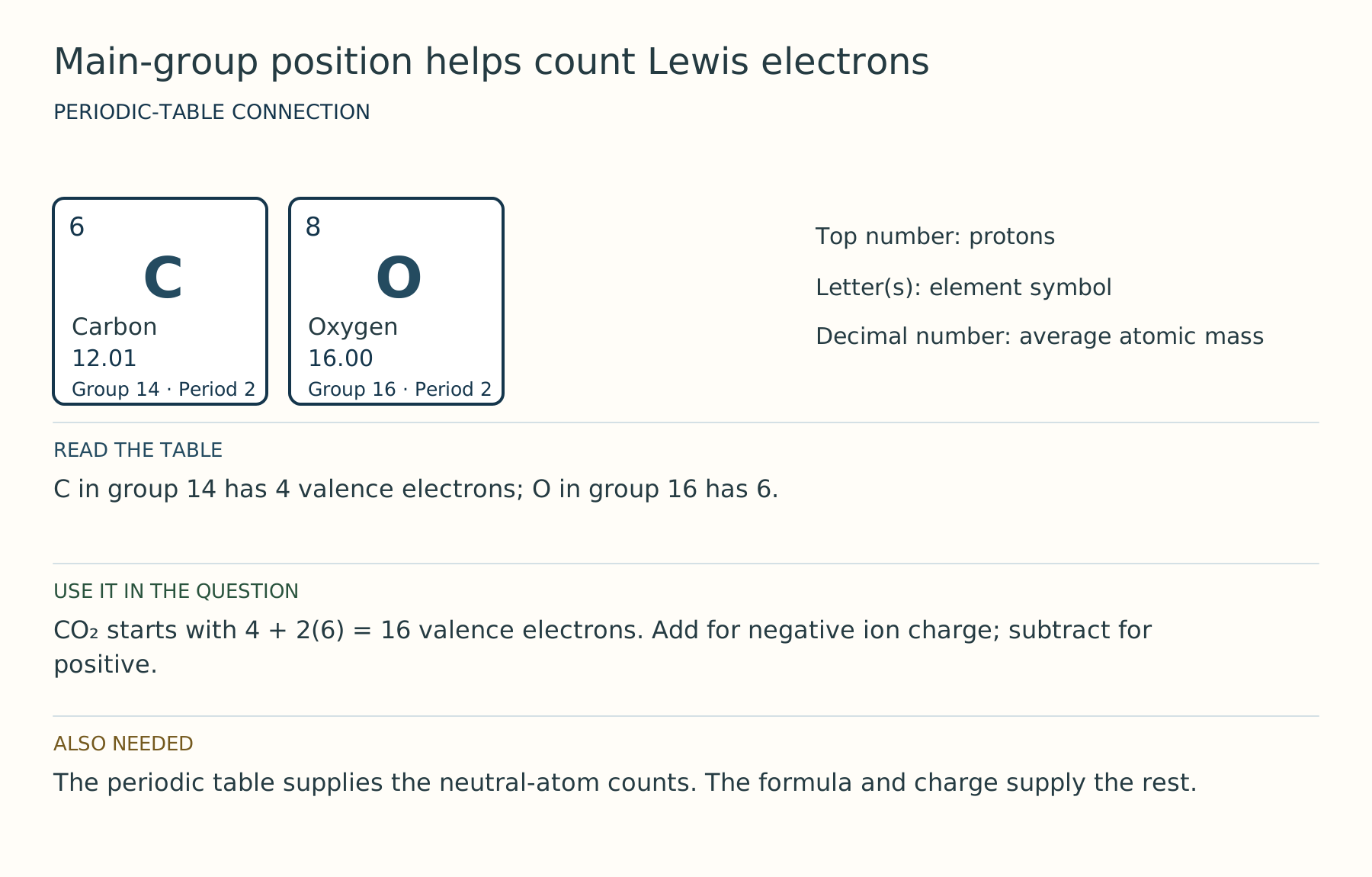
Main-group position helps count Lewis electrons. C in group 14 has 4 valence electrons; O in group 16 has 6. CO₂ starts with 4 + 2(6) = 16 valence electrons. Add for negative ion charge; subtract for positive. The periodic table supplies the neutral-atom counts. The formula and charge supply the rest.
The table gives neutral-atom counts; the formula and charge give the rest.

On the periodic table: On the periodic table, the main-group column gives valence electrons: C (Group 14) 4, N (15) 5, O (16) 6, H (1) 1.

On the periodic table: Helium is the exception in Group 18: it has 2 valence electrons, not 8.

Worked example · 5 steps

Build the usual Lewis structure for CO2.

  1. 1
    Count available valence electrons

    On the periodic table: C is in Group 14 (4 valence electrons); O is in Group 16 (6 each).

    C + 2 O = 4 + 2(6) = 16 electrons
  2. 2
    Connect the atoms

    Carbon is the central atom. Two single bonds use four electrons.

    OCO2 bonds use 4 electrons; 12 left
  3. 3
    Complete the outer octets

    The twelve remaining electrons go on the oxygens as 3 lone pairs each.

    OCOEach O has 8; C has only 4
  4. 4
    Share a lone pair from each oxygen

    Turn one lone pair on each O into an extra bonding pair. Carbon now has eight.

    OCOC, O, O: 8 electrons each
  5. 5
    Check the final budget

    The structure uses exactly the electrons we started with.

    PartCountElectrons
    Double bonds28
    Lone pairs48
    Total16
  6. ✓
    Answer

    O=C=O, with two lone pairs on each oxygen.

Your turn

Lewis structure practice problems

Answer first, then check. Hints open one at a time; the answer and full solution open after you try.

Problem 1 of 3 · warm-up

Count the valence electrons for NO3−. Use H = 1, N = 5, O = 6 valence electrons.

Hint 1 · the clue

Add the valence electrons of every atom, then add 1 electron for the negative charge.

Hint 2 · the next move

An ion with a charge and valence counts is given, and total valence electrons is asked: add atoms, then adjust for charge.

Your path:

  1. Add valence electrons from every atom
  2. Negative charge: add one electron per charge
Answer

Answer: 24

Full worked solution

What you know: NO3− has 1 N, 3 O and a 1− charge. What you want: Total valence electrons.

  1. Add every atom's valence electrons: N gives 5; three O give 3 × 6 = 18. 5 + 18 = 23.
  2. The 1− charge means one extra electron: 23 + 1 = 24.

Check: Recount atom by atom: 5 (N) + 6 + 6 + 6 (three O) + 1 (charge) = 24.

Watch out: A negative charge adds electrons; a positive charge removes them. Subtracting here would give 22.

Your route: Add every atom’s valence count → Add for negative charge or subtract for positive.

On the periodic table: Nitrogen (N) is in Group 15, so it has 5 valence electrons. Oxygen (O) is in Group 16, so it has 6.

Answer: 24

Problem 2 of 3

How many valence electrons are available for NH4+? N contributes 5 and each H contributes 1.

Hint 1 · the clue

Add the valence electrons of every atom, then subtract 1 electron for the positive charge.

Hint 2 · the next move

A positive ion and valence counts are given, and available valence electrons are asked: add atoms, then subtract for the charge.

Your path:

  1. Add valence electrons from every atom
  2. Positive charge: remove one electron per charge
Answer

Answer: 8

Full worked solution

What you know: NH4+ has 1 N, 4 H and a 1+ charge. What you want: Total valence electrons.

  1. Add the atoms: N gives 5; four H give 4 × 1 = 4. 5 + 4 = 9.
  2. The 1+ charge means one electron is missing: 9 − 1 = 8.

Check: 8 electrons make exactly 4 N–H bonds of 2 electrons each, with no lone pair left.

Watch out: Adding 1 for a positive charge gives 10. Positive means fewer electrons.

Your route: Add valence counts → Subtract positive charge.

On the periodic table: Nitrogen (N) is in Group 15, so it has 5 valence electrons. Hydrogen (H) is in Group 1, so it has 1.

Answer: 8

Problem 3 of 3

How many valence electrons in H2O? Describe its Lewis structure.

Hint 1 · the clue

Count valence electrons, draw bonds and lone pairs, then count electron regions around the central atom. Use those regions to identify shape.

Hint 2 · the next move

"Valence electrons" and "Lewis structure" are asked: count electrons first, then build bonds and lone pairs.

Your path:

  1. Add valence electrons from each atom
  2. Put O in center; draw O–H bonds
  3. Place leftover electrons as lone pairs on O
Answer

2(1) + 6 = 8; two O–H bonds and two lone pairs on O.

On the periodic table: Hydrogen (H) is in Group 1, so it has 1 valence electron. Oxygen (O) is in Group 16, so it has 6.

Full worked solution

What you know: H2O has 2 H and 1 O. What you want: The valence electron count and the Lewis structure.

  1. Add valence electrons: 2 H × 1 = 2, plus O = 6. Total 2 + 6 = 8.
  2. Put O in the center (H can make only one bond). Draw two O–H single bonds: that uses 2 × 2 = 4 electrons.
  3. Place the remaining 8 − 4 = 4 electrons on O as 2 lone pairs. Result: 2(1) + 6 = 8; two O–H bonds and two lone pairs on O.

Check: O has 4 + 4 = 8 electrons (octet); each H has 2. 4 regions on O give a bent shape.

Watch out: Do not forget the lone pairs. Without them O would have only 4 electrons.

Answer: 2(1) + 6 = 8; two O–H bonds and two lone pairs on O.

On the periodic table: Hydrogen (H) is in Group 1, so it has 1 valence electron. Oxygen (O) is in Group 16, so it has 6.

YOUR PERIODIC-TABLE REFERENCE

1HHydrogen1.008Group 1 · Period 1
8OOxygen16.00Group 16 · Period 2

Atomic number identifies proton count. The decimal mass is an average, not an isotope’s mass number. Use supplied rounded masses when a problem gives them.

Watch out

Common Lewis structure mistakes