ChemGem

How to Tell If a Molecule Is Polar (Step-by-Step, with Practice)

Whether a molecule is polar depends on two things: its bonds and its shape. Polarity then decides how strongly molecules attract each other, which shows up in properties like boiling point.

Spot it, solve it, practice it: 4 steps, 1 worked example, 4 practice problems. Free, no account.

The route · 4 steps

  1. Find each bond's polarity from electronegativity.
  2. Find the molecular shape.
  3. Decide whether the bond dipoles cancel.
  4. Compare the attractions between molecules.
Spot it

How to recognize polarity questions

Look for "polar," "nonpolar," bond dipoles, symmetry, or a question about which attraction (like hydrogen bonding) acts between molecules.

Example wording, with the clue words marked:

Why is an ideal symmetric BeCl2 molecule nonpolar even though its bonds are polar?

Not sure it’s this type? Compare the neighbors:

Step-by-step

Worked example: polarity

The idea

From bonds to molecules
  • Polar bond: electrons shared unevenly because one atom pulls harder (higher electronegativity).
  • Polar molecule: the bond pulls do not cancel, leaving a net dipole (a positive end and a negative end).
  • Shape decides whether the pulls cancel.
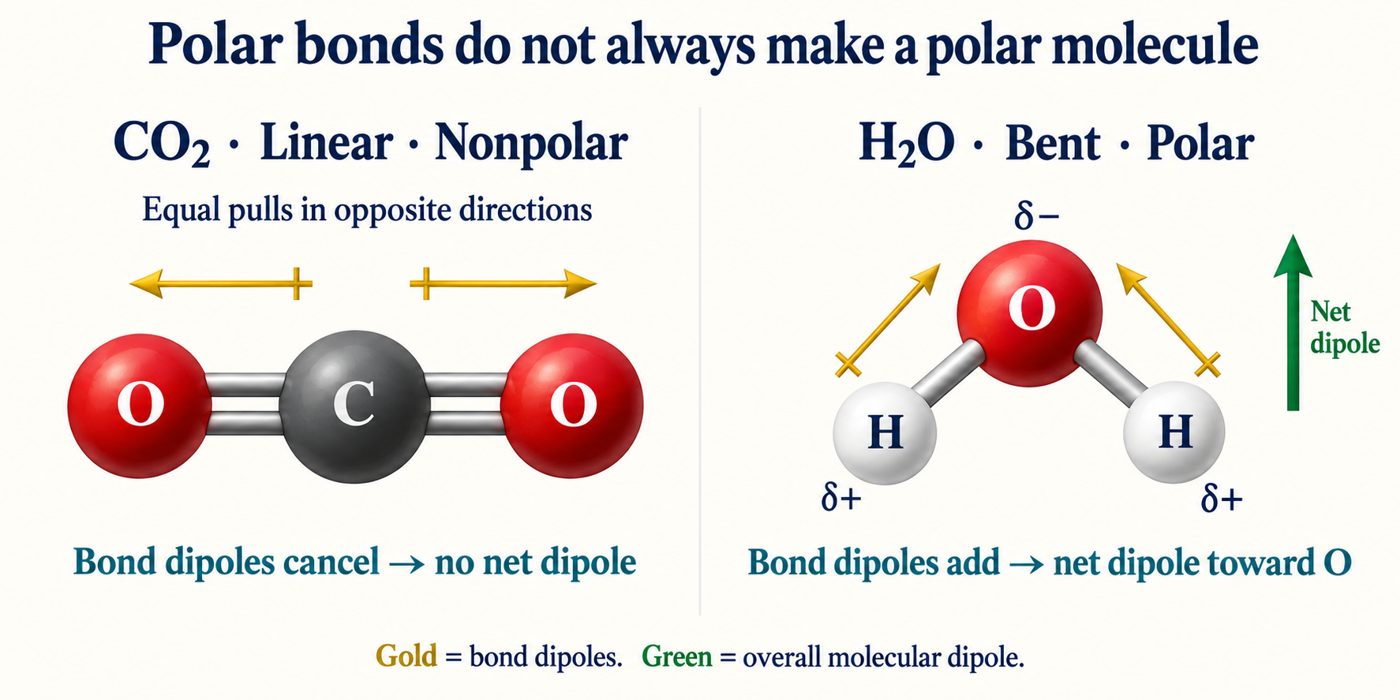
Linear carbon dioxide has two equal opposing C-to-O bond dipoles that cancel. Bent water has H-to-O bond dipoles that add to a net dipole toward oxygen. Gold arrows show bond dipoles; green shows the net molecular dipole.
CO2: polar bonds, no net dipole. H2O: bent, so the dipoles add. Crossed arrow tails mark the positive end.
Same kind of bonds, different result
CO2: nonpolar
Linear. Two equal pulls point in opposite directions and cancel.
H2O: polar
Bent. The two pulls both lean toward O and add up.
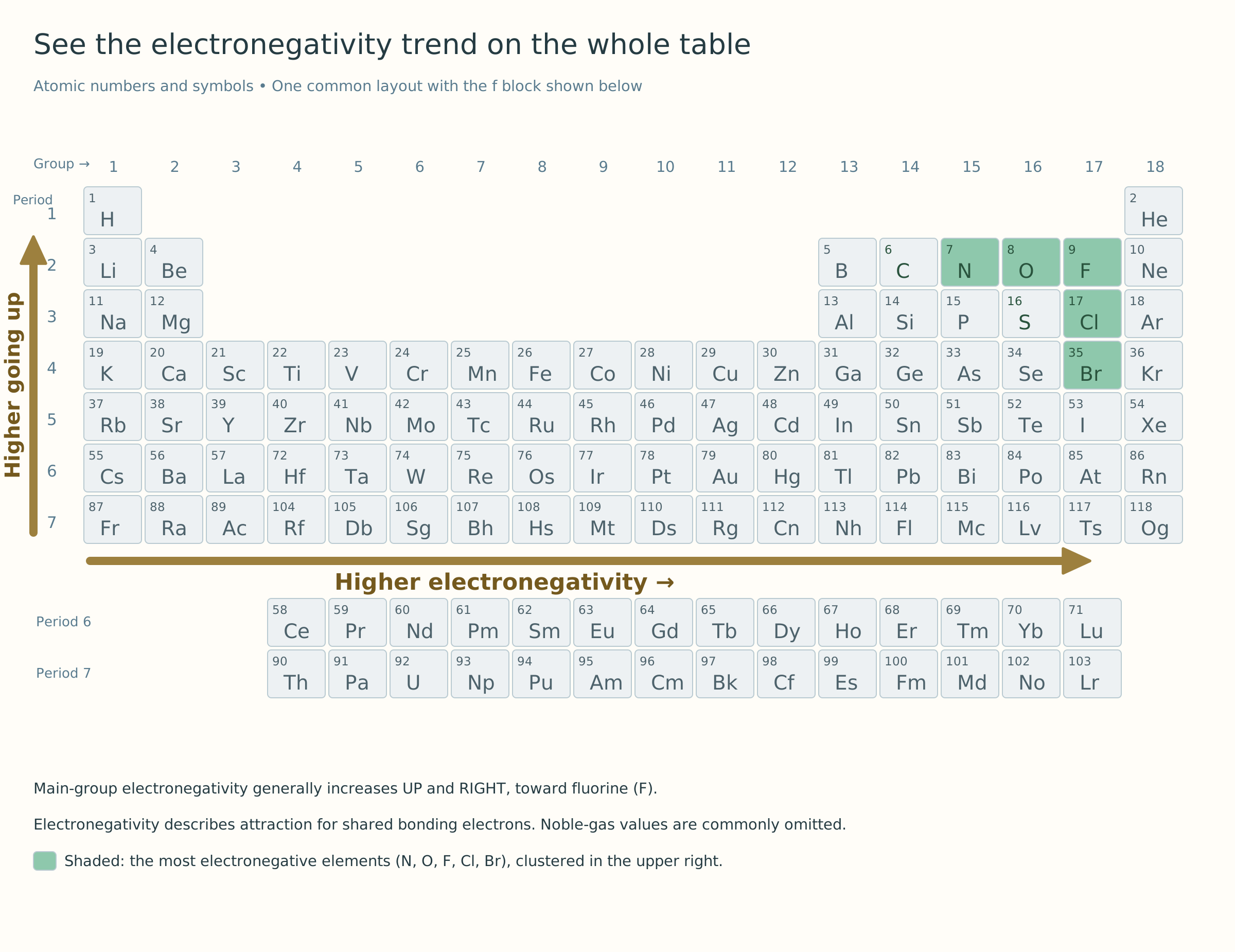
Periodic table with an arrow pointing up the side and an arrow pointing right along the bottom, both marking higher electronegativity. The shaded top-right group of N, O, F, Cl and Br marks the most electronegative elements, with fluorine (F) highest.
Electronegativity rises up a group and to the right, highest at F. Noble gases are usually left out.
Attractions between molecules
AttractionWho has itExample
London dispersionAll atoms and moleculesCH4
Dipole–dipolePolar moleculesNH3, H2O
Hydrogen bondingH bonded to N, O or F, attracted to a lone pair on N, O or F of a neighborNH3, H2O
These act between molecules. They are much weaker than the bonds within a molecule. An H in the formula is not enough for hydrogen bonding.
Stronger attractions, higher boiling point
Methane111.7 K (−161.5 °C)Ammonia239.8 K (−33.3 °C)Water373.2 K (100.0 °C)Boiling point (K)
Similar molar masses: 16.04, 17.03 and 18.02 g/mol. CH4 has dispersion only. NH3 and H2O add dipole–dipole and hydrogen bonding; water hydrogen-bonds the most.

On the periodic table: On the periodic table, electronegativity increases up and to the right, toward fluorine (F).

On the periodic table: O (Group 16) is right of C (Group 14), so O pulls harder in each C=O bond.

On the periodic table: N (Group 15) is more electronegative than H, so each N–H bond is polar.

On the periodic table: Molar masses come from the table: CH4 16.04, NH3 17.03, H2O 18.02 g/mol.

Worked example · 4 steps

Why is CH4 nonpolar overall while NH3 is polar?

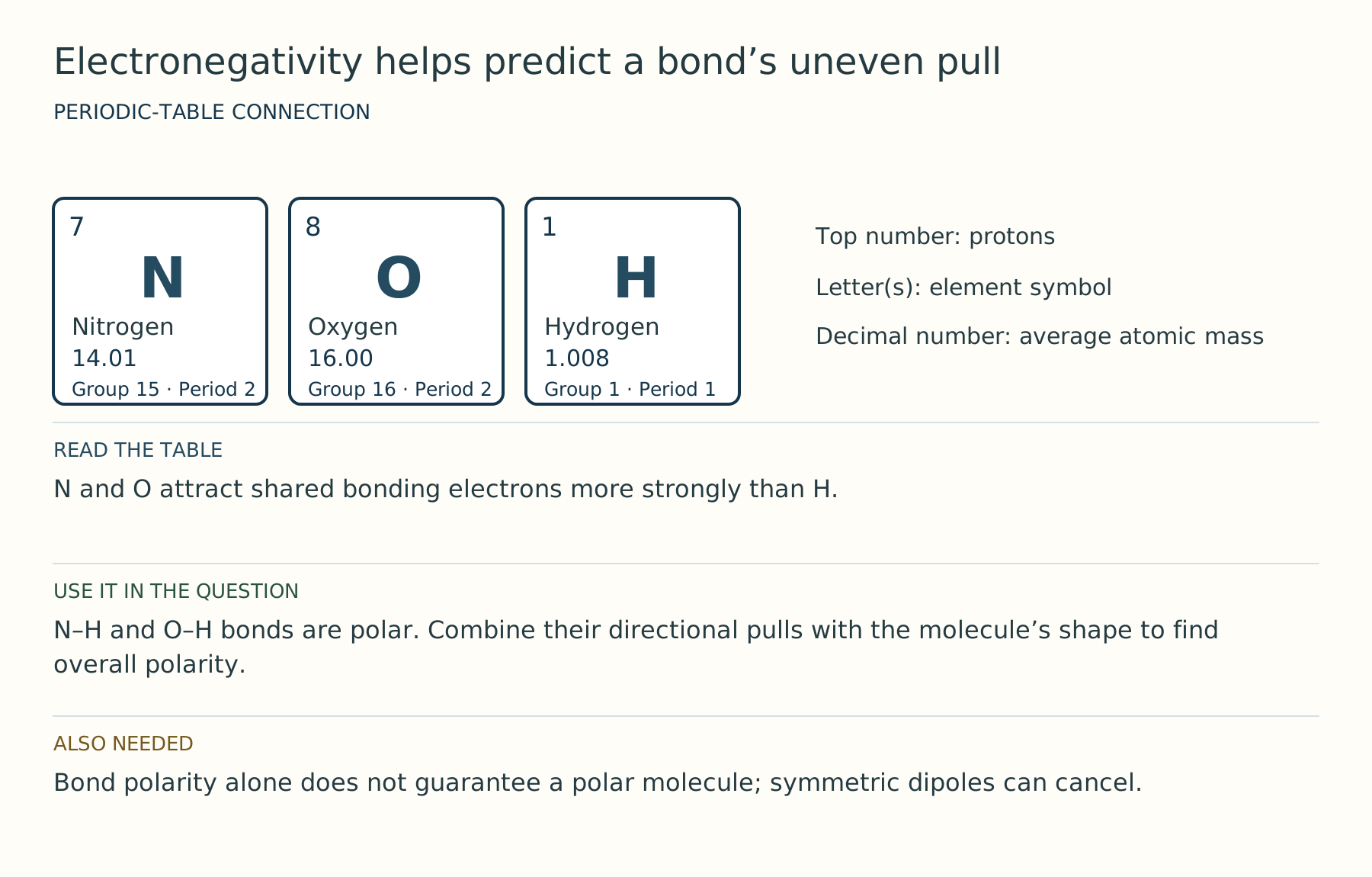
Electronegativity helps predict a bond’s uneven pull. N and O attract shared bonding electrons more strongly than H. N–H and O–H bonds are polar. Combine their directional pulls with the molecule’s shape to find overall polarity. Bond polarity alone does not make a polar molecule; symmetric dipoles can cancel.
Bond polarity comes from the table; overall polarity also needs the shape.
  1. 1
    Check methane's shape

    Four identical outer atoms sit in a symmetric arrangement.

    CH4: 4 bonds + 0 lone pairs → tetrahedral
  2. 2
    Combine methane's dipoles

    Equal pulls in symmetric directions balance each other.

    4 equal bond dipoles, symmetric → net dipole = 0
  3. 3
    Check ammonia's shape

    A lone pair takes the fourth region, so the H atoms are not arranged like methane's.

    NH3: 3 bonds + 1 lone pair → trigonal pyramidal
  4. 4
    Combine ammonia's dipoles

    On the periodic table: N (Group 15, near the top right) is more electronegative than H, so each N–H bond is polar. The pyramid does not cancel them.

    Polar bonds?ShapeDipoles cancel?Molecule
    CH4SlightlyTetrahedralYesNonpolar
    NH3YesTrigonal pyramidalNoPolar
  5. ✓
    Answer

    CH4 is nonpolar overall; NH3 is polar. Shape matters as well as bond polarity.

Your turn

Polarity practice problems

Answer first, then check. Hints open one at a time; the answer and full solution open after you try.

Problem 1 of 4 · warm-up

Why is an ideal symmetric BeCl2 molecule nonpolar even though its bonds are polar?

Hint 1 · the clue

Molecular polarity is asked from a known shape.

Hint 2 · the next move

Polar bonds but a nonpolar molecule: that signals checking the shape to see whether the bond dipoles cancel.

Your path:

  1. Find shape: 2 regions → linear
  2. Equal dipoles point opposite ways
  3. Dipoles cancel, so no net polarity
Answer

Answer: Its bond dipoles cancel as vectors

Full worked solution

What you know: BeCl2 has two polar Be–Cl bonds. What you want: Why the molecule is still nonpolar.

  1. Find the shape: Be has 2 bonds and no lone pairs, so 2 regions, which is linear (180°).
  2. Each Be–Cl bond dipole points from Be toward Cl. The two dipoles are equal in size and point in exactly opposite directions.
  3. Equal, opposite pulls add to zero, like a balanced tug-of-war: Its bond dipoles cancel as vectors.

Why it matters: CO2 works the same way. A bent molecule like H2O cannot cancel, so it is polar.

Watch out: Polar bonds do not guarantee a polar molecule. Always check the shape.

Your route: Identify molecular symmetry → Add equal bond dipoles as vectors.

On the periodic table: Chlorine (Cl) in Group 17 is far to the right of beryllium (Be) in Group 2, so Cl is more electronegative and each Be–Cl bond is polar.

Answer: Its bond dipoles cancel as vectors

YOUR PERIODIC-TABLE REFERENCE

17ClChlorine35.45Group 17 · Period 3

Atomic number identifies proton count. The decimal mass is an average, not an isotope’s mass number. Use supplied rounded masses when a problem gives them.

Problem 2 of 4

Among CH3OH, CH4, H2S, and Ar, which pure substance can hydrogen-bond with its own particles?

Hint 1 · the clue

Look for an H bonded directly to N, O, or F.

Hint 2 · the next move

"Hydrogen-bond" is asked among several substances: look for an H bonded directly to N, O, or F.

Your path:

  1. Check each for H on N, O, or F
  2. Confirm a lone pair partner on N, O, or F
  3. Pick the one meeting both conditions
Answer

Answer: CH3OH

Full worked solution

What you know: Four substances: CH3OH, CH4, H2S and Ar. What you want: Which can hydrogen-bond with itself.

  1. Look for an H bonded directly to N, O or F. CH4 has H only on C. H2S has H on S, which is not N, O or F. Ar has no H at all.
  2. CH3OH has an O–H bond, so it qualifies.
  3. Check for a partner: the O in a neighboring CH3OH has 2 lone pairs to accept that H. So the answer is CH3OH.

Check: Both conditions are met only by methanol: the H–O donor and the O lone-pair acceptor.

Watch out: The three H atoms in the CH3 group do not count. Only the H on O can hydrogen-bond.

Your route: Check H bonded to N O or F → Check lone-pair partner.

Answer: CH3OH

YOUR PERIODIC-TABLE REFERENCE

1HHydrogen1.008Group 1 · Period 1
6CCarbon12.01Group 14 · Period 2
7NNitrogen14.01Group 15 · Period 2
8OOxygen16.00Group 16 · Period 2
9FFluorine19.00Group 17 · Period 2

Atomic number identifies proton count. The decimal mass is an average, not an isotope’s mass number. Use supplied rounded masses when a problem gives them.

Problem 3 of 4

Pure H2O: which strong intermolecular attraction applies?

Hint 1 · the clue

Look for H bonded directly to N, O, or F, and a lone pair on N, O, or F of a neighboring molecule.

Hint 2 · the next move

A strongest intermolecular attraction is asked for a pure substance: check for H bonded to N, O, or F.

Your path:

  1. Check for H bonded to N, O, or F
  2. Check a neighbor has a lone pair
  3. Both true → hydrogen bonding
Answer

Hydrogen bonding, because H is bonded to O.

Full worked solution

What you know: The substance is pure H2O. What you want: The strongest relevant intermolecular attraction.

  1. Check for H bonded to N, O or F: water has two O–H bonds, so yes.
  2. Check for a partner: the O on a neighboring water molecule has 2 lone pairs to accept the H.
  3. Both conditions are met, so the answer is Hydrogen bonding, because H is bonded to O.

Why it matters: Water also has dispersion and dipole–dipole attractions, but hydrogen bonding is the strongest of these, which explains water's high boiling point.

Watch out: A hydrogen bond is an attraction between molecules, not the O–H covalent bond inside one molecule.

Answer: Hydrogen bonding, because H is bonded to O.

YOUR PERIODIC-TABLE REFERENCE

1HHydrogen1.008Group 1 · Period 1
8OOxygen16.00Group 16 · Period 2

Atomic number identifies proton count. The decimal mass is an average, not an isotope’s mass number. Use supplied rounded masses when a problem gives them.

Problem 4 of 4

CO2 has polar bonds and is linear/symmetric. Polar overall?

Hint 1 · the clue

Consider bond polarity and molecular shape together. Check whether the bond dipoles cancel.

Hint 2 · the next move

Polar bonds plus a linear, symmetric shape: check whether the equal bond dipoles cancel to decide overall polarity.

Your path:

  1. Each bond dipole points toward O
  2. Linear: dipoles point opposite ways
  3. Equal and opposite → they cancel
Answer

No: its equal opposing bond dipoles cancel.

Full worked solution

What you know: CO2 has polar C=O bonds and a linear, symmetric shape. What you want: Whether the molecule is polar overall.

  1. Each C=O bond dipole points from C toward the more electronegative O.
  2. Linear means the two O atoms sit 180° apart, so the two dipoles point in opposite directions.
  3. The two bonds are identical, so the pulls are equal. Equal and opposite pulls cancel: No: its equal opposing bond dipoles cancel.

Why it matters: Compare bent H2O: its dipoles do not point in opposite directions, so they add to a net dipole and water is polar.

Watch out: Polar bonds alone do not make a polar molecule. Shape decides.

Answer: No: its equal opposing bond dipoles cancel.

Watch out

Common polarity mistakes