
Chapter 9 · Free lesson
Gases and states of matter
The full lesson, free. For instant answer checking, hints and progress tracking, open the interactive version.
What you will study
- Predict the direction before using a formula
- Using the ideal gas equation
- Partial pressure: each gas contributes to the total
- Effusion: lighter gases escape faster (inside 9.3)
- Phase changes use a different heat route
By the end, you can…
- Explain gas pressure and gas behavior using particle motion.
- Predict and calculate gas changes with Boyle’s, Charles’s, Gay-Lussac’s and the combined gas law.
- Solve ideal-gas volume with matching units.
- Calculate partial pressures from mole fractions.
- Compare effusion rates using molar mass.
- Calculate phase-change heat from moles and enthalpy.
These are the skills to check, not just pages to finish. Use the section goals while studying, then try the chapter checks without hints.
Read the idea first. Then notice the clue, follow the route, and make a choice you can explain. You can return to the worked example if a practice question feels unfamiliar.
9.1 Predict the direction before using a formula
Gas particles hitting the walls make pressure. Read what stays fixed, predict the direction, then pick the law.
- Solving for an unknown (Math first); temperature must be in kelvin.
Need a refresher? Open the table of contents and revisit that topic before starting.
| Law | Held fixed | Equation | Direction |
|---|---|---|---|
| Boyle’s law | T and n | P1V1 = P2V2 | V up → P down |
| Charles’s law | P and n | V1T1 = V2T2 | T up → V up |
| Gay-Lussac’s law | V and n | P1T1 = P2T2 | T up → P up |
| Avogadro’s law | P and T | V1n1 = V2n2 | n up → V up |
| Combined gas law | n only | P1V1T1 = P2V2T2 | track all three |
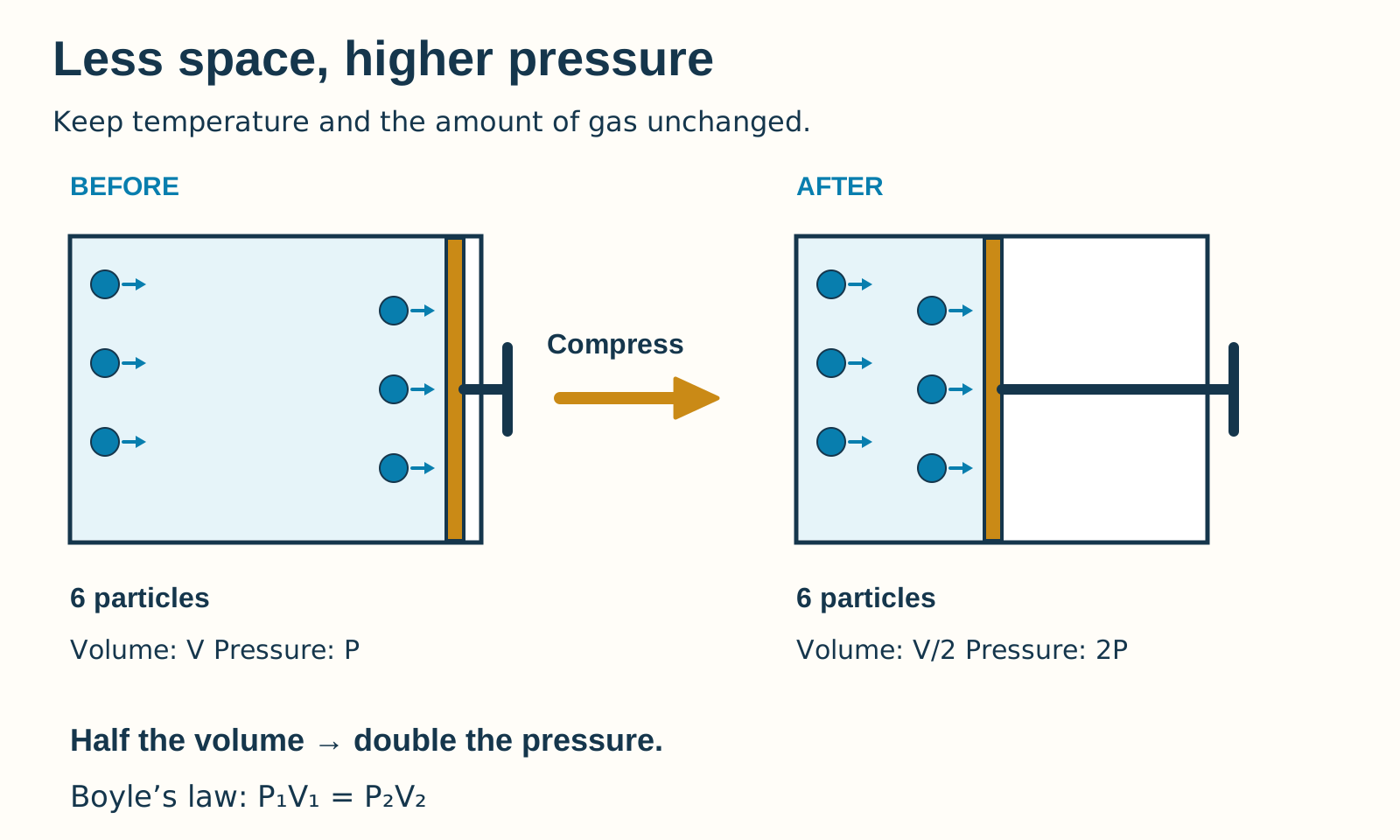
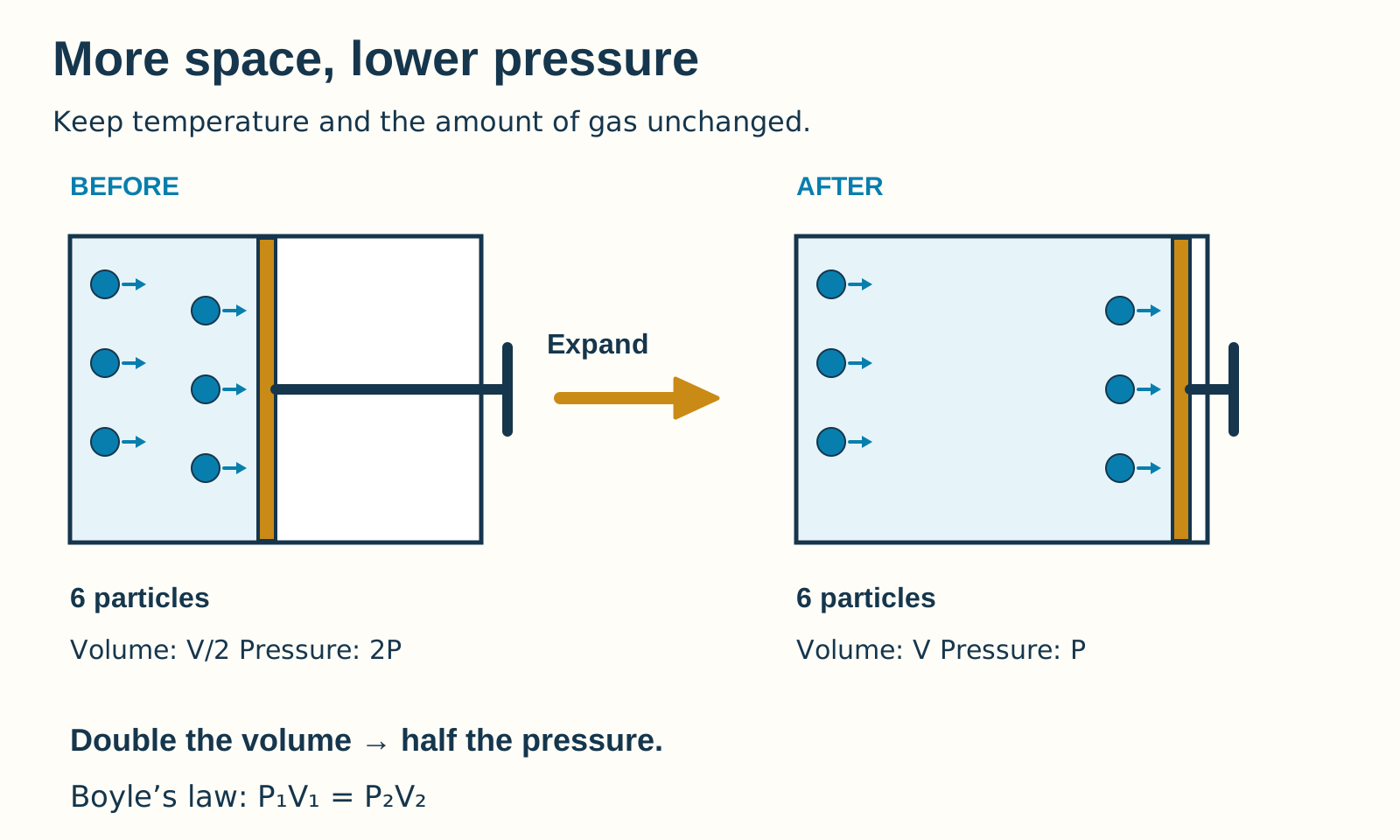
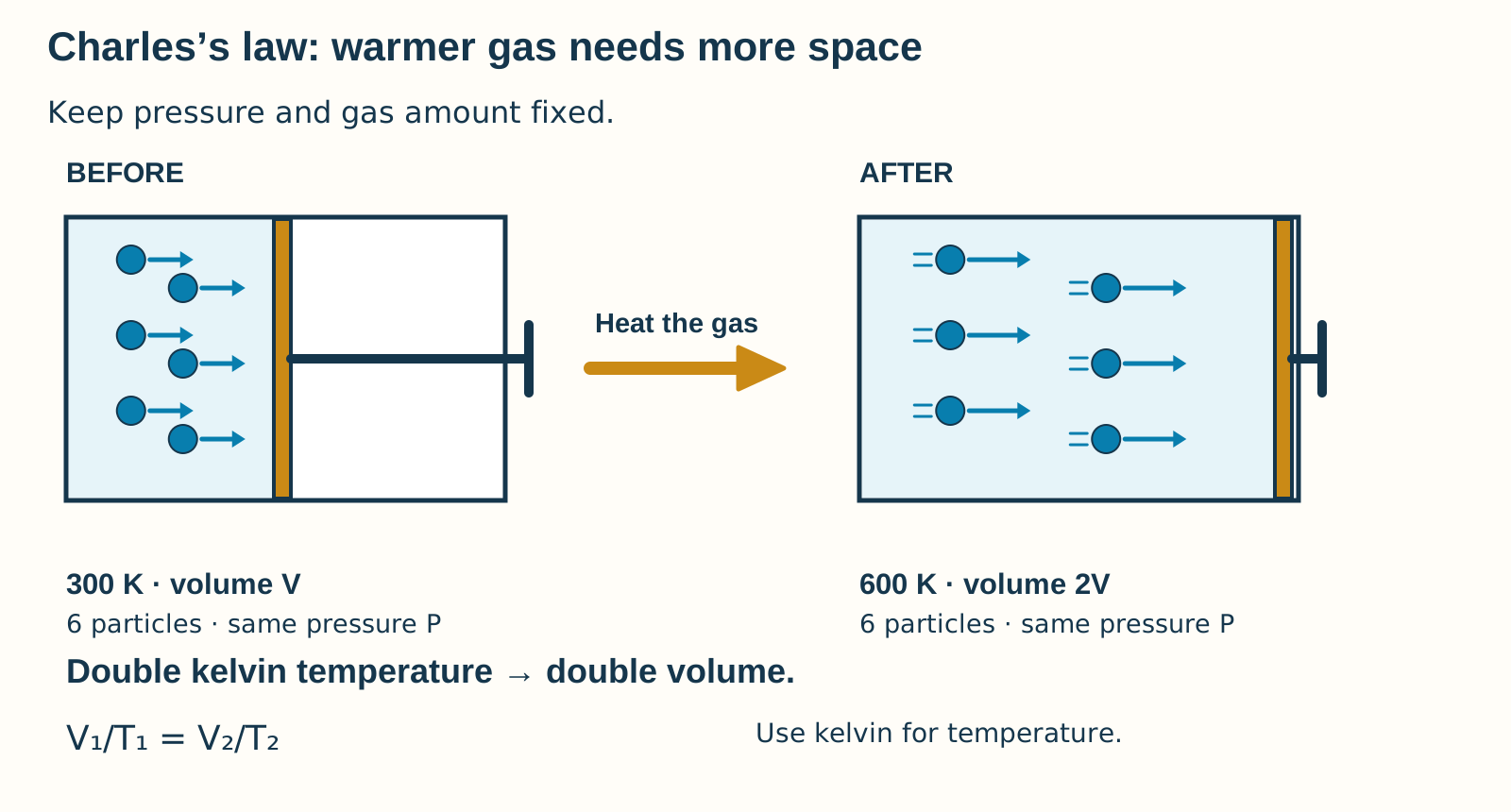
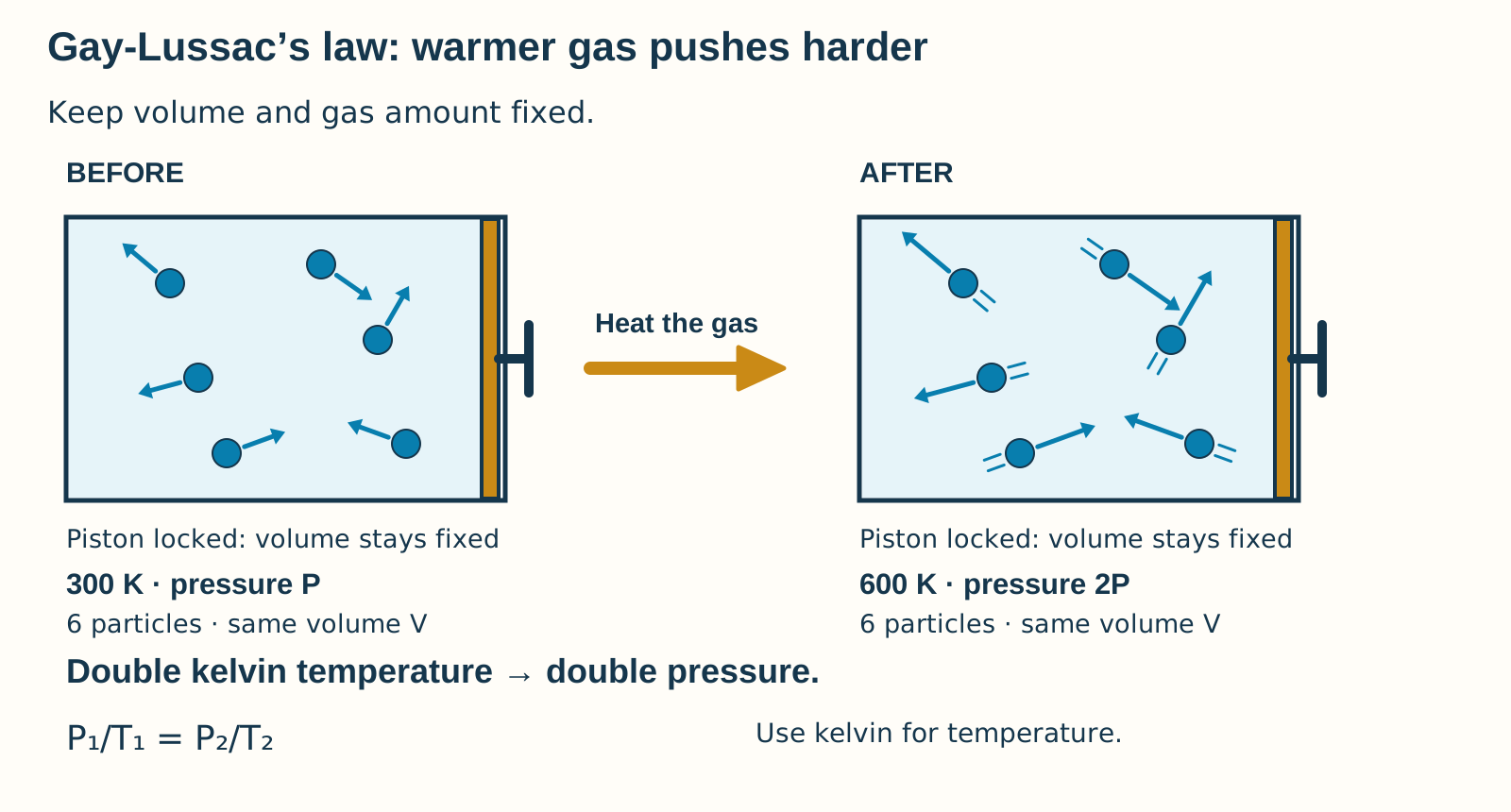
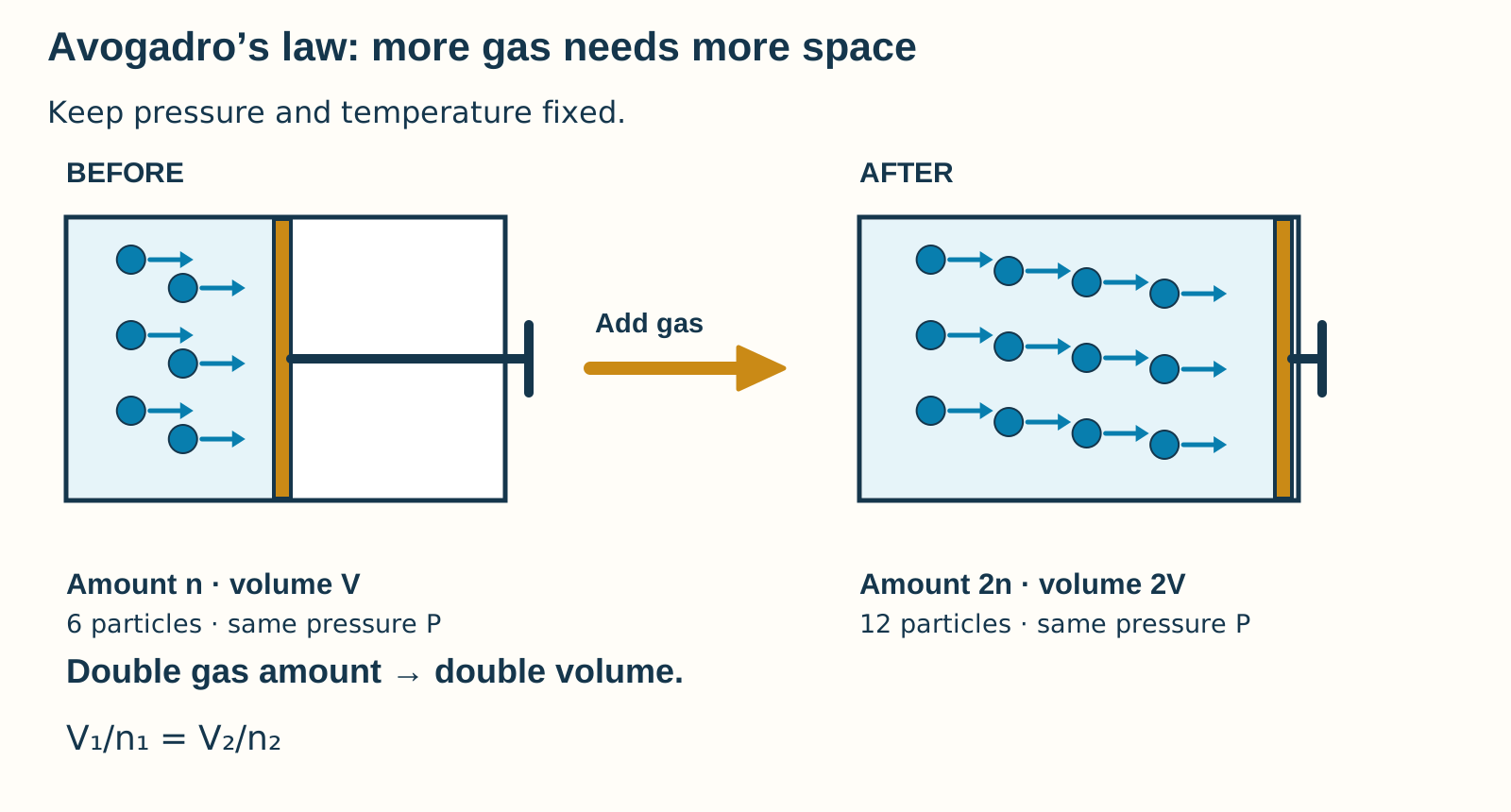
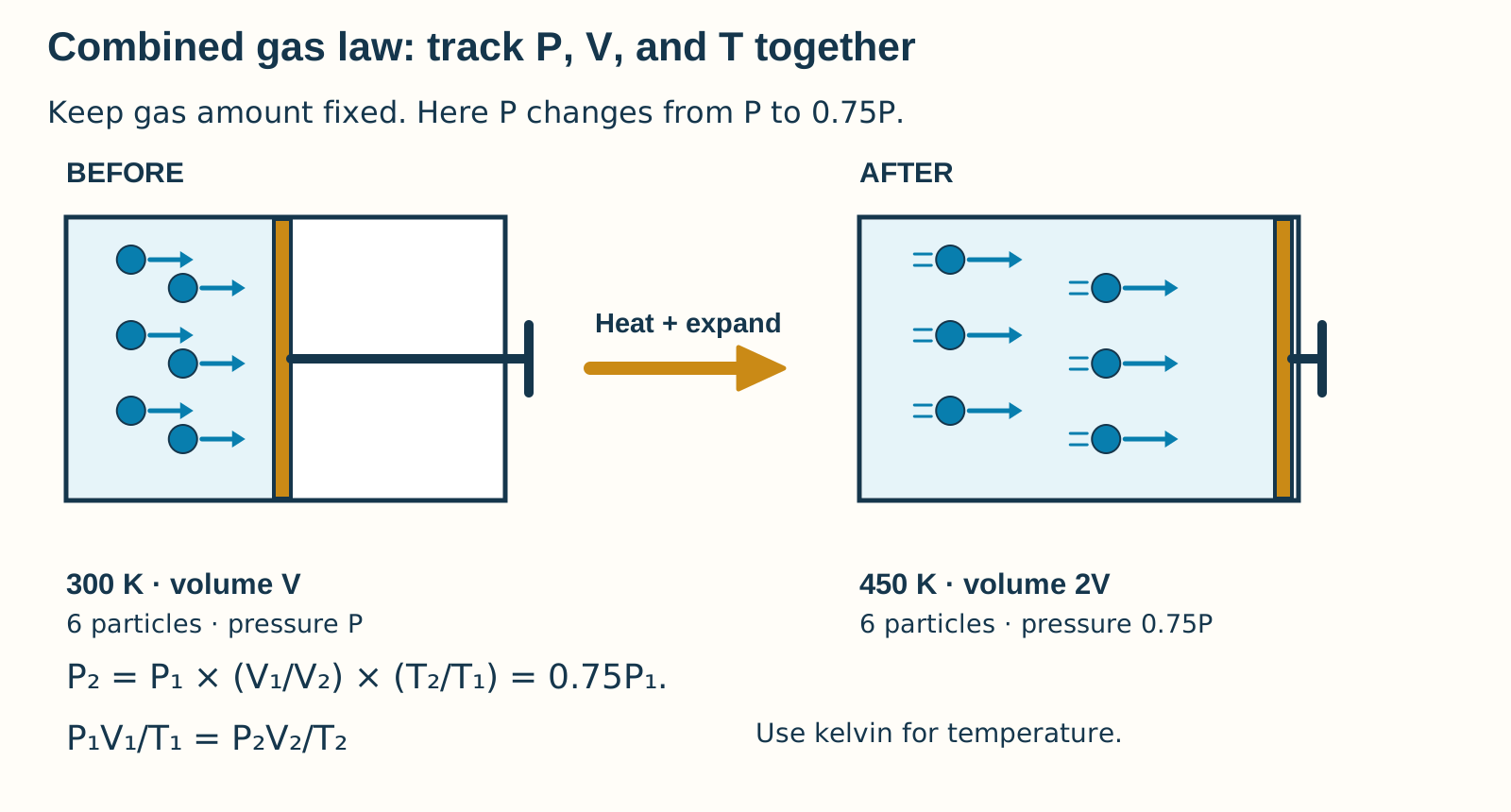
- Particles are tiny compared with the space between them.
- They move randomly in straight lines and bounce off each other and the walls.
- Kelvin temperature is proportional to their average kinetic energy (energy of motion, KE = ½mv2).
- Hotter means faster particles. They hit the walls harder and more often.
- So heating raises pressure at fixed volume, or makes the gas expand at fixed pressure.
| Quantity | Conversion |
|---|---|
| Temperature | K = °C + 273.15 |
| Pressure | 1 atm = 101.325 kPa = 760 mmHg (torr) |
| Pressure | 1 kPa = 1000 Pa |
- Identify what stays constant.
- Predict the direction: will the unknown go up or down?
- Convert temperature to kelvin and match units.
- Solve the matching law and check against your prediction.
On the periodic table: Oxygen is atomic number 8, mass 16.00 (an average, not an isotope’s mass number).
On the periodic table: O2 is two O atoms per molecule; it stays oxygen when compressed.
On the periodic table: The fixed conditions, not periodic-table position, choose the law. Use supplied masses when given.
A gas occupies 4.0 L at 1.0 atm. At fixed temperature and amount, it is compressed to 2.0 L. Find the pressure.
- 1Identify what stays fixed
T and n are fixed: Boyle’s law. No molar mass needed.
Pressure Volume Start (1) 1.0 atm 4.0 L End (2) ? 2.0 L Fixed: T and n → P1V1 = P2V2 - 2Predict the direction
The same particles get half the space, so pressure must rise.
V: 4.0 L → 2.0 L (halved) ⇒ P goes up - 3Solve for final pressure
Divide the starting pressure-volume product by the final volume.
P1V1 = P2V2 ⇒ P2 = P1V1V2 - 4Calculate
Liters cancel, leaving atm. Halving the volume doubles the pressure.
P2 = (1.0 atm)(4.0L)2.0L= 2.0 atm - ✓Answer
P2 = 2.0 atm
9.2 Using the ideal gas equation
PV = nRT links a gas’s pressure, volume, amount and temperature. Know three and you can find the fourth, if the units match R. At STP it gives a handy shortcut: about 22.4 L per mole.
- Moles (Chapter 4), unit conversions, and rearranging equations (Math first).
Need a refresher? Open the table of contents and revisit that topic before starting.
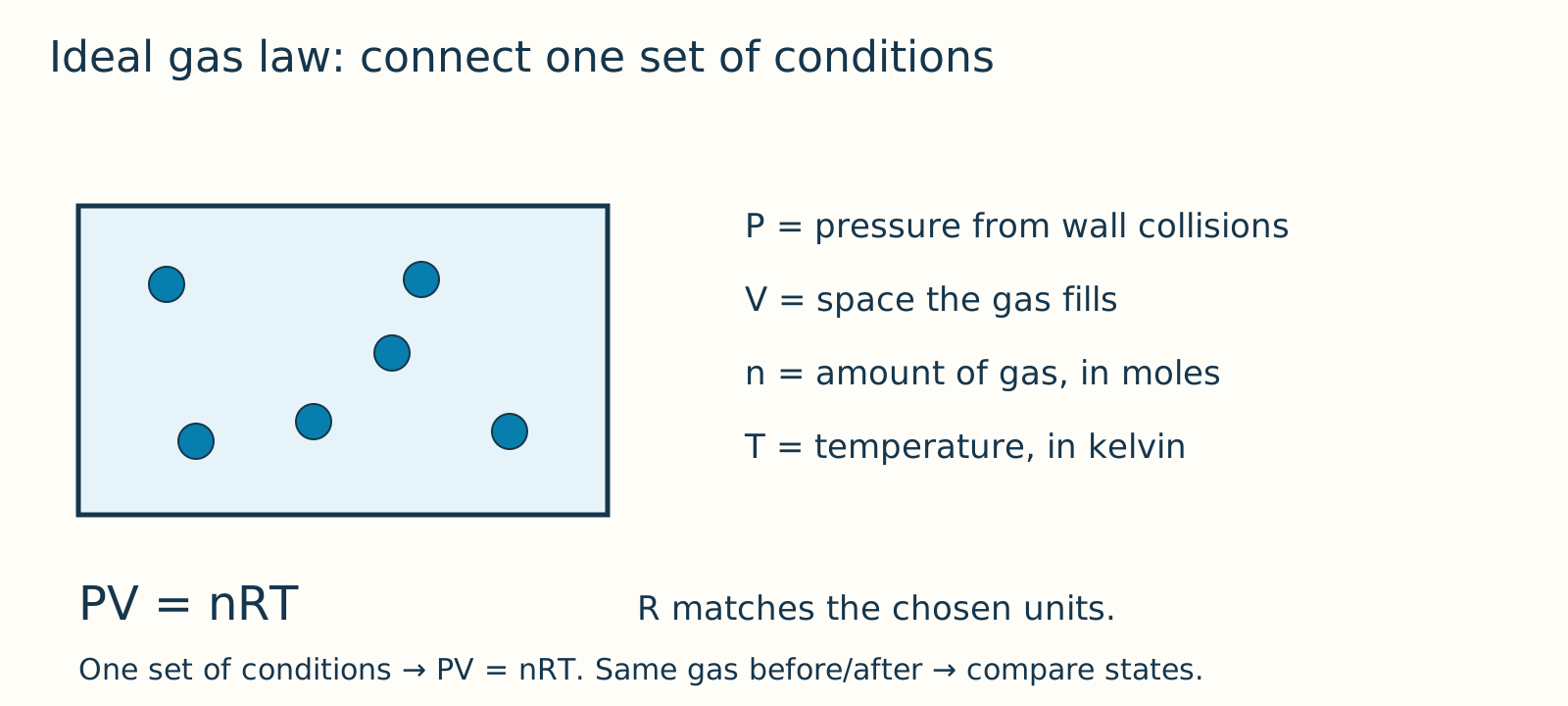
| R value | Pressure | Volume | Amount | Temperature |
|---|---|---|---|---|
| 0.08206 L·atm/(mol·K) | atm | L | mol | K |
| 8.314 J/(mol·K) | Pa | m3 | mol | K |
| If you are given | Convert with | To get |
|---|---|---|
| °C | + 273.15 | K |
| kPa or mmHg | 1 atm = 101.325 kPa = 760 mmHg | atm |
| mL | 1 L = 1000 mL | L |
| grams of gas | ÷ molar mass (g/mol) | mol |
- STP (standard temperature and pressure) means 0 °C (273.15 K) and 1 atm.
- At STP, one mole of any ideal gas fills about 22.4 L: its molar volume.
- Some books define STP with 1 bar, which gives 22.7 L/mol. Use your course’s value.
- Away from STP, go back to PV = nRT.
- It ignores particle volume and attractions.
- Best at low pressure and high temperature.
- Identify the unknown.
- Match units to R; convert P, V or mass as needed.
- Use kelvin temperature.
- Rearrange PV = nRT, substitute and cancel units.
- At STP, you may use 22.4 L/mol instead.
On the periodic table: Each element’s decimal mass is its molar mass in g/mol: N is 14.01, so N2 is 2 × 14.01 = 28.02 g/mol.
On the periodic table: If gas mass is given, n = grams ÷ molar mass. If n is supplied, skip this step.
On the periodic table: O2 = 2 × 16.00 = 32.00 g/mol (O is 16.00 on the table).
Find the volume of 0.500 mol of ideal gas at 300.0 K and 1.00 atm. Use R = 0.08206 L·atm/(mol·K).
- 1Check the units
All units match R, so V comes out in liters. n is given; skip the mass step.
Quantity Value Matches R? n 0.500 mol yes T 300.0 K yes, already kelvin P 1.00 atm yes V ? will be in L - 2Solve for volume
Divide both sides by P.
PV = nRTV = nRTP - 3Insert the values
mol, K and atm cancel, leaving L.
V = (0.500mol)(0.08206 L·atm/(mol·K))(300.0K)1.00atm - 4Calculate and round
0.500 and 1.00 have three significant figures, so round to three.
V = 12.309 L ≈ 12.3 L - ✓Answer
V ≈ 12.3 L
How many liters does 0.500 mol of O2 gas take up at STP? How many grams is that?
- 1Recognize STP
STP fixes T and P, so the molar volume applies.
Quantity Value n 0.500 mol T 273.15 K (0 °C) P 1 atm Molar volume 22.4 L/mol - 2Moles → liters
Each mole of gas at STP fills 22.4 L.
0.500mol× 22.4 L1mol= 11.2 L - 3Confirm with PV = nRT
The full equation gives the same answer.
V = (0.500)(0.08206)(273.15)1 LV = 11.207 L ≈ 11.2 L - 4Moles → grams
O2 is 2 × 16.00 = 32.00 g/mol.
0.500mol× 32.00 g1mol= 16.0 g - 5Line up the amounts
One amount, three units.
Moles Liters at STP Grams 0.500 mol 11.2 L 16.0 g - ✓Answer
11.2 L and 16.0 g O2
9.3 Partial pressure: each gas contributes to the total
Each gas in a mixture adds its own partial pressure to the total. Its share of the moles is its share of the pressure.
- Moles and fractions (Chapter 4 and Math first).
Need a refresher? Open the table of contents and revisit that topic before starting.
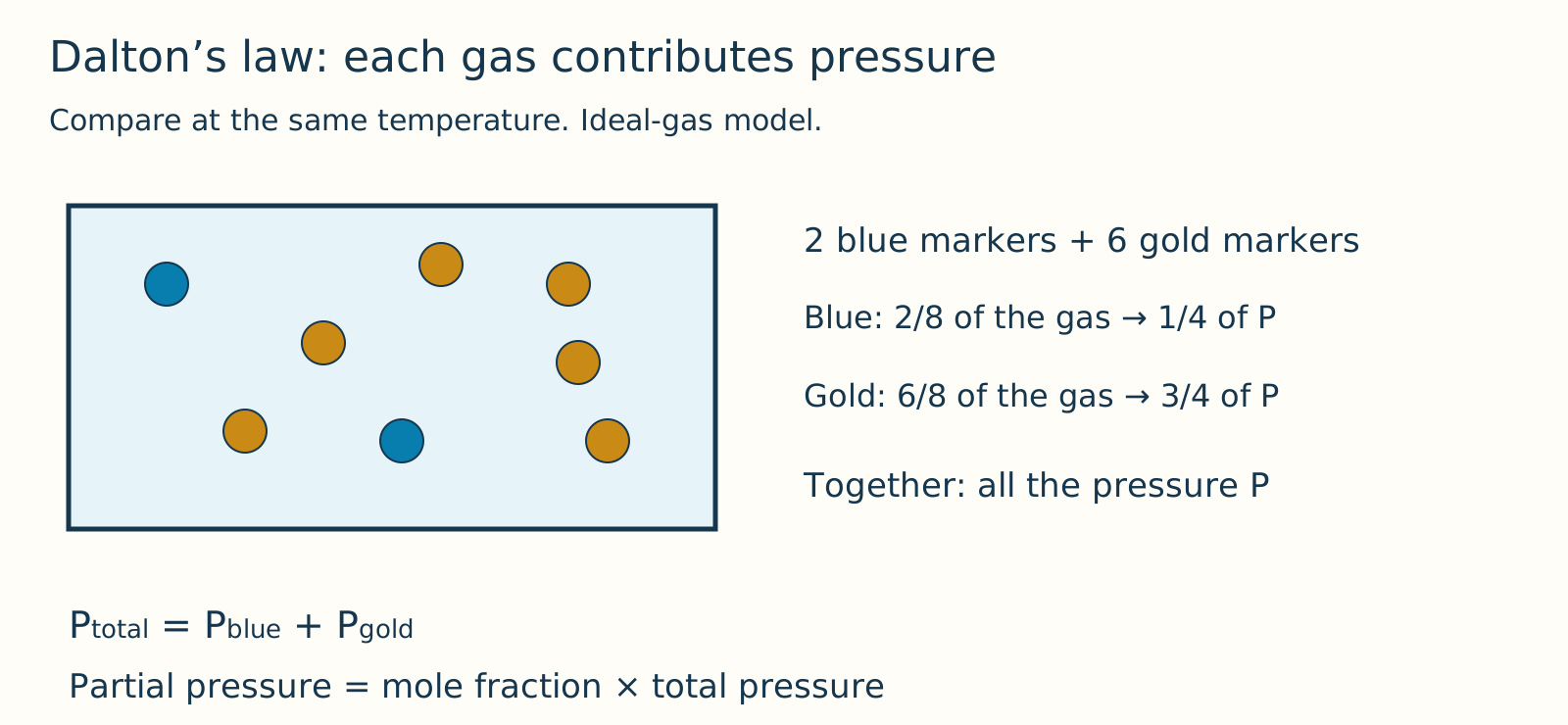
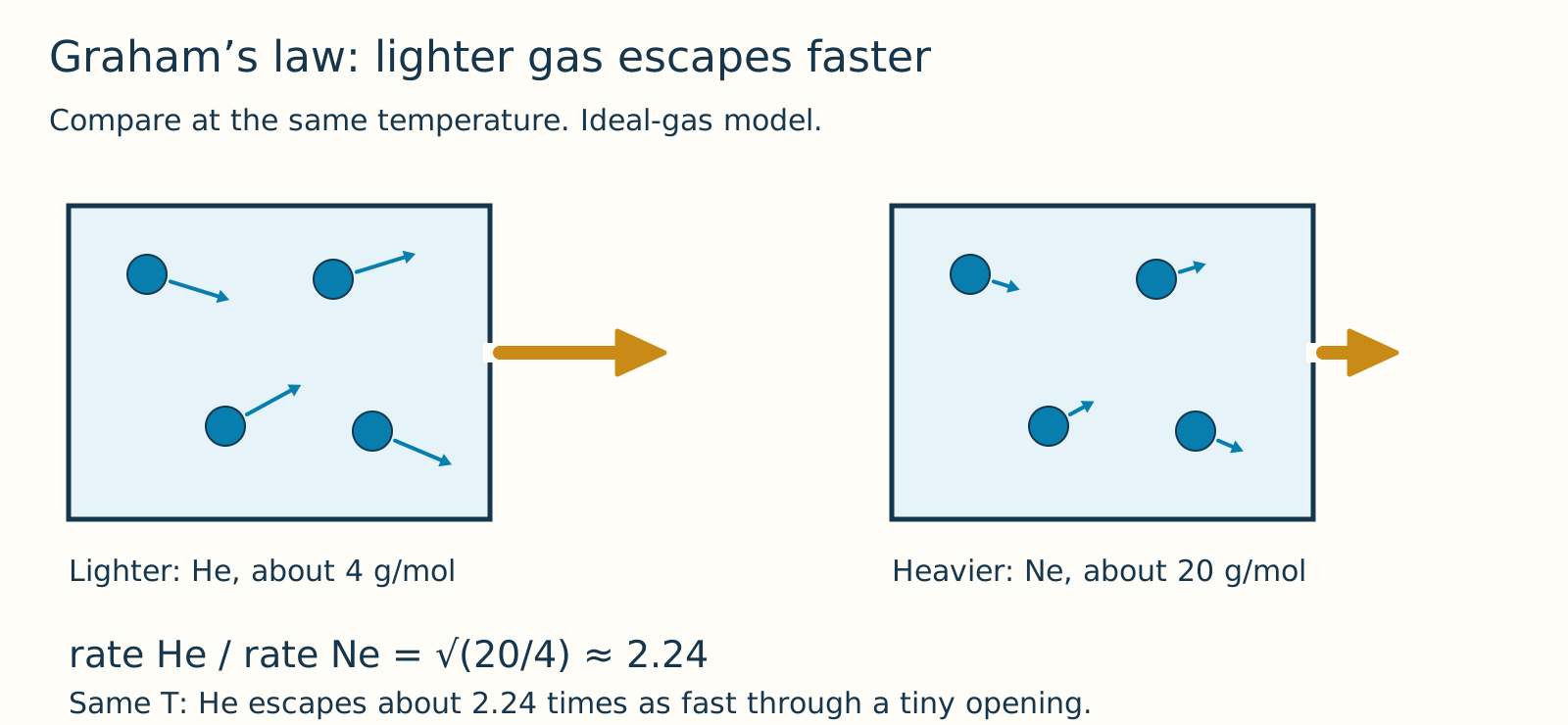
- At the same temperature, all gases have the same average translational kinetic energy, so lighter particles move faster on average.
- Effusion means escaping through a tiny opening.
- Predict first: the lighter gas escapes faster. This is a different question from finding a partial pressure.
- Convert each gas to moles if masses are given.
- Add the moles to get ntotal.
- Find each mole fraction: nA ÷ ntotal.
- Multiply by Ptotal; check the parts add to the total.
On the periodic table: N is 14.01 and O is 16.00: N2 ≈ 28.02 g/mol, O2 ≈ 32.00 g/mol.
On the periodic table: Given masses? Divide each gas’s grams by its molar mass. Use supplied masses when given.
On the periodic table: Read each gas’s molar mass from the decimal numbers in the element boxes: helium (He) is about 4 g/mol and neon (Ne) about 20 g/mol, so helium escapes faster.
A mixture has 2.0 mol gas A and 6.0 mol gas B at 4.0 atm total. Find each partial pressure.
- 1Find total moles
Add both gases.
ntotal = 2.0 mol + 6.0 mol = 8.0 mol - 2Find each partial pressure
Multiply each mole fraction by the total pressure.
PA = 2.0mol8.0mol× 4.0 atm = 1.0 atmPB = 6.0mol8.0mol× 4.0 atm = 3.0 atm - 3Check the sum
The parts add back to the total.
1.0 atm + 3.0 atm = 4.0 atm ✓ - ✓Answer
PA = 1.0 atm, PB = 3.0 atm
A mixture has 1 mol gas A and 3 mol gas B at 2.0 atm total. Find each partial pressure.
- 1Find total moles
The whole mixture is the denominator. A and B are labels, not element symbols.
ntotal = 1 mol + 3 mol = 4 mol - 2Find A’s mole fraction
Gas A supplies one quarter of the particles.
xA = 1mol4mol= 0.25 - 3Find A’s partial pressure
For an ideal mixture, multiply mole fraction by total pressure.
PA = 0.25 × 2.0 atm = 0.50 atm - 4Find B and check the sum
Both partial pressures add back to the total.
Gas Moles Mole fraction Partial pressure A 1 1/4 = 0.25 0.50 atm B 3 3/4 = 0.75 1.5 atm Total 4 1 2.0 atm - ✓Answer
A contributes 0.50 atm and B contributes 1.5 atm.
Section practice · 10 questions · tap to open
What this set is for: practicing the method from this section while it’s fresh. Every problem uses only what this section has taught.
Practice 1
Gas A contributes 0.40 atm and gas B contributes 0.60 atm. Find total pressure.
Give me a hint
Add partial pressures.
Check the answer
Answer: 1.00 atm
Explain the worked problem to me
What you know: PA = 0.40 atm and PB = 0.60 atm. What you want: the total pressure.
- Each gas pushes on the walls on its own. Dalton’s law says the total is the sum of the partial pressures.
- Both values are in atm, so add them directly: Ptotal = 0.40 atm + 0.60 atm = 1.00 atm. Both values have two decimal places, so the sum keeps two: 1.00.
Check: The total must be bigger than either part. 1.00 atm is bigger than 0.60 atm.
That’s right: 1.00 atm
Practice 2
Total pressure is 1.50 atm. A contributes 0.35 atm. Find B’s pressure.
Give me a hint
Subtract the known contribution from the total.
Check the answer
Answer: 1.15 atm
Explain the worked problem to me
What you know: Ptotal = 1.50 atm and PA = 0.35 atm. What you want: PB.
- Dalton’s law: Ptotal = PA + PB.
- Rearrange to isolate B: PB = Ptotal − PA.
- Substitute: PB = 1.50 atm − 0.35 atm = 1.15 atm.
Check: Add the parts back: 0.35 atm + 1.15 atm = 1.50 atm, the total.
That’s right: 1.15 atm
Practice 3
A mixture has 1.0 mol A and 3.0 mol B at 2.0 atm. Find A’s pressure.
Give me a hint
Use A’s fraction of all the moles.
Check the answer
Answer: 0.50 atm
Explain the worked problem to me
What you know: nA = 1.0 mol, nB = 3.0 mol, Ptotal = 2.0 atm. What you want: PA.
- Find total moles: 1.0 mol + 3.0 mol = 4.0 mol.
- Find A’s mole fraction: xA = 1.0 mol ÷ 4.0 mol = 0.25. The mol units cancel, so xA has no unit.
- Partial pressure = mole fraction × total pressure: PA = 0.25 × 2.0 atm = 0.50 atm.
Check: A is one quarter of the particles, and 0.50 atm is one quarter of 2.0 atm.
Watch out: Divide by the total moles (4.0), not by B’s moles (3.0).
That’s right: 0.50 atm
Practice 4
A mixture has 1.0 mol A and 3.0 mol B at 2.0 atm. Find B’s pressure.
Give me a hint
B has three quarters of the moles.
Check the answer
Answer: 1.5 atm
Explain the worked problem to me
What you know: nA = 1.0 mol, nB = 3.0 mol, Ptotal = 2.0 atm. What you want: PB.
- Total moles = 1.0 mol + 3.0 mol = 4.0 mol.
- B’s mole fraction: xB = 3.0 mol ÷ 4.0 mol = 0.75.
- PB = xB × Ptotal = 0.75 × 2.0 atm = 1.5 atm. The 2.0 atm has two significant figures, so the answer has two.
Check: A has the other 0.25 of the moles, so PA = 0.25 × 2.0 atm = 0.50 atm. Dalton’s law: PA + PB = 0.50 atm + 1.5 atm = 2.0 atm, the total. You could also find PB by subtraction: 2.0 − 0.50 = 1.5 atm.
That’s right: 1.5 atm
Practice 5
A mixture has 2.0 mol A and 2.0 mol B at 3.0 atm. Find each partial pressure.
Give me a hint
Equal mole counts give equal pressure contributions.
Check the answer
Answer: 1.5 atm each
Explain the worked problem to me
What you know: nA = 2.0 mol, nB = 2.0 mol, Ptotal = 3.0 atm. What you want: PA and PB.
- Total moles = 2.0 mol + 2.0 mol = 4.0 mol.
- Each mole fraction: x = 2.0 mol ÷ 4.0 mol = 0.50. Equal moles mean equal shares of the particles.
- Each partial pressure: P = 0.50 × 3.0 atm = 1.5 atm each.
Check: 1.5 atm + 1.5 atm = 3.0 atm, the total.
That’s right: 1.5 atm each
Practice 6
A gas has mole fraction 0.20. Total pressure is 5.0 atm. Find its partial pressure.
Give me a hint
Multiply the fraction by total pressure.
Check the answer
Answer: 1.0 atm
Explain the worked problem to me
What you know: x = 0.20 and Ptotal = 5.0 atm. What you want: the gas’s partial pressure.
- The mole fraction is already given, so skip counting moles.
- Partial pressure = mole fraction × total pressure: P = 0.20 × 5.0 atm = 1.0 atm. Both values have two significant figures, so the answer has two.
Check: 0.20 is one fifth, and one fifth of 5.0 atm is 1.0 atm.
That’s right: 1.0 atm
Practice 7
A gas contributes 0.75 atm to a total of 3.0 atm. Find its mole fraction.
Give me a hint
Divide its pressure by total pressure.
Check the answer
Answer: 0.25
Explain the worked problem to me
What you know: Pgas = 0.75 atm and Ptotal = 3.0 atm. What you want: the mole fraction x.
- Start from Pgas = x × Ptotal. Divide both sides by Ptotal to isolate x: x = Pgas ÷ Ptotal.
- Substitute: x = 0.75 atm ÷ 3.0 atm = 0.25. The atm units cancel, so the answer has no unit.
Check: 0.25 × 3.0 atm = 0.75 atm. Also, a mole fraction must be between 0 and 1, and 0.25 is.
Watch out: Don’t write a pressure unit on a mole fraction. It is a pure fraction.
That’s right: 0.25
Practice 8
A, B, and C contribute 120, 230, and 150 kPa. Find total pressure.
Give me a hint
Add all three contributions.
Check the answer
Answer: 500 kPa
Explain the worked problem to me
What you know: PA = 120 kPa, PB = 230 kPa, PC = 150 kPa. What you want: Ptotal.
- Dalton’s law works for any number of gases: add every partial pressure.
- All three are already in kPa, so add directly: 120 kPa + 230 kPa + 150 kPa = 500 kPa.
Check: Group easy pairs: 120 + 230 = 350, then 350 + 150 = 500.
Watch out: If the parts were in different units (say atm and kPa), you would convert first. Here they match.
That’s right: 500 kPa
Practice 9
In an ideal mixture, A has 2 mol and B has 6 mol. Which contributes more pressure?
Give me a hint
Compare moles, not grams or molecular mass.
Check the answer
Answer: B
Explain the worked problem to me
What you know: nA = 2 mol and nB = 6 mol in the same ideal mixture. What you want: which gas contributes more pressure.
- In an ideal mixture, partial pressure = mole fraction × total pressure. So pressure share follows mole share.
- Total moles = 8 mol. xA = 2/8 = 0.25 and xB = 6/8 = 0.75.
- B has three times the moles, so it pushes with three times A’s pressure. The answer is B.
Why it matters: Pressure comes from the number of particles hitting the walls, not their mass.
Watch out: Don’t pick the heavier gas. Compare moles, not grams or molar mass.
That’s right: B
Practice 10
Gas is collected over water. Total pressure is 100.0 kPa; water vapor contributes 3.2 kPa. Find dry-gas pressure.
Give me a hint
Subtract the water-vapor contribution.
Check the answer
Answer: 96.8 kPa
Explain the worked problem to me
What you know: Ptotal = 100.0 kPa and Pwater = 3.2 kPa. What you want: the dry-gas pressure.
- Gas collected over water picks up water vapor. The measured total is gas plus water vapor: Ptotal = Pgas + Pwater.
- Rearrange: Pgas = Ptotal − Pwater.
- Substitute: Pgas = 100.0 kPa − 3.2 kPa = 96.8 kPa. Both values have one decimal place, so the answer keeps one.
Check: 96.8 kPa + 3.2 kPa = 100.0 kPa.
Watch out: Don’t add the water vapor. It is already inside the measured total.
That’s right: 96.8 kPa
9.4 Phase changes use a different heat route
Heat either warms a substance or changes its phase (solid, liquid, gas). Each job has its own equation.
- Heat signs (7.1), moles (Chapter 4), and conversion factors (Math first).
- Heat for a temperature change: q = m × c × ΔT (7.2).
Need a refresher? Open the table of contents and revisit that topic before starting.
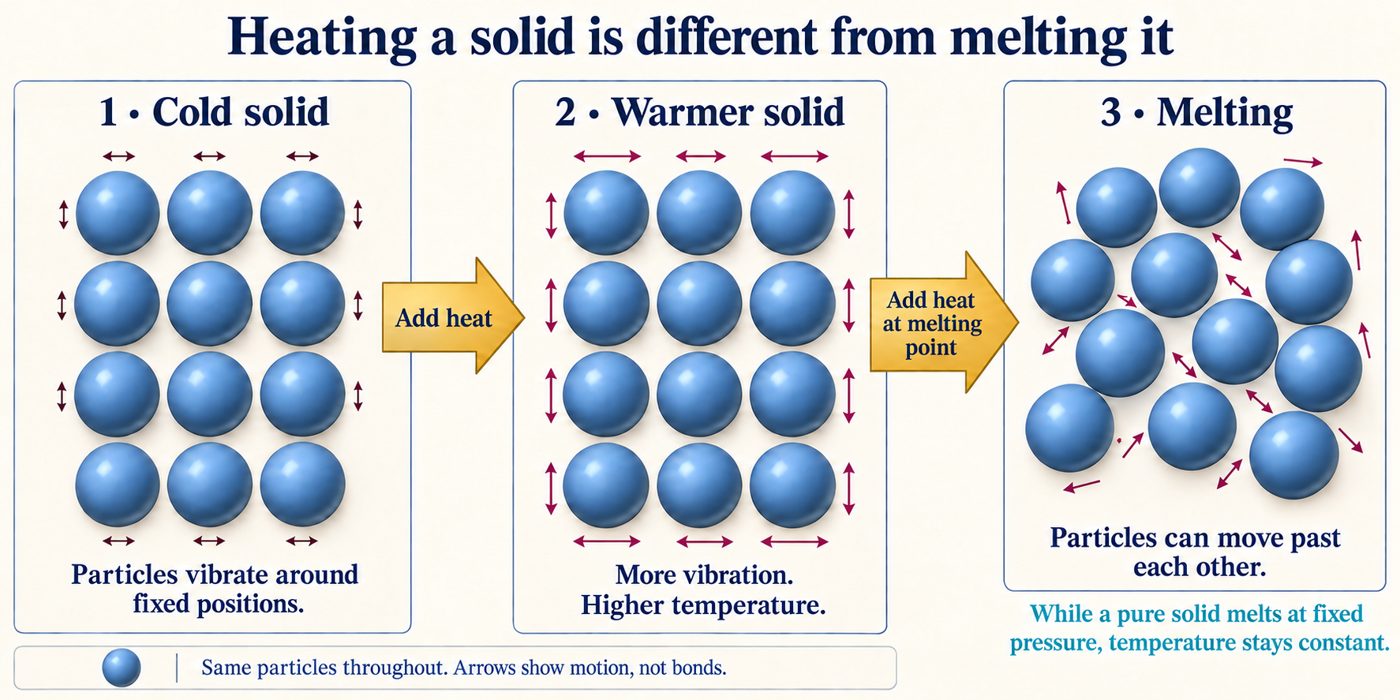
Temperature rises or falls.
q = m × heat per gram (per mass, e.g. J/g or kJ/kg)
Temperature stays constant.
| Change | From → to | Heat | Sign of q |
|---|---|---|---|
| Melting (fusion) | solid → liquid | absorbed | + |
| Vaporization | liquid → gas | absorbed | + |
| Freezing | liquid → solid | released | − |
| Condensation | gas → liquid | released | − |
- Decide: temperature change in one phase, or a phase change?
- One phase: q = mcΔT. Phase change: q = nΔH.
- Convert grams to moles if ΔH is per mole.
- For several stages, calculate each q and add them; check the sign.
On the periodic table: H is atomic number 1, mass 1.008; O is 16.00.
On the periodic table: Ice, water and vapor are all H2O: 2 × 1.008 + 16.00 = 18.02 g/mol, to turn grams of water into moles.
On the periodic table: Fusion and vaporization enthalpies come from phase-change data, not from the periodic table.
Melt 2.0 mol of a solid at its melting point. Its fusion enthalpy is 6.0 kJ/mol. Find the heat required.
- 1Identify the kind of change
Solid → liquid at the melting point: a phase change, not a temperature rise. Use the fusion enthalpy.
Given Value Change solid → liquid (melting) n 2.0 mol ΔHfusion 6.0 kJ/mol q ? The substance is unspecified, so no periodic-table mass is needed. - 2Write the phase-change relationship
Multiply the amount by the energy needed per mole.
q = n × ΔHfusion - 3Calculate
Moles cancel, leaving kilojoules.
q = 2.0mol× 6.0 kJ1mol= 12 kJ - 4Check the sign
Heat enters the melting solid, so q is positive, even though temperature stays constant.
melting absorbs heat ⇒ q = +12 kJ - ✓Answer
q = +12 kJ
Mixed chapter review
Answer in your notebook before revealing help. Keep your first attempt separate from an answer corrected with help.
Mixed chapter review · 16 questions · tap to open
What this set is for: problems from every section of the chapter, mixed together and not labeled, the way a test asks them. Your job is to pick the right method yourself. Do this before the skill check.
Practice 1
A gas at 2.0 atm occupies 9.0 L. At fixed temperature and amount, volume becomes 18.0 L. What is pressure?
Give me a hint
Temperature and amount are fixed while volume changes.
Check the answer
Answer: 1.0 atm
Explain the worked problem to me
What you know: P1 = 2.0 atm, V1 = 9.0 L, V2 = 18.0 L; T and n fixed. What you want: P2.
- Fixed T and n means Boyle’s law: P1V1 = P2V2.
- Divide both sides by V2: P2 = P1V1 ÷ V2.
- Substitute: P2 = 2.0 atm × 9.0 L ÷ 18.0 L. The L units cancel. 9.0 ÷ 18.0 = 0.500, so P2 = 2.0 atm × 0.500 = 1.0 atm.
Check: Volume doubled, so pressure should halve. Half of 2.0 atm is 1.0 atm.
Your route: Fixed T and n → P1V1 = P2V2.
That’s right: 1.0 atm
Practice 2
A gas at 2.0 atm occupies 10.0 L. At fixed temperature and amount, volume becomes 20.0 L. What is pressure?
Give me a hint
Temperature and amount are fixed while volume changes.
Check the answer
Answer: 1.0 atm
Explain the worked problem to me
What you know: P1 = 2.0 atm, V1 = 10.0 L, V2 = 20.0 L; T and n fixed. What you want: P2.
- Fixed T and n means Boyle’s law: P1V1 = P2V2.
- Divide both sides by V2: P2 = P1V1 ÷ V2.
- Substitute: P2 = 2.0 atm × 10.0 L ÷ 20.0 L = 20 atm·L ÷ 20.0 L = 1.0 atm. The L units cancel.
Check: Volume doubled, so pressure halves. Bigger volume, lower pressure, as Boyle’s law predicts.
Your route: Fixed T and n → P1V1 = P2V2.
That’s right: 1.0 atm
Practice 3
At fixed pressure and amount, a gas volume is 9.00 L at 300 K. What is volume at 450 K?
Give me a hint
Temperature changes at fixed pressure and amount.
Check the answer
Answer: 13.5 L
Explain the worked problem to me
What you know: V1 = 9.00 L, T1 = 300 K, T2 = 450 K; P and n fixed. What you want: V2.
- Fixed P and n means Charles’s law: V1/T1 = V2/T2. Both temperatures are already in kelvin.
- Multiply both sides by T2: V2 = V1 × T2/T1.
- Substitute: V2 = 9.00 L × 450 K/300 K = 9.00 L × 1.5 = 13.5 L. The K units cancel.
Check: Temperature rose, so volume should grow. 13.5 L is more than 9.00 L.
Watch out: Put the new temperature on top. Using 300/450 would shrink the volume, the wrong direction.
Your route: Fixed P and n → V/T constant.
That’s right: 13.5 L
Practice 4
At fixed pressure and amount, a gas volume is 10.0 L at 300 K. What is volume at 450 K?
Give me a hint
Temperature changes at fixed pressure and amount.
Check the answer
Answer: 15.0 L
Explain the worked problem to me
What you know: V1 = 10.0 L, T1 = 300 K, T2 = 450 K; P and n fixed. What you want: V2.
- Fixed P and n means Charles’s law: V1/T1 = V2/T2. Both temperatures are in kelvin.
- Isolate V2: V2 = V1 × T2/T1.
- Substitute: V2 = 10.0 L × 450 K/300 K = 10.0 L × 1.5 = 15.0 L. The K units cancel.
Check: The kelvin temperature went up by a factor of 1.5, so the volume does too. Warmer gas takes more space.
Your route: Fixed P and n → V/T constant.
That’s right: 15.0 L
Practice 5
A rigid sealed gas container has pressure 0.80 atm at 200 K. What pressure does it reach at 400 K?
Give me a hint
A rigid sealed container fixes volume and amount.
Check the answer
Answer: 1.6 atm
Explain the worked problem to me
What you know: P1 = 0.80 atm, T1 = 200 K, T2 = 400 K. A rigid sealed can fixes V and n. What you want: P2.
- Fixed V and n means Gay-Lussac’s law: P1/T1 = P2/T2.
- Isolate P2: P2 = P1 × T2/T1.
- Substitute: P2 = 0.80 atm × 400 K/200 K = 0.80 atm × 2 = 1.6 atm. The K units cancel.
Check: Kelvin temperature doubled, so pressure doubles. Hotter gas in a fixed box pushes harder.
Watch out: Read the clue words. Rigid means the volume cannot change, so this is not Boyle’s or Charles’s law.
Your route: Fixed V and n → P/T constant.
That’s right: 1.6 atm
Practice 6
Rounded to two decimal places for this arithmetic drill, what is the volume for 1.2 mol ideal gas at 300 K and 1.00 atm? Use R = 0.08206 L·atm/(mol·K).
Give me a hint
Moles, pressure, and kelvin temperature are supplied.
Check the answer
Answer: 29.54 L
Explain the worked problem to me
What you know: n = 1.2 mol, T = 300 K, P = 1.00 atm, R = 0.08206 L·atm/(mol·K). What you want: V.
- One gas in one state, so use the ideal gas law: PV = nRT.
- Divide both sides by P: V = nRT/P.
- Substitute: V = 1.2 mol × 0.08206 L·atm/(mol·K) × 300 K ÷ 1.00 atm. The mol, K and atm units cancel, leaving L.
- Multiply: 1.2 × 0.08206 = 0.098472; × 300 = 29.5416. Rounded to two decimal places as the drill asks: 29.54 L.
Check: One mole at these conditions is about 24.6 L. 1.2 mol should be 1.2 × 24.6 ≈ 29.5 L. It matches.
Your route: One state → Rearrange PV = nRT.
That’s right: 29.54 L
Practice 7
Rounded to two decimal places for this arithmetic drill, what is the volume for 1.4 mol ideal gas at 300 K and 1.00 atm? Use R = 0.08206 L·atm/(mol·K).
Give me a hint
Moles, pressure, and kelvin temperature are supplied.
Check the answer
Answer: 34.47 L
Explain the worked problem to me
What you know: n = 1.4 mol, T = 300 K, P = 1.00 atm, R = 0.08206 L·atm/(mol·K). What you want: V.
- One gas in one state, so use PV = nRT.
- Divide both sides by P: V = nRT/P.
- Substitute: V = 1.4 mol × 0.08206 L·atm/(mol·K) × 300 K ÷ 1.00 atm. The mol, K and atm units cancel, leaving L.
- Multiply: 1.4 × 0.08206 = 0.114884; × 300 = 34.4652. Rounded to two decimal places as the drill asks: 34.47 L.
Check: About 24.6 L per mole here, so 1.4 × 24.6 ≈ 34.4 L. Close match.
Watch out: R’s units decide the other units. With 0.08206, use L, atm, mol and K.
Your route: One state → Rearrange PV = nRT.
That’s right: 34.47 L
Practice 8
Before using a gas law, convert 100°C to its absolute temperature. What is the value in kelvin?
Give me a hint
A gas-law temperature scale is asked.
Check the answer
Answer: 373.15 K
Explain the worked problem to me
What you know: T = 100°C. What you want: the same temperature in kelvin.
- Gas laws need an absolute scale, kelvin. Kelvin starts at absolute zero, so ratios like V/T make sense. Celsius ratios do not.
- Use K = °C + 273.15.
- Substitute: T = 100 + 273.15 = 373.15 K.
Check: A kelvin value is always 273.15 larger than the Celsius value, and it is never negative.
Watch out: Don’t subtract 273.15. That direction goes from kelvin to Celsius.
Your route: Convert Celsius → Kelvin before gas calculation.
That’s right: 373.15 K
Practice 9
Two gases have partial pressures 1.8 atm and 4.2 atm. What is total pressure?
Give me a hint
Partial pressures are listed.
Check the answer
Answer: 6.0 atm
Explain the worked problem to me
What you know: partial pressures 1.8 atm and 4.2 atm. What you want: Ptotal.
- For a gas mixture, Dalton’s law says the total pressure is the sum of the partial pressures.
- Both are in atm, so add: Ptotal = 1.8 atm + 4.2 atm = 6.0 atm. Both have one decimal place, so keep one: 6.0, not 6.
Check: 6.0 − 1.8 = 4.2, the other part.
Your route: Mixture → Add partial pressures.
That’s right: 6.0 atm
Practice 10
Two gases have partial pressures 2.1 atm and 4.9 atm. What is total pressure?
Give me a hint
Partial pressures are listed.
Check the answer
Answer: 7.0 atm
Explain the worked problem to me
What you know: partial pressures 2.1 atm and 4.9 atm. What you want: Ptotal.
- For a gas mixture, Dalton’s law says add the partial pressures.
- Both are in atm: Ptotal = 2.1 atm + 4.9 atm = 7.0 atm. One decimal place in each, so keep one: 7.0.
Check: The total is larger than either part, and 7.0 − 2.1 = 4.9.
Your route: Mixture → Add partial pressures.
That’s right: 7.0 atm
Practice 11
A mixture contains 6 mol gas A and 18 mol gas B at 4.0 atm total. What is A’s partial pressure?
Give me a hint
Mixture mole amounts and total pressure are given.
Check the answer
Answer: 1.0 atm
Explain the worked problem to me
What you know: nA = 6 mol, nB = 18 mol, Ptotal = 4.0 atm. What you want: PA.
- Total moles = 6 mol + 18 mol = 24 mol.
- A’s mole fraction: xA = 6 mol ÷ 24 mol = 0.25. The mol units cancel.
- PA = xA × Ptotal = 0.25 × 4.0 atm = 1.0 atm.
Check: B’s pressure is 0.75 × 4.0 = 3.0 atm, and 1.0 + 3.0 = 4.0 atm, the total.
Watch out: Use the total moles (24), not B’s moles (18), on the bottom of the fraction.
Your route: Mole fraction → Multiply total pressure.
That’s right: 1.0 atm
Practice 12
A mixture contains 7 mol gas A and 21 mol gas B at 4.0 atm total. What is A’s partial pressure?
Give me a hint
Mixture mole amounts and total pressure are given.
Check the answer
Answer: 1.0 atm
Explain the worked problem to me
What you know: nA = 7 mol, nB = 21 mol, Ptotal = 4.0 atm. What you want: PA.
- Total moles = 7 mol + 21 mol = 28 mol.
- A’s mole fraction: xA = 7 mol ÷ 28 mol = 0.25.
- PA = xA × Ptotal = 0.25 × 4.0 atm = 1.0 atm.
Check: B has three times A’s moles, so B should have three times A’s pressure: 3.0 atm. 1.0 + 3.0 = 4.0 atm.
Your route: Mole fraction → Multiply total pressure.
That’s right: 1.0 atm
Practice 13
For equal-temperature ideal effusion, gas A has molar mass 4 and gas B 100 g/mol. What is rate A/rate B?
Give me a hint
Molar masses and effusion rates are compared.
Check the answer
Answer: 5
Explain the worked problem to me
What you know: MA = 4 g/mol, MB = 100 g/mol, same temperature. What you want: rate A ÷ rate B.
- Effusion at the same temperature uses Graham’s law: rate A/rate B = √(MB/MA). B’s molar mass goes on top, so the lighter gas has the larger rate.
- Substitute: rate A/rate B = √(100 g/mol ÷ 4 g/mol). The g/mol units cancel.
- 100 ÷ 4 = 25, and √25 = 5.
Check: A is the lighter gas, so it should escape faster. A ratio bigger than 1 agrees.
Watch out: Don’t forget the square root. A 25-fold mass difference gives only a 5-fold speed difference.
Your route: Lighter gas faster → Square root of inverse mass ratio.
That’s right: 5
Practice 14
Melting a solid takes 6.0 kJ/mol. How much heat is needed to melt 7 mol at its melting point?
Give me a hint
Amount and fusion enthalpy are given.
Check the answer
Answer: 42 kJ
Explain the worked problem to me
What you know: ΔHfusion = 6.0 kJ/mol and n = 7 mol, at the melting point. What you want: heat q.
- At the melting point, temperature stays constant while the solid melts. All the heat goes into the phase change, so use q = n × ΔHfusion.
- Substitute: q = 7 mol × 6.0 kJ/mol. The mol units cancel, leaving kJ.
- Multiply: q = 42 kJ. The value is positive because melting absorbs heat.
Check: 6.0 kJ for each mole, and 7 moles: 7 × 6 = 42.
Your route: Phase change at fixed temperature → q = nΔH.
That’s right: 42 kJ
Practice 15
Melting a solid takes 6.0 kJ/mol. How much heat is needed to melt 8 mol at its melting point?
Give me a hint
Amount and fusion enthalpy are given.
Check the answer
Answer: 48 kJ
Explain the worked problem to me
What you know: ΔHfusion = 6.0 kJ/mol and n = 8 mol, at the melting point. What you want: heat q.
- Melting at the melting point happens at fixed temperature, so use q = n × ΔHfusion. No temperature change is involved.
- Substitute: q = 8 mol × 6.0 kJ/mol. The mol units cancel, leaving kJ.
- Multiply: q = 48 kJ, positive because the solid absorbs heat to melt.
Check: 6.0 kJ for each mole, and 8 moles: 8 × 6.0 = 48 kJ.
Watch out: Don’t use a heat-capacity formula here. There is no temperature change during melting.
Your route: Phase change at fixed temperature → q = nΔH.
That’s right: 48 kJ
Practice 16
A sealed, rigid can of gas is heated. Explain in terms of particles why its pressure rises.
Give me a hint
What does a higher temperature do to particle speed?
Check the answer
Answer: The particles move faster, so they hit the walls harder and more often.
Explain the worked problem to me
What you know: the can is sealed (fixed n) and rigid (fixed V), and it is heated. What you want: a particle explanation of the pressure rise.
- Kinetic-molecular model: kelvin temperature is proportional to the particles’ average kinetic energy. Heating makes them move faster.
- Pressure comes from particles hitting the walls. Faster particles hit harder, and they reach the walls more often.
- The volume and the number of particles cannot change, so nothing offsets this. Therefore the particles move faster, so they hit the walls harder and more often, and the pressure rises.
Why it matters: This is the particle picture behind Gay-Lussac’s law: at fixed V and n, P/T stays constant.
Watch out: The particles do not get bigger or multiply. Only their speed changes.
That’s right: The particles move faster, so they hit the walls harder and more often.
Skill check: the chapter’s key skills
Try each fresh question without the worked examples. Record your first answer and whether you used a hint. Explain the route as well as the answer.
Skill check · 7 questions · tap to open
What this set is for: one question on each key skill from this chapter. Try each on your own, without hints, then mark how it went in the tracker below. A miss tells you which section to review.
Skill 1: Choose the gas law that fits what stays constant.
3.0 L at 2.0 atm expands to 6.0 L at fixed T and amount. Pressure?
Give me a hint
Choose the gas relation that matches what stays constant. Use kelvin for temperature, match units, and isolate the requested quantity.
Check the answer
P2 = 2.0 × 3.0/6.0 = 1.0 atm.
Explain the worked problem to me
What you know: V1 = 3.0 L, P1 = 2.0 atm, V2 = 6.0 L; T and n fixed. What you want: P2.
- T and n stay constant, so choose Boyle’s law: P1V1 = P2V2.
- Divide both sides by V2: P2 = P1V1 ÷ V2.
- Substitute: P2 = 2.0 atm × 3.0 L ÷ 6.0 L = 6.0 atm·L ÷ 6.0 L = 1.0 atm. The L units cancel.
Check: The gas expanded to twice the volume, so the pressure halves: 2.0 → 1.0 atm.
Watch out: Expansion lowers pressure. If your answer went up to 4.0 atm, you flipped the volume ratio.
That’s right: P2 = 2.0 × 3.0/6.0 = 1.0 atm.
Skill 2: Solve ideal-gas volume with matching units.
n = 1.00 mol, T = 300 K, P = 1.00 atm; R = 0.08206 L·atm/(mol·K). V?
Give me a hint
Rearrange PV = nRT to V = nRT/P. R = 0.08206 L·atm/(mol·K), so the units cancel to L.
Check the answer
V = nRT/P = 24.618 L, about 24.6 L.
Explain the worked problem to me
What you know: n = 1.00 mol, T = 300 K, P = 1.00 atm, R = 0.08206 L·atm/(mol·K). What you want: V.
- One gas in one state, so use PV = nRT. The units already match R: mol, K and atm.
- Divide both sides by P: V = nRT/P.
- Substitute: V = 1.00 mol × 0.08206 L·atm/(mol·K) × 300 K ÷ 1.00 atm. The mol, K and atm units cancel, leaving L.
- Multiply: 0.08206 × 300 = 24.618 L. The 1.00 mol and 1.00 atm carry three significant figures, so round to three: about 24.6 L.
Check: One mole of gas near room conditions fills roughly 24 to 25 L. 24.6 L fits.
Watch out: Temperature must be in kelvin. Using 27°C instead of 300 K would give a volume far too small.
That’s right: V = nRT/P = 24.618 L, about 24.6 L.
Skill 3: Calculate partial pressures from mole fractions.
Gas A is 1 of 5 total moles; total pressure 3.0 atm. A’s pressure?
Give me a hint
Find A’s mole fraction, then multiply it by the total pressure.
Check the answer
(1/5) × 3.0 = 0.60 atm.
Explain the worked problem to me
What you know: nA = 1 mol out of 5 mol total; Ptotal = 3.0 atm. What you want: PA.
- A’s mole fraction: xA = 1 mol ÷ 5 mol = 0.20. The mol units cancel.
- Partial pressure = mole fraction × total pressure: PA = (1/5) × 3.0 atm = 0.20 × 3.0 atm.
- Multiply: PA = 0.60 atm.
Check: The other gases hold 4/5 of the moles, so 0.80 × 3.0 = 2.4 atm. 0.60 + 2.4 = 3.0 atm, the total.
Watch out: The 5 mol is already the total. Don’t add 1 to it again.
That’s right: (1/5) × 3.0 = 0.60 atm.
Skill 4: Calculate phase-change heat from moles and enthalpy.
Melt 3.0 mol with fusion enthalpy 5.0 kJ/mol. Heat?
Give me a hint
Identify the requested heat quantity and the appropriate relation. Keep units consistent and check whether energy enters or leaves the stated system.
Check the answer
3.0 × 5.0 = +15 kJ; melting absorbs heat.
Explain the worked problem to me
What you know: n = 3.0 mol and ΔHfusion = 5.0 kJ/mol. What you want: heat q for melting.
- Melting is a phase change at fixed temperature, so use q = n × ΔHfusion.
- Substitute: q = 3.0 mol × 5.0 kJ/mol. The mol units cancel, leaving kJ.
- Multiply: 3.0 × 5.0 = 15. The sign is positive because the solid takes in heat: +15 kJ; melting absorbs heat.
Check: 5.0 kJ per mole, three moles: 15 kJ. Two significant figures in each input, two in the answer.
Watch out: Freezing the same amount would release heat, giving −15 kJ. Check the direction before writing the sign.
That’s right: 3.0 × 5.0 = +15 kJ; melting absorbs heat.
Skill 5: Explain gas pressure and gas behavior using particle motion.
A rigid, sealed steel tank of gas is heated from 300 K to 600 K. Using particle motion, explain what happens to the gas pressure, and by what factor it changes.
Give me a hint
Pressure comes from particles hitting the walls. Ask what doubling the kelvin temperature does to the particles’ speed, then how that changes their wall hits.
Check the answer
Pressure doubles to 2× its starting value: faster particles hit the walls harder and more often.
Explain the worked problem to me
What you know: Rigid, sealed tank, so V and n are fixed. T rises from 300 K to 600 K. What you want: What happens to pressure, and why, in terms of particle motion.
- Kelvin temperature is proportional to the particles’ average kinetic energy. Doubling T from 300 K to 600 K doubles their average kinetic energy, so they move faster.
- Faster particles hit the walls more often, and each hit pushes harder. Both effects raise the pressure.
- With V and n fixed, use Gay-Lussac’s law: P2/P1 = T2/T1 = 600 K ÷ 300 K = 2. So pressure doubles.
Check: The direction matches the prediction: hotter gas in a fixed space pushes harder on the walls, so pressure goes up, not down.
Watch out: The particles do not get bigger, and there are not more of them. The tank is sealed, so only their speed changes. Also, doubling a Celsius temperature does not double the pressure; the ratio works only in kelvin.
That’s right: Pressure doubles to 2× its starting value: faster particles hit the walls harder and more often.
Skill 6: Predict and calculate gas changes with the combined gas law.
A fixed amount of gas occupies 2.00 L at 1.00 atm and 27°C. It is compressed to 1.00 L and heated to 177°C. What is the new pressure?
Give me a hint
Pressure, volume and temperature all change, so use P1V1/T1 = P2V2/T2. Convert both temperatures to kelvin before substituting.
Check the answer
P2 = 1.00 × 2.00 × 450.15/(300.15 × 1.00) = 3.00 atm.
Explain the worked problem to me
What you know: P1 = 1.00 atm, V1 = 2.00 L, T1 = 27°C; V2 = 1.00 L, T2 = 177°C; n fixed. What you want: P2.
- P, V and T all change while n stays fixed, so use the combined gas law: P1V1/T1 = P2V2/T2.
- Convert to kelvin: T1 = 27 + 273.15 = 300.15 K and T2 = 177 + 273.15 = 450.15 K.
- Isolate P2: P2 = P1V1T2 ÷ (T1V2).
- Substitute: P2 = 1.00 atm × 2.00 L × 450.15 K ÷ (300.15 K × 1.00 L). The L and K units cancel. 900.30 ÷ 300.15 = 2.9995, which rounds to three significant figures as 3.00 atm.
Check: Halving the volume doubles the pressure (to 2.00 atm), and raising T by a factor of about 1.5 raises it again: 2.00 × 1.5 = 3.00 atm. Both changes push pressure up, so a larger answer makes sense.
Watch out: Using Celsius gives 1.00 × 2.00 × 177 ÷ (27 × 1.00) = 13.1 atm, which is far too high. Always convert to kelvin first.
That’s right: P2 = 1.00 × 2.00 × 450.15/(300.15 × 1.00) = 3.00 atm.
Skill 7: Compare effusion rates using molar mass.
Helium (M = 4.00 g/mol) and oxygen gas, O2 (M = 32.00 g/mol), effuse through the same tiny opening at the same temperature. How many times as fast as O2 does He effuse?
Give me a hint
Lighter gases escape faster. Use rate(He)/rate(O2) = √(M(O2)/M(He)), with the heavier molar mass on top.
Check the answer
rate(He)/rate(O2) = √(32.00/4.00) = 2.83; helium effuses about 2.83 times as fast.
Explain the worked problem to me
What you know: M(He) = 4.00 g/mol, M(O2) = 32.00 g/mol, same temperature. What you want: rate(He) ÷ rate(O2).
- Predict first: helium is lighter, so it should escape faster. The ratio should be greater than 1.
- Use Graham’s law: rateA/rateB = √(MB/MA), with A = He and B = O2. The other gas’s molar mass goes on top.
- Substitute: rate(He)/rate(O2) = √(32.00 g/mol ÷ 4.00 g/mol). The g/mol units cancel, leaving √8.00.
- √8.00 = 2.828…, which rounds to three significant figures as 2.83.
Check: The answer is greater than 1, matching the prediction that the lighter gas escapes faster.
Watch out: Don’t skip the square root. An 8-fold mass difference gives only about a 2.83-fold rate difference, not 8. If you got 0.354, you put the molar masses upside down.
That’s right: rate(He)/rate(O2) = √(32.00/4.00) = 2.83; helium effuses about 2.83 times as fast.
What to do next
Mark each skill: “I can do it independently,” “I needed help,” or “I need another explanation.” Revisit the section with the same goal for any skill needing help, then try a different question. A successful first attempt is evidence of progress; one answer alone does not establish lasting mastery.
Final coming up?
Take the 70-question practice final
Modeled on standardized first-term general chemistry finals: 70 questions, 110 minutes. Timed or untimed. Full feedback on every question, plus your score by topic. The first 20 are free; the full final is $7.99 for 2 weeks.
Original ChemGem questions.