
Chapter 6 · Free lesson
Solutions and aqueous reactions
The full lesson, free. For instant answer checking, hints and progress tracking, open the interactive version.
What you will study
- Concentration describes amount per volume
- Dilution conserves the dissolved amount
- What stays dissolved and what reacts
- Acid–base reactions: see the particles in water
- Solution stoichiometry and titration
- Redox: electron transfer
By the end, you can…
- Calculate molarity using liters of solution.
- Solve a dilution using conserved solute moles.
- Predict common precipitates, write a net ionic equation, and identify spectator ions.
- Compare strong electrolytes, weak electrolytes, and nonelectrolytes in water.
- Explain an acid and a strong base in water, identify the reacting ions, and write their neutralization equation.
- Use balanced ratios with moles from solution amounts, including acid–base titrations.
- Identify oxidation and reduction from changing charges.
These are the skills to check, not just pages to finish. Use the section goals while studying, then try the chapter checks without hints.
Read the idea first. Then notice the clue, follow the route, and make a choice you can explain. You can return to the worked example if a practice question feels unfamiliar.
6.1 Concentration describes amount per volume
A solution has a dissolved substance spread evenly through a liquid. Molarity says how many moles of that substance sit in each liter of solution. This lesson calculates molarity from moles and liters.
- Moles (Chapter 4); mL → L and rearranging equations (Math first).
Need a refresher? Open the table of contents and revisit that topic before starting.
| Term | Meaning | Salt water |
|---|---|---|
| Solute | What dissolves | NaCl |
| Solvent | What it dissolves in | Water |
| Solution | Their uniform mixture | Salt water |
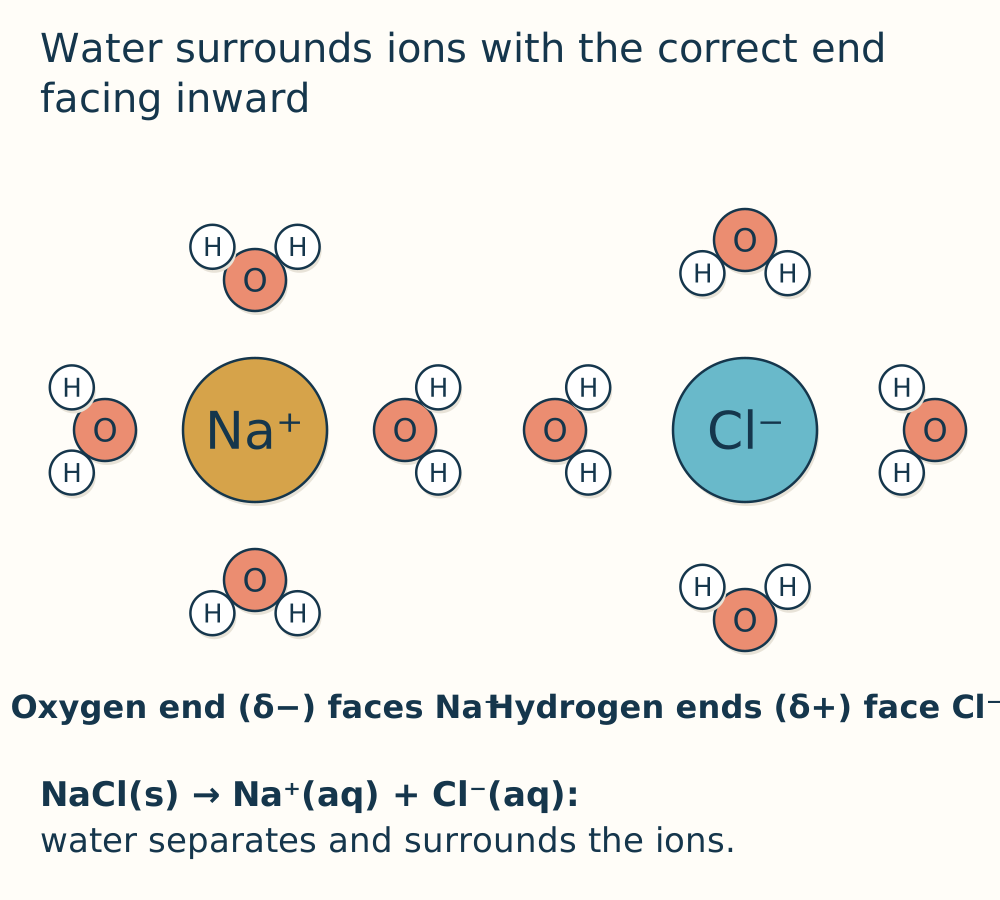
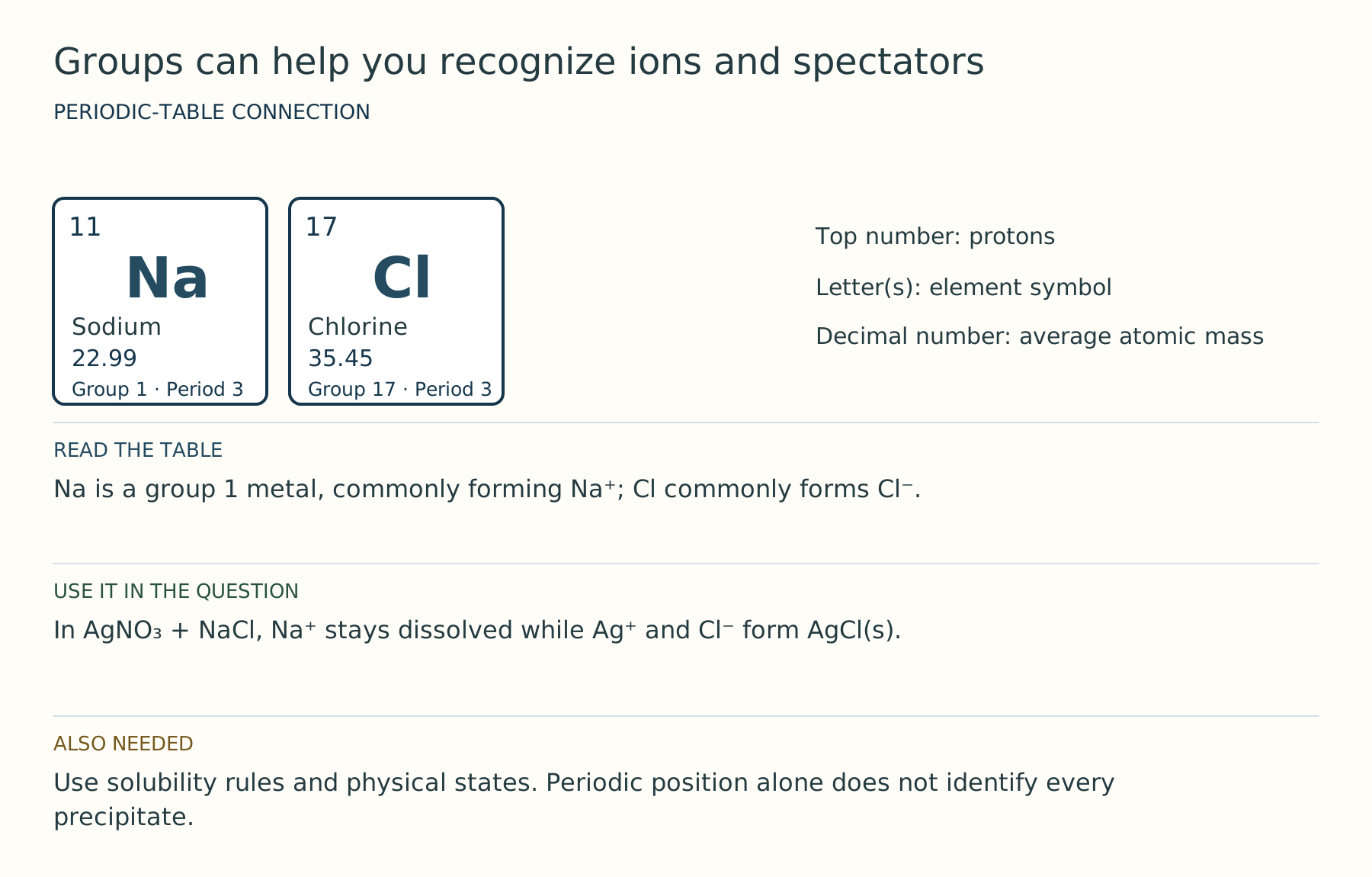
NaCl → Na+ + Cl−
- Find the moles of solute and the solution volume.
- Convert the volume to liters.
- Divide moles by liters.
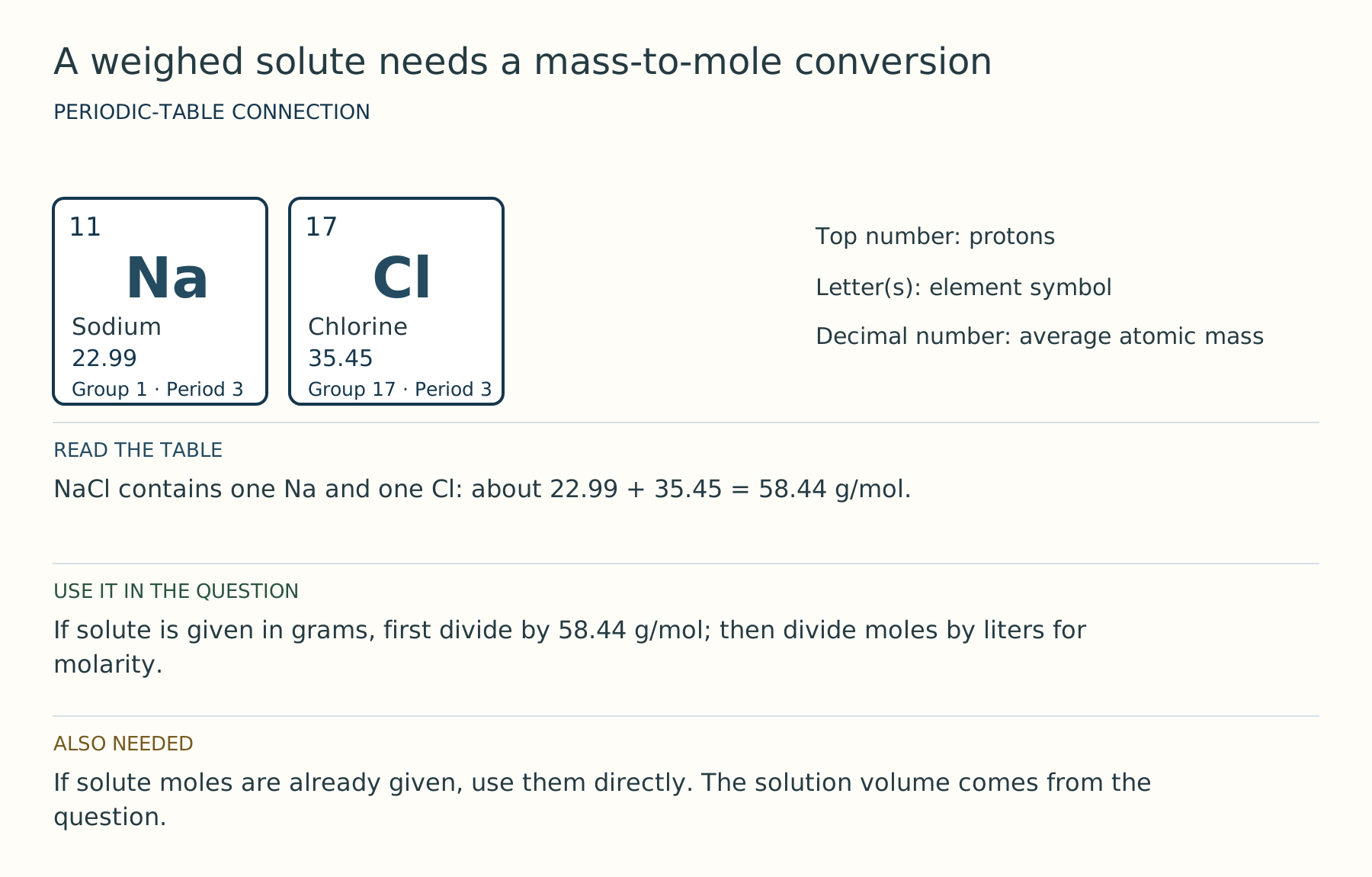
On the periodic table: Sodium (Na) is in Group 1, so it forms Na+. Chlorine (Cl) is in Group 17, so it forms Cl−.
On the periodic table: Molar masses come from the table: Na 22.99 and Cl 35.45, so NaCl is 22.99 + 35.45 = 58.44 g/mol.
On the periodic table: Atomic number gives the proton count (Na 11, Cl 17). The decimal mass is an average, not an isotope’s mass number.
Find molarity for 0.30 mol solute in 600 mL of solution.
The solute is unspecified and its moles are supplied, so no molar mass is needed. Conversion factor: 1 L / 1000 mL.
- 1Convert the volume
Molarity uses liters of final solution, not milliliters.
600 mL × 1 L1000 mL = 0.600 L - 2Write the relationship
n is solute moles; V is liters of solution.
M = nV - 3Divide
Moles per liter is the requested concentration.
M = 0.30 mol0.600 L = 0.50 mol/L - 4Write the short unit
Capital M is short for molarity.
0.50 mol/L = 0.50 M - ✓Answer
0.50 M
6.2 Dilution conserves the dissolved amount
Dilution means adding solvent, usually water, without adding solute. The moles of solute stay the same while the volume grows, so the concentration falls. That one fact gives the dilution equation.
- Molarity (6.1); solve for an unknown (Math first).
Need a refresher? Open the table of contents and revisit that topic before starting.
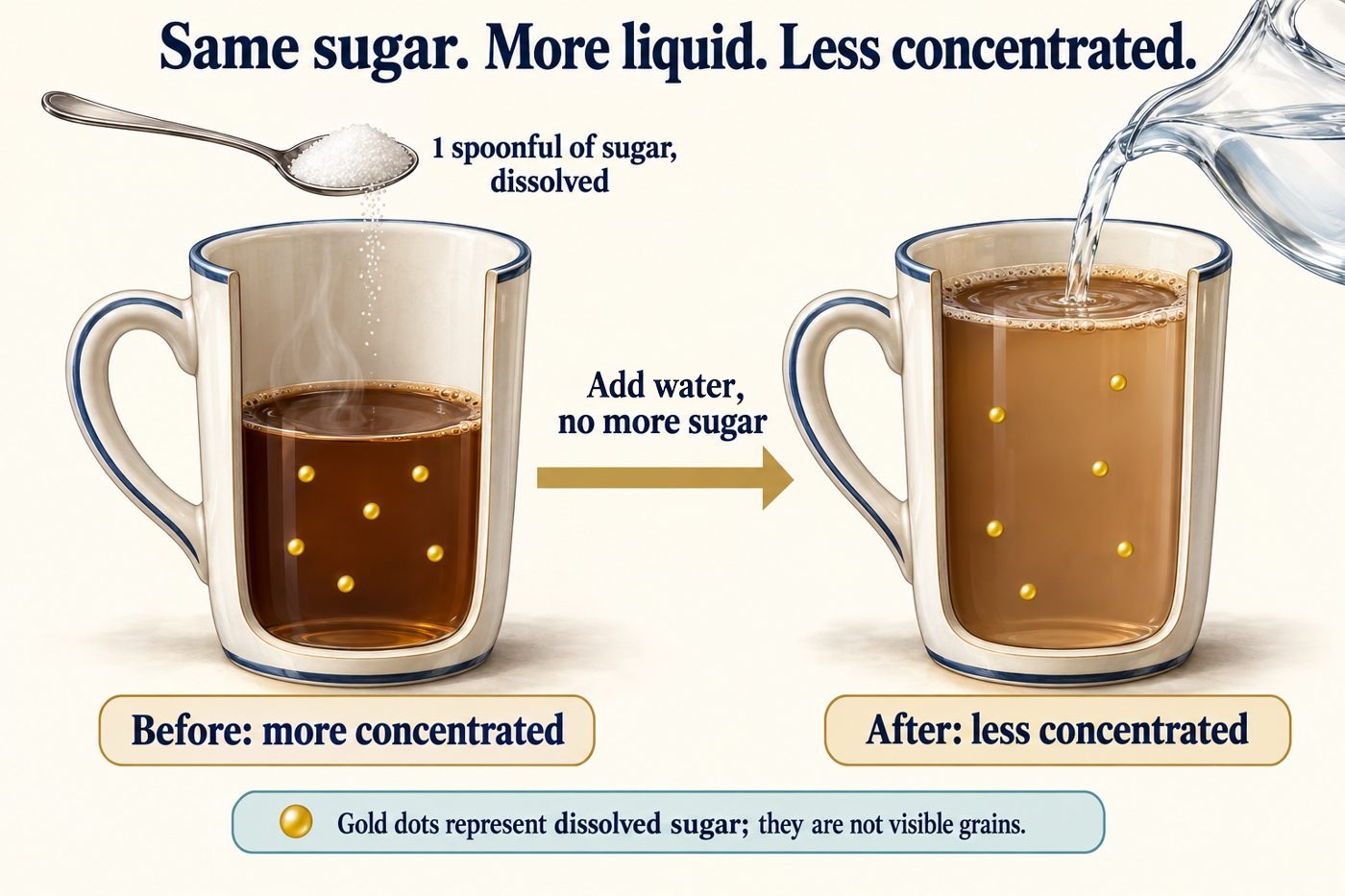
| Before (1) | After (2) | |
|---|---|---|
| Solute moles | 0.100 mol | 0.100 mol |
| Volume | 50.0 mL | 200 mL |
| Molarity | 2.00 M | 0.500 M |
- Both volumes must use the same units (both mL or both L).
- V2 is the final total volume, not the water added.
- It applies to the same solute with no reaction and no loss.
- Check that only solvent is added, so solute moles stay constant.
- Write M1V1 = M2V2 and solve for the unknown.
- Insert values with matching volume units.
- Check: lower concentration means larger final volume.
On the periodic table: No element values are needed here. Concentrations and volumes supply M1V1 = M2V2.
Dilute 50.0 mL of 2.00 M stock to 0.500 M. What final volume is needed?
- 1Name what stays constant
Only solvent is added, so solute moles stay the same.
moles before = moles after → M1V1 = M2V2 - 2Solve for final volume
Divide both sides by the final concentration, M2.
V2 = M1V1M2 - 3Insert the known values
Both volumes can stay in mL because the units match.
V2 = 2.00 M × 50.0 mL0.500 M - 4Calculate and interpret
Concentration becomes one quarter as large, so volume becomes four times as large.
V2 = 2.00 × 10² mL final solution - ✓Answer
Bring the total solution volume to 2.00 × 10² mL (200 mL).
6.3 What stays dissolved and what reacts
When two solutions mix, start by asking which particles are in the water. Some ions pair up into an insoluble solid, a precipitate; others stay dissolved and unchanged. This lesson predicts the solid and writes only the change that happens.
- Ionic compounds and ion charges (Chapter 2).
Need a refresher? Open the table of contents and revisit that topic before starting.
| Type | Particles in water | Conducts? | Examples |
|---|---|---|---|
| Strong electrolyte | Breaks apart completely into ions | Yes | Dissolved ionic compounds: NaCl → Na+ + Cl− |
| Weak electrolyte | Mostly whole molecules, a few ions | Weakly | Weak bases such as ammonia, NH3 |
| Nonelectrolyte | Whole, neutral molecules; no ions | No | Sugar (C12H22O11), ethanol |
- Ionic compounds that dissolve break into ions, so they are strong electrolytes.
- Most molecular compounds stay as molecules, so they are nonelectrolytes.
- Exceptions: acids and weak bases such as NH3 are molecular but form ions in water (6.4).
| Ion group | Usually | Exceptions |
|---|---|---|
| Nitrates (NO3−), Group 1 salts, common ammonium (NH4+) salts | Soluble | None |
| Chlorides, bromides, iodides | Soluble | Ag+, Pb2+, Hg22+ |
| Sulfates (SO42−) | Soluble | Ba2+, Sr2+, Pb2+, Hg22+; CaSO4 is sparingly soluble |
| Carbonates, phosphates, hydroxides | Poorly soluble | Group 1 and NH4+ salts dissolve (first row); Ba(OH)2 and Sr(OH)2 are also soluble, Ca(OH)2 slightly; check your course table for others |
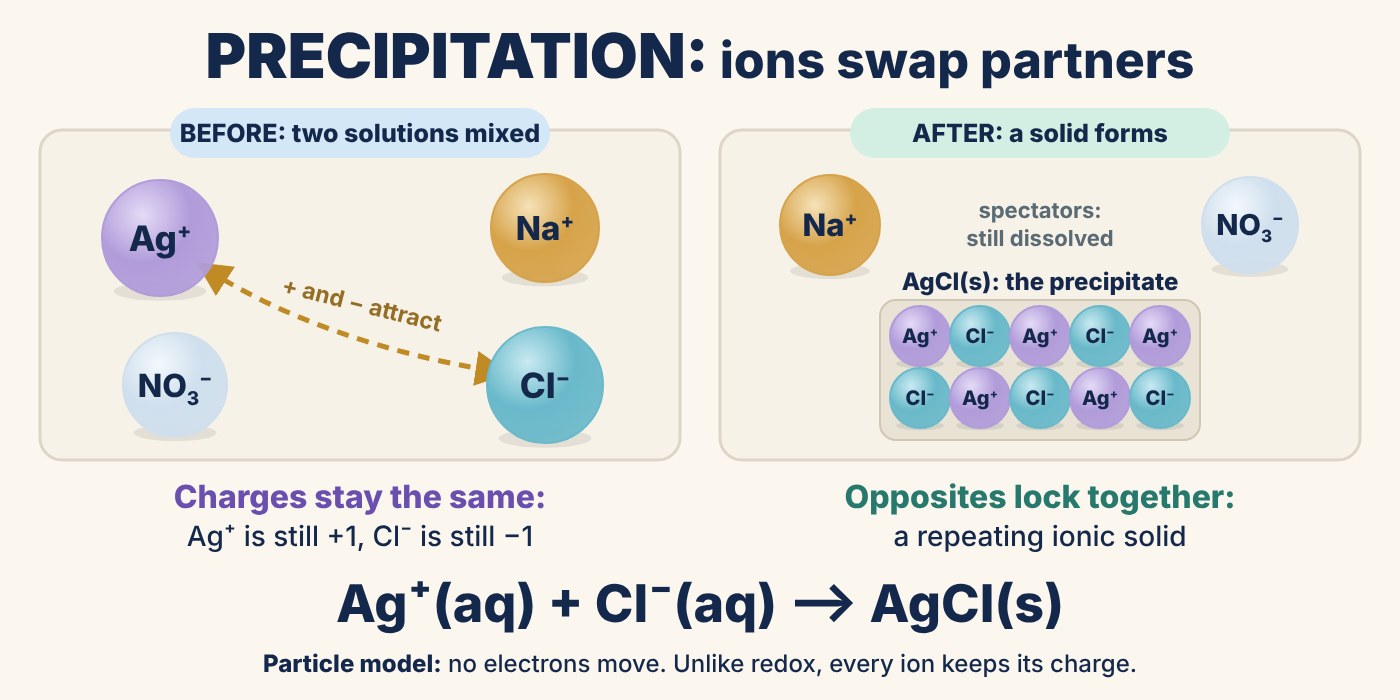
- Swap ion partners.
- Make neutral formulas.
- Check each new formula for a solid.
- Balance.
- Spectator ions: unchanged on both sides. Cross them out.
- What remains is the net ionic equation.
- Check both atoms and total charge.
- Identify each substance’s state.
- Separate aqueous strong electrolytes into ions.
- Cancel the spectator ions.
- Check atoms and total charge.
On the periodic table: Group 1 is the far-left column below hydrogen: lithium (Li), sodium (Na), potassium (K) and the elements under them.
On the periodic table: Barium (Ba) and strontium (Sr) are in Group 2, so they form Ba2+ and Sr2+.
On the periodic table: Sodium (Na) is in Group 1, so it forms Na+. Chlorine (Cl) is in Group 17, so it forms Cl−.
On the periodic table: Ag is silver, atomic number 47 (Group 11).
AgNO3(aq) + NaCl(aq) → AgCl(s) + NaNO3(aq). Find the net ionic equation.
- 1Separate dissolved ionic compounds
Split the aqueous strong electrolytes. Keep the precipitate AgCl together.
Ag+ + NO3− + Na+ + Cl− → AgCl(s) + Na+ + NO3− - 2Find the unchanged ions
Na+ and NO3− stay dissolved and do not form the solid.
Particle Left side Right side Role Ag+ dissolved in AgCl(s) reacts Cl− dissolved in AgCl(s) reacts Na+ dissolved dissolved spectator NO3− dissolved dissolved spectator - 3Cancel the spectators
Remove the unchanged ions to show only what reacts.
Ag+(aq) + Cl−(aq) → AgCl(s) - 4Check conservation
Both atoms and total charge must balance.
Left Right Ag atoms 1 1 Cl atoms 1 1 Total charge (+1) + (−1) = 0 0 - ✓Answer
Ag+(aq) + Cl−(aq) → AgCl(s). Ag+ and Cl− form the precipitate; Na+ and NO3− are spectators.
Section practice · 4 questions · tap to open
What this set is for: practicing the method from this section while it’s fresh. Every problem uses only what this section has taught.
Practice 1
Will AgNO3(aq) + NaCl(aq) form a precipitate?
Give me a hint
Swap ion partners to make two new formulas. Check each one against the solubility rules, including the exceptions.
Check the answer
Answer: Yes, AgCl(s)
Explain the worked problem to me
What you know: AgNO3(aq) and NaCl(aq) are mixed. What you want: whether a solid forms.
- List the dissolved ions: Ag+, NO3−, Na+, Cl−.
- Swap partners to get the two new neutral formulas: NaNO3 and AgCl.
- Check the solubility rules. NaNO3 is a nitrate and a Group 1 salt, so it dissolves. Most chlorides dissolve, but Ag+ is an exception to that rule.
- So a precipitate forms: Yes, AgCl(s).
Check: Ag+ (+1) and Cl− (−1) combine 1 : 1, so AgCl is neutral.
Watch out: "Chlorides dissolve" is not the whole rule. Always check the exceptions: Ag+, Pb2+, Hg22+.
On the periodic table: Sodium (Na) is in Group 1, so it forms Na⁺. Chlorine (Cl) is in Group 17, so it forms Cl⁻.
That’s right: Yes, AgCl(s)
YOUR PERIODIC-TABLE REFERENCE
Atomic number identifies proton count. The decimal mass is an average, not an isotope’s mass number. Use supplied rounded masses when a problem gives them.
Practice 2
Course solubility rules: nitrates, Group 1 salts, and common ammonium salts are soluble. Name a soluble polyatomic group in these rules.
Give me a hint
Pick a soluble group that is made of more than one atom.
Check the answer
Answer: Nitrate (ammonium also counts)
Explain the worked problem to me
What you know: the course solubility rules. What you want: a polyatomic ion whose salts are soluble.
- Read the "soluble" line of the rules: nitrates, Group 1 salts, and common ammonium salts.
- Pick the ones that are polyatomic (more than one atom). Nitrate is NO3−, one N and three O atoms.
- Nitrate salts have no exceptions in these rules, so the answer is Nitrate. Ammonium (NH4+) is also polyatomic and soluble, so it counts too.
Why it matters: If a nitrate appears in a mixing problem, it stays dissolved. It is often a spectator ion.
Watch out: Group 1 is a column of elements, not a polyatomic ion.
That’s right: Nitrate
Practice 3
Sugar, C12H22O11, dissolved in water: strong electrolyte, weak electrolyte, or nonelectrolyte?
Give me a hint
Is sugar ionic or molecular? Does it form ions?
Check the answer
Answer: Nonelectrolyte
Explain the worked problem to me
What you know: sugar, C12H22O11, dissolves in water. What you want: its electrolyte type.
- Look at the formula. It has only C, H and O, all nonmetals. So sugar is a molecular compound, not ionic.
- Most molecular compounds dissolve as whole, neutral molecules. Sugar is not an acid or a base, so it forms no ions.
- No ions means nothing carries charge. Sugar is a Nonelectrolyte.
Why it matters: A sugar solution does not conduct electricity, unlike a salt solution.
Watch out: Dissolving is not the same as forming ions. Sugar dissolves well but stays as molecules.
That’s right: Nonelectrolyte
Practice 4
Which solution conducts electricity: KBr(aq) or C2H5OH(aq) (ethanol)?
Give me a hint
Which one is ionic?
Check the answer
Answer: KBr(aq)
Explain the worked problem to me
What you know: two solutions, KBr(aq) and C2H5OH(aq). What you want: which one conducts.
- Classify each compound. KBr is a metal (K) plus a nonmetal (Br), so it is ionic. Ethanol has only C, H and O, so it is molecular.
- A dissolved ionic compound breaks apart: KBr → K+ + Br−. It is a strong electrolyte.
- Ethanol stays as neutral molecules. It is a nonelectrolyte.
- Moving ions carry charge, so the conductor is KBr(aq).
Why it matters: Conductivity is a quick test for whether ions are present.
Watch out: The OH in ethanol is not a hydroxide ion. It is bonded inside the molecule.
That’s right: KBr(aq)
6.4 Acid–base reactions: see the particles in water
An acid in water makes hydronium, H3O+. A strong base releases hydroxide, OH−. Mixed, these two ions make water: neutralization.
- Positive and negative ions, ionic formulas, and polyatomic ions (Chapter 2).
- Net ionic equations and spectator ions (6.3).
Need a refresher? Open the table of contents and revisit that topic before starting.
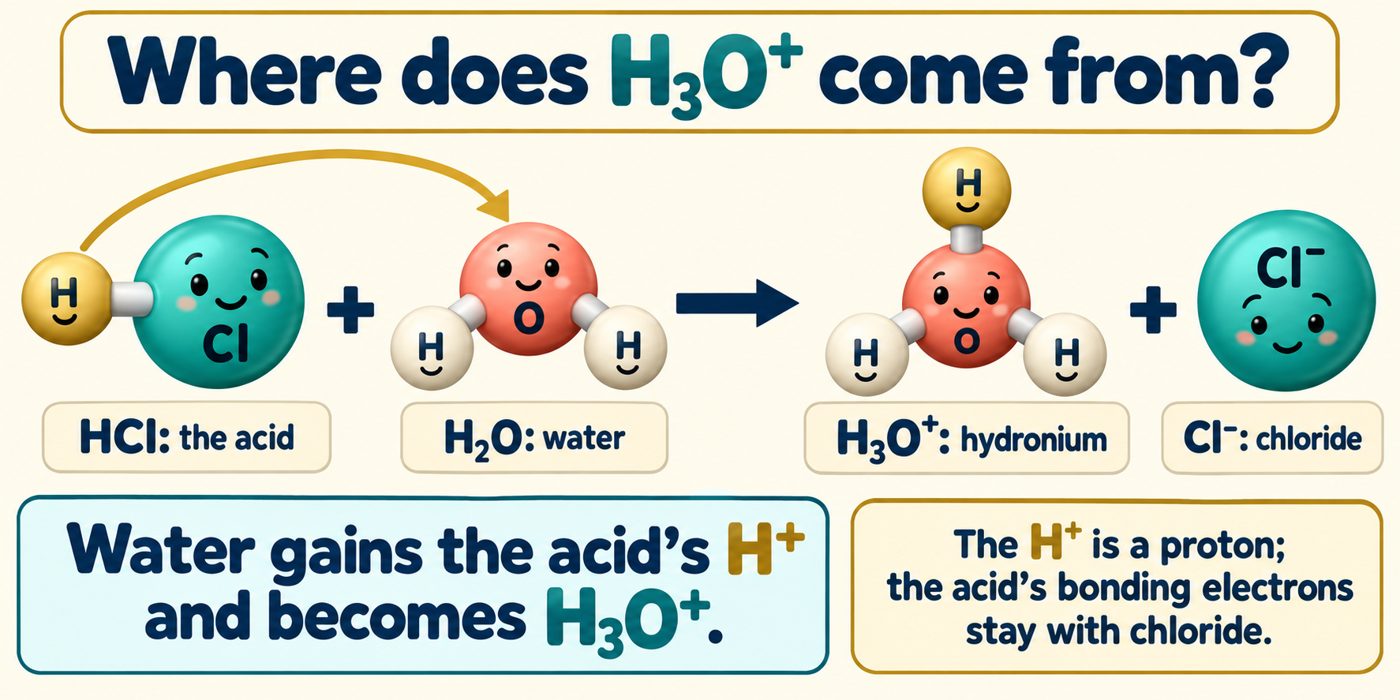
Holds H3O+ and Cl− in water.
Holds many unchanged acid molecules.
H2SO4 is strong for its first proton only: H2SO4 + H2O → H3O+ + HSO4−.
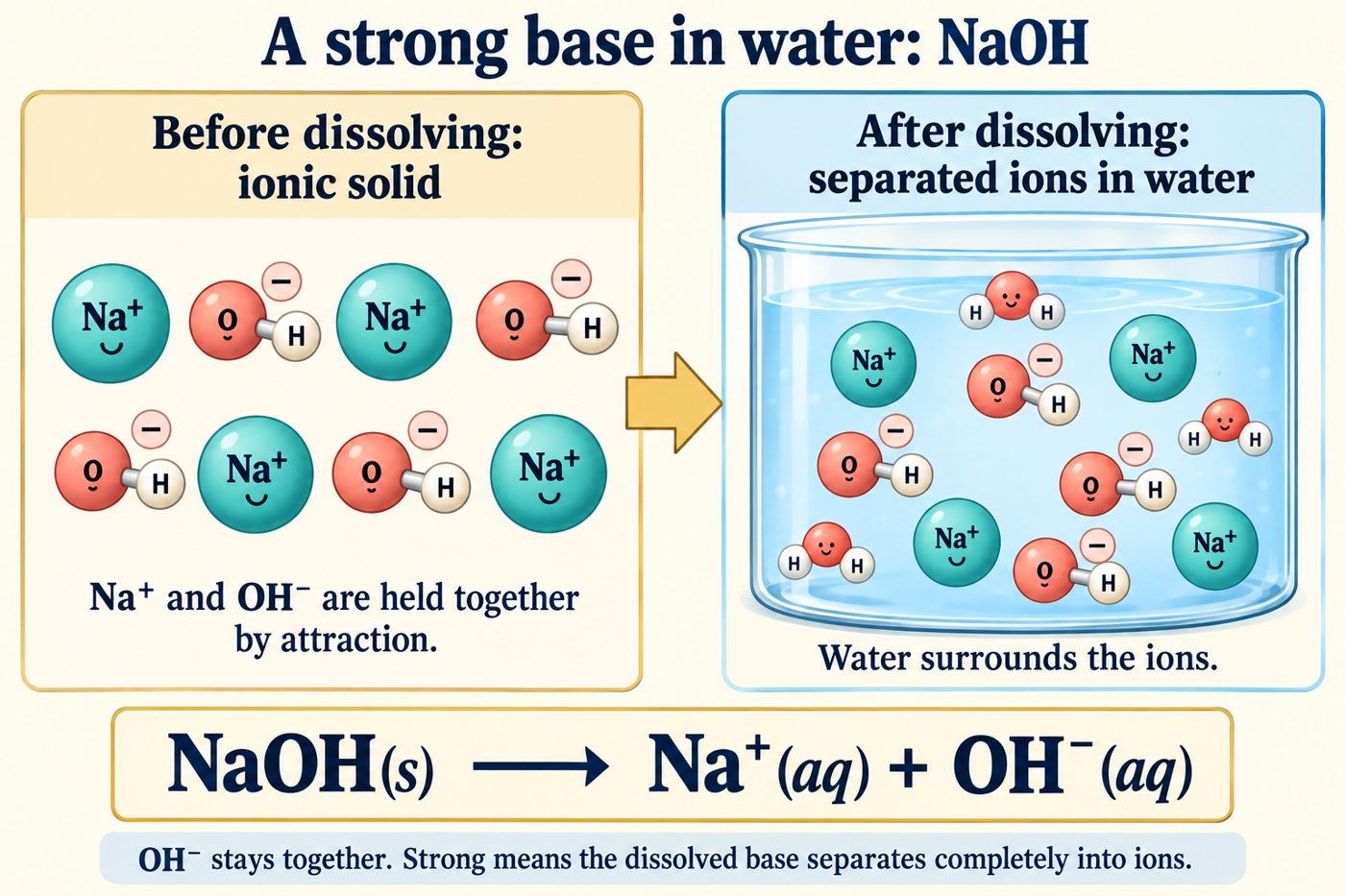
- Base solutions are usually dissolved metal hydroxides.
- Strong base: the dissolved part separates completely into ions.
- “Strong” means full separation, not high concentration.
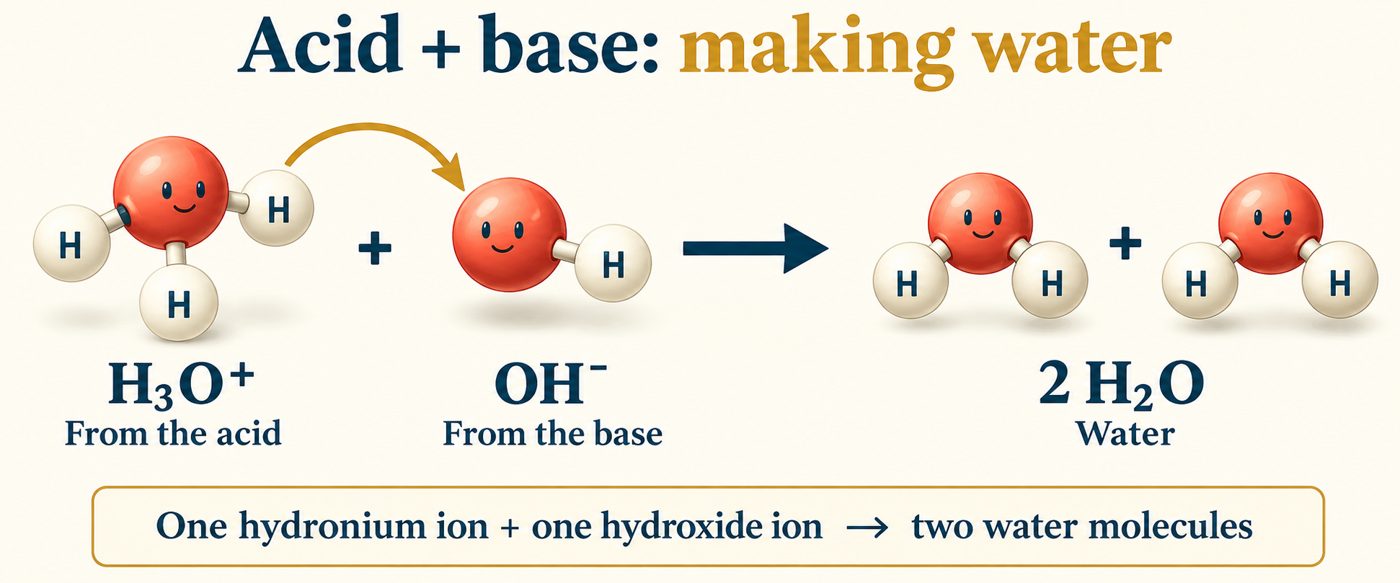
- Acid in water: find H3O+.
- Base in water: find OH−.
- Combine only the ions that change.
On the periodic table: Sodium (Na) is a Group 1 metal, so it forms Na+.
Given H3O+ and OH−, find the product and balanced particle counts.
- 1Count the atoms
Add up what the two ions bring together.
Ion H atoms O atoms Charge H3O+ 3 1 +1 OH− 1 1 −1 Total 4 2 0 - 2Build the product
Two H2O molecules use exactly 4 H and 2 O.
2 H2O = 2 × (2 H + 1 O) = 4 H + 2 O - 3Check the charge
Starting charge is zero; water is neutral.
(+1) + (−1) = 0 → 2H2O has charge 0 - ✓Answer
H3O+ + OH− → 2H2O
6.4a Solution stoichiometry and titration
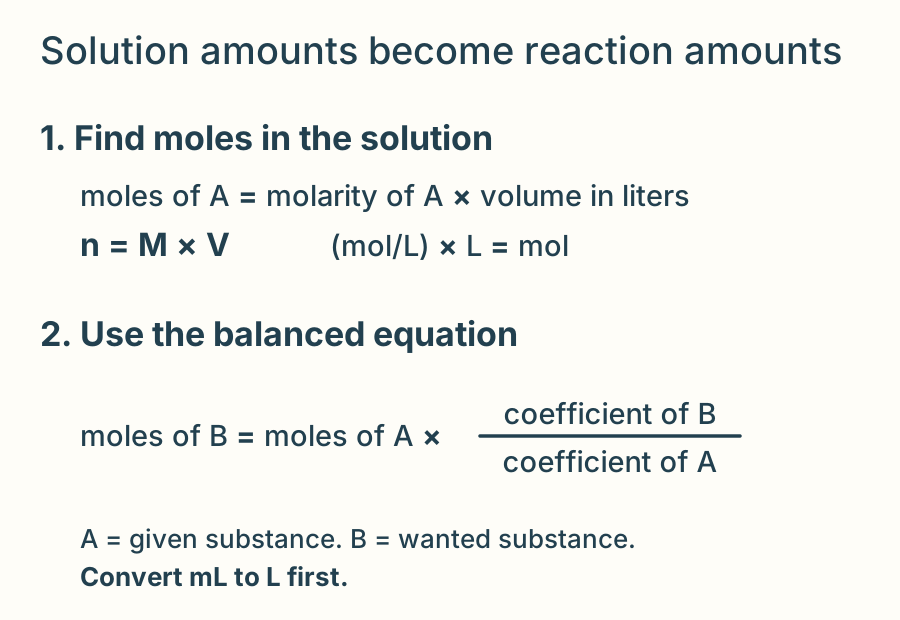
Molarity turns a solution volume into moles. The balanced equation turns those into moles of another substance. A titration uses both steps to find an unknown amount.
- Moles from molarity: n = M × V (6.1).
- Mole ratios from a balanced equation (5.2–5.3).
- Acids, bases and neutralization (6.4).
Need a refresher? Open the table of contents and revisit that topic before starting.
| Term | Meaning |
|---|---|
| Titration | Finds an unknown amount with a measured solution. |
| Equivalence | The balanced mole ratio is met. |
| Endpoint | The observed signal, such as an indicator color change. |
| Acid | Balanced reaction | Acid : NaOH |
|---|---|---|
| HCl | HCl + NaOH → NaCl + H2O | 1 : 1 |
| H2SO4 | H2SO4 + 2NaOH → Na2SO4 + 2H2O | 1 : 2 |
- Convert volumes to liters.
- Find moles of the known: n = M × V.
- Use the balanced ratio for moles of the other.
- Convert to the volume or molarity asked for.
On the periodic table: No table values are needed when molarity and volume are given.
On the periodic table: Given grams instead? Get molar mass from the periodic table first, e.g. NaOH: 22.99 + 16.00 + 1.008 = 40.00 g/mol.
25.0 mL of 0.100 M HCl is titrated with 0.200 M NaOH. Find the moles of HCl and the NaOH volume needed.
- 1Convert the volume
Molarity is per liter.
25.0 mL × 1 L1000 mL = 0.0250 L - 2Find moles of HCl
Use n = M × V.
nHCl = 0.100 molL × 0.0250 L = 0.00250 mol HCl - 3Apply the 1 : 1 ratio
HCl + NaOH → NaCl + H2O, so one NaOH per HCl.
0.00250 mol HCl × 1 mol NaOH1 mol HCl = 0.00250 mol NaOH - 4Find the NaOH volume
Rearrange n = M × V to V = n ÷ M.
V = 0.00250 mol0.200 mol/L = 0.0125 L = 12.5 mL - ✓Answer
0.00250 mol HCl, which needs 0.00250 mol NaOH, or 12.5 mL of 0.200 M NaOH
Section practice · 8 questions · tap to open
What this set is for: practicing the method from this section while it’s fresh. Every problem uses only what this section has taught.
Practice 1
10.0 mL of 0.100 M HCl is neutralized by 0.200 M NaOH. Find NaOH volume; the ratio is 1:1.
Give me a hint
Convert acid volume to liters before calculating moles.
Check the answer
Answer: 5.00 mL
Explain the worked problem to me
What you know: 10.0 mL of 0.100 M HCl; 0.200 M NaOH; HCl : NaOH = 1 : 1. What you want: the NaOH volume.
- Convert the acid volume to liters: 10.0 mL × (1 L / 1000 mL) = 0.0100 L.
- Find moles of HCl with n = M × V: 0.100 mol/L × 0.0100 L = 0.00100 mol HCl. The L units cancel.
- Use the 1 : 1 ratio: 0.00100 mol HCl needs 0.00100 mol NaOH.
- Find the base volume with V = n ÷ M: 0.00100 mol ÷ 0.200 mol/L = 0.00500 L. Then 0.00500 L × (1000 mL / 1 L) = 5.00 mL. Three significant figures, like the data.
Check: The base is twice as concentrated as the acid, so it needs half the volume: 10.0 ÷ 2 = 5.00 mL.
Watch out: Use liters in n = M × V. Using 10.0 mL directly gives moles 1000 times too big.
That’s right: 5.00 mL
YOUR PERIODIC-TABLE REFERENCE
Atomic number identifies proton count. The decimal mass is an average, not an isotope’s mass number. Use supplied rounded masses when a problem gives them.
Practice 2
20.0 mL of 0.100 M HCl is neutralized by 0.200 M NaOH. Find NaOH volume; the ratio is 1:1.
Give me a hint
Convert acid volume to liters before calculating moles.
Check the answer
Answer: 10.0 mL
Explain the worked problem to me
What you know: 20.0 mL of 0.100 M HCl; 0.200 M NaOH; HCl : NaOH = 1 : 1. What you want: the NaOH volume.
- Convert the acid volume to liters: 20.0 mL × (1 L / 1000 mL) = 0.0200 L.
- Find moles of HCl with n = M × V: 0.100 mol/L × 0.0200 L = 0.00200 mol HCl. The L units cancel.
- Use the 1 : 1 ratio: 0.00200 mol HCl needs 0.00200 mol NaOH.
- Find the base volume with V = n ÷ M: 0.00200 mol ÷ 0.200 mol/L = 0.0100 L. Then 0.0100 L × (1000 mL / 1 L) = 10.0 mL. Three significant figures, like the data.
Check: The base is twice as concentrated as the acid, so it needs half the volume: 20.0 ÷ 2 = 10.0 mL.
Watch out: Use liters in n = M × V. Using 20.0 mL directly gives moles 1000 times too big.
That’s right: 10.0 mL
YOUR PERIODIC-TABLE REFERENCE
Atomic number identifies proton count. The decimal mass is an average, not an isotope’s mass number. Use supplied rounded masses when a problem gives them.
Practice 3
30.0 mL of 0.100 M HCl is neutralized by 0.200 M NaOH. Find NaOH volume; the ratio is 1:1.
Give me a hint
Convert acid volume to liters before calculating moles.
Check the answer
Answer: 15.0 mL
Explain the worked problem to me
What you know: 30.0 mL of 0.100 M HCl; 0.200 M NaOH; HCl : NaOH = 1 : 1. What you want: the NaOH volume.
- Convert the acid volume to liters: 30.0 mL × (1 L / 1000 mL) = 0.0300 L.
- Find moles of HCl with n = M × V: 0.100 mol/L × 0.0300 L = 0.00300 mol HCl. The L units cancel.
- Use the 1 : 1 ratio: 0.00300 mol HCl needs 0.00300 mol NaOH.
- Find the base volume with V = n ÷ M: 0.00300 mol ÷ 0.200 mol/L = 0.0150 L. Then 0.0150 L × (1000 mL / 1 L) = 15.0 mL. Three significant figures, like the data.
Check: The base is twice as concentrated as the acid, so it needs half the volume: 30.0 ÷ 2 = 15.0 mL.
Watch out: Use liters in n = M × V. Using 30.0 mL directly gives moles 1000 times too big.
That’s right: 15.0 mL
YOUR PERIODIC-TABLE REFERENCE
Atomic number identifies proton count. The decimal mass is an average, not an isotope’s mass number. Use supplied rounded masses when a problem gives them.
Practice 4
40.0 mL of 0.100 M HCl is neutralized by 0.200 M NaOH. Find NaOH volume; the ratio is 1:1.
Give me a hint
Convert acid volume to liters before calculating moles.
Check the answer
Answer: 20.0 mL
Explain the worked problem to me
What you know: 40.0 mL of 0.100 M HCl; 0.200 M NaOH; HCl : NaOH = 1 : 1. What you want: the NaOH volume.
- Convert the acid volume to liters: 40.0 mL × (1 L / 1000 mL) = 0.0400 L.
- Find moles of HCl with n = M × V: 0.100 mol/L × 0.0400 L = 0.00400 mol HCl. The L units cancel.
- Use the 1 : 1 ratio: 0.00400 mol HCl needs 0.00400 mol NaOH.
- Find the base volume with V = n ÷ M: 0.00400 mol ÷ 0.200 mol/L = 0.0200 L. Then 0.0200 L × (1000 mL / 1 L) = 20.0 mL. Three significant figures, like the data.
Check: The base is twice as concentrated as the acid, so it needs half the volume: 40.0 ÷ 2 = 20.0 mL.
Watch out: Use liters in n = M × V. Using 40.0 mL directly gives moles 1000 times too big.
That’s right: 20.0 mL
YOUR PERIODIC-TABLE REFERENCE
Atomic number identifies proton count. The decimal mass is an average, not an isotope’s mass number. Use supplied rounded masses when a problem gives them.
Practice 5
50.0 mL of 0.100 M HCl is neutralized by 0.200 M NaOH. Find NaOH volume; the ratio is 1:1.
Give me a hint
Convert acid volume to liters before calculating moles.
Check the answer
Answer: 25.0 mL
Explain the worked problem to me
What you know: 50.0 mL of 0.100 M HCl; 0.200 M NaOH; HCl : NaOH = 1 : 1. What you want: the NaOH volume.
- Convert the acid volume to liters: 50.0 mL × (1 L / 1000 mL) = 0.0500 L.
- Find moles of HCl with n = M × V: 0.100 mol/L × 0.0500 L = 0.00500 mol HCl. The L units cancel.
- Use the 1 : 1 ratio: 0.00500 mol HCl needs 0.00500 mol NaOH.
- Find the base volume with V = n ÷ M: 0.00500 mol ÷ 0.200 mol/L = 0.0250 L. Then 0.0250 L × (1000 mL / 1 L) = 25.0 mL. Three significant figures, like the data.
Check: The base is twice as concentrated as the acid, so it needs half the volume: 50.0 ÷ 2 = 25.0 mL.
Watch out: Use liters in n = M × V. Using 50.0 mL directly gives moles 1000 times too big.
That’s right: 25.0 mL
YOUR PERIODIC-TABLE REFERENCE
Atomic number identifies proton count. The decimal mass is an average, not an isotope’s mass number. Use supplied rounded masses when a problem gives them.
Practice 6
How many mol NaOH fully neutralize 1 mol H2SO4?
Give me a hint
Count the H+ each H2SO4 can give. Each OH− takes one.
Check the answer
Answer: 2 mol
Explain the worked problem to me
What you know: 1 mol H2SO4. What you want: moles of NaOH for full neutralization.
- Count the acidic H in H2SO4: there are 2. Each OH− neutralizes one H+.
- Write the balanced equation: H2SO4 + 2NaOH → Na2SO4 + 2H2O.
- Use the ratio: 1 mol H2SO4 × (2 mol NaOH / 1 mol H2SO4) = 2 mol.
Check: Atoms balance: 2 Na, 1 S, 6 O and 4 H on each side.
Watch out: Do not assume 1 : 1 for every acid. The 1 : 1 ratio is for HCl and NaOH.
That’s right: 2 mol
YOUR PERIODIC-TABLE REFERENCE
Atomic number identifies proton count. The decimal mass is an average, not an isotope’s mass number. Use supplied rounded masses when a problem gives them.
Practice 7
Is an endpoint identical by definition to equivalence?
Give me a hint
Equivalence comes from the mole ratio. The endpoint is what the indicator shows.
Check the answer
Answer: No
Explain the worked problem to me
What you know: the definitions of endpoint and equivalence point. What you want: whether endpoint and equivalence mean the same thing.
- Equivalence is a stoichiometric condition: the added base exactly matches the acid in the balanced mole ratio.
- The endpoint is what you observe, such as an indicator changing color.
- A good indicator makes the endpoint land very close to equivalence. But one is a signal and the other is a mole ratio, so they are not identical by definition. The answer is No.
Why it matters: The endpoint is how you estimate equivalence in the lab.
Watch out: "Close in practice" is not the same as "the same by definition."
That’s right: No
Practice 8
Equal volumes of 0.100 M and 0.200 M solutions: equal moles?
Give me a hint
Moles = molarity × volume.
Check the answer
Answer: No
Explain the worked problem to me
What you know: equal volumes, one 0.100 M and one 0.200 M. What you want: whether the moles are equal.
- Use n = M × V for each. Call the shared volume V.
- First solution: 0.100 mol/L × V. Second: 0.200 mol/L × V.
- The second has twice the molarity at the same volume, so it holds twice the moles. The answer is No.
Check: Try V = 1.00 L: 0.100 mol versus 0.200 mol.
Watch out: Equal volumes need not mean equal moles. Molarity tells you how much solute is packed into each liter.
That’s right: No
6.5 Redox: electron transfer
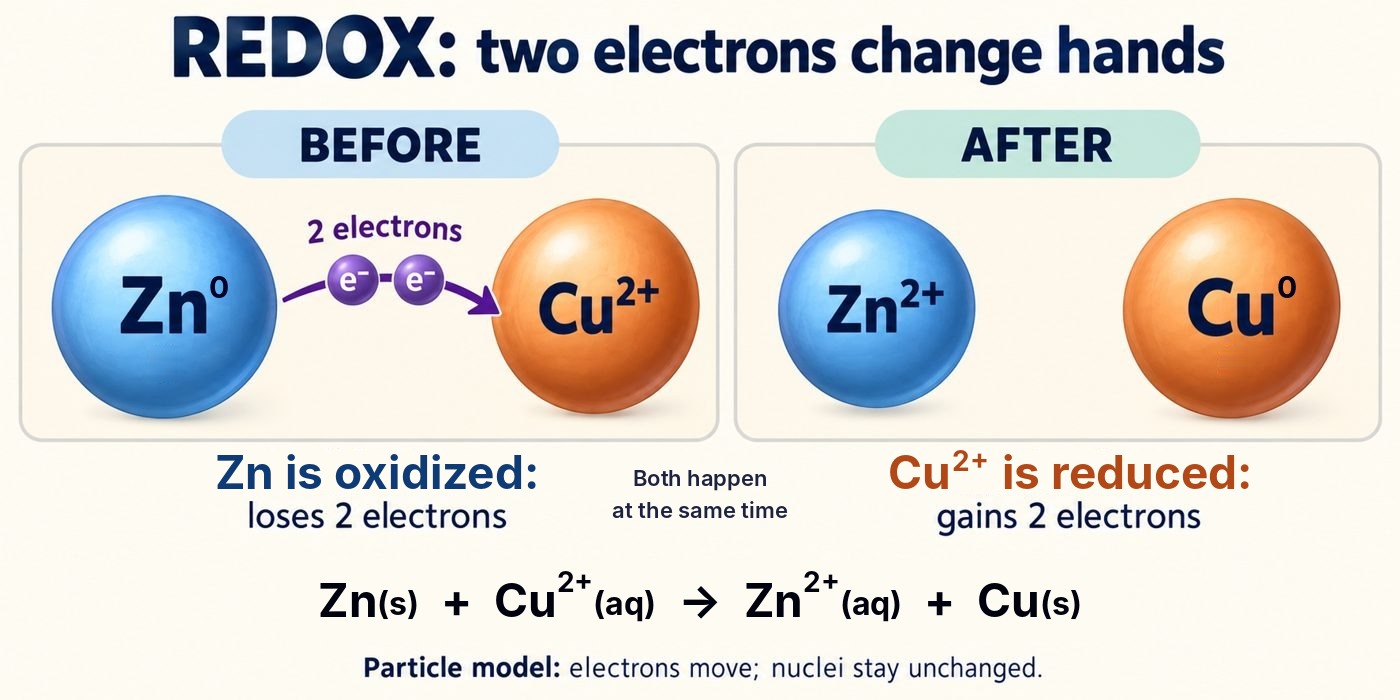
In a redox reaction, electrons move from one substance to another. One side loses electrons while the other gains them. This lesson tracks changing charges to name which is which.
- Ion charge and electron counts (Chapter 1); ionic formulas (Chapter 2).
Need a refresher? Open the table of contents and revisit that topic before starting.
Oxidation number goes up.
Oxidation number goes down.
| Rule | Example |
|---|---|
| An element alone is 0. | Zn metal: 0; Cu metal: 0 |
| A monatomic ion has its ion charge. | Zn2+: +2; Cl−: −1 |
| In a compound or polyatomic ion, the numbers add up to the overall charge. | SO42−: S + 4(−2) = −2, so S = +6 |
| Oxygen is usually −2. | O in SO42−: −2 |
- Assign oxidation numbers before and after.
- An increase means oxidation; a decrease means reduction.
- Check that electrons lost equal electrons gained.
On the periodic table: Zinc (Zn) is atomic number 30 and copper (Cu) is 29. Atomic number does not change in redox.
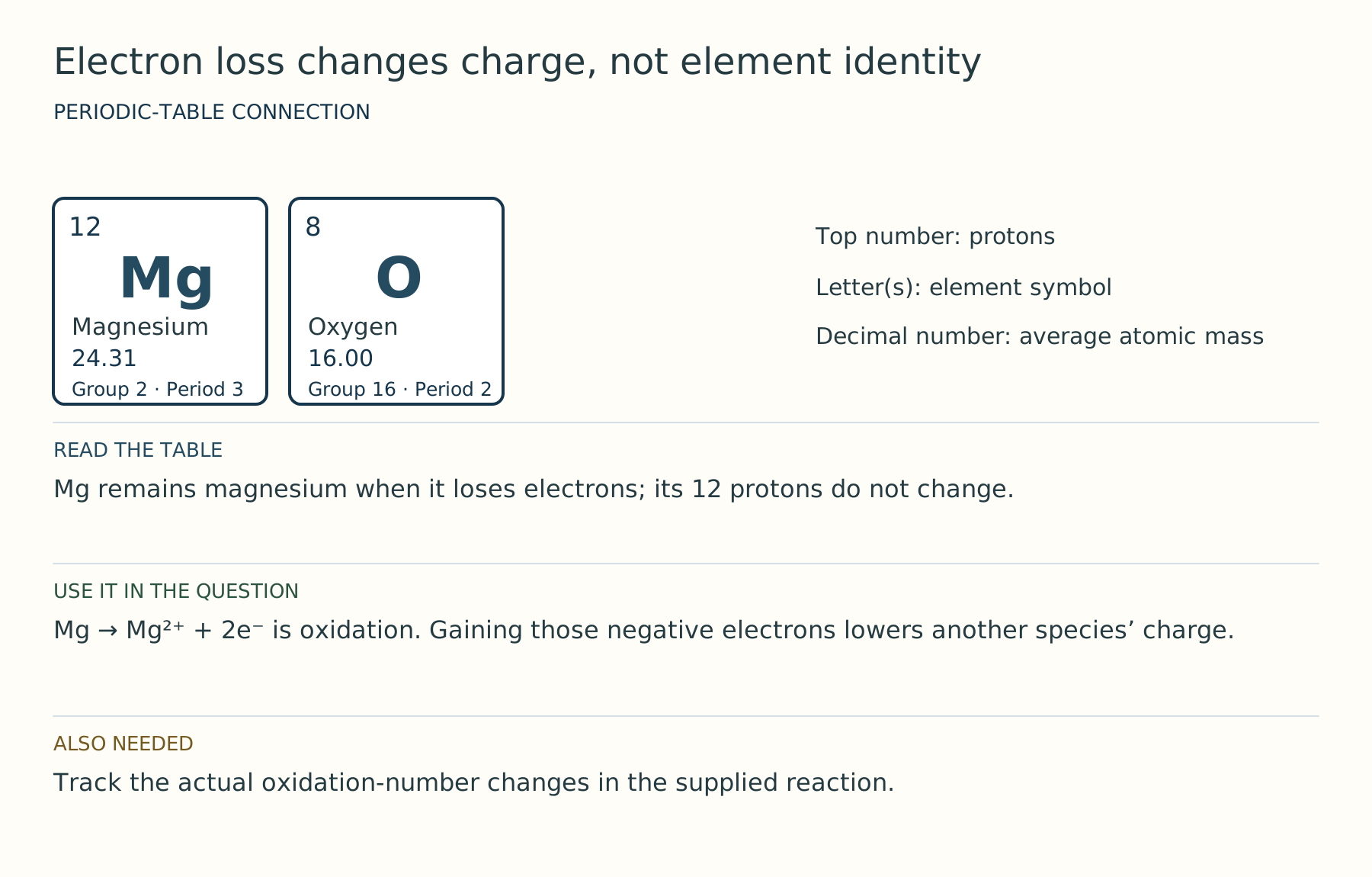
On the periodic table: Magnesium (Mg) is atomic number 12, so Mg2+ still has 12 protons.
In Zn + Cu2+ → Zn2+ + Cu, identify oxidation and reduction.
- 1Track zinc
Its oxidation number increases. More positive means it lost electrons.
Zn: 0 → +2 - 2Name zinc’s change
Oxidation means electron loss.
Zn → Zn2+ + 2e− oxidation - 3Track copper
Its oxidation number decreases as it gains electrons.
Cu: +2 → 0 - 4Name copper’s change
Reduction means electron gain. Cu2+ accepts electrons, so it is the oxidizing agent.
Cu2+ + 2e− → Cu reduction - ✓Answer
Zinc is oxidized and copper(II) is reduced. Cu2+ is the oxidizing agent.
Change Electrons Zn 0 → +2 (oxidized) 2 lost Cu +2 → 0 (reduced) 2 gained The two electron counts match.
Mixed chapter review
Answer in your notebook before revealing help. Keep your first attempt separate from an answer corrected with help.
Mixed chapter review · 14 questions · tap to open
What this set is for: problems from every section of the chapter, mixed together and not labeled, the way a test asks them. Your job is to pick the right method yourself. Do this before the skill check.
Practice 1
A solution contains 1.2 mol solute in 2.4 L solution. What is molarity?
Give me a hint
Moles and solution volume are given.
Check the answer
Answer: 0.50 M
Explain the worked problem to me
What you know: 1.2 mol solute in 2.4 L of solution. What you want: molarity.
- Molarity means moles of solute per liter of solution: M = moles ÷ liters.
- The volume is already in liters, so divide: 1.2 mol ÷ 2.4 L = 0.50 mol/L = 0.50 M. Keep two significant figures, matching the data.
Check: 2.4 L is twice 1.2, so the answer is one half: 0.50 × 2.4 = 1.2 mol.
Watch out: Divide moles by liters, not liters by moles. Flipping it gives 2 L/mol, which is not a molarity.
Your route: Moles ÷ Liters of solution
That’s right: 0.50 M
Practice 2
A solution contains 1.4 mol solute in 2.8 L solution. What is molarity?
Give me a hint
Moles and solution volume are given.
Check the answer
Answer: 0.50 M
Explain the worked problem to me
What you know: 1.4 mol solute in 2.8 L of solution. What you want: molarity.
- Molarity means moles of solute per liter of solution: M = moles ÷ liters.
- The volume is already in liters, so divide: 1.4 mol ÷ 2.8 L = 0.50 mol/L = 0.50 M. Keep two significant figures, matching the data.
Check: 2.8 L is twice 1.4, so the answer is one half: 0.50 × 2.8 = 1.4 mol.
Watch out: Divide moles by liters, not liters by moles. Flipping it gives 2 L/mol, which is not a molarity.
Your route: Moles ÷ Liters of solution
That’s right: 0.50 M
Practice 3
0.3 mol solute is in 600 mL solution. What is molarity?
Give me a hint
The solution volume is in milliliters.
Check the answer
Answer: 0.5 M
Explain the worked problem to me
What you know: 0.3 mol solute in 600 mL of solution. What you want: molarity.
- Molarity uses liters, so convert: 600 mL × (1 L / 1000 mL) = 0.6 L. The mL units cancel.
- Divide moles by liters: 0.3 mol ÷ 0.6 L = 0.5 mol/L = 0.5 M.
Check: 0.5 mol/L × 0.6 L = 0.3 mol, the amount given.
Watch out: Dividing by 600 mL gives 0.0005, which is 1000 times too small.
Your route: mL ÷ 1000 → Moles ÷ L
That’s right: 0.5 M
Practice 4
0.35 mol solute is in 700 mL solution. What is molarity?
Give me a hint
The solution volume is in milliliters.
Check the answer
Answer: 0.50 M
Explain the worked problem to me
What you know: 0.35 mol solute in 700 mL of solution. What you want: molarity.
- Molarity uses liters, so convert: 700 mL × (1 L / 1000 mL) = 0.700 L. The mL units cancel.
- Divide moles by liters: 0.35 mol ÷ 0.700 L = 0.50 mol/L = 0.50 M. Keep two significant figures, matching 0.35 mol.
Check: 0.50 mol/L × 0.700 L = 0.35 mol, the amount given.
Watch out: Dividing by 700 mL gives 0.0005, which is 1000 times too small.
Your route: mL ÷ 1000 → Moles ÷ L
That’s right: 0.50 M
Practice 5
How many moles are in 0.2 L of 4 M solution?
Give me a hint
A concentration and a volume are given.
Check the answer
Answer: 0.8 mol
Explain the worked problem to me
What you know: 0.2 L of 4 M solution. What you want: moles of solute.
- 4 M means 4 mol of solute in every liter of solution.
- Use n = M × V: 4 mol/L × 0.2 L = 0.8 mol. The L units cancel, leaving mol.
Check: 0.2 L is less than 1 L, so the moles should be less than 4. 0.8 is less than 4.
Watch out: Multiply, do not divide. 4 ÷ 0.2 gives 20, which has the wrong units.
Your route: Molarity × Liters → Moles
That’s right: 0.8 mol
Practice 6
How many moles are in 0.2 L of 4.5 M solution?
Give me a hint
A concentration and a volume are given.
Check the answer
Answer: 0.9 mol
Explain the worked problem to me
What you know: 0.2 L of 4.5 M solution. What you want: moles of solute.
- 4.5 M means 4.5 mol of solute in every liter of solution.
- Use n = M × V: 4.5 mol/L × 0.2 L = 0.9 mol. The L units cancel, leaving mol.
Check: 0.2 L is less than 1 L, so the moles should be less than 4.5. 0.9 is less than 4.5.
Watch out: Multiply, do not divide. 4.5 ÷ 0.2 gives 22.5, which has the wrong units.
Your route: Molarity × Liters → Moles
That’s right: 0.9 mol
Practice 7
80 mL of 2.0 M stock is diluted to 320 mL total volume. What is final concentration?
Give me a hint
Only solvent is added.
Check the answer
Answer: 0.50 M
Explain the worked problem to me
What you know: M1 = 2.0 M, V1 = 80 mL, V2 = 320 mL. What you want: M2.
- Only solvent is added, so solute moles stay the same. That gives M1V1 = M2V2.
- Solve for M2: M2 = M1V1 ÷ V2.
- Substitute: 2.0 M × 80 mL ÷ 320 mL = 160 ÷ 320 = 0.50 M (two significant figures, like 2.0 M). The mL units cancel, so you do not need to convert to liters here.
Check: The volume grew 4 times (320 ÷ 80 = 4), so the concentration drops to one quarter: 2.0 ÷ 4 = 0.50 M.
Watch out: V2 is the total final volume, 320 mL. Do not use the 240 mL of water added.
Your route: Same solute → M1V1 = M2V2
That’s right: 0.50 M
Practice 8
90 mL of 2.0 M stock is diluted to 360 mL total volume. What is final concentration?
Give me a hint
Only solvent is added.
Check the answer
Answer: 0.50 M
Explain the worked problem to me
What you know: M1 = 2.0 M, V1 = 90 mL, V2 = 360 mL. What you want: M2.
- Only solvent is added, so solute moles stay the same. That gives M1V1 = M2V2.
- Solve for M2: M2 = M1V1 ÷ V2.
- Substitute: 2.0 M × 90 mL ÷ 360 mL = 180 ÷ 360 = 0.50 M (two significant figures, like 2.0 M). The mL units cancel, so you do not need to convert to liters here.
Check: The volume grew 4 times (360 ÷ 90 = 4), so the concentration drops to one quarter: 2.0 ÷ 4 = 0.50 M.
Watch out: V2 is the total final volume, 360 mL. Do not use the 270 mL of water added.
Your route: Same solute → M1V1 = M2V2
That’s right: 0.50 M
Practice 9
Mixing two aqueous salts gives PbI2(s); K+ and NO3− stay dissolved. Which net ionic equation describes precipitation?
Give me a hint
A precipitate is named.
Check the answer
Answer: Pb2+ + 2I− → PbI2(s)
Explain the worked problem to me
What you know: PbI2(s) forms; K+ and NO3− stay dissolved. What you want: the net ionic equation.
- Write the complete ionic equation. Split the aqueous salts into ions and keep the solid together: Pb2+ + 2NO3− + 2K+ + 2I− → PbI2(s) + 2K+ + 2NO3−.
- Cross out the ions that are unchanged on both sides: 2K+ and 2NO3−. These are spectators.
- What remains is Pb2+ + 2I− → PbI2(s).
Check: Atoms: 1 Pb and 2 I on each side. Charge: (+2) + 2(−1) = 0 on the left, and the solid is 0.
Watch out: Pb2+ needs two I−. Writing Pb2+ + I− leaves the charge unbalanced.
Your route: Separate aqueous strong electrolytes → Cancel spectators
On the periodic table: Potassium (K) is in Group 1, so it forms K⁺. Iodine (I) is in Group 17, so it forms I⁻.
That’s right: Pb2+ + 2I− → PbI2(s)
YOUR PERIODIC-TABLE REFERENCE
Atomic number identifies proton count. The decimal mass is an average, not an isotope’s mass number. Use supplied rounded masses when a problem gives them.
Practice 10
When dilute aqueous HCl and NaOH neutralize, which net ionic pair produces water?
Give me a hint
A strong acid and base neutralize.
Check the answer
Answer: H+ + OH−
Explain the worked problem to me
What you know: HCl(aq) and NaOH(aq), a strong acid and a strong base. What you want: the ions that make water.
- Split both into ions: HCl gives H+ and Cl−; NaOH gives Na+ and OH−.
- Na+ and Cl− stay dissolved and unchanged. They are spectators.
- The reacting pair is H+ + OH−, which gives H+ + OH− → H2O.
Check: Atoms: 2 H and 1 O on each side. Charge: (+1) + (−1) = 0, and water is neutral.
Watch out: In water, H+ is really carried as H3O+. H+ is the short way to write it.
Your route: Identify acid/base ions → Balance neutralization
That’s right: H+ + OH−
YOUR PERIODIC-TABLE REFERENCE
Atomic number identifies proton count. The decimal mass is an average, not an isotope’s mass number. Use supplied rounded masses when a problem gives them.
Practice 11
In Al + 3Ag+ → Al3+ + 3Ag, which reactant is oxidized?
Give me a hint
An electron-transfer reaction is given.
Check the answer
Answer: Al
Explain the worked problem to me
What you know: Al + 3Ag+ → Al3+ + 3Ag. What you want: the reactant that is oxidized.
- Assign oxidation numbers. An element alone is 0, and a monatomic ion has its ion charge.
- Track Al: 0 → +3. It increases, so Al loses 3 electrons. That is oxidation.
- Track Ag: +1 → 0. It decreases, so Ag+ gains electrons. That is reduction.
- The oxidized reactant is Al.
Check: Electrons lost equal electrons gained: Al loses 3, and 3 Ag+ each gain 1.
Watch out: Losing electrons makes the number go up, not down. Electrons are negative.
Your route: Compare oxidation numbers → Increase means oxidation
On the periodic table: Aluminum (Al) is in Group 13 and loses 3 electrons, so it forms Al³⁺.
That’s right: Al
YOUR PERIODIC-TABLE REFERENCE
Atomic number identifies proton count. The decimal mass is an average, not an isotope’s mass number. Use supplied rounded masses when a problem gives them.
Practice 12
Assign oxygen −2 in ClO3−. What is chlorine’s oxidation number?
Give me a hint
An ion charge and oxygen assignment are supplied.
Check the answer
Answer: +5
Explain the worked problem to me
What you know: ClO3− has an overall charge of −1, and each O is −2. What you want: the oxidation number of Cl.
- In a polyatomic ion, the oxidation numbers add up to the ion's charge. Let Cl = x.
- Set up the sum: x + 3(−2) = −1, so x − 6 = −1.
- Add 6 to both sides: x = −1 + 6 = +5.
Check: (+5) + 3(−2) = +5 − 6 = −1, the ion's charge.
Watch out: The sum equals −1, not 0. Setting it to 0 gives +6, which is wrong for an ion.
Your route: Sum oxidation numbers → Equal species charge
On the periodic table: Oxygen (O) is in Group 16, so it usually takes −2, the same as the charge of its O²⁻ ion.
That’s right: +5
Practice 13
For HCl + NaOH → NaCl + H2O, what volume of 0.10 M NaOH neutralizes 45 mL of 0.20 M HCl?
Give me a hint
Concentrations and an acid amount are given.
Check the answer
Answer: 90 mL
Explain the worked problem to me
What you know: 45 mL of 0.20 M HCl; 0.10 M NaOH; ratio 1 : 1. What you want: the NaOH volume.
- Find moles of HCl. Convert first: 45 mL × (1 L / 1000 mL) = 0.045 L. Then 0.20 mol/L × 0.045 L = 0.0090 mol HCl.
- The balanced equation is 1 : 1, so 0.0090 mol NaOH is needed.
- Find the base volume: 0.0090 mol ÷ 0.10 mol/L = 0.090 L. Convert: 0.090 L × (1000 mL / 1 L) = 90 mL.
Check: The base is half as concentrated as the acid, so it needs twice the volume: 2 × 45 mL = 90 mL.
Watch out: A less concentrated base means more volume, not less. If your answer is smaller than 45 mL, the division is upside down.
Your route: Balanced acid/base ratio → Moles acid → Base volume
That’s right: 90 mL
Practice 14
For HCl + NaOH → NaCl + H2O, what volume of 0.10 M NaOH neutralizes 50 mL of 0.20 M HCl?
Give me a hint
Concentrations and an acid amount are given.
Check the answer
Answer: 100 mL
Explain the worked problem to me
What you know: 50 mL of 0.20 M HCl; 0.10 M NaOH; ratio 1 : 1. What you want: the NaOH volume.
- Find moles of HCl. Convert first: 50 mL × (1 L / 1000 mL) = 0.050 L. Then 0.20 mol/L × 0.050 L = 0.010 mol HCl.
- The balanced equation is 1 : 1, so 0.010 mol NaOH is needed.
- Find the base volume: 0.010 mol ÷ 0.10 mol/L = 0.10 L. Convert: 0.10 L × (1000 mL / 1 L) = 100 mL.
Check: The base is half as concentrated as the acid, so it needs twice the volume: 2 × 50 mL = 100 mL.
Watch out: A less concentrated base means more volume, not less. If your answer is smaller than 50 mL, the division is upside down.
Your route: Balanced acid/base ratio → Moles acid → Base volume
That’s right: 100 mL
Skill check: the chapter’s key skills
Try each fresh question without the worked examples. Record your first answer and whether you used a hint. Explain the route as well as the answer.
Skill check · 7 questions · tap to open
What this set is for: one question on each key skill from this chapter. Try each on your own, without hints, then mark how it went in the tracker below. A miss tells you which section to review.
Skill 1: Calculate molarity using liters of solution.
0.20 mol in 400 mL: molarity?
Give me a hint
Convert solution volume to liters, then divide solute moles by solution liters.
Check the answer
400 mL = 0.400 L; 0.20/0.400 = 0.50 M.
Explain the worked problem to me
What you know: 0.20 mol solute in 400 mL of solution. What you want: molarity.
- Molarity uses liters of solution, so convert: 400 mL × (1 L / 1000 mL) = 0.400 L.
- Divide moles by liters: 0.20 mol ÷ 0.400 L = 0.50 M. Keep two significant figures, matching 0.20 mol.
Check: 0.50 mol/L × 0.400 L = 0.20 mol, the amount given.
Watch out: 0.20 ÷ 400 = 0.00050, which is 1000 times too small. Convert mL to L first.
That’s right: 400 mL = 0.400 L; 0.20/0.400 = 0.50 M.
Skill 2: Solve a dilution using conserved solute moles.
Dilute 20 mL of 2.0 M to 0.50 M. Final volume?
Give me a hint
Solute moles stay constant during dilution. Use M1V1 = M2V2 and isolate the requested value.
Check the answer
2.0 × 20/0.50 = 80 mL final solution.
Explain the worked problem to me
What you know: M1 = 2.0 M, V1 = 20 mL, M2 = 0.50 M. What you want: V2, the final volume.
- Only solvent is added, so solute moles stay the same: M1V1 = M2V2.
- Divide both sides by M2: V2 = M1V1 ÷ M2.
- Substitute: 2.0 M × 20 mL ÷ 0.50 M = 40 ÷ 0.50 = 80 mL of final solution. The M units cancel, leaving mL.
Check: The concentration drops to one quarter (2.0 → 0.50), so the volume must grow 4 times: 4 × 20 = 80 mL.
Watch out: 80 mL is the total volume. You add only 80 − 20 = 60 mL of water.
That’s right: 2.0 × 20/0.50 = 80 mL final solution.
Skill 3: Predict common precipitates, write a net ionic equation, and identify spectator ions.
Ag+ + NO3− + Na+ + Cl− → AgCl(s) + Na+ + NO3−: remove spectators.
Give me a hint
Separate dissolved strong electrolytes into ions. Cancel species unchanged on both sides; preserve atom and charge balance.
Check the answer
Ag+ + Cl− → AgCl(s); Na+ and NO3− are spectators.
Explain the worked problem to me
What you know: the complete ionic equation, with AgCl(s) as the solid. What you want: the net ionic equation and the spectators.
- The aqueous ions are already split. AgCl stays together because it is a solid.
- Find ions that appear unchanged on both sides: Na+ and NO3−. Cross them out.
- What remains is Ag+ + Cl− → AgCl(s); Na+ and NO3− are spectators.
Check: Atoms: 1 Ag and 1 Cl on each side. Charge: (+1) + (−1) = 0 on the left, and the solid is 0.
Watch out: Do not split AgCl(s) into ions. Only dissolved strong electrolytes are split.
On the periodic table: Sodium (Na) is in Group 1, so it forms Na⁺. Chlorine (Cl) is in Group 17, so it forms Cl⁻.
That’s right: Ag+ + Cl− → AgCl(s); Na+ and NO3− are spectators.
YOUR PERIODIC-TABLE REFERENCE
Atomic number identifies proton count. The decimal mass is an average, not an isotope’s mass number. Use supplied rounded masses when a problem gives them.
Skill 4: Explain an acid and a strong base in water, identify the reacting ions, and write their neutralization equation.
Mix HCl(aq) and NaOH(aq). Which ions react, which are spectators, and what forms?
Give me a hint
Separate dissolved strong electrolytes into ions. Cancel species unchanged on both sides; preserve atom and charge balance.
Check the answer
H3O+ and OH− react: H3O+ + OH− → 2H2O. Na+ and Cl− remain dissolved as spectator ions. The acid supplies the extra proton in hydronium.
Explain the worked problem to me
What you know: HCl(aq) and NaOH(aq) are mixed. What you want: the reacting ions, the spectators, and the product.
- In water, HCl gives its H+ to H2O, making H3O+ and Cl−. NaOH splits into Na+ and OH−.
- OH− takes the extra proton from H3O+. Hydronium becomes one water and hydroxide becomes another: H3O+ + OH− → 2H2O.
- Na+ and Cl− are unchanged on both sides. So H3O+ and OH− react to form 2H2O; Na+ and Cl− are spectator ions.
Check: Atoms: 4 H and 2 O on each side. Charge: (+1) + (−1) = 0, and water is neutral.
Watch out: Do not draw solid NaCl forming. Na+ and Cl− stay dissolved.
On the periodic table: Sodium (Na) is in Group 1, so it forms Na⁺. Chlorine (Cl) is in Group 17, so it forms Cl⁻.
That’s right: H3O+ and OH− react: H3O+ + OH− → 2H2O. Na+ and Cl− remain dissolved as spectator ions. The acid supplies the extra proton in hydronium.
YOUR PERIODIC-TABLE REFERENCE
Atomic number identifies proton count. The decimal mass is an average, not an isotope’s mass number. Use supplied rounded masses when a problem gives them.
Skill 5: Use balanced ratios with moles from solution amounts, including acid–base titrations.
25.0 mL of 0.100 M HCl is neutralized by 0.200 M NaOH (HCl : NaOH = 1 : 1). What volume of NaOH is needed?
Give me a hint
Convert each volume to liters and find moles with n = M × V. Use the balanced equation’s mole ratio to get moles of the other substance, then convert to the requested volume or amount.
Check the answer
25.0 mL of 0.100 M HCl contains 0.00250 mol HCl. It needs 0.00250 mol NaOH, or 12.5 mL of 0.200 M NaOH.
Explain the worked problem to me
What you know: 25.0 mL of 0.100 M HCl; 0.200 M NaOH; HCl : NaOH = 1 : 1. What you want: the NaOH volume.
- Convert to liters: 25.0 mL × (1 L / 1000 mL) = 0.0250 L.
- Find moles of acid with n = M × V: 0.100 mol/L × 0.0250 L = 0.00250 mol HCl.
- Use the 1 : 1 ratio: 0.00250 mol HCl needs 0.00250 mol NaOH.
- Find the base volume: 0.00250 mol ÷ 0.200 mol/L = 0.0125 L. Convert: 0.0125 L × (1000 mL / 1 L) = 12.5 mL of 0.200 M NaOH.
Check: The base is twice as concentrated, so it needs half the volume: 25.0 ÷ 2 = 12.5 mL.
Watch out: The ratio is not always 1 : 1. For H2SO4 and NaOH it is 1 : 2.
That’s right: 25.0 mL of 0.100 M HCl contains 0.00250 mol HCl. It needs 0.00250 mol NaOH, or 12.5 mL of 0.200 M NaOH.
YOUR PERIODIC-TABLE REFERENCE
Atomic number identifies proton count. The decimal mass is an average, not an isotope’s mass number. Use supplied rounded masses when a problem gives them.
Skill 6: Identify oxidation and reduction from changing charges.
Mg → Mg2+: oxidation or reduction?
Give me a hint
Compare oxidation numbers before and after: an increase means oxidation; a decrease means reduction.
Check the answer
Oxidation: loses electrons and its oxidation number increases.
Explain the worked problem to me
What you know: Mg → Mg2+. What you want: oxidation or reduction.
- Assign oxidation numbers. Mg alone is an element, so it is 0. Mg2+ is a monatomic ion, so it is +2.
- The number goes from 0 to +2. An increase means oxidation.
- To become more positive, Mg must lose 2 electrons: Mg → Mg2+ + 2e−. So it is Oxidation: Mg loses electrons and its oxidation number increases.
Check: Charge balances: 0 on the left; (+2) + 2(−1) = 0 on the right.
Watch out: Gaining a positive charge comes from losing electrons, not gaining protons. Mg keeps its 12 protons.
That’s right: Oxidation: loses electrons and its oxidation number increases.
Skill 7: Compare strong electrolytes, weak electrolytes, and nonelectrolytes in water.
Classify each dissolved solute as a strong electrolyte, weak electrolyte, or nonelectrolyte: CaCl2(aq), NH3(aq), and glucose, C6H12O6(aq).
Give me a hint
Ask two questions for each: is it ionic (metal + nonmetal) or molecular? If molecular, is it a weak acid or a weak base, like ammonia, that forms only some ions?
Check the answer
CaCl2: strong electrolyte; NH3: weak electrolyte; C6H12O6: nonelectrolyte.
Explain the worked problem to me
What you know: CaCl2, NH3, and C6H12O6 each dissolve in water. What you want: the electrolyte type of each.
- CaCl2 is a metal (Ca) plus a nonmetal (Cl), so it is ionic. It breaks apart completely: CaCl2 → Ca2+ + 2Cl−. It is a strong electrolyte.
- NH3 is molecular, but it is a weak base. Only some molecules react with water to form NH4+ and OH−; most stay as whole NH3 molecules. It is a weak electrolyte.
- Glucose has only C, H and O, so it is molecular. It is not an acid or a base, so it dissolves as whole, neutral molecules and forms no ions. It is a nonelectrolyte.
Check: Conductivity ranks them the same way: CaCl2(aq) conducts strongly, NH3(aq) weakly, and glucose(aq) not at all.
Watch out: Dissolving well is not the same as forming ions. Glucose dissolves easily but stays as molecules, and NH3 is mostly molecules even though it makes some ions.
On the periodic table: Calcium (Ca) is in Group 2, so it forms Ca²⁺. Chlorine (Cl) is in Group 17, so it forms Cl⁻.
That’s right: CaCl2: strong electrolyte; NH3: weak electrolyte; C6H12O6: nonelectrolyte.
What to do next
Mark each skill: “I can do it independently,” “I needed help,” or “I need another explanation.” Revisit the section with the same goal for any skill needing help, then try a different question. A successful first attempt is evidence of progress; one answer alone does not establish lasting mastery.
Final coming up?
Take the 70-question practice final
Modeled on standardized first-term general chemistry finals: 70 questions, 110 minutes. Timed or untimed. Full feedback on every question, plus your score by topic. The first 20 are free; the full final is $7.99 for 2 weeks.
Original ChemGem questions.