ChemGem

How to Assign Oxidation Numbers in Redox Reactions (Step-by-Step, with Practice)

In a redox reaction, electrons move from one substance to another. One side loses electrons while the other gains them. This lesson tracks changing charges to name which is which.

Spot it, solve it, practice it: 3 steps, 1 worked example, 3 practice problems. Free, no account.

The route · 3 steps

  1. Assign oxidation numbers before and after.
  2. An increase means oxidation; a decrease means reduction.
  3. Check that electrons lost equal electrons gained.
Spot it

How to recognize redox questions

Look for words like oxidized, reduced, oxidation number, or a reaction where a metal or ion changes charge.

Example wording, with the clue words marked:

In Al + 3Ag+ → Al3+ + 3Ag, which reactant is oxidized?

Not sure it’s this type? Compare the neighbors:

Step-by-step

Worked example: redox

The idea

Two halves of one transfer
Oxidation
Loss of electrons.
Oxidation number goes up.
Reduction
Gain of electrons.
Oxidation number goes down.
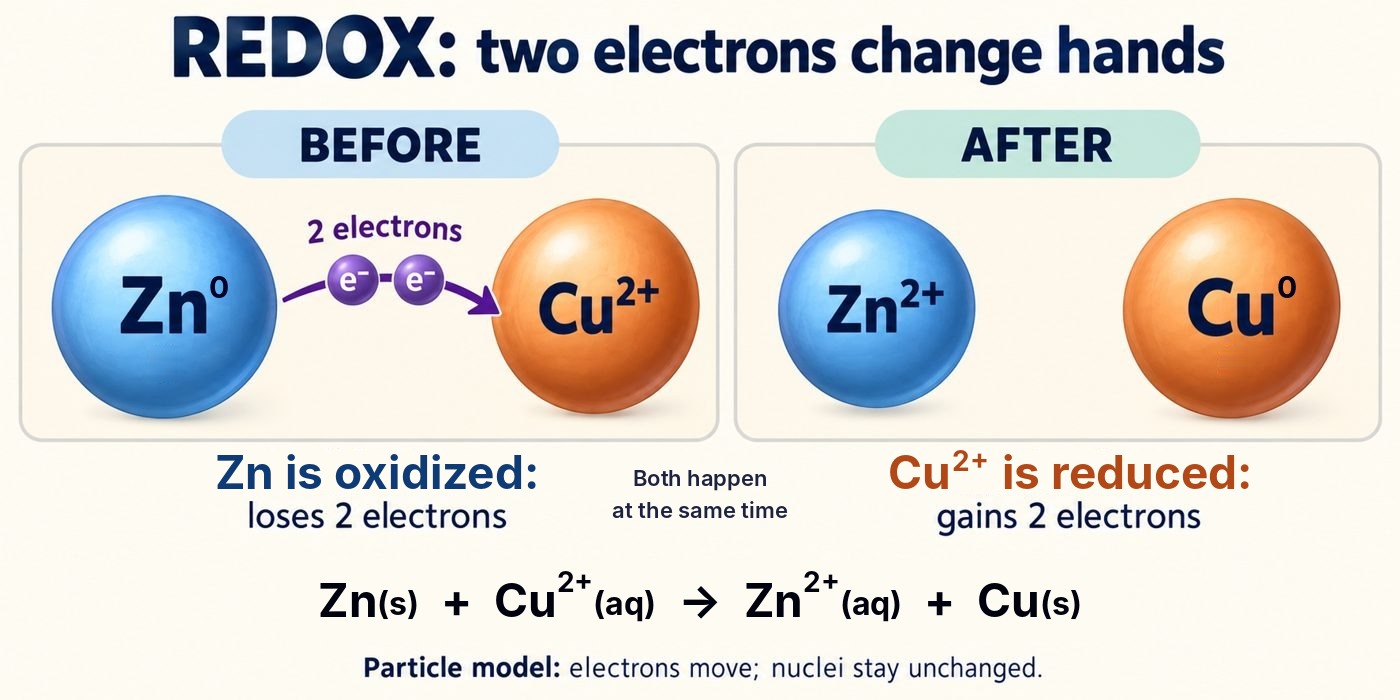
Zinc loses two electrons to become Zn²⁺; copper ions gain those two electrons to become copper. Nuclei remain unchanged.
Oxidation and reduction are paired: the 2 electrons zinc loses are the 2 that Cu2+ gains. Nuclei do not change.
Zn + Cu2+ → Zn2+ + Cu, split in two
Zn → Zn2+ + 2e−   (oxidation)
Cu2+ + 2e− → Cu   (reduction)
They happen together. Proton counts do not change.
Assigning oxidation numbers
RuleExample
An element alone is 0.Zn metal: 0; Cu metal: 0
A monatomic ion has its ion charge.Zn2+: +2; Cl−: −1
In a compound or polyatomic ion, the numbers add up to the overall charge.SO42−: S + 4(−2) = −2, so S = +6
Oxygen is usually −2.O in SO42−: −2
Read the change on a number line
−10+1+2+3oxidation numberZn: 0 → +2 · oxidation · loses 2e−Cu: +2 → 0 · reduction · gains 2e−
Up the line is oxidation; down the line is reduction.
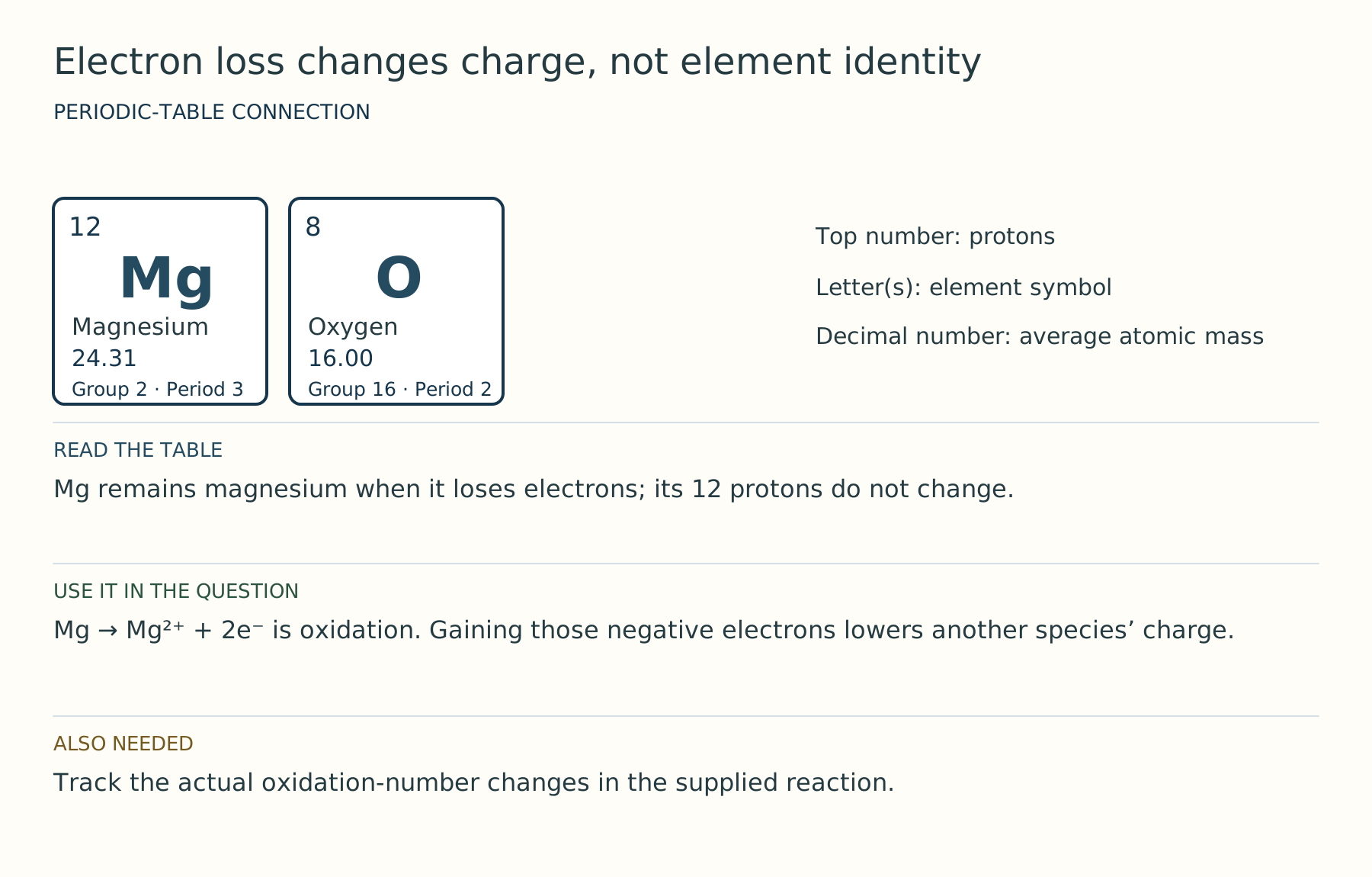
Periodic-table tiles for magnesium (12, Mg, 24.31) and oxygen (8, O, 16.00). Notes say Mg keeps its 12 protons when it loses electrons, and Mg → Mg²⁺ + 2e⁻ is oxidation.
A second case: Mg → Mg2+ + 2e− is oxidation. Mg keeps its 12 protons, so the element does not change.

On the periodic table: zinc (Zn) is atomic number 30 and copper (Cu) is 29. Atomic number does not change in redox.

On the periodic table: Magnesium (Mg) is atomic number 12, so Mg2+ still has 12 protons.

Worked example · 4 steps

In Zn + Cu2+ → Zn2+ + Cu, identify oxidation and reduction.

  1. 1
    Track zinc

    Its oxidation number increases. More positive means it lost electrons.

    Zn: 0 → +2
  2. 2
    Name zinc’s change

    Oxidation means electron loss.

    Zn → Zn2+ + 2e−   oxidation
  3. 3
    Track copper

    Its oxidation number decreases as it gains electrons.

    Cu: +2 → 0
  4. 4
    Name copper’s change

    Reduction means electron gain. Cu2+ accepts electrons, so it is the oxidizing agent.

    Cu2+ + 2e− → Cu   reduction
  5. ✓
    Answer

    Zinc is oxidized and copper(II) is reduced. Cu2+ is the oxidizing agent.

    ChangeElectrons
    Zn0 → +2 (oxidized)2 lost
    Cu+2 → 0 (reduced)2 gained
    The two electron counts match.
Your turn

Redox practice problems

Answer first, then check. Hints open one at a time; the answer and full solution open after you try.

Problem 1 of 3 · warm-up

In Al + 3Ag+ → Al3+ + 3Ag, which reactant is oxidized?

Hint 1 · the clue

An electron-transfer reaction is given.

Hint 2 · the next move

Asking which reactant is oxidized means tracking oxidation numbers: the one whose number goes up loses electrons.

Your path:

  1. Assign oxidation numbers on both sides
  2. Al: 0 → +3, number goes up
  3. Going up means oxidized
Answer

Answer: Al

Full worked solution

What you know: Al + 3Ag+ → Al3+ + 3Ag. What you want: the reactant that is oxidized.

  1. Assign oxidation numbers. An element alone is 0, and a monatomic ion has its ion charge.
  2. Track Al: 0 → +3. It increases, so Al loses 3 electrons. That is oxidation.
  3. Track Ag: +1 → 0. It decreases, so Ag+ gains electrons. That is reduction.
  4. The oxidized reactant is Al.

Check: Electrons lost equal electrons gained: Al loses 3, and 3 Ag+ each gain 1.

Watch out: Losing electrons makes the number go up, not down. Electrons are negative.

Your route: Compare oxidation numbers → Increase means oxidation

On the periodic table: Aluminum (Al) is in Group 13 and loses 3 electrons, so it forms Al³⁺.

Answer: Al

YOUR PERIODIC-TABLE REFERENCE

13AlAluminum26.98Group 13 · Period 3

Atomic number identifies proton count. The decimal mass is an average, not an isotope’s mass number. Use supplied rounded masses when a problem gives them.

Problem 2 of 3

Assign oxygen −2 in ClO3−. What is chlorine’s oxidation number?

Hint 1 · the clue

An ion charge and oxygen assignment are supplied.

Hint 2 · the next move

An oxidation number inside a charged polyatomic ion is asked: the numbers must add up to the ion's charge.

Your path:

  1. Let Cl = x
  2. Sum: x + 3(−2) = ion charge −1
  3. Solve for x
Answer

Answer: +5

Full worked solution

What you know: ClO3− has an overall charge of −1, and each O is −2. What you want: the oxidation number of Cl.

  1. In a polyatomic ion, the oxidation numbers add up to the ion's charge. Let Cl = x.
  2. Set up the sum: x + 3(−2) = −1, so x − 6 = −1.
  3. Add 6 to both sides: x = −1 + 6 = +5.

Check: (+5) + 3(−2) = +5 − 6 = −1, the ion's charge.

Watch out: The sum equals −1, not 0. Setting it to 0 gives +6, which is wrong for an ion.

Your route: Sum oxidation numbers → Equal species charge

On the periodic table: Oxygen (O) is in Group 16, so it usually takes −2, the same as the charge of its O²⁻ ion.

Answer: +5

Problem 3 of 3

Mg → Mg2+: oxidation or reduction?

Hint 1 · the clue

Compare oxidation numbers before and after: an increase means oxidation; a decrease means reduction.

Hint 2 · the next move

A single atom changes to an ion, and you must name the change: track its oxidation number.

Your path:

  1. Mg is 0; Mg2+ is +2
  2. Number goes up → loses electrons
  3. Losing electrons is oxidation
Answer

Oxidation: loses electrons and its oxidation number increases.

Full worked solution

What you know: Mg → Mg2+. What you want: oxidation or reduction.

  1. Assign oxidation numbers. Mg alone is an element, so it is 0. Mg2+ is a monatomic ion, so it is +2.
  2. The number goes from 0 to +2. An increase means oxidation.
  3. To become more positive, Mg must lose 2 electrons: Mg → Mg2+ + 2e−. So it is Oxidation: Mg loses electrons and its oxidation number increases.

Check: Charge balances: 0 on the left; (+2) + 2(−1) = 0 on the right.

Watch out: Gaining a positive charge comes from losing electrons, not gaining protons. Mg keeps its 12 protons.

Answer: Oxidation: loses electrons and its oxidation number increases.

Watch out

Common redox mistakes