ChemGem

How to Calculate Molarity (Step-by-Step, with Practice)

A solution has a dissolved substance spread evenly through a liquid. Molarity (molar concentration, M) says how many moles of that substance sit in each liter of solution. This lesson calculates molarity from moles and liters.

Spot it, solve it, practice it: 3 steps, 1 worked example, 8 practice problems. Free, no account.

The route · 3 steps

  1. Find the moles of solute and the solution volume.
  2. Convert the volume to liters.
  3. Divide moles by liters.
Spot it

How to recognize molarity questions

Look for moles (or grams) of solute plus a solution volume, and a question asking for molarity, M, or moles from M and volume.

Example wording, with the clue words marked:

Equal volumes of 0.100 M and 0.200 M solutions: equal moles?

Not sure it’s this type? Compare the neighbors:

Step-by-step

Worked example: molarity

The idea

Three words for one mixture
TermMeaningSalt water
SoluteWhat dissolvesNaCl
SolventWhat it dissolves inWater
SolutionTheir uniform mixtureSalt water
Molarity = moles of solute ÷ liters of solution
M = n (mol)V (L)
M is concentration in mol/L. n is moles of solute. V is the total solution volume, in liters.
Need moles instead? Multiply.
n = M × V    molL × L = mol
Liters cancel and moles remain.
Same 0.30 mol of solute, three solution volumes
in 0.300 L1.0 Min 0.600 L0.50 Min 1.20 L0.25 MMolarity (mol/L)
More volume spreads the same moles thinner, so molarity falls.
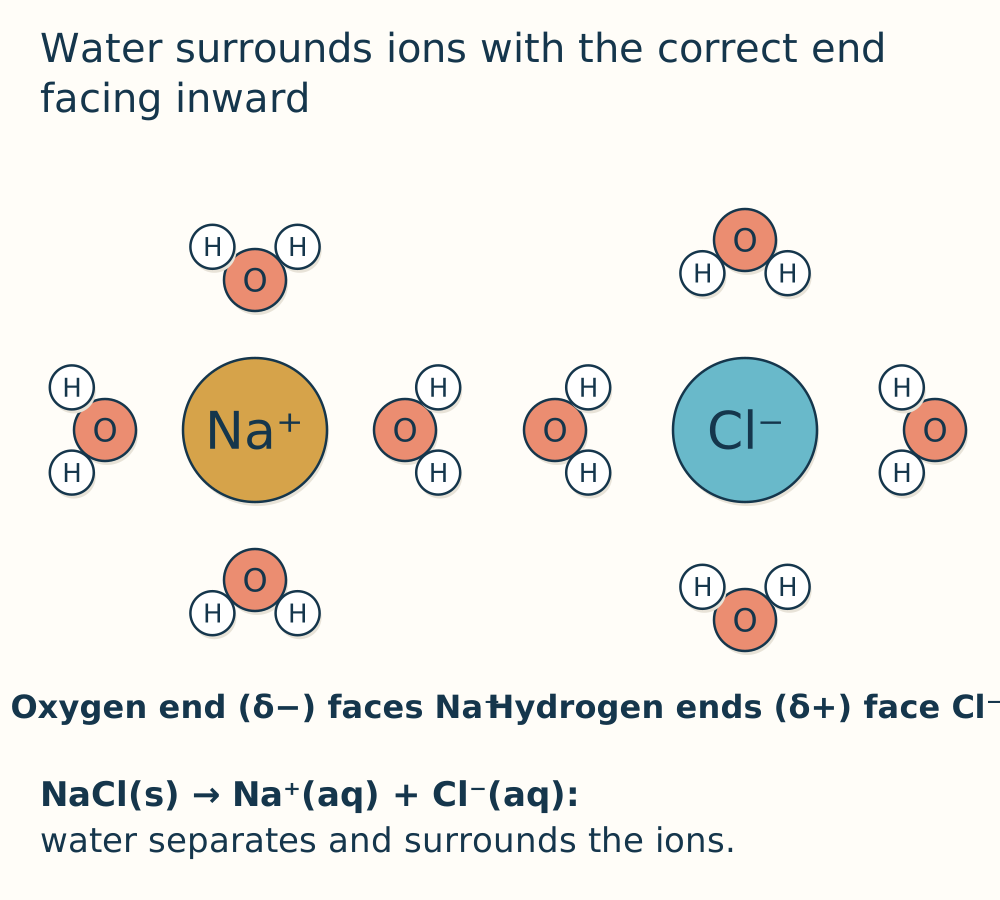
Water surrounds ions with the correct end facing inward. Four nearby water molecules are schematic, not a fixed hydration number. Water is polar; NaCl does not become neutral Na and Cl atoms.
Water is polar; its matching end faces each ion. Four water molecules are schematic, not a fixed number. NaCl does not become neutral Na and Cl atoms.
Molarity counts solute, not particle type
Sugar
Stays as whole molecules.
NaCl
Separates into ions:
NaCl → Na+ + Cl−
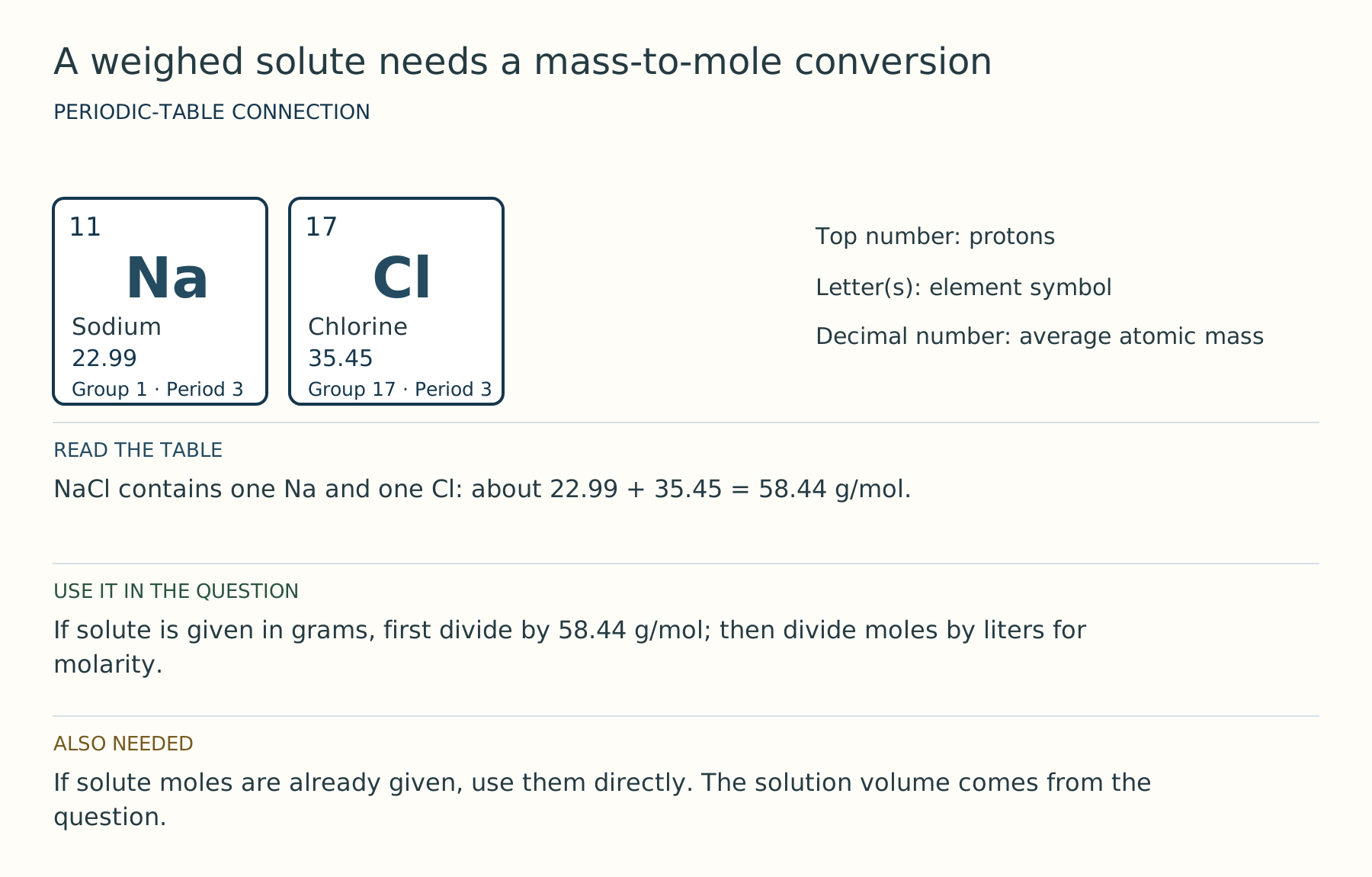
A weighed solute needs a mass-to-mole conversion. NaCl contains one Na and one Cl: about 22.99 + 35.45 = 58.44 g/mol. If solute is given in grams, first divide by 58.44 g/mol; then divide moles by liters for molarity. If solute moles are already given, use them directly. The solution volume comes from the question.
Solute given in grams? Divide by molar mass first (NaCl: 58.44 g/mol), then by liters. Moles given? Use them directly. Use supplied masses when a question gives them.

On the periodic table: sodium (Na) is in Group 1, so it forms Na+. Chlorine (Cl) is in Group 17, so it forms Cl−.

On the periodic table: Molar masses come from the table: Na 22.99 and Cl 35.45, so NaCl is 22.99 + 35.45 = 58.44 g/mol.

On the periodic table: Atomic number gives the proton count (Na 11, Cl 17). The decimal mass is an average, not an isotope’s mass number.

Worked example · 4 steps

Find molarity for 0.30 mol solute in 600 mL of solution.

The solute is unspecified and its moles are supplied, so no molar mass is needed. Conversion factor: 1 L / 1000 mL.

  1. 1
    Convert the volume

    Molarity uses liters of final solution, not milliliters.

    600 mL × 1 L1000 mL = 0.600 L
  2. 2
    Write the relationship

    n is solute moles; V is liters of solution.

    M = nV
  3. 3
    Divide

    Moles per liter is the requested concentration.

    M = 0.30 mol0.600 L = 0.50 mol/L
  4. 4
    Write the short unit

    Capital M is short for molarity.

    0.50 mol/L = 0.50 M
  5. ✓
    Answer

    0.50 M

Your turn

Molarity practice problems

Answer first, then check. Hints open one at a time; the answer and full solution open after you try.

Problem 1 of 8 · warm-up

Equal volumes of 0.100 M and 0.200 M solutions: equal moles?

Hint 1 · the clue

Moles = molarity × volume.

Hint 2 · the next move

Same volume but different molarity, asking about moles: that signals using moles = M × V for each.

Your path:

  1. Write moles = M × V for each
  2. Volume is the same for both
  3. Higher M → more moles
Answer

Answer: No

Full worked solution

What you know: equal volumes, one 0.100 M and one 0.200 M. What you want: whether the moles are equal.

  1. Use n = M × V for each. Call the shared volume V.
  2. First solution: 0.100 mol/L × V. Second: 0.200 mol/L × V.
  3. The second has twice the molarity at the same volume, so it holds twice the moles. The answer is No.

Check: Try V = 1.00 L: 0.100 mol versus 0.200 mol.

Watch out: Equal volumes need not mean equal moles. Molarity tells you how much solute is packed into each liter.

Answer: No

Problem 2 of 8

A solution contains 1.2 mol solute in 2.4 L solution. What is molarity?

Hint 1 · the clue

Moles and solution volume are given.

Hint 2 · the next move

Moles of solute and liters of solution are given, and molarity is asked: divide moles by liters.

Your path:

  1. Check the volume is in liters
  2. Molarity = moles ÷ liters
Answer

Answer: 0.50 M

Full worked solution

What you know: 1.2 mol solute in 2.4 L of solution. What you want: molarity.

  1. Molarity means moles of solute per liter of solution: M = moles ÷ liters.
  2. The volume is already in liters, so divide: 1.2 mol ÷ 2.4 L = 0.50 mol/L = 0.50 M. Keep two significant figures, matching the data.

Check: 2.4 L is twice 1.2, so the answer is one half: 0.50 × 2.4 = 1.2 mol.

Watch out: Divide moles by liters, not liters by moles. Flipping it gives 2 L/mol, which is not a molarity.

Your route: Moles ÷ Liters of solution

Answer: 0.50 M

Problem 3 of 8

A solution contains 1.4 mol solute in 2.8 L solution. What is molarity?

Hint 1 · the clue

Moles and solution volume are given.

Hint 2 · the next move

Moles of solute and liters of solution are given, and molarity is asked: divide moles by liters.

Your path:

  1. Check the volume is in liters
  2. Molarity = moles ÷ liters
Answer

Answer: 0.50 M

Full worked solution

What you know: 1.4 mol solute in 2.8 L of solution. What you want: molarity.

  1. Molarity means moles of solute per liter of solution: M = moles ÷ liters.
  2. The volume is already in liters, so divide: 1.4 mol ÷ 2.8 L = 0.50 mol/L = 0.50 M. Keep two significant figures, matching the data.

Check: 2.8 L is twice 1.4, so the answer is one half: 0.50 × 2.8 = 1.4 mol.

Watch out: Divide moles by liters, not liters by moles. Flipping it gives 2 L/mol, which is not a molarity.

Your route: Moles ÷ Liters of solution

Answer: 0.50 M

Problem 4 of 8

0.3 mol solute is in 600 mL solution. What is molarity?

Hint 1 · the clue

The solution volume is in milliliters.

Hint 2 · the next move

Moles are given but volume is in mL, and molarity is asked: convert to liters first, then divide.

Your path:

  1. Change mL to L (÷ 1000)
  2. Molarity = moles ÷ liters
Answer

Answer: 0.5 M

Full worked solution

What you know: 0.3 mol solute in 600 mL of solution. What you want: molarity.

  1. Molarity uses liters, so convert: 600 mL × (1 L / 1000 mL) = 0.6 L. The mL units cancel.
  2. Divide moles by liters: 0.3 mol ÷ 0.6 L = 0.5 mol/L = 0.5 M.

Check: 0.5 mol/L × 0.6 L = 0.3 mol, the amount given.

Watch out: Dividing by 600 mL gives 0.0005, which is 1000 times too small.

Your route: mL ÷ 1000 → Moles ÷ L

Answer: 0.5 M

Problem 5 of 8

0.35 mol solute is in 700 mL solution. What is molarity?

Hint 1 · the clue

The solution volume is in milliliters.

Hint 2 · the next move

Moles are given but volume is in mL, and molarity is asked: convert to liters first, then divide.

Your path:

  1. Change mL to L (÷ 1000)
  2. Molarity = moles ÷ liters
Answer

Answer: 0.50 M

Full worked solution

What you know: 0.35 mol solute in 700 mL of solution. What you want: molarity.

  1. Molarity uses liters, so convert: 700 mL × (1 L / 1000 mL) = 0.700 L. The mL units cancel.
  2. Divide moles by liters: 0.35 mol ÷ 0.700 L = 0.50 mol/L = 0.50 M. Keep two significant figures, matching 0.35 mol.

Check: 0.50 mol/L × 0.700 L = 0.35 mol, the amount given.

Watch out: Dividing by 700 mL gives 0.0005, which is 1000 times too small.

Your route: mL ÷ 1000 → Moles ÷ L

Answer: 0.50 M

Problem 6 of 8

How many moles are in 0.2 L of 4 M solution?

Hint 1 · the clue

A concentration and a volume are given.

Hint 2 · the next move

Liters and molarity are given, and moles are asked: multiply molarity by liters.

Your path:

  1. Read M as mol per liter
  2. Moles = M × liters
Answer

Answer: 0.8 mol

Full worked solution

What you know: 0.2 L of 4 M solution. What you want: moles of solute.

  1. 4 M means 4 mol of solute in every liter of solution.
  2. Use n = M × V: 4 mol/L × 0.2 L = 0.8 mol. The L units cancel, leaving mol.

Check: 0.2 L is less than 1 L, so the moles should be less than 4. 0.8 is less than 4.

Watch out: Multiply, do not divide. 4 ÷ 0.2 gives 20, which has the wrong units.

Your route: Molarity × Liters → Moles

Answer: 0.8 mol

Problem 7 of 8

How many moles are in 0.2 L of 4.5 M solution?

Hint 1 · the clue

A concentration and a volume are given.

Hint 2 · the next move

Liters and molarity are given, and moles are asked: multiply molarity by liters.

Your path:

  1. Read M as mol per liter
  2. Moles = M × liters
Answer

Answer: 0.9 mol

Full worked solution

What you know: 0.2 L of 4.5 M solution. What you want: moles of solute.

  1. 4.5 M means 4.5 mol of solute in every liter of solution.
  2. Use n = M × V: 4.5 mol/L × 0.2 L = 0.9 mol. The L units cancel, leaving mol.

Check: 0.2 L is less than 1 L, so the moles should be less than 4.5. 0.9 is less than 4.5.

Watch out: Multiply, do not divide. 4.5 ÷ 0.2 gives 22.5, which has the wrong units.

Your route: Molarity × Liters → Moles

Answer: 0.9 mol

Problem 8 of 8

0.20 mol in 400 mL: molarity?

Hint 1 · the clue

Convert solution volume to liters, then divide solute moles by solution liters.

Hint 2 · the next move

Moles and a volume in mL are given, and molarity is asked: convert mL to L, then divide.

Your path:

  1. Change mL to L (÷ 1000)
  2. Molarity = moles ÷ liters
Answer

400 mL = 0.400 L; 0.20/0.400 = 0.50 M.

Full worked solution

What you know: 0.20 mol solute in 400 mL of solution. What you want: molarity.

  1. Molarity uses liters of solution, so convert: 400 mL × (1 L / 1000 mL) = 0.400 L.
  2. Divide moles by liters: 0.20 mol ÷ 0.400 L = 0.50 M. Keep two significant figures, matching 0.20 mol.

Check: 0.50 mol/L × 0.400 L = 0.20 mol, the amount given.

Watch out: 0.20 ÷ 400 = 0.00050, which is 1000 times too small. Convert mL to L first.

Answer: 400 mL = 0.400 L; 0.20/0.400 = 0.50 M.

Watch out

Common molarity mistakes