ChemGem

How to Solve Titration Problems (Step-by-Step, with Practice)

Molarity turns a solution volume into moles. The balanced equation turns those into moles of another substance. A titration uses both steps to find an unknown amount.

Spot it, solve it, practice it: 4 steps, 1 worked example, 10 practice problems. Free, no account.

The route · 4 steps

  1. Convert volumes to liters.
  2. Find moles of the known: n = M × V.
  3. Use the balanced ratio for moles of the other.
  4. Convert to the volume or molarity asked for.
Spot it

How to recognize titration questions

Look for a volume and molarity of one solution, a second solution's molarity, and words like neutralized, titration, or mole ratio.

Example wording, with the clue words marked:

10.0 mL of 0.100 M HCl is neutralized by 0.200 M NaOH. Find NaOH volume; the ratio is 1:1.

Not sure it’s this type? Compare the neighbors:

Step-by-step

Worked example: titration

The idea

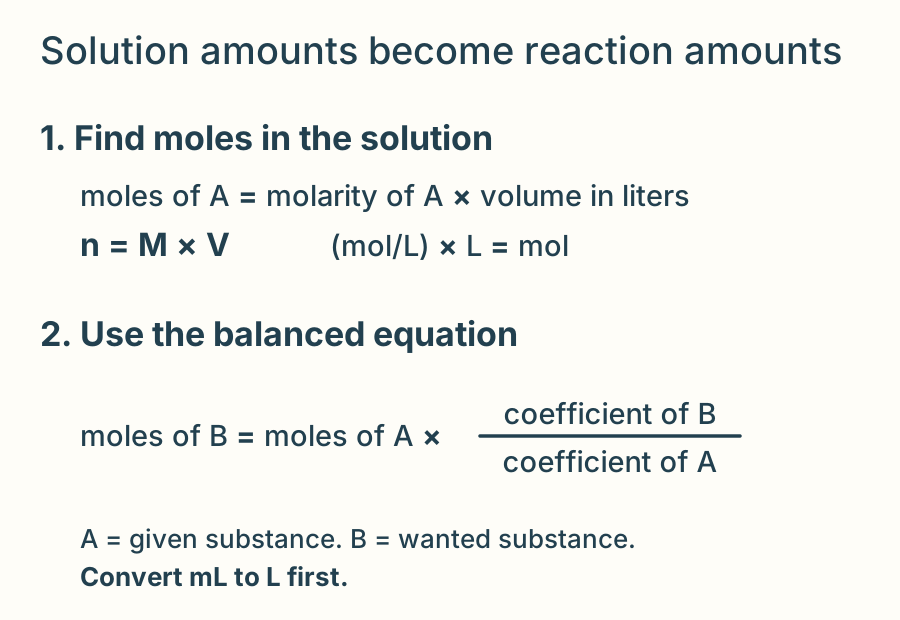
Moles in a solution = molarity × liters
n = M × V
n in moles, M in mol/L, V in liters. Convert mL to L first.
A two-step text diagram. Step 1 finds moles in the solution with n = M × V, volume in liters. Step 2 uses the balanced equation: moles of B = moles of A × (coefficient of B ÷ coefficient of A).
Volume → moles (n = M × V) → moles of the other substance (balanced ratio).
A titration setup
Buretteknown molarityvolume read hereFlaskmeasured sample+ indicatoradd drop by drop
Add the known solution until the indicator changes color.
Titration words
TermMeaning
TitrationFinds an unknown amount with a measured solution.
EquivalenceThe balanced mole ratio is met.
EndpointThe observed signal, such as an indicator color change.
At equivalence: reactants match the balanced mole ratio
MA × VAcoefficient A = MB × VBcoefficient B
Use liters for both volumes and the balanced coefficients.
Full neutralization ratios
AcidBalanced reactionAcid : NaOH
HClHCl + NaOH → NaCl + H2O1 : 1
H2SO4H2SO4 + 2NaOH → Na2SO4 + 2H2O1 : 2

On the periodic table: No table values are needed when molarity and volume are given.

On the periodic table: Given grams instead? Get molar mass from the periodic table first, e.g. NaOH: 22.99 + 16.00 + 1.008 = 40.00 g/mol.

Worked example · 4 steps

25.0 mL of 0.100 M HCl is titrated with 0.200 M NaOH. Find the moles of HCl and the NaOH volume needed.

  1. 1
    Convert the volume

    Molarity is per liter.

    25.0 mL × 1 L1000 mL = 0.0250 L
  2. 2
    Find moles of HCl

    Use n = M × V.

    nHCl = 0.100 molL × 0.0250 L = 0.00250 mol HCl
  3. 3
    Apply the 1 : 1 ratio

    HCl + NaOH → NaCl + H2O, so one NaOH per HCl.

    0.00250 mol HCl × 1 mol NaOH1 mol HCl = 0.00250 mol NaOH
  4. 4
    Find the NaOH volume

    Rearrange n = M × V to V = n ÷ M.

    V = 0.00250 mol0.200 mol/L = 0.0125 L = 12.5 mL
  5. ✓
    Answer

    0.00250 mol HCl, which needs 0.00250 mol NaOH, or 12.5 mL of 0.200 M NaOH

Your turn

Titration practice problems

Answer first, then check. Hints open one at a time; the answer and full solution open after you try.

Problem 1 of 10 · warm-up

10.0 mL of 0.100 M HCl is neutralized by 0.200 M NaOH. Find NaOH volume; the ratio is 1:1.

Hint 1 · the clue

Convert acid volume to liters before calculating moles.

Hint 2 · the next move

A known acid volume and M, a base M, and a mole ratio are given: that signals a titration volume problem.

Your path:

  1. Convert mL of acid to L
  2. Moles of HCl = M × V
  3. Use 1:1 ratio → moles of NaOH
  4. NaOH volume = moles ÷ M, then mL
Answer

Answer: 5.00 mL

Full worked solution

What you know: 10.0 mL of 0.100 M HCl; 0.200 M NaOH; HCl : NaOH = 1 : 1. What you want: the NaOH volume.

  1. Convert the acid volume to liters: 10.0 mL × (1 L / 1000 mL) = 0.0100 L.
  2. Find moles of HCl with n = M × V: 0.100 mol/L × 0.0100 L = 0.00100 mol HCl. The L units cancel.
  3. Use the 1 : 1 ratio: 0.00100 mol HCl needs 0.00100 mol NaOH.
  4. Find the base volume with V = n ÷ M: 0.00100 mol ÷ 0.200 mol/L = 0.00500 L. Then 0.00500 L × (1000 mL / 1 L) = 5.00 mL. Three significant figures, like the data.

Check: The base is twice as concentrated as the acid, so it needs half the volume: 10.0 ÷ 2 = 5.00 mL.

Watch out: Use liters in n = M × V. Using 10.0 mL directly gives moles 1000 times too big.

Answer: 5.00 mL

YOUR PERIODIC-TABLE REFERENCE

1HHydrogen1.008Group 1 · Period 1

Atomic number identifies proton count. The decimal mass is an average, not an isotope’s mass number. Use supplied rounded masses when a problem gives them.

Problem 2 of 10

20.0 mL of 0.100 M HCl is neutralized by 0.200 M NaOH. Find NaOH volume; the ratio is 1:1.

Hint 1 · the clue

Convert acid volume to liters before calculating moles.

Hint 2 · the next move

A known acid volume and M, a base M, and a mole ratio are given: that signals a titration volume problem.

Your path:

  1. Convert mL of acid to L
  2. Moles of HCl = M × V
  3. Use 1:1 ratio → moles of NaOH
  4. NaOH volume = moles ÷ M, then mL
Answer

Answer: 10.0 mL

Full worked solution

What you know: 20.0 mL of 0.100 M HCl; 0.200 M NaOH; HCl : NaOH = 1 : 1. What you want: the NaOH volume.

  1. Convert the acid volume to liters: 20.0 mL × (1 L / 1000 mL) = 0.0200 L.
  2. Find moles of HCl with n = M × V: 0.100 mol/L × 0.0200 L = 0.00200 mol HCl. The L units cancel.
  3. Use the 1 : 1 ratio: 0.00200 mol HCl needs 0.00200 mol NaOH.
  4. Find the base volume with V = n ÷ M: 0.00200 mol ÷ 0.200 mol/L = 0.0100 L. Then 0.0100 L × (1000 mL / 1 L) = 10.0 mL. Three significant figures, like the data.

Check: The base is twice as concentrated as the acid, so it needs half the volume: 20.0 ÷ 2 = 10.0 mL.

Watch out: Use liters in n = M × V. Using 20.0 mL directly gives moles 1000 times too big.

Answer: 10.0 mL

YOUR PERIODIC-TABLE REFERENCE

1HHydrogen1.008Group 1 · Period 1

Atomic number identifies proton count. The decimal mass is an average, not an isotope’s mass number. Use supplied rounded masses when a problem gives them.

Problem 3 of 10

30.0 mL of 0.100 M HCl is neutralized by 0.200 M NaOH. Find NaOH volume; the ratio is 1:1.

Hint 1 · the clue

Convert acid volume to liters before calculating moles.

Hint 2 · the next move

A known acid volume and M, a base M, and a mole ratio are given: that signals a titration volume problem.

Your path:

  1. Convert mL of acid to L
  2. Moles of HCl = M × V
  3. Use 1:1 ratio → moles of NaOH
  4. NaOH volume = moles ÷ M, then mL
Answer

Answer: 15.0 mL

Full worked solution

What you know: 30.0 mL of 0.100 M HCl; 0.200 M NaOH; HCl : NaOH = 1 : 1. What you want: the NaOH volume.

  1. Convert the acid volume to liters: 30.0 mL × (1 L / 1000 mL) = 0.0300 L.
  2. Find moles of HCl with n = M × V: 0.100 mol/L × 0.0300 L = 0.00300 mol HCl. The L units cancel.
  3. Use the 1 : 1 ratio: 0.00300 mol HCl needs 0.00300 mol NaOH.
  4. Find the base volume with V = n ÷ M: 0.00300 mol ÷ 0.200 mol/L = 0.0150 L. Then 0.0150 L × (1000 mL / 1 L) = 15.0 mL. Three significant figures, like the data.

Check: The base is twice as concentrated as the acid, so it needs half the volume: 30.0 ÷ 2 = 15.0 mL.

Watch out: Use liters in n = M × V. Using 30.0 mL directly gives moles 1000 times too big.

Answer: 15.0 mL

YOUR PERIODIC-TABLE REFERENCE

1HHydrogen1.008Group 1 · Period 1

Atomic number identifies proton count. The decimal mass is an average, not an isotope’s mass number. Use supplied rounded masses when a problem gives them.

Problem 4 of 10

40.0 mL of 0.100 M HCl is neutralized by 0.200 M NaOH. Find NaOH volume; the ratio is 1:1.

Hint 1 · the clue

Convert acid volume to liters before calculating moles.

Hint 2 · the next move

A known acid volume and M, a base M, and a mole ratio are given: that signals a titration volume problem.

Your path:

  1. Convert mL of acid to L
  2. Moles of HCl = M × V
  3. Use 1:1 ratio → moles of NaOH
  4. NaOH volume = moles ÷ M, then mL
Answer

Answer: 20.0 mL

Full worked solution

What you know: 40.0 mL of 0.100 M HCl; 0.200 M NaOH; HCl : NaOH = 1 : 1. What you want: the NaOH volume.

  1. Convert the acid volume to liters: 40.0 mL × (1 L / 1000 mL) = 0.0400 L.
  2. Find moles of HCl with n = M × V: 0.100 mol/L × 0.0400 L = 0.00400 mol HCl. The L units cancel.
  3. Use the 1 : 1 ratio: 0.00400 mol HCl needs 0.00400 mol NaOH.
  4. Find the base volume with V = n ÷ M: 0.00400 mol ÷ 0.200 mol/L = 0.0200 L. Then 0.0200 L × (1000 mL / 1 L) = 20.0 mL. Three significant figures, like the data.

Check: The base is twice as concentrated as the acid, so it needs half the volume: 40.0 ÷ 2 = 20.0 mL.

Watch out: Use liters in n = M × V. Using 40.0 mL directly gives moles 1000 times too big.

Answer: 20.0 mL

YOUR PERIODIC-TABLE REFERENCE

1HHydrogen1.008Group 1 · Period 1

Atomic number identifies proton count. The decimal mass is an average, not an isotope’s mass number. Use supplied rounded masses when a problem gives them.

Problem 5 of 10

50.0 mL of 0.100 M HCl is neutralized by 0.200 M NaOH. Find NaOH volume; the ratio is 1:1.

Hint 1 · the clue

Convert acid volume to liters before calculating moles.

Hint 2 · the next move

A known acid volume and M, a base M, and a mole ratio are given: that signals a titration volume problem.

Your path:

  1. Convert mL of acid to L
  2. Moles of HCl = M × V
  3. Use 1:1 ratio → moles of NaOH
  4. NaOH volume = moles ÷ M, then mL
Answer

Answer: 25.0 mL

Full worked solution

What you know: 50.0 mL of 0.100 M HCl; 0.200 M NaOH; HCl : NaOH = 1 : 1. What you want: the NaOH volume.

  1. Convert the acid volume to liters: 50.0 mL × (1 L / 1000 mL) = 0.0500 L.
  2. Find moles of HCl with n = M × V: 0.100 mol/L × 0.0500 L = 0.00500 mol HCl. The L units cancel.
  3. Use the 1 : 1 ratio: 0.00500 mol HCl needs 0.00500 mol NaOH.
  4. Find the base volume with V = n ÷ M: 0.00500 mol ÷ 0.200 mol/L = 0.0250 L. Then 0.0250 L × (1000 mL / 1 L) = 25.0 mL. Three significant figures, like the data.

Check: The base is twice as concentrated as the acid, so it needs half the volume: 50.0 ÷ 2 = 25.0 mL.

Watch out: Use liters in n = M × V. Using 50.0 mL directly gives moles 1000 times too big.

Answer: 25.0 mL

YOUR PERIODIC-TABLE REFERENCE

1HHydrogen1.008Group 1 · Period 1

Atomic number identifies proton count. The decimal mass is an average, not an isotope’s mass number. Use supplied rounded masses when a problem gives them.

Problem 6 of 10

How many mol NaOH fully neutralize 1 mol H2SO4?

Hint 1 · the clue

Count the H+ each H2SO4 can give. Each OH− takes one.

Hint 2 · the next move

Moles of base to fully neutralize an acid with two H means you need the balanced equation's mole ratio, not 1:1.

Your path:

  1. Count acidic H in H2SO4: two
  2. Balance: H2SO4 + 2NaOH → Na2SO4 + 2H2O
  3. Use the 2 : 1 mole ratio
Answer

Answer: 2 mol

Full worked solution

What you know: 1 mol H2SO4. What you want: moles of NaOH for full neutralization.

  1. Count the acidic H in H2SO4: there are 2. Each OH− neutralizes one H+.
  2. Write the balanced equation: H2SO4 + 2NaOH → Na2SO4 + 2H2O.
  3. Use the ratio: 1 mol H2SO4 × (2 mol NaOH / 1 mol H2SO4) = 2 mol.

Check: Atoms balance: 2 Na, 1 S, 6 O and 4 H on each side.

Watch out: Do not assume 1 : 1 for every acid. The 1 : 1 ratio is for HCl and NaOH.

Answer: 2 mol

YOUR PERIODIC-TABLE REFERENCE

1HHydrogen1.008Group 1 · Period 1
11NaSodium22.99Group 1 · Period 3
16SSulfur32.06Group 16 · Period 3

Atomic number identifies proton count. The decimal mass is an average, not an isotope’s mass number. Use supplied rounded masses when a problem gives them.

Problem 7 of 10

Is an endpoint identical by definition to equivalence?

Hint 1 · the clue

Equivalence comes from the mole ratio. The endpoint is what the indicator shows.

Hint 2 · the next move

Two titration terms are compared: recall what each one means, a seen signal versus an exact mole match.

Your path:

  1. Equivalence: base matches acid by mole ratio
  2. Endpoint: the color change you see
  3. A signal is not a ratio → answer No
Answer

Answer: No

Full worked solution

What you know: the definitions of endpoint and equivalence point. What you want: whether endpoint and equivalence mean the same thing.

  1. Equivalence is a stoichiometric condition: the added base exactly matches the acid in the balanced mole ratio.
  2. The endpoint is what you observe, such as an indicator changing color.
  3. A good indicator makes the endpoint land very close to equivalence. But one is a signal and the other is a mole ratio, so they are not identical by definition. The answer is No.

Why it matters: The endpoint is how you estimate equivalence in the lab.

Watch out: "Close in practice" is not the same as "the same by definition."

Answer: No

Problem 8 of 10

For HCl + NaOH → NaCl + H2O, what volume of 0.10 M NaOH neutralizes 45 mL of 0.20 M HCl?

Hint 1 · the clue

Concentrations and an acid amount are given.

Hint 2 · the next move

A base volume to neutralize a known acid volume and M is asked: that signals titration stoichiometry with the mole ratio.

Your path:

  1. Moles of HCl = M × liters
  2. Use the 1 : 1 ratio
  3. NaOH volume = moles ÷ its M
  4. Convert L back to mL
Answer

Answer: 90 mL

Full worked solution

What you know: 45 mL of 0.20 M HCl; 0.10 M NaOH; ratio 1 : 1. What you want: the NaOH volume.

  1. Find moles of HCl. Convert first: 45 mL × (1 L / 1000 mL) = 0.045 L. Then 0.20 mol/L × 0.045 L = 0.0090 mol HCl.
  2. The balanced equation is 1 : 1, so 0.0090 mol NaOH is needed.
  3. Find the base volume: 0.0090 mol ÷ 0.10 mol/L = 0.090 L. Convert: 0.090 L × (1000 mL / 1 L) = 90 mL.

Check: The base is half as concentrated as the acid, so it needs twice the volume: 2 × 45 mL = 90 mL.

Watch out: A less concentrated base means more volume, not less. If your answer is smaller than 45 mL, the division is upside down.

Your route: Balanced acid/base ratio → Moles acid → Base volume

Answer: 90 mL

Problem 9 of 10

For HCl + NaOH → NaCl + H2O, what volume of 0.10 M NaOH neutralizes 50 mL of 0.20 M HCl?

Hint 1 · the clue

Concentrations and an acid amount are given.

Hint 2 · the next move

A base volume to neutralize a known acid volume and M is asked: that signals titration stoichiometry with the mole ratio.

Your path:

  1. Moles of HCl = M × liters
  2. Use the 1 : 1 ratio
  3. NaOH volume = moles ÷ its M
  4. Convert L back to mL
Answer

Answer: 100 mL

Full worked solution

What you know: 50 mL of 0.20 M HCl; 0.10 M NaOH; ratio 1 : 1. What you want: the NaOH volume.

  1. Find moles of HCl. Convert first: 50 mL × (1 L / 1000 mL) = 0.050 L. Then 0.20 mol/L × 0.050 L = 0.010 mol HCl.
  2. The balanced equation is 1 : 1, so 0.010 mol NaOH is needed.
  3. Find the base volume: 0.010 mol ÷ 0.10 mol/L = 0.10 L. Convert: 0.10 L × (1000 mL / 1 L) = 100 mL.

Check: The base is half as concentrated as the acid, so it needs twice the volume: 2 × 50 mL = 100 mL.

Watch out: A less concentrated base means more volume, not less. If your answer is smaller than 50 mL, the division is upside down.

Your route: Balanced acid/base ratio → Moles acid → Base volume

Answer: 100 mL

Problem 10 of 10

25.0 mL of 0.100 M HCl is neutralized by 0.200 M NaOH (HCl : NaOH = 1 : 1). What volume of NaOH is needed?

Hint 1 · the clue

Convert each volume to liters and find moles with n = M × V. Use the balanced equation’s mole ratio to get moles of the other substance, then convert to the requested volume or amount.

Hint 2 · the next move

A known acid volume and M, a base M, and a mole ratio are given: that signals a titration volume problem.

Your path:

  1. Convert mL of acid to L
  2. Moles of HCl = M × V
  3. Use 1:1 ratio → moles of NaOH
  4. NaOH volume = moles ÷ M, then mL
Answer

25.0 mL of 0.100 M HCl contains 0.00250 mol HCl. It needs 0.00250 mol NaOH, or 12.5 mL of 0.200 M NaOH.

Full worked solution

What you know: 25.0 mL of 0.100 M HCl; 0.200 M NaOH; HCl : NaOH = 1 : 1. What you want: the NaOH volume.

  1. Convert to liters: 25.0 mL × (1 L / 1000 mL) = 0.0250 L.
  2. Find moles of acid with n = M × V: 0.100 mol/L × 0.0250 L = 0.00250 mol HCl.
  3. Use the 1 : 1 ratio: 0.00250 mol HCl needs 0.00250 mol NaOH.
  4. Find the base volume: 0.00250 mol ÷ 0.200 mol/L = 0.0125 L. Convert: 0.0125 L × (1000 mL / 1 L) = 12.5 mL of 0.200 M NaOH.

Check: The base is twice as concentrated, so it needs half the volume: 25.0 ÷ 2 = 12.5 mL.

Watch out: The ratio is not always 1 : 1. For H2SO4 and NaOH it is 1 : 2.

Answer: 25.0 mL of 0.100 M HCl contains 0.00250 mol HCl. It needs 0.00250 mol NaOH, or 12.5 mL of 0.200 M NaOH.

YOUR PERIODIC-TABLE REFERENCE

1HHydrogen1.008Group 1 · Period 1
11NaSodium22.99Group 1 · Period 3

Atomic number identifies proton count. The decimal mass is an average, not an isotope’s mass number. Use supplied rounded masses when a problem gives them.

Watch out

Common titration mistakes