
Problem 1 of 7 · warm-up
Will AgNO3(aq) + NaCl(aq) form a precipitate?
Hint 1 · the clue
Swap ion partners to make two new formulas. Check each one against the solubility rules, including the exceptions.
Hint 2 · the next move
Two aqueous salts are mixed and you are asked about a solid: that signals swapping partners and checking the solubility rules.
Your path:
- List the dissolved ions
- Swap partners to make two new compounds
- Check each with the solubility rules
- An insoluble one is the precipitate
Answer
Answer: Yes, AgCl(s)
Full worked solution
What you know: AgNO3(aq) and NaCl(aq) are mixed. What you want: whether a solid forms.
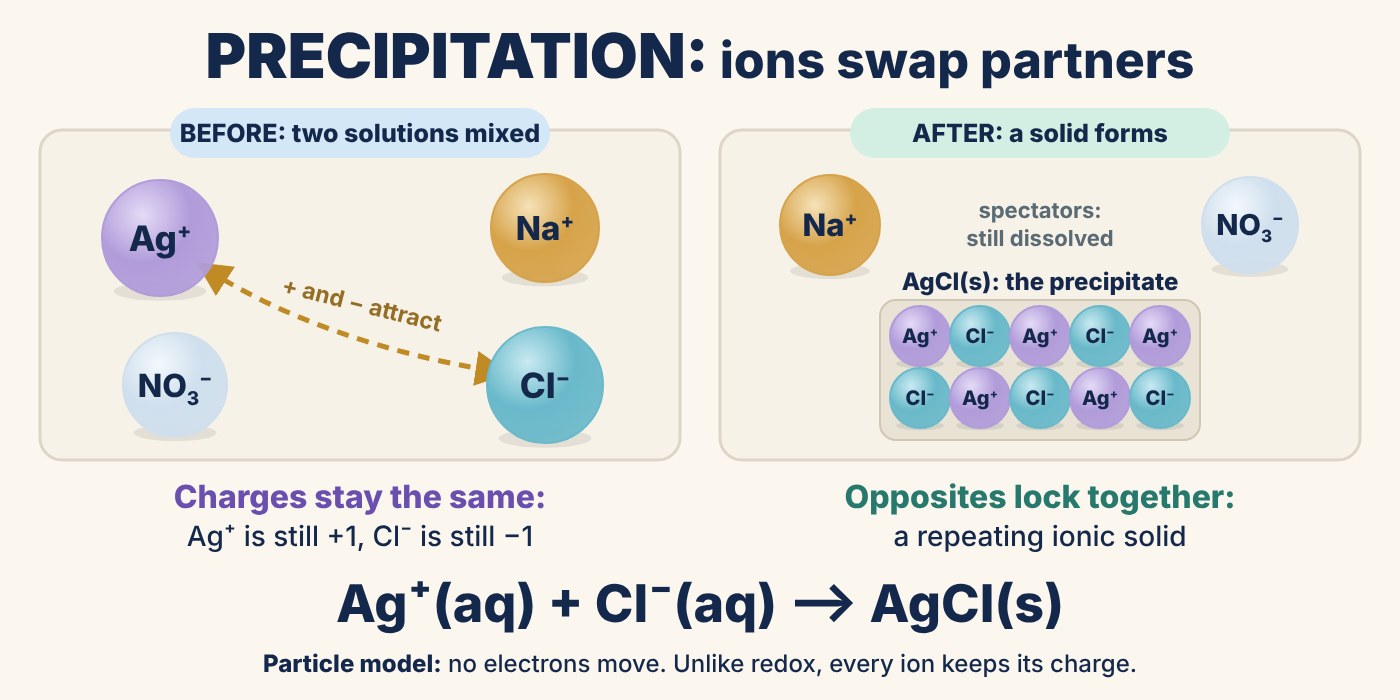
- List the dissolved ions: Ag+, NO3−, Na+, Cl−.
- Swap partners to get the two new neutral formulas: NaNO3 and AgCl.
- Check the solubility rules. NaNO3 is a nitrate and a Group 1 salt, so it dissolves. Most chlorides dissolve, but Ag+ is an exception to that rule.
- So a precipitate forms: Yes, AgCl(s).
Check: Ag+ (+1) and Cl− (−1) combine 1 : 1, so AgCl is neutral.
Watch out: "Chlorides dissolve" is not the whole rule. Always check the exceptions: Ag+, Pb2+, Hg22+.
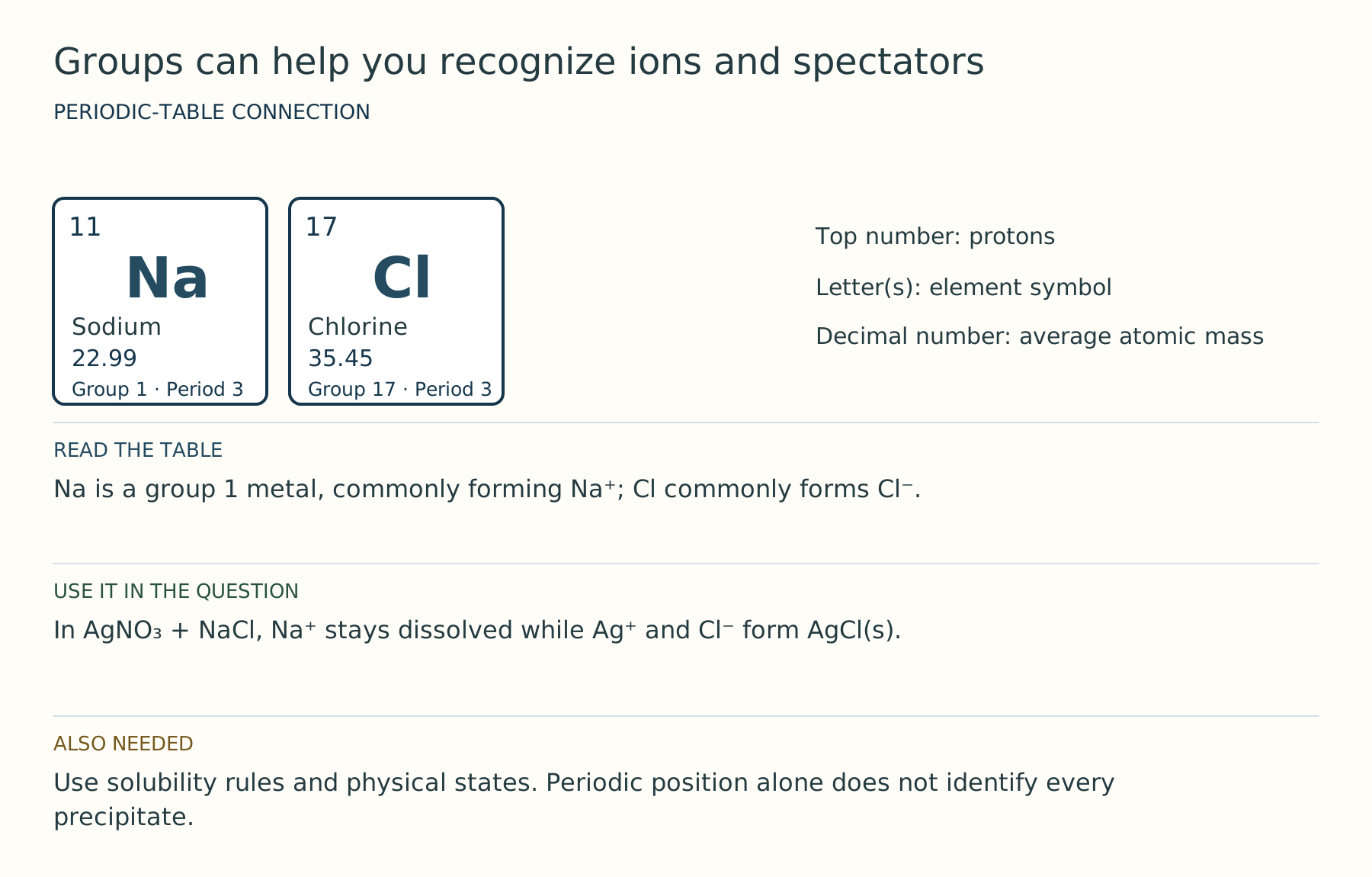
On the periodic table: Sodium (Na) is in Group 1, so it forms Na⁺. Chlorine (Cl) is in Group 17, so it forms Cl⁻.
Answer: Yes, AgCl(s)
YOUR PERIODIC-TABLE REFERENCE
Atomic number identifies proton count. The decimal mass is an average, not an isotope’s mass number. Use supplied rounded masses when a problem gives them.