
Chapter 7 · Free lesson
Heat and enthalpy
The full lesson, free. For instant answer checking, hints and progress tracking, open the interactive version.
What you will study
- Choose the system before choosing a sign
- Connecting heat to a temperature change
- Scaling and combining reaction energies
- Formation values and bond energies
By the end, you can…
- Choose the sign of heat for a stated system.
- Calculate heat from mass, specific heat, and temperature change.
- Adjust and combine reaction enthalpies.
- Calculate reaction enthalpy from formation enthalpies, or estimate it from bond energies.
These are the skills to check, not just pages to finish. Use the section goals while studying, then try the chapter checks without hints.
Read the idea first. Then notice the clue, follow the route, and make a choice you can explain. You can return to the worked example if a practice question feels unfamiliar.
7.1 Choose the system before choosing a sign
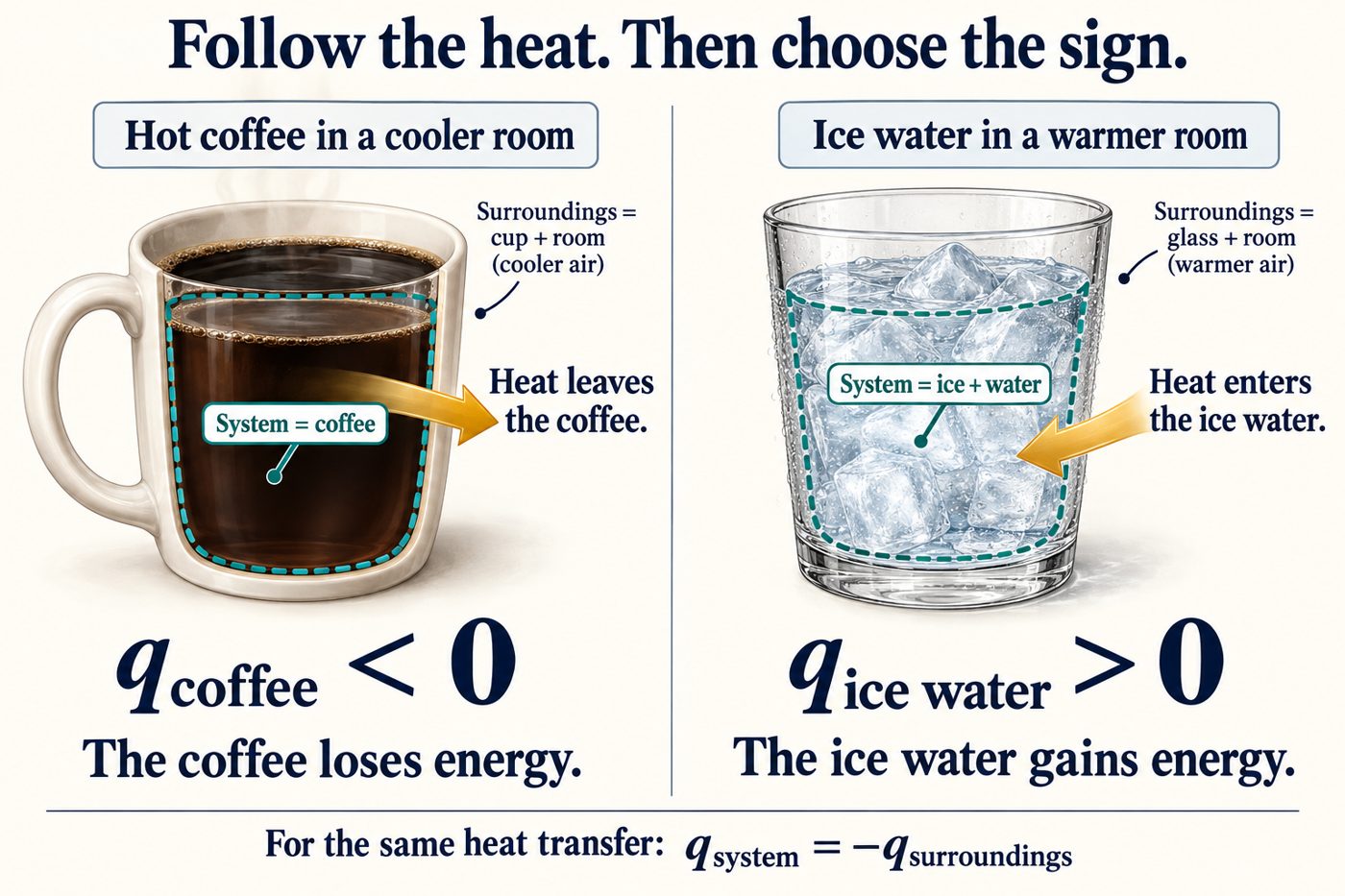
Every heat sign depends on what you call the system. Choose the system first, then ask whether heat leaves it or enters it.
- Heat flowing from a hotter object to a colder one (0.5).
Need a refresher? Open the table of contents and revisit that topic before starting.
| Heat flow | Name | Sign of q | Everyday case |
|---|---|---|---|
| Out of the system | Exothermic | q < 0 (negative) | Hot coffee cooling in a room |
| Into the system | Endothermic | q > 0 (positive) | Ice water warming in a room |
- Name the system.
- Decide whether heat leaves it or enters it.
- Leaving: q is negative (exothermic). Entering: q is positive (endothermic).
- Give the surroundings the same size with the opposite sign.
On the periodic table: H has atomic number 1 (its proton count) and average atomic mass 1.008 u. That decimal is an average, not an isotope’s mass number; use supplied rounded masses when a problem gives them.
On the periodic table: Heat signs need no periodic-table value: they come from the direction of heat flow.
A reaction releases 40 kJ to its surroundings. Assign the heat signs.
- 1Choose the reaction as the system
A sign describes heat entering or leaving the chosen system. Here heat moves out of the reaction.
Part Role Heat Reaction System Leaves (40 kJ out) Everything else Surroundings Enters (40 kJ in) - 2Write the reaction’s heat
Losing heat gives the reaction a negative q.
qreaction = −40 kJ - 3Write the surroundings’ heat
The surroundings receive that same heat, so their q is positive.
qsurroundings = −qreaction = −(−40 kJ) = +40 kJ - ✓Answer
qreaction = −40 kJ (exothermic); qsurroundings = +40 kJ
7.2 Connecting heat to a temperature change
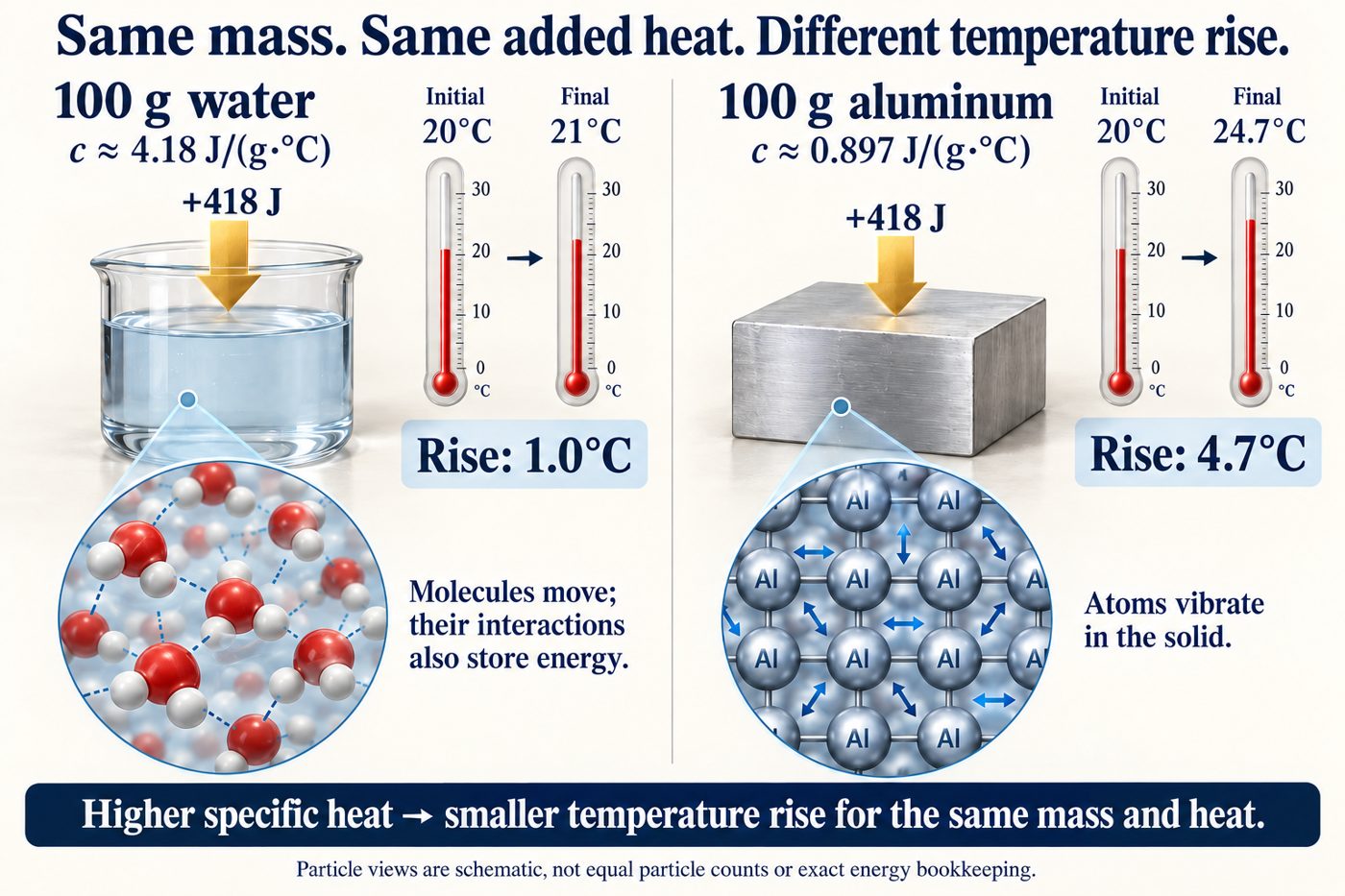
Warming or cooling a sample takes heat. How much depends on its mass, its specific heat and its temperature change, tied together by q = mcΔT.
- Unit conversions and solving for an unknown (Math first).
Need a refresher? Open the table of contents and revisit that topic before starting.
| Substance | c (J/(g·°C)) | Heat to warm 100 g by 1 °C |
|---|---|---|
| Water (liquid) | 4.184 | 418 J |
| Aluminum | 0.897 | 89.7 J |
| Iron | 0.449 | 44.9 J |
| Copper | 0.385 | 38.5 J |
- Warming gives positive q; cooling gives negative q.
- A temperature difference has the same value in kelvin and °C.
- Insulated calorimeter: heat lost = heat gained. Include the calorimeter’s heat capacity if given.
- Added energy speeds particles and changes their interactions. Temperature is not total energy.
- Heating speed also depends on heat transfer, size and surroundings.
- Find ΔT: final minus initial temperature.
- Multiply m × c × ΔT, or rearrange for the unknown.
- Check the sign and units; convert J to kJ if asked.
On the periodic table: The periodic table gives molar masses, not specific heats: H 1.008 and O 16.00 make H2O about 18.02 g/mol.
On the periodic table: Q = mcΔT uses the sample’s mass in grams. Specific heat is supplied or read from a data table.
Equal 100 g samples of water and aluminum each absorb 418 J. Which warms more? Use c = 4.18 J/(g·°C) for water and 0.90 J/(g·°C) for aluminum.
- 1Rearrange for ΔT
ΔT is the unknown.
ΔT = qm × c - 2Water
Grams and joules cancel, leaving °C.
ΔT = 418 J100 g × 4.18 J/(g·°C) = 1.0 °C - 3Aluminum
Rounded c gives 4.6 °C; c = 0.897 gives 4.7 °C.
ΔT = 418 J100 g × 0.90 J/(g·°C) ≈ 4.6 °CΔT = 418 J100 g × 0.897 J/(g·°C) ≈ 4.7 °C - 4Compare
Lower specific heat, bigger rise.
Sample (100 g) c (J/(g·°C)) ΔT for 418 J Water 4.18 1.0 °C Aluminum 0.90 (0.897) 4.6 °C (4.7 °C) - ✓Answer
Aluminum warms more (about 4.6 °C, or 4.7 °C with c = 0.897, vs 1.0 °C) because its specific heat is lower.
100.0 g of water warms from 20.00 °C to 25.00 °C. Use c = 4.184 J/(g·°C). Find the heat gained.
- 1Find the temperature change
Final minus initial, not the final temperature alone.
ΔT = 25.00 °C − 20.00 °C = 5.00 °C - 2Write the relationship
Multiply mass, specific heat and temperature change.
q = m × c × ΔT - 3Insert the values
Grams and °C cancel, leaving joules.
q = 100.0g× 4.184 Jg·°C× 5.00°C= 2092 J - 4Convert if needed
1 kJ = 1000 J. Round to three significant figures, matching 5.00 °C.
2092J× 1 kJ1000J≈ 2.09 kJ - ✓Answer
q ≈ +2.09 kJ (2092 J) gained
7.3 Scaling and combining reaction energies
ΔH belongs to a reaction exactly as written. Scale the equation and ΔH scales; reverse it and ΔH flips sign. Hess’s law then lets you add known reactions to reach one you need.
- Balanced equations and their coefficients (Chapter 5); heat signs (7.1).
Need a refresher? Open the table of contents and revisit that topic before starting.
| What you do to the equation | What happens to ΔH | Example |
|---|---|---|
| Use it as written | Keep ΔH | 2H2 + O2 → 2H2O ΔH = −571.6 kJ |
| Multiply every coefficient by a factor | Multiply ΔH by that factor | × ½: H2 + ½O2 → H2O ΔH = −285.8 kJ |
| Reverse it | Flip the sign | 2H2O → 2H2 + O2 ΔH = +571.6 kJ |
| Add equations | Add their ΔH values | Cancel any substance on both sides first |
- Match each supplied reaction to the target.
- Reverse or scale whole equations; adjust ΔH the same way.
- Cancel intermediates and add the ΔH values.
- Check the sum matches the target.
On the periodic table: H2, O2 and H2O are different substances made from the same elements; keep each formula intact when you scale or reverse.
On the periodic table: The periodic table gives H as atomic number 1, average mass 1.008 u (an average, not a mass number; use supplied rounded masses when given). Reaction enthalpies come from supplied energy data, not from the table.
A → B has ΔH = −30 kJ. B → C has ΔH = +10 kJ. Find ΔH for A → C, then C → A.
A, B and C are placeholder substances, not element symbols.
- 1Add the reaction steps
B is made in the first step and used in the second, so it cancels.
A →BB→ CA → C - 2Add their enthalpies
Keep each sign. The larger negative step keeps the sum negative.
ΔH = (−30 kJ) + (+10 kJ) = −20 kJ - 3Reverse for the second target
Reversing the reaction reverses the sign.
Reaction ΔH A → C −20 kJ C → A (reversed) +20 kJ - ✓Answer
A → C: ΔH = −20 kJ; C → A: ΔH = +20 kJ
7.4 Formation values and bond energies
Two tools give a reaction’s ΔH. Formation enthalpies give products minus reactants. Bond energies give an estimate: bonds broken minus bonds formed.
- Balanced equations (5.1). Each problem gives you the bonds to count.
Need a refresher? Open the table of contents and revisit that topic before starting.
| Substance | Type | ΔH°f (kJ/mol) |
|---|---|---|
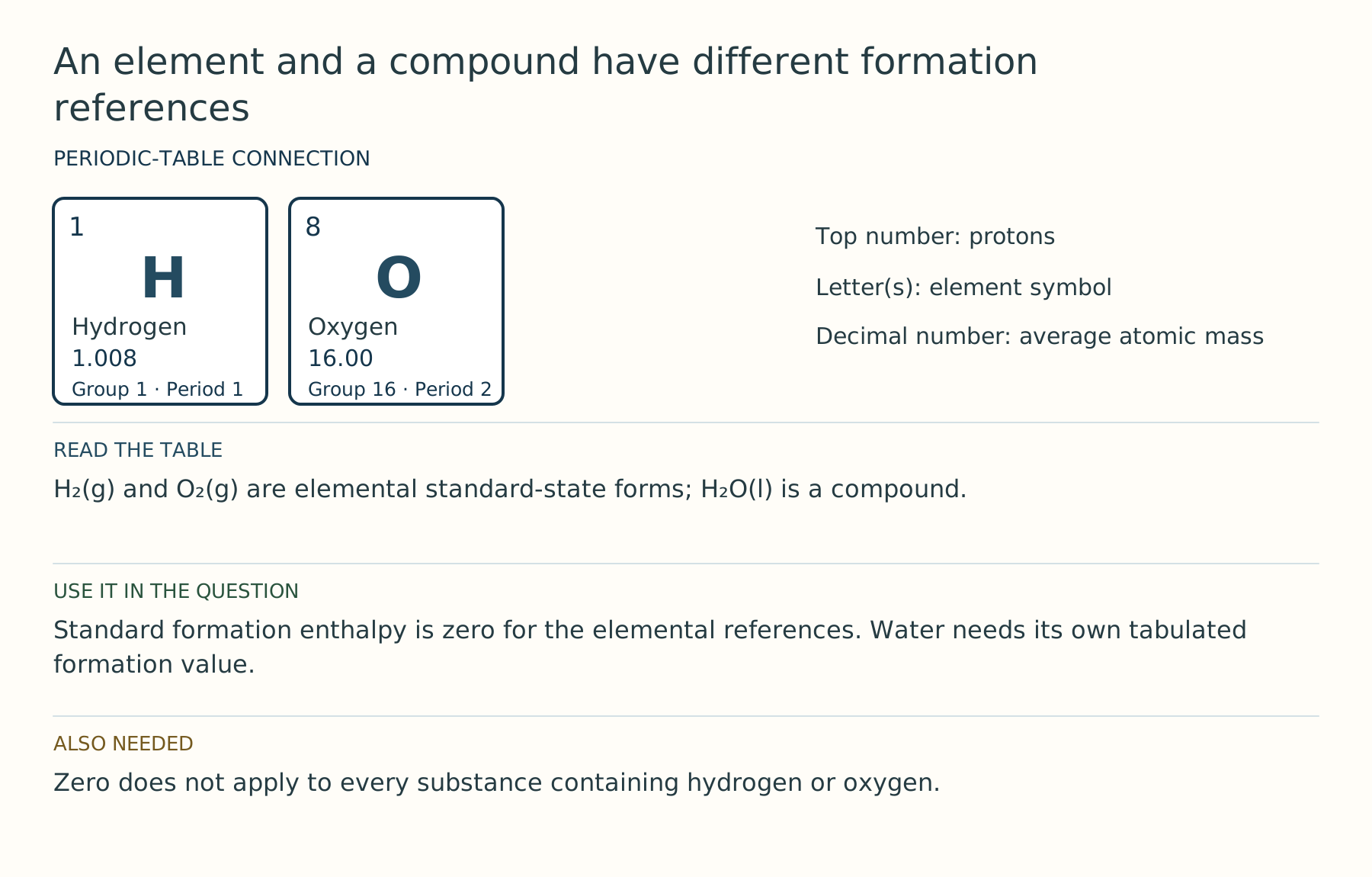
| H2(g) | Element, standard state | 0 |
| O2(g) | Element, standard state | 0 |
| H2O(l) | Compound | −285.8 |
- Check which data you are given: formation values or bond energies.
- Formation: multiply each ΔH°f by its coefficient; elements in standard states are 0.
- Take products − reactants.
- Bonds: total the bonds broken and the bonds formed, then take broken − formed.
On the periodic table: The periodic table identifies the elements: H is atomic number 1 (1.008 u); O is atomic number 8 (16.00 u). These decimals are averages, not mass numbers; use supplied rounded masses when given.
On the periodic table: It also tells you which species are elements, such as H2(g) and O2(g), whose ΔH°f is 0. Formation values and bond energies themselves come from supplied data.
Estimate ΔH for H2 + Cl2 → 2HCl. Bond energies: H–H 436, Cl–Cl 243, H–Cl 431 kJ/mol.
- 1Total the bonds broken
Every reactant bond must break.
Bond broken Count Energy (kJ/mol) Total (kJ) H–H 1 436 436 Cl–Cl 1 243 243 Sum 679 - 2Total the bonds formed
Two HCl molecules form two H–Cl bonds.
2 × 431 kJ = 862 kJ - 3Subtract
Broken minus formed.
ΔH ≈ 679 kJ − 862 kJ = −183 kJ - ✓Answer
ΔH ≈ −183 kJ: exothermic. More energy is released forming bonds than is spent breaking them.
Find ΔH for 2H2(g) + O2(g) → 2H2O(l). Use ΔH°f[H2O(l)] = −285.8 kJ/mol.
- 1Weight the product by its coefficient
The reaction makes 2 mol of water, so multiply its formation value by 2.
Products: 2mol× −285.8 kJmol= −571.6 kJ - 2Use the elemental references
H2(g) and O2(g) are elements in their standard states, so each is 0.
Reactant Coefficient ΔH°f (kJ/mol) Total (kJ) H2(g) 2 0 0 O2(g) 1 0 0 Sum 0 - 3Subtract reactants from products
Coefficient-weighted products minus reactants.
ΔH = (−571.6 kJ) − (0 kJ) = −571.6 kJ - ✓Answer
ΔH = −571.6 kJ for the reaction as written. Negative: heat is released.
Mixed chapter review
Answer in your notebook before revealing help. Keep your first attempt separate from an answer corrected with help.
Mixed chapter review · 13 questions · tap to open
What this set is for: problems from every section of the chapter, mixed together and not labeled, the way a test asks them. Your job is to pick the right method yourself. Do this before the skill check.
Practice 1
A reaction releases 45 kJ to the surroundings at constant pressure with only pressure–volume work. What is its ΔH?
Give me a hint
The reaction releases heat.
Check the answer
Answer: −45 kJ
Explain the worked problem to me
What you know: The reaction releases 45 kJ to the surroundings. Pressure is constant and only pressure–volume work happens. What you want: ΔH for the reaction.
- Choose the reaction as the system. The heat moves out of it, into the surroundings.
- Heat leaving the system means q is negative: qreaction = −45 kJ. The reaction is exothermic.
- At constant pressure with only pressure–volume work, q = ΔH. So ΔH = −45 kJ.
Check: The surroundings gain the same heat, so qsurroundings = +45 kJ. The two values are equal and opposite.
Watch out: Do not write +45 kJ just because the surroundings warm up. The sign belongs to the reaction, which lost energy.
Your route: Name reaction as system → Heat leaves → Negative
That’s right: −45 kJ
YOUR PERIODIC-TABLE REFERENCE
Atomic number identifies proton count. The decimal mass is an average, not an isotope’s mass number. Use supplied rounded masses when a problem gives them.
Practice 2
A reaction releases 50 kJ to the surroundings at constant pressure with only pressure–volume work. What is its ΔH?
Give me a hint
The reaction releases heat.
Check the answer
Answer: −50 kJ
Explain the worked problem to me
What you know: The reaction releases 50 kJ to the surroundings. Pressure is constant and only pressure–volume work happens. What you want: ΔH for the reaction.
- Choose the reaction as the system. The heat moves out of it, into the surroundings.
- Heat leaving the system means q is negative: qreaction = −50 kJ. The reaction is exothermic.
- At constant pressure with only pressure–volume work, q = ΔH. So ΔH = −50 kJ.
Check: The surroundings gain the same heat, so qsurroundings = +50 kJ. The two values are equal and opposite.
Watch out: Do not write +50 kJ just because the surroundings warm up. The sign belongs to the reaction, which lost energy.
Your route: Name reaction as system → Heat leaves → Negative
That’s right: −50 kJ
YOUR PERIODIC-TABLE REFERENCE
Atomic number identifies proton count. The decimal mass is an average, not an isotope’s mass number. Use supplied rounded masses when a problem gives them.
Practice 3
150 g of a material with c = 2.0 J/(g·°C) warms from 20°C to 24°C. What heat does it absorb?
Give me a hint
Mass, specific heat, and two temperatures are given.
Check the answer
Answer: 1200 J
Explain the worked problem to me
What you know: m = 150 g, c = 2.0 J/(g·°C), and the material warms from 20°C to 24°C. What you want: the heat q it absorbs.
- Find the temperature change as final minus initial: ΔT = 24°C − 20°C = 4°C. It is positive because the material warms.
- Use q = mcΔT, which fits because there is no phase change.
- Insert the values: q = 150 g × 2.0 J/(g·°C) × 4°C. Grams cancel and °C cancels, leaving joules. 150 × 2.0 = 300, and 300 × 4 = 1200. So q = 1200 J.
Check: Work backward: 1200 J ÷ (150 g × 2.0 J/(g·°C)) = 4°C, the temperature change you started with. The positive sign fits, since a warming material absorbs heat.
Watch out: Use the change in temperature (4°C), not the final temperature (24°C). Using 24 would give an answer six times too large.
Your route: Final minus initial → q = mcΔT
That’s right: 1200 J
YOUR PERIODIC-TABLE REFERENCE
Atomic number identifies proton count. The decimal mass is an average, not an isotope’s mass number. Use supplied rounded masses when a problem gives them.
Practice 4
175 g of a material with c = 2.0 J/(g·°C) warms from 20°C to 24°C. What heat does it absorb?
Give me a hint
Mass, specific heat, and two temperatures are given.
Check the answer
Answer: 1400 J
Explain the worked problem to me
What you know: m = 175 g, c = 2.0 J/(g·°C), and the material warms from 20°C to 24°C. What you want: the heat q it absorbs.
- Find the temperature change as final minus initial: ΔT = 24°C − 20°C = 4°C. It is positive because the material warms.
- Use q = mcΔT, which fits because there is no phase change.
- Insert the values: q = 175 g × 2.0 J/(g·°C) × 4°C. Grams cancel and °C cancels, leaving joules. 175 × 2.0 = 350, and 350 × 4 = 1400. So q = 1400 J.
Check: Work backward: 1400 J ÷ (175 g × 2.0 J/(g·°C)) = 4°C, the temperature change you started with. The positive sign fits, since a warming material absorbs heat.
Watch out: Use the change in temperature (4°C), not the final temperature (24°C). Using 24 would give an answer six times too large.
Your route: Final minus initial → q = mcΔT
That’s right: 1400 J
YOUR PERIODIC-TABLE REFERENCE
Atomic number identifies proton count. The decimal mass is an average, not an isotope’s mass number. Use supplied rounded masses when a problem gives them.
Practice 5
In an insulated reaction-water pair, water absorbs +220 J. Ignore the calorimeter. What is q for the reaction?
Give me a hint
The surrounding water warms in an insulated setup.
Check the answer
Answer: −220 J
Explain the worked problem to me
What you know: The setup is insulated, so no heat escapes. The water absorbs +220 J, and the calorimeter is ignored. What you want: q for the reaction.
- Separate the two parts. The reaction is the system. The water is the surroundings.
- In an insulated setup, heat lost equals heat gained. So qreaction = −qwater.
- Insert the value: qreaction = −(+220 J) = −220 J. The reaction released the heat that warmed the water.
Check: Add the two heats: −220 J + 220 J = 0. Nothing is lost in an insulated setup, so the total must be zero.
Watch out: The water's heat is not the reaction's heat. They have the same size but opposite signs.
Your route: Separate system and surroundings → Opposite heat signs
That’s right: −220 J
Practice 6
A → B has ΔH = −100 kJ. What is ΔH for B → A?
Give me a hint
The same reaction is reversed.
Check the answer
Answer: +100 kJ
Explain the worked problem to me
What you know: A → B has ΔH = −100 kJ. What you want: ΔH for B → A.
- Notice that B → A is the same reaction written backward. The starting and ending states swap.
- Enthalpy depends only on the starting and ending states. Swapping them reverses the sign of ΔH and keeps its size.
- So ΔH = −(−100 kJ) = +100 kJ.
Check: Go A → B and then back B → A: −100 kJ + 100 kJ = 0. You end where you began, so the total change must be zero.
Your route: Reverse reaction → Reverse ΔH sign
That’s right: +100 kJ
YOUR PERIODIC-TABLE REFERENCE
Atomic number identifies proton count. The decimal mass is an average, not an isotope’s mass number. Use supplied rounded masses when a problem gives them.
Practice 7
A → B has ΔH = −110 kJ. What is ΔH for B → A?
Give me a hint
The same reaction is reversed.
Check the answer
Answer: +110 kJ
Explain the worked problem to me
What you know: A → B has ΔH = −110 kJ. What you want: ΔH for B → A.
- Notice that B → A is the same reaction written backward. The starting and ending states swap.
- Enthalpy depends only on the starting and ending states. Swapping them reverses the sign of ΔH and keeps its size.
- So ΔH = −(−110 kJ) = +110 kJ.
Check: Go A → B and then back B → A: −110 kJ + 110 kJ = 0. You end where you began, so the total change must be zero.
Your route: Reverse reaction → Reverse ΔH sign
That’s right: +110 kJ
YOUR PERIODIC-TABLE REFERENCE
Atomic number identifies proton count. The decimal mass is an average, not an isotope’s mass number. Use supplied rounded masses when a problem gives them.
Practice 8
For A → B, ΔH = −100 kJ. What is ΔH for 3A → 3B?
Give me a hint
The reaction amounts are multiplied.
Check the answer
Answer: −300 kJ
Explain the worked problem to me
What you know: A → B has ΔH = −100 kJ. What you want: ΔH for 3A → 3B.
- Compare the equations. Every coefficient in 3A → 3B is 3 times the original. The direction is unchanged.
- ΔH is for the reaction exactly as written, so three times the amount releases three times the heat. Multiply ΔH by 3.
- ΔH = 3 × (−100 kJ) = −300 kJ.
Check: The sign stays negative because the reaction still runs forward. Only the size changes.
Watch out: Scaling does not flip the sign. Only reversing the reaction does that.
Your route: Scale all coefficients → Scale ΔH equally
That’s right: −300 kJ
YOUR PERIODIC-TABLE REFERENCE
Atomic number identifies proton count. The decimal mass is an average, not an isotope’s mass number. Use supplied rounded masses when a problem gives them.
Practice 9
For A → B, ΔH = −110 kJ. What is ΔH for 3A → 3B?
Give me a hint
The reaction amounts are multiplied.
Check the answer
Answer: −330 kJ
Explain the worked problem to me
What you know: A → B has ΔH = −110 kJ. What you want: ΔH for 3A → 3B.
- Compare the equations. Every coefficient in 3A → 3B is 3 times the original. The direction is unchanged.
- ΔH is for the reaction exactly as written, so three times the amount releases three times the heat. Multiply ΔH by 3.
- ΔH = 3 × (−110 kJ) = −330 kJ.
Check: The sign stays negative because the reaction still runs forward. Only the size changes.
Watch out: Scaling does not flip the sign. Only reversing the reaction does that.
Your route: Scale all coefficients → Scale ΔH equally
That’s right: −330 kJ
YOUR PERIODIC-TABLE REFERENCE
Atomic number identifies proton count. The decimal mass is an average, not an isotope’s mass number. Use supplied rounded masses when a problem gives them.
Practice 10
A → B has ΔH = −100 kJ and B → C has ΔH = +15 kJ. What is ΔH for A → C?
Give me a hint
Several reaction steps lead to a target.
Check the answer
Answer: −85 kJ
Explain the worked problem to me
What you know: A → B, ΔH = −100 kJ. B → C, ΔH = +15 kJ. What you want: ΔH for A → C.
- Match the target. A is a reactant in step 1 and C is a product in step 2, just as in A → C. So use both steps as written.
- Add the equations: A + B → B + C. B is made in step 1 and used in step 2, so it cancels, leaving A → C.
- Add the enthalpies with their signs: −100 kJ + 15 kJ = −85 kJ.
Check: The large negative step outweighs the small positive one, so the total should be negative and a bit smaller in size than 100. It is.
Watch out: Keep the + sign on 15. Subtracting it would give −115 kJ.
Your route: Add equations → Cancel intermediate → Add ΔH
That’s right: −85 kJ
YOUR PERIODIC-TABLE REFERENCE
Atomic number identifies proton count. The decimal mass is an average, not an isotope’s mass number. Use supplied rounded masses when a problem gives them.
Practice 11
A → B has ΔH = −110 kJ and B → C has ΔH = +15 kJ. What is ΔH for A → C?
Give me a hint
Several reaction steps lead to a target.
Check the answer
Answer: −95 kJ
Explain the worked problem to me
What you know: A → B, ΔH = −110 kJ. B → C, ΔH = +15 kJ. What you want: ΔH for A → C.
- Match the target. A is a reactant in step 1 and C is a product in step 2, just as in A → C. So use both steps as written.
- Add the equations: A + B → B + C. B is made in step 1 and used in step 2, so it cancels, leaving A → C.
- Add the enthalpies with their signs: −110 kJ + 15 kJ = −95 kJ.
Check: The large negative step outweighs the small positive one, so the total should be negative and a bit smaller in size than 110. It is.
Watch out: Keep the + sign on 15. Subtracting it would give −125 kJ.
Your route: Add equations → Cancel intermediate → Add ΔH
That’s right: −95 kJ
YOUR PERIODIC-TABLE REFERENCE
Atomic number identifies proton count. The decimal mass is an average, not an isotope’s mass number. Use supplied rounded masses when a problem gives them.
Practice 12
What standard formation enthalpy is assigned to C(s, graphite), an element in its standard state?
Give me a hint
6C12.01On the periodic table: Carbon (C) has its own box, atomic number 6, so C(s, graphite) is a pure element, not a compound.
Standard formation enthalpy of an element is asked.
Check the answer
Answer: 0 kJ/mol
Explain the worked problem to me
What you know: C(s, graphite) is the element carbon in its standard state. What you want: its standard formation enthalpy.
- Recall the definition. Standard formation enthalpy is the enthalpy change for making one mole of a substance from its elements in their standard states.
- Graphite already is carbon in its standard state. Making it from itself means no change at all.
- So the standard-state form of an element is the zero reference: ΔH°f = 0 kJ/mol.
Why it matters: This is why elements like O2(g) and C(s, graphite) count as zero when you take products minus reactants.
Watch out: The zero applies only to the standard-state form. A compound such as CO2 has a nonzero value.
Your route: Recognize element in standard state → Zero reference
That’s right: 0 kJ/mol
Practice 13
A bond-energy estimate needs 600 kJ to break bonds and releases 650 kJ when new bonds form. What is ΔH?
Give me a hint
Bond energy totals are supplied.
Check the answer
Answer: −50 kJ
Explain the worked problem to me
What you know: Breaking bonds takes 600 kJ. Forming new bonds releases 650 kJ. What you want: the estimated ΔH.
- Use the bond-energy estimate: ΔH ≈ Σ(bonds broken) − Σ(bonds formed). Energy goes in to break bonds and comes out when bonds form.
- Insert the totals: ΔH ≈ 600 kJ − 650 kJ = −50 kJ.
Check: More energy is released forming bonds than is spent breaking them, so the reaction gives off energy overall. A negative ΔH fits.
Watch out: Do not reverse the order. Formed minus broken would give +50 kJ, the wrong sign.
Your route: Energy to break → Minus energy released forming
That’s right: −50 kJ
YOUR PERIODIC-TABLE REFERENCE
Atomic number identifies proton count. The decimal mass is an average, not an isotope’s mass number. Use supplied rounded masses when a problem gives them.
Skill check: the chapter’s key skills
Try each fresh question without the worked examples. Record your first answer and whether you used a hint. Explain the route as well as the answer.
Skill check · 6 questions · tap to open
What this set is for: one question on each key skill from this chapter. Try each on your own, without hints, then mark how it went in the tracker below. A miss tells you which section to review.
Skill 1: Choose the sign of heat for a stated system.
Heat leaves the system. Sign of q?
Give me a hint
Identify the requested heat quantity and the appropriate relation. Keep units consistent and check whether energy enters or leaves the stated system.
Check the answer
Negative; the system loses energy.
Explain the worked problem to me
What you know: Heat leaves the system. What you want: the sign of q.
- Remember that q is defined from the system's point of view.
- Heat leaving the system means the system loses energy. That is an exothermic change.
- Losing energy gives a negative q. So q is negative; the system loses energy.
Why it matters: The surroundings gain that same heat, so their q is positive. For the same exchange, qsystem = −qsurroundings.
Watch out: Warmer surroundings do not mean a positive q for the system. Always ask which side you chose as the system.
That’s right: Negative; the system loses energy.
Skill 2: Calculate heat from mass, specific heat, and temperature change.
m = 10 g, c = 2.0 J/(g·°C), temperatures 20°C → 25°C. q?
Give me a hint
Find ΔT = final − initial first, then use q = mcΔT. The g and °C units cancel, leaving J.
Check the answer
ΔT = 5°C; q = 10 × 2.0 × 5 = +100 J.
Explain the worked problem to me
What you know: m = 10 g, c = 2.0 J/(g·°C), temperature goes from 20°C to 25°C. What you want: q.
- Find ΔT as final minus initial: 25°C − 20°C = 5°C.
- Use q = mcΔT, since the material warms with no phase change.
- Insert the values: q = 10 g × 2.0 J/(g·°C) × 5°C. Grams and °C cancel, leaving joules. 10 × 2.0 = 20, and 20 × 5 = 100. So ΔT = 5°C; q = 10 × 2.0 × 5 = +100 J.
Check: 100 J ÷ (10 g × 2.0 J/(g·°C)) = 5°C, which matches. q is positive because the material warms and absorbs heat.
Watch out: Use ΔT, not the final temperature of 25°C.
That’s right: ΔT = 5°C; q = 10 × 2.0 × 5 = +100 J.
YOUR PERIODIC-TABLE REFERENCE
Atomic number identifies proton count. The decimal mass is an average, not an isotope’s mass number. Use supplied rounded masses when a problem gives them.
Skill 3: Adjust and combine reaction enthalpies.
A reaction has ΔH = −30 kJ. Reverse it and double its coefficients. New ΔH?
Give me a hint
Handle one change at a time. Reversing a reaction flips the sign of ΔH; multiplying its coefficients multiplies ΔH by the same factor.
Check the answer
+60 kJ: reversing changes the sign; doubling scales the magnitude.
Explain the worked problem to me
What you know: The original reaction has ΔH = −30 kJ. What you want: ΔH after reversing it and doubling its coefficients.
- Reverse the reaction. Reversing swaps the starting and ending states, so the sign flips: −30 kJ becomes +30 kJ.
- Double the coefficients. Twice the amount means twice the heat: 2 × (+30 kJ) = +60 kJ.
- So the new ΔH is +60 kJ: reversing changes the sign; doubling scales the magnitude.
Check: Do the steps in the other order: 2 × (−30 kJ) = −60 kJ, then reverse to get +60 kJ. The order does not matter.
Watch out: Doubling never changes the sign. Only reversing does.
That’s right: +60 kJ: reversing changes the sign; doubling scales the magnitude.
Skill 4: Estimate a reaction enthalpy from bond energies.
Bonds broken require 500 kJ; bonds formed release 650 kJ. Estimated ΔH?
Give me a hint
Use ΔH ≈ Σ(bonds broken) − Σ(bonds formed), in that order.
Check the answer
500 − 650 = −150 kJ.
Explain the worked problem to me
What you know: Bonds broken require 500 kJ. Bonds formed release 650 kJ. What you want: the estimated ΔH.
- Use ΔH ≈ Σ(bonds broken) − Σ(bonds formed). Breaking bonds takes energy in. Forming bonds releases energy.
- Insert the totals: 500 − 650 = −150 kJ.
Check: Forming bonds releases more energy than breaking them costs, so the reaction is exothermic. A negative value fits.
Watch out: Bond energies are approximate gas-phase values, so this is an estimate. Also keep the order: broken minus formed, not the reverse.
That’s right: 500 − 650 = −150 kJ.
Skill 5: Calculate reaction enthalpy from formation enthalpies.
CH4(g) + 2O2(g) → CO2(g) + 2H2O(l). ΔH°f values: CH4 −75, CO2 −394, H2O(l) −286 kJ/mol. Find ΔH°rxn.
Give me a hint
O2 is an element in its standard state, so its value is 0. Multiply each value by its coefficient.
Check the answer
−891 kJ
Explain the worked problem to me
What you know: CH4(g) + 2O2(g) → CO2(g) + 2H2O(l). ΔH°f: CH4 −75, CO2 −394, H2O(l) −286 kJ/mol. What you want: ΔH°rxn.
- Note that O2(g) is an element in its standard state, so its ΔH°f = 0.
- Add the products, each times its coefficient: 1(−394) + 2(−286) = −394 − 572 = −966 kJ.
- Add the reactants the same way: 1(−75) + 2(0) = −75 kJ.
- Take products minus reactants: ΔH°rxn = −966 − (−75) = −966 + 75 = −891 kJ.
Check: Burning methane releases heat, so a large negative value makes sense.
Watch out: Two traps: forgetting to multiply −286 by 2, and dropping the double negative. Subtracting −75 means adding 75.
That’s right: −891 kJ
Skill 6: Combine two reactions to find a new reaction enthalpy.
Given (1) C(s) + O2(g) → CO2(g), ΔH = −394 kJ, and (2) CO(g) + ½O2(g) → CO2(g), ΔH = −283 kJ. Find ΔH for C(s) + ½O2(g) → CO(g).
Give me a hint
CO has to end up as a product. Which reaction should you reverse?
Check the answer
−111 kJ
Explain the worked problem to me
What you know: (1) C(s) + O2(g) → CO2(g), ΔH = −394 kJ. (2) CO(g) + ½O2(g) → CO2(g), ΔH = −283 kJ. What you want: ΔH for C(s) + ½O2(g) → CO(g).
- Match the target. C is a reactant in (1) and in the target, so keep (1) as written: ΔH = −394 kJ.
- CO must be a product, but it is a reactant in (2). Reverse (2): CO2(g) → CO(g) + ½O2(g). Reversing flips the sign: ΔH = +283 kJ.
- Add the equations. CO2 appears on both sides and cancels. O2: 1 on the left minus ½ on the right leaves ½O2 on the left. Result: C(s) + ½O2(g) → CO(g), the target.
- Add the enthalpies: −394 kJ + 283 kJ = −111 kJ.
Check: The final equation matches the target exactly, so the sum is the answer.
Watch out: Reverse the step's sign when you reverse its equation. Using −283 would give −677 kJ.
That’s right: −111 kJ
What to do next
Mark each skill: “I can do it independently,” “I needed help,” or “I need another explanation.” Revisit the section with the same goal for any skill needing help, then try a different question. A successful first attempt is evidence of progress; one answer alone does not establish lasting mastery.
Final coming up?
Take the 70-question practice final
Modeled on standardized first-term general chemistry finals: 70 questions, 110 minutes. Timed or untimed. Full feedback on every question, plus your score by topic. The first 20 are free; the full final is $7.99 for 2 weeks.
Original ChemGem questions.