ChemGem

How to Solve Dilution Problems (Step-by-Step, with Practice)

Dilution means adding solvent, usually water, without adding solute. The moles of solute stay the same while the volume grows, so the concentration falls. That one fact gives the dilution equation.

Spot it, solve it, practice it: 4 steps, 1 worked example, 3 practice problems. Free, no account.

The route · 4 steps

  1. Check that only solvent is added, so solute moles stay constant.
  2. Write M1V1 = M2V2 and solve for the unknown.
  3. Insert values with matching volume units.
  4. Check: lower concentration means larger final volume.
Spot it

How to recognize dilution questions

Look for a stock solution being diluted: a starting M and volume, plus a final M or final total volume to find.

Example wording, with the clue words marked:

80 mL of 2.0 M stock is diluted to 320 mL total volume. What is final concentration?

Not sure it’s this type? Compare the neighbors:

Step-by-step

Worked example: dilution

The idea

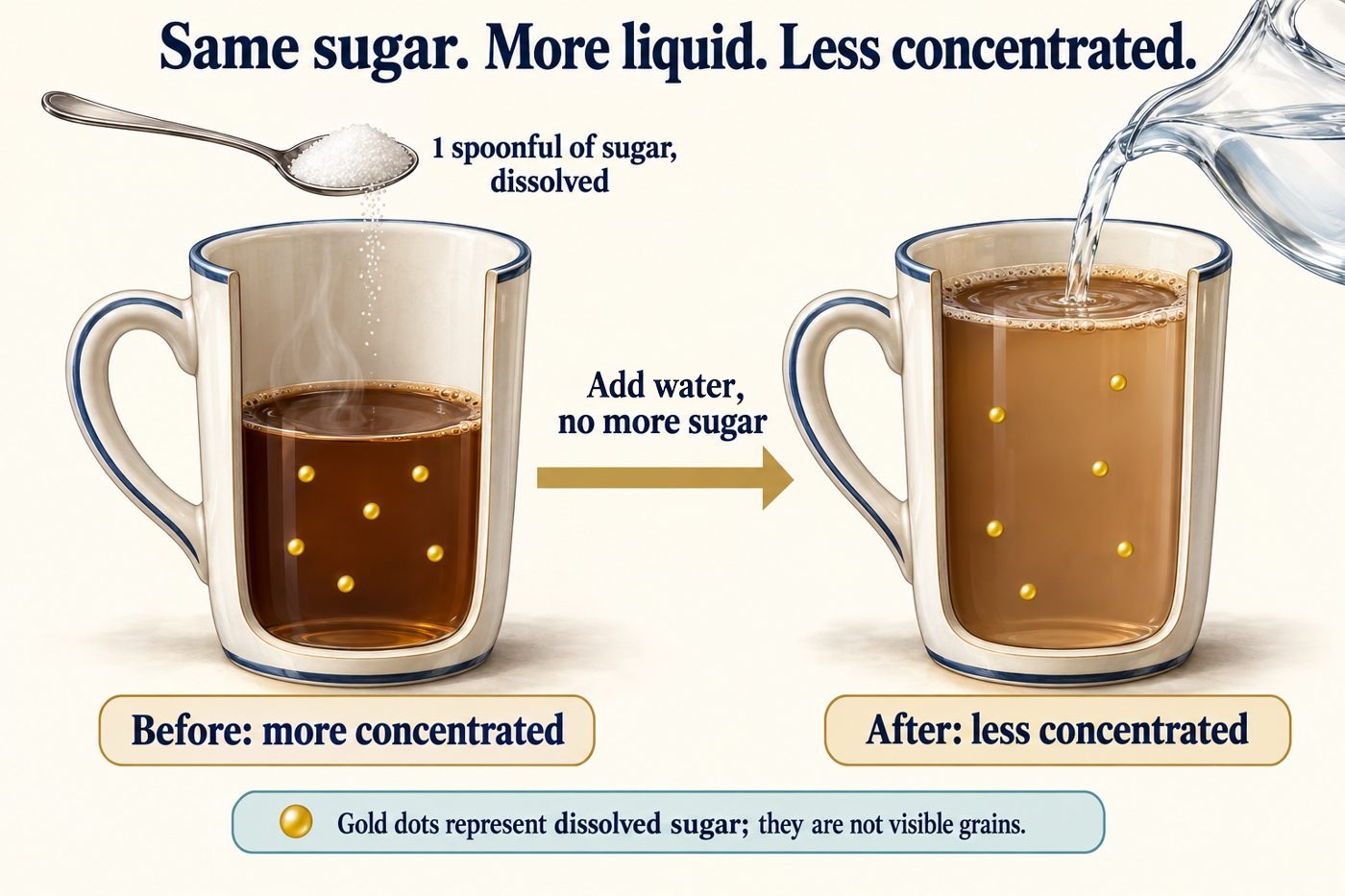
Before: one spoonful of sugar dissolved in half a cup of coffee, represented by six gold markers. After adding only water: a full cup with the same six sugar markers spread through more liquid. The sugar amount stays constant and its concentration decreases.
Same sugar, more liquid. Each gold dot is an equal amount of dissolved sugar. Adding water lowers the concentration. A second spoonful would add solute: a different comparison.
Before dilution = after dilution: same solute moles
M1V1 = M2V2
M is molarity; V is solution volume. Subscript 1 means before; 2 means after.
What changes and what does not
Before (1)After (2)
Solute moles0.100 mol0.100 mol
Volume50.0 mL200 mL
Molarity2.00 M0.500 M
Numbers from the worked example: 2.00 M × 0.0500 L = 0.500 M × 0.200 L = 0.100 mol.
Fixed solute moles: more volume, lower molarity
00.511.5201002003004000.100 mol solute50 mL, 2.00 M100 mL, 1.00 M200 mL, 0.500 MFinal volume (mL)Molarity (M)
Doubling the final volume halves the concentration.
Rules for using M1V1 = M2V2
  • Both volumes must use the same units (both mL or both L).
  • V2 is the final total volume, not the water added.
  • It applies to the same solute with no reaction and no loss.

On the periodic table: No element values are needed here. Concentrations and volumes supply M1V1 = M2V2.

Worked example · 4 steps

Dilute 50.0 mL of 2.00 M stock to 0.500 M. What final volume is needed?

  1. 1
    Name what stays constant

    Only solvent is added, so solute moles stay the same.

    moles before = moles after → M1V1 = M2V2
  2. 2
    Solve for final volume

    Divide both sides by the final concentration, M2.

    V2 = M1V1M2
  3. 3
    Insert the known values

    Both volumes can stay in mL because the units match.

    V2 = 2.00 M × 50.0 mL0.500 M
  4. 4
    Calculate and interpret

    Concentration becomes one quarter as large, so volume becomes four times as large.

    V2 = 2.00 × 10² mL final solution
  5. ✓
    Answer

    Bring the total solution volume to 2.00 × 10² mL (200 mL).

Your turn

Dilution practice problems

Answer first, then check. Hints open one at a time; the answer and full solution open after you try.

Problem 1 of 3 · warm-up

80 mL of 2.0 M stock is diluted to 320 mL total volume. What is final concentration?

Hint 1 · the clue

Only solvent is added.

Hint 2 · the next move

A stock is diluted to a new total volume and the new concentration is asked: that signals M1V1 = M2V2.

Your path:

  1. Solute moles stay the same
  2. Write M1V1 = M2V2
  3. Solve M2 = M1V1 ÷ V2
Answer

Answer: 0.50 M

Full worked solution

What you know: M1 = 2.0 M, V1 = 80 mL, V2 = 320 mL. What you want: M2.

  1. Only solvent is added, so solute moles stay the same. That gives M1V1 = M2V2.
  2. Solve for M2: M2 = M1V1 ÷ V2.
  3. Substitute: 2.0 M × 80 mL ÷ 320 mL = 160 ÷ 320 = 0.50 M (two significant figures, like 2.0 M). The mL units cancel, so you do not need to convert to liters here.

Check: The volume grew 4 times (320 ÷ 80 = 4), so the concentration drops to one quarter: 2.0 ÷ 4 = 0.50 M.

Watch out: V2 is the total final volume, 320 mL. Do not use the 240 mL of water added.

Your route: Same solute → M1V1 = M2V2

Answer: 0.50 M

Problem 2 of 3

90 mL of 2.0 M stock is diluted to 360 mL total volume. What is final concentration?

Hint 1 · the clue

Only solvent is added.

Hint 2 · the next move

A stock is diluted to a new total volume and the new concentration is asked: that signals M1V1 = M2V2.

Your path:

  1. Solute moles stay the same
  2. Write M1V1 = M2V2
  3. Solve M2 = M1V1 ÷ V2
Answer

Answer: 0.50 M

Full worked solution

What you know: M1 = 2.0 M, V1 = 90 mL, V2 = 360 mL. What you want: M2.

  1. Only solvent is added, so solute moles stay the same. That gives M1V1 = M2V2.
  2. Solve for M2: M2 = M1V1 ÷ V2.
  3. Substitute: 2.0 M × 90 mL ÷ 360 mL = 180 ÷ 360 = 0.50 M (two significant figures, like 2.0 M). The mL units cancel, so you do not need to convert to liters here.

Check: The volume grew 4 times (360 ÷ 90 = 4), so the concentration drops to one quarter: 2.0 ÷ 4 = 0.50 M.

Watch out: V2 is the total final volume, 360 mL. Do not use the 270 mL of water added.

Your route: Same solute → M1V1 = M2V2

Answer: 0.50 M

Problem 3 of 3

Dilute 20 mL of 2.0 M to 0.50 M. Final volume?

Hint 1 · the clue

Solute moles stay constant during dilution. Use M1V1 = M2V2 and isolate the requested value.

Hint 2 · the next move

A solution is diluted to a lower M and the final volume is asked: that signals M1V1 = M2V2.

Your path:

  1. Solute moles stay the same
  2. Write M1V1 = M2V2
  3. Solve V2 = M1V1 ÷ M2
Answer

2.0 × 20/0.50 = 80 mL final solution.

Full worked solution

What you know: M1 = 2.0 M, V1 = 20 mL, M2 = 0.50 M. What you want: V2, the final volume.

  1. Only solvent is added, so solute moles stay the same: M1V1 = M2V2.
  2. Divide both sides by M2: V2 = M1V1 ÷ M2.
  3. Substitute: 2.0 M × 20 mL ÷ 0.50 M = 40 ÷ 0.50 = 80 mL of final solution. The M units cancel, leaving mL.

Check: The concentration drops to one quarter (2.0 → 0.50), so the volume must grow 4 times: 4 × 20 = 80 mL.

Watch out: 80 mL is the total volume. You add only 80 − 20 = 60 mL of water.

Answer: 2.0 × 20/0.50 = 80 mL final solution.

Watch out

Common dilution mistakes