ChemGem

How to Write Acid–Base Neutralization Reactions (Step-by-Step, with Practice)

An acid in water makes hydronium, H3O+. A strong base releases hydroxide, OH−. Mixed, these two ions make water: neutralization.

Spot it, solve it, practice it: 3 steps, 1 worked example, 2 practice problems. Free, no account.

The route · 3 steps

  1. Acid in water: find H3O+.
  2. Base in water: find OH−.
  3. Combine only the ions that change.
Spot it

How to recognize neutralization questions

Look for an acid and a strong base mixed in water, asking which ions react, which are spectators, or what forms.

Example wording, with the clue words marked:

When dilute aqueous HCl and NaOH neutralize, which net ionic pair produces water?

Not sure it’s this type? Compare the neighbors:

Step-by-step

Worked example: neutralization

The idea

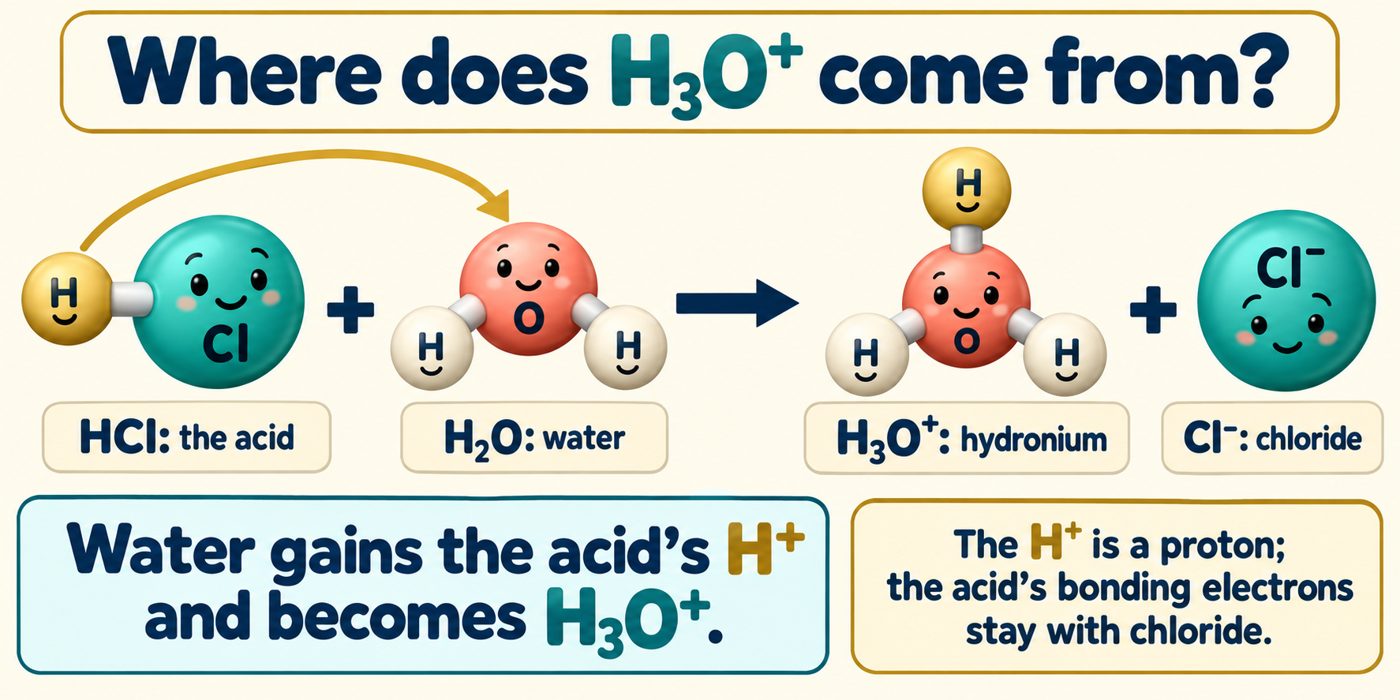
HCl transfers its gold hydrogen as H⁺ to H₂O, producing H₃O⁺ and Cl⁻.
1. Acid in water: the gold H moves from HCl to water.
HCl + H2O → H3O+ + Cl−
HCl donates H+, a proton. Water accepts it, becoming hydronium (+1).
Strong acid vs weak acid in water
Strong acid (HCl)
Essentially every molecule gives up its proton.
Holds H3O+ and Cl− in water.
Weak acid
Only some molecules do.
Holds many unchanged acid molecules.

H2SO4 is strong for its first proton only: H2SO4 + H2O → H3O+ + HSO4−.

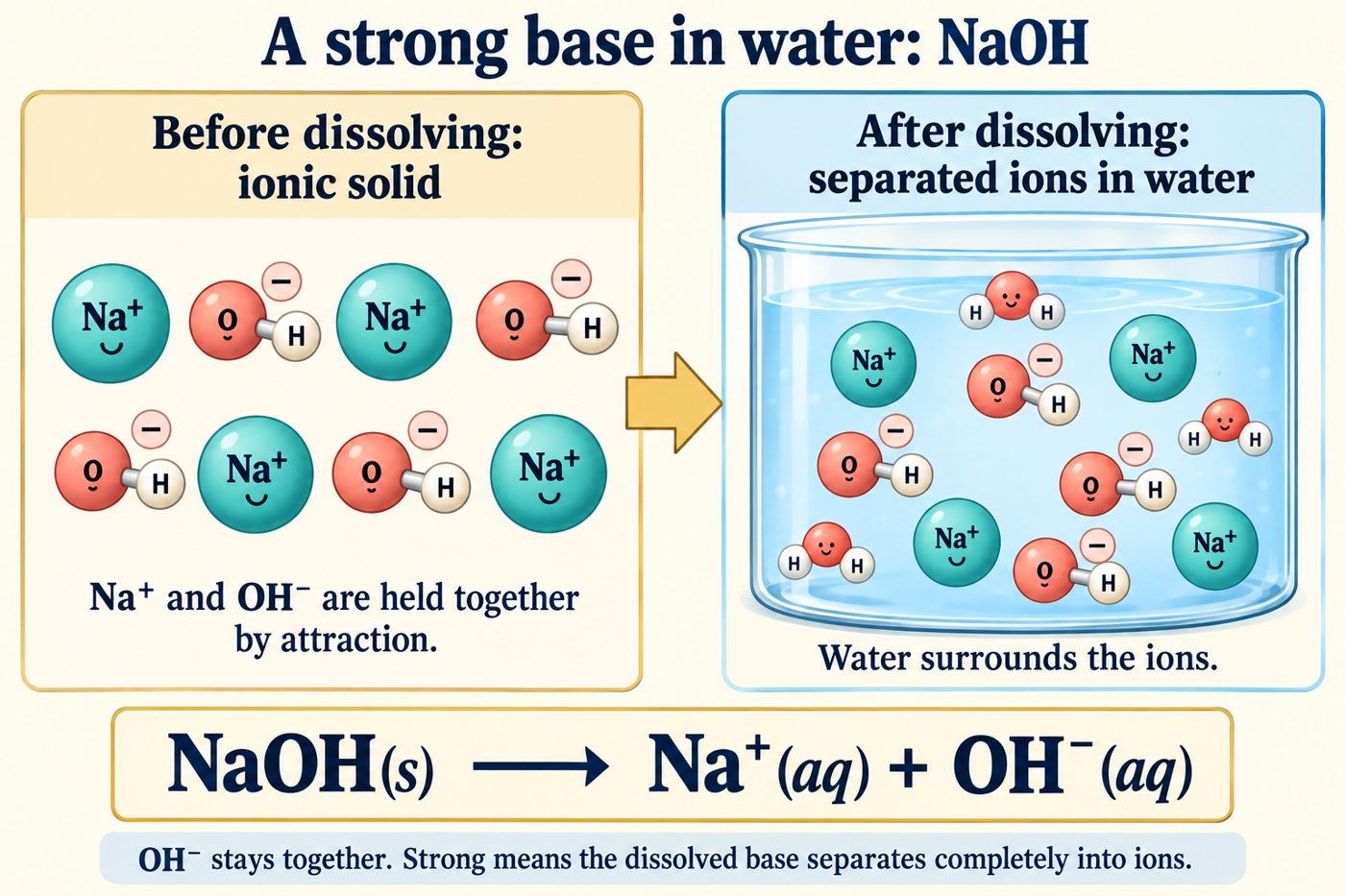
Left: Na⁺ and OH⁻ ions packed together in a solid. Right: the same ions spread apart in a beaker of water, with a few water molecules drawn among them.
2. Base in water: Na+ and OH− separate; OH− stays one ion.
NaOH(s) → Na+(aq) + OH−(aq)
NaOH is ionic: Na+ plus polyatomic OH−.
  • Base solutions are usually dissolved metal hydroxides.
  • Strong base: the dissolved part separates completely into ions.
  • “Strong” means full separation, not high concentration.
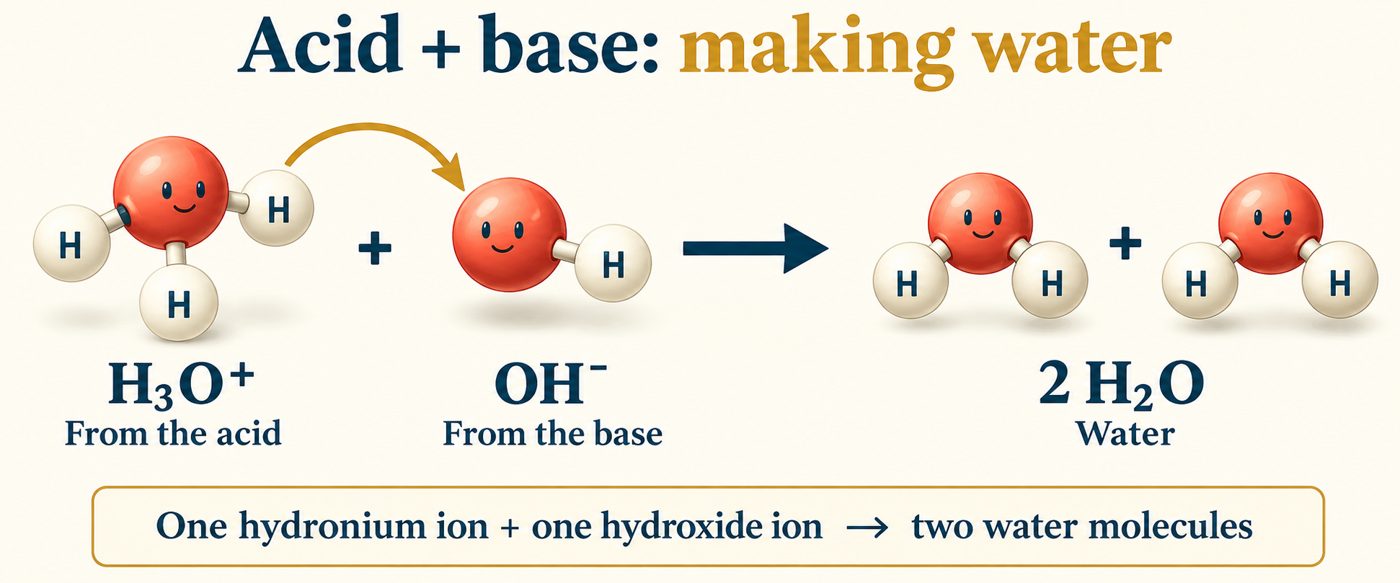
One H₃O⁺ and one OH⁻ react to form two H₂O molecules.
3. Mix: OH− takes H+ from H3O+. Two waters form; charges cancel.
Neutralization: HCl(aq) + NaOH(aq)
Full ionic: H3O+ + Cl− + Na+ + OH− → 2H2O + Cl− + Na+
Net ionic: H3O+ + OH− → 2H2O
Shorthand: H+ + OH− → H2O
Cross out unchanged Na+ and Cl− for the net ionic equation. H+ is shorthand for the proton in water.

On the periodic table: sodium (Na) is a Group 1 metal, so it forms Na+.

Worked example · 3 steps

Given H3O+ and OH−, find the product and balanced particle counts.

  1. 1
    Count the atoms

    Add up what the two ions bring together.

    IonH atomsO atomsCharge
    H3O+31+1
    OH−11−1
    Total420
  2. 2
    Build the product

    Two H2O molecules use exactly 4 H and 2 O.

    2 H2O = 2 × (2 H + 1 O) = 4 H + 2 O
  3. 3
    Check the charge

    Starting charge is zero; water is neutral.

    (+1) + (−1) = 0 → 2H2O has charge 0
  4. ✓
    Answer

    H3O+ + OH− → 2H2O

Your turn

Neutralization practice problems

Answer first, then check. Hints open one at a time; the answer and full solution open after you try.

Problem 1 of 2 · warm-up

When dilute aqueous HCl and NaOH neutralize, which net ionic pair produces water?

Hint 1 · the clue

A strong acid and base neutralize.

Hint 2 · the next move

A strong acid and strong base neutralize, and you need the ions that make water: split both and find the reacting pair.

Your path:

  1. Split HCl and NaOH into ions
  2. Na+ and Cl− are spectators
  3. H+ + OH− → H2O
Answer

Answer: H+ + OH−

Full worked solution

What you know: HCl(aq) and NaOH(aq), a strong acid and a strong base. What you want: the ions that make water.

  1. Split both into ions: HCl gives H+ and Cl−; NaOH gives Na+ and OH−.
  2. Na+ and Cl− stay dissolved and unchanged. They are spectators.
  3. The reacting pair is H+ + OH−, which gives H+ + OH− → H2O.

Check: Atoms: 2 H and 1 O on each side. Charge: (+1) + (−1) = 0, and water is neutral.

Watch out: In water, H+ is really carried as H3O+. H+ is the short way to write it.

Your route: Identify acid/base ions → Balance neutralization

Answer: H+ + OH−

YOUR PERIODIC-TABLE REFERENCE

1HHydrogen1.008Group 1 · Period 1
8OOxygen16.00Group 16 · Period 2

Atomic number identifies proton count. The decimal mass is an average, not an isotope’s mass number. Use supplied rounded masses when a problem gives them.

Problem 2 of 2

Mix HCl(aq) and NaOH(aq). Which ions react, which are spectators, and what forms?

Hint 1 · the clue

Separate dissolved strong electrolytes into ions. Cancel species unchanged on both sides; preserve atom and charge balance.

Hint 2 · the next move

An acid and base are mixed and you must name reacting ions, spectators and product: picture the ions in water.

Your path:

  1. HCl gives H3O+ and Cl− in water
  2. NaOH gives Na+ and OH−
  3. H3O+ + OH− → 2H2O
  4. Na+ and Cl− are spectators
Answer

H3O+ and OH− react: H3O+ + OH− → 2H2O. Na+ and Cl− remain dissolved as spectator ions. The acid supplies the extra proton in hydronium.

Full worked solution

What you know: HCl(aq) and NaOH(aq) are mixed. What you want: the reacting ions, the spectators, and the product.

  1. In water, HCl gives its H+ to H2O, making H3O+ and Cl−. NaOH splits into Na+ and OH−.
  2. OH− takes the extra proton from H3O+. Hydronium becomes one water and hydroxide becomes another: H3O+ + OH− → 2H2O.
  3. Na+ and Cl− are unchanged on both sides. So H3O+ and OH− react to form 2H2O; Na+ and Cl− are spectator ions.

Check: Atoms: 4 H and 2 O on each side. Charge: (+1) + (−1) = 0, and water is neutral.

Watch out: Do not draw solid NaCl forming. Na+ and Cl− stay dissolved.

On the periodic table: Sodium (Na) is in Group 1, so it forms Na⁺. Chlorine (Cl) is in Group 17, so it forms Cl⁻.

Answer: H3O+ and OH− react: H3O+ + OH− → 2H2O. Na+ and Cl− remain dissolved as spectator ions. The acid supplies the extra proton in hydronium.

YOUR PERIODIC-TABLE REFERENCE

1HHydrogen1.008Group 1 · Period 1
8OOxygen16.00Group 16 · Period 2
11NaSodium22.99Group 1 · Period 3
17ClChlorine35.45Group 17 · Period 3

Atomic number identifies proton count. The decimal mass is an average, not an isotope’s mass number. Use supplied rounded masses when a problem gives them.

Watch out

Common neutralization mistakes