
Chapter 5 · Free lesson
Stoichiometry and reaction amounts
The full lesson, free. For instant answer checking, hints and progress tracking, open the interactive version.
What you will study
- Balance equations before using the recipe
- Five common reaction types
- A balanced reaction is a recipe
- Grams A ↔ moles A ↔ moles B ↔ grams B
- The limiting reactant
- Yield tells how close the result came
By the end, you can…
- Balance a chemical equation using the smallest whole-number coefficients, and verify every element on both sides.
- Classify a reaction as synthesis, decomposition, single displacement, double displacement, or combustion.
- Use a balanced mole ratio to find product amount.
- Identify the given substance A and requested substance B, choose the start and stop units, and use molar mass → coefficient ratio → molar mass to convert reaction amounts.
- Identify the limiting reactant by product capacity.
- Calculate percent yield.
These are the skills to check, not just pages to finish. Use the section goals while studying, then try the chapter checks without hints.
Read the idea first. Then notice the clue, follow the route, and make a choice you can explain. You can return to the worked example if a practice question feels unfamiliar.
5.1 Balance equations before using the recipe
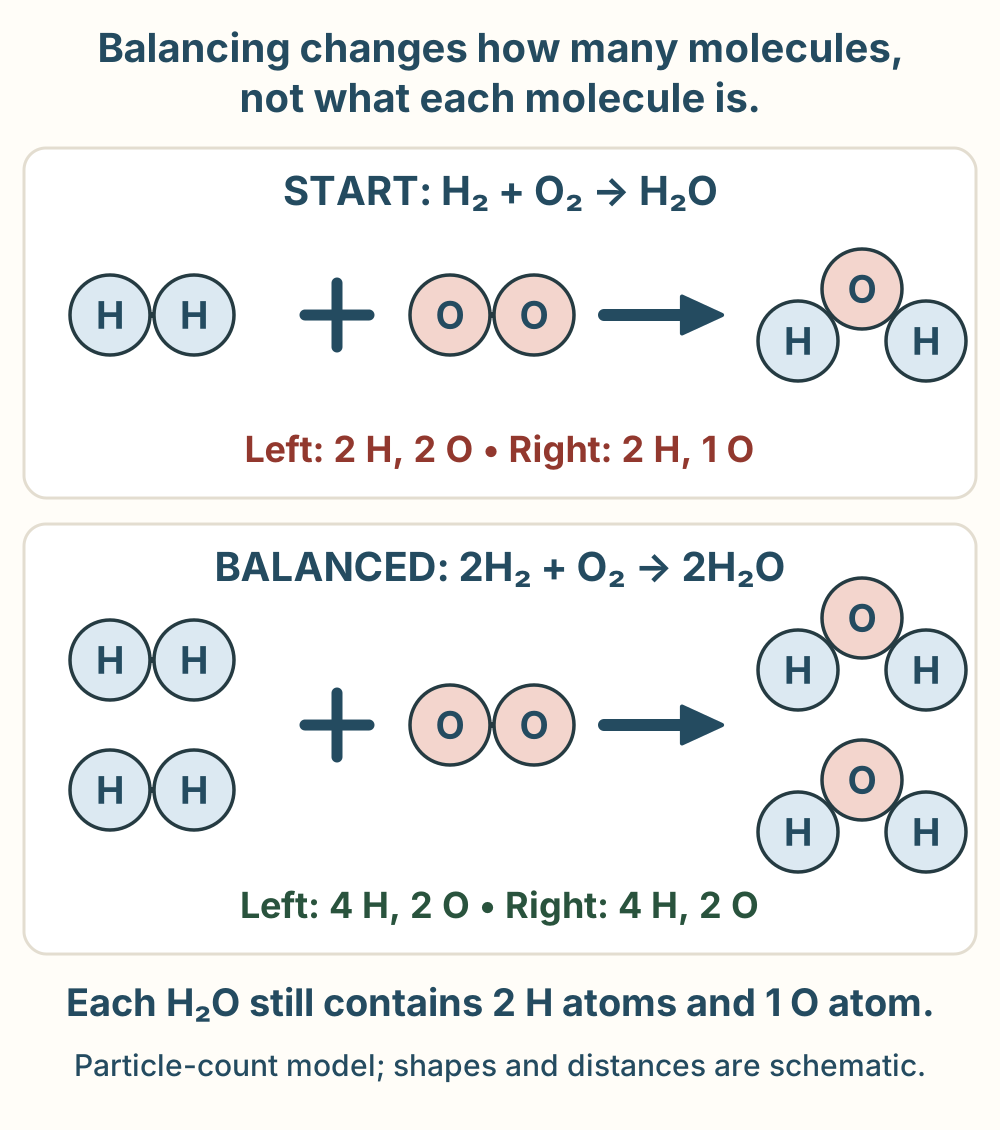
A reaction rearranges atoms. It never creates or removes them. Balancing makes the count of each kind of atom equal on both sides. Here the formulas are given; you choose how many of each.
- Read subscripts and count atoms in a formula (Chapter 2). Change coefficients, never subscripts.
Need a refresher? Open the table of contents and revisit that topic before starting.
| Number | Where | Example | Meaning |
|---|---|---|---|
| Subscript | Small, inside the formula | H2O | 2 H and 1 O. Leave it alone. |
| Coefficient | In front of the formula | 3H2O | 3 × 2 = 6 H and 3 × 1 = 3 O. |
| No coefficient | Nothing written | H2O | Means 1. |
Still water, just more of it.
Now it is hydrogen peroxide, a different substance.
- Start with the most complicated formula, the one with the most atoms or elements.
- Next, balance elements that show up in only one formula on each side. Leave lone elements (O2, H2, Fe) for last. Changing their coefficient changes only that element, so nothing else is disturbed.
- If a group like SO4, PO4, NO3 or OH (a polyatomic ion) appears unchanged on both sides, count it as one unit.
- Stuck with an odd number of O atoms? Use a fraction, such as 72O2. Then multiply every coefficient by 2 to clear it.
- At the end, recount every element on both sides.
- Use the smallest whole-number coefficients. A 1 can stay unwritten.
- Count each element on both sides before checking an answer.
- No moles or grams are needed yet. The next lesson turns coefficients into a mole recipe.
- Count the atoms of each element on each side.
- Start with the most complicated formula; leave lone elements (O2, H2, Fe) for last.
- Change one coefficient at a time; it multiplies the whole formula.
- Recount every element after each change.
- Clear any fractions, reduce to the smallest whole numbers, then check again.
On the periodic table: The periodic table names each symbol (H, O, Al). Balancing needs only atom counts, not masses.
Balance: H2 + O2 → H2O
- 1Count first
Oxygen does not match. Hydrogen matches for now.
Element Left Right H 2 2 O 2 1 - 2Put 2 before water
Two waters give 2 O, but also 4 H. Recount both elements.
H2 + O2 → 2H2OElement Left Right H 2 4 O 2 2 - 3Put 2 before hydrogen
Two H2 give 4 H. Both sides now have 4 H and 2 O.
2H2 + O2 → 2H2OElement Left Right H 2 × 2 = 4 2 × 2 = 4 O 1 × 2 = 2 2 × 1 = 2 - ✓Answer
2H2 + O2 → 2H2O
Check: H 4 = 4; O 2 = 2.
Balance: Al + O2 → Al2O3
- 1Compare oxygen counts
O2 holds 2 O; Al2O3 holds 3 O. The smallest multiple of both 2 and 3 is 6.
O2: 2 O | Al2O3: 3 O → shared total: 6 O - 2Make 6 O on each side
Put 3 before O2 and 2 before Al2O3.
Al + 3O2 → 2Al2O3Left: 3 × 2 = 6 O Right: 2 × 3 = 6 O - 3Fix aluminum
The products now hold 2 × 2 = 4 Al, so put 4 before Al.
4Al + 3O2 → 2Al2O3Element Left Right Al 4 2 × 2 = 4 O 3 × 2 = 6 2 × 3 = 6 - ✓Answer
4Al + 3O2 → 2Al2O3
Check: Al 4 = 2 × 2; O 3 × 2 = 2 × 3.
Balance: CH4 + O2 → CO2 + H2O
- 1Check carbon
1 C on each side already. Keep both coefficients at 1.
Element Left Right C 1 1 H 4 2 O 2 2 + 1 = 3 - 2Balance hydrogen
CH4 has 4 H. Two waters give 2 × 2 = 4 H.
CH4 + O2 → CO2 + 2H2O - 3Count all product oxygen
Add oxygen from every product, not just one formula.
CO2: 2 O + 2H2O: 2 × 1 = 2 O = 4 O - 4Balance oxygen
Two O2 give 4 O. Leaving oxygen until last avoids repeated changes.
CH4 + 2O2 → CO2 + 2H2OElement Left Right C 1 1 H 4 2 × 2 = 4 O 2 × 2 = 4 2 + 2 = 4 - ✓Answer
CH4 + 2O2 → CO2 + 2H2O
Check: C 1 = 1; H 4 = 2 × 2; O 2 × 2 = 2 + 2.C2H6 + 72O2→ 2CO2 + 3H2O× 2:2C2H6 + 7O2→ 4CO2 + 6H2OC: 2 × 2 = 4 = 4H: 2 × 6 = 12 = 6 × 2 = 12O: 7 × 2 = 14 = 4 × 2 + 6 = 14
Balance: Ca(OH)2 + H3PO4 → Ca3(PO4)2 + H2O
- 1Count, keeping PO4 together
PO4 appears unchanged on both sides, so count it as one unit. “Other O” means O atoms outside PO4.
Atom or unit Left Right Ca 1 3 PO4 1 2 H 2 + 3 = 5 2 Other O 2 1 - 2Start with Ca3(PO4)2
It is the most complicated formula. It holds 2 PO4 units, so put 2 before H3PO4.
Ca(OH)2 + 2H3PO4→ Ca3(PO4)2 + H2OPO4: 2 × 1 = 2 = 1 × 2 = 2 - 3Balance calcium
Ca3(PO4)2 holds 3 Ca, so put 3 before Ca(OH)2.
3Ca(OH)2 + 2H3PO4→ Ca3(PO4)2 + H2OCa: 3 × 1 = 3 = 3 - 4Balance H with water
Add the hydrogen from both reactants. Each water holds 2 H, so divide by 2.
H: 3 × 2 + 2 × 3 = 1212 ÷ 2 = 6H2O3Ca(OH)2 + 2H3PO4→ Ca3(PO4)2 + 6H2O - 5Recount everything
The other O now matches too: 6 = 6.
Atom or unit Left Right Ca 3 × 1 = 3 3 PO4 2 × 1 = 2 1 × 2 = 2 H 6 + 6 = 12 6 × 2 = 12 Other O 3 × 2 = 6 6 × 1 = 6 - ✓Answer
3Ca(OH)2 + 2H3PO4 → Ca3(PO4)2 + 6H2O
Check single atoms: Ca 3 = 3; P 2 = 2; H 12 = 12; O 14 = 14.
Section practice · 10 questions · tap to open
What this set is for: practicing the method from this section while it’s fresh. Every problem uses only what this section has taught.
Balance 1
H2 + Cl2 → HCl
Give me a hint
Count the start: left has 2 H and 2 Cl; right has 1 H and 1 Cl.
Check the balanced equation and atom counts
Answer: H2 + Cl2 → 2HCl
That’s right: H: 2 = 2; Cl: 2 = 2.
Explain the worked problem to me
What you know: H2 + Cl2 → HCl. Left: 2 H, 2 Cl. Right: 1 H, 1 Cl. What you want: The smallest whole-number coefficients that make every count equal.
- Both elements are short on the right by the same amount. Each HCl holds only 1 H and 1 Cl.
- Put 2 before HCl. Now the right has 2 × 1 = 2 H and 2 × 1 = 2 Cl.
- Recount the left: H2 gives 2 H, Cl2 gives 2 Cl. Everything matches: H2 + Cl2 → 2HCl.
Check: H: 2 = 2. Cl: 2 = 2. The coefficients 1, 1, 2 cannot be reduced further.
Watch out: Do not write H2Cl2 or HCl2. Changing a subscript makes a different substance. Change coefficients only.
- Count the start: left has 2 H and 2 Cl; right has 1 H and 1 Cl.
- Put 2 before HCl. This multiplies both H and Cl by 2.
- Check: both sides now have 2 H and 2 Cl. The coefficients 1, 1, 2 cannot be reduced.
Answer: H2 + Cl2 → 2HCl
H: 2 = 2; Cl: 2 = 2.
Balance 2
Na + Cl2 → NaCl
Give me a hint
Cl2 gives 2 Cl on the left, but NaCl has only 1 Cl on the right.
Check the balanced equation and atom counts
Answer: 2Na + Cl2 → 2NaCl
That’s right: Na: 2 = 2; Cl: 2 = 2.
Explain the worked problem to me
What you know: Na + Cl2 → NaCl. Left: 1 Na, 2 Cl. Right: 1 Na, 1 Cl. What you want: The smallest whole-number coefficients.
- Fix chlorine first. Cl2 brings 2 Cl, so put 2 before NaCl: 2 × 1 = 2 Cl on the right.
- That 2 also doubles sodium on the right: 2 × 1 = 2 Na. The left has only 1 Na.
- Put 2 before Na. Now 2Na + Cl2 → 2NaCl.
Check: Na: 2 = 2. Cl: 2 = 2. Recount every element after each change, as you just did.
Watch out: After fixing chlorine, students often forget that the coefficient on NaCl also changed the sodium count.
- Cl2 gives 2 Cl on the left, but NaCl has only 1 Cl on the right.
- Put 2 before NaCl to get 2 Cl. This also gives 2 Na on the right.
- Put 2 before Na. Both elements match; the smallest coefficients are 2, 1, 2.
Answer: 2Na + Cl2 → 2NaCl
Na: 2 = 2; Cl: 2 = 2.
Balance 3
Mg + O2 → MgO
Give me a hint
O2 has 2 O, but MgO has only 1 O.
Check the balanced equation and atom counts
Answer: 2Mg + O2 → 2MgO
That’s right: Mg: 2 = 2; O: 2 = 2.
Explain the worked problem to me
What you know: Mg + O2 → MgO. Left: 1 Mg, 2 O. Right: 1 Mg, 1 O. What you want: The smallest whole-number coefficients.
- Fix oxygen. O2 has 2 O, so put 2 before MgO: 2 × 1 = 2 O on the right.
- Recount: 2MgO also holds 2 × 1 = 2 Mg. The left has 1 Mg.
- Put 2 before Mg. Result: 2Mg + O2 → 2MgO.
Check: Mg: 2 = 2. O: 2 = 2. The set 2, 1, 2 has no common factor, so it is smallest.
Watch out: Never write MgO2 to fix oxygen. That changes a subscript and the substance.
- O2 has 2 O, but MgO has only 1 O.
- Put 2 before MgO. The right now has 2 O and 2 Mg.
- Put 2 before Mg. Check both elements: 2 Mg and 2 O on each side.
Answer: 2Mg + O2 → 2MgO
Mg: 2 = 2; O: 2 = 2.
Balance 4
N2 + H2 → NH3
Give me a hint
N2 has 2 N. Put 2 before NH3 to make 2 N on the right.
Check the balanced equation and atom counts
Answer: N2 + 3H2 → 2NH3
That’s right: N: 2 = 2; H: 6 = 6.
Explain the worked problem to me
What you know: N2 + H2 → NH3. Left: 2 N, 2 H. Right: 1 N, 3 H. What you want: The smallest whole-number coefficients.
- Fix nitrogen. Put 2 before NH3: 2 × 1 = 2 N on the right.
- Recount hydrogen on the right: 2 × 3 = 6 H. The left has only 2 H.
- Put 3 before H2: 3 × 2 = 6 H. Result: N2 + 3H2 → 2NH3.
Check: N: 2 = 2. H: 3 × 2 = 6 on the left; 2 × 3 = 6 on the right.
Watch out: A coefficient multiplies every atom in the formula. 2NH3 has 6 H, not 3 or 5.
- N2 has 2 N. Put 2 before NH3 to make 2 N on the right.
- Those two NH3 units contain 2 × 3 = 6 H.
- Put 3 before H2 to supply 3 × 2 = 6 H. Check: 2 N and 6 H on each side.
Answer: N2 + 3H2 → 2NH3
N: 2 = 2; H: 6 = 6.
Balance 5
Al + Cl2 → AlCl3
Give me a hint
Chlorine comes in groups of 2 in Cl2 and groups of 3 in AlCl3. Use 6 as their first shared total.
Check the balanced equation and atom counts
Answer: 2Al + 3Cl2 → 2AlCl3
That’s right: Al: 2 = 2; Cl: 6 = 6.
Explain the worked problem to me
What you know: Al + Cl2 → AlCl3. Chlorine comes in groups of 2 on the left and 3 on the right. What you want: The smallest whole-number coefficients.
- Find the smallest total that is a multiple of both 2 and 3: that is 6 Cl.
- Make 6 Cl on each side: 3Cl2 gives 3 × 2 = 6, and 2AlCl3 gives 2 × 3 = 6.
- Now the right has 2 × 1 = 2 Al. Put 2 before Al. Result: 2Al + 3Cl2 → 2AlCl3.
Check: Al: 2 = 2. Cl: 6 = 6.
Watch out: Aluminum looks balanced at the start (1 = 1), but it changes once you fix chlorine. Fix the 2-and-3 element first, then recount aluminum.
- Chlorine comes in groups of 2 in Cl2 and groups of 3 in AlCl3. Use 6 as their first shared total.
- Put 3 before Cl2 and 2 before AlCl3. Both sides now have 6 Cl.
- The products have 2 Al. Put 2 before Al. Check: 2 Al and 6 Cl on each side.
Answer: 2Al + 3Cl2 → 2AlCl3
Al: 2 = 2; Cl: 6 = 6.
Balance 6
Fe + O2 → Fe2O3
Give me a hint
O2 has 2 O per molecule; Fe2O3 has 3. Their smallest shared oxygen total is 6.
Check the balanced equation and atom counts
Answer: 4Fe + 3O2 → 2Fe2O3
That’s right: Fe: 4 = 4; O: 6 = 6.
Explain the worked problem to me
What you know: Fe + O2 → Fe2O3. Oxygen comes in groups of 2 on the left and 3 on the right. What you want: The smallest whole-number coefficients.
- The smallest shared oxygen total is 6. Use 3O2 (3 × 2 = 6 O) and 2Fe2O3 (2 × 3 = 6 O).
- Count iron on the right: 2 × 2 = 4 Fe.
- Put 4 before Fe. Result: 4Fe + 3O2 → 2Fe2O3.
Check: Fe: 4 = 2 × 2. O: 3 × 2 = 6 on the left; 2 × 3 = 6 on the right.
Watch out: The subscript 2 in Fe2O3 means each unit holds 2 Fe. Two units hold 4 Fe, not 2.
- O2 has 2 O per molecule; Fe2O3 has 3. Their smallest shared oxygen total is 6.
- Put 3 before O2 and 2 before Fe2O3. Now oxygen matches.
- Two Fe2O3 units contain 4 Fe. Put 4 before Fe. Check: 4 Fe and 6 O on each side.
Answer: 4Fe + 3O2 → 2Fe2O3
Fe: 4 = 4; O: 6 = 6.
Balance 7
H2O2 → H2O + O2
Give me a hint
Start with hydrogen: H2O2 and H2O each have 2 H. Oxygen is unequal: 2 on the left and 3 total on the right.
Check the balanced equation and atom counts
Answer: 2H2O2 → 2H2O + O2
That’s right: H: 4 = 4; O: 4 = 2 + 2.
Explain the worked problem to me
What you know: H2O2 → H2O + O2. H: 2 = 2. O: 2 on the left, 1 + 2 = 3 on the right. What you want: The smallest whole-number coefficients.
- Oxygen is uneven: 2 on the left, 3 on the right. Try 2H2O2, which gives the left 2 × 2 = 4 H and 2 × 2 = 4 O.
- Match hydrogen with 2H2O: 2 × 2 = 4 H on the right.
- Count all product oxygen: 2H2O gives 2 O, O2 gives 2 O, total 4. It matches. Result: 2H2O2 → 2H2O + O2.
Check: H: 4 = 4. O: 4 = 2 + 2.
Watch out: Add oxygen from every product. Counting only the O2 or only the water gives the wrong total.
- Start with hydrogen: H2O2 and H2O each have 2 H. Oxygen is unequal: 2 on the left and 3 total on the right.
- Try 2H2O2 → 2H2O + O2. Doubling peroxide and water keeps hydrogen matched.
- Check oxygen: 2 × 2 = 4 on the left; 2 × 1 + 2 = 4 on the right. Hydrogen is 4 on each side.
Answer: 2H2O2 → 2H2O + O2
H: 4 = 4; O: 4 = 2 + 2.
Balance 8
C2H4 + O2 → CO2 + H2O
Give me a hint
C2H4 has 2 C. Put 2 before CO2 to match carbon.
Check the balanced equation and atom counts
Answer: C2H4 + 3O2 → 2CO2 + 2H2O
That’s right: C: 2 = 2; H: 4 = 4; O: 6 = 4 + 2.
Explain the worked problem to me
What you know: C2H4 + O2 → CO2 + H2O. This is a combustion, so balance C, then H, then O. What you want: The smallest whole-number coefficients.
- Carbon: C2H4 has 2 C. Put 2 before CO2.
- Hydrogen: C2H4 has 4 H. Put 2 before H2O: 2 × 2 = 4 H.
- Oxygen last: 2CO2 gives 4 O, 2H2O gives 2 O, total 6. Use 3O2 (3 × 2 = 6). Result: C2H4 + 3O2 → 2CO2 + 2H2O.
Check: C: 2 = 2. H: 4 = 4. O: 6 = 4 + 2.
Watch out: Leave O2 for last. It is the only formula with just one element, so changing it disturbs nothing else.
- C2H4 has 2 C. Put 2 before CO2 to match carbon.
- C2H4 has 4 H. Put 2 before H2O to match hydrogen.
- Count product oxygen: 2CO2 gives 4 O and 2H2O gives 2 O, totaling 6. Put 3 before O2. Check C, H, and O.
Answer: C2H4 + 3O2 → 2CO2 + 2H2O
C: 2 = 2; H: 4 = 4; O: 6 = 4 + 2.
Balance 9
NaOH + H2SO4 → Na2SO4 + H2O
Give me a hint
Na2SO4 contains 2 Na. Put 2 before NaOH.
Check the balanced equation and atom counts
Answer: 2NaOH + H2SO4 → Na2SO4 + 2H2O
That’s right: Na: 2 = 2; H: 4 = 4; S: 1 = 1; O: 6 = 6. You may track unchanged SO4 as one group, then verify individual atoms.
Explain the worked problem to me
What you know: NaOH + H2SO4 → Na2SO4 + H2O. The SO4 group appears unchanged on both sides. What you want: The smallest whole-number coefficients.
- Sodium: Na2SO4 has 2 Na. Put 2 before NaOH.
- Hydrogen: left now has 2 (from 2NaOH) + 2 (from H2SO4) = 4 H. Put 2 before H2O: 2 × 2 = 4 H.
- Track SO4 as one group: 1 = 1. Result: 2NaOH + H2SO4 → Na2SO4 + 2H2O.
Check: Now verify single atoms. O: 2 + 4 = 6 on the left; 4 + 2 = 6 on the right. Na 2 = 2, H 4 = 4, S 1 = 1.
Watch out: Hydrogen sits in two reactants. Add both sources before choosing the water coefficient.
- Na2SO4 contains 2 Na. Put 2 before NaOH.
- The left now has 2 H from 2NaOH plus 2 H from H2SO4, totaling 4 H. Put 2 before H2O.
- Check sulfur: 1 on each side. Check oxygen: 2 + 4 = 6 on the left and 4 + 2 = 6 on the right. Na and H also match.
Answer: 2NaOH + H2SO4 → Na2SO4 + 2H2O
Na: 2 = 2; H: 4 = 4; S: 1 = 1; O: 6 = 6. You may track unchanged SO4 as one group, then verify individual atoms.
Balance 10
Ca(OH)2 + HCl → CaCl2 + H2O
Give me a hint
Read the parentheses first: Ca(OH)2 contains 1 Ca, 2 O, and 2 H.
Check the balanced equation and atom counts
Answer: Ca(OH)2 + 2HCl → CaCl2 + 2H2O
That’s right: Ca: 1 = 1; O: 2 = 2; H: 4 = 4; Cl: 2 = 2. The parentheses give 2 O and 2 H in Ca(OH)2.
Explain the worked problem to me
What you know: Ca(OH)2 + HCl → CaCl2 + H2O. Read the parentheses: Ca(OH)2 has 1 Ca, 2 O and 2 H. What you want: The smallest whole-number coefficients.
- Chlorine: CaCl2 has 2 Cl. Put 2 before HCl.
- Hydrogen on the left: 2 (from OH groups) + 2 (from 2HCl) = 4 H. Put 2 before H2O: 2 × 2 = 4 H.
- Oxygen: 2 on the left; 2 × 1 = 2 on the right. Result: Ca(OH)2 + 2HCl → CaCl2 + 2H2O.
Check: Ca: 1 = 1. O: 2 = 2. H: 4 = 4. Cl: 2 = 2.
Watch out: The 2 after the parentheses multiplies both O and H. Ca(OH)2 has 2 H, not 1.
- Read the parentheses first: Ca(OH)2 contains 1 Ca, 2 O, and 2 H.
- CaCl2 needs 2 Cl. Put 2 before HCl. This supplies 2 more H, giving 4 H total on the left.
- Put 2 before H2O to get 4 H and 2 O on the right. Check: Ca 1, Cl 2, H 4, and O 2 on each side.
Answer: Ca(OH)2 + 2HCl → CaCl2 + 2H2O
Ca: 1 = 1; O: 2 = 2; H: 4 = 4; Cl: 2 = 2. The parentheses give 2 O and 2 H in Ca(OH)2.
5.1a Five common reaction types
Most reactions follow one of five patterns. Naming the pattern tells you what kind of change happened, and later helps you predict products.
- Balanced equations (5.1).
- Ionic formulas (2.3).
Need a refresher? Open the table of contents and revisit that topic before starting.
| Type | Pattern | Example |
|---|---|---|
| Synthesis (combination) | A + B → AB | H2 + Cl2 → 2HCl |
| Decomposition | AB → A + B | 2H2O2 → 2H2O + O2 |
| Single displacement | A + BC → AC + B | Zn + 2HCl → ZnCl2 + H2 |
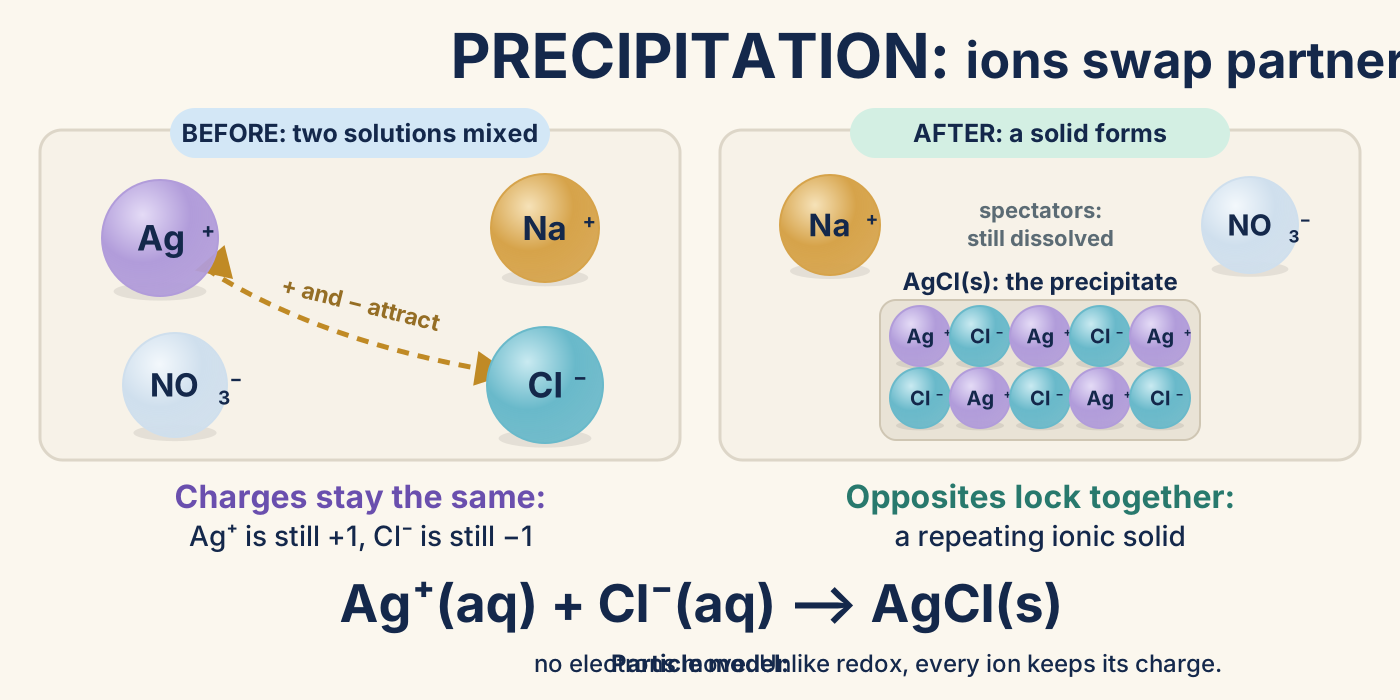
| Double displacement | AB + CD → AD + CB | AgNO3 + NaCl → AgCl + NaNO3 |
| Combustion | fuel + O2 → … | CH4 + 2O2 → CO2 + 2H2O |
- Count the reactants and the products.
- Look for O2 as a reactant.
- Look for an element standing alone.
- A compound of only C and H that burns completely gives CO2 and H2O.
- Count reactants and products: many to one, or one to many?
- Check for O2 as a reactant (combustion).
- Check for a lone element replacing another (single displacement).
- Check for two ionic compounds swapping partners (double displacement).
On the periodic table: The periodic table shows whether a lone element is a metal; in Fe + CuSO4, one metal (Fe) replaces another (Cu).
Classify each reaction: 2Na + Cl2 → 2NaCl; CaCO3 → CaO + CO2; Fe + CuSO4 → FeSO4 + Cu; C3H8 + 5O2 → 3CO2 + 4H2O.
- 1Reaction 1: count partners
Two reactants make one product: synthesis.
2Na + Cl2 → 2NaClReactants Products Clue 2 1 many → one - 2Reaction 2: count partners
One reactant breaks into two products: decomposition.
CaCO3 → CaO + CO2Reactants Products Clue 1 2 one → many - 3Reaction 3: look for a lone element
Iron, standing alone, replaces copper in the compound: single displacement.
Fe + CuSO4 → FeSO4 + CuReactants Products Clue Fe alone Cu alone lone element swaps in - 4Reaction 4: look for O2
A carbon–hydrogen compound reacts with O2 to make CO2 and H2O: combustion.
C3H8 + 5O2 → 3CO2 + 4H2OReactants Products Clue C3H8 + O2 CO2 + H2O burns in O2 - ✓Answer
Synthesis, decomposition, single displacement, combustion.
Section practice · 5 questions · tap to open
What this set is for: practicing the method from this section while it’s fresh. Every problem uses only what this section has taught.
Practice 1
Classify: 2KClO3 → 2KCl + 3O2
Give me a hint
How many reactants? How many products?
Check the answer
Answer: Decomposition
Explain the worked problem to me
What you know: 2KClO3 → 2KCl + 3O2. What you want: The reaction type.
- Count the reactants: only one substance, KClO3.
- Count the products: two substances, KCl and O2.
- One substance breaking into two or more fits AB → A + B. This is Decomposition.
Why it matters: Classifying a reaction tells you what kind of products to expect before you balance anything.
Watch out: O2 appears, but as a product. Combustion needs O2 as a reactant.
That’s right: Decomposition
Practice 2
Classify: Mg + 2HCl → MgCl2 + H2
Give me a hint
Look for an element standing alone on each side.
Check the answer
Answer: Single displacement
Explain the worked problem to me
What you know: Mg + 2HCl → MgCl2 + H2. What you want: The reaction type.
- Look for an element standing alone: Mg on the left, H2 on the right.
- Mg ends up in the compound with Cl. Hydrogen leaves the compound and stands alone.
- An element replacing another in a compound fits A + BC → AC + B. This is Single displacement.
Why it matters: The lone element on each side is the fingerprint. Double displacement has compounds only.
Watch out: Two reactants and two products also describes double displacement. Check whether one reactant is a lone element.
That’s right: Single displacement
Practice 3
Classify: BaCl2 + Na2SO4 → BaSO4 + 2NaCl
Give me a hint
Do two compounds trade partners?
Check the answer
Answer: Double displacement
Explain the worked problem to me
What you know: BaCl2 + Na2SO4 → BaSO4 + 2NaCl. What you want: The reaction type.
- Both reactants are ionic compounds. No element stands alone.
- Follow the ions: Ba2+ leaves Cl− and pairs with SO42−. Na+ pairs with Cl−.
- Two compounds swapping partners fits AB + CD → AD + CB. This is Double displacement.
Why it matters: Spotting a swap lets you predict products later, in Section 6.3, where you check whether a solid forms.
That’s right: Double displacement
Practice 4
Classify: N2 + 3H2 → 2NH3
Give me a hint
Count the products.
Check the answer
Answer: Synthesis
Explain the worked problem to me
What you know: N2 + 3H2 → 2NH3. What you want: The reaction type.
- Count the reactants: two substances, N2 and H2.
- Count the products: one substance, NH3. The coefficient 2 is still one kind of substance.
- Two substances making one product fits A + B → AB. This is Synthesis.
Why it matters: Count kinds of substances, not coefficients. 2NH3 is one product.
Watch out: Do not read the coefficient 2 as two products.
That’s right: Synthesis
Practice 5
Ethane, C2H6, burns completely in O2. Write the balanced equation.
Give me a hint
Complete combustion of a carbon–hydrogen compound gives CO2 and H2O. Balance C, then H, then O.
Check the answer
Answer: 2C2H6 + 7O2 → 4CO2 + 6H2O
Explain the worked problem to me
What you know: Ethane, C2H6, burns completely in O2. Complete combustion of a carbon–hydrogen compound gives CO2 and H2O. What you want: The balanced equation.
- Write the skeleton: C2H6 + O2 → CO2 + H2O. Carbon: put 2 before CO2.
- Hydrogen: 6 H, so put 3 before H2O (3 × 2 = 6).
- Oxygen on the right: 2 × 2 + 3 = 7, an odd number. O2 only supplies O in pairs, so double every coefficient: 2C2H6, 4CO2, 6H2O.
- Now right-side oxygen is 4 × 2 + 6 = 14. Use 7O2. Result: 2C2H6 + 7O2 → 4CO2 + 6H2O.
Check: C: 4 = 4. H: 12 = 12. O: 14 = 8 + 6.
Watch out: An odd oxygen total cannot come from whole O2 molecules. Doubling fixes it.
That’s right: 2C2H6 + 7O2 → 4CO2 + 6H2O
5.2 A balanced reaction is a recipe
A balanced equation is a recipe. Its coefficients say how many moles of each substance react and form. Use that ratio to get from the amount you have to the amount you want.
- Coefficients count complete formula units; balance atoms first (5.1).
Need a refresher? Open the table of contents and revisit that topic before starting.
- Reactants are the starting substances; products are what they become.
- Balanced means the same number of each kind of atom on both sides.
- Change only coefficients, the numbers in front of formulas. A new subscript means a new substance.
- Coefficients give particle and mole ratios.
| 2H2 | + O2 | → 2H2O | |
|---|---|---|---|
| Molecules | 2 | 1 | 2 |
| Moles | 2 mol | 1 mol | 2 mol |
| Grams | 4.032 g | 32.00 g | 36.03 g |
- Balance the equation.
- Convert the given amount to moles.
- Multiply by the coefficient ratio: wanted on top, given below.
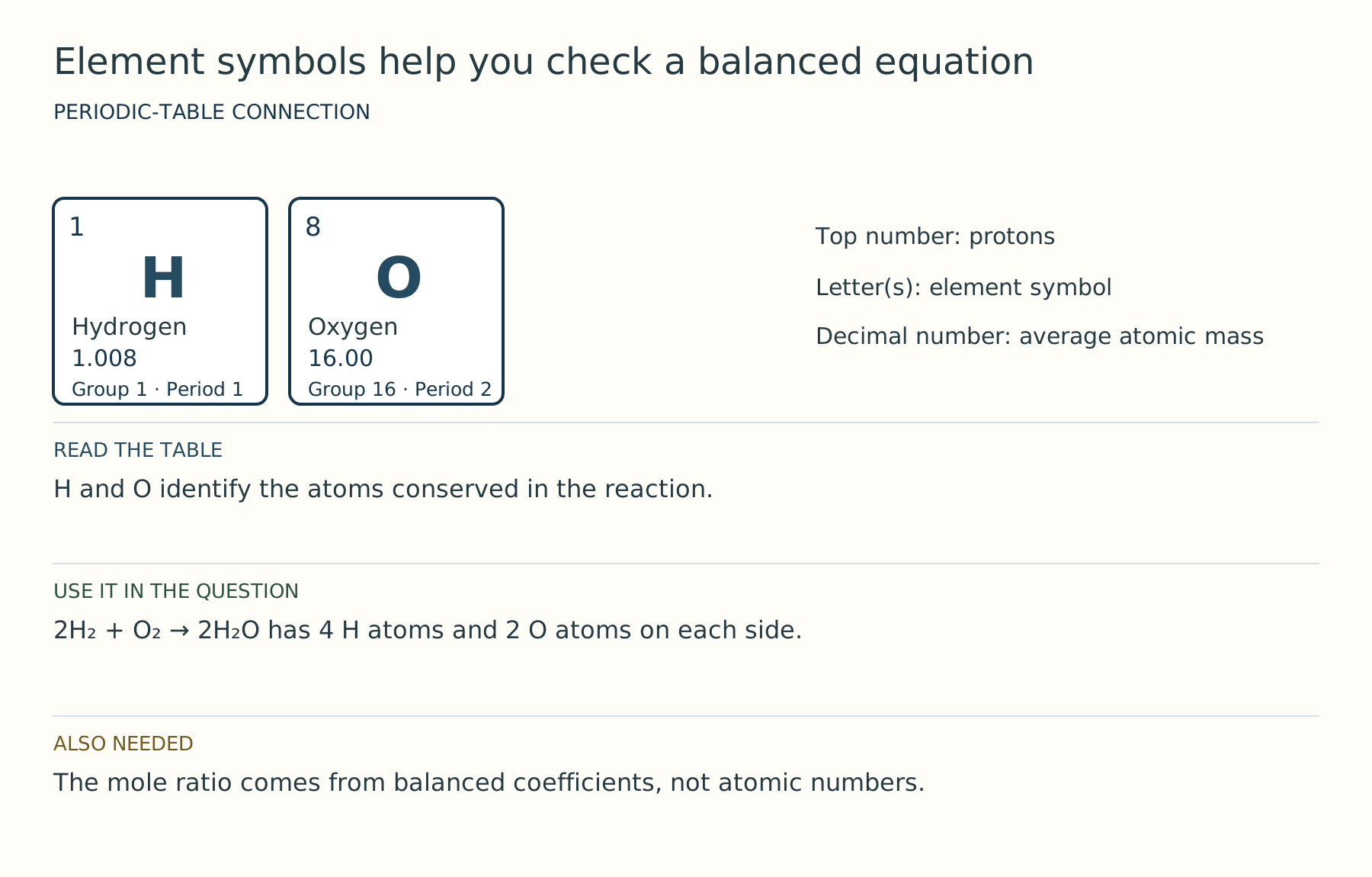
On the periodic table: H: atomic number 1, molar mass 1.008 g/mol. O: atomic number 8, molar mass 16.00 g/mol.
On the periodic table: Atomic number is the proton count. The decimal mass is an average, not an isotope’s mass number.
On the periodic table: Use supplied rounded masses when a problem gives them.
For 2H2 + O2 → 2H2O, how much water can 3.0 mol O2 make with excess H2?
| From the balanced equation |
|---|
| 2 mol H2O1 mol O2 |
- 1Read the balanced recipe
The coefficients compare mole amounts.
1 mol O2 → 2 mol H2O - 2Set the wanted/given ratio
Wanted substance on top, given substance underneath.
3.0 mol O2 × 2 mol H2O1 mol O2 - 3Calculate
The oxygen unit cancels, leaving moles of water.
3.0mol O2× 2 mol H2O1mol O2= 6.0 mol H2O - ✓Answer
6.0 mol H2O. Two moles of water form per mole of oxygen.
5.3 Grams A ↔ moles A ↔ moles B ↔ grams B
A balanced equation links moles, not grams. To go from grams of one substance to grams of another, convert to moles, use the coefficient ratio, then convert back.
- Grams ↔ moles (Chapter 4), balanced coefficients (5.1), and unit cancellation (Math first).
Need a refresher? Open the table of contents and revisit that topic before starting.
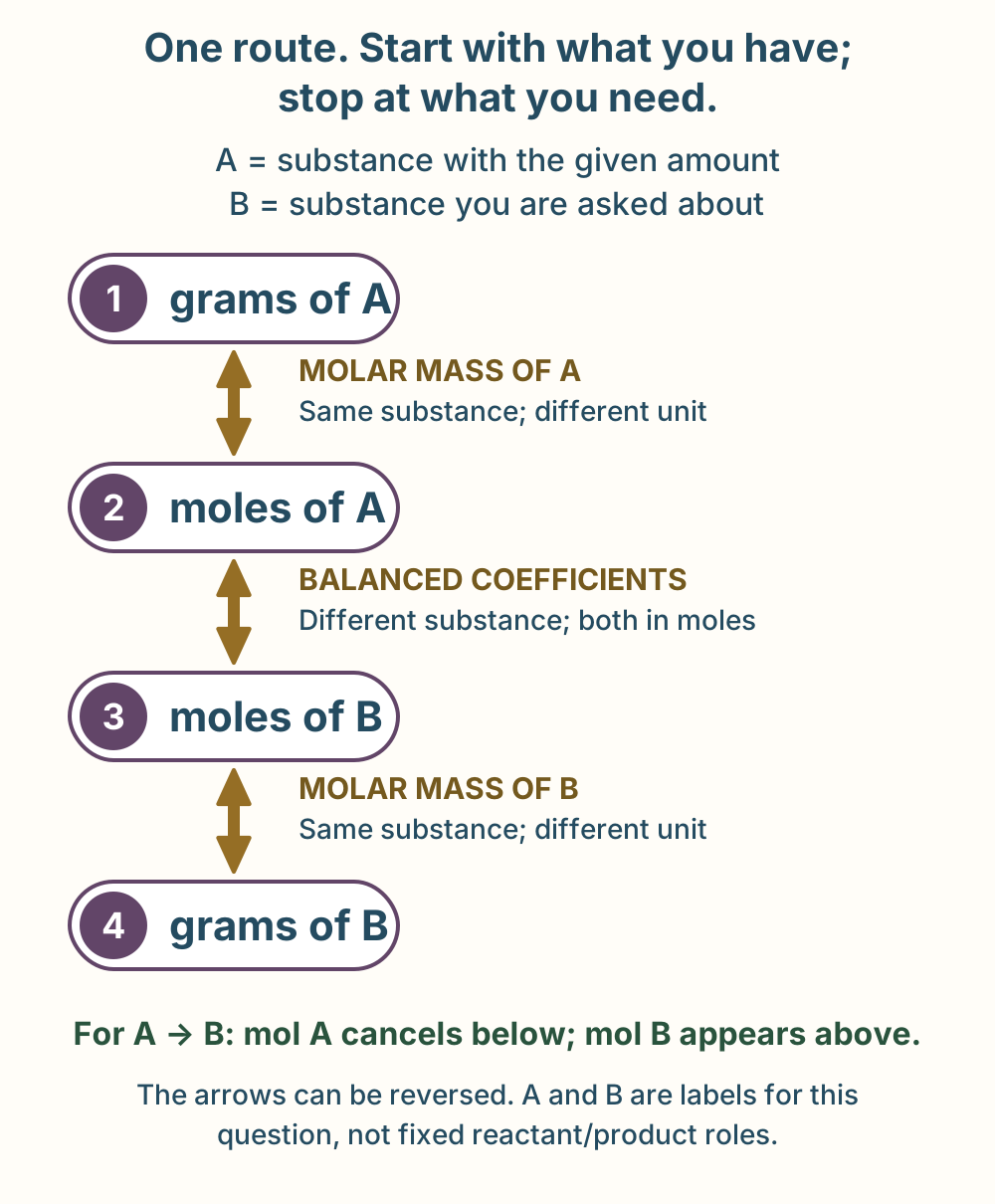
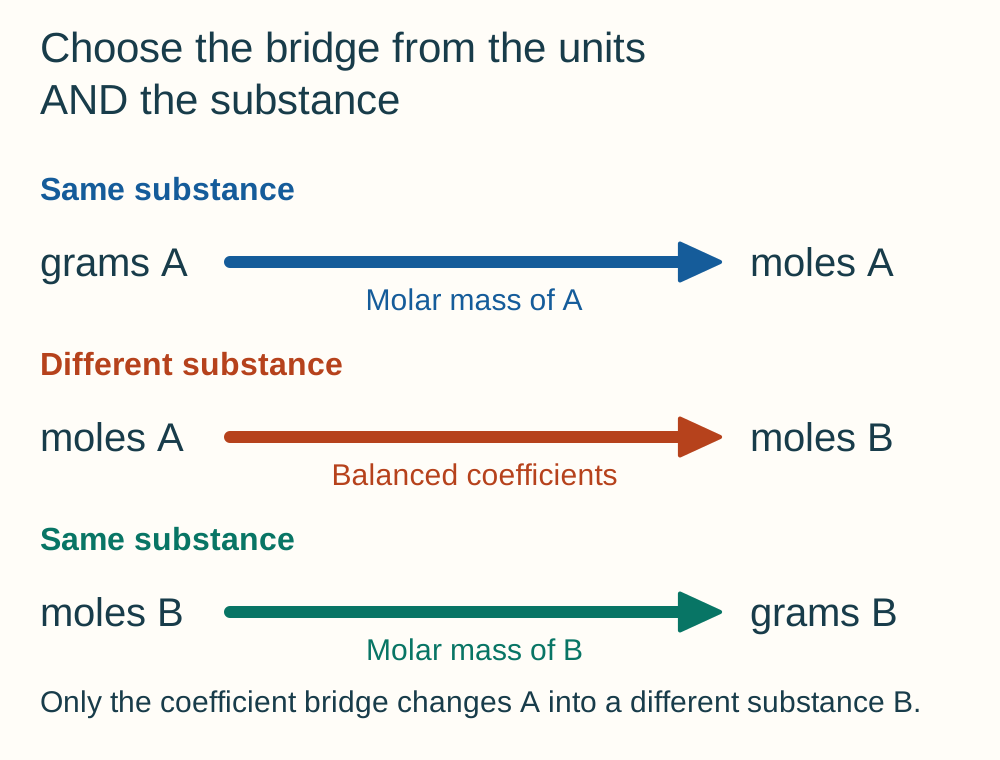
| Given → wanted | Bridges you use |
|---|---|
| mol A → mol B | coefficient ratio only |
| g A → mol B | molar mass A, then coefficient ratio |
| mol A → g B | coefficient ratio, then molar mass B |
| g A → g B | all three bridges |
- A can be a product and B a reactant: the same route finds the reactant needed for a requested product.
- These are theoretical amounts. If two reactant amounts are given, first find the limiting one (5.4).
- Product mass includes atoms from every reacting substance.
- Label the given substance A and the wanted substance B.
- Grams A → moles A with A’s molar mass.
- Moles A → moles B with the coefficient ratio, wanted on top.
- Moles B → grams B with B’s molar mass.
- Check that the only unit left is the one requested.
On the periodic table: Molar mass is the decimal number in an element’s box: O has an average atomic mass of 16.00 u, so 16.00 g/mol.
On the periodic table: For a compound, add the box masses of every atom in its formula.
Given 12.0 g Mg with oxygen in excess, find grams of MgO. Balanced equation: 2Mg + O2 → 2MgO.
- 1Find the molar masses
On the periodic table (rounded for this example): Mg 24.0 g/mol, O 16.0 g/mol.
MgO = 24.0 + 16.0 = 40.0 g/mol - 2Face each bridge
The unit to cancel goes below; the wanted unit goes above.
Bridge Factor Why it faces this way g Mg → mol Mg 1 mol Mg24.0 g Mg g Mg below cancels the given g Mg. mol Mg → mol MgO 2 mol MgO2 mol Mg Balanced coefficients: wanted above, current below. mol MgO → g MgO 40.0 g MgO1 mol MgO mol MgO below cancels; g MgO stays. - 3Multiply across, then divide
Multiply the tops, multiply the bottoms, then divide.
12.0g Mg× 1mol Mg24.0g Mg× 2mol MgO2mol Mg× 40.0 g MgO1mol MgO= 96048.0 = 20.0 g MgO - 4Check the units
Every unit cancels except g MgO, which matches the question.
Unit Cancelled by g Mg 24.0 g Mg mol Mg 2 mol Mg mol MgO 1 mol MgO g MgO kept - ✓Answer
20.0 g MgO. It exceeds 12.0 g because the product includes oxygen that joined the magnesium.
For 2H2 + O2 → 2H2O, find the mass of water made from 4 g H2 with excess O2. Use approximate molar masses H2 = 2 g/mol and H2O = 18 g/mol.
| g H2 → mol H2 | mol H2 → mol H2O | mol H2O → g H2O |
|---|---|---|
| 1 mol H22 g H2 | 2 mol H2O2 mol H2 | 18 g H2O1 mol H2O |
- 1Convert hydrogen grams to moles
Coefficients compare moles, so convert the mass first. On the periodic table: H is about 1 g/mol (1.008 in its box), so H2 = 2 × 1 = 2 g/mol.
4g H2× 1 mol H22g H2= 2 mol H2 - 2Use the reaction ratio
The hydrogen-to-water mole ratio is 1 : 1.
2mol H2× 2 mol H2O2mol H2= 2 mol H2O - 3Convert product moles to grams
Use the product’s molar mass to reach the requested unit. On the periodic table: H about 1 g/mol and O about 16 g/mol (1.008 and 16.00), so H2O = 2 × 1 + 16 = 18 g/mol.
2mol H2O× 18 g H2O1mol H2O= 36 g H2O - ✓Answer
36 g H2O, using the supplied approximate data. Oxygen contributes the extra mass.
Section practice · 4 questions · tap to open
What this set is for: practicing the method from this section while it’s fresh. Every problem uses only what this section has taught.
For 2Mg + O2 → 2MgO, given 0.500 mol Mg; find mol MgO. Which bridge?
Give me a hint
Write the start unit and the requested unit. If both are moles, only one bridge connects them.
Check the answer
Coefficient ratio only: 0.500 × 2/2 = 0.500 mol MgO.
Explain the worked problem to me
What you know: 0.500 mol Mg. Equation: 2Mg + O2 → 2MgO. What you want: Moles MgO, and which bridge to use.
- Start unit is moles A (Mg). Stop unit is moles B (MgO). Both are moles, so only the middle bridge is needed.
- Use the coefficient ratio, wanted over given: 0.500 mol Mg × (2 mol MgO / 2 mol Mg).
- mol Mg cancels. 0.500 × 2 ÷ 2 = 0.500 mol MgO.
Check: The ratio is 1:1, so the moles should not change. They don't.
Watch out: No molar mass is needed here. Adding one would wrongly move you to grams.
Coefficient ratio only: 0.500 × 2/2 = 0.500 mol MgO.
YOUR PERIODIC-TABLE REFERENCE
Atomic number identifies proton count. The decimal mass is an average, not an isotope’s mass number. Use supplied rounded masses when a problem gives them.
For 2Mg + O2 → 2MgO, given 12.0 g Mg (Mg = 24.0 g/mol); find mol MgO. Where do you stop?
Give me a hint
Start at grams of Mg. Write the unit the question asks for; that unit tells you where the route stops.
Check the answer
Stop at moles B: 12.0 / 24.0 × 2/2 = 0.500 mol MgO.
On the periodic table: Magnesium (Mg) has an average atomic mass of 24.31 u (molar mass 24.31 g/mol), the decimal number in its box; this problem uses a simplified 24.0 g/mol (24.31 would round to 24.3).
Explain the worked problem to me
What you know: 12.0 g Mg, Mg = 24.0 g/mol. Equation: 2Mg + O2 → 2MgO. What you want: Moles MgO, and where to stop.
- Start at grams A. First bridge: 12.0 g Mg × (1 mol Mg / 24.0 g Mg) = 0.500 mol Mg. g Mg cancels.
- Middle bridge: 0.500 mol Mg × (2 mol MgO / 2 mol Mg) = 0.500 mol MgO. mol Mg cancels.
- The question asks for moles, so stop at moles B: 0.500 mol MgO.
Check: 12.0 is half of 24.0, so 0.500 mol makes sense. Three significant figures throughout.
Watch out: Do not continue to grams MgO. Stop where the requested unit is.
On the periodic table: Magnesium (Mg) has an average atomic mass of 24.31 u (molar mass 24.31 g/mol), the decimal number in its box; this problem uses a simplified 24.0 g/mol (24.31 would round to 24.3).
Stop at moles B: 12.0 / 24.0 × 2/2 = 0.500 mol MgO.
YOUR PERIODIC-TABLE REFERENCE
Atomic number identifies proton count. The decimal mass is an average, not an isotope’s mass number. Use supplied rounded masses when a problem gives them.
For 2Mg + O2 → 2MgO, given 0.500 mol Mg (MgO = 40.0 g/mol); find grams MgO. Where do you start?
Give me a hint
Is the given amount in grams or in moles? That decides whether you need the first bridge.
Check the answer
Start at moles A: 0.500 × 2/2 × 40.0 = 20.0 g MgO.
On the periodic table: You can also build this from the table: magnesium (Mg) 24.0 + oxygen (O) 16.0 = 40.0 g/mol for MgO, using simplified values of the box masses 24.31 and 16.00.
Explain the worked problem to me
What you know: 0.500 mol Mg. MgO = 40.0 g/mol. Equation: 2Mg + O2 → 2MgO. What you want: Grams MgO, and where to start.
- The given amount is already in moles, so start at moles A. Skip the first bridge.
- Middle bridge: 0.500 mol Mg × (2 mol MgO / 2 mol Mg) = 0.500 mol MgO.
- Last bridge: 0.500 mol MgO × (40.0 g MgO / 1 mol MgO) = 20.0 g MgO. mol MgO cancels.
Check: Only g MgO is left, matching the ask. 0.500 is half of 1 mole, and 20.0 is half of 40.0.
Watch out: Do not divide 0.500 by 24.0. It is already moles, not grams.
On the periodic table: You can also build this from the table: magnesium (Mg) 24.0 + oxygen (O) 16.0 = 40.0 g/mol for MgO, using simplified values of the box masses 24.31 and 16.00.
Start at moles A: 0.500 × 2/2 × 40.0 = 20.0 g MgO.
YOUR PERIODIC-TABLE REFERENCE
Atomic number identifies proton count. The decimal mass is an average, not an isotope’s mass number. Use supplied rounded masses when a problem gives them.
For 2Mg + O2 → 2MgO, you need 40.0 g MgO. Find grams Mg required with excess oxygen (Mg = 24.0 g/mol; MgO = 40.0 g/mol).
Give me a hint
Here the given substance A is the product MgO and B is the reactant Mg. Convert grams MgO with MgO’s own molar mass first.
Check the answer
A = MgO; B = Mg. 40.0 / 40.0 × 2/2 × 24.0 = 24.0 g Mg.
On the periodic table: Magnesium (Mg) is taken as 24.0 g/mol here (24.31 in its box, simplified). For MgO, add oxygen (O) at 16.0 g/mol (16.00 in its box): 24.0 + 16.0 = 40.0 g/mol.
Explain the worked problem to me
What you know: Need 40.0 g MgO, oxygen in excess. MgO = 40.0 g/mol, Mg = 24.0 g/mol. Equation: 2Mg + O2 → 2MgO. What you want: Grams Mg required.
- Here A is the product MgO and B is the reactant Mg. The route works in either direction.
- First bridge: 40.0 g MgO × (1 mol MgO / 40.0 g MgO) = 1.00 mol MgO.
- Middle bridge: 1.00 mol MgO × (2 mol Mg / 2 mol MgO) = 1.00 mol Mg.
- Last bridge: 1.00 mol Mg × (24.0 g Mg / 1 mol Mg) = 24.0 g Mg.
Check: Less Mg than MgO makes sense, because MgO also contains oxygen's mass.
Watch out: Use each substance's own molar mass. Do not convert MgO grams with 24.0.
On the periodic table: Magnesium (Mg) is taken as 24.0 g/mol here (24.31 in its box, simplified). For MgO, add oxygen (O) at 16.0 g/mol (16.00 in its box): 24.0 + 16.0 = 40.0 g/mol.
A = MgO; B = Mg. 40.0 / 40.0 × 2/2 × 24.0 = 24.0 g Mg.
YOUR PERIODIC-TABLE REFERENCE
Atomic number identifies proton count. The decimal mass is an average, not an isotope’s mass number. Use supplied rounded masses when a problem gives them.
5.4 The limiting reactant
The limiting reactant runs out first and stops the product. Find it by asking how much product each reactant could make.
- Balanced mole ratios and mass conversions (5.2–5.3).
Need a refresher? Open the table of contents and revisit that topic before starting.
| Part | Have | Needed per bicycle | Bicycles possible |
|---|---|---|---|
| Wheels | 10 | 2 | 5 |
| Frames | 3 | 1 | 3 |
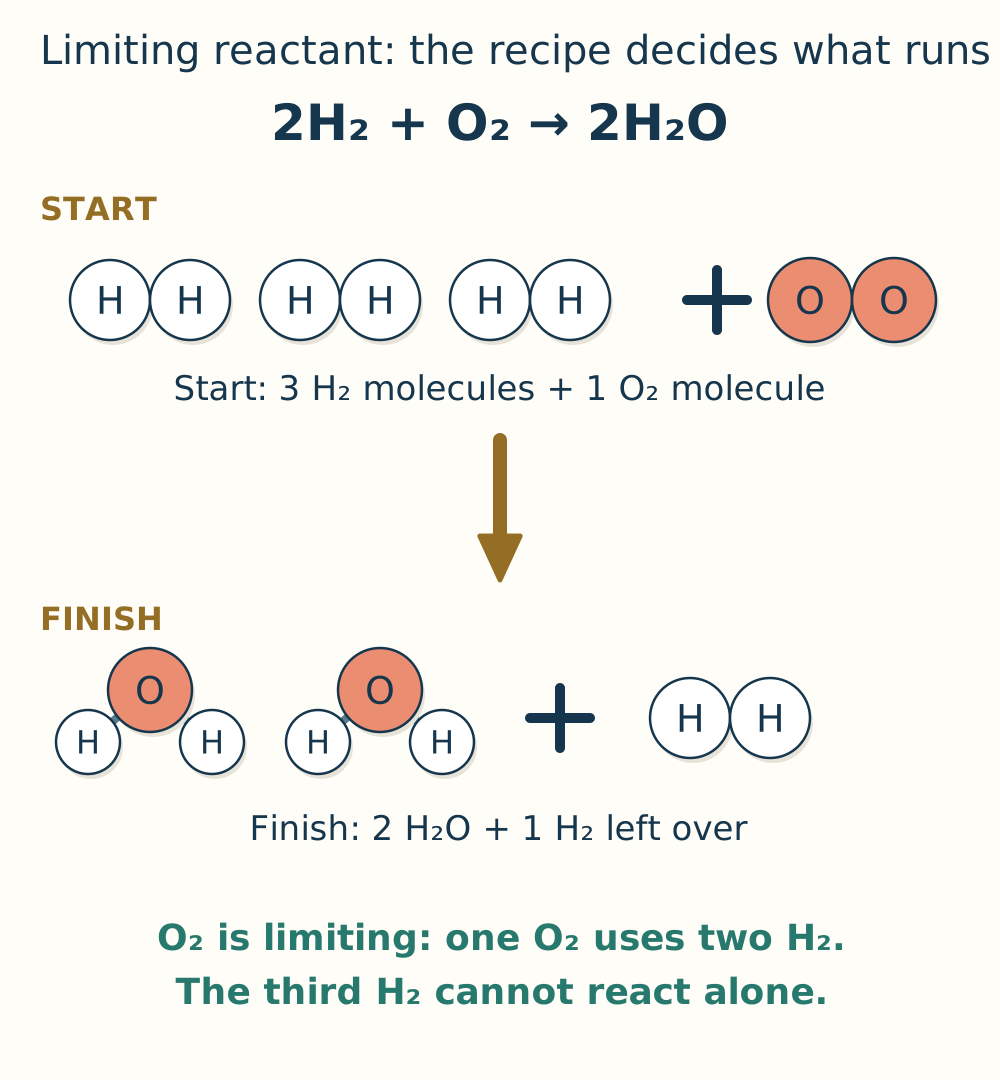
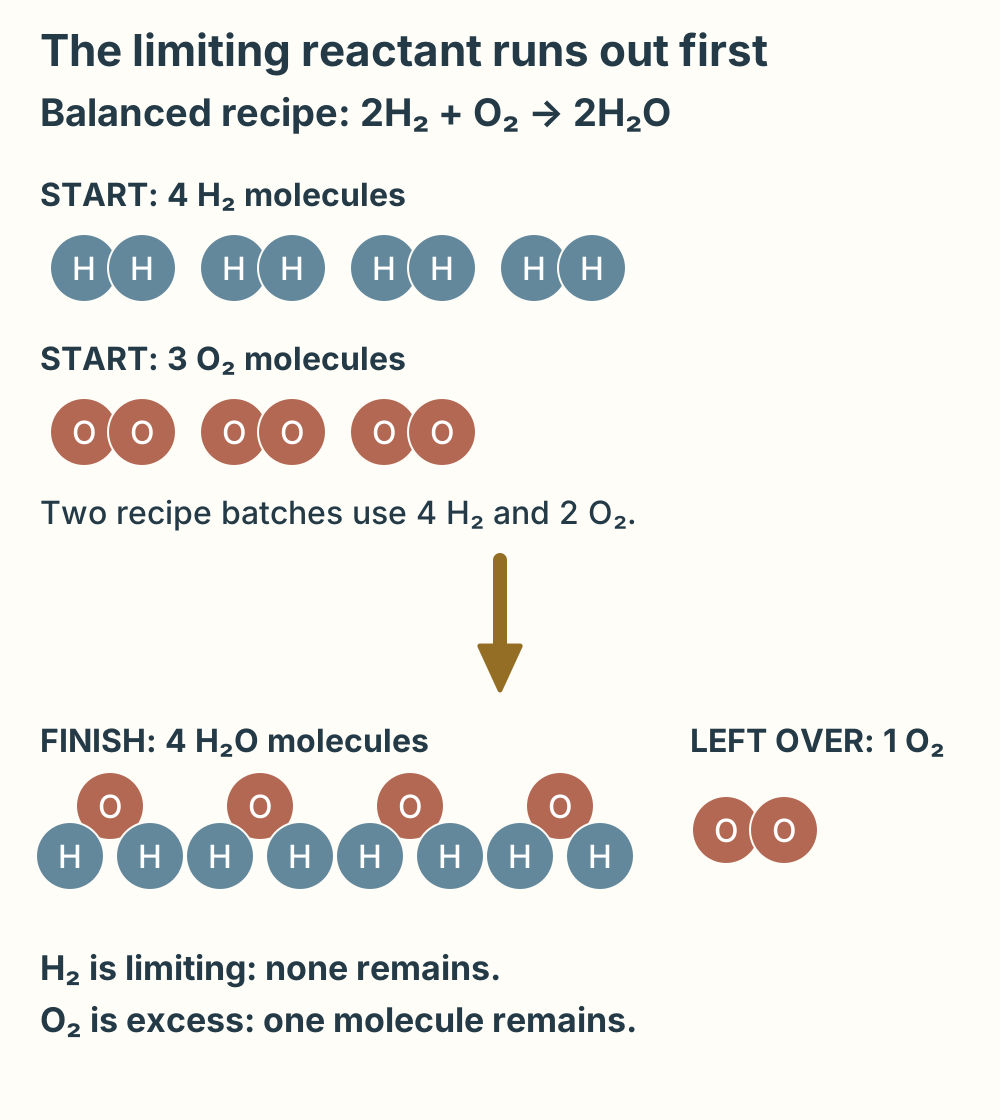
| 2H2 | + O2 | → 2H2O | |
|---|---|---|---|
| Before | 4 | 3 | 0 |
| Change | −4 | −2 | +4 |
| After | 0 | 1 | 4 |
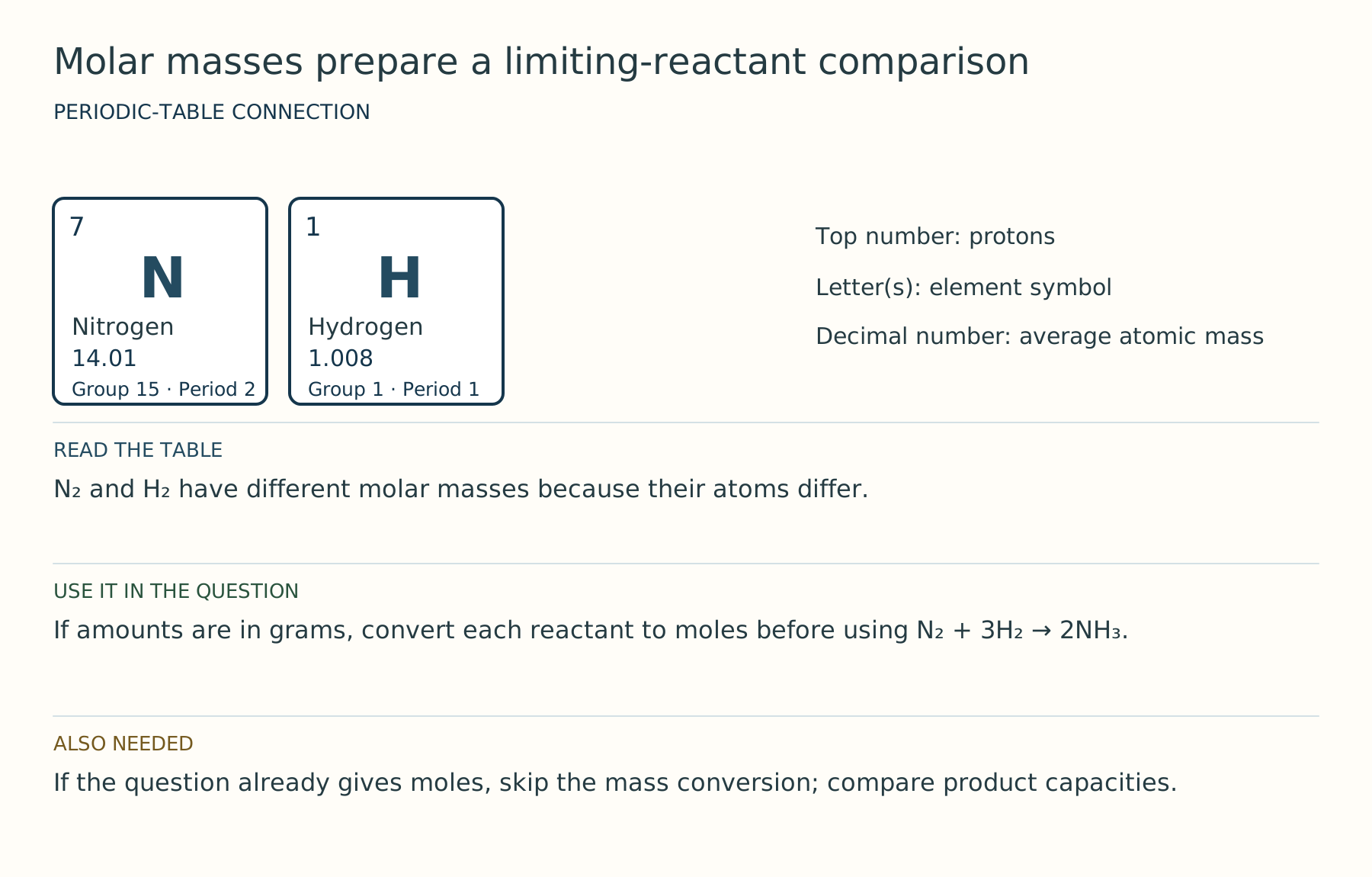
- Get both reactant amounts in moles.
- Find the product each reactant could make.
- The smaller amount is the maximum product; its reactant limits.
On the periodic table: Molar masses come from the periodic table: N 14.01, H 1.008 g/mol. Use supplied masses when given.
On the periodic table: Amounts already in moles need no periodic-table conversion.
For N2 + 3H2 → 2NH3, you have 2 mol N2 and 3 mol H2. Find the limiting reactant and maximum ammonia.
| From N2 | From H2 |
|---|---|
| 2 mol NH31 mol N2 | 2 mol NH33 mol H2 |
- 1Check nitrogen’s capacity
What N2 could make with unlimited H2.
2mol N2× 2 mol NH31mol N2= 4 mol NH3 - 2Check hydrogen’s capacity
Same product, so the results compare fairly.
3mol H2× 2 mol NH33mol H2= 2 mol NH3 - 3Choose the smaller capacity
Hydrogen runs out first; nitrogen’s 4 mol is never reached.
Reactant Could make Result N2 4 mol NH3 excess H2 2 mol NH3 limiting - 4State both answers
The smaller capacity gives both answers.
Before / change / after (mol) N2 + 3H2 → 2NH3 Before 2 3 0 Change −1 −3 +2 After 1 0 2 H2 reaches 0; 1 mol N2 is left over. - ✓Answer
Limiting reactant: H2. Maximum product: 2 mol NH3.
5.5 Yield tells how close the result came
Real reactions rarely make the full predicted amount. Percent yield compares what you collected with what the limiting reactant could make.
- Theoretical yield from the reaction route (5.3–5.4); percentages (1.4 and 4.3).
Need a refresher? Open the table of contents and revisit that topic before starting.
- Find the actual and theoretical yields.
- Put both in the same units.
- Divide actual by theoretical, then multiply by 100%.
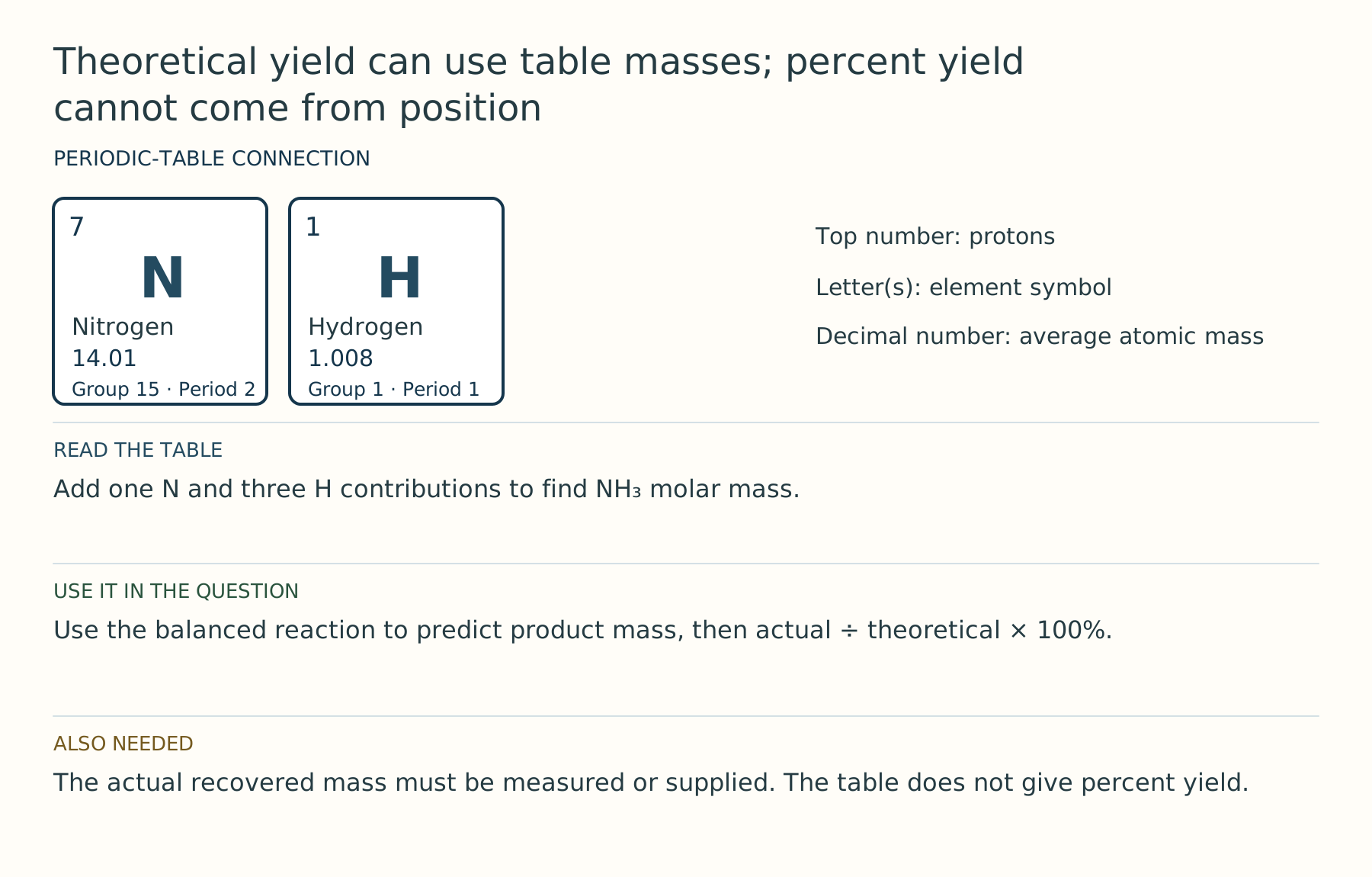
On the periodic table: Theoretical yield can use periodic-table molar masses, e.g. NH3 = 14.01 + 3(1.008) = 17.03 g/mol.
On the periodic table: The table never gives actual or percent yield. In the example both masses are supplied, so no element box is needed.
A reaction should make 25.0 g product but you collect 20.0 g. What is percent yield?
- 1Put actual above theoretical
What fraction of the predicted amount was collected?
20.0 g25.0 g - 2Divide
Matching gram units cancel, leaving a fraction.
20.0g25.0g= 0.800 - 3Turn the fraction into percent
Multiply by 100 to express it per hundred.
0.800 × 100% = 80.0% - ✓Answer
80.0%. Actual is smaller than theoretical, so any answer above 100% is wrong here.
Mixed chapter review
Answer in your notebook before revealing help. Keep your first attempt separate from an answer corrected with help.
Mixed chapter review · 14 questions · tap to open
What this set is for: problems from every section of the chapter, mixed together and not labeled, the way a test asks them. Your job is to pick the right method yourself. Do this before the skill check.
Practice 1
For N2 + 3H2 → 2NH3, how many moles of NH3 can form from 7 mol N2 with excess H2?
Give me a hint
One reactant is stated to be in excess.
Check the answer
Answer: 14 mol
Explain the worked problem to me
What you know: N2 + 3H2 → 2NH3; 7 mol N2; H2 is in excess. What you want: Moles NH3.
- Excess H2 means N2 decides the amount. No limiting check needed.
- Read the ratio, wanted over given: 2 mol NH3 / 1 mol N2.
- 7 mol N2 × (2 mol NH3 / 1 mol N2) = 14 mol NH3.
Check: Each N2 makes 2 NH3, so the answer should be double 7.
Watch out: Do not flip the ratio to 1/2. The wanted substance goes on top.
Your route: Balanced coefficients → Wanted/given mole ratio
That’s right: 14 mol
YOUR PERIODIC-TABLE REFERENCE
Atomic number identifies proton count. The decimal mass is an average, not an isotope’s mass number. Use supplied rounded masses when a problem gives them.
Practice 2
For N2 + 3H2 → 2NH3, how many moles of NH3 can form from 8 mol N2 with excess H2?
Give me a hint
One reactant is stated to be in excess.
Check the answer
Answer: 16 mol
Explain the worked problem to me
What you know: N2 + 3H2 → 2NH3; 8 mol N2; H2 is in excess. What you want: Moles NH3.
- Excess H2 means N2 controls the product.
- Ratio, wanted over given: 2 mol NH3 / 1 mol N2.
- 8 mol N2 × (2 mol NH3 / 1 mol N2) = 16 mol NH3. mol N2 cancels.
Check: Twice as many NH3 as N2: 16 is double 8.
Watch out: The 3 in front of H2 plays no part here. Use only the two substances in the question.
Your route: Balanced coefficients → Wanted/given mole ratio
That’s right: 16 mol
YOUR PERIODIC-TABLE REFERENCE
Atomic number identifies proton count. The decimal mass is an average, not an isotope’s mass number. Use supplied rounded masses when a problem gives them.
Practice 3
In left-to-right order, which smallest whole-number coefficients balance Na + Cl2 → NaCl?
Give me a hint
A reaction needs balancing.
Check the answer
Answer: 2, 1, 2
Explain the worked problem to me
What you know: Na + Cl2 → NaCl. Left: 1 Na, 2 Cl. Right: 1 Na, 1 Cl. What you want: Coefficients in left-to-right order.
- Fix chlorine: put 2 before NaCl, giving 2 Cl on the right.
- That makes 2 Na on the right. Put 2 before Na.
- Cl2 keeps an unwritten 1. In order: 2, 1, 2.
Check: Na: 2 = 2. Cl: 2 = 2. The numbers share no common factor, so they are smallest.
Watch out: List the unwritten 1 for Cl2. Skipping it gives "2, 2", which is incomplete.
Your route: Count each atom → Adjust coefficients only
That’s right: 2, 1, 2
Practice 4
For 2H2 + O2 → 2H2O with excess oxygen, what water mass forms from 14 g H2? Use H2 = 2 and H2O = 18 g/mol.
Give me a hint
The mass of one reactant is given; the product mass is requested.
Check the answer
Answer: 126 g
Explain the worked problem to me
What you know: 2H2 + O2 → 2H2O; 14 g H2; O2 in excess. H2 = 2 g/mol, H2O = 18 g/mol. What you want: Grams H2O.
- Grams to moles: 14 g H2 × (1 mol H2 / 2 g H2) = 7 mol H2.
- Reaction ratio: 7 mol H2 × (2 mol H2O / 2 mol H2) = 7 mol H2O.
- Moles to grams: 7 mol H2O × (18 g H2O / 1 mol H2O) = 126 g.
Check: Water outweighs the hydrogen because it includes the oxygen that joined. 126 − 14 = 112 g came from O2.
Watch out: Do not multiply 14 by 18 directly. Grams of one substance never convert straight to grams of another.
Your route: Grams → Moles → Reaction ratio → Product grams
On the periodic table: You can also build these from the table: hydrogen (H) is about 1 g/mol and oxygen (O) about 16 g/mol (1.008 and 16.00 in their boxes), so H2 = 2 × 1 = 2 g/mol and H2O = 2 × 1 + 16 = 18 g/mol.
That’s right: 126 g
YOUR PERIODIC-TABLE REFERENCE
Atomic number identifies proton count. The decimal mass is an average, not an isotope’s mass number. Use supplied rounded masses when a problem gives them.
Practice 5
For 2H2 + O2 → 2H2O with excess oxygen, what water mass forms from 16 g H2? Use H2 = 2 and H2O = 18 g/mol.
Give me a hint
The mass of one reactant is given; the product mass is requested.
Check the answer
Answer: 144 g
Explain the worked problem to me
What you know: 2H2 + O2 → 2H2O; 16 g H2; O2 in excess. H2 = 2 g/mol, H2O = 18 g/mol. What you want: Grams H2O.
- Grams to moles: 16 g H2 × (1 mol H2 / 2 g H2) = 8 mol H2.
- Reaction ratio: 8 mol H2 × (2 mol H2O / 2 mol H2) = 8 mol H2O.
- Moles to grams: 8 mol H2O × (18 g H2O / 1 mol H2O) = 144 g.
Check: Reverse it: 144 ÷ 18 = 8 mol water, which needs 8 mol H2 = 16 g. It matches.
Watch out: Use 2 g/mol for H2, not 1. Hydrogen gas has two atoms per molecule.
Your route: Grams → Moles → Reaction ratio → Product grams
On the periodic table: You can also build these from the table: hydrogen (H) is about 1 g/mol and oxygen (O) about 16 g/mol (1.008 and 16.00 in their boxes), so H2 = 2 × 1 = 2 g/mol and H2O = 2 × 1 + 16 = 18 g/mol.
That’s right: 144 g
YOUR PERIODIC-TABLE REFERENCE
Atomic number identifies proton count. The decimal mass is an average, not an isotope’s mass number. Use supplied rounded masses when a problem gives them.
Practice 6
For N2 + 3H2 → 2NH3, a mixture has 8 mol N2 and 18 mol H2. Which reactant limits the product?
Give me a hint
Amounts of both reactants are provided.
Check the answer
Answer: H2
Explain the worked problem to me
What you know: N2 + 3H2 → 2NH3; 8 mol N2 and 18 mol H2. What you want: Which reactant limits.
- N2 capacity: 8 mol N2 × (2 mol NH3 / 1 mol N2) = 16 mol NH3.
- H2 capacity: 18 mol H2 × (2 mol NH3 / 3 mol H2) = 12 mol NH3.
- 12 mol is less than 16 mol. Hydrogen runs out first, so H2 limits.
Check: 8 mol N2 would need 8 × 3 = 24 mol H2. Only 18 is there, so H2 is short.
Watch out: Do not pick N2 because 8 is smaller than 18. Compare product capacities, not starting amounts.
Your route: Product capacity for both → Smaller limits
That’s right: H2
YOUR PERIODIC-TABLE REFERENCE
Atomic number identifies proton count. The decimal mass is an average, not an isotope’s mass number. Use supplied rounded masses when a problem gives them.
Practice 7
For N2 + 3H2 → 2NH3, a mixture has 9 mol N2 and 21 mol H2. Which reactant limits the product?
Give me a hint
Amounts of both reactants are provided.
Check the answer
Answer: H2
Explain the worked problem to me
What you know: N2 + 3H2 → 2NH3; 9 mol N2 and 21 mol H2. What you want: Which reactant limits.
- N2 capacity: 9 mol N2 × (2 mol NH3 / 1 mol N2) = 18 mol NH3.
- H2 capacity: 21 mol H2 × (2 mol NH3 / 3 mol H2) = 14 mol NH3.
- 14 mol is less than 18 mol. Hydrogen runs out first, so H2 limits.
Check: 9 mol N2 would need 9 × 3 = 27 mol H2. Only 21 is available.
Watch out: The larger starting number (21) is still the limiting one. The recipe needs 3 H2 per N2.
Your route: Product capacity for both → Smaller limits
That’s right: H2
YOUR PERIODIC-TABLE REFERENCE
Atomic number identifies proton count. The decimal mass is an average, not an isotope’s mass number. Use supplied rounded masses when a problem gives them.
Practice 8
For N2 + 3H2 → 2NH3, 8 mol N2 and 18 mol H2 are available. What maximum NH3 amount can form?
Give me a hint
Both reactants are given and a maximum product is requested.
Check the answer
Answer: 12 mol
Explain the worked problem to me
What you know: N2 + 3H2 → 2NH3; 8 mol N2 and 18 mol H2. What you want: Maximum moles NH3.
- Find the limiting reactant by product capacity. N2: 8 × 2/1 = 16 mol NH3. H2: 18 × 2/3 = 12 mol NH3.
- H2 gives the smaller capacity, so H2 limits.
- The limiting reactant's capacity is the maximum: 18 mol H2 × (2 mol NH3 / 3 mol H2) = 12 mol NH3.
Check: 12 mol NH3 uses 6 mol N2, leaving 2 mol N2 in excess.
Watch out: Do not report 16 mol. The excess reactant's capacity can never be reached.
Your route: Find limiting reactant → Its moles × Product/reactant ratio
That’s right: 12 mol
YOUR PERIODIC-TABLE REFERENCE
Atomic number identifies proton count. The decimal mass is an average, not an isotope’s mass number. Use supplied rounded masses when a problem gives them.
Practice 9
For N2 + 3H2 → 2NH3, 9 mol N2 and 21 mol H2 are available. What maximum NH3 amount can form?
Give me a hint
Both reactants are given and a maximum product is requested.
Check the answer
Answer: 14 mol
Explain the worked problem to me
What you know: N2 + 3H2 → 2NH3; 9 mol N2 and 21 mol H2. What you want: Maximum moles NH3.
- Product capacities: N2: 9 × 2/1 = 18 mol NH3. H2: 21 × 2/3 = 14 mol NH3.
- The smaller capacity comes from H2, so H2 limits.
- Maximum product: 21 mol H2 × (2 mol NH3 / 3 mol H2) = 14 mol NH3.
Check: 14 mol NH3 uses 7 mol N2, leaving 2 mol N2 unused.
Watch out: Do not report 18 mol, the excess reactant's capacity.
Your route: Find limiting reactant → Its moles × Product/reactant ratio
That’s right: 14 mol
YOUR PERIODIC-TABLE REFERENCE
Atomic number identifies proton count. The decimal mass is an average, not an isotope’s mass number. Use supplied rounded masses when a problem gives them.
Practice 10
Theoretical yield is 55 g and actual yield is 44 g. What is percent yield?
Give me a hint
Actual and theoretical yields are both given.
Check the answer
Answer: 80%
Explain the worked problem to me
What you know: Theoretical yield 55 g. Actual yield 44 g. What you want: Percent yield.
- Put actual above theoretical: 44 g / 55 g. The gram units cancel.
- Divide: 44 ÷ 55 = 0.80.
- Turn it into a percent: 0.80 × 100% = 80%.
Check: Actual is less than theoretical, so the answer must be below 100%. It is.
Watch out: Do not divide 55 by 44. That gives 125%, which is impossible here.
Your route: Actual ÷ Theoretical × 100
That’s right: 80%
Practice 11
Theoretical yield is 60 g and actual yield is 48 g. What is percent yield?
Give me a hint
Actual and theoretical yields are both given.
Check the answer
Answer: 80%
Explain the worked problem to me
What you know: Theoretical yield 60 g. Actual yield 48 g. What you want: Percent yield.
- Put actual above theoretical: 48 g / 60 g. Units match, so they cancel.
- Divide: 48 ÷ 60 = 0.80.
- Multiply by 100%: 0.80 × 100% = 80%.
Check: Reverse it: 80% of 60 g is 0.80 × 60 = 48 g, the actual yield.
Watch out: Theoretical always goes on the bottom. Flipping gives 125%.
Your route: Actual ÷ Theoretical × 100
That’s right: 80%
Practice 12
A student wants to read a mole ratio from the unbalanced equation Na + Cl2 → NaCl. What must happen first?
Give me a hint
The task asks how to use a reaction equation.
Check the answer
Answer: Balance atoms by changing coefficients
Explain the worked problem to me
What you know: Na + Cl2 → NaCl is unbalanced. Left: 1 Na, 2 Cl. Right: 1 Na, 1 Cl. What you want: What to do before reading a mole ratio.
- Mole ratios come from coefficients. Unbalanced coefficients give a false recipe.
- So first Balance atoms by changing coefficients: 2Na + Cl2 → 2NaCl.
- Only now read the ratio, for example 2 mol NaCl / 1 mol Cl2.
Why it matters: Using the unbalanced 1:1 ratio would predict half the NaCl that 1 mol Cl2 really makes.
Watch out: Balance with coefficients, never subscripts. Writing NaCl2 invents a different substance.
Your route: Balance → Read ratio
That’s right: Balance atoms by changing coefficients
Practice 13
For N2 + 3H2 → 2NH3, how many H2 moles are required for 7 mol N2?
Give me a hint
One reactant amount is given; the required amount of the other reactant is asked.
Check the answer
Answer: 21 mol
Explain the worked problem to me
What you know: N2 + 3H2 → 2NH3; 7 mol N2. What you want: Moles H2 required.
- Both amounts are in moles, so only the coefficient ratio is needed.
- Ratio, required over given: 3 mol H2 / 1 mol N2.
- 7 mol N2 × (3 mol H2 / 1 mol N2) = 21 mol H2.
Check: The recipe needs 3 H2 per N2. 21 is three times 7.
Watch out: Use 3/1, not 1/3. The substance you want goes on top.
Your route: Given moles → Required/given coefficient ratio
That’s right: 21 mol
YOUR PERIODIC-TABLE REFERENCE
Atomic number identifies proton count. The decimal mass is an average, not an isotope’s mass number. Use supplied rounded masses when a problem gives them.
Practice 14
For N2 + 3H2 → 2NH3, how many H2 moles are required for 8 mol N2?
Give me a hint
One reactant amount is given; the required amount of the other reactant is asked.
Check the answer
Answer: 24 mol
Explain the worked problem to me
What you know: N2 + 3H2 → 2NH3; 8 mol N2. What you want: Moles H2 required.
- Moles to moles uses the coefficient ratio only.
- Ratio, required over given: 3 mol H2 / 1 mol N2.
- 8 mol N2 × (3 mol H2 / 1 mol N2) = 24 mol H2. mol N2 cancels.
Check: Reverse it: 24 ÷ 3 = 8 mol N2. It matches.
Watch out: Do not use the NH3 coefficient. Only N2 and H2 are in this question.
Your route: Given moles → Required/given coefficient ratio
That’s right: 24 mol
YOUR PERIODIC-TABLE REFERENCE
Atomic number identifies proton count. The decimal mass is an average, not an isotope’s mass number. Use supplied rounded masses when a problem gives them.
Skill check: the chapter’s key skills
Try each fresh question without the worked examples. Record your first answer and whether you used a hint. Explain the route as well as the answer.
Skill check · 6 questions · tap to open
What this set is for: one question on each key skill from this chapter. Try each on your own, without hints, then mark how it went in the tracker below. A miss tells you which section to review.
Skill 1: Balance a chemical equation using the smallest whole-number coefficients, and verify every element on both sides.
Balance Al + O2 → Al2O3 and explain your oxygen count.
Give me a hint
Count each element on both sides. Change coefficients only; recount after each change and reduce to the smallest whole numbers.
Check the answer
4Al + 3O2 → 2Al2O3. Each side has 4 Al and 6 O atoms; coefficients are the smallest whole numbers.
Explain the worked problem to me
What you know: Al + O2 → Al2O3. Oxygen comes in groups of 2 on the left and 3 on the right. What you want: The balanced equation and the oxygen count.
- The smallest total that is a multiple of both 2 and 3 is 6 O.
- Make 6 O on each side: 3O2 gives 3 × 2 = 6; 2Al2O3 gives 2 × 3 = 6.
- Aluminum on the right is now 2 × 2 = 4. Put 4 before Al. Result: 4Al + 3O2 → 2Al2O3.
Check: Al: 4 = 4. O: 6 = 6. The set 4, 3, 2 has no common factor, so it is smallest.
Watch out: Count O2 as 2 atoms per molecule. 3O2 is 6 O atoms, not 3.
That’s right: 4Al + 3O2 → 2Al2O3. Each side has 4 Al and 6 O atoms; coefficients are the smallest whole numbers.
YOUR PERIODIC-TABLE REFERENCE
Atomic number identifies proton count. The decimal mass is an average, not an isotope’s mass number. Use supplied rounded masses when a problem gives them.
Skill 2: Classify a reaction as synthesis, decomposition, single displacement, double displacement, or combustion.
Classify: 2Al + 3Br2 → 2AlBr3
Give me a hint
Count the reactants and products.
Check the answer
Answer: Synthesis
Explain the worked problem to me
What you know: 2Al + 3Br2 → 2AlBr3. What you want: The reaction type.
- Count reactants: two substances, Al and Br2.
- Count products: one substance, AlBr3.
- Two substances making one product fits A + B → AB. This is Synthesis.
Why it matters: Recognizing synthesis tells you the product is a single compound built from the reactants.
Watch out: Coefficients do not count as extra substances. 2AlBr3 is still one product.
That’s right: Synthesis
Skill 3: Use a balanced mole ratio to find product amount.
For 2H2 + O2 → 2H2O, find water from 1.5 mol O2 with excess H2.
Give me a hint
Use the wanted substance’s coefficient above the given substance’s coefficient. Cancel the given mole label.
Check the answer
1.5 × 2/1 = 3.0 mol H2O.
Explain the worked problem to me
What you know: 2H2 + O2 → 2H2O; 1.5 mol O2; H2 in excess. What you want: Moles H2O.
- Excess H2 means O2 controls the product.
- Ratio, wanted over given: 2 mol H2O / 1 mol O2.
- 1.5 mol O2 × (2 mol H2O / 1 mol O2) = 3.0 mol H2O. Keep two significant figures, as in 1.5.
Check: Each O2 makes 2 H2O, so the answer should be double 1.5.
Watch out: Do not use the H2 coefficient. Use only the given (O2) and wanted (H2O) substances.
That’s right: 1.5 × 2/1 = 3.0 mol H2O.
YOUR PERIODIC-TABLE REFERENCE
Atomic number identifies proton count. The decimal mass is an average, not an isotope’s mass number. Use supplied rounded masses when a problem gives them.
Skill 4: Identify the given substance A and requested substance B, choose the start and stop units, and use molar mass → coefficient ratio → molar mass to convert reaction amounts.
For 2Mg + O2 → 2MgO, find grams MgO from 12.0 g Mg with excess O2. Use Mg = 24.0 g/mol and MgO = 40.0 g/mol.
Give me a hint
Convert the given grams to moles, apply the balanced coefficient ratio, then use the product’s molar mass to reach grams.
Check the answer
12.0 g Mg × (1 mol Mg / 24.0 g Mg) × (2 mol MgO / 2 mol Mg) × (40.0 g MgO / 1 mol MgO) = 20.0 g MgO. All units except g MgO cancel.
On the periodic table: You can also build these from the table: magnesium (Mg) is taken as 24.0 g/mol (24.31 in its box, simplified), and MgO = 24.0 + 16.0 for oxygen (O) = 40.0 g/mol.
Explain the worked problem to me
What you know: 2Mg + O2 → 2MgO; 12.0 g Mg; O2 in excess. Mg = 24.0 g/mol, MgO = 40.0 g/mol. What you want: Grams MgO.
- Grams A → grams B uses all three bridges. First: 12.0 g Mg × (1 mol Mg / 24.0 g Mg) = 0.500 mol Mg.
- Middle: 0.500 mol Mg × (2 mol MgO / 2 mol Mg) = 0.500 mol MgO.
- Last: 0.500 mol MgO × (40.0 g MgO / 1 mol MgO) = 20.0 g MgO. Every unit except g MgO cancels.
Check: MgO weighs more than the Mg because it includes oxygen. 20.0 − 12.0 = 8.0 g O joined.
Watch out: Do not use 24.0 for both conversions. Each bridge uses its own substance's molar mass.
On the periodic table: You can also build these from the table: magnesium (Mg) is taken as 24.0 g/mol (24.31 in its box, simplified), and MgO = 24.0 + 16.0 for oxygen (O) = 40.0 g/mol.
That’s right: 12.0 g Mg × (1 mol Mg / 24.0 g Mg) × (2 mol MgO / 2 mol Mg) × (40.0 g MgO / 1 mol MgO) = 20.0 g MgO. All units except g MgO cancel.
YOUR PERIODIC-TABLE REFERENCE
Atomic number identifies proton count. The decimal mass is an average, not an isotope’s mass number. Use supplied rounded masses when a problem gives them.
Skill 5: Identify the limiting reactant by product capacity.
N2 + 3H2 → 2NH3: 1 mol N2 and 1 mol H2. Which limits?
Give me a hint
Calculate the amount of the same product each reactant could make using the balanced mole ratio. The smaller capacity identifies the limiting reactant.
Check the answer
H2: it can make only 2/3 mol NH3; N2 could make 2 mol.
Explain the worked problem to me
What you know: N2 + 3H2 → 2NH3; 1 mol N2 and 1 mol H2. What you want: Which reactant limits.
- N2 capacity: 1 mol N2 × (2 mol NH3 / 1 mol N2) = 2 mol NH3.
- H2 capacity: 1 mol H2 × (2 mol NH3 / 3 mol H2) = 2/3 mol NH3.
- 2/3 mol is less than 2 mol, so hydrogen runs out first. H2 limits: it can make only 2/3 mol NH3.
Check: 1 mol N2 would need 3 mol H2. Only 1 mol is there.
Watch out: Equal starting moles do not mean equal use. The recipe uses 3 H2 for each N2.
That’s right: H2: it can make only 2/3 mol NH3; N2 could make 2 mol.
YOUR PERIODIC-TABLE REFERENCE
Atomic number identifies proton count. The decimal mass is an average, not an isotope’s mass number. Use supplied rounded masses when a problem gives them.
Skill 6: Calculate percent yield.
Actual yield 9.0 g; theoretical 12 g. Percent?
Give me a hint
Divide actual yield by theoretical yield and multiply by 100. Use the same units in both amounts.
Check the answer
9.0/12 × 100 = 75%.
Explain the worked problem to me
What you know: Actual yield 9.0 g. Theoretical yield 12 g. What you want: Percent yield.
- Put actual above theoretical: 9.0 g / 12 g. Same units, so they cancel.
- Divide: 9.0 ÷ 12 = 0.75.
- Multiply by 100%: 0.75 × 100% = 75%. Both values have two significant figures.
Check: Actual is below theoretical, so the result is under 100%. 75% of 12 g is 9.0 g.
Watch out: Dividing 12 by 9.0 gives 133%, a sign the fraction is upside down.
That’s right: 9.0/12 × 100 = 75%.
What to do next
Mark each skill: “I can do it independently,” “I needed help,” or “I need another explanation.” Revisit the section with the same goal for any skill needing help, then try a different question. A successful first attempt is evidence of progress; one answer alone does not establish lasting mastery.
Final coming up?
Take the 70-question practice final
Modeled on standardized first-term general chemistry finals: 70 questions, 110 minutes. Timed or untimed. Full feedback on every question, plus your score by topic. The first 20 are free; the full final is $7.99 for 2 weeks.
Original ChemGem questions.