ChemGem

How to Use Mole Ratios from a Balanced Equation (Step-by-Step, with Practice)

A balanced equation is a recipe. Its coefficients say how many moles of each substance react and form. Use that ratio to get from the amount you have to the amount you want.

Spot it, solve it, practice it: 3 steps, 1 worked example, 5 practice problems. Free, no account.

The route · 3 steps

  1. Balance the equation.
  2. Convert the given amount to moles.
  3. Multiply by the coefficient ratio: wanted on top, given below.
Spot it

How to recognize mole ratio questions

Look for a balanced equation with moles of one substance given and moles of another asked, often with “excess” of the other reactant.

Example wording, with the clue words marked:

For N2 + 3H2 → 2NH3, how many moles of NH3 can form from 7 mol N2 with excess H2?

Not sure it’s this type? Compare the neighbors:

Step-by-step

Worked example: mole ratio

The idea

What the recipe says
  • Reactants are the starting substances; products are what they become.
  • Balanced means the same number of each kind of atom on both sides.
  • Change only coefficients, the numbers in front of formulas. A new subscript means a new substance.
  • Coefficients give particle and mole ratios.
Reading 2H2 + O2 → 2H2O
2H2+ O2→ 2H2O
Molecules212
Moles2 mol1 mol2 mol
Grams4.032 g32.00 g36.03 g
Moles follow 2 : 1 : 2. Grams do not, because each substance has its own molar mass.
Moles wanted = moles given × balanced ratio
mol B = mol A × coefficient Bcoefficient A
A is the given substance; B is the wanted one. Coefficients come from the balanced equation.
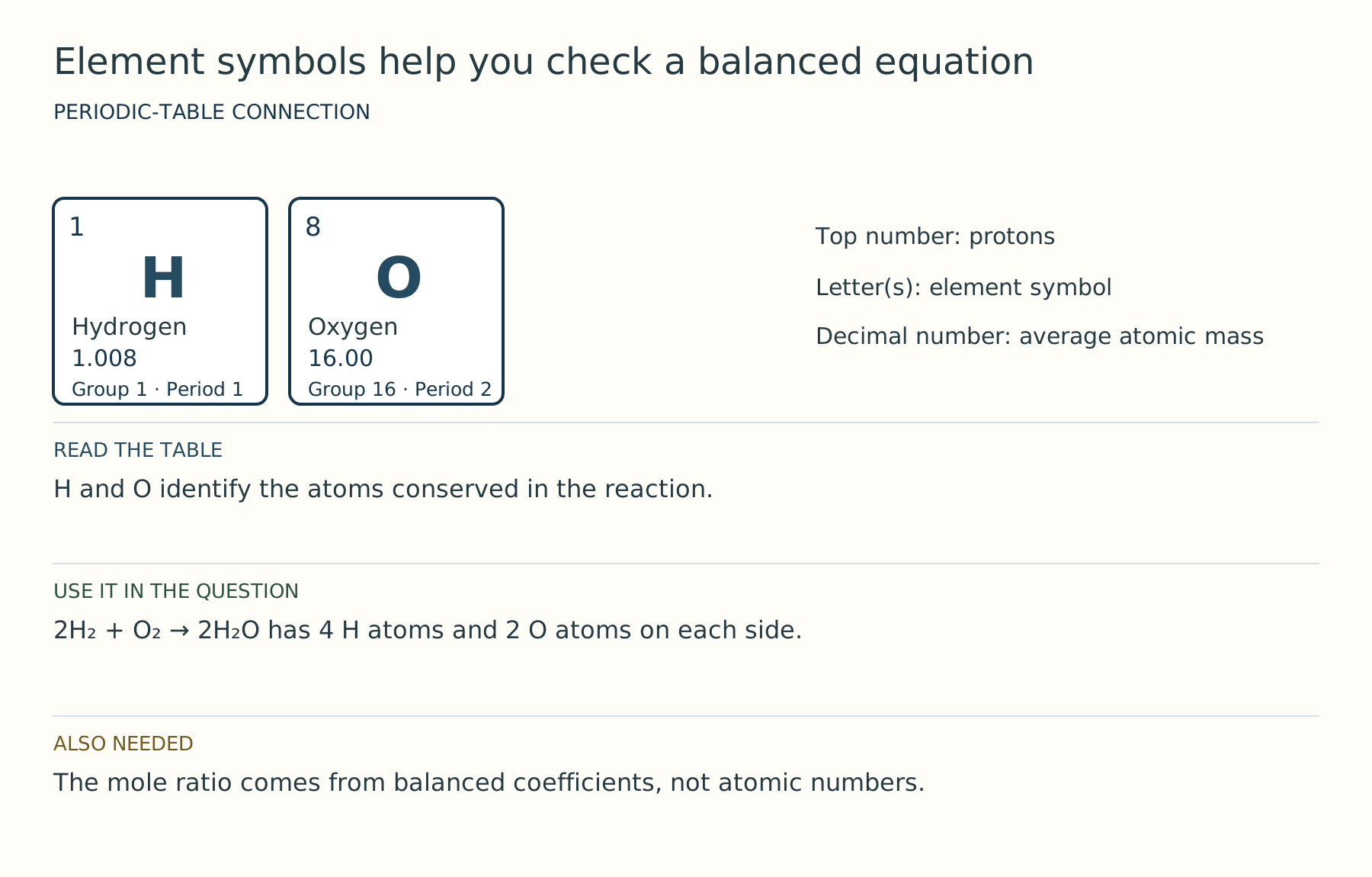
Element symbols help you check a balanced equation. H and O identify the atoms conserved in the reaction. 2H₂ + O₂ → 2H₂O has 4 H atoms and 2 O atoms on each side. The mole ratio comes from balanced coefficients, not atomic numbers.
4 H and 2 O on each side. The mole ratio comes from coefficients, not atomic numbers.

On the periodic table: H: atomic number 1, molar mass 1.008 g/mol. O: atomic number 8, molar mass 16.00 g/mol.

On the periodic table: Atomic number is the proton count. The decimal mass is an average, not an isotope’s mass number.

On the periodic table: Use supplied rounded masses when a problem gives them.

Worked example · 3 steps

For 2H2 + O2 → 2H2O, how much water can 3.0 mol O2 make with excess H2?

Conversion factor for this route
From the balanced equation
2 mol H2O1 mol O2
Excess H2 means oxygen sets the amount.
  1. 1
    Read the balanced recipe

    The coefficients compare mole amounts.

    1 mol O2 → 2 mol H2O
  2. 2
    Set the wanted/given ratio

    Wanted substance on top, given substance underneath.

    3.0 mol O2 × 2 mol H2O1 mol O2
  3. 3
    Calculate

    The oxygen unit cancels, leaving moles of water.

    3.0 mol O2 × 2 mol H2O1 mol O2 = 6.0 mol H2O
  4. ✓
    Answer

    6.0 mol H2O. Two moles of water form per mole of oxygen.

Your turn

Mole ratio practice problems

Answer first, then check. Hints open one at a time; the answer and full solution open after you try.

Problem 1 of 5 · warm-up

For N2 + 3H2 → 2NH3, how many moles of NH3 can form from 7 mol N2 with excess H2?

Hint 1 · the clue

One reactant is stated to be in excess.

Hint 2 · the next move

Moles of N2 with “excess H2” and moles of NH3 asked: N2 controls, so use the mole ratio.

Your path:

  1. Excess H2: N2 sets the amount
  2. Ratio, wanted over given: 2 NH3 / 1 N2
  3. Multiply moles N2 by the ratio
Answer

Answer: 14 mol

Full worked solution

What you know: N2 + 3H2 → 2NH3; 7 mol N2; H2 is in excess. What you want: Moles NH3.

  1. Excess H2 means N2 decides the amount. No limiting check needed.
  2. Read the ratio, wanted over given: 2 mol NH3 / 1 mol N2.
  3. 7 mol N2 × (2 mol NH3 / 1 mol N2) = 14 mol NH3.

Check: Each N2 makes 2 NH3, so the answer should be double 7.

Watch out: Do not flip the ratio to 1/2. The wanted substance goes on top.

Your route: Balanced coefficients → Wanted/given mole ratio

Answer: 14 mol

YOUR PERIODIC-TABLE REFERENCE

7NNitrogen14.01Group 15 · Period 2

Atomic number identifies proton count. The decimal mass is an average, not an isotope’s mass number. Use supplied rounded masses when a problem gives them.

Problem 2 of 5

For N2 + 3H2 → 2NH3, how many moles of NH3 can form from 8 mol N2 with excess H2?

Hint 1 · the clue

One reactant is stated to be in excess.

Hint 2 · the next move

Moles of N2 with “excess H2” and moles of NH3 asked: N2 controls, so use the mole ratio.

Your path:

  1. Excess H2: N2 sets the amount
  2. Ratio, wanted over given: 2 NH3 / 1 N2
  3. Multiply moles N2 by the ratio
Answer

Answer: 16 mol

Full worked solution

What you know: N2 + 3H2 → 2NH3; 8 mol N2; H2 is in excess. What you want: Moles NH3.

  1. Excess H2 means N2 controls the product.
  2. Ratio, wanted over given: 2 mol NH3 / 1 mol N2.
  3. 8 mol N2 × (2 mol NH3 / 1 mol N2) = 16 mol NH3. mol N2 cancels.

Check: Twice as many NH3 as N2: 16 is double 8.

Watch out: The 3 in front of H2 plays no part here. Use only the two substances in the question.

Your route: Balanced coefficients → Wanted/given mole ratio

Answer: 16 mol

YOUR PERIODIC-TABLE REFERENCE

7NNitrogen14.01Group 15 · Period 2

Atomic number identifies proton count. The decimal mass is an average, not an isotope’s mass number. Use supplied rounded masses when a problem gives them.

Problem 3 of 5

For N2 + 3H2 → 2NH3, how many H2 moles are required for 7 mol N2?

Hint 1 · the clue

One reactant amount is given; the required amount of the other reactant is asked.

Hint 2 · the next move

Moles of N2 given and moles of H2 “required” asked: moles to moles uses only the coefficient ratio.

Your path:

  1. Read ratio: 3 mol H2 / 1 mol N2
  2. Multiply moles N2 by the ratio
Answer

Answer: 21 mol

Full worked solution

What you know: N2 + 3H2 → 2NH3; 7 mol N2. What you want: Moles H2 required.

  1. Both amounts are in moles, so only the coefficient ratio is needed.
  2. Ratio, required over given: 3 mol H2 / 1 mol N2.
  3. 7 mol N2 × (3 mol H2 / 1 mol N2) = 21 mol H2.

Check: The recipe needs 3 H2 per N2. 21 is three times 7.

Watch out: Use 3/1, not 1/3. The substance you want goes on top.

Your route: Given moles → Required/given coefficient ratio

Answer: 21 mol

YOUR PERIODIC-TABLE REFERENCE

1HHydrogen1.008Group 1 · Period 1

Atomic number identifies proton count. The decimal mass is an average, not an isotope’s mass number. Use supplied rounded masses when a problem gives them.

Problem 4 of 5

For N2 + 3H2 → 2NH3, how many H2 moles are required for 8 mol N2?

Hint 1 · the clue

One reactant amount is given; the required amount of the other reactant is asked.

Hint 2 · the next move

Moles of N2 given and moles of H2 “required” asked: moles to moles uses only the coefficient ratio.

Your path:

  1. Read ratio: 3 mol H2 / 1 mol N2
  2. Multiply moles N2 by the ratio
Answer

Answer: 24 mol

Full worked solution

What you know: N2 + 3H2 → 2NH3; 8 mol N2. What you want: Moles H2 required.

  1. Moles to moles uses the coefficient ratio only.
  2. Ratio, required over given: 3 mol H2 / 1 mol N2.
  3. 8 mol N2 × (3 mol H2 / 1 mol N2) = 24 mol H2. mol N2 cancels.

Check: Reverse it: 24 ÷ 3 = 8 mol N2. It matches.

Watch out: Do not use the NH3 coefficient. Only N2 and H2 are in this question.

Your route: Given moles → Required/given coefficient ratio

Answer: 24 mol

YOUR PERIODIC-TABLE REFERENCE

1HHydrogen1.008Group 1 · Period 1

Atomic number identifies proton count. The decimal mass is an average, not an isotope’s mass number. Use supplied rounded masses when a problem gives them.

Problem 5 of 5

For 2H2 + O2 → 2H2O, find water from 1.5 mol O2 with excess H2.

Hint 1 · the clue

Use the wanted substance’s coefficient above the given substance’s coefficient. Cancel the given mole label.

Hint 2 · the next move

Moles of O2 with “excess H2” and water asked: O2 controls, so use the mole ratio.

Your path:

  1. Excess H2: O2 sets the amount
  2. Ratio, wanted over given: 2 H2O / 1 O2
  3. Multiply moles O2 by the ratio
Answer

1.5 × 2/1 = 3.0 mol H2O.

Full worked solution

What you know: 2H2 + O2 → 2H2O; 1.5 mol O2; H2 in excess. What you want: Moles H2O.

  1. Excess H2 means O2 controls the product.
  2. Ratio, wanted over given: 2 mol H2O / 1 mol O2.
  3. 1.5 mol O2 × (2 mol H2O / 1 mol O2) = 3.0 mol H2O. Keep two significant figures, as in 1.5.

Check: Each O2 makes 2 H2O, so the answer should be double 1.5.

Watch out: Do not use the H2 coefficient. Use only the given (O2) and wanted (H2O) substances.

Answer: 1.5 × 2/1 = 3.0 mol H2O.

YOUR PERIODIC-TABLE REFERENCE

1HHydrogen1.008Group 1 · Period 1
8OOxygen16.00Group 16 · Period 2

Atomic number identifies proton count. The decimal mass is an average, not an isotope’s mass number. Use supplied rounded masses when a problem gives them.

Watch out

Common mole ratio mistakes