ChemGem

How to Balance Chemical Equations (Step-by-Step, with Practice)

A reaction rearranges atoms. It never creates or removes them. Balancing makes the count of each kind of atom equal on both sides. Here the formulas are given; you choose how many of each.

Spot it, solve it, practice it: 5 steps, 1 worked example, 13 practice problems. Free, no account.

The route · 5 steps

  1. Count the atoms of each element on each side.
  2. Start with the most complicated formula; leave lone elements (O2, H2, Fe) for last.
  3. Change one coefficient at a time; it multiplies the whole formula.
  4. Recount every element after each change.
  5. Clear any fractions, reduce to the smallest whole numbers, then check again.
Spot it

How to recognize balancing equations questions

Look for an equation with an arrow and the word “balance,” or coefficients asked for, so every element’s atom count matches on both sides.

Example wording, with the clue words marked:

H2 + Cl2 → HCl

Not sure it’s this type? Compare the neighbors:

Step-by-step

Worked example: balancing equations

The idea

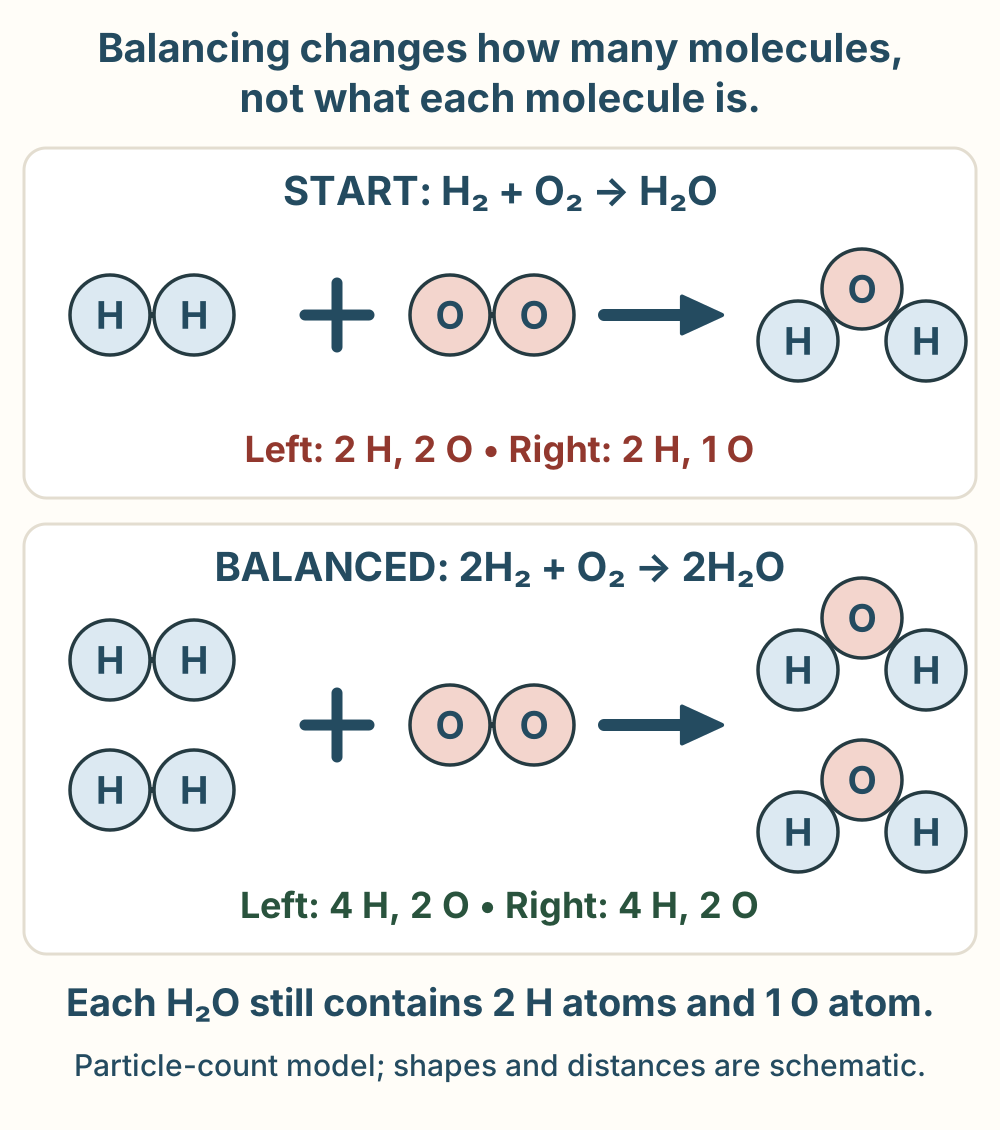
An unbalanced water reaction has two oxygen atoms on the left and one on the right. Two hydrogen molecules plus one oxygen molecule form two water molecules, conserving four hydrogen and two oxygen atoms.
2H2 + O2 → 2H2O: the same atoms, rearranged. Count each colored atom, not the molecules.
Two numbers with different jobs
NumberWhereExampleMeaning
SubscriptSmall, inside the formulaH2O2 H and 1 O. Leave it alone.
CoefficientIn front of the formula3H2O3 × 2 = 6 H and 3 × 1 = 3 O.
No coefficientNothing writtenH2OMeans 1.
Reactants sit left of the arrow; products sit right.
Fixing a count: the right way and the wrong way
Change a coefficient
H2O → 2H2O
Still water, just more of it.
Change a subscript
H2O → H2O2
Now it is hydrogen peroxide, a different substance.
Order of attack
  • Start with the most complicated formula, the one with the most atoms or elements.
  • Next, balance elements that show up in only one formula on each side. Leave lone elements (O2, H2, Fe) for last. Changing their coefficient changes only that element, so nothing else is disturbed.
  • If a group like SO4, PO4, NO3 or OH (a polyatomic ion) appears unchanged on both sides, count it as one unit.
  • Stuck with an odd number of O atoms? Use a fraction, such as 72O2. Then multiply every coefficient by 2 to clear it.
  • At the end, recount every element on both sides.
Before you calculate
  • Use the smallest whole-number coefficients. A 1 can stay unwritten.
  • Count each element on both sides before checking an answer.
  • No moles or grams are needed yet. The next lesson turns coefficients into a mole recipe.

On the periodic table: The periodic table names each symbol (H, O, Al). Balancing needs only atom counts, not masses.

Worked example · 3 steps

Balance: H2 + O2 → H2O

  1. 1
    Count first

    Oxygen does not match. Hydrogen matches for now.

    ElementLeftRight
    H22
    O21
  2. 2
    Put 2 before water

    Two waters give 2 O, but also 4 H. Recount both elements.

    H2 + O2 → 2H2O
    ElementLeftRight
    H24
    O22
  3. 3
    Put 2 before hydrogen

    Two H2 give 4 H. Both sides now have 4 H and 2 O.

    2H2 + O2 → 2H2O
    ElementLeftRight
    H2 × 2 = 42 × 2 = 4
    O1 × 2 = 22 × 1 = 2
  4. ✓
    Answer

    2H2 + O2 → 2H2O
    Check: H 4 = 4; O 2 = 2.

Your turn

Balancing equations practice problems

Answer first, then check. Hints open one at a time; the answer and full solution open after you try.

Problem 1 of 13 · warm-up

H2 + Cl2 → HCl

Hint 1 · the clue

Count the start: left has 2 H and 2 Cl; right has 1 H and 1 Cl.

Hint 2 · the next move

An unbalanced equation: H and Cl are each short on the right, so a coefficient goes before HCl.

Your path:

  1. Count each element on both sides
  2. Add coefficients to fix uneven elements
  3. Recount until every element matches
Answer

Answer: H2 + Cl2 → 2HCl
That’s right: H: 2 = 2; Cl: 2 = 2.

Full worked solution

What you know: H2 + Cl2 → HCl. Left: 2 H, 2 Cl. Right: 1 H, 1 Cl. What you want: The smallest whole-number coefficients that make every count equal.

  1. Both elements are short on the right by the same amount. Each HCl holds only 1 H and 1 Cl.
  2. Put 2 before HCl. Now the right has 2 × 1 = 2 H and 2 × 1 = 2 Cl.
  3. Recount the left: H2 gives 2 H, Cl2 gives 2 Cl. Everything matches: H2 + Cl2 → 2HCl.

Check: H: 2 = 2. Cl: 2 = 2. The coefficients 1, 1, 2 cannot be reduced further.

Watch out: Do not write H2Cl2 or HCl2. Changing a subscript makes a different substance. Change coefficients only.

  1. Count the start: left has 2 H and 2 Cl; right has 1 H and 1 Cl.
  2. Put 2 before HCl. This multiplies both H and Cl by 2.
  3. Check: both sides now have 2 H and 2 Cl. The coefficients 1, 1, 2 cannot be reduced.

Answer: H2 + Cl2 → 2HCl
H: 2 = 2; Cl: 2 = 2.

Problem 2 of 13

Na + Cl2 → NaCl

Hint 1 · the clue

Cl2 gives 2 Cl on the left, but NaCl has only 1 Cl on the right.

Hint 2 · the next move

An unbalanced equation: Cl2 brings 2 Cl but NaCl has 1, so fix chlorine, then sodium.

Your path:

  1. Count Na and Cl on both sides
  2. Put 2 before NaCl for chlorine
  3. Then put 2 before Na
Answer

Answer: 2Na + Cl2 → 2NaCl
That’s right: Na: 2 = 2; Cl: 2 = 2.

Full worked solution

What you know: Na + Cl2 → NaCl. Left: 1 Na, 2 Cl. Right: 1 Na, 1 Cl. What you want: The smallest whole-number coefficients.

  1. Fix chlorine first. Cl2 brings 2 Cl, so put 2 before NaCl: 2 × 1 = 2 Cl on the right.
  2. That 2 also doubles sodium on the right: 2 × 1 = 2 Na. The left has only 1 Na.
  3. Put 2 before Na. Now 2Na + Cl2 → 2NaCl.

Check: Na: 2 = 2. Cl: 2 = 2. Recount every element after each change, as you just did.

Watch out: After fixing chlorine, students often forget that the coefficient on NaCl also changed the sodium count.

  1. Cl2 gives 2 Cl on the left, but NaCl has only 1 Cl on the right.
  2. Put 2 before NaCl to get 2 Cl. This also gives 2 Na on the right.
  3. Put 2 before Na. Both elements match; the smallest coefficients are 2, 1, 2.

Answer: 2Na + Cl2 → 2NaCl
Na: 2 = 2; Cl: 2 = 2.

Problem 3 of 13

Mg + O2 → MgO

Hint 1 · the clue

O2 has 2 O, but MgO has only 1 O.

Hint 2 · the next move

An unbalanced equation: O2 has 2 O but MgO has 1, so fix oxygen, then magnesium.

Your path:

  1. Count Mg and O on both sides
  2. Put 2 before MgO for oxygen
  3. Then put 2 before Mg
Answer

Answer: 2Mg + O2 → 2MgO
That’s right: Mg: 2 = 2; O: 2 = 2.

Full worked solution

What you know: Mg + O2 → MgO. Left: 1 Mg, 2 O. Right: 1 Mg, 1 O. What you want: The smallest whole-number coefficients.

  1. Fix oxygen. O2 has 2 O, so put 2 before MgO: 2 × 1 = 2 O on the right.
  2. Recount: 2MgO also holds 2 × 1 = 2 Mg. The left has 1 Mg.
  3. Put 2 before Mg. Result: 2Mg + O2 → 2MgO.

Check: Mg: 2 = 2. O: 2 = 2. The set 2, 1, 2 has no common factor, so it is smallest.

Watch out: Never write MgO2 to fix oxygen. That changes a subscript and the substance.

  1. O2 has 2 O, but MgO has only 1 O.
  2. Put 2 before MgO. The right now has 2 O and 2 Mg.
  3. Put 2 before Mg. Check both elements: 2 Mg and 2 O on each side.

Answer: 2Mg + O2 → 2MgO
Mg: 2 = 2; O: 2 = 2.

Problem 4 of 13

N2 + H2 → NH3

Hint 1 · the clue

N2 has 2 N. Put 2 before NH3 to make 2 N on the right.

Hint 2 · the next move

An unbalanced equation: N2 has 2 N but NH3 has 1, so fix nitrogen first, then hydrogen.

Your path:

  1. Put 2 before NH3 for nitrogen
  2. Recount hydrogen on the right
  3. Put 3 before H2 to match
Answer

Answer: N2 + 3H2 → 2NH3
That’s right: N: 2 = 2; H: 6 = 6.

Full worked solution

What you know: N2 + H2 → NH3. Left: 2 N, 2 H. Right: 1 N, 3 H. What you want: The smallest whole-number coefficients.

  1. Fix nitrogen. Put 2 before NH3: 2 × 1 = 2 N on the right.
  2. Recount hydrogen on the right: 2 × 3 = 6 H. The left has only 2 H.
  3. Put 3 before H2: 3 × 2 = 6 H. Result: N2 + 3H2 → 2NH3.

Check: N: 2 = 2. H: 3 × 2 = 6 on the left; 2 × 3 = 6 on the right.

Watch out: A coefficient multiplies every atom in the formula. 2NH3 has 6 H, not 3 or 5.

  1. N2 has 2 N. Put 2 before NH3 to make 2 N on the right.
  2. Those two NH3 units contain 2 × 3 = 6 H.
  3. Put 3 before H2 to supply 3 × 2 = 6 H. Check: 2 N and 6 H on each side.

Answer: N2 + 3H2 → 2NH3
N: 2 = 2; H: 6 = 6.

Problem 5 of 13

Al + Cl2 → AlCl3

Hint 1 · the clue

Chlorine comes in groups of 2 in Cl2 and groups of 3 in AlCl3. Use 6 as their first shared total.

Hint 2 · the next move

Chlorine comes in 2s (Cl2) and 3s (AlCl3): find a shared total so both sides match.

Your path:

  1. Find smallest multiple of 2 and 3
  2. Use 3Cl2 and 2AlCl3
  3. Then balance Al with 2Al
Answer

Answer: 2Al + 3Cl2 → 2AlCl3
That’s right: Al: 2 = 2; Cl: 6 = 6.

Full worked solution

What you know: Al + Cl2 → AlCl3. Chlorine comes in groups of 2 on the left and 3 on the right. What you want: The smallest whole-number coefficients.

  1. Find the smallest total that is a multiple of both 2 and 3: that is 6 Cl.
  2. Make 6 Cl on each side: 3Cl2 gives 3 × 2 = 6, and 2AlCl3 gives 2 × 3 = 6.
  3. Now the right has 2 × 1 = 2 Al. Put 2 before Al. Result: 2Al + 3Cl2 → 2AlCl3.

Check: Al: 2 = 2. Cl: 6 = 6.

Watch out: Aluminum looks balanced at the start (1 = 1), but it changes once you fix chlorine. Fix the 2-and-3 element first, then recount aluminum.

  1. Chlorine comes in groups of 2 in Cl2 and groups of 3 in AlCl3. Use 6 as their first shared total.
  2. Put 3 before Cl2 and 2 before AlCl3. Both sides now have 6 Cl.
  3. The products have 2 Al. Put 2 before Al. Check: 2 Al and 6 Cl on each side.

Answer: 2Al + 3Cl2 → 2AlCl3
Al: 2 = 2; Cl: 6 = 6.

Problem 6 of 13

Fe + O2 → Fe2O3

Hint 1 · the clue

O2 has 2 O per molecule; Fe2O3 has 3. Their smallest shared oxygen total is 6.

Hint 2 · the next move

Oxygen comes in 2s (O2) and 3s (Fe2O3): find a shared total, then balance iron.

Your path:

  1. Find smallest multiple of 2 and 3
  2. Use 3O2 and 2Fe2O3
  3. Then balance Fe with 4Fe
Answer

Answer: 4Fe + 3O2 → 2Fe2O3
That’s right: Fe: 4 = 4; O: 6 = 6.

Full worked solution

What you know: Fe + O2 → Fe2O3. Oxygen comes in groups of 2 on the left and 3 on the right. What you want: The smallest whole-number coefficients.

  1. The smallest shared oxygen total is 6. Use 3O2 (3 × 2 = 6 O) and 2Fe2O3 (2 × 3 = 6 O).
  2. Count iron on the right: 2 × 2 = 4 Fe.
  3. Put 4 before Fe. Result: 4Fe + 3O2 → 2Fe2O3.

Check: Fe: 4 = 2 × 2. O: 3 × 2 = 6 on the left; 2 × 3 = 6 on the right.

Watch out: The subscript 2 in Fe2O3 means each unit holds 2 Fe. Two units hold 4 Fe, not 2.

  1. O2 has 2 O per molecule; Fe2O3 has 3. Their smallest shared oxygen total is 6.
  2. Put 3 before O2 and 2 before Fe2O3. Now oxygen matches.
  3. Two Fe2O3 units contain 4 Fe. Put 4 before Fe. Check: 4 Fe and 6 O on each side.

Answer: 4Fe + 3O2 → 2Fe2O3
Fe: 4 = 4; O: 6 = 6.

Problem 7 of 13

H2O2 → H2O + O2

Hint 1 · the clue

Start with hydrogen: H2O2 and H2O each have 2 H. Oxygen is unequal: 2 on the left and 3 total on the right.

Hint 2 · the next move

Oxygen appears in two products, H2O and O2, so the counts are uneven: try a coefficient on H2O2.

Your path:

  1. Count H and O on both sides
  2. Put 2 before H2O2
  3. Put 2 before H2O, recount O
Answer

Answer: 2H2O2 → 2H2O + O2
That’s right: H: 4 = 4; O: 4 = 2 + 2.

Full worked solution

What you know: H2O2 → H2O + O2. H: 2 = 2. O: 2 on the left, 1 + 2 = 3 on the right. What you want: The smallest whole-number coefficients.

  1. Oxygen is uneven: 2 on the left, 3 on the right. Try 2H2O2, which gives the left 2 × 2 = 4 H and 2 × 2 = 4 O.
  2. Match hydrogen with 2H2O: 2 × 2 = 4 H on the right.
  3. Count all product oxygen: 2H2O gives 2 O, O2 gives 2 O, total 4. It matches. Result: 2H2O2 → 2H2O + O2.

Check: H: 4 = 4. O: 4 = 2 + 2.

Watch out: Add oxygen from every product. Counting only the O2 or only the water gives the wrong total.

  1. Start with hydrogen: H2O2 and H2O each have 2 H. Oxygen is unequal: 2 on the left and 3 total on the right.
  2. Try 2H2O2 → 2H2O + O2. Doubling peroxide and water keeps hydrogen matched.
  3. Check oxygen: 2 × 2 = 4 on the left; 2 × 1 + 2 = 4 on the right. Hydrogen is 4 on each side.

Answer: 2H2O2 → 2H2O + O2
H: 4 = 4; O: 4 = 2 + 2.

Problem 8 of 13

C2H4 + O2 → CO2 + H2O

Hint 1 · the clue

C2H4 has 2 C. Put 2 before CO2 to match carbon.

Hint 2 · the next move

A hydrocarbon making CO2 and H2O is a combustion: balance C, then H, then O last.

Your path:

  1. Balance carbon with CO2
  2. Balance hydrogen with H2O
  3. Balance oxygen last with O2
Answer

Answer: C2H4 + 3O2 → 2CO2 + 2H2O
That’s right: C: 2 = 2; H: 4 = 4; O: 6 = 4 + 2.

Full worked solution

What you know: C2H4 + O2 → CO2 + H2O. This is a combustion, so balance C, then H, then O. What you want: The smallest whole-number coefficients.

  1. Carbon: C2H4 has 2 C. Put 2 before CO2.
  2. Hydrogen: C2H4 has 4 H. Put 2 before H2O: 2 × 2 = 4 H.
  3. Oxygen last: 2CO2 gives 4 O, 2H2O gives 2 O, total 6. Use 3O2 (3 × 2 = 6). Result: C2H4 + 3O2 → 2CO2 + 2H2O.

Check: C: 2 = 2. H: 4 = 4. O: 6 = 4 + 2.

Watch out: Leave O2 for last. It is the only formula with just one element, so changing it disturbs nothing else.

  1. C2H4 has 2 C. Put 2 before CO2 to match carbon.
  2. C2H4 has 4 H. Put 2 before H2O to match hydrogen.
  3. Count product oxygen: 2CO2 gives 4 O and 2H2O gives 2 O, totaling 6. Put 3 before O2. Check C, H, and O.

Answer: C2H4 + 3O2 → 2CO2 + 2H2O
C: 2 = 2; H: 4 = 4; O: 6 = 4 + 2.

Problem 9 of 13

NaOH + H2SO4 → Na2SO4 + H2O

Hint 1 · the clue

Na2SO4 contains 2 Na. Put 2 before NaOH.

Hint 2 · the next move

The SO4 group appears unchanged on both sides, so track it as one unit while balancing.

Your path:

  1. Balance Na with 2NaOH
  2. Treat SO4 as one group
  3. Balance H with 2H2O, recount all
Answer

Answer: 2NaOH + H2SO4 → Na2SO4 + 2H2O
That’s right: Na: 2 = 2; H: 4 = 4; S: 1 = 1; O: 6 = 6. You may track unchanged SO4 as one group, then verify individual atoms.

Full worked solution

What you know: NaOH + H2SO4 → Na2SO4 + H2O. The SO4 group appears unchanged on both sides. What you want: The smallest whole-number coefficients.

  1. Sodium: Na2SO4 has 2 Na. Put 2 before NaOH.
  2. Hydrogen: left now has 2 (from 2NaOH) + 2 (from H2SO4) = 4 H. Put 2 before H2O: 2 × 2 = 4 H.
  3. Track SO4 as one group: 1 = 1. Result: 2NaOH + H2SO4 → Na2SO4 + 2H2O.

Check: Now verify single atoms. O: 2 + 4 = 6 on the left; 4 + 2 = 6 on the right. Na 2 = 2, H 4 = 4, S 1 = 1.

Watch out: Hydrogen sits in two reactants. Add both sources before choosing the water coefficient.

  1. Na2SO4 contains 2 Na. Put 2 before NaOH.
  2. The left now has 2 H from 2NaOH plus 2 H from H2SO4, totaling 4 H. Put 2 before H2O.
  3. Check sulfur: 1 on each side. Check oxygen: 2 + 4 = 6 on the left and 4 + 2 = 6 on the right. Na and H also match.

Answer: 2NaOH + H2SO4 → Na2SO4 + 2H2O
Na: 2 = 2; H: 4 = 4; S: 1 = 1; O: 6 = 6. You may track unchanged SO4 as one group, then verify individual atoms.

Problem 10 of 13

Ca(OH)2 + HCl → CaCl2 + H2O

Hint 1 · the clue

Read the parentheses first: Ca(OH)2 contains 1 Ca, 2 O, and 2 H.

Hint 2 · the next move

Parentheses in Ca(OH)2 mean 2 O and 2 H; CaCl2 needs 2 Cl, so start with chlorine.

Your path:

  1. Read parentheses: 1 Ca, 2 O, 2 H
  2. Put 2 before HCl for chlorine
  3. Put 2 before H2O, recount all
Answer

Answer: Ca(OH)2 + 2HCl → CaCl2 + 2H2O
That’s right: Ca: 1 = 1; O: 2 = 2; H: 4 = 4; Cl: 2 = 2. The parentheses give 2 O and 2 H in Ca(OH)2.

Full worked solution

What you know: Ca(OH)2 + HCl → CaCl2 + H2O. Read the parentheses: Ca(OH)2 has 1 Ca, 2 O and 2 H. What you want: The smallest whole-number coefficients.

  1. Chlorine: CaCl2 has 2 Cl. Put 2 before HCl.
  2. Hydrogen on the left: 2 (from OH groups) + 2 (from 2HCl) = 4 H. Put 2 before H2O: 2 × 2 = 4 H.
  3. Oxygen: 2 on the left; 2 × 1 = 2 on the right. Result: Ca(OH)2 + 2HCl → CaCl2 + 2H2O.

Check: Ca: 1 = 1. O: 2 = 2. H: 4 = 4. Cl: 2 = 2.

Watch out: The 2 after the parentheses multiplies both O and H. Ca(OH)2 has 2 H, not 1.

  1. Read the parentheses first: Ca(OH)2 contains 1 Ca, 2 O, and 2 H.
  2. CaCl2 needs 2 Cl. Put 2 before HCl. This supplies 2 more H, giving 4 H total on the left.
  3. Put 2 before H2O to get 4 H and 2 O on the right. Check: Ca 1, Cl 2, H 4, and O 2 on each side.

Answer: Ca(OH)2 + 2HCl → CaCl2 + 2H2O
Ca: 1 = 1; O: 2 = 2; H: 4 = 4; Cl: 2 = 2. The parentheses give 2 O and 2 H in Ca(OH)2.

Problem 11 of 13

In left-to-right order, which smallest whole-number coefficients balance Na + Cl2 → NaCl?

Hint 1 · the clue

A reaction needs balancing.

Hint 2 · the next move

“Smallest whole-number coefficients” for an equation: balance it, then list every coefficient, including unwritten 1s.

Your path:

  1. Put 2 before NaCl for chlorine
  2. Put 2 before Na
  3. Read left to right; Cl2 is 1
Answer

Answer: 2, 1, 2

Full worked solution

What you know: Na + Cl2 → NaCl. Left: 1 Na, 2 Cl. Right: 1 Na, 1 Cl. What you want: Coefficients in left-to-right order.

  1. Fix chlorine: put 2 before NaCl, giving 2 Cl on the right.
  2. That makes 2 Na on the right. Put 2 before Na.
  3. Cl2 keeps an unwritten 1. In order: 2, 1, 2.

Check: Na: 2 = 2. Cl: 2 = 2. The numbers share no common factor, so they are smallest.

Watch out: List the unwritten 1 for Cl2. Skipping it gives "2, 2", which is incomplete.

Your route: Count each atom → Adjust coefficients only

Answer: 2, 1, 2

Problem 12 of 13

A student wants to read a mole ratio from the unbalanced equation Na + Cl2 → NaCl. What must happen first?

Hint 1 · the clue

The task asks how to use a reaction equation.

Hint 2 · the next move

A mole ratio from an “unbalanced equation”: ratios come from coefficients, so the equation must be balanced first.

Your path:

  1. Mole ratios come from coefficients
  2. Unbalanced coefficients give a false recipe
  3. Balance atoms by changing coefficients first
Answer

Answer: Balance atoms by changing coefficients

Full worked solution

What you know: Na + Cl2 → NaCl is unbalanced. Left: 1 Na, 2 Cl. Right: 1 Na, 1 Cl. What you want: What to do before reading a mole ratio.

  1. Mole ratios come from coefficients. Unbalanced coefficients give a false recipe.
  2. So first Balance atoms by changing coefficients: 2Na + Cl2 → 2NaCl.
  3. Only now read the ratio, for example 2 mol NaCl / 1 mol Cl2.

Why it matters: Using the unbalanced 1:1 ratio would predict half the NaCl that 1 mol Cl2 really makes.

Watch out: Balance with coefficients, never subscripts. Writing NaCl2 invents a different substance.

Your route: Balance → Read ratio

Answer: Balance atoms by changing coefficients

Problem 13 of 13

Balance Al + O2 → Al2O3 and explain your oxygen count.

Hint 1 · the clue

Count each element on both sides. Change coefficients only; recount after each change and reduce to the smallest whole numbers.

Hint 2 · the next move

Oxygen comes in 2s (O2) and 3s (Al2O3): find a shared total, then balance aluminum.

Your path:

  1. Find smallest multiple of 2 and 3
  2. Use 3O2 and 2Al2O3
  3. Then balance Al with 4Al
  4. Recount Al and O both sides
Answer

4Al + 3O2 → 2Al2O3. Each side has 4 Al and 6 O atoms; coefficients are the smallest whole numbers.

Full worked solution

What you know: Al + O2 → Al2O3. Oxygen comes in groups of 2 on the left and 3 on the right. What you want: The balanced equation and the oxygen count.

  1. The smallest total that is a multiple of both 2 and 3 is 6 O.
  2. Make 6 O on each side: 3O2 gives 3 × 2 = 6; 2Al2O3 gives 2 × 3 = 6.
  3. Aluminum on the right is now 2 × 2 = 4. Put 4 before Al. Result: 4Al + 3O2 → 2Al2O3.

Check: Al: 4 = 4. O: 6 = 6. The set 4, 3, 2 has no common factor, so it is smallest.

Watch out: Count O2 as 2 atoms per molecule. 3O2 is 6 O atoms, not 3.

Answer: 4Al + 3O2 → 2Al2O3. Each side has 4 Al and 6 O atoms; coefficients are the smallest whole numbers.

YOUR PERIODIC-TABLE REFERENCE

8OOxygen16.00Group 16 · Period 2
13AlAluminum26.98Group 13 · Period 3

Atomic number identifies proton count. The decimal mass is an average, not an isotope’s mass number. Use supplied rounded masses when a problem gives them.

Watch out

Common balancing equations mistakes