ChemGem

How to Calculate Percent Yield (Step-by-Step, with Practice)

Real reactions rarely make the full predicted amount. Percent yield compares what you collected with what the limiting reactant could make.

Spot it, solve it, practice it: 3 steps, 1 worked example, 3 practice problems. Free, no account.

The route · 3 steps

  1. Find the actual and theoretical yields.
  2. Put both in the same units.
  3. Divide actual by theoretical, then multiply by 100%.
Spot it

How to recognize percent yield questions

Look for “percent yield,” or an actual (collected) amount compared with a theoretical (predicted) amount.

Example wording, with the clue words marked:

Theoretical yield is 55 g and actual yield is 44 g. What is percent yield?

Not sure it’s this type? Compare the neighbors:

Step-by-step

Worked example: percent yield

The idea

Two yields
Theoretical yield
The maximum product, calculated from the limiting reactant.
Actual yield
The amount you collect, measured or supplied.
Percent yield
percent yield = actual yieldtheoretical yield × 100%
Use the same units for both amounts.
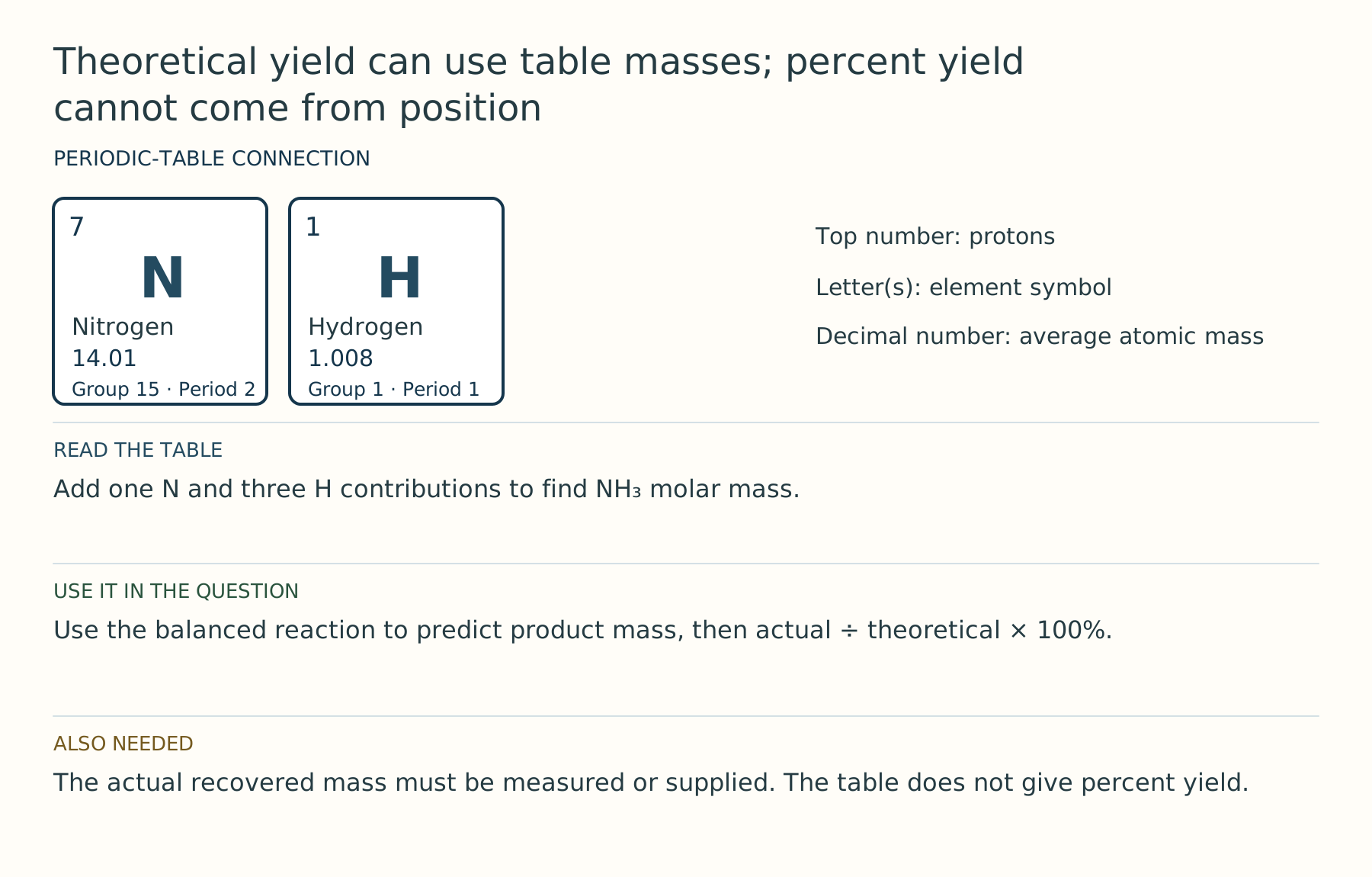
Theoretical yield can use table masses; percent yield cannot come from position. Add one N and three H contributions to find NH₃ molar mass. Use the balanced reaction to predict product mass, then actual ÷ theoretical × 100%. The actual recovered mass must be measured or supplied. The table does not give percent yield.
The table helps find theoretical yield. Actual yield must be measured or supplied.

On the periodic table: Theoretical yield can use periodic-table molar masses, e.g. NH3 = 14.01 + 3(1.008) = 17.03 g/mol.

On the periodic table: The table never gives actual or percent yield. In the example both masses are supplied, so no element box is needed.

Worked example · 3 steps

A reaction should make 25.0 g product but you collect 20.0 g. What is percent yield?

Collected vs predicted
Theoretical25.0 gActual20.0 g
  1. 1
    Put actual above theoretical

    What fraction of the predicted amount was collected?

    20.0 g25.0 g
  2. 2
    Divide

    Matching gram units cancel, leaving a fraction.

    20.0 g25.0 g = 0.800
  3. 3
    Turn the fraction into percent

    Multiply by 100 to express it per hundred.

    0.800 × 100% = 80.0%
  4. ✓
    Answer

    80.0%. Actual is smaller than theoretical, so any answer above 100% is wrong here.

Your turn

Percent yield practice problems

Answer first, then check. Hints open one at a time; the answer and full solution open after you try.

Problem 1 of 3 · warm-up

Theoretical yield is 55 g and actual yield is 44 g. What is percent yield?

Hint 1 · the clue

Actual and theoretical yields are both given.

Hint 2 · the next move

Theoretical and actual yields given, “percent yield” asked: divide actual by theoretical, times 100%.

Your path:

  1. Put actual over theoretical
  2. Divide; grams cancel
  3. Multiply by 100%
Answer

Answer: 80%

Full worked solution

What you know: Theoretical yield 55 g. Actual yield 44 g. What you want: Percent yield.

  1. Put actual above theoretical: 44 g / 55 g. The gram units cancel.
  2. Divide: 44 ÷ 55 = 0.80.
  3. Turn it into a percent: 0.80 × 100% = 80%.

Check: Actual is less than theoretical, so the answer must be below 100%. It is.

Watch out: Do not divide 55 by 44. That gives 125%, which is impossible here.

Your route: Actual ÷ Theoretical × 100

Answer: 80%

Problem 2 of 3

Theoretical yield is 60 g and actual yield is 48 g. What is percent yield?

Hint 1 · the clue

Actual and theoretical yields are both given.

Hint 2 · the next move

Theoretical and actual yields given, “percent yield” asked: divide actual by theoretical, times 100%.

Your path:

  1. Put actual over theoretical
  2. Divide; grams cancel
  3. Multiply by 100%
Answer

Answer: 80%

Full worked solution

What you know: Theoretical yield 60 g. Actual yield 48 g. What you want: Percent yield.

  1. Put actual above theoretical: 48 g / 60 g. Units match, so they cancel.
  2. Divide: 48 ÷ 60 = 0.80.
  3. Multiply by 100%: 0.80 × 100% = 80%.

Check: Reverse it: 80% of 60 g is 0.80 × 60 = 48 g, the actual yield.

Watch out: Theoretical always goes on the bottom. Flipping gives 125%.

Your route: Actual ÷ Theoretical × 100

Answer: 80%

Problem 3 of 3

Actual yield 9.0 g; theoretical 12 g. Percent?

Hint 1 · the clue

Divide actual yield by theoretical yield and multiply by 100. Use the same units in both amounts.

Hint 2 · the next move

Actual and theoretical yields given and a percent asked: that signals percent yield.

Your path:

  1. Put actual over theoretical
  2. Divide; grams cancel
  3. Multiply by 100%
Answer

9.0/12 × 100 = 75%.

Full worked solution

What you know: Actual yield 9.0 g. Theoretical yield 12 g. What you want: Percent yield.

  1. Put actual above theoretical: 9.0 g / 12 g. Same units, so they cancel.
  2. Divide: 9.0 ÷ 12 = 0.75.
  3. Multiply by 100%: 0.75 × 100% = 75%. Both values have two significant figures.

Check: Actual is below theoretical, so the result is under 100%. 75% of 12 g is 9.0 g.

Watch out: Dividing 12 by 9.0 gives 133%, a sign the fraction is upside down.

Answer: 9.0/12 × 100 = 75%.

Watch out

Common percent yield mistakes