ChemGem

How to Classify Chemical Reaction Types (Step-by-Step, with Practice)

Most reactions follow one of five patterns. Naming the pattern tells you what kind of change happened, and later helps you predict products.

Spot it, solve it, practice it: 4 steps, 1 worked example, 6 practice problems. Free, no account.

The route · 4 steps

  1. Count reactants and products: many to one, or one to many?
  2. Check for O2 as a reactant (combustion).
  3. Check for a lone element replacing another (single displacement).
  4. Check for two ionic compounds swapping partners (double displacement).
Spot it

How to recognize reaction type questions

Look for “classify” or a reaction type question; compare how many reactants and products there are, and whether an element stands alone.

Example wording, with the clue words marked:

Classify: 2KClO3 → 2KCl + 3O2

Not sure it’s this type? Compare the neighbors:

Step-by-step

Worked example: reaction type

The idea

Five patterns at a glance
SynthesisABABDecompositionABABSingle displacementABCACBDouble displacementABCDADCBCombustionfuelO₂CO₂H₂O
Letters stand for elements or ion groups. Watch which partners stay together and which swap.
The five types
TypePatternExample
Synthesis (combination)A + B → ABH2 + Cl2 → 2HCl
DecompositionAB → A + B2H2O2 → 2H2O + O2
Single displacementA + BC → AC + BZn + 2HCl → ZnCl2 + H2
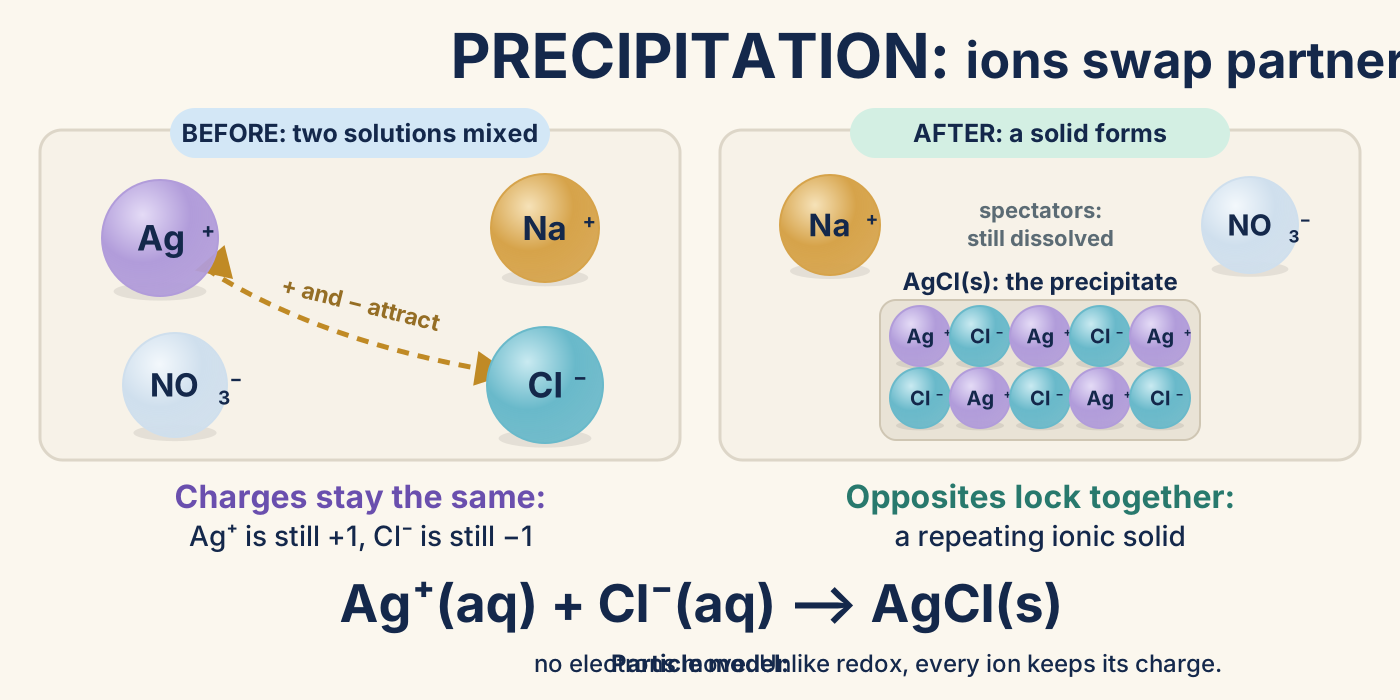
Double displacementAB + CD → AD + CBAgNO3 + NaCl → AgCl + NaNO3
Combustionfuel + O2 → …CH4 + 2O2 → CO2 + 2H2O
Synthesis: several substances make one. Decomposition: one breaks into several. Single displacement: a lone element replaces one in a compound. Double displacement: two ionic compounds swap partners. Combustion: a substance reacts with O2, usually releasing heat and light.
Double displacement: in AgNO3 plus NaCl, the ions swap partners to form AgCl and NaNO3.
Double displacement: Ag+ and Na+ trade partners. Section 6.3 shows how to predict whether a solid forms.
Clues to look for
  • Count the reactants and the products.
  • Look for O2 as a reactant.
  • Look for an element standing alone.
  • A compound of only C and H that burns completely gives CO2 and H2O.

On the periodic table: The periodic table shows whether a lone element is a metal; in Fe + CuSO4, one metal (Fe) replaces another (Cu).

Worked example · 4 steps

Classify each reaction: 2Na + Cl2 → 2NaCl; CaCO3 → CaO + CO2; Fe + CuSO4 → FeSO4 + Cu; C3H8 + 5O2 → 3CO2 + 4H2O.

  1. 1
    Reaction 1: count partners

    Two reactants make one product: synthesis.

    2Na + Cl2 → 2NaCl
    ReactantsProductsClue
    21many → one
  2. 2
    Reaction 2: count partners

    One reactant breaks into two products: decomposition.

    CaCO3 → CaO + CO2
    ReactantsProductsClue
    12one → many
  3. 3
    Reaction 3: look for a lone element

    Iron, standing alone, replaces copper in the compound: single displacement.

    Fe + CuSO4 → FeSO4 + Cu
    ReactantsProductsClue
    Fe aloneCu alonelone element swaps in
  4. 4
    Reaction 4: look for O2

    A carbon–hydrogen compound reacts with O2 to make CO2 and H2O: combustion.

    C3H8 + 5O2 → 3CO2 + 4H2O
    ReactantsProductsClue
    C3H8 + O2CO2 + H2Oburns in O2
  5. ✓
    Answer

    Synthesis, decomposition, single displacement, combustion.

Your turn

Reaction type practice problems

Answer first, then check. Hints open one at a time; the answer and full solution open after you try.

Problem 1 of 6 · warm-up

Classify: 2KClO3 → 2KCl + 3O2

Hint 1 · the clue

How many reactants? How many products?

Hint 2 · the next move

“Classify” with one reactant breaking into two products: that pattern is decomposition.

Your path:

  1. Count reactants: one substance
  2. Count products: two substances
  3. One → many means decomposition
Answer

Answer: Decomposition

Full worked solution

What you know: 2KClO3 → 2KCl + 3O2. What you want: The reaction type.

  1. Count the reactants: only one substance, KClO3.
  2. Count the products: two substances, KCl and O2.
  3. One substance breaking into two or more fits AB → A + B. This is Decomposition.

Why it matters: Classifying a reaction tells you what kind of products to expect before you balance anything.

Watch out: O2 appears, but as a product. Combustion needs O2 as a reactant.

Answer: Decomposition

Problem 2 of 6

Classify: Mg + 2HCl → MgCl2 + H2

Hint 1 · the clue

Look for an element standing alone on each side.

Hint 2 · the next move

“Classify” with an element alone on each side: Mg replaces H in the compound, a single displacement.

Your path:

  1. Spot lone elements: Mg and H2
  2. Mg takes hydrogen’s place with Cl
  3. Element replacing element: single displacement
Answer

Answer: Single displacement

Full worked solution

What you know: Mg + 2HCl → MgCl2 + H2. What you want: The reaction type.

  1. Look for an element standing alone: Mg on the left, H2 on the right.
  2. Mg ends up in the compound with Cl. Hydrogen leaves the compound and stands alone.
  3. An element replacing another in a compound fits A + BC → AC + B. This is Single displacement.

Why it matters: The lone element on each side is the fingerprint. Double displacement has compounds only.

Watch out: Two reactants and two products also describes double displacement. Check whether one reactant is a lone element.

Answer: Single displacement

Problem 3 of 6

Classify: BaCl2 + Na2SO4 → BaSO4 + 2NaCl

Hint 1 · the clue

Do two compounds trade partners?

Hint 2 · the next move

“Classify” with two ionic compounds trading partners and no lone element: that is double displacement.

Your path:

  1. Check: both reactants are compounds
  2. Follow the ions swapping partners
  3. Partner swap means double displacement
Answer

Answer: Double displacement

Full worked solution

What you know: BaCl2 + Na2SO4 → BaSO4 + 2NaCl. What you want: The reaction type.

  1. Both reactants are ionic compounds. No element stands alone.
  2. Follow the ions: Ba2+ leaves Cl− and pairs with SO42−. Na+ pairs with Cl−.
  3. Two compounds swapping partners fits AB + CD → AD + CB. This is Double displacement.

Why it matters: Spotting a swap lets you predict products later, in Section 6.3, where you check whether a solid forms.

Answer: Double displacement

Problem 4 of 6

Classify: N2 + 3H2 → 2NH3

Hint 1 · the clue

Count the products.

Hint 2 · the next move

“Classify” with two reactants making one product: that pattern is synthesis.

Your path:

  1. Count reactants: two substances
  2. Count products: one substance
  3. Many → one means synthesis
Answer

Answer: Synthesis

Full worked solution

What you know: N2 + 3H2 → 2NH3. What you want: The reaction type.

  1. Count the reactants: two substances, N2 and H2.
  2. Count the products: one substance, NH3. The coefficient 2 is still one kind of substance.
  3. Two substances making one product fits A + B → AB. This is Synthesis.

Why it matters: Count kinds of substances, not coefficients. 2NH3 is one product.

Watch out: Do not read the coefficient 2 as two products.

Answer: Synthesis

Problem 5 of 6

Ethane, C2H6, burns completely in O2. Write the balanced equation.

Hint 1 · the clue

Complete combustion of a carbon–hydrogen compound gives CO2 and H2O. Balance C, then H, then O.

Hint 2 · the next move

A carbon–hydrogen compound that “burns completely in O2” is combustion: products are CO2 and H2O, then balance.

Your path:

  1. Write C2H6 + O2 → CO2 + H2O
  2. Balance C, then H
  3. Balance O last; clear any fraction
Answer

Answer: 2C2H6 + 7O2 → 4CO2 + 6H2O

Full worked solution

What you know: Ethane, C2H6, burns completely in O2. Complete combustion of a carbon–hydrogen compound gives CO2 and H2O. What you want: The balanced equation.

  1. Write the skeleton: C2H6 + O2 → CO2 + H2O. Carbon: put 2 before CO2.
  2. Hydrogen: 6 H, so put 3 before H2O (3 × 2 = 6).
  3. Oxygen on the right: 2 × 2 + 3 = 7, an odd number. O2 only supplies O in pairs, so double every coefficient: 2C2H6, 4CO2, 6H2O.
  4. Now right-side oxygen is 4 × 2 + 6 = 14. Use 7O2. Result: 2C2H6 + 7O2 → 4CO2 + 6H2O.

Check: C: 4 = 4. H: 12 = 12. O: 14 = 8 + 6.

Watch out: An odd oxygen total cannot come from whole O2 molecules. Doubling fixes it.

Answer: 2C2H6 + 7O2 → 4CO2 + 6H2O

Problem 6 of 6

Classify: 2Al + 3Br2 → 2AlBr3

Hint 1 · the clue

Count the reactants and products.

Hint 2 · the next move

“Classify” with two reactants making one product: that pattern is synthesis.

Your path:

  1. Count reactants: two substances
  2. Count products: one substance
  3. Many → one means synthesis
Answer

Answer: Synthesis

Full worked solution

What you know: 2Al + 3Br2 → 2AlBr3. What you want: The reaction type.

  1. Count reactants: two substances, Al and Br2.
  2. Count products: one substance, AlBr3.
  3. Two substances making one product fits A + B → AB. This is Synthesis.

Why it matters: Recognizing synthesis tells you the product is a single compound built from the reactants.

Watch out: Coefficients do not count as extra substances. 2AlBr3 is still one product.

Answer: Synthesis

Watch out

Common reaction type mistakes