ChemGem

How to Find the Limiting Reactant (Step-by-Step, with Practice)

The limiting reactant (also called the limiting reagent) runs out first and stops the product. Find it by asking how much product each reactant could make.

Spot it, solve it, practice it: 3 steps, 1 worked example, 5 practice problems. Free, no account.

The route · 3 steps

  1. Get both reactant amounts in moles.
  2. Find the product each reactant could make.
  3. The smaller amount is the maximum product; its reactant limits.
Spot it

How to recognize limiting reactant questions

Look for amounts of two reactants given together, asking which one “limits” or the maximum product that can form.

Example wording, with the clue words marked:

For N2 + 3H2 → 2NH3, a mixture has 8 mol N2 and 18 mol H2. Which reactant limits the product?

Not sure it’s this type? Compare the neighbors:

Step-by-step

Worked example: limiting reactant

The idea

The recipe decides: building bicycles
PartHaveNeeded per bicycleBicycles possible
Wheels1025
Frames313
Only 3 bicycles: extra wheels cannot replace missing frames.
Product capacity = available moles × mole ratio
mol product = mol reactant × product coefficientreactant coefficient
The balanced equation is the recipe. Do this for each reactant, same product; the smaller result limits.
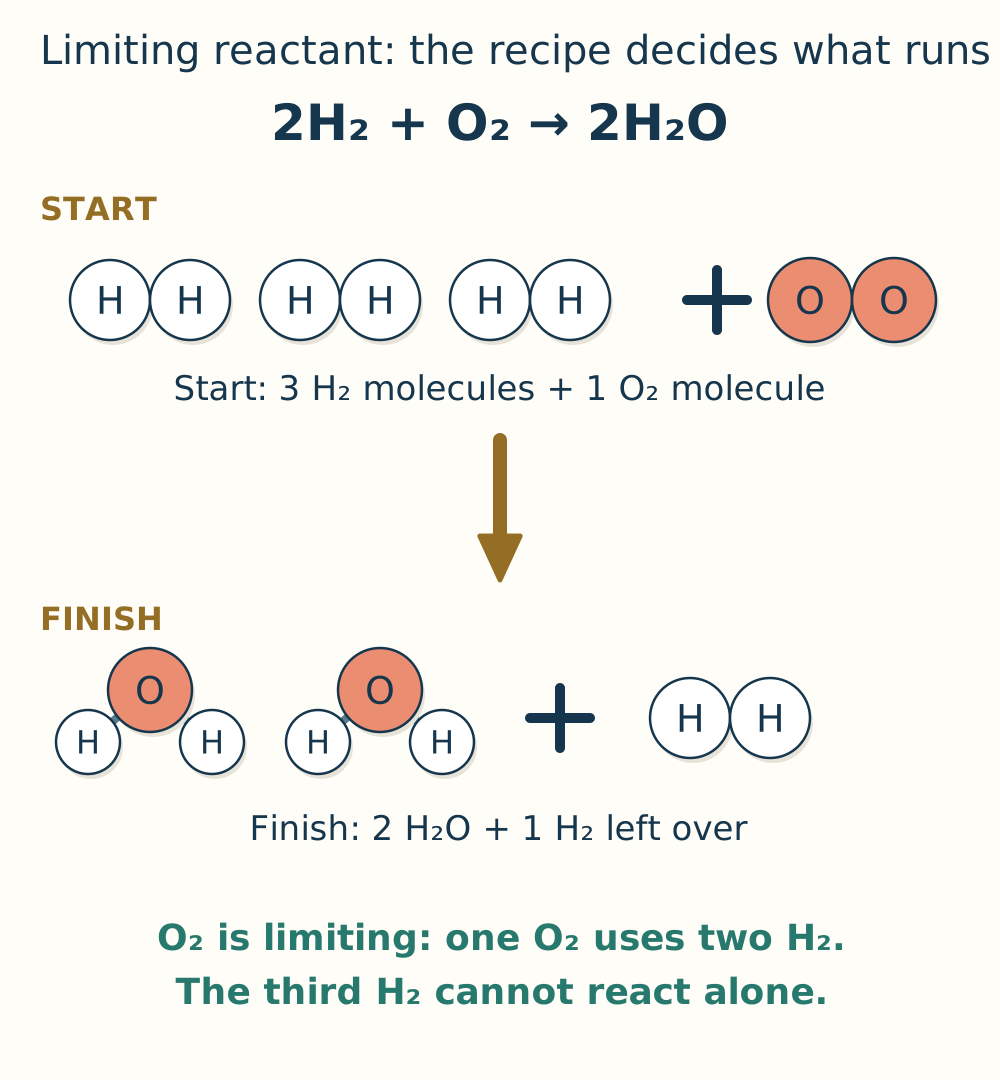
Limiting reactant: the recipe decides what runs out. Conserved atoms: 6 H and 2 O before and after. Molecular counts illustrate the same coefficient ratio used with moles.
6 H and 2 O before and after. Molecules follow the same ratio as moles.
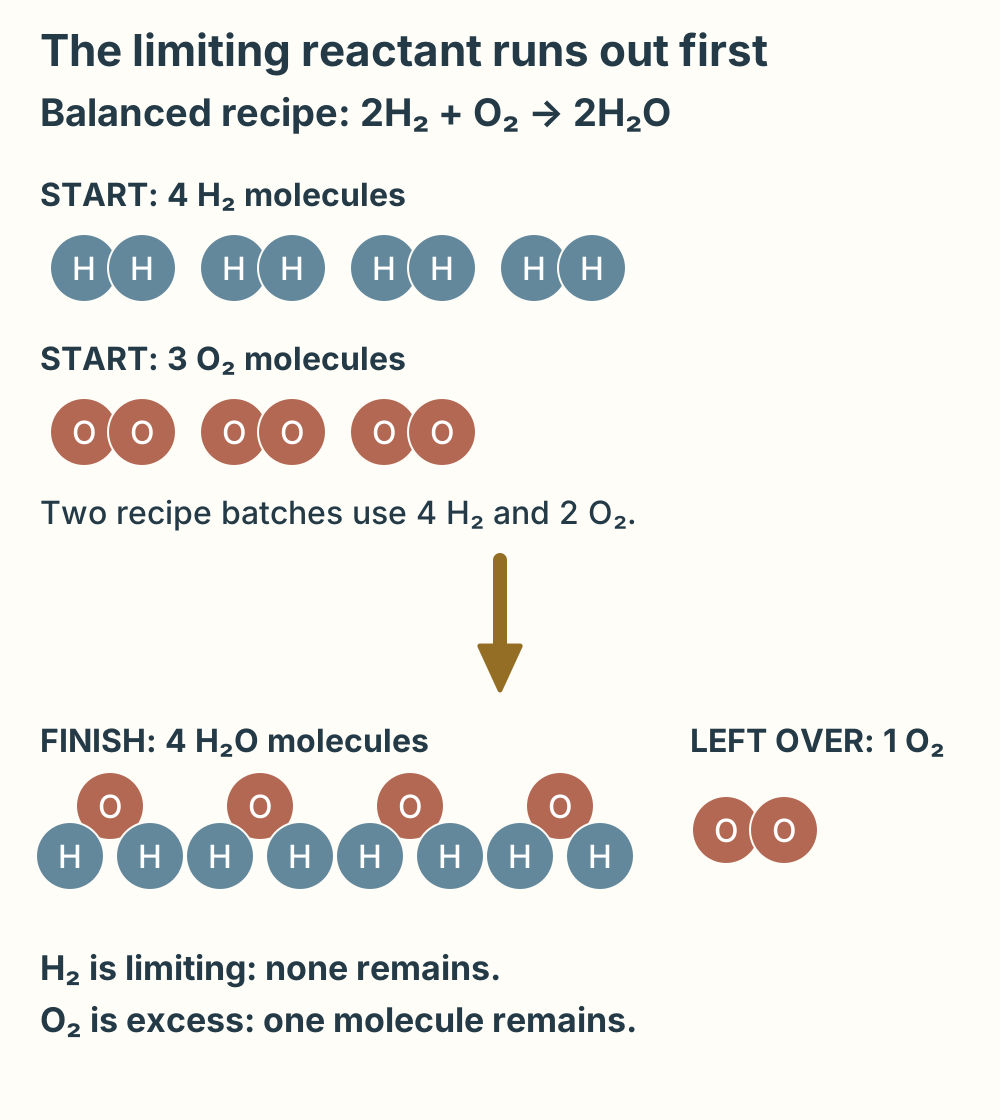
Four H₂ molecules and three O₂ molecules react by 2H₂ + O₂ → 2H₂O, making four H₂O molecules with one O₂ left over. There are 8 H atoms and 6 O atoms both before and after.
H2 runs out first; one O2 is left in excess.
That picture as a before / change / after table
2H2+ O2→ 2H2O
Before430
Change−4−2+4
After014
Changes follow the 2 : 1 : 2 coefficients. Atoms: 8 H and 6 O before and after.
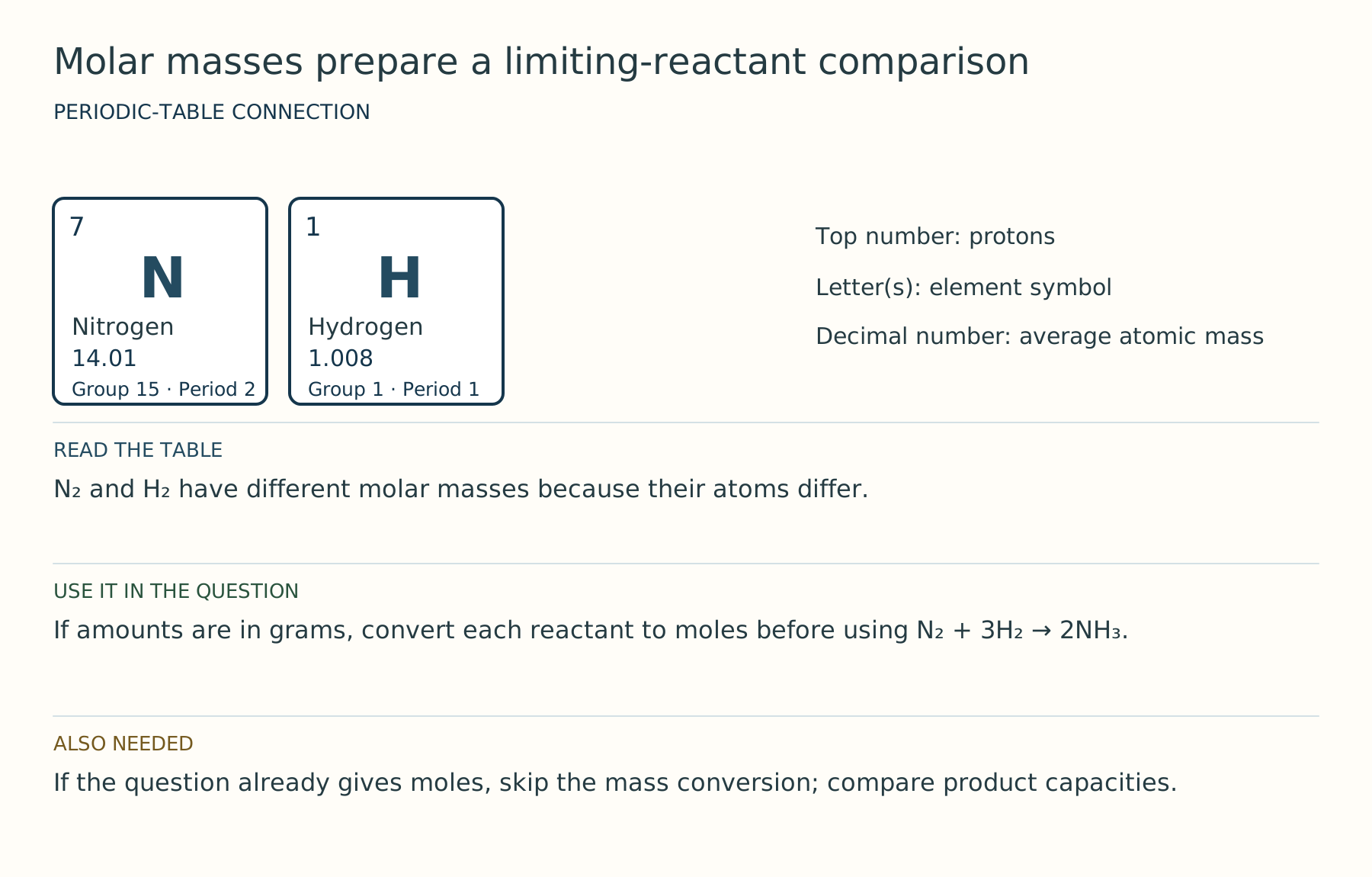
Molar masses prepare a limiting-reactant comparison. N₂ and H₂ have different molar masses because their atoms differ. If amounts are in grams, convert each reactant to moles before using N₂ + 3H₂ → 2NH₃. If the question already gives moles, skip the mass conversion; compare product capacities.
Grams? Convert to moles first. Moles? Skip to product capacities.

On the periodic table: Molar masses come from the periodic table: N 14.01, H 1.008 g/mol. Use supplied masses when given.

On the periodic table: Amounts already in moles need no periodic-table conversion.

Worked example · 4 steps

For N2 + 3H2 → 2NH3, you have 2 mol N2 and 3 mol H2. Find the limiting reactant and maximum ammonia.

Conversion factors (same product for both)
From N2From H2
2 mol NH31 mol N22 mol NH33 mol H2
Amounts are already in moles, so no mass conversion is needed.
  1. 1
    Check nitrogen’s capacity

    What N2 could make with unlimited H2.

    2 mol N2 × 2 mol NH31 mol N2 = 4 mol NH3
  2. 2
    Check hydrogen’s capacity

    Same product, so the results compare fairly.

    3 mol H2 × 2 mol NH33 mol H2 = 2 mol NH3
  3. 3
    Choose the smaller capacity

    Hydrogen runs out first; nitrogen’s 4 mol is never reached.

    ReactantCould makeResult
    N24 mol NH3excess
    H22 mol NH3limiting
  4. 4
    State both answers

    The smaller capacity gives both answers.

    Before / change / after (mol)
    N2+ 3H2→ 2NH3
    Before230
    Change−1−3+2
    After102
    H2 reaches 0; 1 mol N2 is left over.
  5. ✓
    Answer

    Limiting reactant: H2. Maximum product: 2 mol NH3.

Your turn

Limiting reactant practice problems

Answer first, then check. Hints open one at a time; the answer and full solution open after you try.

Problem 1 of 5 · warm-up

For N2 + 3H2 → 2NH3, a mixture has 8 mol N2 and 18 mol H2. Which reactant limits the product?

Hint 1 · the clue

Amounts of both reactants are provided.

Hint 2 · the next move

Two reactant amounts given and “which reactant limits” asked: compare how much product each can make.

Your path:

  1. Find NH3 each reactant could make
  2. Compare the two product amounts
  3. Smaller amount marks the limiting reactant
Answer

Answer: H2

Full worked solution

What you know: N2 + 3H2 → 2NH3; 8 mol N2 and 18 mol H2. What you want: Which reactant limits.

  1. N2 capacity: 8 mol N2 × (2 mol NH3 / 1 mol N2) = 16 mol NH3.
  2. H2 capacity: 18 mol H2 × (2 mol NH3 / 3 mol H2) = 12 mol NH3.
  3. 12 mol is less than 16 mol. Hydrogen runs out first, so H2 limits.

Check: 8 mol N2 would need 8 × 3 = 24 mol H2. Only 18 is there, so H2 is short.

Watch out: Do not pick N2 because 8 is smaller than 18. Compare product capacities, not starting amounts.

Your route: Product capacity for both → Smaller limits

Answer: H2

YOUR PERIODIC-TABLE REFERENCE

1HHydrogen1.008Group 1 · Period 1
7NNitrogen14.01Group 15 · Period 2

Atomic number identifies proton count. The decimal mass is an average, not an isotope’s mass number. Use supplied rounded masses when a problem gives them.

Problem 2 of 5

For N2 + 3H2 → 2NH3, a mixture has 9 mol N2 and 21 mol H2. Which reactant limits the product?

Hint 1 · the clue

Amounts of both reactants are provided.

Hint 2 · the next move

Two reactant amounts given and “which reactant limits” asked: compare how much product each can make.

Your path:

  1. Find NH3 each reactant could make
  2. Compare the two product amounts
  3. Smaller amount marks the limiting reactant
Answer

Answer: H2

Full worked solution

What you know: N2 + 3H2 → 2NH3; 9 mol N2 and 21 mol H2. What you want: Which reactant limits.

  1. N2 capacity: 9 mol N2 × (2 mol NH3 / 1 mol N2) = 18 mol NH3.
  2. H2 capacity: 21 mol H2 × (2 mol NH3 / 3 mol H2) = 14 mol NH3.
  3. 14 mol is less than 18 mol. Hydrogen runs out first, so H2 limits.

Check: 9 mol N2 would need 9 × 3 = 27 mol H2. Only 21 is available.

Watch out: The larger starting number (21) is still the limiting one. The recipe needs 3 H2 per N2.

Your route: Product capacity for both → Smaller limits

Answer: H2

YOUR PERIODIC-TABLE REFERENCE

1HHydrogen1.008Group 1 · Period 1
7NNitrogen14.01Group 15 · Period 2

Atomic number identifies proton count. The decimal mass is an average, not an isotope’s mass number. Use supplied rounded masses when a problem gives them.

Problem 3 of 5

For N2 + 3H2 → 2NH3, 8 mol N2 and 18 mol H2 are available. What maximum NH3 amount can form?

Hint 1 · the clue

Both reactants are given and a maximum product is requested.

Hint 2 · the next move

Two reactant amounts and a “maximum” product are asked: the limiting reactant decides the most product.

Your path:

  1. Find NH3 each reactant could make
  2. Pick the smaller amount (limiting reactant)
  3. That smaller amount is the maximum
Answer

Answer: 12 mol

Full worked solution

What you know: N2 + 3H2 → 2NH3; 8 mol N2 and 18 mol H2. What you want: Maximum moles NH3.

  1. Find the limiting reactant by product capacity. N2: 8 × 2/1 = 16 mol NH3. H2: 18 × 2/3 = 12 mol NH3.
  2. H2 gives the smaller capacity, so H2 limits.
  3. The limiting reactant's capacity is the maximum: 18 mol H2 × (2 mol NH3 / 3 mol H2) = 12 mol NH3.

Check: 12 mol NH3 uses 6 mol N2, leaving 2 mol N2 in excess.

Watch out: Do not report 16 mol. The excess reactant's capacity can never be reached.

Your route: Find limiting reactant → Its moles × Product/reactant ratio

Answer: 12 mol

YOUR PERIODIC-TABLE REFERENCE

1HHydrogen1.008Group 1 · Period 1
7NNitrogen14.01Group 15 · Period 2

Atomic number identifies proton count. The decimal mass is an average, not an isotope’s mass number. Use supplied rounded masses when a problem gives them.

Problem 4 of 5

For N2 + 3H2 → 2NH3, 9 mol N2 and 21 mol H2 are available. What maximum NH3 amount can form?

Hint 1 · the clue

Both reactants are given and a maximum product is requested.

Hint 2 · the next move

Two reactant amounts and a “maximum” product are asked: the limiting reactant decides the most product.

Your path:

  1. Find NH3 each reactant could make
  2. Pick the smaller amount (limiting reactant)
  3. That smaller amount is the maximum
Answer

Answer: 14 mol

Full worked solution

What you know: N2 + 3H2 → 2NH3; 9 mol N2 and 21 mol H2. What you want: Maximum moles NH3.

  1. Product capacities: N2: 9 × 2/1 = 18 mol NH3. H2: 21 × 2/3 = 14 mol NH3.
  2. The smaller capacity comes from H2, so H2 limits.
  3. Maximum product: 21 mol H2 × (2 mol NH3 / 3 mol H2) = 14 mol NH3.

Check: 14 mol NH3 uses 7 mol N2, leaving 2 mol N2 unused.

Watch out: Do not report 18 mol, the excess reactant's capacity.

Your route: Find limiting reactant → Its moles × Product/reactant ratio

Answer: 14 mol

YOUR PERIODIC-TABLE REFERENCE

1HHydrogen1.008Group 1 · Period 1
7NNitrogen14.01Group 15 · Period 2

Atomic number identifies proton count. The decimal mass is an average, not an isotope’s mass number. Use supplied rounded masses when a problem gives them.

Problem 5 of 5

N2 + 3H2 → 2NH3: 1 mol N2 and 1 mol H2. Which limits?

Hint 1 · the clue

Calculate the amount of the same product each reactant could make using the balanced mole ratio. The smaller capacity identifies the limiting reactant.

Hint 2 · the next move

Amounts of both reactants given and “Which limits?” asked: compare how much product each can make.

Your path:

  1. Find NH3 each reactant could make
  2. Compare the two product amounts
  3. Smaller amount marks the limiting reactant
Answer

H2: it can make only 2/3 mol NH3; N2 could make 2 mol.

Full worked solution

What you know: N2 + 3H2 → 2NH3; 1 mol N2 and 1 mol H2. What you want: Which reactant limits.

  1. N2 capacity: 1 mol N2 × (2 mol NH3 / 1 mol N2) = 2 mol NH3.
  2. H2 capacity: 1 mol H2 × (2 mol NH3 / 3 mol H2) = 2/3 mol NH3.
  3. 2/3 mol is less than 2 mol, so hydrogen runs out first. H2 limits: it can make only 2/3 mol NH3.

Check: 1 mol N2 would need 3 mol H2. Only 1 mol is there.

Watch out: Equal starting moles do not mean equal use. The recipe uses 3 H2 for each N2.

Answer: H2: it can make only 2/3 mol NH3; N2 could make 2 mol.

YOUR PERIODIC-TABLE REFERENCE

1HHydrogen1.008Group 1 · Period 1
7NNitrogen14.01Group 15 · Period 2

Atomic number identifies proton count. The decimal mass is an average, not an isotope’s mass number. Use supplied rounded masses when a problem gives them.

Watch out

Common limiting reactant mistakes