ChemGem

How to Do Stoichiometry: Grams to Grams (Step-by-Step, with Practice)

A balanced equation links moles, not grams. To go from grams of one substance to grams of another, convert to moles, use the coefficient ratio, then convert back.

Spot it, solve it, practice it: 5 steps, 1 worked example, 7 practice problems. Free, no account.

The route · 5 steps

  1. Label the given substance A and the wanted substance B.
  2. Grams A → moles A with A’s molar mass.
  3. Moles A → moles B with the coefficient ratio, wanted on top.
  4. Moles B → grams B with B’s molar mass.
  5. Check that the only unit left is the one requested.
Spot it

How to recognize stoichiometry questions

Look for grams or moles of one substance in a reaction and grams or moles of another asked, with molar masses given.

Example wording, with the clue words marked:

For 2Mg + O2 → 2MgO, given 0.500 mol Mg; find mol MgO. Which bridge?

Not sure it’s this type? Compare the neighbors:

Step-by-step

Worked example: stoichiometry

The idea

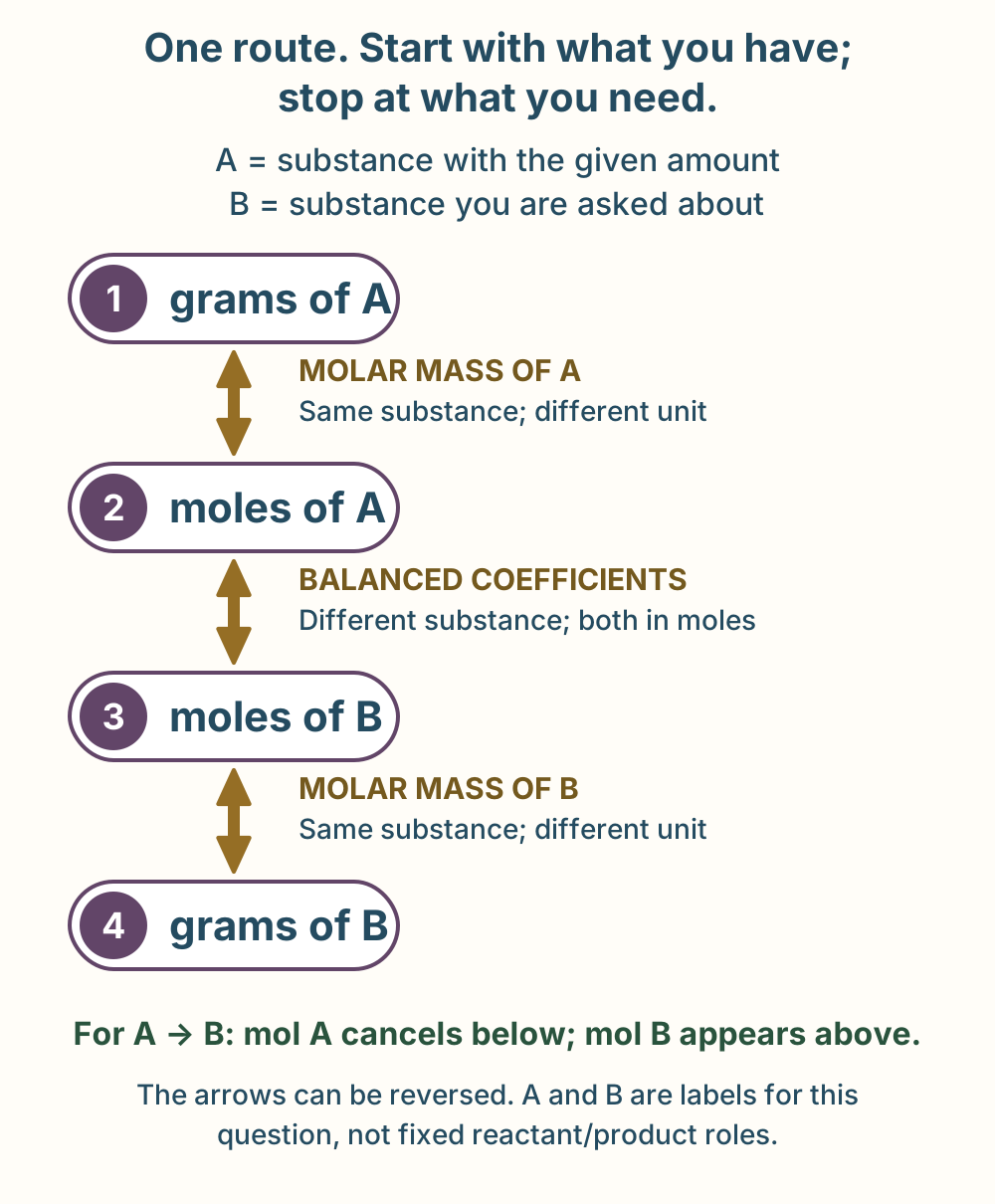
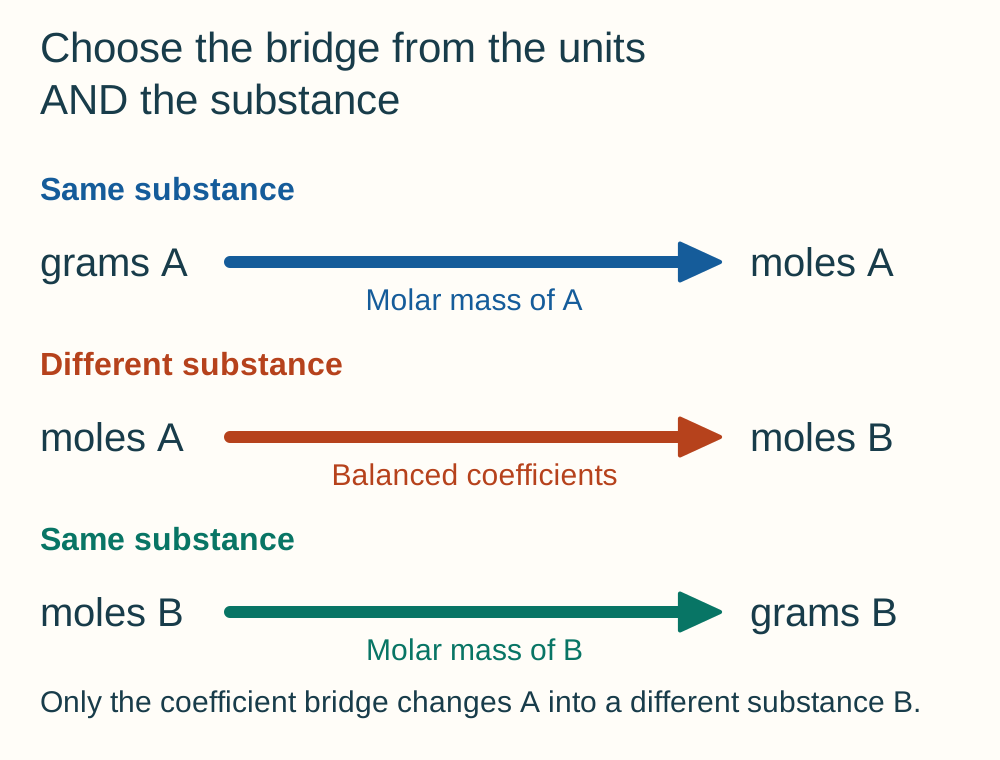
Grams of A connects to moles of A through molar mass of A. Moles of A connects to moles of B through balanced coefficients. Moles of B connects to grams of B through molar mass of B. Each connection can be reversed.
A is what you know. B is what you need. Only the middle bridge changes the substance.
Grams A → moles A → moles B → grams B
g B = g A × 1 mol Amolar mass A (g) × coefficient B mol Bcoefficient A mol A × molar mass B (g)1 mol B
Each factor cancels the unit before it. The unit left must be grams of B.
Molar mass connects grams and moles of the same substance. Balanced coefficients connect moles of different reacting substances.
Molar mass: same substance, grams ↔ moles. Coefficients: different substances, moles ↔ moles.
Choose your start and stop
Given → wantedBridges you use
mol A → mol Bcoefficient ratio only
g A → mol Bmolar mass A, then coefficient ratio
mol A → g Bcoefficient ratio, then molar mass B
g A → g Ball three bridges
  • A can be a product and B a reactant: the same route finds the reactant needed for a requested product.
  • These are theoretical amounts. If two reactant amounts are given, first find the limiting one (5.4).
  • Product mass includes atoms from every reacting substance.

On the periodic table: Molar mass is the decimal number in an element’s box: O has an average atomic mass of 16.00 u, so 16.00 g/mol.

On the periodic table: For a compound, add the box masses of every atom in its formula.

Worked example · 4 steps

Given 12.0 g Mg with oxygen in excess, find grams of MgO. Balanced equation: 2Mg + O2 → 2MgO.

  1. 1
    Find the molar masses

    On the periodic table (rounded for this example): Mg 24.0 g/mol, O 16.0 g/mol.

    MgO = 24.0 + 16.0 = 40.0 g/mol
  2. 2
    Face each bridge

    The unit to cancel goes below; the wanted unit goes above.

    BridgeFactorWhy it faces this way
    g Mg → mol Mg1 mol Mg24.0 g Mgg Mg below cancels the given g Mg.
    mol Mg → mol MgO2 mol MgO2 mol MgBalanced coefficients: wanted above, current below.
    mol MgO → g MgO40.0 g MgO1 mol MgOmol MgO below cancels; g MgO stays.
  3. 3
    Multiply across, then divide

    Multiply the tops, multiply the bottoms, then divide.

    12.0 g Mg × 1 mol Mg24.0 g Mg × 2 mol MgO2 mol Mg × 40.0 g MgO1 mol MgO = 96048.0 = 20.0 g MgO
  4. 4
    Check the units

    Every unit cancels except g MgO, which matches the question.

    UnitCancelled by
    g Mg24.0 g Mg
    mol Mg2 mol Mg
    mol MgO1 mol MgO
    g MgOkept
  5. ✓
    Answer

    20.0 g MgO. It exceeds 12.0 g because the product includes oxygen that joined the magnesium.

Your turn

Stoichiometry practice problems

Answer first, then check. Hints open one at a time; the answer and full solution open after you try.

Problem 1 of 7 · warm-up

For 2Mg + O2 → 2MgO, given 0.500 mol Mg; find mol MgO. Which bridge?

Hint 1 · the clue

Write the start unit and the requested unit. If both are moles, only one bridge connects them.

Hint 2 · the next move

Moles of Mg given, moles of MgO asked: both are moles, so only the coefficient-ratio bridge is needed.

Your path:

  1. Start: moles A; stop: moles B
  2. Use only the coefficient ratio
  3. Ratio, wanted over given: 2 MgO / 2 Mg
Answer

Coefficient ratio only: 0.500 × 2/2 = 0.500 mol MgO.

Full worked solution

What you know: 0.500 mol Mg. Equation: 2Mg + O2 → 2MgO. What you want: Moles MgO, and which bridge to use.

  1. Start unit is moles A (Mg). Stop unit is moles B (MgO). Both are moles, so only the middle bridge is needed.
  2. Use the coefficient ratio, wanted over given: 0.500 mol Mg × (2 mol MgO / 2 mol Mg).
  3. mol Mg cancels. 0.500 × 2 ÷ 2 = 0.500 mol MgO.

Check: The ratio is 1:1, so the moles should not change. They don't.

Watch out: No molar mass is needed here. Adding one would wrongly move you to grams.

Coefficient ratio only: 0.500 × 2/2 = 0.500 mol MgO.

YOUR PERIODIC-TABLE REFERENCE

12MgMagnesium24.31Group 2 · Period 3

Atomic number identifies proton count. The decimal mass is an average, not an isotope’s mass number. Use supplied rounded masses when a problem gives them.

Problem 2 of 7

For 2Mg + O2 → 2MgO, given 12.0 g Mg (Mg = 24.0 g/mol); find mol MgO. Where do you stop?

Hint 1 · the clue

Start at grams of Mg. Write the unit the question asks for; that unit tells you where the route stops.

Hint 2 · the next move

Grams of Mg given, moles of MgO asked: convert grams to moles, use the ratio, and stop at moles.

Your path:

  1. Grams Mg → moles Mg with molar mass
  2. Moles Mg → moles MgO with ratio
  3. Stop at moles B
Answer

Stop at moles B: 12.0 / 24.0 × 2/2 = 0.500 mol MgO.

On the periodic table: Magnesium (Mg) has an average atomic mass of 24.31 u (molar mass 24.31 g/mol), the decimal number in its box; this problem uses a simplified 24.0 g/mol (24.31 would round to 24.3).

Full worked solution

What you know: 12.0 g Mg, Mg = 24.0 g/mol. Equation: 2Mg + O2 → 2MgO. What you want: Moles MgO, and where to stop.

  1. Start at grams A. First bridge: 12.0 g Mg × (1 mol Mg / 24.0 g Mg) = 0.500 mol Mg. g Mg cancels.
  2. Middle bridge: 0.500 mol Mg × (2 mol MgO / 2 mol Mg) = 0.500 mol MgO. mol Mg cancels.
  3. The question asks for moles, so stop at moles B: 0.500 mol MgO.

Check: 12.0 is half of 24.0, so 0.500 mol makes sense. Three significant figures throughout.

Watch out: Do not continue to grams MgO. Stop where the requested unit is.

On the periodic table: Magnesium (Mg) has an average atomic mass of 24.31 u (molar mass 24.31 g/mol), the decimal number in its box; this problem uses a simplified 24.0 g/mol (24.31 would round to 24.3).

Stop at moles B: 12.0 / 24.0 × 2/2 = 0.500 mol MgO.

YOUR PERIODIC-TABLE REFERENCE

12MgMagnesium24.31Group 2 · Period 3

Atomic number identifies proton count. The decimal mass is an average, not an isotope’s mass number. Use supplied rounded masses when a problem gives them.

Problem 3 of 7

For 2Mg + O2 → 2MgO, given 0.500 mol Mg (MgO = 40.0 g/mol); find grams MgO. Where do you start?

Hint 1 · the clue

Is the given amount in grams or in moles? That decides whether you need the first bridge.

Hint 2 · the next move

Moles of Mg given, grams of MgO asked: skip the first bridge, use the ratio, then molar mass.

Your path:

  1. Start at moles A; skip first bridge
  2. Moles Mg → moles MgO with ratio
  3. Moles MgO → grams with molar mass
Answer

Start at moles A: 0.500 × 2/2 × 40.0 = 20.0 g MgO.

On the periodic table: You can also build this from the table: magnesium (Mg) 24.0 + oxygen (O) 16.0 = 40.0 g/mol for MgO, using simplified values of the box masses 24.31 and 16.00.

Full worked solution

What you know: 0.500 mol Mg. MgO = 40.0 g/mol. Equation: 2Mg + O2 → 2MgO. What you want: Grams MgO, and where to start.

  1. The given amount is already in moles, so start at moles A. Skip the first bridge.
  2. Middle bridge: 0.500 mol Mg × (2 mol MgO / 2 mol Mg) = 0.500 mol MgO.
  3. Last bridge: 0.500 mol MgO × (40.0 g MgO / 1 mol MgO) = 20.0 g MgO. mol MgO cancels.

Check: Only g MgO is left, matching the ask. 0.500 is half of 1 mole, and 20.0 is half of 40.0.

Watch out: Do not divide 0.500 by 24.0. It is already moles, not grams.

On the periodic table: You can also build this from the table: magnesium (Mg) 24.0 + oxygen (O) 16.0 = 40.0 g/mol for MgO, using simplified values of the box masses 24.31 and 16.00.

Start at moles A: 0.500 × 2/2 × 40.0 = 20.0 g MgO.

YOUR PERIODIC-TABLE REFERENCE

12MgMagnesium24.31Group 2 · Period 3

Atomic number identifies proton count. The decimal mass is an average, not an isotope’s mass number. Use supplied rounded masses when a problem gives them.

Problem 4 of 7

For 2Mg + O2 → 2MgO, you need 40.0 g MgO. Find grams Mg required with excess oxygen (Mg = 24.0 g/mol; MgO = 40.0 g/mol).

Hint 1 · the clue

Here the given substance A is the product MgO and B is the reactant Mg. Convert grams MgO with MgO’s own molar mass first.

Hint 2 · the next move

Grams of product MgO given, grams of Mg asked: run grams A → moles A → moles B → grams B.

Your path:

  1. Grams MgO → moles MgO
  2. Moles MgO → moles Mg with ratio
  3. Moles Mg → grams Mg
Answer

A = MgO; B = Mg. 40.0 / 40.0 × 2/2 × 24.0 = 24.0 g Mg.

On the periodic table: Magnesium (Mg) is taken as 24.0 g/mol here (24.31 in its box, simplified). For MgO, add oxygen (O) at 16.0 g/mol (16.00 in its box): 24.0 + 16.0 = 40.0 g/mol.

Full worked solution

What you know: Need 40.0 g MgO, oxygen in excess. MgO = 40.0 g/mol, Mg = 24.0 g/mol. Equation: 2Mg + O2 → 2MgO. What you want: Grams Mg required.

  1. Here A is the product MgO and B is the reactant Mg. The route works in either direction.
  2. First bridge: 40.0 g MgO × (1 mol MgO / 40.0 g MgO) = 1.00 mol MgO.
  3. Middle bridge: 1.00 mol MgO × (2 mol Mg / 2 mol MgO) = 1.00 mol Mg.
  4. Last bridge: 1.00 mol Mg × (24.0 g Mg / 1 mol Mg) = 24.0 g Mg.

Check: Less Mg than MgO makes sense, because MgO also contains oxygen's mass.

Watch out: Use each substance's own molar mass. Do not convert MgO grams with 24.0.

On the periodic table: Magnesium (Mg) is taken as 24.0 g/mol here (24.31 in its box, simplified). For MgO, add oxygen (O) at 16.0 g/mol (16.00 in its box): 24.0 + 16.0 = 40.0 g/mol.

A = MgO; B = Mg. 40.0 / 40.0 × 2/2 × 24.0 = 24.0 g Mg.

YOUR PERIODIC-TABLE REFERENCE

12MgMagnesium24.31Group 2 · Period 3

Atomic number identifies proton count. The decimal mass is an average, not an isotope’s mass number. Use supplied rounded masses when a problem gives them.

Problem 5 of 7

For 2H2 + O2 → 2H2O with excess oxygen, what water mass forms from 14 g H2? Use H2 = 2 and H2O = 18 g/mol.

Hint 1 · the clue

The mass of one reactant is given; the product mass is requested.

Hint 2 · the next move

Grams of H2 given, “water mass” asked, molar masses given: go grams → moles → moles → grams.

Your path:

  1. Grams H2 → moles H2
  2. Moles H2 → moles H2O with ratio
  3. Moles H2O → grams H2O
Answer

Answer: 126 g

Full worked solution

What you know: 2H2 + O2 → 2H2O; 14 g H2; O2 in excess. H2 = 2 g/mol, H2O = 18 g/mol. What you want: Grams H2O.

  1. Grams to moles: 14 g H2 × (1 mol H2 / 2 g H2) = 7 mol H2.
  2. Reaction ratio: 7 mol H2 × (2 mol H2O / 2 mol H2) = 7 mol H2O.
  3. Moles to grams: 7 mol H2O × (18 g H2O / 1 mol H2O) = 126 g.

Check: Water outweighs the hydrogen because it includes the oxygen that joined. 126 − 14 = 112 g came from O2.

Watch out: Do not multiply 14 by 18 directly. Grams of one substance never convert straight to grams of another.

Your route: Grams → Moles → Reaction ratio → Product grams

On the periodic table: You can also build these from the table: hydrogen (H) is about 1 g/mol and oxygen (O) about 16 g/mol (1.008 and 16.00 in their boxes), so H2 = 2 × 1 = 2 g/mol and H2O = 2 × 1 + 16 = 18 g/mol.

Answer: 126 g

YOUR PERIODIC-TABLE REFERENCE

1HHydrogen1.008Group 1 · Period 1
8OOxygen16.00Group 16 · Period 2

Atomic number identifies proton count. The decimal mass is an average, not an isotope’s mass number. Use supplied rounded masses when a problem gives them.

Problem 6 of 7

For 2H2 + O2 → 2H2O with excess oxygen, what water mass forms from 16 g H2? Use H2 = 2 and H2O = 18 g/mol.

Hint 1 · the clue

The mass of one reactant is given; the product mass is requested.

Hint 2 · the next move

Grams of H2 given, “water mass” asked, molar masses given: go grams → moles → moles → grams.

Your path:

  1. Grams H2 → moles H2
  2. Moles H2 → moles H2O with ratio
  3. Moles H2O → grams H2O
Answer

Answer: 144 g

Full worked solution

What you know: 2H2 + O2 → 2H2O; 16 g H2; O2 in excess. H2 = 2 g/mol, H2O = 18 g/mol. What you want: Grams H2O.

  1. Grams to moles: 16 g H2 × (1 mol H2 / 2 g H2) = 8 mol H2.
  2. Reaction ratio: 8 mol H2 × (2 mol H2O / 2 mol H2) = 8 mol H2O.
  3. Moles to grams: 8 mol H2O × (18 g H2O / 1 mol H2O) = 144 g.

Check: Reverse it: 144 ÷ 18 = 8 mol water, which needs 8 mol H2 = 16 g. It matches.

Watch out: Use 2 g/mol for H2, not 1. Hydrogen gas has two atoms per molecule.

Your route: Grams → Moles → Reaction ratio → Product grams

On the periodic table: You can also build these from the table: hydrogen (H) is about 1 g/mol and oxygen (O) about 16 g/mol (1.008 and 16.00 in their boxes), so H2 = 2 × 1 = 2 g/mol and H2O = 2 × 1 + 16 = 18 g/mol.

Answer: 144 g

YOUR PERIODIC-TABLE REFERENCE

1HHydrogen1.008Group 1 · Period 1
8OOxygen16.00Group 16 · Period 2

Atomic number identifies proton count. The decimal mass is an average, not an isotope’s mass number. Use supplied rounded masses when a problem gives them.

Problem 7 of 7

For 2Mg + O2 → 2MgO, find grams MgO from 12.0 g Mg with excess O2. Use Mg = 24.0 g/mol and MgO = 40.0 g/mol.

Hint 1 · the clue

Convert the given grams to moles, apply the balanced coefficient ratio, then use the product’s molar mass to reach grams.

Hint 2 · the next move

Grams of Mg given and grams MgO asked, molar masses given: use all three bridges.

Your path:

  1. Grams Mg → moles Mg
  2. Moles Mg → moles MgO with ratio
  3. Moles MgO → grams MgO
Answer

12.0 g Mg × (1 mol Mg / 24.0 g Mg) × (2 mol MgO / 2 mol Mg) × (40.0 g MgO / 1 mol MgO) = 20.0 g MgO. All units except g MgO cancel.

On the periodic table: You can also build these from the table: magnesium (Mg) is taken as 24.0 g/mol (24.31 in its box, simplified), and MgO = 24.0 + 16.0 for oxygen (O) = 40.0 g/mol.

Full worked solution

What you know: 2Mg + O2 → 2MgO; 12.0 g Mg; O2 in excess. Mg = 24.0 g/mol, MgO = 40.0 g/mol. What you want: Grams MgO.

  1. Grams A → grams B uses all three bridges. First: 12.0 g Mg × (1 mol Mg / 24.0 g Mg) = 0.500 mol Mg.
  2. Middle: 0.500 mol Mg × (2 mol MgO / 2 mol Mg) = 0.500 mol MgO.
  3. Last: 0.500 mol MgO × (40.0 g MgO / 1 mol MgO) = 20.0 g MgO. Every unit except g MgO cancels.

Check: MgO weighs more than the Mg because it includes oxygen. 20.0 − 12.0 = 8.0 g O joined.

Watch out: Do not use 24.0 for both conversions. Each bridge uses its own substance's molar mass.

On the periodic table: You can also build these from the table: magnesium (Mg) is taken as 24.0 g/mol (24.31 in its box, simplified), and MgO = 24.0 + 16.0 for oxygen (O) = 40.0 g/mol.

Answer: 12.0 g Mg × (1 mol Mg / 24.0 g Mg) × (2 mol MgO / 2 mol Mg) × (40.0 g MgO / 1 mol MgO) = 20.0 g MgO. All units except g MgO cancel.

YOUR PERIODIC-TABLE REFERENCE

12MgMagnesium24.31Group 2 · Period 3

Atomic number identifies proton count. The decimal mass is an average, not an isotope’s mass number. Use supplied rounded masses when a problem gives them.

Watch out

Common stoichiometry mistakes