
Chapter 3 · Free lesson
Electrons and periodic patterns
The full lesson, free. For instant answer checking, hints and progress tracking, open the interactive version.
What you will study
- Shells, subshells, orbitals, and electrons
- Writing an electron configuration
- Light and atomic energy: what changes when an electron absorbs energy?
- Reading the quantum labels
- Using periodic trends with care
- Periodic patterns: shielding, electron affinity, and successive ionization
By the end, you can…
- Distinguish shells, subshells, orbitals, and electrons; connect the periodic table to electron counts.
- Contrast the Bohr model with the current quantum model of the atom.
- Write full and noble-gas electron configurations for atoms and ions.
- Relate wavelength, frequency, and photon energy; identify absorption and emission.
- Check whether quantum-number values are allowed.
- Compare atom or ion sizes, and electronegativity, using position and electron counts.
- Explain trends using shells, shielding, and nuclear attraction; recognize a large ionization-energy jump.
These are the skills to check, not just pages to finish. Use the section goals while studying, then try the chapter checks without hints.
Read the idea first. Then notice the clue, follow the route, and make a choice you can explain. You can return to the worked example if a practice question feels unfamiliar.
3.1 Shells, subshells, orbitals, and electrons
Electrons are organized in layers: a shell holds subshells, a subshell holds orbitals, and each orbital holds at most two electrons. This lesson sorts out those four words and ties each one to the periodic table.
- Periodic-table rows, columns, and atomic numbers (Chapter 1).
Need a refresher? Open the table of contents and revisit that topic before starting.
Absorbing exactly the right energy moves it up; dropping back gives off that energy as light.
This explains hydrogen’s line spectrum: only certain colors (3.2a calculates the energy).
Replaces orbits with orbitals: regions where an electron is likely to be found.
Needed because Bohr fails for atoms with more electrons, and electrons do not travel fixed paths.
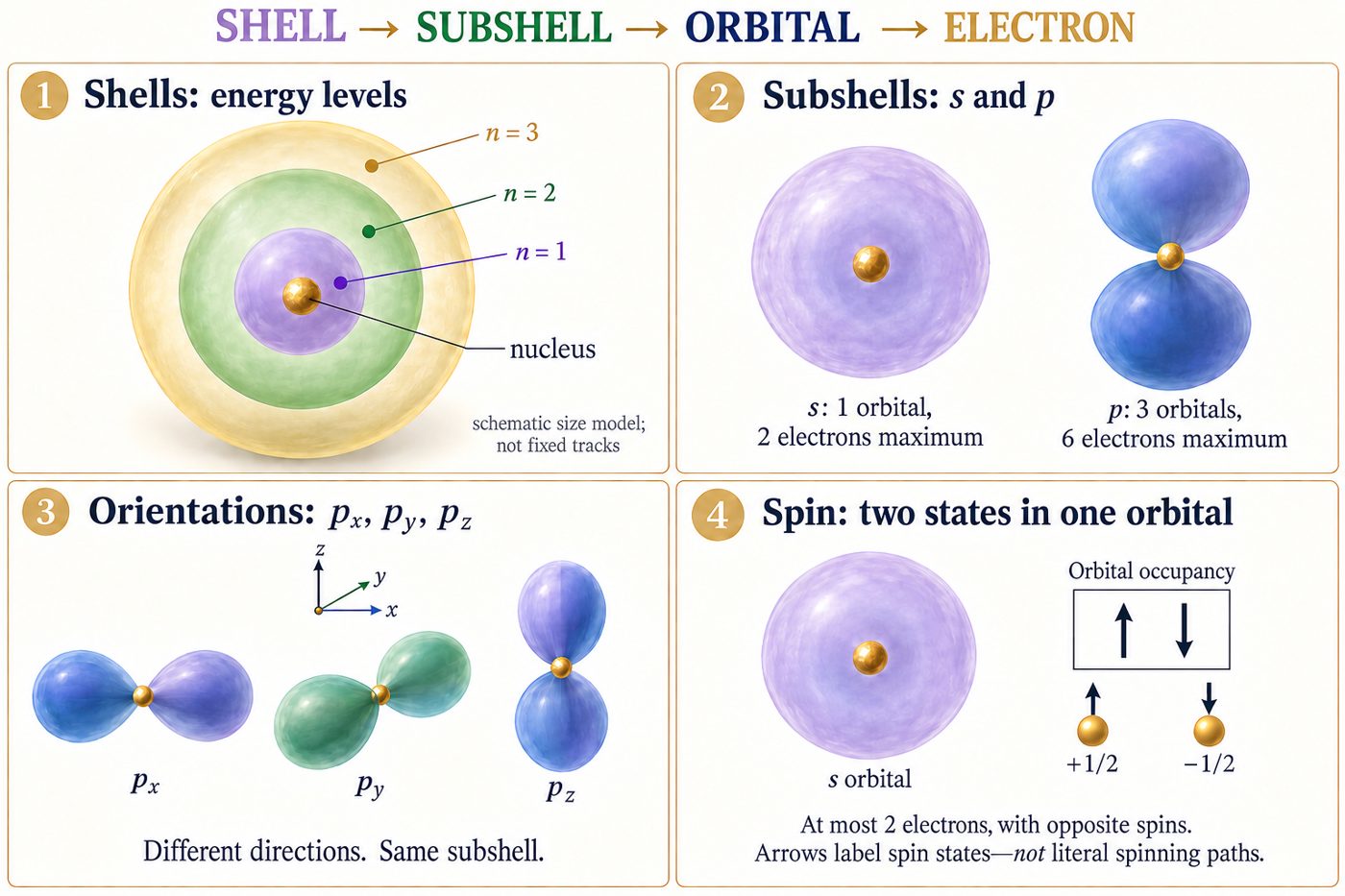
| Level | What it is | How it is labeled | Chlorine example |
|---|---|---|---|
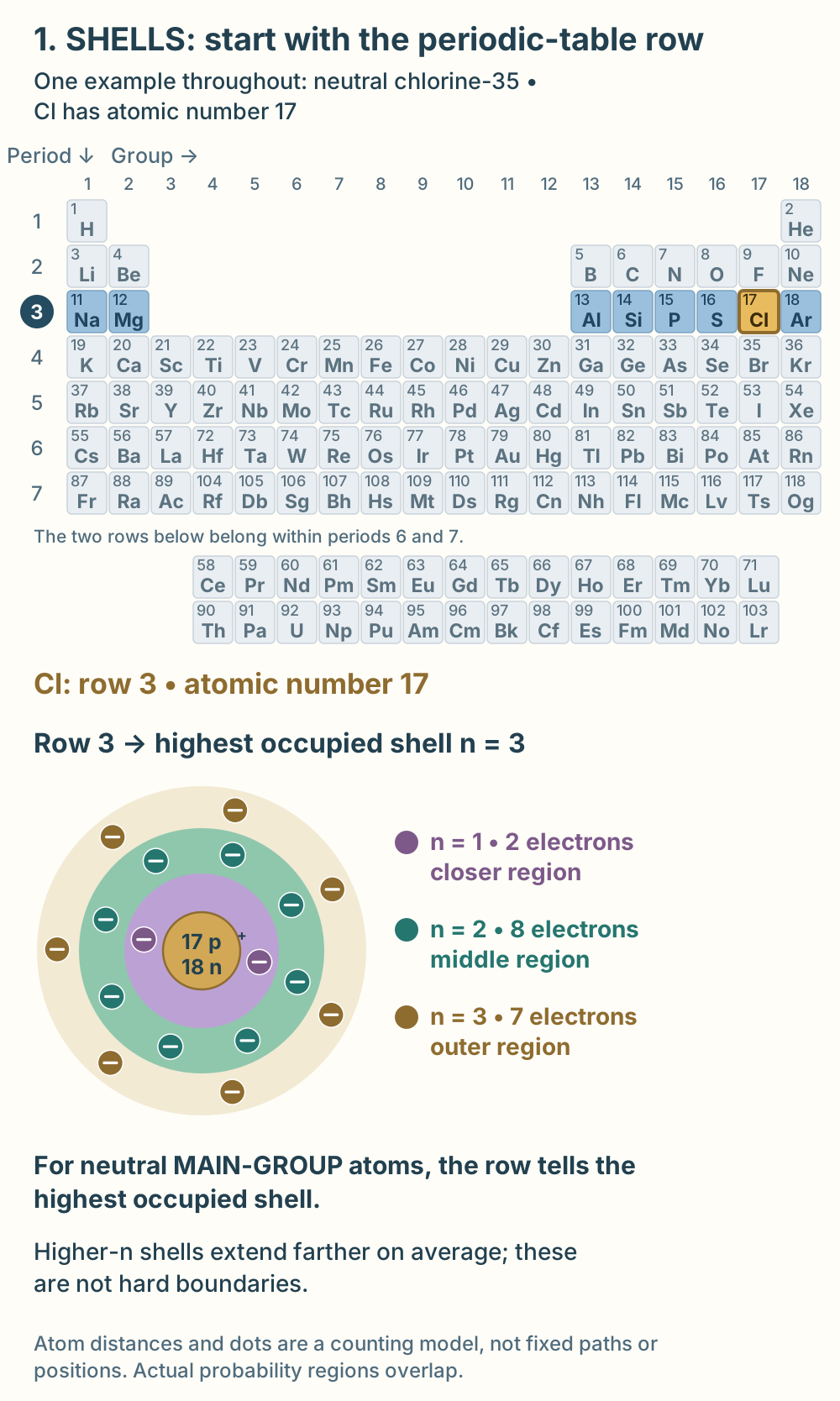
| Shell | A main energy level | n = 1, 2, 3, … | Highest occupied shell: n = 3 |
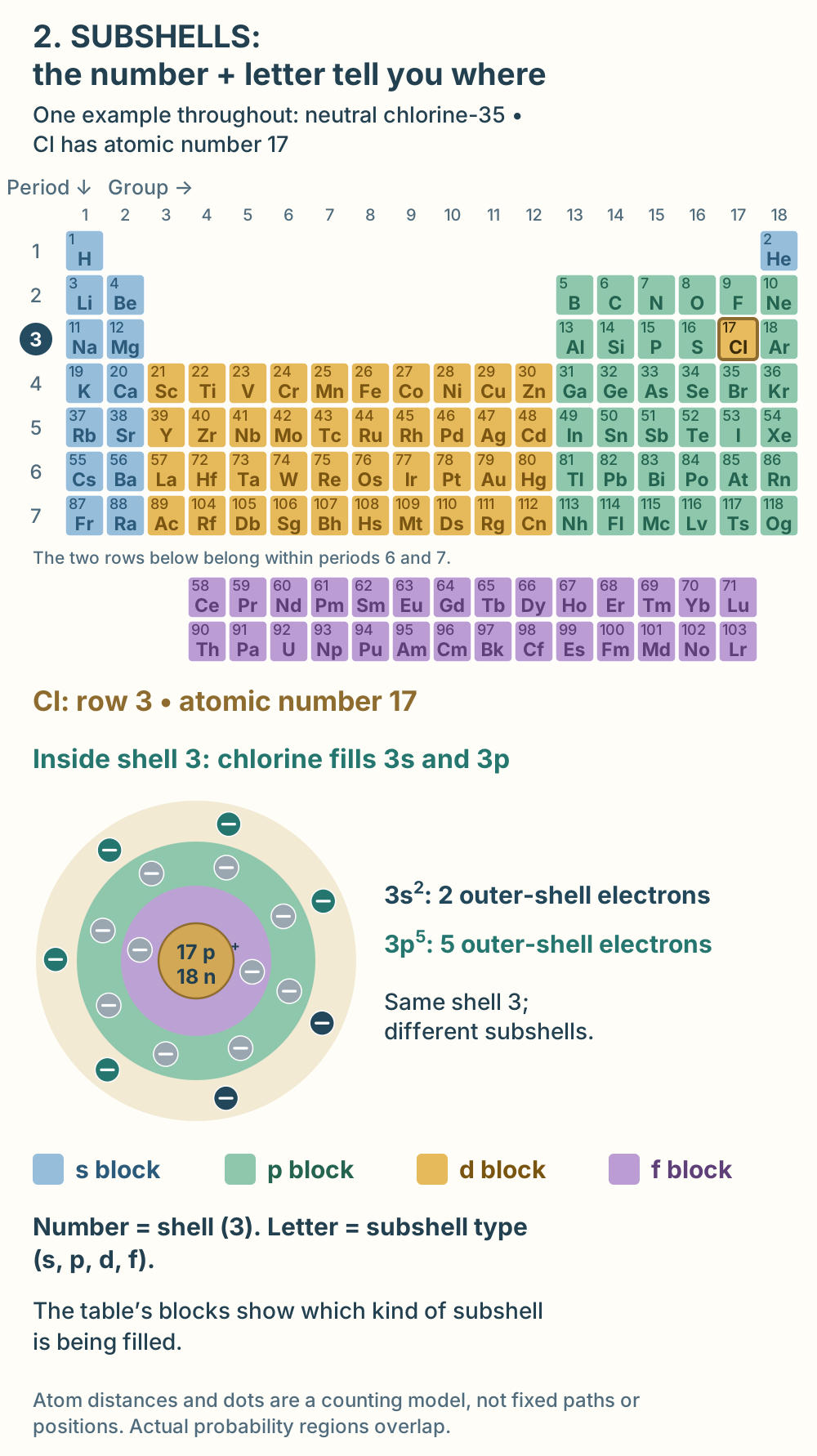
| Subshell | A smaller division of a shell | Number = shell, letter = type | 3s and 3p, both in shell 3 |
| Orbital | A probability region, not a path | s: 1, p: 3, d: 5, f: 7 orbitals | 3p has 3 orbitals |
| Electron | A negative particle outside the nucleus | Superscript counts them | 3s2 3p5: 2 + 5 in shell 3 |
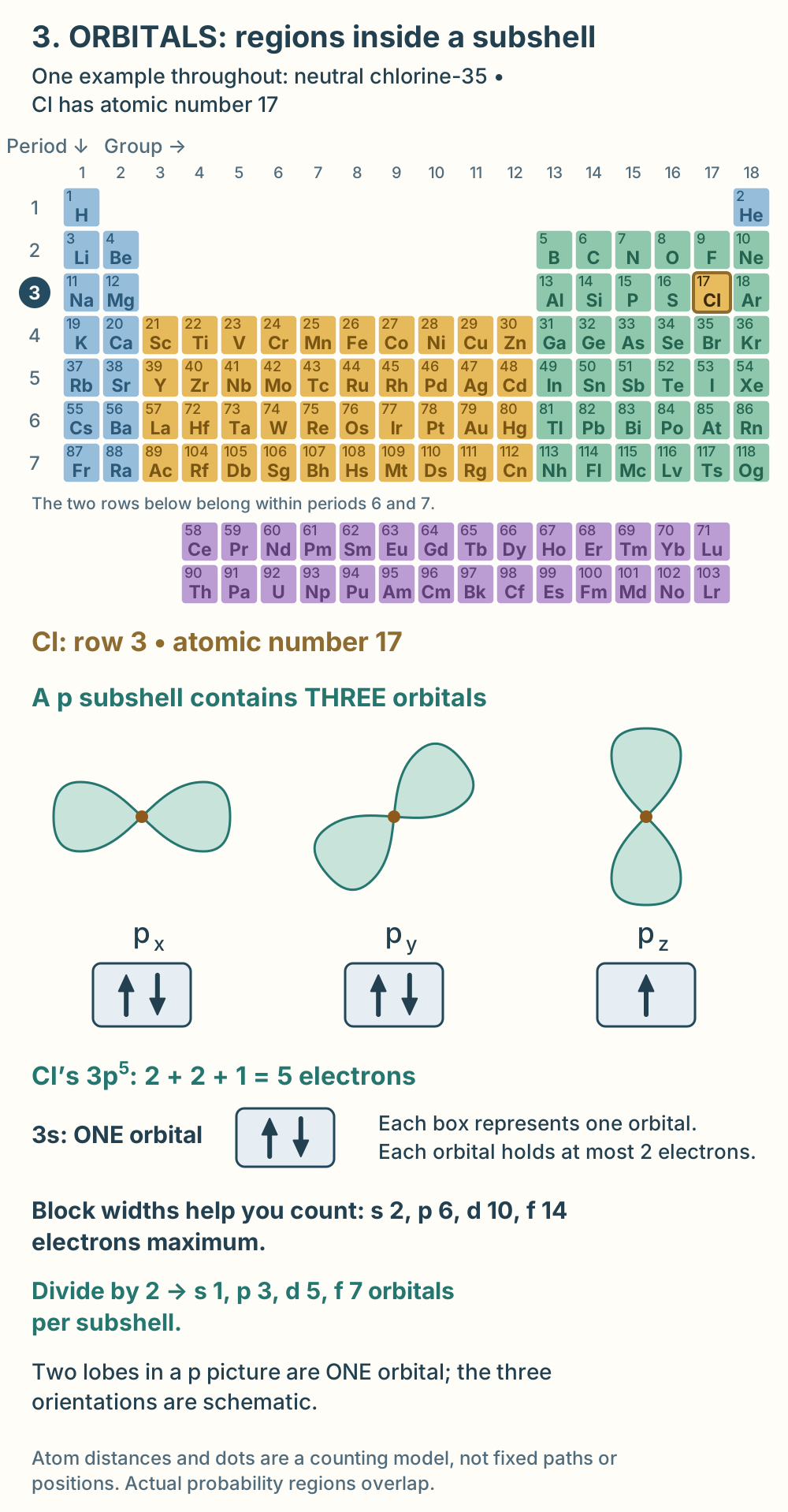
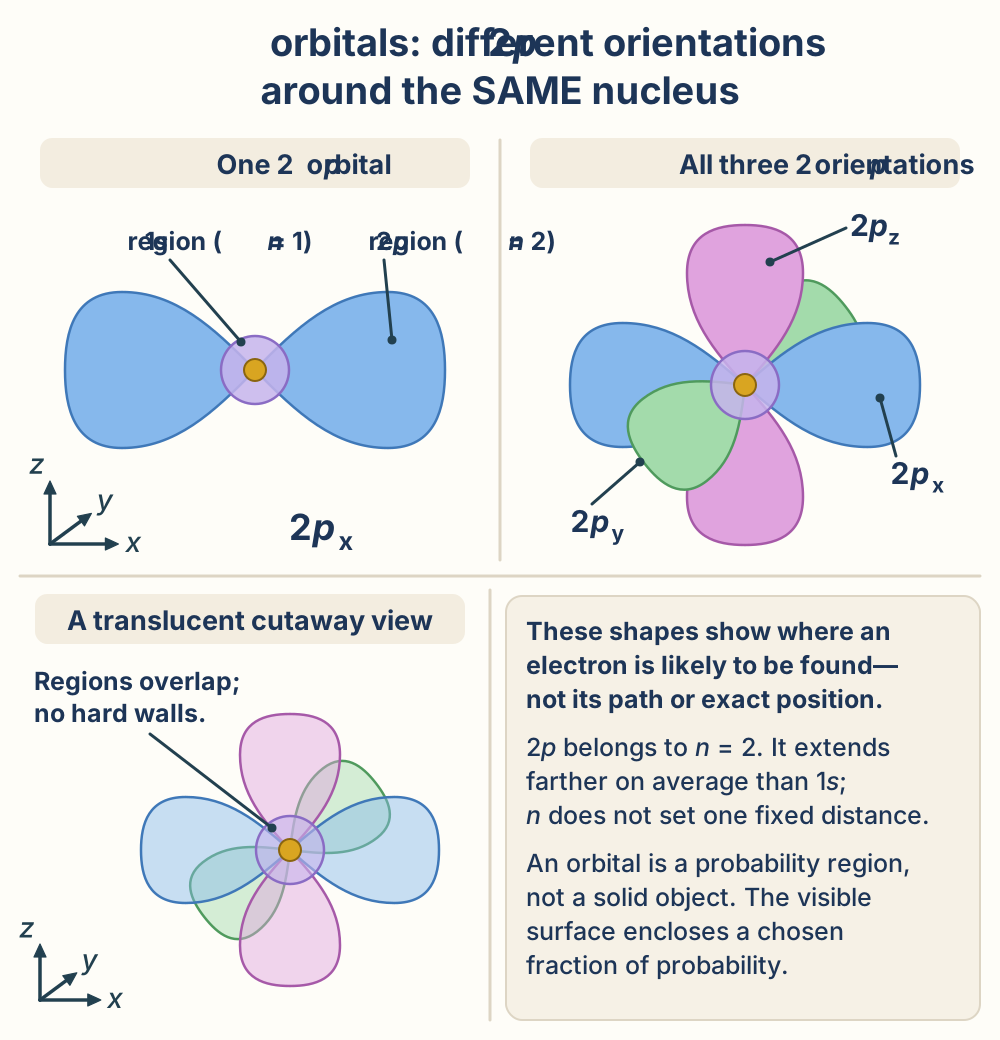
- The shape: where an electron is likely to be found, from a probability model. Not its exact location.
- The surface: a boundary holding a chosen fraction of the probability. Not a solid wall.
- n = 2: a shell label, not one fixed distance. 2p reaches farther on average than 1s, and the regions overlap.
- The overlay: three orientations around one nucleus, not three atoms.
- Chlorine fills 2p and 3p. Both have three orbitals; their shell numbers and probability spreads differ.
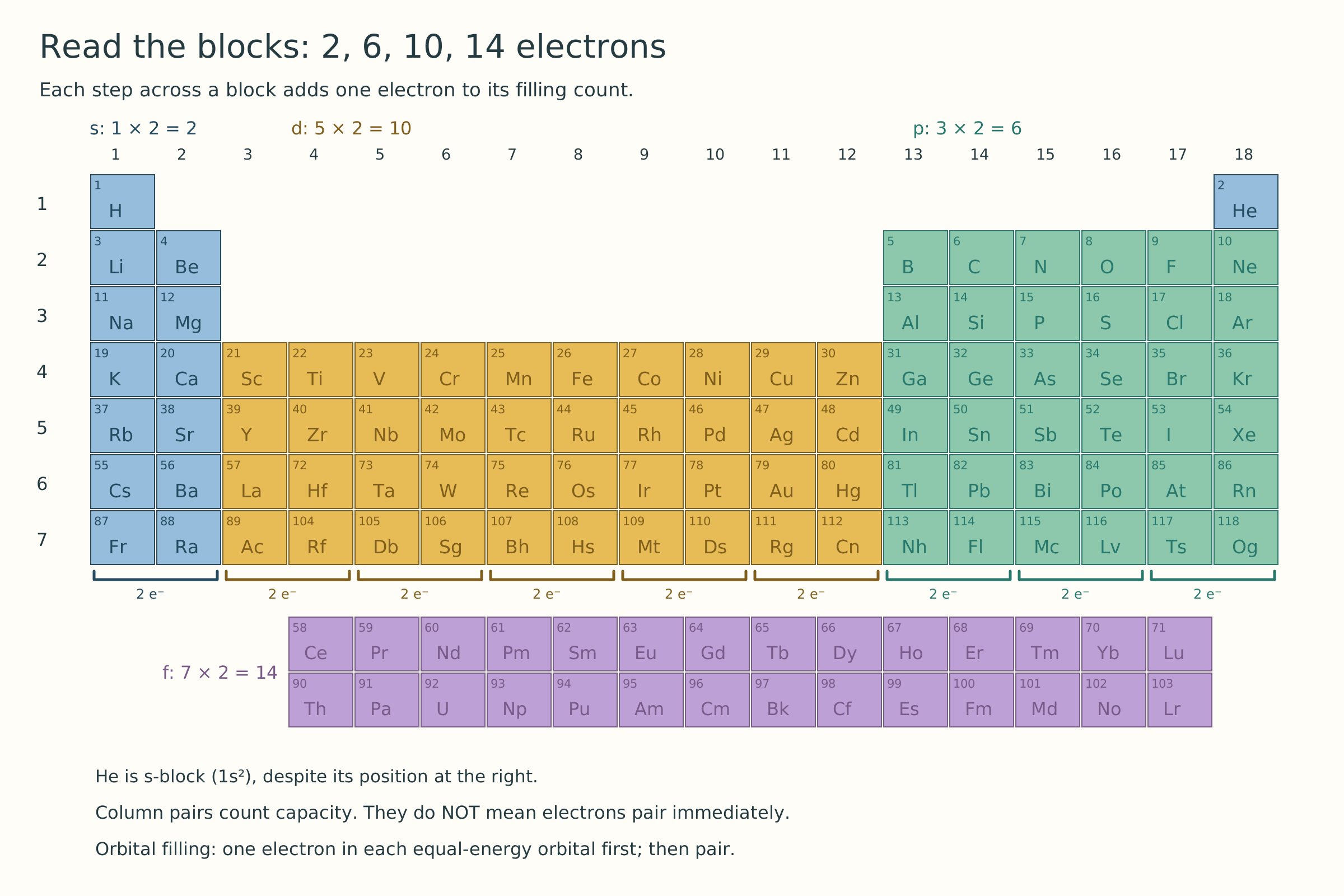
| Block | Columns | Pairs = orbitals | Maximum electrons |
|---|---|---|---|
| s | 2 | 1 | 2 |
| p | 6 | 3 | 6 |
| d | 10 | 5 | 10 |
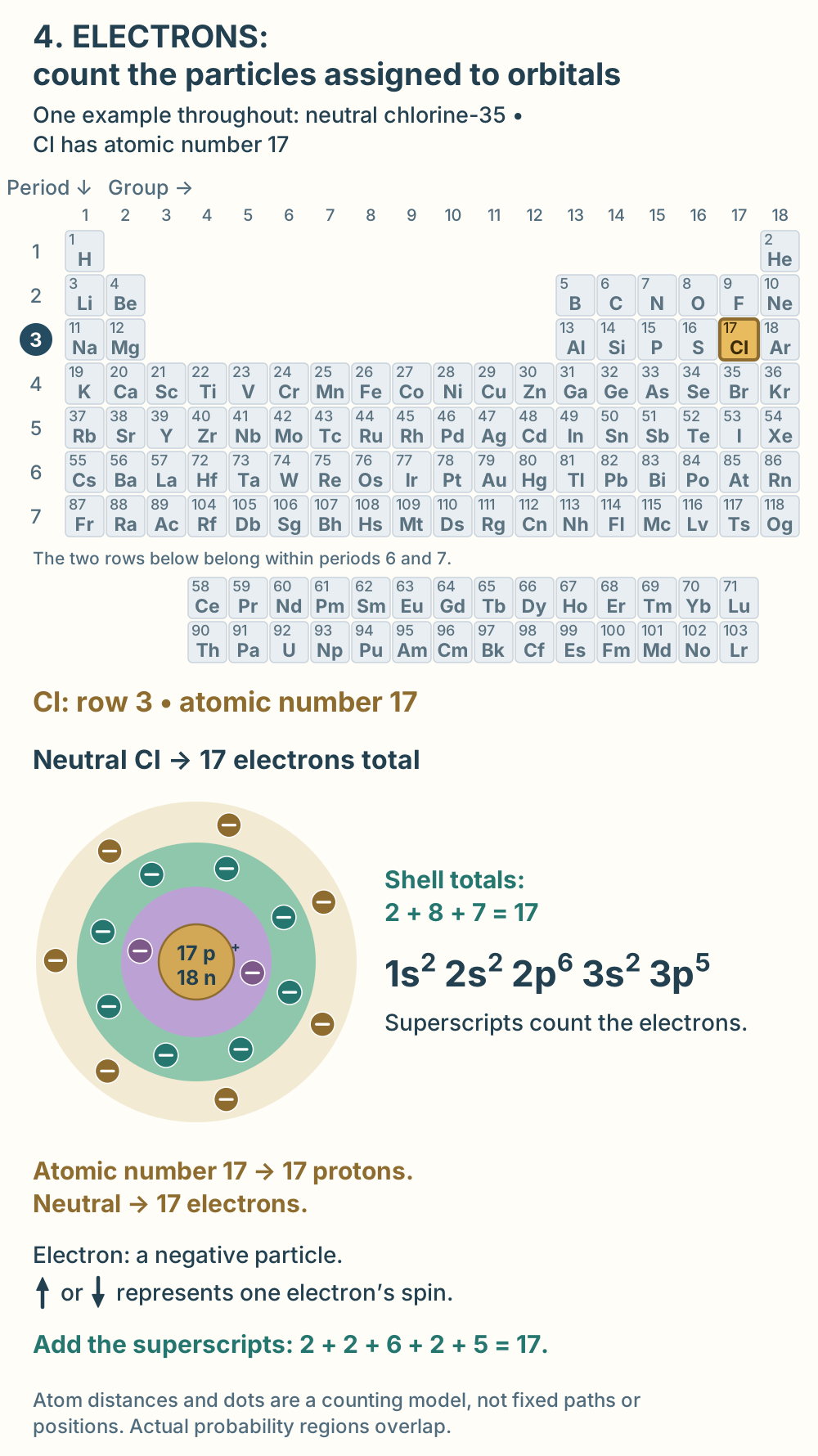
- Count: atomic number = electrons, for a neutral atom.
- Locate: find its row and colored block.
- Fill: follow energy order; count across the final block.
- Check: add the superscripts. They must equal the electron count.
- For Cl: shell 3 → 3p subshell → 3 orbitals → 5 electrons there (6 maximum).
| Shell | Subshell types allowed |
|---|---|
| n = 1 | s |
| n = 2 | s, p |
| n = 3 | s, p, d |
- Identify the subshell from its letter.
- Count its orbitals: s 1, p 3, d 5, f 7.
- Multiply by two electrons per orbital.
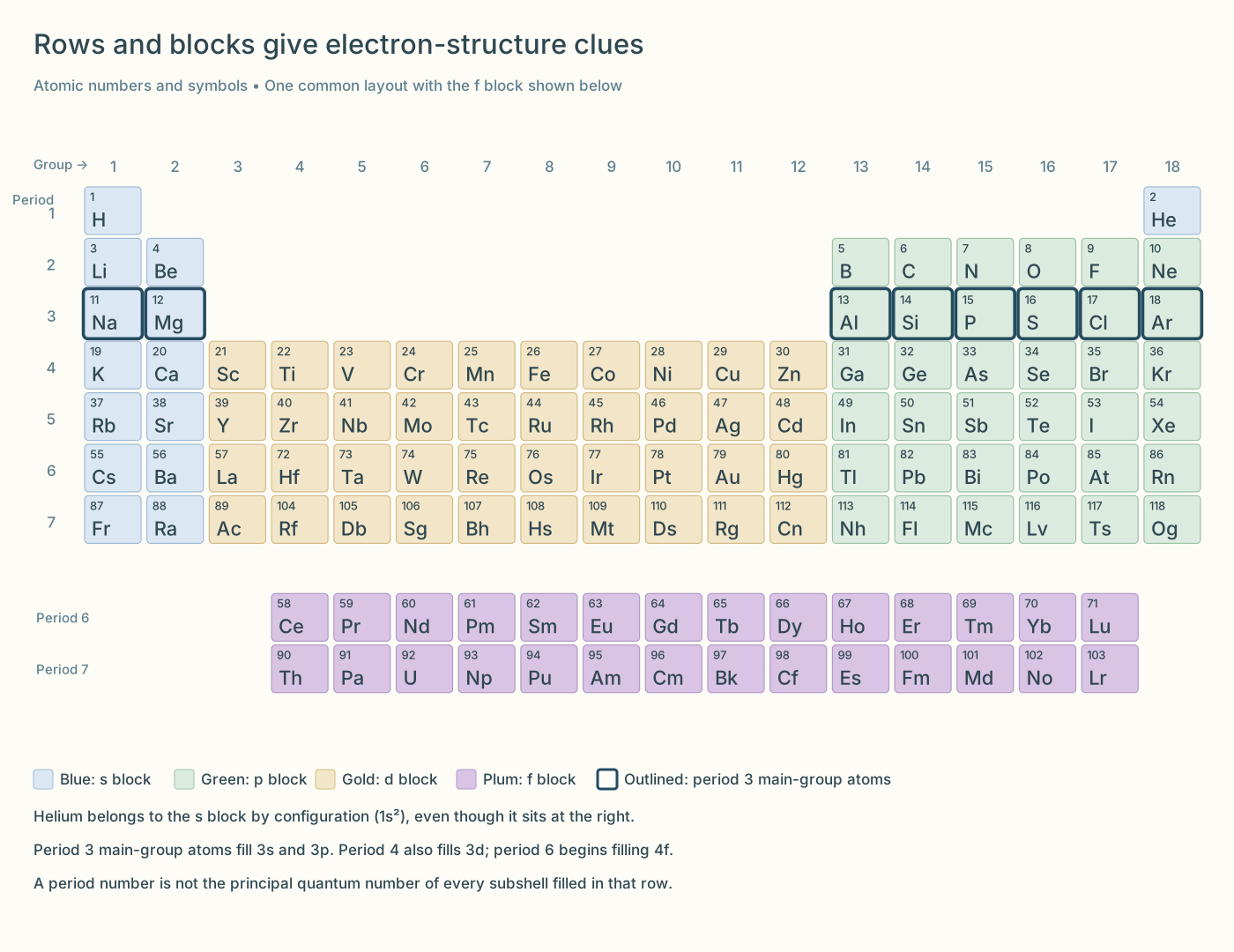
On the periodic table: For a neutral main-group atom, the row (period) gives the highest occupied shell: chlorine in row 3 uses n = 3.
On the periodic table: The colored block gives the subshell letter: chlorine is in the fifth column of the p block, so its outer shell ends in 3p5.
On the periodic table: The atomic number, the whole number in each box, counts protons; for a neutral atom it also counts electrons (Cl: 17).
On the periodic table: Block widths give capacity: s is 2 columns, p is 6, d is 10.
How many electrons can the 3p subshell hold?
- 1Read the letter
The letter p gives the orbital count. The 3 only names the shell.
3p → p subshell → 3 orbitals - 2Use the limit for one orbital
Each orbital holds at most two electrons, with opposite spins.
one orbital ↑↓ Two electrons, opposite spins: the most one box can hold. - 3Multiply
Add the capacity of all three orbitals.
3 orbitals × 2 electrons1 orbital = 6 electrons3p6 ↑↓ ↑↓ ↑↓ - ✓Answer
6 electrons. The shell label 3 does not multiply the number of p orbitals again.
Section practice · 6 questions · tap to open
What this set is for: practicing the method from this section while it’s fresh. Every problem uses only what this section has taught.
Practice 1
A p drawing has two lobes. How many orbitals does that one drawing represent?
Give me a hint
Count orbitals, not lobes.
Check the answer
Answer: One orbital
Explain the worked problem to me
What you know: A p drawing shows two lobes on opposite sides of the nucleus. What you want: How many orbitals that one drawing shows.
- Recall what an orbital is: one region where an electron is likely to be found.
- The two lobes are two parts of that same probability region. They belong together as one shape.
- So one two-lobed drawing is One orbital. Like any orbital, it holds at most two electrons.
Why it matters: A p subshell has three orbitals, shown as three separate two-lobed drawings, not six lobes counted one by one.
Watch out: Counting lobes instead of orbitals gives 2, which is wrong.
That’s right: One orbital
Practice 2
How many orbitals make up one p subshell?
Give me a hint
A p subshell has one orbital pointing along each axis: x, y, and z.
Check the answer
Answer: Three
Explain the worked problem to me
What you know: A p subshell is drawn as three two-lobed shapes pointing in different directions (px, py, pz). What you want: How many orbitals are in one p subshell.
- Each differently oriented drawing is one separate orbital.
- Count the orientations: x, y, and z make Three orbitals.
Check: Each row of the p block is six columns wide. Six electrons at two per orbital needs exactly 3 orbitals.
Watch out: Don't count lobes (6) or electrons (6). The question asks for orbitals.
That’s right: Three
Practice 3
Can ↑↑ occupy the same orbital?
Give me a hint
Apply the two-electrons-in-one-orbital rule.
Check the answer
Answer: No
Explain the worked problem to me
What you know: The arrows ↑↑ show two electrons with the same spin. What you want: Whether both can sit in one orbital.
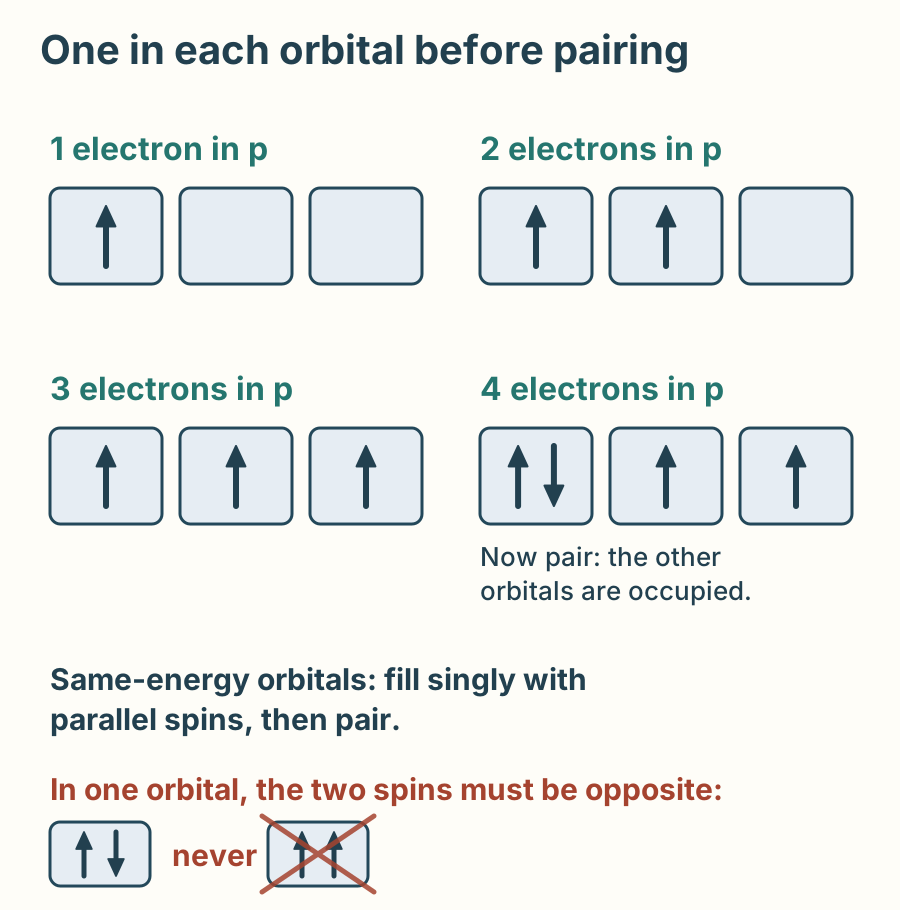
- Use the orbital rule: one orbital holds at most two electrons, and they must have opposite spins.
- ↑↑ has two parallel spins, not opposite ones.
- So the answer is No. A paired orbital must be drawn ↑↓.
Why it matters: Parallel arrows are fine in two different orbitals, as when a p subshell fills singly (↑ | ↑ | ↑) before pairing.
That’s right: No
Practice 4
Read 3p5: what do 3, p, and 5 mean?
Give me a hint
The leading number, letter, and superscript have three different jobs.
Check the answer
Answer: Shell 3; p subshell; five electrons
Explain the worked problem to me
What you know: The label 3p5. What you want: What each part means.
- The leading number 3 is the shell (n = 3).
- The letter p names the subshell type in that shell.
- The superscript 5 counts electrons in that subshell.
- Together: Shell 3; p subshell; five electrons.
Why it matters: 5 is less than the p maximum of 6, so 3p5 is possible. In boxes it is ↑↓ | ↑↓ | ↑.
Watch out: The superscript counts electrons, not orbitals. A p subshell always has three orbitals.
That’s right: Shell 3; p subshell; five electrons
Practice 5
In the Bohr model, what happens when hydrogen’s electron drops from n = 3 to n = 2?
Give me a hint
Does the electron gain or lose energy when it moves closer?
Check the answer
Answer: It gives off light carrying the energy difference.
Explain the worked problem to me
What you know: Hydrogen's electron moves from n = 3 to n = 2 in the Bohr model. What you want: What happens to the energy.
- In Bohr's model, a smaller n is a lower energy level. So n = 2 is lower than n = 3.
- Moving to a lower level means the electron loses energy.
- That lost energy leaves the atom as light. So It gives off light carrying the energy difference.
Why it matters: The reverse move, n = 2 to n = 3, would need the atom to absorb exactly that same amount of energy.
Watch out: Moving closer to the nucleus releases energy; it does not take energy in.
That’s right: It gives off light carrying the energy difference.
Practice 6
What does the quantum model use in place of Bohr’s fixed orbits?
Give me a hint
The quantum model does not give an exact path.
Check the answer
Answer: Orbitals: regions where an electron is likely to be found.
Explain the worked problem to me
What you know: Bohr pictured electrons on fixed circular orbits. What you want: What the quantum model uses instead.
- The quantum model keeps Bohr's energy levels (n).
- It drops the idea of an exact path, because electrons do not travel in fixed tracks.
- Instead it uses Orbitals: regions where an electron is likely to be found.
Why it matters: This is why orbital drawings are probability regions, not racetracks the electron follows.
Watch out: "Orbit" and "orbital" sound alike but are different ideas.
That’s right: Orbitals: regions where an electron is likely to be found.
3.2 Writing an electron configuration
An electron configuration shows which subshells hold an atom’s electrons, and how many. Count the electrons, fill subshells in energy order, then check that the superscripts add up.
- Shell → subshell → orbital; two electrons maximum per orbital (3.1).
Need a refresher? Open the table of contents and revisit that topic before starting.
- Start with the electron count, then fill in energy order.
- Superscripts count electrons: 2p6 is six electrons in 2p.
- Pauli’s rule: at most two electrons per orbital, with opposite spins.
- Hund’s rule: fill equal-energy orbitals singly before pairing.
- Valence electrons (main group): those in the outermost shell, highest n. Core electrons: all the inner ones.
| Subshell | Orbitals = boxes | Maximum electrons |
|---|---|---|
| s | 1 | 2 |
| p | 3 | 6 |
| d | 5 | 10 |
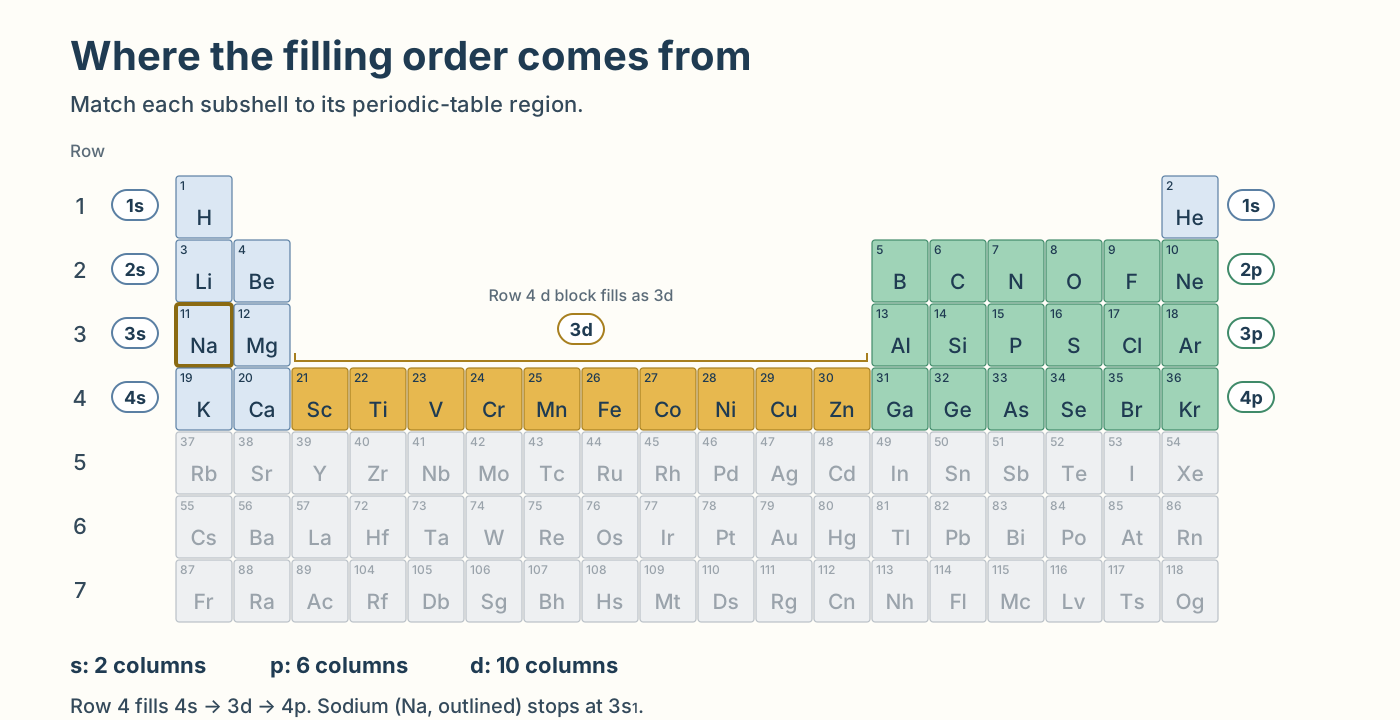
- The middle of the table is the d block. Iron is a transition metal: its atom has a partly filled d subshell.
- In the introductory route, 4s fills before 3d. The d label is one less than the period: period 4 → 3d, period 5 → 4d.
- Transition metals often form more than one ion; iron commonly forms Fe2+ and Fe3+.
- Exceptions such as chromium and copper need adjustments. Follow your course’s examples.
- d block is not the same as transition metal: Zn and Zn2+ have full d subshells, so zinc is usually excluded.
| Ion | Rule | Configuration | Same as |
|---|---|---|---|
| Cl− | Add 1 electron per negative charge | [Ne] 3s2 3p6 | Ar |
| Na+ | Remove from the highest n first | [Ne] | Ne |
| Fe2+ | Remove 4s before 3d | [Ar] 3d6 | — |
| Fe3+ | Then one 3d electron | [Ar] 3d5 | — |
- A full outer shell is ns2np6, or 1s2 like helium for ions such as Li+.
- This explains the column charges in 2.2: Group 1 loses 1, Group 2 loses 2, Group 16 gains 2, Group 17 gains 1.
- Isoelectronic: having the same number of electrons (and so, here, the same configuration). Na+, Mg2+, F− and O2− all match neon.
- Count the electrons: the atomic number, plus one per negative charge, minus one per positive charge.
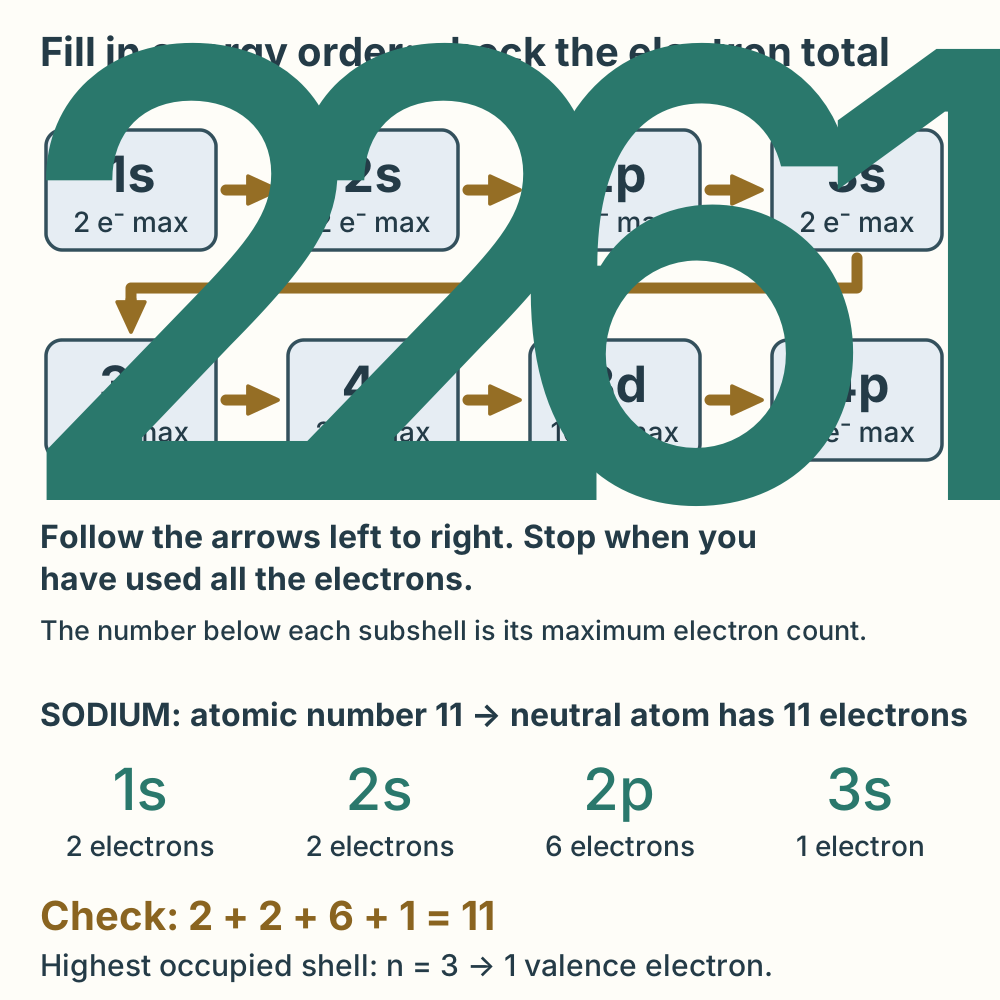
- Fill subshells in energy order: 1s, 2s, 2p, 3s, 3p, 4s, 3d, 4p.
- Stop when every electron is placed.
- Add the superscripts to check the total.
On the periodic table: The atomic number in each box is the electron count of the neutral atom.
On the periodic table: The block shows which subshell is filling; the period gives the s and p shell number.
On the periodic table: The noble-gas core is the Group 18 element in the row above yours.
On the periodic table: Group number gives main-group valence electrons and ion charges.
Write the ground-state electron configuration of neutral sodium, atomic number 11.
- 1Set the electron total
Neutral means equal protons and electrons. On the periodic table: Na is atomic number 11, Period 3.
Neutral Na: 11 protons → 11 electrons - 2Fill the first two s subshells
Each s subshell holds two.
Subshell Electrons added Running total 1s 2 2 2s 2 4 11 − 4 = 7 electrons left - 3Fill the next p subshell
A p subshell holds six. One electron remains.
1s2 2s2 2p6 → 10 used, 11 − 10 = 1 left - 4Place the last electron
The next subshell is 3s.
Sodium in boxes Pairs point opposite ways; the single 3s electron is the valence electron. - 5Check the total
The highest shell, n = 3, holds one valence electron. On the periodic table: Na is Group 1 (1 valence electron) and Period 3 (shell 3).
2 + 2 + 6 + 1 = 11 - ✓Answer
1s2 2s2 2p6 3s1, exactly 11 electrons
Write the electron configuration of chlorine. It finishes in p.
- 1Find it
On the periodic table: Cl has atomic number 17, the whole number in its box, in Period 3, fifth column of the p block.
Symbol Atomic number Period Position Cl 17 3 p block, 5th column - 2Fill in order
Fill 1s, 2s, 2p and 3s, then put five electrons in 3p.
Subshell Electrons added Running total 1s 2 2 2s 2 4 2p 6 10 3s 2 12 3p 5 17 - 3Check the total
The superscripts must equal 17.
2 + 2 + 6 + 2 + 5 = 17 - 4Draw the last subshell
Five electrons in three boxes: two pairs and one single.
3p5 ↑↓ ↑↓ ↑ One cell per orbital. Fill singly first; a pair points opposite ways. - ✓Answer
1s2 2s2 2p6 3s2 3p5
Write the electron configuration of magnesium. It finishes in s.
- 1Find it
On the periodic table: Mg has atomic number 12, in Period 3, second column of the s block (Group 2).
Symbol Atomic number Period Position Mg 12 3 s block, 2nd column - 2Fill in order
Fill 1s, 2s and 2p, then put two electrons in 3s.
Subshell Electrons added Running total 1s 2 2 2s 2 4 2p 6 10 3s 2 12 - 3Check the total
The superscripts must equal 12.
2 + 2 + 6 + 2 = 12 - 4Draw the last subshell
One box, one pair.
3s2 ↑↓ One cell per orbital. Fill singly first; a pair points opposite ways. - ✓Answer
1s2 2s2 2p6 3s2
Write the electron configuration of iron. It includes the d block.
- 1Find it
On the periodic table: Fe has atomic number 26, in Period 4, sixth column of the d block. Argon (Ar, 18) ends Period 3, so it gives the [Ar] core.
Symbol Atomic number Period Position Fe 26 4 d block, 6th column - 2Fill in order
Fill through argon, then 4s, then 3d.
Subshell Electrons added Running total [Ar] 18 18 4s 2 20 3d 6 26 - 3Check the total
Core plus the electrons after it.
18 + 2 + 6 = 26 - 4Draw the last subshell
Six electrons in five boxes: one each, then one pair.
3d6 ↑↓ ↑ ↑ ↑ ↑ One cell per orbital. Fill singly first; a pair points opposite ways. - ✓Answer
[Ar] 4s2 3d6
Write the electron configurations of S2− and Mg2+.
- 1Count electrons for S2−
A 2− charge means 2 extra electrons. On the periodic table: S is atomic number 16.
16 + 2 = 18 electrons - 2Fill in order
18 electrons fill through 3p, matching argon.
S2−: 1s2 2s2 2p6 3s2 3p6 = [Ar] - 3Count electrons for Mg2+
A 2+ charge means 2 electrons removed, from 3s. On the periodic table: Mg is atomic number 12.
12 − 2 = 10 electrons - 4Write it
10 electrons match neon.
Mg2+: 1s2 2s2 2p6 = [Ne] - ✓Answer
S2−: [Ar] and Mg2+: [Ne]; both are noble-gas configurations
3.2a Light and atomic energy: what changes when an electron absorbs energy?
Light travels as waves, and it also comes in packets of energy called photons. This lesson links a photon’s wavelength, frequency and energy, and shows how atoms absorb or give off light when an electron changes energy level.
- Unit conversions and rearranging equations (0.1–0.2).
Need a refresher? Open the table of contents and revisit that topic before starting.
| Light | λ (nm) | ν (s−1) | E per photon (J) |
|---|---|---|---|
| Violet | 400. | 7.50 × 10¹⁴ | 4.97 × 10⁻¹⁹ |
| Green | 500. | 6.00 × 10¹⁴ | 3.98 × 10⁻¹⁹ |
| Red | 700. | 4.29 × 10¹⁴ | 2.84 × 10⁻¹⁹ |
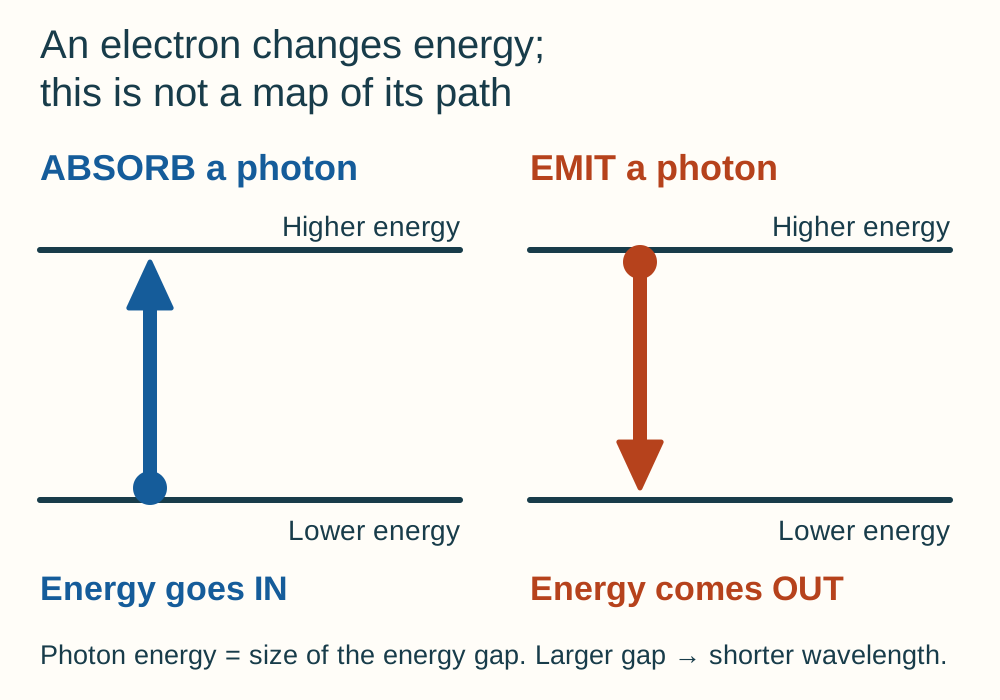
The photon’s energy must match an allowed energy gap.
An electron moves to a higher-energy state.
The atom releases a photon.
Photon energy = the positive size of the gap.
- Atomic energy levels are discrete: only certain values are allowed.
- Higher-energy states are not fixed circular tracks. The diagram shows energy, not a literal orbit.
- Convert the wavelength to meters (1 nm = 10−9 m).
- Find frequency: ν = c / λ.
- Find photon energy: E = hν.
- Check the units cancel and keep three significant figures.
On the periodic table: Nothing in this lesson is read from the periodic table: c and h are constants supplied with the problem.
Light has wavelength λ = 500. nm. Find its frequency and the energy of one photon.
- 1Convert to meters
c is in m/s, so λ must be in meters.
λ = 500. nm × 10−9 m1 nm = 5.00 × 10⁻⁷ m - 2Find the frequency
Meters cancel, leaving s−1 (Hz).
ν = cλ = 3.00 × 10⁸ m/s5.00 × 10−7 m = 6.00 × 10¹⁴ Hz - 3Find the photon energy
Seconds cancel, leaving joules.
E = hν = (6.626 × 10⁻³⁴ J·s)(6.00 × 10¹⁴ s−1) = 3.98 × 10⁻¹⁹ J - 4Check with E = hc/λ
The other form of the equation gives the same energy.
E = (6.626 × 10⁻³⁴ J·s)(3.00 × 10⁸ m/s)5.00 × 10−7 m = 3.98 × 10⁻¹⁹ J - ✓Answer
ν = 6.00 × 10¹⁴ Hz; E = 3.98 × 10⁻¹⁹ J per photon
Section practice · 10 questions · tap to open
What this set is for: practicing the method from this section while it’s fresh. Every problem uses only what this section has taught.
Practice 1
Light has frequency 1.00 × 10¹⁴ Hz. Find wavelength using c = 3.00 × 10⁸ m/s.
Give me a hint
Rearrange c = λν for λ.
Check the answer
Answer: 3.00 × 10³ nm
Explain the worked problem to me
What you know: ν = 1.00 × 10¹⁴ Hz (s−1) and c = 3.00 × 10⁸ m/s. What you want: Wavelength λ in nm.
- Rearrange c = λν to λ = c ÷ ν.
- λ = (3.00 × 10⁸ m/s) ÷ (1.00 × 10¹⁴ s−1) = 3.00 × 10⁻⁶ m. The s−1 and /s cancel, leaving meters.
- Convert to nm: 3.00 × 10−6 m × (1 nm / 10−9 m) = 3.00 × 10³ nm. Three significant figures, matching the data.
Check: Reverse it: 3000 × 10−9 m × 1.00 × 1014 s−1 should give 3.00 × 10⁸ m/s.
Watch out: Divide c by ν; don't multiply. And convert m to nm by dividing by 10−9 (multiplying by 109).
That’s right: 3.00 × 10³ nm
Practice 2
Light has frequency 2.00 × 10¹⁴ Hz. Find wavelength using c = 3.00 × 10⁸ m/s.
Give me a hint
Rearrange c = λν for λ.
Check the answer
Answer: 1.50 × 10³ nm
Explain the worked problem to me
What you know: ν = 2.00 × 10¹⁴ Hz (s−1) and c = 3.00 × 10⁸ m/s. What you want: Wavelength λ in nm.
- Rearrange c = λν to λ = c ÷ ν.
- λ = (3.00 × 10⁸ m/s) ÷ (2.00 × 10¹⁴ s−1) = 1.50 × 10⁻⁶ m. The s−1 and /s cancel, leaving meters.
- Convert to nm: 1.50 × 10−6 m × (1 nm / 10−9 m) = 1.50 × 10³ nm. Three significant figures, matching the data.
Check: Reverse it: 1500 × 10−9 m × 2.00 × 1014 s−1 should give 3.00 × 10⁸ m/s.
Watch out: Divide c by ν; don't multiply. And convert m to nm by dividing by 10−9 (multiplying by 109).
That’s right: 1.50 × 10³ nm
Practice 3
Light has frequency 3.00 × 10¹⁴ Hz. Find wavelength using c = 3.00 × 10⁸ m/s.
Give me a hint
Rearrange c = λν for λ.
Check the answer
Answer: 1.00 × 10³ nm
Explain the worked problem to me
What you know: ν = 3.00 × 10¹⁴ Hz (s−1) and c = 3.00 × 10⁸ m/s. What you want: Wavelength λ in nm.
- Rearrange c = λν to λ = c ÷ ν.
- λ = (3.00 × 10⁸ m/s) ÷ (3.00 × 10¹⁴ s−1) = 1.00 × 10⁻⁶ m. The s−1 and /s cancel, leaving meters.
- Convert to nm: 1.00 × 10−6 m × (1 nm / 10−9 m) = 1.00 × 10³ nm. Three significant figures, matching the data.
Check: Reverse it: 1000 × 10−9 m × 3.00 × 1014 s−1 should give 3.00 × 10⁸ m/s.
Watch out: Divide c by ν; don't multiply. And convert m to nm by dividing by 10−9 (multiplying by 109).
That’s right: 1.00 × 10³ nm
Practice 4
Light has frequency 4.00 × 10¹⁴ Hz. Find wavelength using c = 3.00 × 10⁸ m/s.
Give me a hint
Rearrange c = λν for λ.
Check the answer
Answer: 750. nm
Explain the worked problem to me
What you know: ν = 4.00 × 10¹⁴ Hz (s−1) and c = 3.00 × 10⁸ m/s. What you want: Wavelength λ in nm.
- Rearrange c = λν to λ = c ÷ ν.
- λ = (3.00 × 10⁸ m/s) ÷ (4.00 × 10¹⁴ s−1) = 7.50 × 10⁻⁷ m. The s−1 and /s cancel, leaving meters.
- Convert to nm: 7.50 × 10−7 m × (1 nm / 10−9 m) = 750. nm. Three significant figures, matching the data. The decimal point in 750. shows the zero counts.
Check: Reverse it: 750 × 10−9 m × 4.00 × 1014 s−1 should give 3.00 × 10⁸ m/s.
Watch out: Divide c by ν; don't multiply. And convert m to nm by dividing by 10−9 (multiplying by 109).
That’s right: 750. nm
Practice 5
Light has frequency 5.00 × 10¹⁴ Hz. Find wavelength using c = 3.00 × 10⁸ m/s.
Give me a hint
Rearrange c = λν for λ.
Check the answer
Answer: 600. nm
Explain the worked problem to me
What you know: ν = 5.00 × 10¹⁴ Hz (s−1) and c = 3.00 × 10⁸ m/s. What you want: Wavelength λ in nm.
- Rearrange c = λν to λ = c ÷ ν.
- λ = (3.00 × 10⁸ m/s) ÷ (5.00 × 10¹⁴ s−1) = 6.00 × 10⁻⁷ m. The s−1 and /s cancel, leaving meters.
- Convert to nm: 6.00 × 10−7 m × (1 nm / 10−9 m) = 600. nm. Three significant figures, matching the data. The decimal point in 600. shows both zeros count.
Check: Reverse it: 600 × 10−9 m × 5.00 × 1014 s−1 should give 3.00 × 10⁸ m/s.
Watch out: Divide c by ν; don't multiply. And convert m to nm by dividing by 10−9 (multiplying by 109).
That’s right: 600. nm
Practice 6
Which photon has more energy: 400 nm or 700 nm?
Give me a hint
Use E = hc/λ. Is λ in the numerator or the denominator?
Check the answer
Answer: 400 nm
Explain the worked problem to me
What you know: Two photons: 400 nm and 700 nm. What you want: Which carries more energy.
- Use E = hc/λ. h and c are constants, so energy depends only on λ.
- λ is in the denominator, so a smaller wavelength gives a larger energy.
- 400 nm is shorter than 700 nm, so 400 nm has more energy.
Check: 700/400 = 1.75, so the 400 nm photon has 1.75 times the energy. Violet light (400 nm) is more energetic than red (700 nm).
Watch out: Bigger wavelength does not mean bigger energy. It is the opposite.
That’s right: 400 nm
Practice 7
Does emission move an electron up or down in energy?
Give me a hint
In emission, does the photon carry energy into the atom or out of it?
Check the answer
Answer: Down
Explain the worked problem to me
What you know: In emission, an atom gives off a photon. What you want: Whether the electron moves up or down in energy.
- The photon carries energy away from the atom.
- Energy is conserved, so the electron must end with less energy than it started with.
- So emission moves the electron Down to a lower-energy state.
Why it matters: The photon's energy equals the size of the gap between the two levels.
That’s right: Down
Practice 8
Does absorption move an electron up or down?
Give me a hint
Absorption takes in a photon’s energy.
Check the answer
Answer: Up
Explain the worked problem to me
What you know: In absorption, an atom takes in a photon. What you want: Whether the electron moves up or down.
- The photon's energy is added to the atom.
- It is absorbed only if it matches an allowed gap between levels.
- The electron gains that energy, so it moves Up to a higher-energy state.
Why it matters: Absorption and emission are opposites: absorption goes up, emission goes down.
That’s right: Up
Practice 9
What unit must λ use with c in m/s?
Give me a hint
The length unit of λ must cancel the meters in c.
Check the answer
Answer: Meters
Explain the worked problem to me
What you know: c = λν with c in m/s and ν in s−1. What you want: The unit λ must use.
- Write the units: m/s = λ × s−1.
- For the units to match on both sides, λ must be in meters.
- So λ must use Meters. Convert nm to m first (1 nm = 10−9 m).
Check: (m) × (s−1) = m/s, which matches c's units.
Watch out: Plugging 500 nm straight in as "500" makes the answer off by 109.
That’s right: Meters
Practice 10
Double frequency: what happens to photon energy?
Give me a hint
E = hν, so photon energy is proportional to frequency.
Check the answer
Answer: It doubles
Explain the worked problem to me
What you know: E = hν, and h is a constant. What you want: What happens to E when ν doubles.
- E is directly proportional to ν: E = h × ν.
- Replace ν with 2ν: Enew = h × 2ν = 2 × (hν).
- The answer: It doubles.
Check: Try numbers. ν = 1.00 × 10¹⁴ s−1 gives E = 6.63 × 10⁻²⁰ J; ν = 2.00 × 10¹⁴ s−1 gives E = 1.33 × 10⁻¹⁹ J, twice as much.
Watch out: Don't confuse this with wavelength. Doubling λ would halve the energy.
That’s right: It doubles
3.3 Reading the quantum labels
Every electron in an atom can be described by four quantum numbers. Each one answers a different question, and each has an allowed range. This lesson checks whether a set of four values is allowed.
- Shell and subshell labels; orbital and spin meanings (3.1–3.2).
Need a refresher? Open the table of contents and revisit that topic before starting.
| Label | Question it answers | Allowed values |
|---|---|---|
| n | Which shell? | 1, 2, 3, … (positive whole numbers) |
| l | Which subshell type? | 0 up to n − 1 |
| ml | Which orbital state? | −l up to +l, in whole steps |
| ms | Which spin? | +½ or −½ |
| l | Letter | ml values | Orbitals |
|---|---|---|---|
| 0 | s | 0 | 1 |
| 1 | p | −1, 0, +1 | 3 |
| 2 | d | −2, −1, 0, +1, +2 | 5 |
| 3 | f | −3 to +3 | 7 |
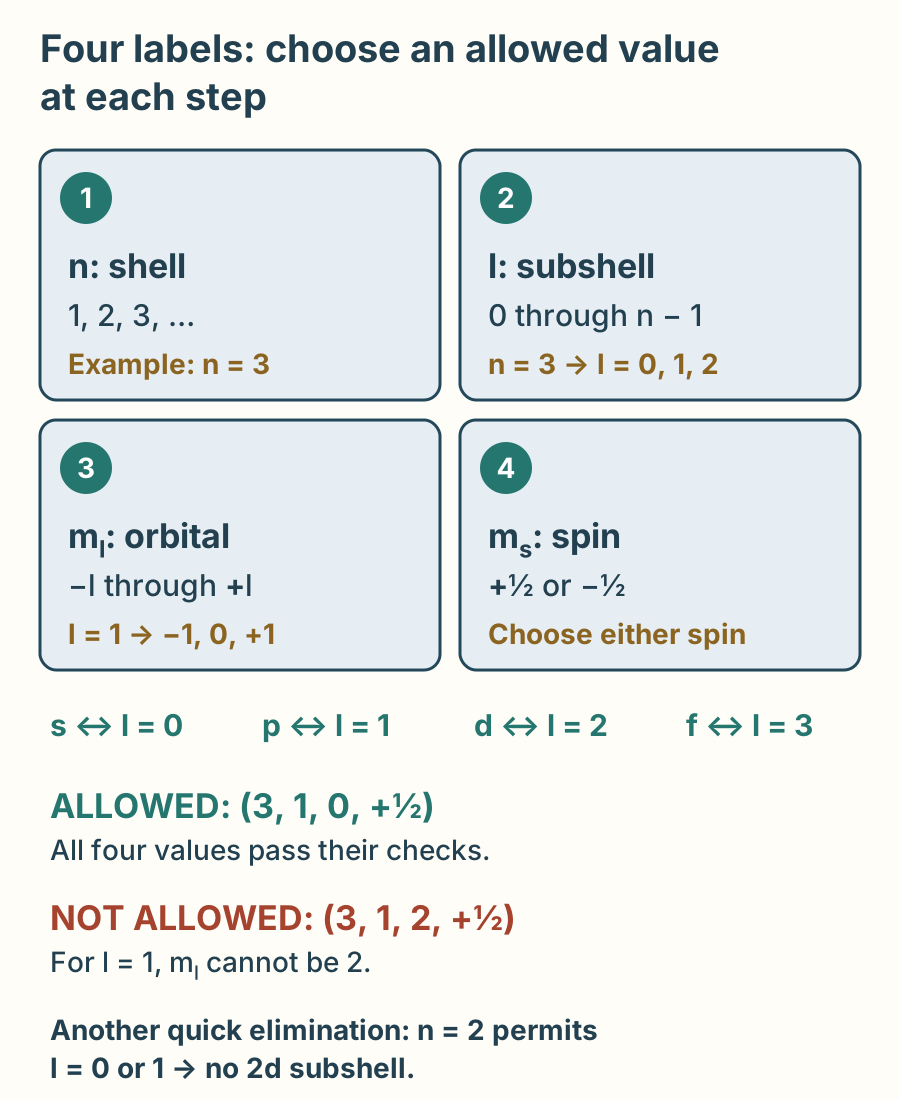
Connect to the orbital pictures: pz corresponds to ml = 0. px and py are combinations of the ml = +1 and −1 states, so do not match each drawing to one ml value.
- Check n: a positive whole number.
- Check l: from 0 to n − 1.
- Check ml: from −l to +l.
- Check ms: +½ or −½.
On the periodic table: The block tells you which subshell is filling (s, p, d, f), and the period gives the shell for s and p: Period 3 fills 3s, then 3p.
On the periodic table: Quantum-number problems often give the numbers instead of an element; then check the ranges directly.
Is n = 3, l = 1, ml = 0, ms = +½ an allowed set of quantum numbers?
- 1Check the shell
n must be a positive whole number.
n = 3 → allowed - 2Check the subshell
For n = 3, l can be 0, 1 or 2.
l = 0 to (3 − 1) = 0, 1, 2 → l = 1 is allowed - 3Check the orbital label
For l = 1, ml can be −1, 0 or +1.
ml = −1, 0, +1 → ml = 0 is allowed - 4Check the spin
Spin can be +½ or −½.
n l ml ms 3 1 0 +½ allowed allowed allowed allowed - ✓Answer
Yes, all four labels are allowed (an electron in a 3p orbital).
3.4 Using periodic trends with care
The periodic table predicts which atoms are larger and which pull hardest on shared electrons. Ions need one extra check first. These trends are general patterns, not rules without exceptions.
- Periodic-table position, electron counts, and ion charge (2.2).
Need a refresher? Open the table of contents and revisit that topic before starting.
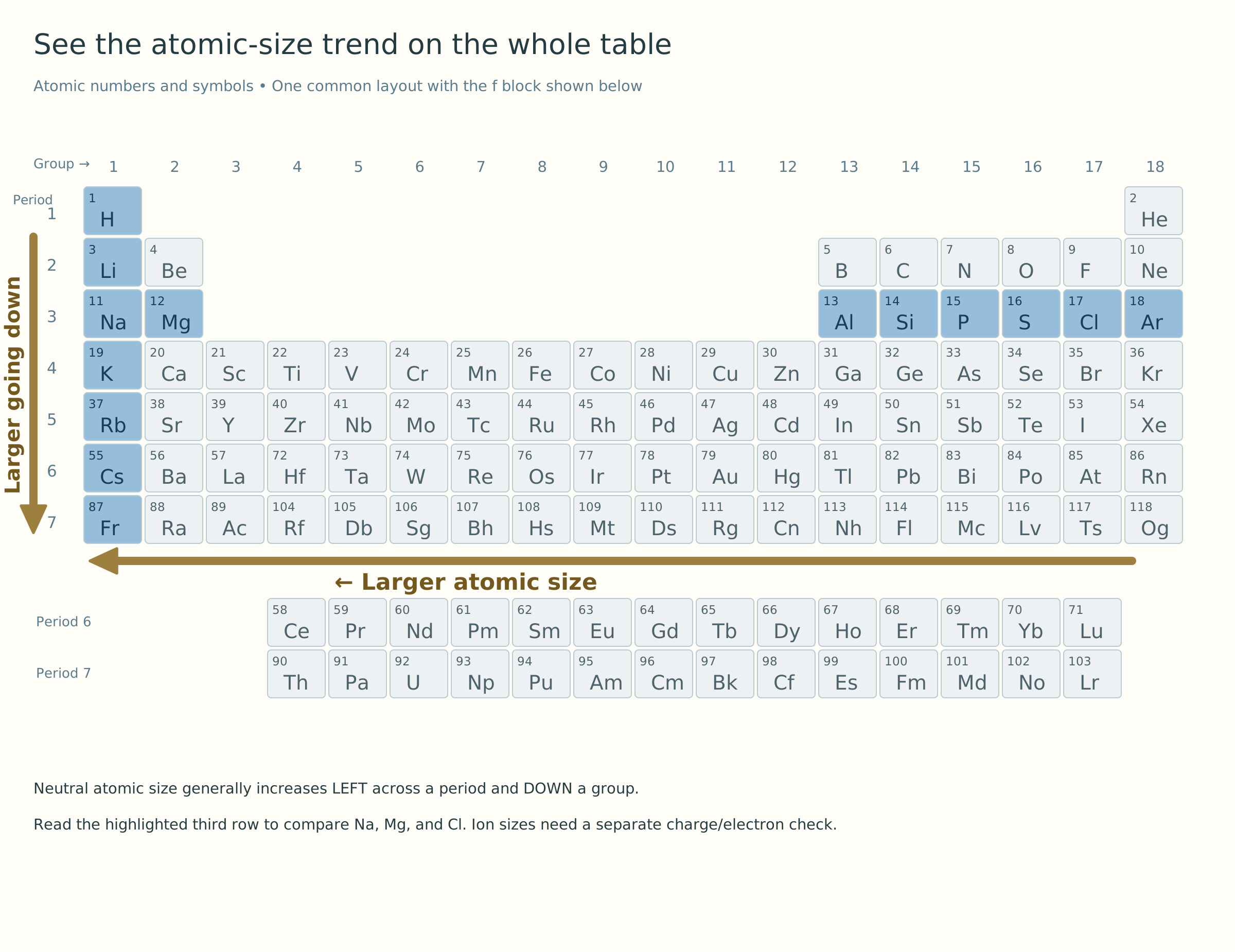
Size generally grows down a group and to the left across a period.
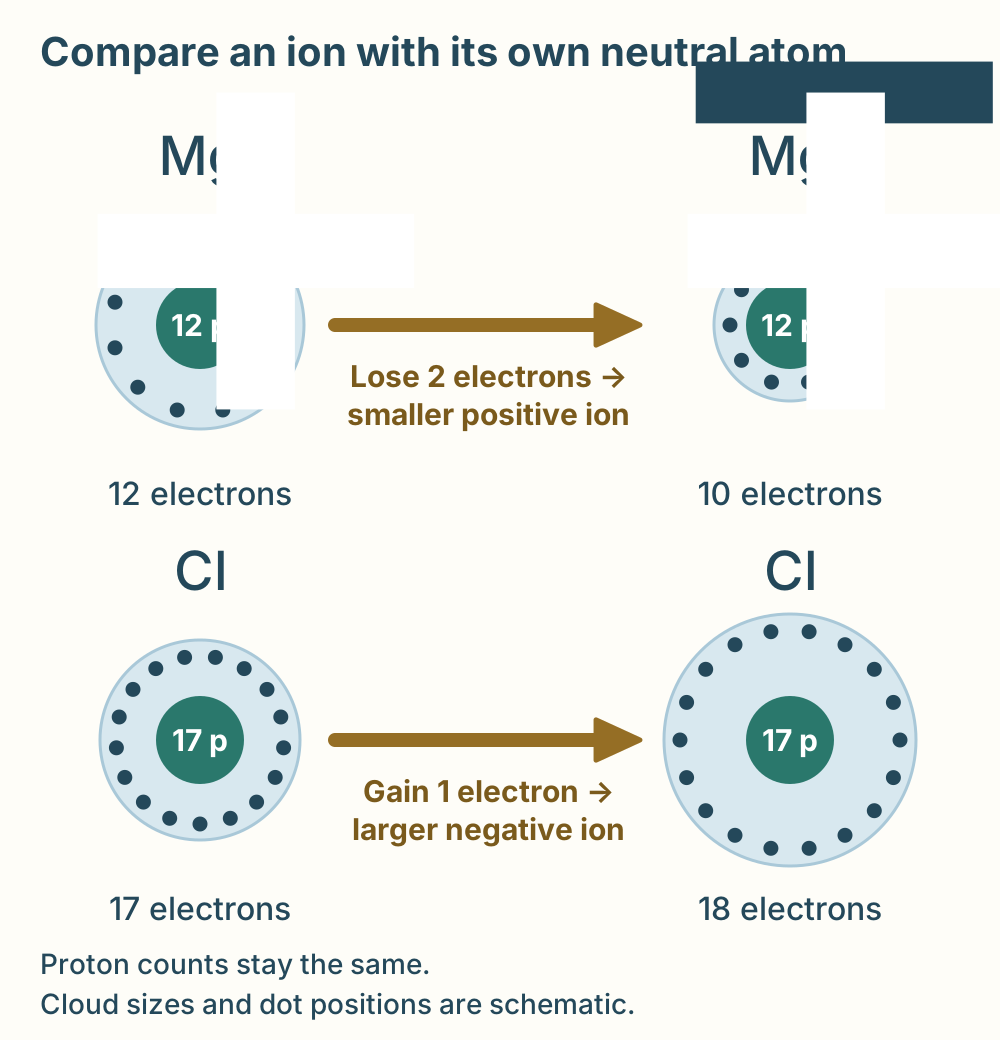
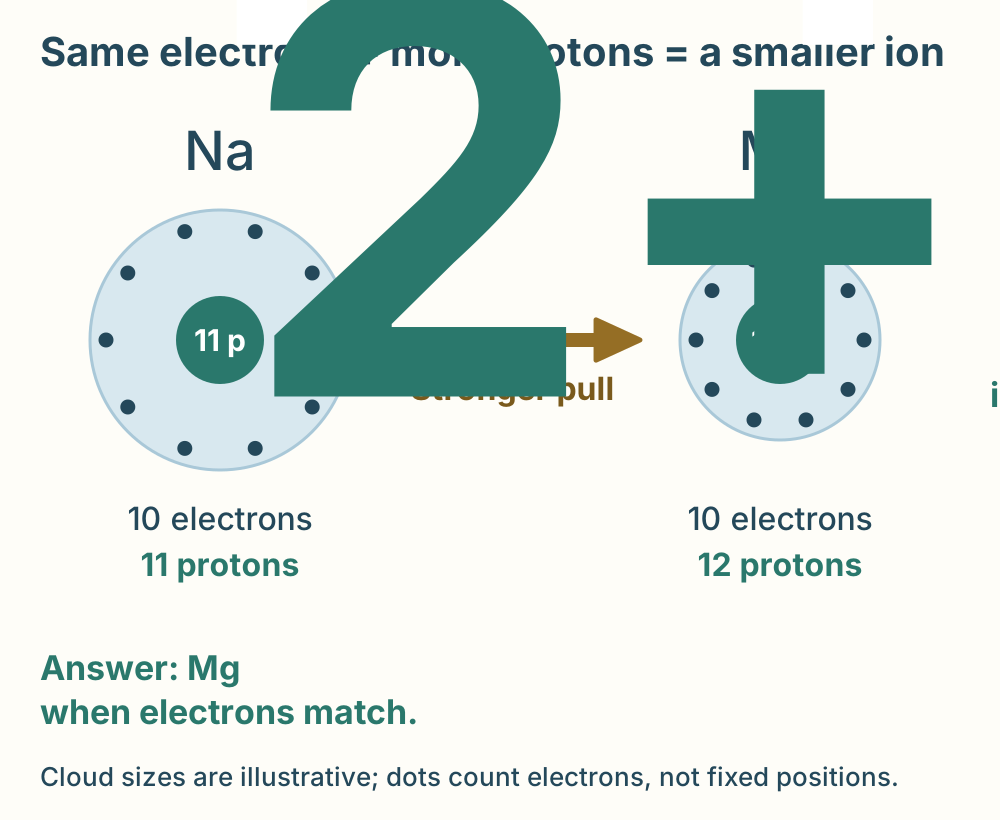
More protons pull the same electrons in tighter: a smaller ion.
| Change | Example | Protons | Size |
|---|---|---|---|
| Loses electrons (cation) | Mg → Mg2+ | Unchanged, 12 | Smaller |
| Gains electrons (anion) | Cl → Cl− | Unchanged, 17 | Larger |
- Decide: neutral atom or ion?
- Neutral atoms: same period or same group? Apply the size or electronegativity trend.
- Ions with equal electrons: the one with more protons is smaller.
On the periodic table: Size: read position. Larger down a group and to the left across a period.
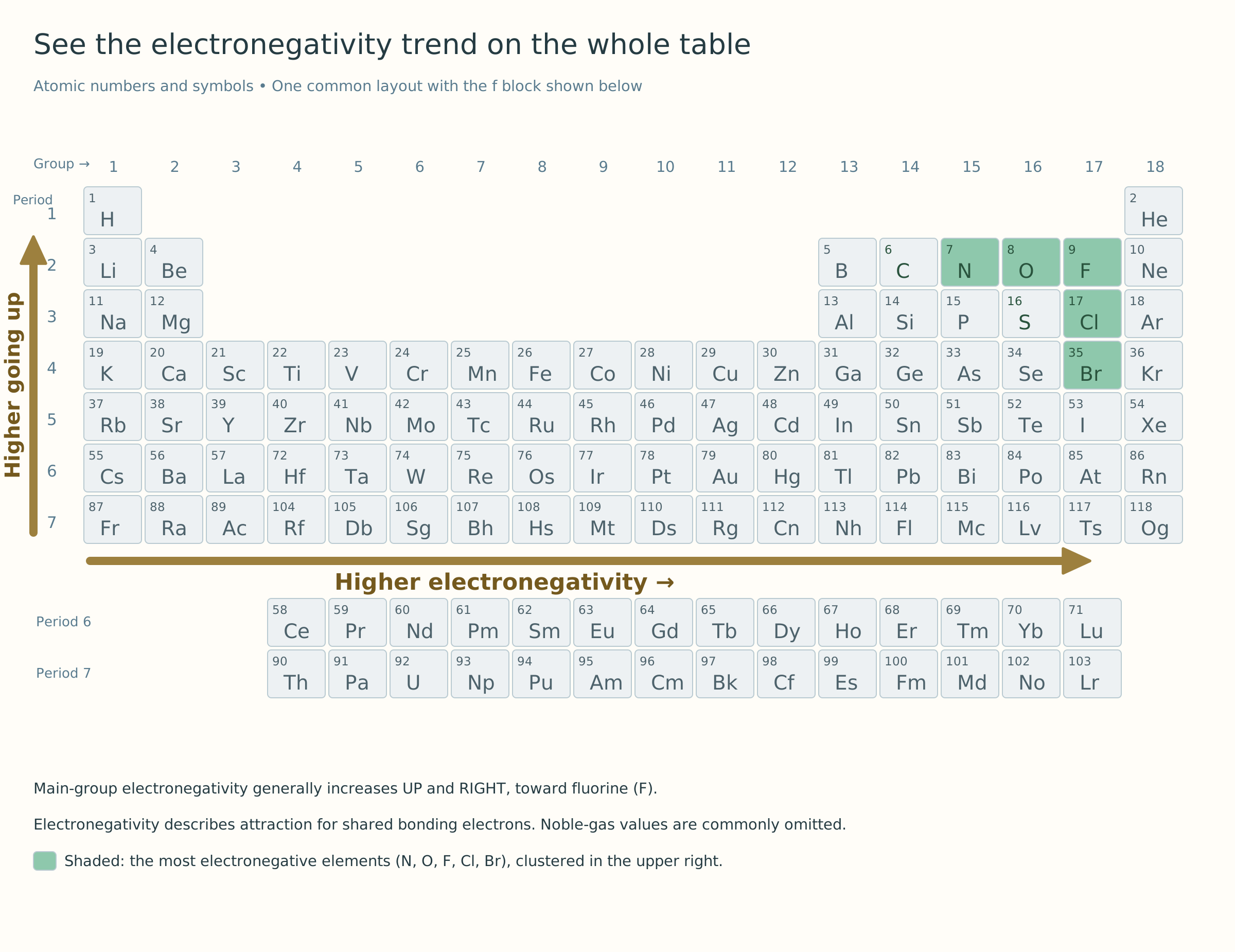
On the periodic table: Electronegativity: higher up and to the right, toward fluorine (F).
On the periodic table: Group number gives the main-group ion: Group 1 forms 1+ (Na+), Group 2 forms 2+ (Mg2+).
On the periodic table: The atomic number gives the proton count: Na 11, Mg 12.
Na+ and Mg2+ both have 10 electrons. Which ion is smaller?
- 1Check the common feature
Equal electron counts let us compare nuclear pull. On the periodic table: Na is Group 1, so it forms Na+; Mg is Group 2, so it forms Mg2+. Each loses its valence electrons.
Na+: 11 − 1 = 10 electrons Mg2+: 12 − 2 = 10 electrons - 2Compare the protons
On the periodic table: the atomic numbers are 11 and 12.
Ion Atomic number = protons Electrons Atomic mass (u) Position Na+ 11 10 22.99 Group 1 · Period 3 Mg2+ 12 10 24.31 Group 2 · Period 3 - 3Choose the stronger pull
One more proton attracts the same 10 electrons. More protons generally pull the cloud in tighter.
Na+11 protons pull on 10 electronsMg2+12 protons pull on 10 electrons: smaller - ✓Answer
Mg2+ is smaller. Decide with proton attraction, not the charge label alone.
3.5 Periodic patterns: shielding, electron affinity, and successive ionization
Why do atoms shrink across a row and hold their electrons more tightly? The answer is nuclear pull and shielding. This lesson uses those ideas to explain ionization energy, electron affinity and the big jump that reveals valence electrons.
- Electron configurations and valence electrons (3.2).
- Atomic size trends (3.4).
Need a refresher? Open the table of contents and revisit that topic before starting.
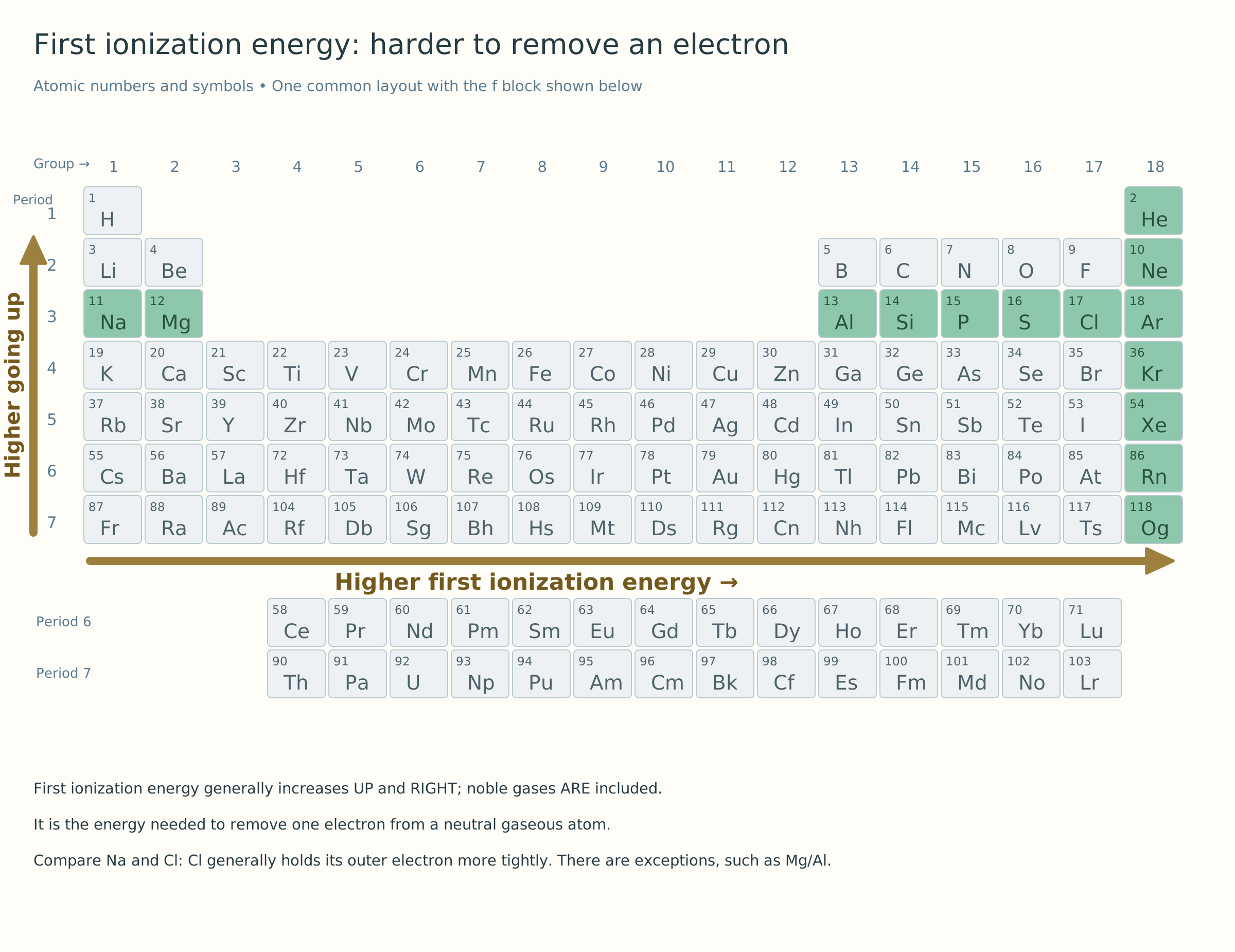
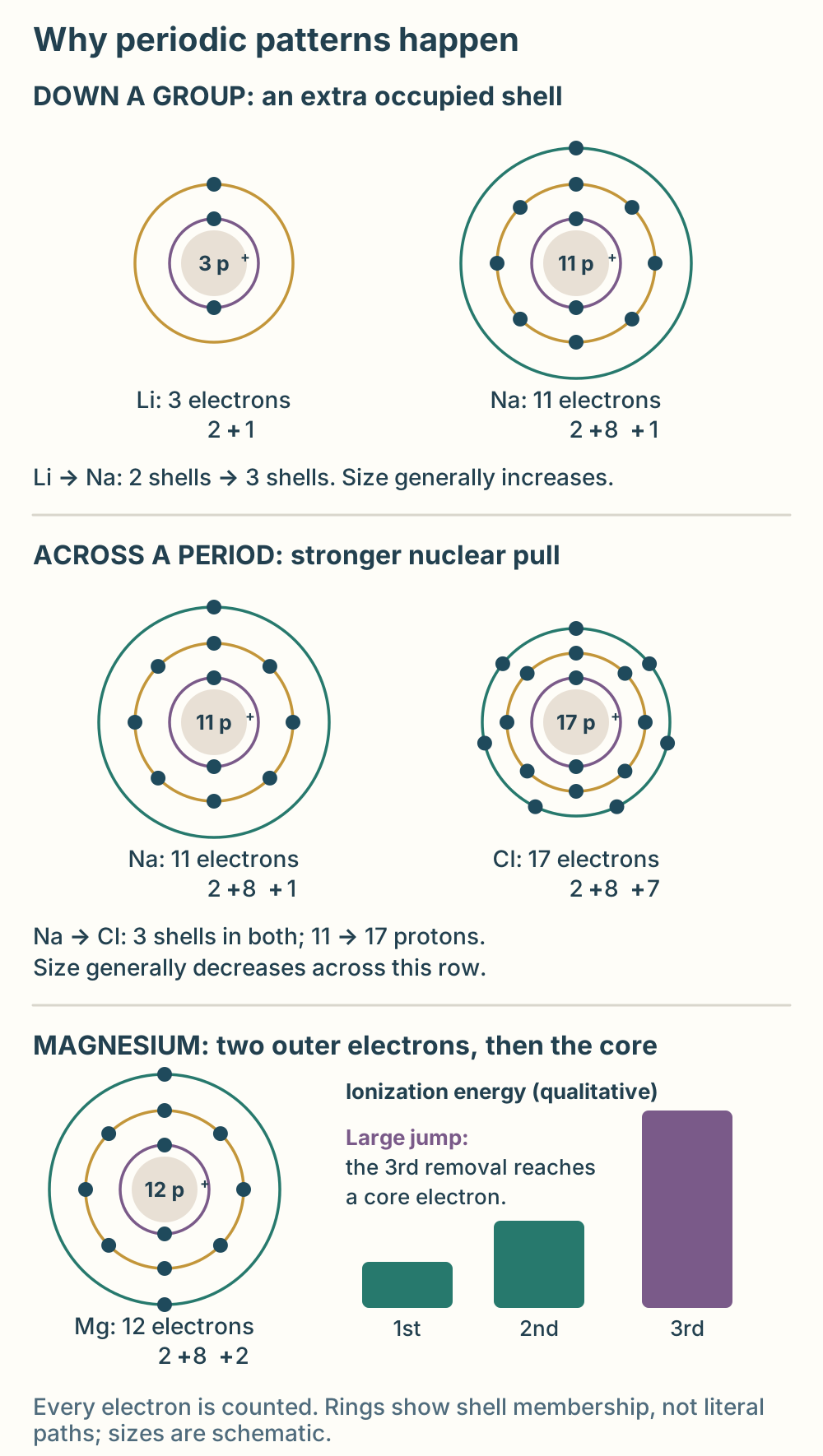
Inner electrons shield the outer ones from part of the nuclear pull.
The atom usually gets larger.
Attraction generally strengthens.
Radius shrinks; first ionization energy generally rises.
| Quantity | What happens | Pattern |
|---|---|---|
| First ionization energy | Remove one electron from a gaseous neutral atom | Generally up and right |
| Successive ionization energies | Remove more electrons from ever more positive ions | Each is larger than the last; a very large jump means a core electron |
| Electron affinity | Add an electron to a gaseous atom | Favorable attachment releases energy; sign depends on convention. Less regular than radius |
- Use the group as a first clue to the valence electrons.
- Compare each successive ionization energy with the one before it.
- Find the jump much larger than the others.
- Electrons removed before that jump are the valence electrons; the next is a core electron.
On the periodic table: Group 2 atoms, such as magnesium (Mg), have 2 valence electrons, so they often show the jump between the second and third ionizations.
On the periodic table: Beryllium (Be) and boron (B) sit side by side in Period 2, as do nitrogen (N) and oxygen (O): the two first-ionization exceptions.
On the periodic table: The atomic number gives the proton count (N 7, O 8, Mg 12). The decimal mass (14.01, 16.00, 24.31) is an average, not an isotope’s mass number; use supplied rounded masses when given.
Magnesium is in Group 2. Where should its large ionization-energy jump fall, and why?
- 1Read the group
On the periodic table: Mg is Group 2, Period 3, atomic number 12.
Symbol Atomic number Group Shells Mg 12 2 2 + 8 + 2 - 2Count valence electrons
The outer shell holds 2 electrons; the 10 inside are core electrons.
Mg: [Ne] 3s2 → 12 − 10 = 2 valence electrons - 3Predict the jump
Removing a third electron would reach the core: closer to the nucleus and less shielded, from an already positive ion.
Ionization Electron removed Expected size 1st 3s (valence) Small 2nd 3s (valence) Somewhat larger 3rd 2p (core) Very large jump - 4Check against data
The group is a starting clue, not a substitute for supplied data. Measured values show the jump.
Magnesium’s successive ionization energies 1451738 ≈ 2.0 77331451 ≈ 5.3 - ✓Answer
The jump falls between the 2nd and 3rd ionizations: Mg has 2 valence electrons, and the third electron comes from the core.
Section practice · 10 questions · tap to open
What this set is for: practicing the method from this section while it’s fresh. Every problem uses only what this section has taught.
Practice 1
An atom has successive ionization energies 590, 1145, and 4912 kJ/mol. How many valence electrons does the large jump suggest?
Give me a hint
Find the unusually large increase, not the largest absolute value alone.
Check the answer
Answer: 2
Explain the worked problem to me
What you know: Successive ionization energies: 590, 1145, and 4912 kJ/mol. What you want: The number of valence electrons.
- Compare each step, not the raw numbers. 590 → 1145 is about 1.9 times larger.
- 1145 → 4912 is about 4.3 times larger. That is the unusually large jump.
- The jump comes right before the third electron. That third electron must be a core electron, much closer to the nucleus.
- So the first two removed were valence electrons: 2.
Check: These are the measured values for calcium (Ca), a Group 2 atom, which shows exactly this pattern: a big jump between the second and third ionizations.
Watch out: Each ionization energy is always higher than the last, so a rise alone means nothing. Look for the rise that is much bigger than the others.
That’s right: 2
Practice 2
An atom has successive ionization energies 550, 1064, and 4138 kJ/mol. How many valence electrons does the large jump suggest?
Give me a hint
Find the unusually large increase, not the largest absolute value alone.
Check the answer
Answer: 2
Explain the worked problem to me
What you know: Successive ionization energies: 550, 1064, and 4138 kJ/mol. What you want: The number of valence electrons.
- Compare each step, not the raw numbers. 550 → 1064 is about 1.9 times larger.
- 1064 → 4138 is about 3.9 times larger. That is the unusually large jump.
- The jump comes right before the third electron. That third electron must be a core electron, much closer to the nucleus.
- So the first two removed were valence electrons: 2.
Check: These are the measured values for strontium (Sr), a Group 2 atom, which shows exactly this pattern: a big jump between the second and third ionizations.
Watch out: Each ionization energy is always higher than the last, so a rise alone means nothing. Look for the rise that is much bigger than the others.
That’s right: 2
Practice 3
An atom has successive ionization energies 503, 965, and 3458 kJ/mol. How many valence electrons does the large jump suggest?
Give me a hint
Find the unusually large increase, not the largest absolute value alone.
Check the answer
Answer: 2
Explain the worked problem to me
What you know: Successive ionization energies: 503, 965, and 3458 kJ/mol. What you want: The number of valence electrons.
- Compare each step, not the raw numbers. 503 → 965 is about 1.9 times larger.
- 965 → 3458 is about 3.6 times larger. That is the unusually large jump.
- The jump comes right before the third electron. That third electron must be a core electron, much closer to the nucleus.
- So the first two removed were valence electrons: 2.
Check: These are the measured values for barium (Ba), a Group 2 atom, which shows exactly this pattern: a big jump between the second and third ionizations.
Watch out: Each ionization energy is always higher than the last, so a rise alone means nothing. Look for the rise that is much bigger than the others.
That’s right: 2
Practice 4
An atom has successive ionization energies 900, 1757, and 14,849 kJ/mol. How many valence electrons does the large jump suggest?
Give me a hint
Find the unusually large increase, not the largest absolute value alone.
Check the answer
Answer: 2
Explain the worked problem to me
What you know: Successive ionization energies: 900, 1757, and 14,849 kJ/mol. What you want: The number of valence electrons.
- Compare each step, not the raw numbers. 900 → 1757 is about 2.0 times larger.
- 1757 → 14,849 is about 8.5 times larger. That is the unusually large jump.
- The jump comes right before the third electron. That third electron must be a core electron, much closer to the nucleus.
- So the first two removed were valence electrons: 2.
Check: These are the measured values for beryllium (Be), a Group 2 atom, which shows exactly this pattern: a big jump between the second and third ionizations.
Watch out: Each ionization energy is always higher than the last, so a rise alone means nothing. Look for the rise that is much bigger than the others.
That’s right: 2
Practice 5
An atom has successive ionization energies 738, 1451, and 7733 kJ/mol. How many valence electrons does the large jump suggest?
Give me a hint
Find the unusually large increase, not the largest absolute value alone.
Check the answer
Answer: 2
Explain the worked problem to me
What you know: Successive ionization energies: 738, 1451, and 7733 kJ/mol. What you want: The number of valence electrons.
- Compare each step, not the raw numbers. 738 → 1451 is about 2.0 times larger.
- 1451 → 7733 is about 5.3 times larger. That is the unusually large jump.
- The jump comes right before the third electron. That third electron must be a core electron, much closer to the nucleus.
- So the first two removed were valence electrons: 2.
Check: These are the measured values for magnesium (Mg), a Group 2 atom, which shows exactly this pattern: a big jump between the second and third ionizations.
Watch out: Each ionization energy is always higher than the last, so a rise alone means nothing. Look for the rise that is much bigger than the others.
That’s right: 2
Practice 6
Which neutral atom is generally larger, Na or K?
Give me a hint
On the periodic table: Sodium (Na) and potassium (K) are both in Group 1. K is one row lower, in Period 4.
What does moving down a group add to an atom?
Check the answer
Answer: K
Explain the worked problem to me
What you know: Na and K are neutral atoms in the same group. What you want: Which is generally larger.
- Same group, so use the down-a-group trend.
- Going down a group adds an occupied shell. The outer electrons sit farther from the nucleus, and inner electrons shield them.
- K is one row below Na, so K is larger.
Why it matters: Neutral atomic size grows down and to the left. K is lower, so it should be bigger.
Watch out: K has more protons, but more protons does not make it smaller here. The extra shell wins down a group.
On the periodic table: Sodium (Na) is in Period 3 and potassium (K) is in Period 4, both in Group 1, so K has one more occupied shell.
That’s right: K
YOUR PERIODIC-TABLE REFERENCE
Atomic number identifies proton count. The decimal mass is an average, not an isotope’s mass number. Use supplied rounded masses when a problem gives them.
Practice 7
Which is generally smaller, Na or Cl?
Give me a hint
On the periodic table: Sodium (Na, Group 1) and chlorine (Cl, Group 17) are both in Period 3. Cl is farther right.
Across a period, protons are added but the outer shell stays the same. How does that change the pull on the outer electrons?
Check the answer
Answer: Cl
Explain the worked problem to me
What you know: Na and Cl are neutral atoms in the same period. What you want: Which is generally smaller.
- Same period, so use the across-a-row trend.
- Across a period, protons are added while electrons go into the same main shell. Shielding barely changes.
- The stronger pull draws the electrons in. Cl is farther right, so Cl is smaller.
Why it matters: Size grows down and to the left; Na is at the left edge, so it should be the larger one.
Watch out: More electrons does not mean bigger across a row. Cl has more electrons but is smaller.
On the periodic table: Sodium (Na) and chlorine (Cl) are both in Period 3, and Cl is farther right, so Cl is generally smaller.
That’s right: Cl
YOUR PERIODIC-TABLE REFERENCE
Atomic number identifies proton count. The decimal mass is an average, not an isotope’s mass number. Use supplied rounded masses when a problem gives them.
Practice 8
Why can removing a core electron require much more energy?
Give me a hint
Core electrons sit closer to the nucleus and are less shielded than valence electrons.
Check the answer
Answer: It is more tightly bound
Explain the worked problem to me
What you know: Core electrons are the inner electrons, below the valence shell. What you want: Why removing one takes much more energy.
- Core electrons sit in a lower shell, closer to the nucleus.
- They are shielded by fewer electrons, so they feel more of the nuclear pull.
- By then the ion is already positive, which pulls even harder. In short: It is more tightly bound.
Why it matters: This is why ionization-energy data show a huge jump right after the last valence electron is removed.
That’s right: It is more tightly bound
Practice 9
Is electron affinity the same as ionization energy?
Give me a hint
Compare what each one measures: adding an electron or removing one.
Check the answer
Answer: No
Explain the worked problem to me
What you know: Two quantities: electron affinity and ionization energy. What you want: Whether they are the same.
- Ionization energy is the energy needed to remove an electron from a gaseous atom.
- Electron affinity concerns adding an electron to a gaseous atom.
- Removing and adding are different processes, so the answer is No.
Why it matters: The energy changes differ too. Removing an electron always takes energy in, while adding an electron to many atoms, such as Cl, releases energy.
Watch out: The two trends look similar on the table, but that does not make them the same thing.
That’s right: No
Practice 10
Is first ionization energy always increasing across a row?
Give me a hint
On the periodic table: Look across Period 2: beryllium (Be) to boron (B), and nitrogen (N) to oxygen (O).
The trend is general. Check the pairs Be → B and N → O.
Check the answer
Answer: No
Explain the worked problem to me
What you know: First ionization energy generally increases across a row. What you want: Whether it always does.
- "Generally" is the clue: trends are patterns, not exception-free laws.
- Period 2 has two known exceptions: B is lower than Be, and O is lower than N.
- These come from subshell energy (B's electron is in 2p) and paired-electron repulsion (O's first paired 2p electron). So the answer is No.
Why it matters: One exception is enough to make "always" false.
On the periodic table: Beryllium (Be) and boron (B) sit side by side in Period 2, as do nitrogen (N) and oxygen (O). Each pair is one step to the right across the same row.
That’s right: No
YOUR PERIODIC-TABLE REFERENCE
Atomic number identifies proton count. The decimal mass is an average, not an isotope’s mass number. Use supplied rounded masses when a problem gives them.
Mixed chapter review
Answer in your notebook before revealing help. Keep your first attempt separate from an answer corrected with help.
Mixed chapter review · 14 questions · tap to open
What this set is for: problems from every section of the chapter, mixed together and not labeled, the way a test asks them. Your job is to pick the right method yourself. Do this before the skill check.
Practice 1
An f subshell contains 7 orbitals. What is its maximum electron count?
Give me a hint
The question asks subshell capacity.
Check the answer
Answer: 14
Explain the worked problem to me
What you know: An f subshell has 7 orbitals. Each orbital holds at most 2 electrons. What you want: The maximum electron count.
- Count the orbitals given: 7.
- Multiply by two electrons per orbital: 7 orbitals × 2 electrons/orbital = 14.
Check: The pattern fits s (1 × 2 = 2), p (3 × 2 = 6), d (5 × 2 = 10), f (7 × 2 = 14).
Watch out: Don't stop at 7. That is the orbital count, not the electron count.
Your route: Count the supplied orbitals → Multiply by two.
That’s right: 14
Practice 2
Neutral fluorine has 9 electrons. Write its ground-state electron configuration.
Give me a hint
9F19.00On the periodic table: Fluorine (F) has atomic number 9, the whole number in its box.
Neutral atom and electron count are specified.
Check the answer
Answer: 1s2 2s2 2p5
Explain the worked problem to me
What you know: Neutral F has 9 electrons. What you want: The ground-state configuration.
- Neutral means electrons = protons = 9.
- Fill in energy order: 1s2 uses 2, 2s2 uses 2 more (4 used, 5 left).
- Put the last 5 in 2p: 1s2 2s2 2p5.
Check: Add the superscripts: 2 + 2 + 5 = 9. And 5 is under the p maximum of 6.
Watch out: Don't skip 2s or fill 2p before it. Also 2p5 is right; 2p6 would be the F− ion.
Your route: Count electrons → Fill in energy order → Check total.
9F19.00On the periodic table: Fluorine (F) has atomic number 9, the whole number in its box, so neutral F has 9 electrons. It sits in Period 2, in the fifth column of the p block, so its configuration ends in 2p5.
That’s right: 1s2 2s2 2p5
Practice 3
For a main-group atom written [Ne] 3s2 3p6, how many electrons are in the valence shell?
Give me a hint
Valence electrons are requested.
Check the answer
Answer: 8
Explain the worked problem to me
What you know: The configuration [Ne] 3s2 3p6. What you want: Electrons in the valence (outermost) shell.
- The highest shell number shown is 3, so shell 3 is the valence shell.
- [Ne] stands for the 10 core electrons in shells 1 and 2. They are not valence.
- Add the shell-3 electrons: 3s2 + 3p6 = 2 + 6 = 8.
Check: Total electrons = 10 + 8 = 18, which is argon, a noble gas with a full outer shell of 8.
Watch out: Count only the 6 in 3p and you miss the 2 in 3s. Both are in shell 3.
Your route: Identify the highest occupied shell → Add s and p electrons.
On the periodic table: [Ne] 3s2 3p6 is argon (Ar), atomic number 18, the noble gas in Group 18 at the end of Period 3. Group 18 atoms other than helium have 8 valence electrons.
That’s right: 8
Practice 4
For principal quantum number n = 5, which of these l values is permitted: 4, 5, or 6?
Give me a hint
Principal and subshell quantum labels appear.
Check the answer
Answer: 4
Explain the worked problem to me
What you know: n = 5. What you want: Which l value is allowed.
- The rule is 0 ≤ l ≤ n − 1.
- For n = 5: n − 1 = 5 − 1 = 4, so l can be 0, 1, 2, 3, or 4.
- Of the listed values, 4 falls in that range.
Check: l = 5 would equal n, which is never allowed.
Watch out: l stops at n − 1, not at n.
Your route: Read n → Require 0 ≤ l ≤ n − 1.
That’s right: 4
Practice 5
An orbital has l = 4. Which of these ml values is outside its allowed range: −4, 0, +3, or 5?
Give me a hint
An orbital quantum-number range is requested.
Check the answer
Answer: 5
Explain the worked problem to me
What you know: l = 4. What you want: Which listed ml value is not allowed.
- The rule is −l ≤ ml ≤ +l.
- For l = 4, ml can be −4, −3, −2, −1, 0, +1, +2, +3, +4.
- 5 is bigger than +4, so it is outside the range.
Check: Count the allowed values: 2l + 1 = 9, one per orbital in the subshell.
Watch out: Negative values from −1 to −4 are allowed. Don't reject an ml just because it is negative.
Your route: Read l → Check −l ≤ ml ≤ +l.
That’s right: 5
Practice 6
Compare neutral potassium and bromine, both in period 4. Which generally has the larger atomic radius?
Give me a hint
On the periodic table: Potassium (K) is in Group 1 at the far left of Period 4. Bromine (Br) is in Group 17, near the right end of Period 4.
The comparison is between neutral atoms in one period.
Check the answer
Answer: potassium
Explain the worked problem to me
What you know: K and Br are neutral atoms in Period 4. What you want: Which is generally larger.
- Same period, so use the across-a-row trend.
- Moving right, protons increase while electrons go into the same main shell, so the pull strengthens and size shrinks.
- K is at the far left; Br is near the right. So potassium is larger.
Why it matters: Size grows down and to the left. Both are in row 4, so the one farther left wins.
Watch out: Br has more electrons, but more electrons in the same shell does not make it bigger.
Your route: Same period → Size generally decreases to the right.
On the periodic table: Potassium (K, Group 1) and bromine (Br, Group 17) are both in Period 4. K is farther left, so it is generally larger.
That’s right: potassium
YOUR PERIODIC-TABLE REFERENCE
Atomic number identifies proton count. The decimal mass is an average, not an isotope’s mass number. Use supplied rounded masses when a problem gives them.
Practice 7
Within one periodic-table group, compare neutral magnesium and barium. Which generally has a larger radius?
Give me a hint
On the periodic table: Magnesium (Mg) and barium (Ba) are both in Group 2. Mg is in Period 3 and Ba is in Period 6.
The comparison is down a group.
Check the answer
Answer: barium
Explain the worked problem to me
What you know: Mg and Ba are neutral atoms in Group 2. What you want: Which is generally larger.
- Same group, so use the down-a-group trend.
- Mg is in Period 3 and Ba is in Period 6, so Ba has three more occupied shells.
- Its outer electrons are much farther from the nucleus, so barium is larger.
Why it matters: Size grows down and to the left. Ba is lower, so it should be bigger.
Watch out: Ba has many more protons, but down a group the extra shells win.
Your route: Same group → More shells down the group.
On the periodic table: Magnesium (Mg) is in Period 3 and barium (Ba) is in Period 6 of Group 2, so Ba has more occupied shells.
That’s right: barium
YOUR PERIODIC-TABLE REFERENCE
Atomic number identifies proton count. The decimal mass is an average, not an isotope’s mass number. Use supplied rounded masses when a problem gives them.
Practice 8
Ca2+ and K+ each contain 18 electrons. Which ion is generally smaller?
Give me a hint
On the periodic table: Calcium (Ca) has atomic number 20 and potassium (K) has atomic number 19, the whole numbers in their boxes.
The ions are isoelectronic.
Check the answer
Answer: Ca2+
Explain the worked problem to me
What you know: Ca2+ and K+ both have 18 electrons. What you want: Which ion is smaller.
- Equal electron counts (isoelectronic), so compare protons.
- Ca has 20 protons. K has 19 protons.
- 20 protons pull the same 18 electrons in more tightly, so Ca2+ is smaller.
Why it matters: Electron counts: Ca 20 − 2 = 18; K 19 − 1 = 18. They match, so the proton comparison is fair.
Watch out: Don't use the atom trend here. Neutral Ca is smaller than neutral K too, but for ions the proton count is the reason.
Your route: Equal electrons → Compare proton counts.
On the periodic table: Calcium (Ca) has atomic number 20 and potassium (K) has atomic number 19, so Ca2+ has 20 protons and K+ has 19.
That’s right: Ca2+
YOUR PERIODIC-TABLE REFERENCE
Atomic number identifies proton count. The decimal mass is an average, not an isotope’s mass number. Use supplied rounded masses when a problem gives them.
Practice 9
How many electrons can one p subshell hold at most?
Give me a hint
The question asks subshell capacity.
Check the answer
Answer: 6
Explain the worked problem to me
What you know: A p subshell has 3 orbitals. Each holds at most 2 electrons. What you want: The maximum electrons in one p subshell.
- Identify the subshell: p.
- A p subshell has three orbitals (px, py, pz).
- 3 orbitals × 2 electrons/orbital = 6.
Check: Each row of the p block on the periodic table has six places, one per p electron.
Watch out: Answering 3 gives the orbital count, not the electron count.
Your route: Identify p → Three orbitals → Two electrons each.
That’s right: 6
Practice 10
Write the ground-state electron configuration of a neutral magnesium atom with 12 electrons.
Give me a hint
12Mg24.31On the periodic table: Magnesium (Mg) has atomic number 12, the whole number in its box.
Neutral atom and electron count are specified.
Check the answer
Answer: 1s2 2s2 2p6 3s2
Explain the worked problem to me
What you know: Neutral Mg has 12 electrons. What you want: The ground-state configuration.
- Neutral means 12 electrons.
- Fill in energy order: 1s2 (2), 2s2 (4 total), 2p6 (10 total). 12 − 10 = 2 left.
- The next subshell is 3s, which takes both: 1s2 2s2 2p6 3s2.
Check: 2 + 2 + 6 + 2 = 12. Mg is in Group 2, so 2 valence electrons in 3s fits.
Watch out: Don't put the last two in 3p. 3s fills before 3p.
Your route: Count electrons → Fill in energy order → Check total.
12Mg24.31On the periodic table: Magnesium (Mg) has atomic number 12, the whole number in its box. It sits in Period 3, in the second column of the s block, so its configuration ends in 3s2.
That’s right: 1s2 2s2 2p6 3s2
Practice 11
Which is more electronegative, N or P?
Give me a hint
Both are in Group 15. Which is higher in the column?
Check the answer
Answer: N
Explain the worked problem to me
What you know: N and P are both in Group 15. N is above P. What you want: Which is more electronegative.
- Electronegativity is how strongly an atom pulls on shared bonding electrons.
- It generally increases up a group and to the right, toward F.
- N is higher in the group, so N is more electronegative.
Why it matters: N's bonding electrons are in shell 2, closer to the nucleus than P's shell-3 electrons, so they are pulled harder.
That’s right: N
Practice 12
Write the electron configuration of O2−.
Give me a hint
Oxygen has 8 electrons; a 2− charge adds 2.
Check the answer
Answer: 1s2 2s2 2p6 ([Ne])
Explain the worked problem to me
What you know: O has 8 electrons as a neutral atom. The ion has a 2− charge. What you want: The configuration of O2−.
- A negative charge means extra electrons: 8 + 2 = 10 electrons.
- Fill in energy order: 1s2 (2), 2s2 (4), then 6 in 2p.
- Result: 1s2 2s2 2p6 ([Ne]).
Check: 2 + 2 + 6 = 10, the same as neon. O2− is isoelectronic with Ne.
Watch out: A 2− charge adds electrons; don't subtract them.
That’s right: 1s2 2s2 2p6 ([Ne])
Practice 13
Write the electron configuration of K+.
Give me a hint
Potassium has 19 electrons; a 1+ charge removes the 4s electron.
Check the answer
Answer: 1s2 2s2 2p6 3s2 3p6 ([Ar])
Explain the worked problem to me
What you know: K has 19 electrons as a neutral atom: [Ar] 4s1. The ion has a 1+ charge. What you want: The configuration of K+.
- A 1+ charge means one electron is removed: 19 − 1 = 18 electrons.
- Remove from the highest shell first. That is the single 4s electron.
- What remains is the argon core: 1s2 2s2 2p6 3s2 3p6 ([Ar]).
Check: 2 + 2 + 6 + 2 + 6 = 18 electrons, matching argon.
Watch out: Don't take the electron from 3p. The outermost shell (n = 4) loses electrons first.
That’s right: 1s2 2s2 2p6 3s2 3p6 ([Ar])
Practice 14
Write the noble-gas configuration of Fe3+.
Give me a hint
Fe is [Ar] 4s2 3d6. Remove 4s electrons first.
Check the answer
Answer: [Ar] 3d5
Explain the worked problem to me
What you know: Fe has 26 electrons: [Ar] 4s2 3d6. The ion has a 3+ charge. What you want: The noble-gas configuration of Fe3+.
- A 3+ charge removes 3 electrons: 26 − 3 = 23 electrons.
- Remove the 4s electrons first, since n = 4 is the highest shell: [Ar] 3d6 (that is Fe2+).
- Remove the third electron from 3d: [Ar] 3d5.
Check: 18 (argon core) + 5 = 23 electrons.
Watch out: Removing 3d electrons first gives [Ar] 4s2 3d3, which is wrong. 4s goes first.
That’s right: [Ar] 3d5
Skill check: the chapter’s key skills
Try each fresh question without the worked examples. Record your first answer and whether you used a hint. Explain the route as well as the answer.
Skill check · 7 questions · tap to open
What this set is for: one question on each key skill from this chapter. Try each on your own, without hints, then mark how it went in the tracker below. A miss tells you which section to review.
Skill 1: Distinguish shells, subshells, orbitals, and electrons; connect the periodic table to electron counts.
Neutral chlorine is in row 3 with atomic number 17. Name its highest occupied shell and total electrons. How many orbitals and electrons maximum are in a p subshell?
Give me a hint
On the periodic table: Chlorine (Cl) is in Period 3 and has atomic number 17, the whole number in its box.
Use the period for a neutral main-group atom’s highest occupied shell and atomic number for its electron count. A p subshell has three orbitals, each holding at most two electrons.
Check the answer
Highest occupied shell: n = 3. Neutral Cl: 17 electrons. A p subshell has 3 orbitals and holds at most 6 electrons.
On the periodic table: Chlorine (Cl) is in Period 3 and has atomic number 17, the whole number in its box.
Explain the worked problem to me
What you know: Neutral Cl is in Period 3 with atomic number 17. What you want: Its highest occupied shell, its electron count, and the p subshell's orbitals and capacity.
- The period number of a main-group atom gives its highest occupied shell: Period 3 → n = 3.
- Neutral means electrons = protons = atomic number: 17 electrons.
- A p subshell has three orientations, so 3 orbitals. At 2 electrons each, 3 × 2 = 6 electrons maximum.
Check: Cl is 1s2 2s2 2p6 3s2 3p5: the highest shell is 3, and 2 + 2 + 6 + 2 + 5 = 17.
Watch out: Keep the four levels straight: shell (n = 3), subshell (p), orbital (3 of them), electrons (up to 6).
On the periodic table: Chlorine (Cl) is in Period 3 and has atomic number 17, the whole number in its box.
That’s right: Highest occupied shell: n = 3. Neutral Cl: 17 electrons. A p subshell has 3 orbitals and holds at most 6 electrons.
YOUR PERIODIC-TABLE REFERENCE
Atomic number identifies proton count. The decimal mass is an average, not an isotope’s mass number. Use supplied rounded masses when a problem gives them.
Skill 2: Write full and noble-gas electron configurations for atoms and ions.
Write neutral neon’s configuration (10 electrons).
Give me a hint
10Ne20.18On the periodic table: Neon (Ne) has atomic number 10, the whole number in its box.
Use the electron count to fill subshells in energy order. Check capacities and add the superscripts.
Check the answer
1s2 2s2 2p6; total 10.
Explain the worked problem to me
What you know: Neutral Ne has 10 electrons. What you want: Its configuration.
- Neutral means 10 electrons.
- Fill in energy order: 1s2 (2 used), 2s2 (4 used), leaving 6.
- 2p holds up to 6, so it takes all of them: 1s2 2s2 2p6; total 10.
Check: 2 + 2 + 6 = 10. Ne is a noble gas, so ending with a completely full 2p makes sense.
Watch out: Don't write 2p8 or add a 3s. A p subshell holds only 6.
On the periodic table: Neon (Ne) has atomic number 10, so neutral Ne has 10 electrons. It is the noble gas at the end of Period 2, so its configuration ends with a full 2p6.
That’s right: 1s2 2s2 2p6; total 10.
Skill 3: Relate wavelength, frequency, and photon energy; identify absorption and emission.
Light of wavelength 500. nm strikes an atom, and an electron moves up to a higher energy level. Find the light’s frequency and the energy of one photon. Is the photon absorbed or emitted? Use c = 3.00 × 10⁸ m/s and h = 6.626 × 10⁻³⁴ J·s.
Give me a hint
Convert nm to m first. Then ν = c ÷ λ and E = hν. Moving up a level takes energy in.
Check the answer
ν = 6.00 × 10¹⁴ Hz; E = 3.98 × 10⁻¹⁹ J per photon. The electron absorbs the photon and moves up to a higher energy level.
Explain the worked problem to me
What you know: λ = 500. nm, c = 3.00 × 10⁸ m/s, h = 6.626 × 10⁻³⁴ J·s. The electron moves up a level. What you want: ν, E, and whether light is absorbed or emitted.
- Convert λ to meters: 500. nm × (10−9 m / 1 nm) = 5.00 × 10⁻⁷ m.
- ν = c ÷ λ = (3.00 × 10⁸ m/s) ÷ (5.00 × 10⁻⁷ m) = 6.00 × 10¹⁴ s−1 (Hz).
- E = hν = (6.626 × 10⁻³⁴ J·s) × (6.00 × 10¹⁴ s−1) = 3.9756 × 10⁻¹⁹ J, which rounds to 3.98 × 10⁻¹⁹ J.
- Moving up needs energy, so the photon is absorbed. Its energy must match the gap between the two levels. So: ν = 6.00 × 10¹⁴ Hz; E = 3.98 × 10⁻¹⁹ J per photon. The electron absorbs the photon and moves up to a higher energy level.
Check: J·s × s−1: the s cancels, leaving J. A tiny energy makes sense for one photon.
Watch out: Leaving λ in nm gives a frequency 109 times too small. Moving down a level is emission, the reverse.
That’s right: ν = 6.00 × 10¹⁴ Hz; E = 3.98 × 10⁻¹⁹ J per photon. The electron absorbs the photon and moves up to a higher energy level.
Skill 4: Check whether quantum-number values are allowed.
Can n = 2 have l = 2?
Give me a hint
For a given n, allowed l values run from 0 through n − 1. Compare the proposed l with that range.
Check the answer
No. l is 0 or 1 for n = 2.
Explain the worked problem to me
What you know: n = 2 and a proposed l = 2. What you want: Whether this pair is allowed.
- Check n: 2 is a positive whole number, so it is fine.
- Allowed l values run from 0 to n − 1. For n = 2: 0 to 2 − 1 = 1.
- So l can be 0 or 1. l = 2 is outside that range: No. l is 0 or 1 for n = 2.
Check: This matches the fact that shell 2 has only 2s (l = 0) and 2p (l = 1). There is no 2d.
Watch out: l can never equal n. It stops one below.
That’s right: No. l is 0 or 1 for n = 2.
Skill 5: Compare atom or ion sizes, and electronegativity, using position and electron counts.
Which is smaller: Na+ or Mg2+? Both have 10 electrons.
Give me a hint
On the periodic table: Sodium (Na) has atomic number 11 and magnesium (Mg) has atomic number 12, the whole numbers in their boxes.
The electron counts match, so compare protons. More protons attract those electrons more strongly, making the ion smaller.
Check the answer
Mg2+: 12 protons attract the same 10 electrons more strongly than 11 protons.
On the periodic table: Magnesium (Mg) has atomic number 12 and sodium (Na) has atomic number 11, the whole numbers in their boxes.
Explain the worked problem to me
What you know: Na+ and Mg2+ both have 10 electrons. What you want: Which ion is smaller.
- Equal electron counts, so compare proton counts.
- Na has 11 protons. Mg has 12 protons.
- 12 protons pull the same 10 electrons in more tightly, so Mg2+ is smaller.
Check: Electron counts: 11 − 1 = 10 and 12 − 2 = 10. They match, so the comparison is fair.
Watch out: Use the proton count, not just the bigger charge label, as the reason.
On the periodic table: Sodium (Na) has atomic number 11 and magnesium (Mg) has atomic number 12, so Na+ has 11 protons and Mg2+ has 12.
That’s right: Mg2+: 12 protons attract the same 10 electrons more strongly than 11 protons.
YOUR PERIODIC-TABLE REFERENCE
Atomic number identifies proton count. The decimal mass is an average, not an isotope’s mass number. Use supplied rounded masses when a problem gives them.
Skill 6: Explain trends using shells, shielding, and nuclear attraction; recognize a large ionization-energy jump.
Magnesium’s first three ionization energies are 738, 1451 and 7733 kJ/mol. How many valence electrons does Mg have, and why is the third value so much larger than the second?
Give me a hint
Divide each ionization energy by the one before it. The step that is several times larger marks where the core begins.
Check the answer
On the periodic table: Magnesium (Mg) is in Group 2, so it has 2 valence electrons.
Mg has 2 valence electrons. The third electron would come from the inner (core) shell, which is closer to the nucleus and less shielded.
Explain the worked problem to me
What you know: Mg’s first three ionization energies: 738, 1451 and 7733 kJ/mol. What you want: the number of valence electrons, and why the third value is so large.
- Compare each step with the one before: 1451 ÷ 738 ≈ 2.0, and 7733 ÷ 1451 ≈ 5.3.
- The big jump comes before the 3rd electron, so the first 2 electrons come from the valence shell (3s).
- The 3rd electron would come from shell 2, the core. It is closer to the nucleus and shielded by fewer inner electrons, so it is held much more tightly. So: Mg has 2 valence electrons. The third electron would come from the inner (core) shell, which is closer to the nucleus and less shielded.
Check: Mg is in Group 2, which also predicts 2 valence electrons. Mg2+ has the neon core, [Ne].
Watch out: Every ionization energy is bigger than the one before. Look for the step that is several times larger, not just larger.
On the periodic table: Magnesium (Mg) is in Group 2, so it has 2 valence electrons.
That’s right: Mg has 2 valence electrons. The third electron would come from the inner (core) shell, which is closer to the nucleus and less shielded.
YOUR PERIODIC-TABLE REFERENCE
Atomic number identifies proton count. The decimal mass is an average, not an isotope’s mass number. Use supplied rounded masses when a problem gives them.
Skill 7: Contrast the Bohr model with the current quantum model of the atom.
A student writes: “In a hydrogen atom, the electron travels in a fixed circular path at n = 2.” Which model is this? Name one idea the current quantum model keeps from it, one idea it replaces, and one reason the older model was replaced.
Give me a hint
A fixed circular path is an orbit, Bohr’s 1913 picture. Compare the word orbit with orbital, and ask which part of Bohr’s picture still labels shells today.
Check the answer
On the periodic table: Hydrogen (H) has atomic number 1, so a neutral hydrogen atom has just 1 electron. That one-electron case is the only one Bohr’s model handles well.
Bohr model. Kept: numbered energy levels (n = 1, 2, 3, …) and jumps between them that absorb or emit light. Replaced: fixed circular orbits become orbitals, regions where the electron is likely to be found. Reason: Bohr’s model fails for atoms with more than one electron.
Explain the worked problem to me
What you know: the statement describes hydrogen’s electron in a fixed circular path at n = 2. What you want: the model’s name, one idea kept, one idea replaced, and why it was replaced.
- Fixed circular paths with numbered energies are Bohr’s orbits, so this is the Bohr model.
- Kept: the numbered energy levels. Today’s shells are still labeled n = 1, 2, 3, …, and an electron still absorbs or emits a definite amount of energy as light when it changes level, which explains line spectra.
- Replaced: the fixed path. The quantum model uses orbitals, probability regions where the electron is likely to be found, not tracks it follows.
- Reason: Bohr’s model works for hydrogen but fails for atoms with more electrons, and electrons do not actually travel in fixed paths.
Check: A corrected statement reads: “Hydrogen’s electron is in shell n = 2, in an orbital where it is likely to be found.” It keeps n but drops the path.
Watch out: Orbit (Bohr: a path) and orbital (quantum: a probability region) look alike but mean different things. An orbital picture is not the electron’s track.
On the periodic table: Hydrogen (H) has atomic number 1, so a neutral hydrogen atom has just 1 electron. That one-electron case is the only one Bohr’s model handles well.
That’s right: Bohr model. Kept: numbered energy levels (n = 1, 2, 3, …) and jumps between them that absorb or emit light. Replaced: fixed circular orbits become orbitals, regions where the electron is likely to be found. Reason: Bohr’s model fails for atoms with more than one electron.
What to do next
Mark each skill: “I can do it independently,” “I needed help,” or “I need another explanation.” Revisit the section with the same goal for any skill needing help, then try a different question. A successful first attempt is evidence of progress; one answer alone does not establish lasting mastery.
Final coming up?
Take the 70-question practice final
Modeled on standardized first-term general chemistry finals: 70 questions, 110 minutes. Timed or untimed. Full feedback on every question, plus your score by topic. The first 20 are free; the full final is $7.99 for 2 weeks.
Original ChemGem questions.