ChemGem

How to Count Electrons in Shells, Subshells and Orbitals (Step-by-Step, with Practice)

Electrons are organized in layers: a shell holds subshells, a subshell holds orbitals, and each orbital holds at most two electrons. This lesson sorts out those four words and ties each one to the periodic table.

Spot it, solve it, practice it: 3 steps, 1 worked example, 10 practice problems. Free, no account.

The route · 3 steps

  1. Identify the subshell from its letter.
  2. Count its orbitals: s 1, p 3, d 5, f 7.
  3. Multiply by two electrons per orbital.
Spot it

How to recognize orbital questions

Look for words like orbital, subshell, shell, lobes, or spin arrows (↑↓), or a label like 3p5 to read apart.

Example wording, with the clue words marked:

A p drawing has two lobes. How many orbitals does that one drawing represent?

Not sure it’s this type? Compare the neighbors:

Step-by-step

Worked example: orbital

The idea

From Bohr’s orbits to today’s orbitals
Bohr model (1913)
Hydrogen’s electron moves only in certain circular orbits, n = 1, 2, 3, …, each with a fixed energy.
Absorbing exactly the right energy moves it up; dropping back gives off that energy as light.
This explains hydrogen’s line spectrum: only certain colors (3.2a calculates the energy).
Quantum model (today)
Keeps Bohr’s energy levels, n.
Replaces orbits with orbitals: regions where an electron is likely to be found.
Needed because Bohr fails for atoms with more electrons, and electrons do not travel fixed paths.
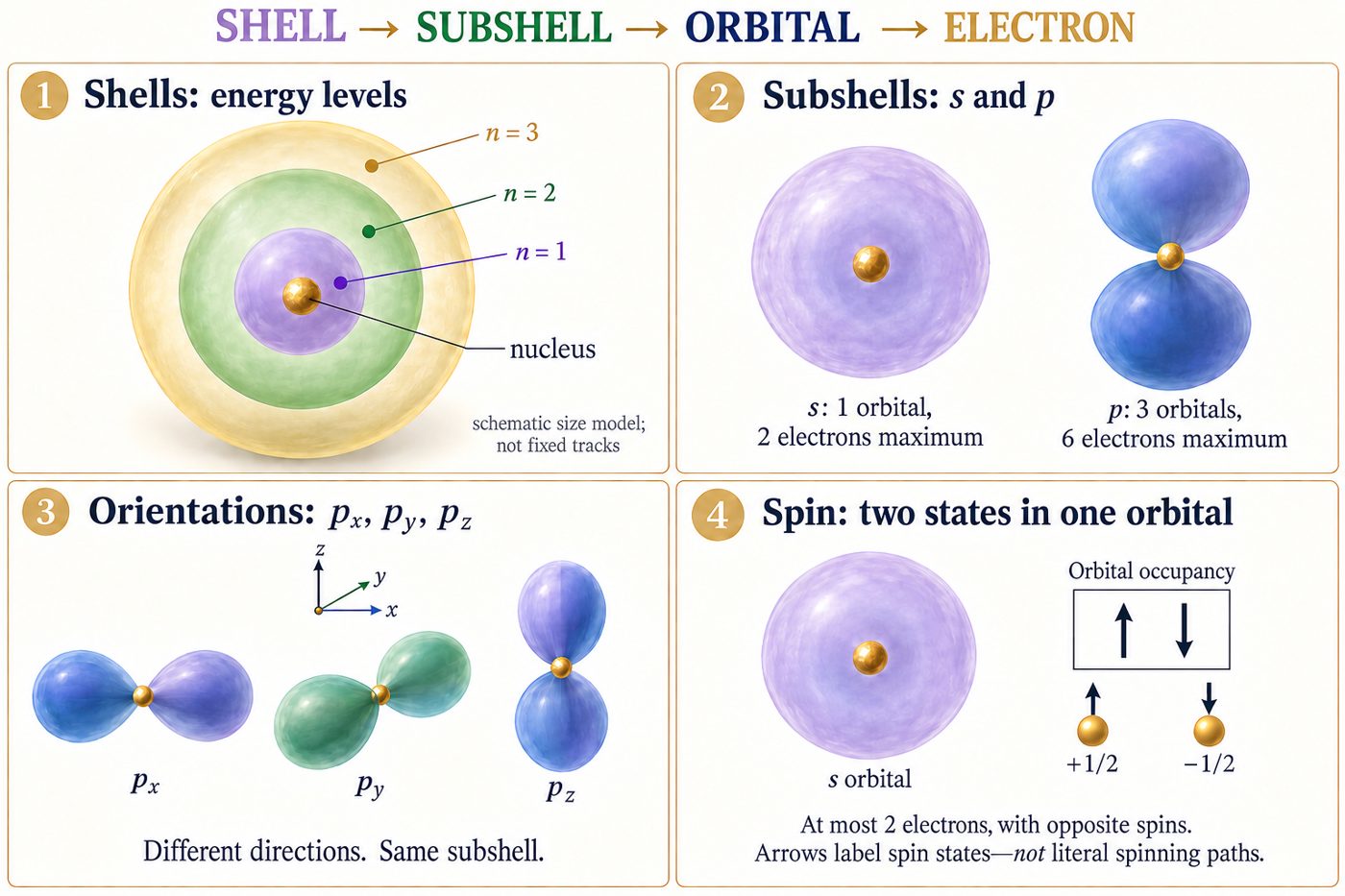
A coordinated four-panel model shows nested spherical shell regions, a spherical s orbital and two-lobed p orbital, the three perpendicular p orientations, and two opposite spin states in one orbital.
Shells group energy levels. Subshells group orbitals. Orbitals have shapes and orientations. Each holds at most two electrons, with opposite spins. These are probability models, not solid objects or tracks.
Four words, from biggest to smallest
LevelWhat it isHow it is labeledChlorine example
ShellA main energy leveln = 1, 2, 3, …Highest occupied shell: n = 3
SubshellA smaller division of a shellNumber = shell, letter = type3s and 3p, both in shell 3
OrbitalA probability region, not a paths: 1, p: 3, d: 5, f: 7 orbitals3p has 3 orbitals
ElectronA negative particle outside the nucleusSuperscript counts them3s2 3p5: 2 + 5 in shell 3
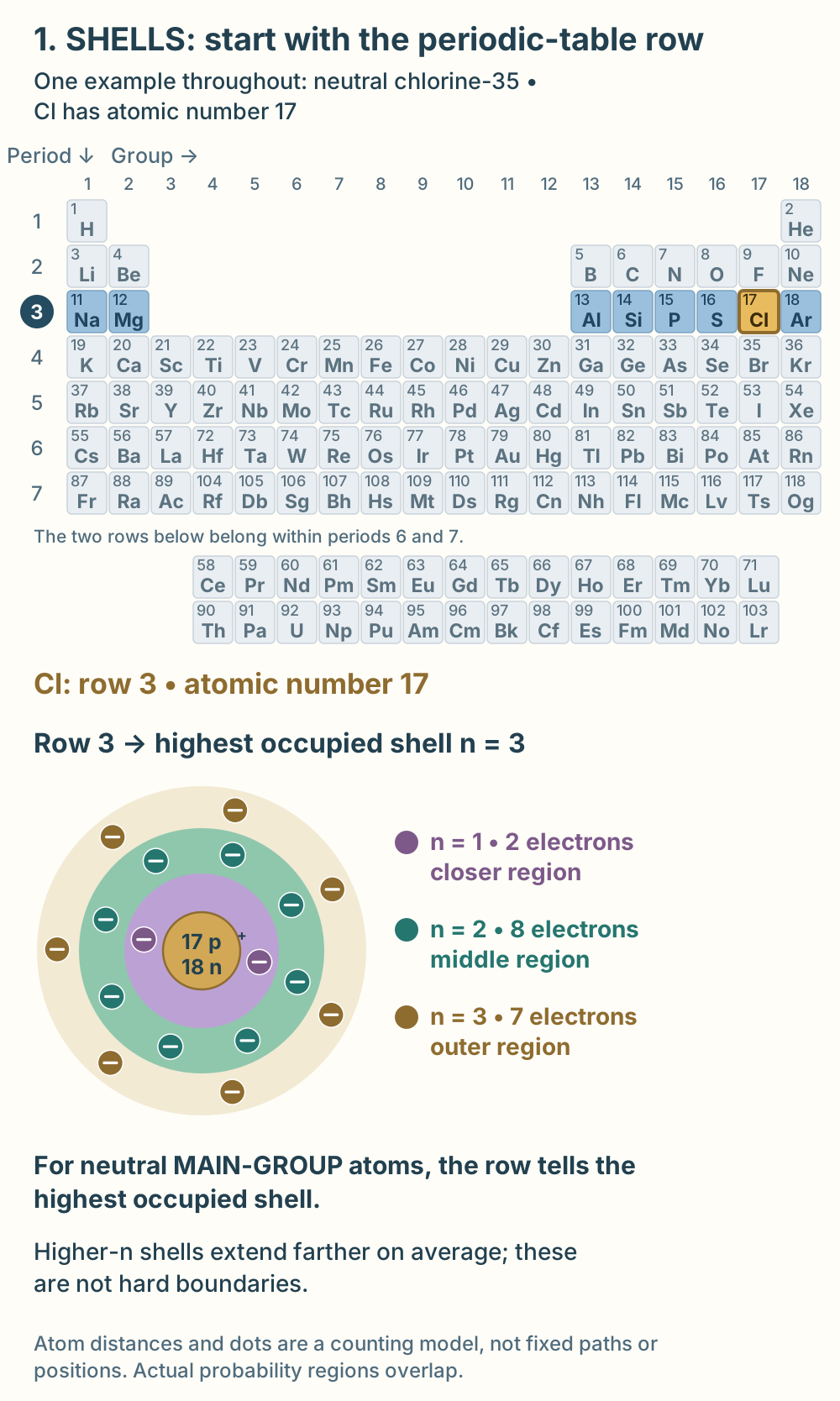
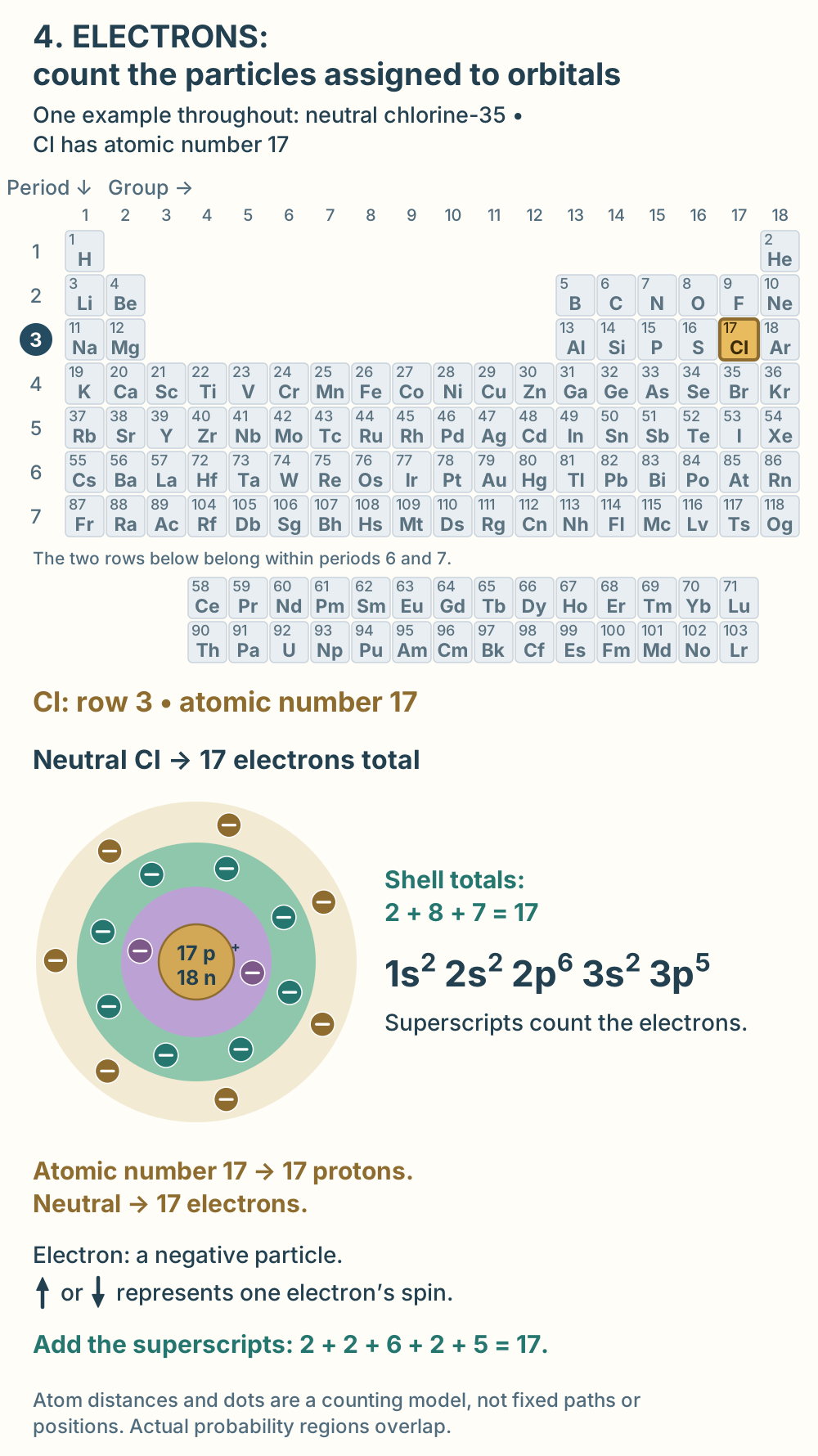
The periodic table highlights row 3 and chlorine. A neutral chlorine-35 atom has 17 protons and 18 neutrons in its nucleus, with 2, 8, and 7 electrons assigned to shells 1, 2, and 3.
Shells: chlorine-35 has 17 protons and 18 neutrons, with 2, 8 and 7 electrons in shells 1, 2 and 3. The drawing spreads the shells apart; real electron regions overlap.
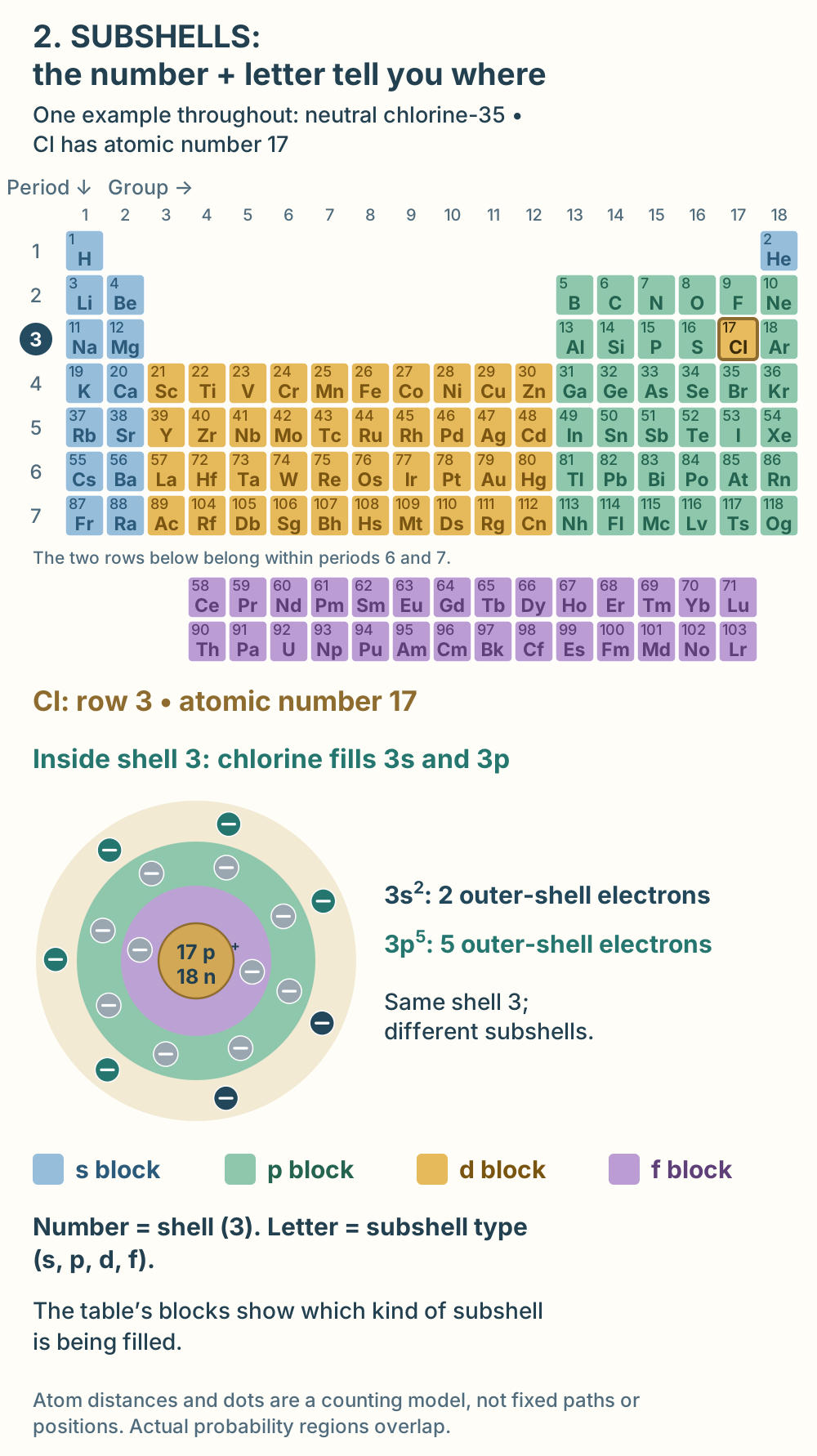
Color-coded s, p, d, and f periodic-table blocks connect to subshell letters. Chlorine’s outer shell is 3s² 3p⁵: two 3s electrons and five 3p electrons, all in shell 3.
Subshells: the colored blocks match s, p, d and f. Chlorine’s shell 3 is 3s2 3p5. Subshells are not separate fixed-distance tracks.
Inside one shell: subshells, orbitals, electrons
Shell n = 3 in chlorine3s1 orbital2 electrons3p3 orbitals5 electrons3d5 orbitals0 electrons (empty)box = one orbital · arrow = one electron · allowed is not the same as occupied
Shell 3 allows s, p and d. Chlorine uses 3s and 3p; its 3d is empty. Each orbital holds at most two electrons, with opposite spins (↑↓).
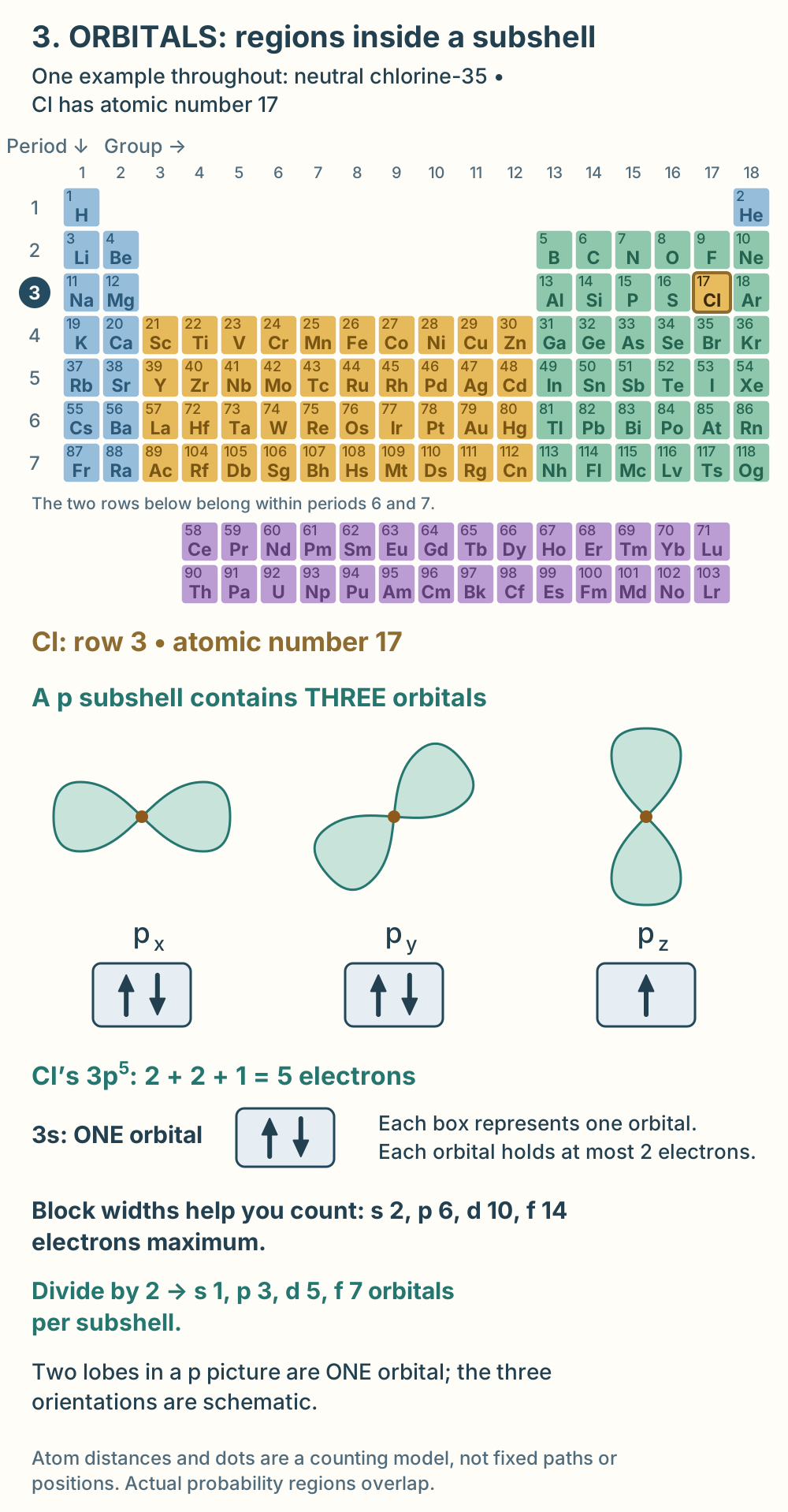
Three differently oriented p probability regions each correspond to one orbital box. Chlorine’s 3p⁵ fills the boxes with two, two, and one electrons. Its 3s² uses one orbital. p maximum capacity is six.
Orbitals: each oriented p region is one box. Chlorine’s 3p5 fills them 2, 2, 1. A p subshell holds at most six.
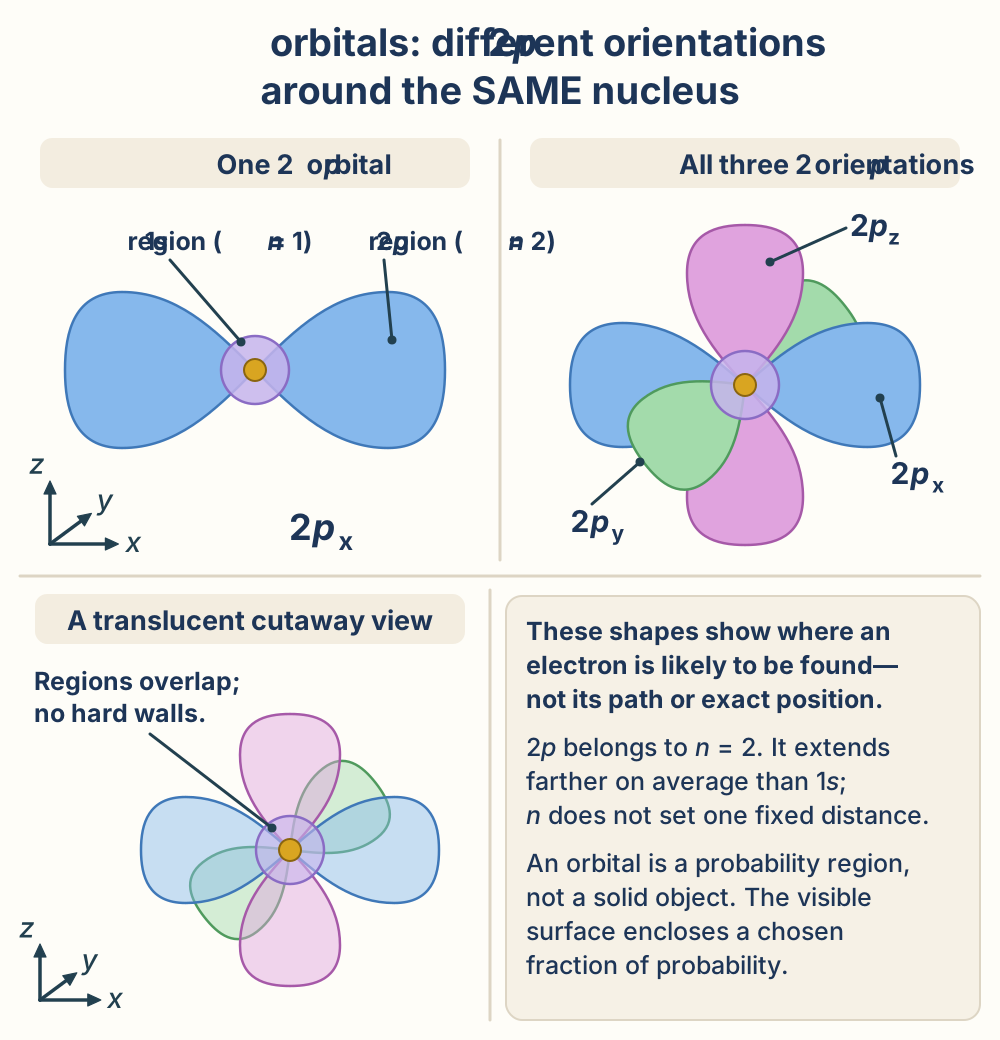
Three views show a single 2p orbital, three perpendicular 2p orbitals sharing one nucleus, and a translucent view with an inner 1s probability region.
2p means a p subshell in shell 2. There is no 1p. The three orientations share one nucleus and overlap.
Reading an orbital picture
  • The shape: where an electron is likely to be found, from a probability model. Not its exact location.
  • The surface: a boundary holding a chosen fraction of the probability. Not a solid wall.
  • n = 2: a shell label, not one fixed distance. 2p reaches farther on average than 1s, and the regions overlap.
  • The overlay: three orientations around one nucleus, not three atoms.
  • Chlorine fills 2p and 3p. Both have three orbitals; their shell numbers and probability spreads differ.
Chlorine’s atomic number gives 17 protons, and a neutral atom has 17 electrons. Its electron configuration is 1s² 2s² 2p⁶ 3s² 3p⁵; superscripts add to 17.
Electrons: atomic number counts protons. A neutral atom has equal electrons, so chlorine has 17. In 1s2 2s2 2p6 3s2 3p5 the superscripts add to 17.
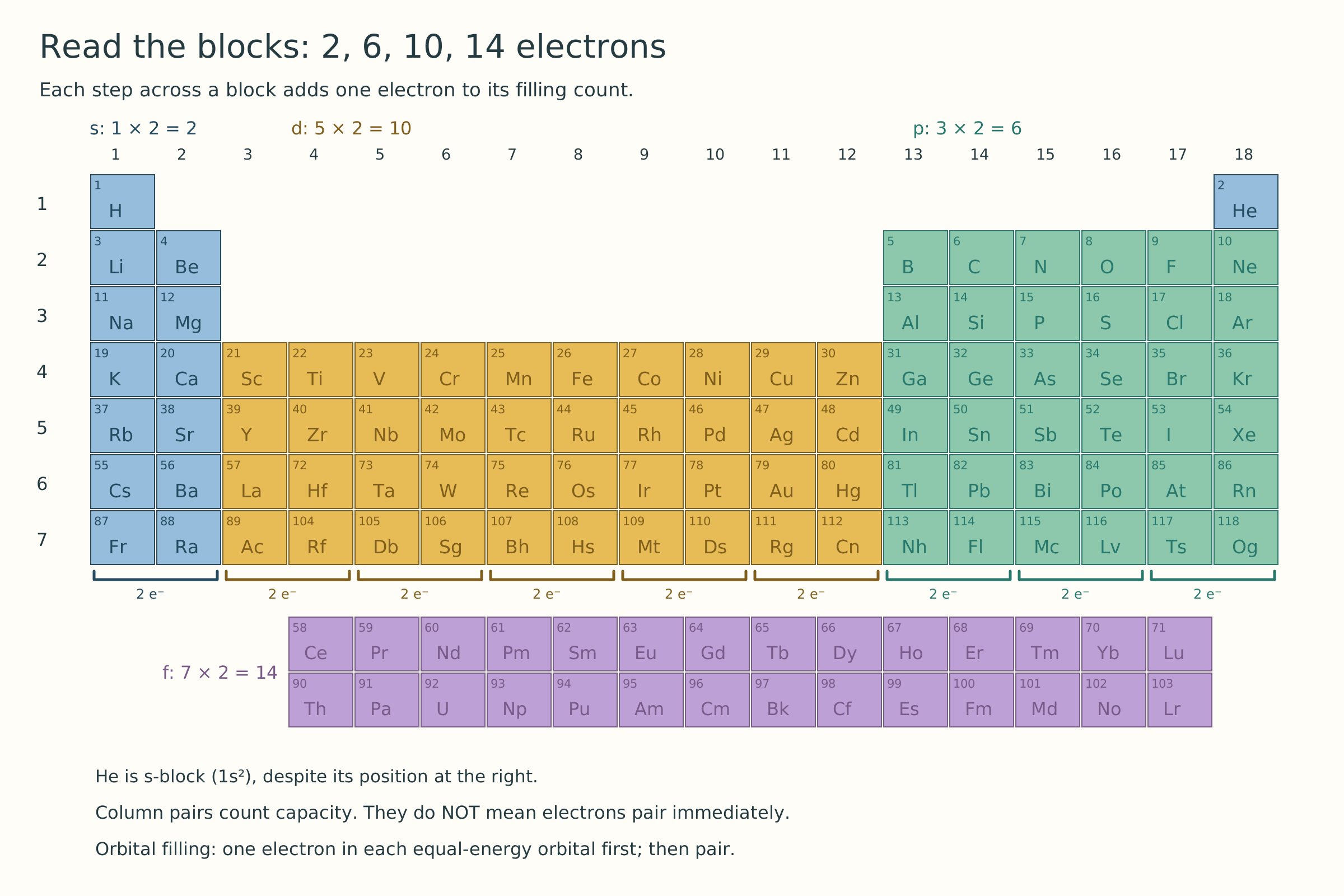
Complete periodic table with s blue, p green, d gold, and f plum; brackets group adjacent columns into pairs for capacity counting.
Two columns = room for two electrons. s has one pair, p three, d five. These are counting brackets, not maps of which orbital each element fills.
Count pairs, then fill singly
BlockColumnsPairs = orbitalsMaximum electrons
s212
p636
d10510
Actual filling puts one electron in each equal-energy orbital before pairing: p3 is ↑ | ↑ | ↑ and p4 is ↑↓ | ↑ | ↑.
One route for any atom
  • Count: atomic number = electrons, for a neutral atom.
  • Locate: find its row and colored block.
  • Fill: follow energy order; count across the final block.
  • Check: add the superscripts. They must equal the electron count.
  • For Cl: shell 3 → 3p subshell → 3 orbitals → 5 electrons there (6 maximum).
Keep this for later: higher shells allow more subshells
ShellSubshell types allowed
n = 1s
n = 2s, p
n = 3s, p, d
Allowed does not mean occupied: chlorine’s 3d is empty. Filling order comes in 3.2, the labels in 3.3. Helium sits in the last column but fills 1s, so it belongs with the s block.

On the periodic table: For a neutral main-group atom, the row (period) gives the highest occupied shell: chlorine in row 3 uses n = 3.

On the periodic table: The colored block gives the subshell letter: chlorine is in the fifth column of the p block, so its outer shell ends in 3p5.

On the periodic table: The atomic number, the whole number in each box, counts protons; for a neutral atom it also counts electrons (Cl: 17).

On the periodic table: Block widths give capacity: s is 2 columns, p is 6, d is 10.

Worked example · 3 steps

How many electrons can the 3p subshell hold?

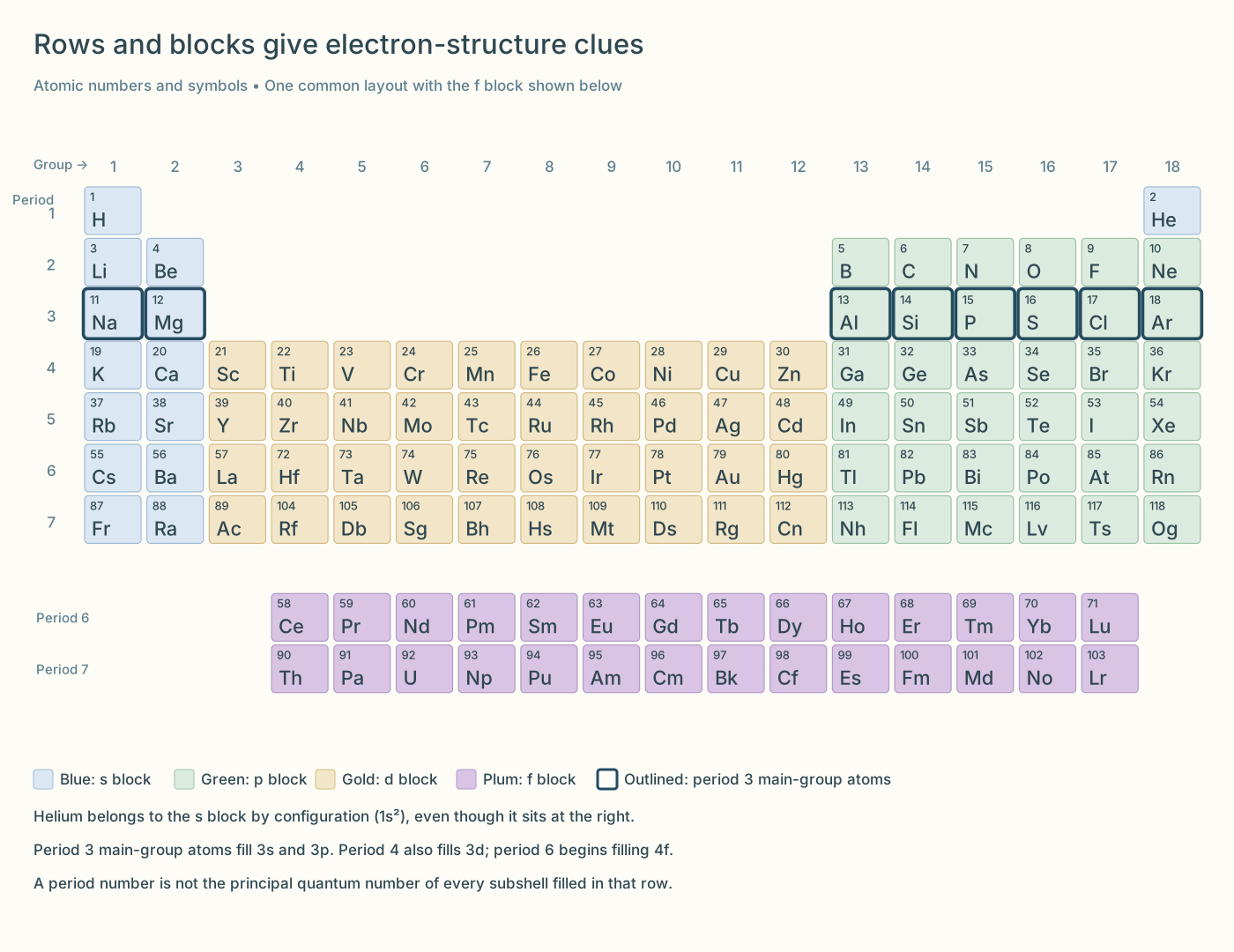
Periodic table colored by block: s block blue (groups 1 and 2, plus He), d block gold (groups 3 to 12), p block green (groups 13 to 18) and f block plum (the two rows below). The period 3 main-group atoms, Na, Mg and Al to Ar, are outlined.
3p names a shell and subshell, not an element. The block tells you which subshell is filling; Period 3 fills 3s, then 3p.
  1. 1
    Read the letter

    The letter p gives the orbital count. The 3 only names the shell.

    3p → p subshell → 3 orbitals
  2. 2
    Use the limit for one orbital

    Each orbital holds at most two electrons, with opposite spins.

    one orbital↑↓
    Two electrons, opposite spins: the most one box can hold.
  3. 3
    Multiply

    Add the capacity of all three orbitals.

    3 orbitals × 2 electrons1 orbital = 6 electrons
    3p6↑↓↑↓↑↓
  4. ✓
    Answer

    6 electrons. The shell label 3 does not multiply the number of p orbitals again.

Your turn

Orbital practice problems

Answer first, then check. Hints open one at a time; the answer and full solution open after you try.

Problem 1 of 10 · warm-up

A p drawing has two lobes. How many orbitals does that one drawing represent?

Hint 1 · the clue

Count orbitals, not lobes.

Hint 2 · the next move

"Two lobes" and "one drawing" ask whether lobes are separate orbitals; the two lobes form one region.

Your path:

  1. An orbital is one likely-electron region
  2. Both lobes belong to that region
  3. One drawing = one orbital
Answer

Answer: One orbital

Full worked solution

What you know: A p drawing shows two lobes on opposite sides of the nucleus. What you want: How many orbitals that one drawing shows.

  1. Recall what an orbital is: one region where an electron is likely to be found.
  2. The two lobes are two parts of that same probability region. They belong together as one shape.
  3. So one two-lobed drawing is One orbital. Like any orbital, it holds at most two electrons.

Why it matters: A p subshell has three orbitals, shown as three separate two-lobed drawings, not six lobes counted one by one.

Watch out: Counting lobes instead of orbitals gives 2, which is wrong.

Answer: One orbital

Problem 2 of 10

How many orbitals make up one p subshell?

Hint 1 · the clue

A p subshell has one orbital pointing along each axis: x, y, and z.

Hint 2 · the next move

"How many orbitals" in "one p subshell" means count the p orientations, not lobes or electrons.

Your path:

  1. p orbitals point along x, y, z
  2. Each orientation is one orbital
  3. Count the orientations
Answer

Answer: Three

Full worked solution

What you know: A p subshell is drawn as three two-lobed shapes pointing in different directions (px, py, pz). What you want: How many orbitals are in one p subshell.

  1. Each differently oriented drawing is one separate orbital.
  2. Count the orientations: x, y, and z make Three orbitals.

Check: Each row of the p block is six columns wide. Six electrons at two per orbital needs exactly 3 orbitals.

Watch out: Don't count lobes (6) or electrons (6). The question asks for orbitals.

Answer: Three

Problem 3 of 10

Can ↑↑ occupy the same orbital?

Hint 1 · the clue

Apply the two-electrons-in-one-orbital rule.

Hint 2 · the next move

Two same-direction arrows in "the same orbital" test the pairing rule: paired spins must be opposite.

Your path:

  1. One orbital holds two electrons maximum
  2. Paired electrons must have opposite spins
  3. ↑↑ is parallel, so not allowed
Answer

Answer: No

Full worked solution

What you know: The arrows ↑↑ show two electrons with the same spin. What you want: Whether both can sit in one orbital.

  1. Use the orbital rule: one orbital holds at most two electrons, and they must have opposite spins.
  2. ↑↑ has two parallel spins, not opposite ones.
  3. So the answer is No. A paired orbital must be drawn ↑↓.

Why it matters: Parallel arrows are fine in two different orbitals, as when a p subshell fills singly (↑ | ↑ | ↑) before pairing.

Answer: No

Problem 4 of 10

Read 3p5: what do 3, p, and 5 mean?

Hint 1 · the clue

The leading number, letter, and superscript have three different jobs.

Hint 2 · the next move

A label like 3p5 with "what do … mean" asks you to read shell, subshell, and electron count.

Your path:

  1. Leading number = shell (n)
  2. Letter = subshell type
  3. Superscript = electrons in that subshell
Answer

Answer: Shell 3; p subshell; five electrons

Full worked solution

What you know: The label 3p5. What you want: What each part means.

  1. The leading number 3 is the shell (n = 3).
  2. The letter p names the subshell type in that shell.
  3. The superscript 5 counts electrons in that subshell.
  4. Together: Shell 3; p subshell; five electrons.

Why it matters: 5 is less than the p maximum of 6, so 3p5 is possible. In boxes it is ↑↓ | ↑↓ | ↑.

Watch out: The superscript counts electrons, not orbitals. A p subshell always has three orbitals.

Answer: Shell 3; p subshell; five electrons

Problem 5 of 10

In the Bohr model, what happens when hydrogen’s electron drops from n = 3 to n = 2?

Hint 1 · the clue

Does the electron gain or lose energy when it moves closer?

Hint 2 · the next move

"Bohr model" and an electron that "drops" to a lower n tell you energy is released as light.

Your path:

  1. Smaller n = lower energy level
  2. Dropping down loses energy
  3. Lost energy leaves as light
Answer

Answer: It gives off light carrying the energy difference.

Full worked solution

What you know: Hydrogen's electron moves from n = 3 to n = 2 in the Bohr model. What you want: What happens to the energy.

  1. In Bohr's model, a smaller n is a lower energy level. So n = 2 is lower than n = 3.
  2. Moving to a lower level means the electron loses energy.
  3. That lost energy leaves the atom as light. So It gives off light carrying the energy difference.

Why it matters: The reverse move, n = 2 to n = 3, would need the atom to absorb exactly that same amount of energy.

Watch out: Moving closer to the nucleus releases energy; it does not take energy in.

Answer: It gives off light carrying the energy difference.

Problem 6 of 10

What does the quantum model use in place of Bohr’s fixed orbits?

Hint 1 · the clue

The quantum model does not give an exact path.

Hint 2 · the next move

"In place of Bohr’s fixed orbits" asks what the quantum model uses instead: orbitals, regions of likely location.

Your path:

  1. Quantum model keeps energy levels n
  2. It drops exact circular paths
  3. Uses orbitals: probability regions
Answer

Answer: Orbitals: regions where an electron is likely to be found.

Full worked solution

What you know: Bohr pictured electrons on fixed circular orbits. What you want: What the quantum model uses instead.

  1. The quantum model keeps Bohr's energy levels (n).
  2. It drops the idea of an exact path, because electrons do not travel in fixed tracks.
  3. Instead it uses Orbitals: regions where an electron is likely to be found.

Why it matters: This is why orbital drawings are probability regions, not racetracks the electron follows.

Watch out: "Orbit" and "orbital" sound alike but are different ideas.

Answer: Orbitals: regions where an electron is likely to be found.

Problem 7 of 10

An f subshell contains 7 orbitals. What is its maximum electron count?

Hint 1 · the clue

The question asks subshell capacity.

Hint 2 · the next move

Orbitals are given and "maximum electron count" is asked: multiply orbitals by two electrons each.

Your path:

  1. Count the orbitals given
  2. Each orbital holds two electrons
  3. Multiply orbitals × 2
Answer

Answer: 14

Full worked solution

What you know: An f subshell has 7 orbitals. Each orbital holds at most 2 electrons. What you want: The maximum electron count.

  1. Count the orbitals given: 7.
  2. Multiply by two electrons per orbital: 7 orbitals × 2 electrons/orbital = 14.

Check: The pattern fits s (1 × 2 = 2), p (3 × 2 = 6), d (5 × 2 = 10), f (7 × 2 = 14).

Watch out: Don't stop at 7. That is the orbital count, not the electron count.

Your route: Count the supplied orbitals → Multiply by two.

Answer: 14

Problem 8 of 10

How many electrons can one p subshell hold at most?

Hint 1 · the clue

The question asks subshell capacity.

Hint 2 · the next move

"How many electrons" and "one p subshell" "at most" means orbitals in p times two electrons each.

Your path:

  1. A p subshell has three orbitals
  2. Each orbital holds two electrons
  3. Multiply orbitals × 2
Answer

Answer: 6

Full worked solution

What you know: A p subshell has 3 orbitals. Each holds at most 2 electrons. What you want: The maximum electrons in one p subshell.

  1. Identify the subshell: p.
  2. A p subshell has three orbitals (px, py, pz).
  3. 3 orbitals × 2 electrons/orbital = 6.

Check: Each row of the p block on the periodic table has six places, one per p electron.

Watch out: Answering 3 gives the orbital count, not the electron count.

Your route: Identify p → Three orbitals → Two electrons each.

Answer: 6

Problem 9 of 10

Neutral chlorine is in row 3 with atomic number 17. Name its highest occupied shell and total electrons. How many orbitals and electrons maximum are in a p subshell?

Hint 1 · the clue

On the periodic table: Chlorine (Cl) is in Period 3 and has atomic number 17, the whole number in its box.

Use the period for a neutral main-group atom’s highest occupied shell and atomic number for its electron count. A p subshell has three orbitals, each holding at most two electrons.

Hint 2 · the next move

Row number, atomic number, and "highest occupied shell" link the table to shells; "p subshell" asks orbitals and capacity.

Your path:

  1. Period number = highest occupied shell
  2. Neutral: electrons = atomic number
  3. p: three orbitals × 2 electrons
Answer

Highest occupied shell: n = 3. Neutral Cl: 17 electrons. A p subshell has 3 orbitals and holds at most 6 electrons.

On the periodic table: Chlorine (Cl) is in Period 3 and has atomic number 17, the whole number in its box.

Full worked solution

What you know: Neutral Cl is in Period 3 with atomic number 17. What you want: Its highest occupied shell, its electron count, and the p subshell's orbitals and capacity.

  1. The period number of a main-group atom gives its highest occupied shell: Period 3 → n = 3.
  2. Neutral means electrons = protons = atomic number: 17 electrons.
  3. A p subshell has three orientations, so 3 orbitals. At 2 electrons each, 3 × 2 = 6 electrons maximum.

Check: Cl is 1s2 2s2 2p6 3s2 3p5: the highest shell is 3, and 2 + 2 + 6 + 2 + 5 = 17.

Watch out: Keep the four levels straight: shell (n = 3), subshell (p), orbital (3 of them), electrons (up to 6).

On the periodic table: Chlorine (Cl) is in Period 3 and has atomic number 17, the whole number in its box.

Answer: Highest occupied shell: n = 3. Neutral Cl: 17 electrons. A p subshell has 3 orbitals and holds at most 6 electrons.

YOUR PERIODIC-TABLE REFERENCE

17ClChlorine35.45Group 17 · Period 3

Atomic number identifies proton count. The decimal mass is an average, not an isotope’s mass number. Use supplied rounded masses when a problem gives them.

Problem 10 of 10

A student writes: “In a hydrogen atom, the electron travels in a fixed circular path at n = 2.” Which model is this? Name one idea the current quantum model keeps from it, one idea it replaces, and one reason the older model was replaced.

Hint 1 · the clue

A fixed circular path is an orbit, Bohr’s 1913 picture. Compare the word orbit with orbital, and ask which part of Bohr’s picture still labels shells today.

Hint 2 · the next move

"Fixed circular path" with "n = 2" describes Bohr orbits; compare it with the quantum model's orbitals.

Your path:

  1. Fixed circular orbits → Bohr model
  2. Kept: numbered energy levels n
  3. Replaced: paths become orbitals (probability regions)
  4. Bohr worked well only for hydrogen
Answer

On the periodic table: Hydrogen (H) has atomic number 1, so a neutral hydrogen atom has just 1 electron. That one-electron case is the only one Bohr’s model handles well.

Bohr model. Kept: numbered energy levels (n = 1, 2, 3, …) and jumps between them that absorb or emit light. Replaced: fixed circular orbits become orbitals, regions where the electron is likely to be found. Reason: Bohr’s model fails for atoms with more than one electron.

Full worked solution

What you know: the statement describes hydrogen’s electron in a fixed circular path at n = 2. What you want: the model’s name, one idea kept, one idea replaced, and why it was replaced.

  1. Fixed circular paths with numbered energies are Bohr’s orbits, so this is the Bohr model.
  2. Kept: the numbered energy levels. Today’s shells are still labeled n = 1, 2, 3, …, and an electron still absorbs or emits a definite amount of energy as light when it changes level, which explains line spectra.
  3. Replaced: the fixed path. The quantum model uses orbitals, probability regions where the electron is likely to be found, not tracks it follows.
  4. Reason: Bohr’s model works for hydrogen but fails for atoms with more electrons, and electrons do not actually travel in fixed paths.

Check: A corrected statement reads: “Hydrogen’s electron is in shell n = 2, in an orbital where it is likely to be found.” It keeps n but drops the path.

Watch out: Orbit (Bohr: a path) and orbital (quantum: a probability region) look alike but mean different things. An orbital picture is not the electron’s track.

On the periodic table: Hydrogen (H) has atomic number 1, so a neutral hydrogen atom has just 1 electron. That one-electron case is the only one Bohr’s model handles well.

Answer: Bohr model. Kept: numbered energy levels (n = 1, 2, 3, …) and jumps between them that absorb or emit light. Replaced: fixed circular orbits become orbitals, regions where the electron is likely to be found. Reason: Bohr’s model fails for atoms with more than one electron.

Watch out

Common orbital mistakes