ChemGem

How to Tell If a Set of Quantum Numbers Is Allowed (Step-by-Step, with Practice)

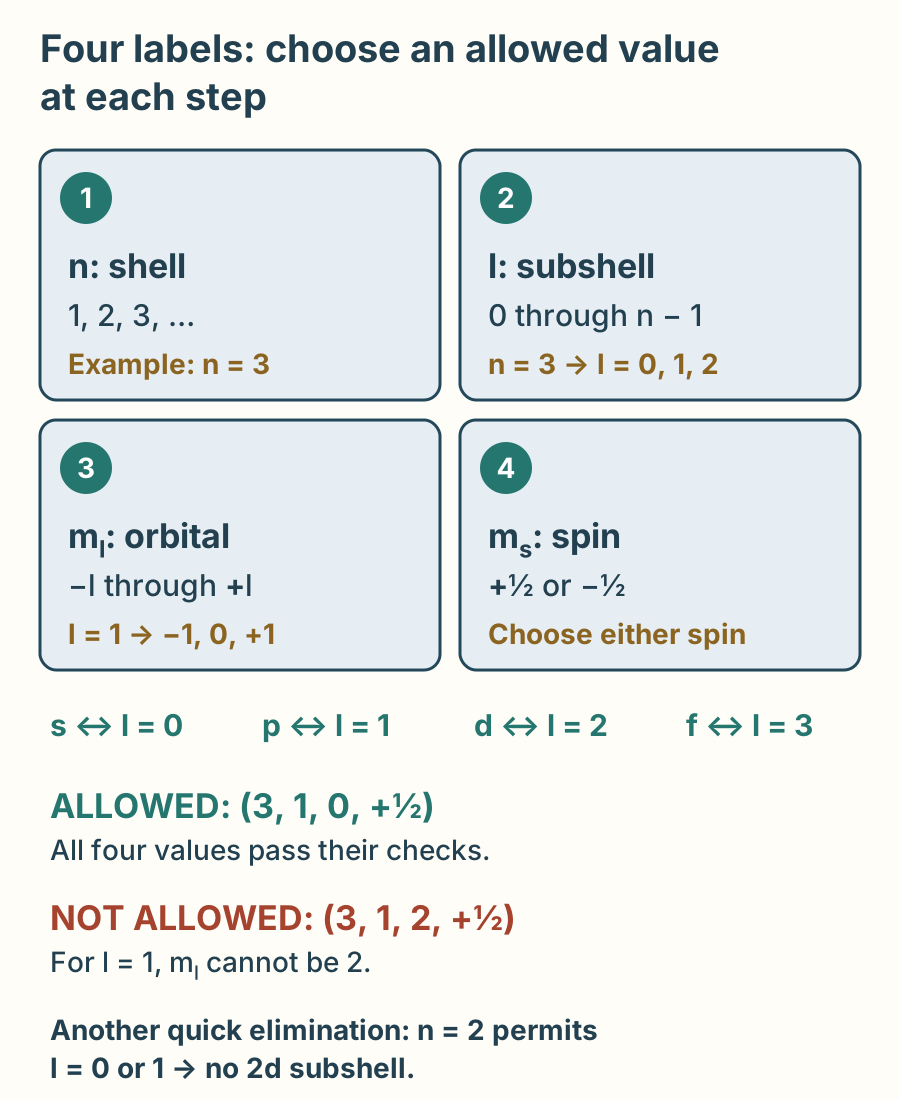
Every electron in an atom can be described by four quantum numbers. Each one answers a different question, and each has an allowed range. This lesson checks whether a set of four values is allowed.

Spot it, solve it, practice it: 4 steps, 1 worked example, 3 practice problems. Free, no account.

The route · 4 steps

  1. Check n: a positive whole number.
  2. Check l: from 0 to n − 1.
  3. Check ml: from −l to +l.
  4. Check ms: +½ or −½.
Spot it

How to recognize quantum number questions

Look for values of n, l, or mₗ and words like "allowed" or "permitted" — a quantum-number range check.

Example wording, with the clue words marked:

For principal quantum number n = 5, which of these l values is permitted: 4, 5, or 6?

Not sure it’s this type? Compare the neighbors:

Step-by-step

Worked example: quantum number

The idea

Four labels, four questions
LabelQuestion it answersAllowed values
nWhich shell?1, 2, 3, … (positive whole numbers)
lWhich subshell type?0 up to n − 1
mlWhich orbital state?−l up to +l, in whole steps
msWhich spin?+½ or −½
Check them in this order. If any one value is out of range, the set cannot describe an electron.
From l to the subshell letter and orbital count
lLetterml valuesOrbitals
0s01
1p−1, 0, +13
2d−2, −1, 0, +1, +25
3f−3 to +37
The number of ml values matches the orbital counts from 3.1.
Quantum-number range checks: positive integer n; l from zero to n minus one; m sub l from minus l to plus l; spin plus or minus one half. Allowed and disallowed examples are contrasted.
Range checks for n, l, ml and spin, with allowed and disallowed examples side by side.

Connect to the orbital pictures: pz corresponds to ml = 0. px and py are combinations of the ml = +1 and −1 states, so do not match each drawing to one ml value.

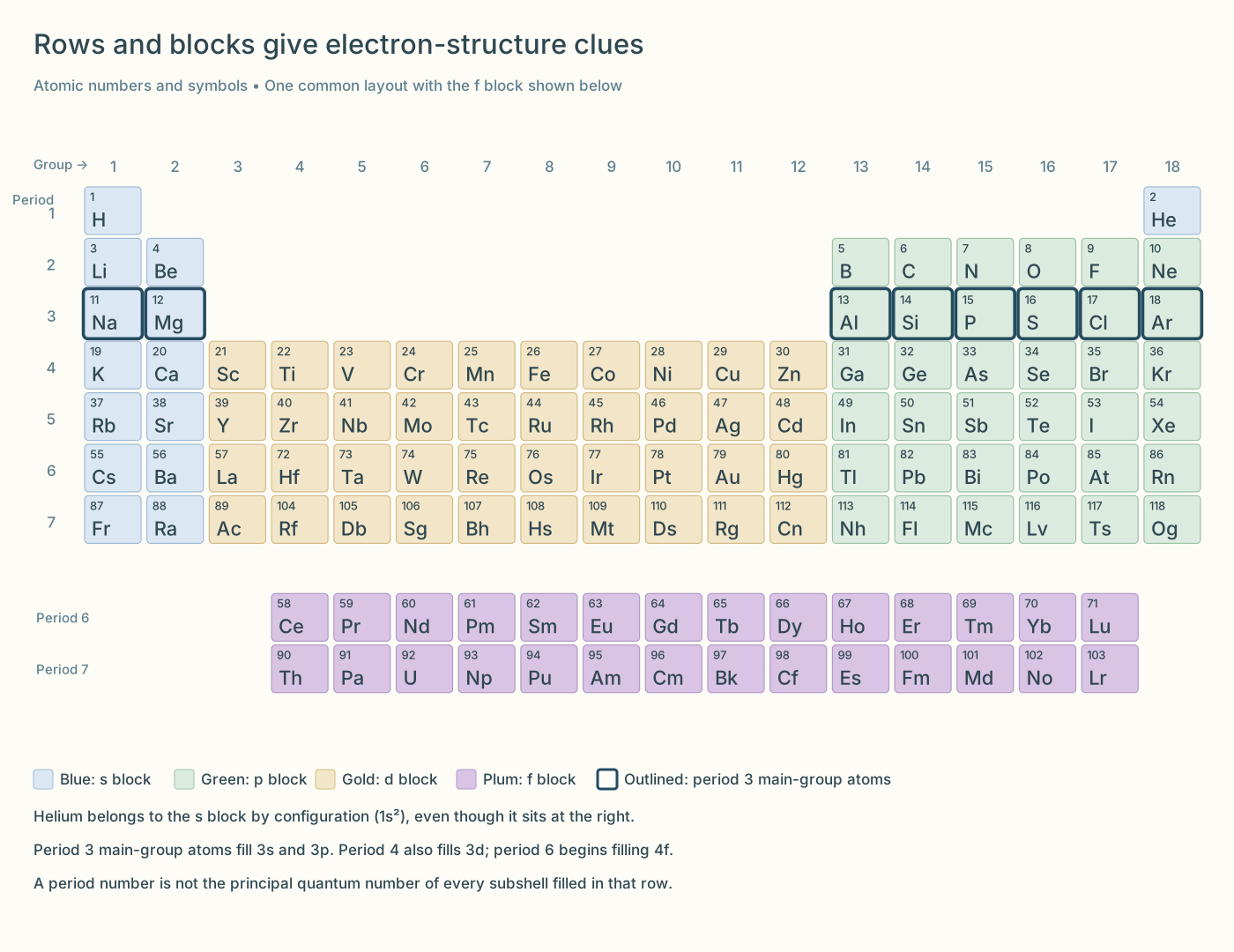
On the periodic table: The block tells you which subshell is filling (s, p, d, f), and the period gives the shell for s and p: Period 3 fills 3s, then 3p.

On the periodic table: Quantum-number problems often give the numbers instead of an element; then check the ranges directly.

Worked example · 4 steps

Is n = 3, l = 1, ml = 0, ms = +½ an allowed set of quantum numbers?

Periodic table colored by block: s block blue (groups 1 and 2, plus He), d block gold (groups 3 to 12), p block green (groups 13 to 18) and f block plum (the two rows below). The period 3 main-group atoms, Na, Mg and Al to Ar, are outlined.
This example gives quantum numbers, not an element. The block shows which subshell is filling; Period 3 fills 3s, then 3p.
  1. 1
    Check the shell

    n must be a positive whole number.

    n = 3 → allowed
  2. 2
    Check the subshell

    For n = 3, l can be 0, 1 or 2.

    l = 0 to (3 − 1) = 0, 1, 2 → l = 1 is allowed
  3. 3
    Check the orbital label

    For l = 1, ml can be −1, 0 or +1.

    ml = −1, 0, +1 → ml = 0 is allowed
  4. 4
    Check the spin

    Spin can be +½ or −½.

    nlmlms
    310+½
    allowedallowedallowedallowed
  5. ✓
    Answer

    Yes, all four labels are allowed (an electron in a 3p orbital).

Your turn

Quantum number practice problems

Answer first, then check. Hints open one at a time; the answer and full solution open after you try.

Problem 1 of 3 · warm-up

For principal quantum number n = 5, which of these l values is permitted: 4, 5, or 6?

Hint 1 · the clue

Principal and subshell quantum labels appear.

Hint 2 · the next move

"Principal quantum number n" with l values and "permitted" signals the rule 0 ≤ l ≤ n − 1.

Your path:

  1. Read n
  2. Allowed l runs from 0 to n − 1
  3. Pick the listed value in range
Answer

Answer: 4

Full worked solution

What you know: n = 5. What you want: Which l value is allowed.

  1. The rule is 0 ≤ l ≤ n − 1.
  2. For n = 5: n − 1 = 5 − 1 = 4, so l can be 0, 1, 2, 3, or 4.
  3. Of the listed values, 4 falls in that range.

Check: l = 5 would equal n, which is never allowed.

Watch out: l stops at n − 1, not at n.

Your route: Read n → Require 0 ≤ l ≤ n − 1.

Answer: 4

Problem 2 of 3

An orbital has l = 4. Which of these ml values is outside its allowed range: −4, 0, +3, or 5?

Hint 1 · the clue

An orbital quantum-number range is requested.

Hint 2 · the next move

An l value with mₗ choices and "outside its allowed range" signals the rule −l ≤ ml ≤ +l.

Your path:

  1. Read l
  2. Allowed mₗ runs from −l to +l
  3. Find the value outside that range
Answer

Answer: 5

Full worked solution

What you know: l = 4. What you want: Which listed ml value is not allowed.

  1. The rule is −l ≤ ml ≤ +l.
  2. For l = 4, ml can be −4, −3, −2, −1, 0, +1, +2, +3, +4.
  3. 5 is bigger than +4, so it is outside the range.

Check: Count the allowed values: 2l + 1 = 9, one per orbital in the subshell.

Watch out: Negative values from −1 to −4 are allowed. Don't reject an ml just because it is negative.

Your route: Read l → Check −l ≤ ml ≤ +l.

Answer: 5

Problem 3 of 3

Can n = 2 have l = 2?

Hint 1 · the clue

For a given n, allowed l values run from 0 through n − 1. Compare the proposed l with that range.

Hint 2 · the next move

An n and l pair with "Can … have" asks whether l fits the rule 0 ≤ l ≤ n − 1.

Your path:

  1. Read n
  2. Allowed l runs from 0 to n − 1
  3. Is the given l in range?
Answer

No. l is 0 or 1 for n = 2.

Full worked solution

What you know: n = 2 and a proposed l = 2. What you want: Whether this pair is allowed.

  1. Check n: 2 is a positive whole number, so it is fine.
  2. Allowed l values run from 0 to n − 1. For n = 2: 0 to 2 − 1 = 1.
  3. So l can be 0 or 1. l = 2 is outside that range: No. l is 0 or 1 for n = 2.

Check: This matches the fact that shell 2 has only 2s (l = 0) and 2p (l = 1). There is no 2d.

Watch out: l can never equal n. It stops one below.

Answer: No. l is 0 or 1 for n = 2.

Watch out

Common quantum number mistakes