
Chapter 4 · Free lesson
The mole and chemical formulas
The full lesson, free. For instant answer checking, hints and progress tracking, open the interactive version.
What you will study
- A mole is a counting unit
- Moving between grams and moles
- Percent composition and empirical formulas
- Finding the molecular formula
By the end, you can…
- Convert between moles and particles.
- Convert between grams and moles.
- Count atoms from grams or moles using the formula.
- Calculate the mass percent of an element in a compound.
- Find an empirical formula from composition.
- Find a molecular formula from an empirical formula and molar mass.
These are the skills to check, not just pages to finish. Use the section goals while studying, then try the chapter checks without hints.
Read the idea first. Then notice the clue, follow the route, and make a choice you can explain. You can return to the worked example if a practice question feels unfamiliar.
4.1 A mole is a counting unit
A mole is a counting unit, like a dozen but far bigger. Here you convert between moles and particles; every later mole calculation builds on this.
- Dimensional analysis: put the unwanted unit opposite itself (Math first).
Need a refresher? Open the table of contents and revisit that topic before starting.
| Unit | Always means | Tells you the mass? |
|---|---|---|
| 1 dozen | 12 items | No |
| 1 mole | 6.022 × 10²³ items | No |
- Avogadro’s number: 6.022 × 10²³, the count in one mole.
- Avogadro constant (NA): that number with units, 6.022 × 10²³ mol−1.
- Formula unit: the simplest ion ratio in an ionic compound, e.g. one Na+ per Cl− in NaCl.
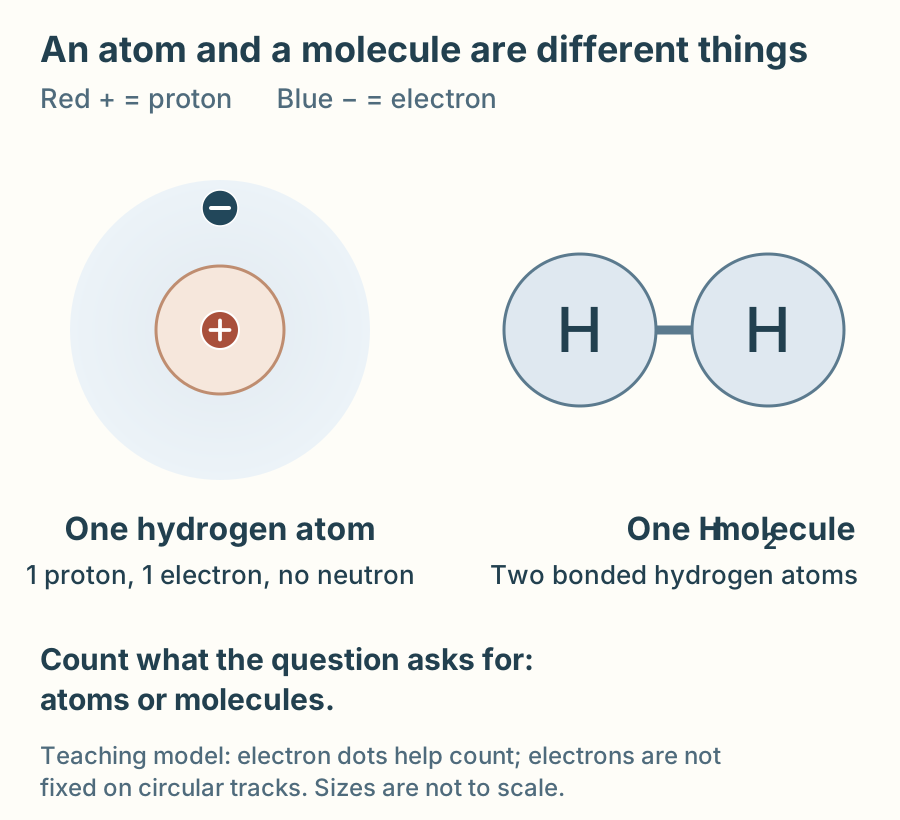
- Always name what you count: atoms, molecules or formula units.
about 4.003 g
about 18.02 g
| CO2 molecules | C atoms | O atoms | |
|---|---|---|---|
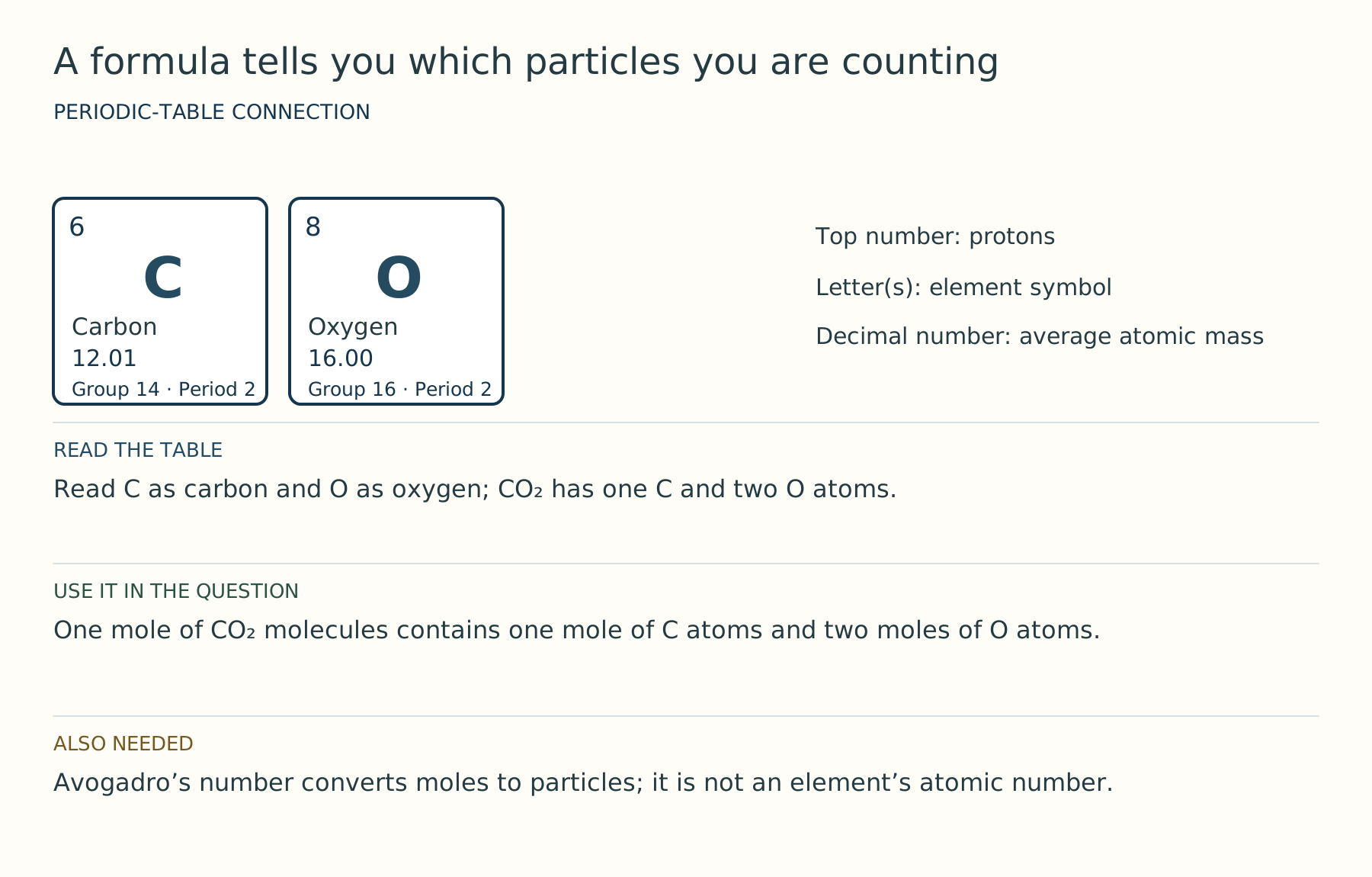
| In 1 molecule | 1 | 1 | 2 |
| In 1 mole | 1 mol | 1 mol | 2 mol |
| Count in 1 mole | 6.022 × 10²³ | 6.022 × 10²³ | 1.204 × 1024 |
- Start with the amount in moles.
- Multiply by 6.022 × 10²³ particles / 1 mol so mol cancels.
- Keep extra digits while you calculate.
- Round to the significant figures of the data and name the particle.
On the periodic table: Each box shows the symbol and name: C carbon, O oxygen, He helium.
On the periodic table: The whole number is the atomic number (proton count): C 6, O 8, He 2.
On the periodic table: The decimal is the average atomic mass, not a mass number: C 12.01, O 16.00, He 4.003. Use rounded masses when a problem supplies them.
How many molecules are in 0.25 mol? Use 6.022 × 10²³ molecules per mole.
- 1Start with the amount
A quarter mole, so expect fewer than a mole’s worth. No element mass is needed.
0.25 mol - 2Choose the counting conversion
Multiply to go from moles to molecules. Mol cancels.
0.25mol× 6.022 × 1023 molecules1mol - 3Calculate
Keep extra digits until the final rounding.
0.25 × 6.022 × 1023 = 1.5055 × 10²³ molecules - 4Round
0.25 has two significant figures, so report two.
1.5055 × 10²³ ≈ 1.5 × 10²³ molecules - ✓Answer
about 1.5 × 10²³ molecules
4.2 Moving between grams and moles
Balances measure grams; chemists count in moles. Molar mass bridges grams and moles, Avogadro’s number bridges moles and particles, and the formula’s subscripts bridge particles and atoms. Only the unit changes, never the substance.
- Read formulas and count atoms (Chapter 2); use conversion factors (Math first).
Need a refresher? Open the table of contents and revisit that topic before starting.
| Atom | How many | × mass from table (g/mol) | = contribution |
|---|---|---|---|
| Ca | 1 | 40.08 | 40.08 |
| O | 2 | 16.00 | 32.00 |
| H | 2 | 1.008 | 2.016 |
| Total | 74.10 g/mol |
g on the bottom cancels g.
Flipped: mol on the bottom cancels mol.
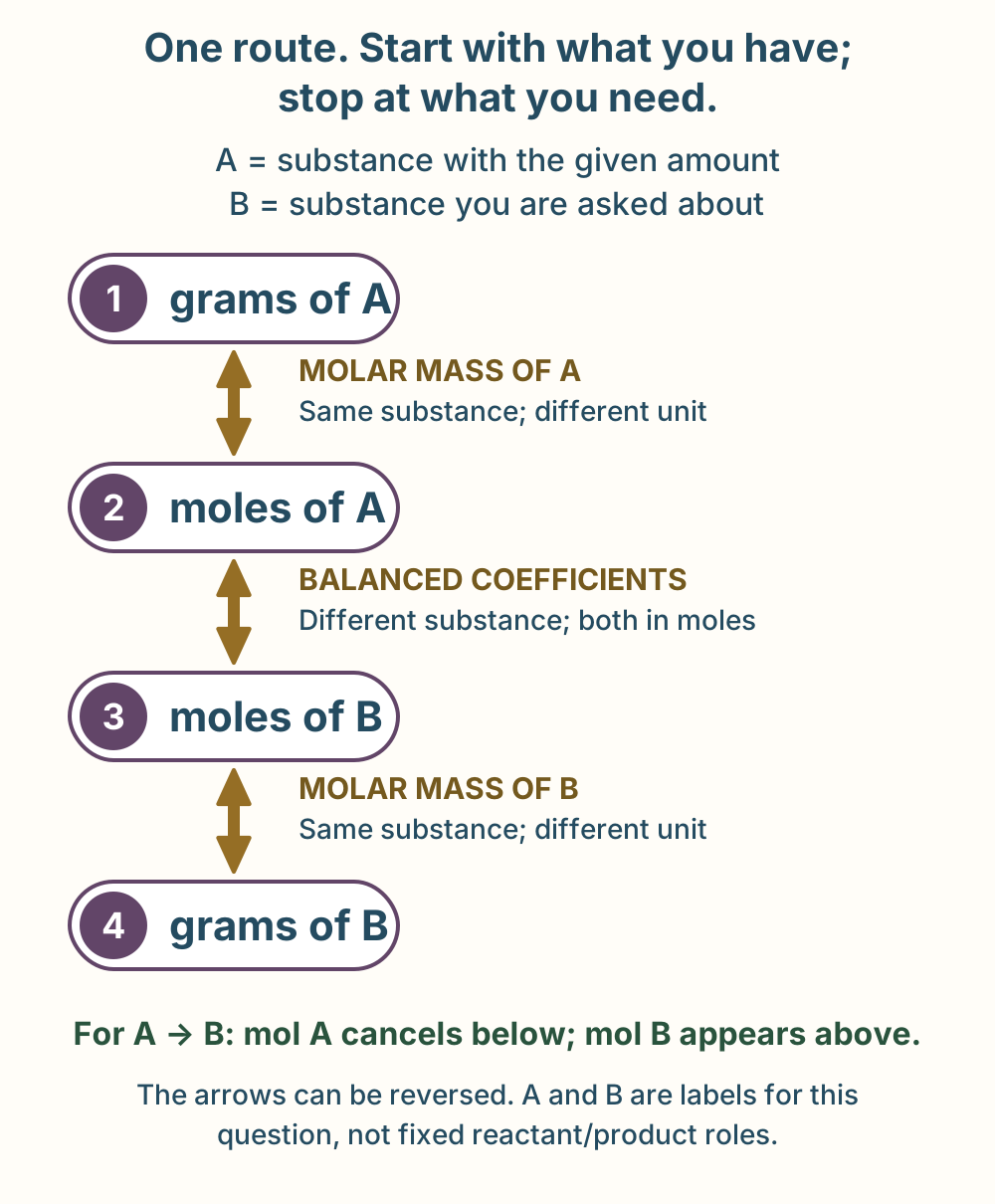
- Write the starting amount with unit and formula.
- Find the bridge: molar mass for grams, 6.022 × 10²³ for particles, subscripts for atoms.
- Write it as a fraction, unit to cancel on the bottom.
- Multiply, cancel units, round at the end.
On the periodic table: Molar mass comes from the periodic table: add each atom’s decimal mass once per atom in the formula.
On the periodic table: Here: H 1.008, C 12.01, O 16.00, Ca 40.08 g/mol. Use supplied masses when given.
On the periodic table: H2O = 2(1.008) + 16.00 = 18.016 ≈ 18.02 g/mol.
How many moles are in 22.005 g CO2? Use molar mass 44.01 g/mol.
| Atom | How many | × mass (g/mol) | = contribution |
|---|---|---|---|
| C | 1 | 12.01 | 12.01 |
| O | 2 | 16.00 | 32.00 |
| Total | 44.01 g/mol |
- 1Label the starting mass
The question asks for moles, so grams must cancel.
22.005 g CO2 - 2Set up the conversion
Grams go on the bottom.
22.005g CO2× 1 mol CO244.01g CO2 - 3Divide
Moles remain. Four significant figures, like 44.01.
22.00544.01 mol = 0.5000 mol CO2 - ✓Answer
0.5000 mol CO2
How many H2O molecules, and how many hydrogen atoms, are in 9.00 g of water? Use 18.02 g/mol.
- 1Grams → moles
Divide by molar mass so grams cancel. Keep extra digits for now.
9.00g× 1 mol18.02g= 0.49945 mol H2O - 2Moles → molecules
Multiply by Avogadro’s number so mol cancels.
0.49945mol× 6.022 × 10231mol= 3.0077 × 10²³ molecules - 3Molecules → H atoms
Each H2O holds 2 H atoms, so multiply by 2.
3.0077 × 1023 × 2 H atoms1 molecule= 6.0154 × 10²³ H atoms - 4Round and line up the amounts
9.00 g has three significant figures, so report three. One sample, four units.
Amount Value Grams 9.00 g Moles 0.499 mol H2O molecules 3.01 × 10²³ H atoms 6.02 × 10²³ - ✓Answer
3.01 × 10²³ molecules of H2O and 6.02 × 10²³ H atoms
4.3 Percent composition and empirical formulas
Mass percent tells how much of a compound’s mass comes from each element. Working backward, percentages give the simplest atom ratio: the empirical formula.
- Grams → moles (4.2); divide a set of values by the smallest.
Need a refresher? Open the table of contents and revisit that topic before starting.
Water: 88.8% O.
Water: H2O.
| Ratio ends near | Multiply all ratios by | Example |
|---|---|---|
| .5 | 2 | 1 : 1.5 → 2 : 3 |
| .33 or .67 | 3 | 1 : 1.33 → 3 : 4 or 1 : 1.67 → 3 : 5 |
- Assume a 100 g sample, so percent becomes grams.
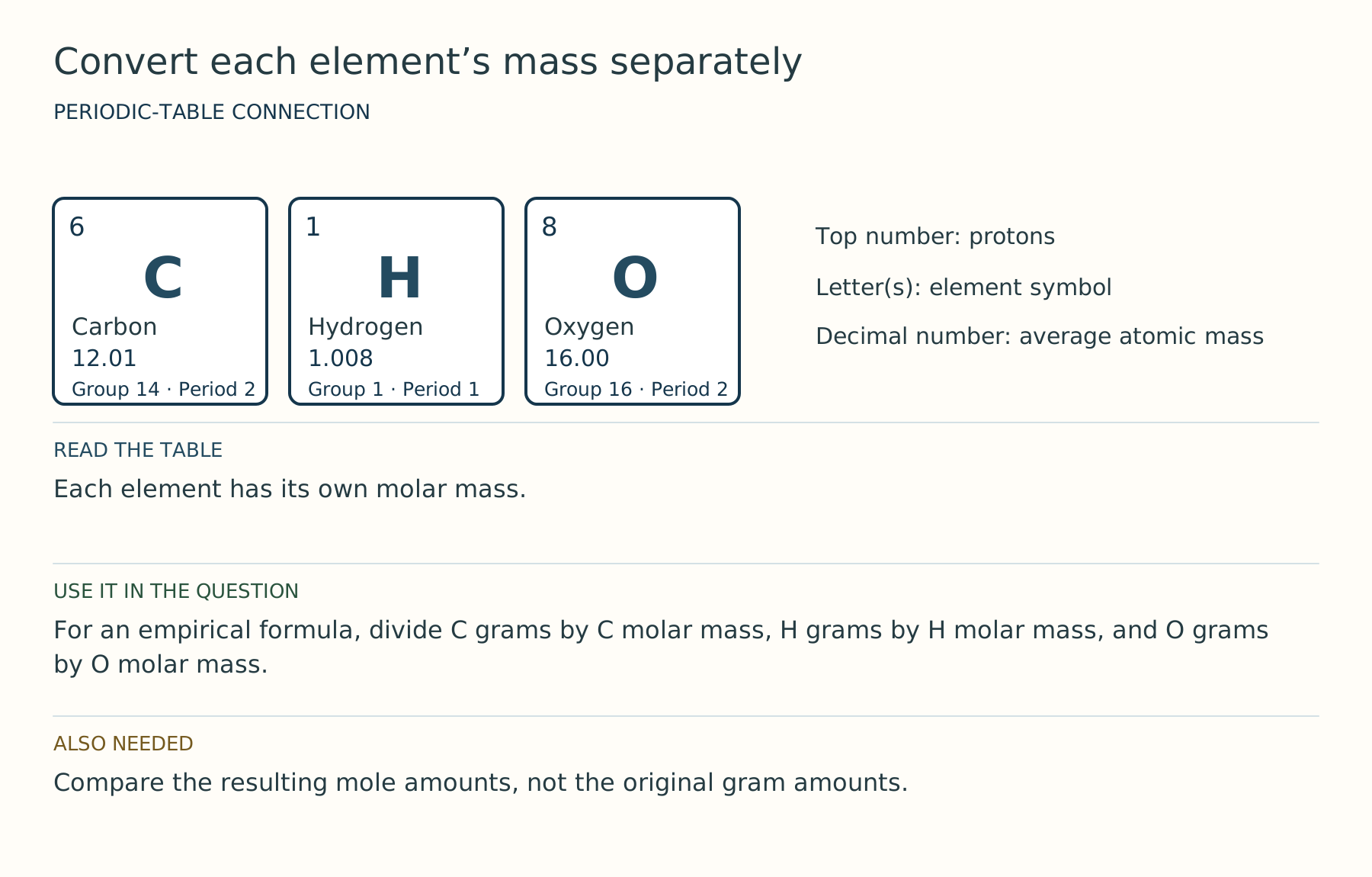
- Convert each element’s grams to moles.
- Divide every mole amount by the smallest.
- Clear any .5, .33 or .67 by multiplying all ratios.
- Write the ratios as subscripts.
On the periodic table: Molar masses are the decimal number in each box: C 12.01, H 1.008, O 16.00 g/mol; rounded, 12, 1 and 16.
On the periodic table: Use the masses the problem gives.
What is the mass percent of oxygen in water, H2O? Use H = 1.008 g/mol and O = 16.00 g/mol.
- 1Find the molar mass of the whole
The whole is one mole of water.
Atom How many × mass (g/mol) = contribution H 2 1.008 2.016 O 1 16.00 16.00 Total 18.02 g/mol - 2Find the mass of the part
One O atom per H2O.
oxygen in 1 mol H2O = 16.00 g - 3Divide part by total
Grams cancel, leaving a percent.
16.00g18.02g× 100% = 88.8% O - 4Check the total
The parts must add to 100%.
Element Calculation Mass percent H 2.016 ÷ 18.02 × 100% 11.2% O 16.00 ÷ 18.02 × 100% 88.8% Total 100.0% - ✓Answer
Water is 88.8% oxygen by mass.
A sample is 40.0% C, 6.7% H, and 53.3% O. Find its empirical formula. Use approximate masses C = 12 g/mol, H = 1 g/mol, O = 16 g/mol.
- 1Imagine a 100 g sample
With a 100 g total, each percent equals its gram amount.
C H O Percent 40.0% 6.7% 53.3% Grams in 100 g 40.0 g 6.7 g 53.3 g - 2Convert each mass to moles
Atom ratios come from moles, not grams. Each element uses its own molar mass.
C: 40.0g× 1 mol12g≈ 3.33 molH: 6.7g× 1 mol1g= 6.7 molO: 53.3g× 1 mol16g≈ 3.33 mol - 3Divide all by the smallest
The smallest is 3.33 mol.
C H O Moles 3.33 6.7 3.33 ÷ 3.33 3.333.33 ≈ 1 6.73.33 ≈ 2 3.333.33 ≈ 1 - 4Write the formula
The ratios become subscripts. A subscript of 1 is left out.
C : H : O ≈ 1 : 2 : 1 → CH2O - ✓Answer
CH2O. The approximate data give a ratio close to 1 : 2 : 1.
4.4 Finding the molecular formula
An empirical formula gives only the simplest atom ratio. The molar mass tells how many of those units make one molecule: the molecular formula.
- Molar mass (4.2) and empirical formula (4.3).
Need a refresher? Open the table of contents and revisit that topic before starting.
CH2O (1 : 2 : 1)
C6H12O6 (still 1 : 2 : 1)
| Molecular molar mass (g/mol) | Multiplier | Molecular formula |
|---|---|---|
| 30 | 30 ÷ 30 = 1 | CH2O |
| 60 | 60 ÷ 30 = 2 | C2H4O2 |
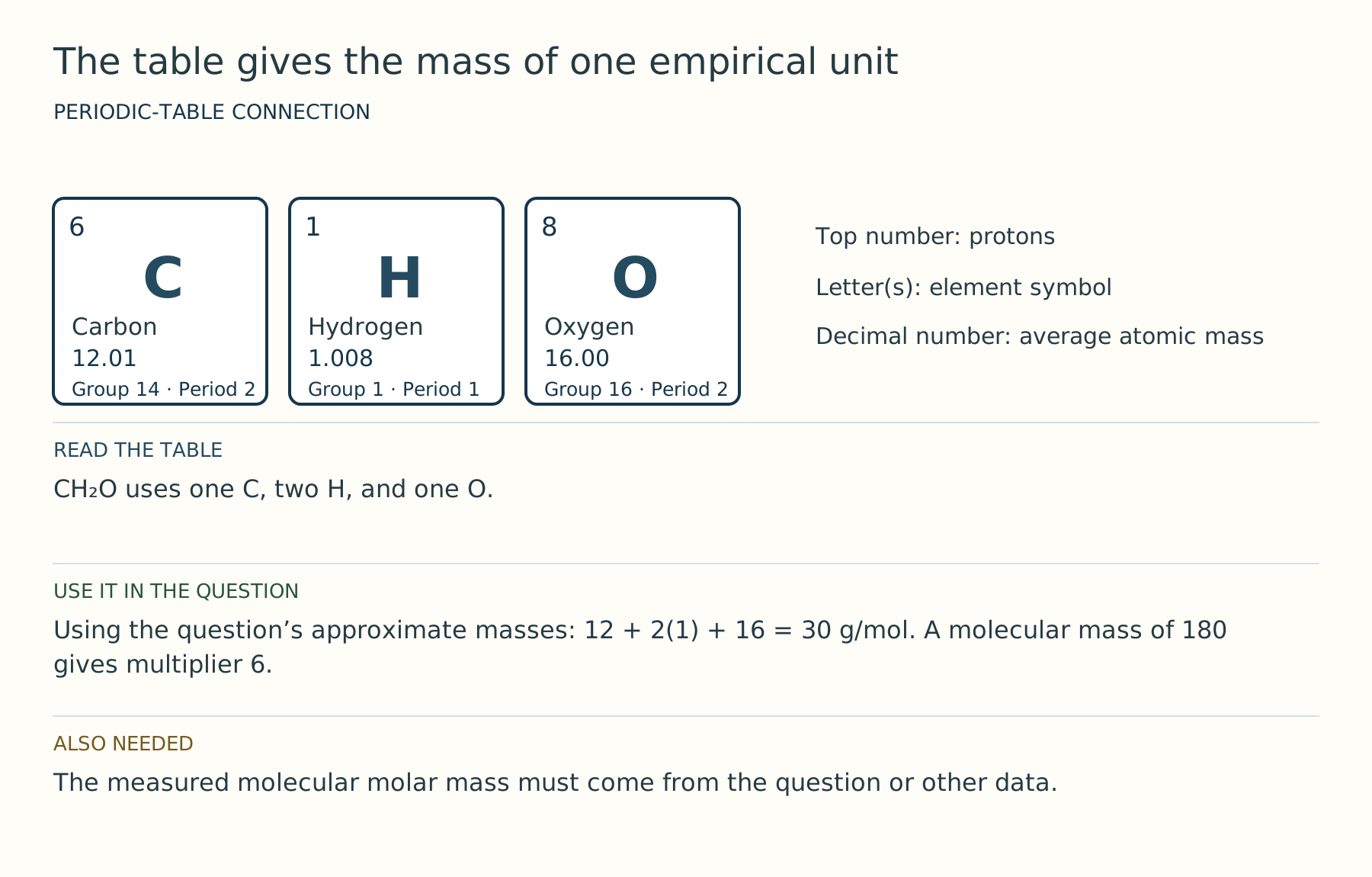
| 180 | 180 ÷ 30 = 6 | C6H12O6 |
- Find the empirical formula’s molar mass.
- Divide the molecular molar mass by it.
- Round to the nearest whole number.
- Multiply every subscript by that number.
On the periodic table: Molar masses are the decimal numbers in each box: C 12.01, H 1.008, O 16.00 g/mol; this problem rounds them to 12, 1 and 16.
On the periodic table: The molecular molar mass is not on the periodic table; it comes from the question or an experiment.
The empirical formula is CH2O and the molecular molar mass is 180 g/mol. Find the molecular formula. Use C = 12 g/mol, H = 1 g/mol, O = 16 g/mol.
- 1Find one empirical unit’s mass
Add the atom contributions for CH2O.
Atom How many × mass (g/mol) = contribution C 1 12 12 H 2 1 2 O 1 16 16 Total 30 g/mol - 2Find the multiplier
The molecule contains six empirical units.
multiplier = 180g/mol30g/mol= 6 - 3Multiply every subscript
One multiplier for every element keeps the ratio 1 : 2 : 1.
C1×6H2×6O1×6 → C6H12O6 - ✓Answer
C6H12O6
Mixed chapter review
Answer in your notebook before revealing help. Keep your first attempt separate from an answer corrected with help.
Mixed chapter review · 16 questions · tap to open
What this set is for: problems from every section of the chapter, mixed together and not labeled, the way a test asks them. Your job is to pick the right method yourself. Do this before the skill check.
Practice 1
Using molar mass 18.0 g/mol, how many moles are in 126 g of water?
Give me a hint
Mass and molar mass are given.
Check the answer
Answer: 7.00 mol
Explain the worked problem to me
What you know: 126 g of water, molar mass 18.0 g/mol. What you want: moles of water.
- Molar mass says 1 mol of water has a mass of 18.0 g. To turn grams into moles, divide by it so grams cancel: 126 g × (1 mol / 18.0 g).
- Grams cancel, leaving mol. Do the arithmetic: 126 ÷ 18.0 = 7. Keep 3 significant figures: 7.00 mol.
Check: Reverse it: 7.00 mol × 18.0 g/mol = 126 g. That matches the starting mass.
Watch out: Do not multiply 126 × 18.0. That gives 2268, with units of g²/mol, which makes no sense.
Your route: Grams → Divide by molar mass.
On the periodic table: You can also build this from the table: hydrogen (H) is 1.008 and oxygen (O) is 16.00 g/mol, so water (H2O) is 2 × 1.008 + 16.00 = 18.02 g/mol, which rounds to 18.0 g/mol.
That’s right: 7.00 mol
Practice 2
Using molar mass 18.0 g/mol, how many moles are in 144 g of water?
Give me a hint
Mass and molar mass are given.
Check the answer
Answer: 8.00 mol
Explain the worked problem to me
What you know: 144 g of water, molar mass 18.0 g/mol. What you want: moles of water.
- Each mole of water weighs 18.0 g. Divide by molar mass so grams cancel: 144 g × (1 mol / 18.0 g).
- Grams cancel, leaving mol: 144 ÷ 18.0 = 8. Both values have 3 significant figures, so the answer is 8.00 mol.
Check: 8.00 mol × 18.0 g/mol = 144 g. That is the mass you started with.
Watch out: Going from grams to moles always means dividing by molar mass. Multiplying would give a huge number with the wrong units.
Your route: Grams → Divide by molar mass.
On the periodic table: You can also build this from the table: hydrogen (H) is 1.008 and oxygen (O) is 16.00 g/mol, so water (H2O) is 2 × 1.008 + 16.00 = 18.02 g/mol, which rounds to 18.0 g/mol.
That’s right: 8.00 mol
Practice 3
A substance has molar mass 40.0 g/mol. What mass is 0.900 mol?
Give me a hint
Moles and molar mass are given.
Check the answer
Answer: 36.0 g
Explain the worked problem to me
What you know: 0.900 mol of a substance, molar mass 40.0 g/mol. What you want: its mass in grams.
- Molar mass says 1 mol has a mass of 40.0 g. To go from moles to grams, multiply so moles cancel: 0.900 mol × (40.0 g / 1 mol).
- Mol cancels, leaving g: 0.900 × 40.0 = 36. Both values have 3 significant figures, so the answer is 36.0 g.
Check: Less than 1 mol should weigh less than 40 g. 36.0 g is a bit under 40 g, as expected.
Watch out: Dividing (0.900 ÷ 40.0 = 0.0225) is the grams → moles direction. Here you start with moles, so multiply.
Your route: Moles → Multiply by molar mass.
That’s right: 36.0 g
Practice 4
A substance has molar mass 40.0 g/mol. What mass is 1.05 mol?
Give me a hint
Moles and molar mass are given.
Check the answer
Answer: 42.0 g
Explain the worked problem to me
What you know: 1.05 mol of a substance, molar mass 40.0 g/mol. What you want: its mass in grams.
- Each mole has a mass of 40.0 g. Multiply so moles cancel: 1.05 mol × (40.0 g / 1 mol).
- Mol cancels, leaving g: 1.05 × 40.0 = 42. Both values have 3 significant figures, so the answer is 42.0 g.
Check: A little more than 1 mol should weigh a little more than 40 g. 42.0 g fits.
Watch out: Starting from moles means multiply by molar mass. Dividing would give about 0.026, which is far too small.
Your route: Moles → Multiply by molar mass.
That’s right: 42.0 g
Practice 5
Using 6.022 × 10²³ particles/mol, how many molecules are in 0.600 mol?
Give me a hint
A molecule count is requested from moles.
Check the answer
Answer: 3.61 × 10²³ molecules
Explain the worked problem to me
What you know: 0.600 mol, and 1 mol = 6.022 × 10²³ molecules. What you want: the number of molecules.
- Avogadro’s number is a counting factor, like 12 per dozen. Multiply so moles cancel: 0.600 mol × (6.022 × 1023 molecules / 1 mol).
- Multiply the front numbers and keep the power of ten: 0.600 × 6.022 = 3.6132.
- Round to 3 significant figures, because 0.600 mol has 3: 3.61 × 10²³ molecules.
Check: 0.6 mol is a bit more than half a mole, and 3.6 × 10²³ is a bit more than half of 6.0 × 10²³.
Watch out: Do not multiply the exponent by 0.6. Only the 6.022 part gets multiplied.
Your route: Moles → Multiply by Avogadro’s number.
That’s right: 3.61 × 10²³ molecules
Practice 6
Using 6.022 × 10²³ particles/mol, how many molecules are in 0.700 mol?
Give me a hint
A molecule count is requested from moles.
Check the answer
Answer: 4.22 × 10²³ molecules
Explain the worked problem to me
What you know: 0.700 mol, and 1 mol = 6.022 × 10²³ molecules. What you want: the number of molecules.
- Avogadro’s number tells how many particles are in one mole. Multiply so moles cancel: 0.700 mol × (6.022 × 1023 molecules / 1 mol).
- Multiply the front numbers and keep 1023: 0.700 × 6.022 = 4.2154.
- Round to 3 significant figures, because 0.700 mol has 3: 4.22 × 10²³ molecules.
Check: 0.7 mol is less than 1 mol, so the count must be less than 6.022 × 10²³. 4.2 × 10²³ is.
Watch out: Dividing 0.7 by 6.022 × 1023 gives a tiny number. Going from moles to particles always means multiplying.
Your route: Moles → Multiply by Avogadro’s number.
That’s right: 4.22 × 10²³ molecules
Practice 7
How many oxygen atoms are represented by 8 formula units of Ca(NO3)2?
Give me a hint
The formula contains parentheses.
Check the answer
Answer: 48
Explain the worked problem to me
What you know: 8 formula units of Ca(NO3)2. What you want: the total number of oxygen atoms.
- Read the inner subscript: each NO3 group has 3 oxygen atoms.
- Apply the parentheses: the 2 outside means two NO3 groups, so one formula unit has 3 × 2 = 6 O atoms.
- Multiply by the number of formula units: 8 × 6 = 48 oxygen atoms.
Check: Write it out: one unit is CaN2O6. Eight of those give 8 × 6 = 48 O.
Watch out: Forgetting the outside 2 gives 3 O per unit and 24 total. The subscript after a parenthesis multiplies everything inside.
Your route: Read inner subscript → Apply parentheses → Multiply formula units.
On the periodic table: Oxygen’s symbol is O, shown in its box, so count every O in the formula.
That’s right: 48
YOUR PERIODIC-TABLE REFERENCE
Atomic number identifies proton count. The decimal mass is an average, not an isotope’s mass number. Use supplied rounded masses when a problem gives them.
Practice 8
How many oxygen atoms are represented by 9 formula units of Ca(NO3)2?
Give me a hint
The formula contains parentheses.
Check the answer
Answer: 54
Explain the worked problem to me
What you know: 9 formula units of Ca(NO3)2. What you want: the total number of oxygen atoms.
- Read the inner subscript: each NO3 group has 3 O atoms.
- Apply the parentheses: the outside 2 doubles the group, so each formula unit has 3 × 2 = 6 O atoms.
- Multiply by the number of formula units: 9 × 6 = 54 oxygen atoms.
Check: 54 ÷ 9 = 6 O per unit, which matches CaN2O6.
Watch out: A common slip is 9 × 3 = 27, which ignores the 2 outside the parentheses.
Your route: Read inner subscript → Apply parentheses → Multiply formula units.
On the periodic table: Oxygen’s symbol is O, shown in its box, so count every O in the formula.
That’s right: 54
YOUR PERIODIC-TABLE REFERENCE
Atomic number identifies proton count. The decimal mass is an average, not an isotope’s mass number. Use supplied rounded masses when a problem gives them.
Practice 9
Using S = 32 g/mol and O = 16 g/mol, what is the molar mass of SO3?
Give me a hint
A formula and atomic masses are supplied.
Check the answer
Answer: 80 g/mol
Explain the worked problem to me
What you know: The formula SO3, with S = 32 g/mol and O = 16 g/mol. What you want: the molar mass of SO3.
- Count every atom: SO3 has 1 S and 3 O.
- Multiply each count by its atomic mass: S: 1 × 32 = 32 g/mol. O: 3 × 16 = 48 g/mol.
- Add the contributions: 32 + 48 = 80 g/mol.
Check: With the table values, 32.06 + 3(16.00) = 80.06 g/mol, which rounds to 80 g/mol. It matches.
Watch out: The subscript 3 belongs to O only. Writing 3 × (32 + 16) = 144 is wrong.
Your route: Count every atom → Add atomic masses.
16S32.068O16.00On the periodic table: Sulfur (S) has an average atomic mass of 32.06 g/mol and oxygen (O) has 16.00 g/mol, the decimal numbers in their boxes; the problem rounds them to 32 and 16.
That’s right: 80 g/mol
Practice 10
Use C = 12 g/mol, H = 1 g/mol, O = 16 g/mol, S = 32 g/mol. What is sulfur’s mass percent in SO2, nearest whole percent?
Give me a hint
Mass percent is requested.
Check the answer
Answer: 50%
Explain the worked problem to me
What you know: The formula SO2, with S = 32 g/mol and O = 16 g/mol. What you want: sulfur’s mass percent.
- Find the formula mass: 1 S + 2 O = 32 + 2(16) = 64 g/mol.
- Sulfur’s part of that mass is 32 g/mol (one S atom).
- Mass percent = part ÷ total × 100: (32 g/mol ÷ 64 g/mol) × 100 = 50. The units cancel. The answer is 50%.
Check: Oxygen’s share is 32 ÷ 64 × 100 = 50%. The two percents add to 100%.
Watch out: Do not count atoms instead of mass. S is 1 of 3 atoms, but 1/3 (33%) is not the mass percent.
Your route: Component mass ÷ Formula mass × 100.
On the periodic table: Sulfur (S) has an average atomic mass of 32.06 g/mol and oxygen (O) has 16.00 g/mol, the decimal numbers in their boxes; the problem rounds them to 32 and 16.
That’s right: 50%
YOUR PERIODIC-TABLE REFERENCE
Atomic number identifies proton count. The decimal mass is an average, not an isotope’s mass number. Use supplied rounded masses when a problem gives them.
Practice 11
An analysis gives 6 mol C, 6 mol H, and 3 mol O. Which is the simplest whole-number formula?
Give me a hint
Element amounts are already in moles.
Check the answer
Answer: C2H2O
Explain the worked problem to me
What you know: 6 mol C, 6 mol H, 3 mol O. What you want: the simplest whole-number formula (empirical formula).
- The amounts are already in moles, so no gram conversion is needed. Find the smallest amount: 3 mol (O).
- Divide every amount by 3: C: 6 ÷ 3 = 2. H: 6 ÷ 3 = 2. O: 3 ÷ 3 = 1.
- All are whole numbers, so they become subscripts: C2H2O.
Check: 2 : 2 : 1 is the same ratio as 6 : 6 : 3, and no whole number larger than 1 divides all of 2, 2 and 1.
Watch out: C6H6O3 keeps the right ratio but is not the simplest. Always divide by the smallest.
Your route: Mole amounts → Divide by smallest → Whole-number ratio.
That’s right: C2H2O
YOUR PERIODIC-TABLE REFERENCE
Atomic number identifies proton count. The decimal mass is an average, not an isotope’s mass number. Use supplied rounded masses when a problem gives them.
Practice 12
The mole ratio C:H:O is 1:1.5:0.5. Which empirical formula keeps that ratio using whole numbers?
Give me a hint
The ratio includes a half.
Check the answer
Answer: C2H3O
Explain the worked problem to me
What you know: The mole ratio C : H : O = 1 : 1.5 : 0.5. What you want: the empirical formula with whole numbers.
- Notice the halves (1.5 and 0.5). Subscripts must be whole numbers, and you cannot just round 1.5 or 0.5.
- Multiply every part of the ratio by 2, the smallest number that clears a half: C: 1 × 2 = 2. H: 1.5 × 2 = 3. O: 0.5 × 2 = 1.
- Use 2 : 3 : 1 as subscripts: C2H3O.
Check: Divide 2 : 3 : 1 by 2 and you get back 1 : 1.5 : 0.5.
Watch out: Multiply all three numbers, not just the fractions. Doubling only H and O would change the ratio.
Your route: Fractional ratio → Multiply all ratios to whole numbers.
That’s right: C2H3O
YOUR PERIODIC-TABLE REFERENCE
Atomic number identifies proton count. The decimal mass is an average, not an isotope’s mass number. Use supplied rounded masses when a problem gives them.
Practice 13
An empirical formula is CH2O with mass 30 g/mol. Molecular molar mass is 210 g/mol. What is the molecular formula?
Give me a hint
An empirical formula and actual molar mass are given.
Check the answer
Answer: C7H14O7
Explain the worked problem to me
What you know: Empirical formula CH2O at 30 g/mol; molecular molar mass 210 g/mol. What you want: the molecular formula.
- Find how many empirical units fit in one molecule: 210 g/mol ÷ 30 g/mol = 7. The g/mol units cancel, leaving a pure number.
- Multiply every subscript in CH2O (1 : 2 : 1) by 7: C: 1 × 7 = 7. H: 2 × 7 = 14. O: 1 × 7 = 7. The answer is C7H14O7.
Check: 7(12) + 14(1) + 7(16) = 84 + 14 + 112 = 210 g/mol. It matches.
Watch out: Multiply every subscript, including the unwritten 1s on C and O. C1H14O1 is a common slip.
Your route: Molecular mass ÷ Empirical mass → Multiply subscripts.
On the periodic table: You can also build the 30 g/mol from the table: carbon (C) is 12.01, hydrogen (H) is 1.008, and oxygen (O) is 16.00 g/mol, so CH2O is 12.01 + 2 × 1.008 + 16.00 ≈ 30 g/mol.
That’s right: C7H14O7
YOUR PERIODIC-TABLE REFERENCE
Atomic number identifies proton count. The decimal mass is an average, not an isotope’s mass number. Use supplied rounded masses when a problem gives them.
Practice 14
An empirical formula is CH2O with mass 30 g/mol. Molecular molar mass is 240 g/mol. What is the molecular formula?
Give me a hint
An empirical formula and actual molar mass are given.
Check the answer
Answer: C8H16O8
Explain the worked problem to me
What you know: Empirical formula CH2O at 30 g/mol; molecular molar mass 240 g/mol. What you want: the molecular formula.
- Find the multiplier: 240 g/mol ÷ 30 g/mol = 8. The molecule holds 8 empirical units.
- Multiply every subscript in CH2O by 8: C: 1 × 8 = 8. H: 2 × 8 = 16. O: 1 × 8 = 8. The answer is C8H16O8.
Check: 8(12) + 16(1) + 8(16) = 96 + 16 + 128 = 240 g/mol. It matches.
Watch out: Divide molecular mass by empirical mass, not the other way. 30 ÷ 240 = 0.125 is not a useful multiplier.
Your route: Molecular mass ÷ Empirical mass → Multiply subscripts.
On the periodic table: You can also build the 30 g/mol from the table: carbon (C) is 12.01, hydrogen (H) is 1.008, and oxygen (O) is 16.00 g/mol, so CH2O is 12.01 + 2 × 1.008 + 16.00 ≈ 30 g/mol.
That’s right: C8H16O8
YOUR PERIODIC-TABLE REFERENCE
Atomic number identifies proton count. The decimal mass is an average, not an isotope’s mass number. Use supplied rounded masses when a problem gives them.
Practice 15
How many oxygen atoms are in 0.500 mol of CO2? Use 6.022 × 10²³ molecules/mol.
Give me a hint
Moles → molecules with Avogadro’s number, then multiply by the 2 O atoms in each CO2 molecule.
Check the answer
Answer: 6.02 × 10²³ O atoms
Explain the worked problem to me
What you know: 0.500 mol CO2, and 1 mol = 6.022 × 10²³ molecules. Each CO2 molecule holds 1 C atom and 2 O atoms. What you want: the number of O atoms.
- Moles to molecules: multiply by Avogadro’s number so mol cancels. 0.500 mol × (6.022 × 1023 molecules / 1 mol) = 3.011 × 10²³ CO2 molecules.
- Molecules to atoms: the subscript 2 means 2 O atoms per molecule. 3.011 × 10²³ molecules × (2 O atoms / 1 molecule) = 6.022 × 10²³ O atoms.
- 0.500 has 3 significant figures, so round to 3. The answer is 6.02 × 10²³ O atoms.
Check: 0.500 mol CO2 holds 2 × 0.500 = 1.00 mol of O atoms, and 1.00 mol is 6.022 × 10²³. It matches.
Watch out: Do not stop at 3.01 × 10²³. That counts CO2 molecules, but the question asks for oxygen atoms.
That’s right: 6.02 × 10²³ O atoms
Practice 16
How many hydrogen atoms are in 3.60 g of H2O? Use 18.0 g/mol and 6.022 × 10²³ molecules/mol.
Give me a hint
Go grams → moles → molecules, then multiply by the 2 H atoms in each H2O molecule.
Check the answer
Answer: 2.41 × 10²³ H atoms
Explain the worked problem to me
What you know: 3.60 g of H2O, molar mass 18.0 g/mol, and 1 mol = 6.022 × 10²³ molecules. Each H2O molecule holds 2 H atoms. What you want: the number of H atoms.
- Grams to moles: divide by molar mass so grams cancel. 3.60 g × (1 mol / 18.0 g) = 0.200 mol H2O.
- Moles to molecules: multiply by Avogadro’s number so mol cancels. 0.200 mol × (6.022 × 1023 molecules / 1 mol) = 1.2044 × 10²³ molecules.
- Molecules to atoms: 1.2044 × 10²³ molecules × (2 H atoms / 1 molecule) = 2.4088 × 10²³ H atoms.
- The data have 3 significant figures (3.60 and 18.0), so round to 3. The answer is 2.41 × 10²³ H atoms.
Check: 3.60 g is one fifth of 18.0 g, so 0.200 mol of water. That holds 2 × 0.200 = 0.400 mol of H atoms, and 0.400 × 6.022 × 1023 = 2.4088 × 10²³. It matches.
Watch out: Do not double the molar mass for the two H atoms. 18.0 g/mol already covers the whole molecule; the 2 is used only in the last step.
That’s right: 2.41 × 10²³ H atoms
On the periodic table: H is 1.008 and O is 16.00, so H2O is 2(1.008) + 16.00 = 18.016 g/mol, rounded here to 18.0 g/mol.
Skill check: the chapter’s key skills
Try each fresh question without the worked examples. Record your first answer and whether you used a hint. Explain the route as well as the answer.
Skill check · 6 questions · tap to open
What this set is for: one question on each key skill from this chapter. Try each on your own, without hints, then mark how it went in the tracker below. A miss tells you which section to review.
Skill 1: Convert between moles and particles.
Find molecules in 2.0 mol, using 6.022 × 10²³ molecules/mol.
Give me a hint
Multiply moles by Avogadro’s number in molecules per mole. The mole units cancel.
Check the answer
1.2 × 1024 molecules (two significant figures).
Explain the worked problem to me
What you know: 2.0 mol, and 1 mol = 6.022 × 10²³ molecules. What you want: the number of molecules.
- Multiply by Avogadro’s number so moles cancel: 2.0 mol × (6.022 × 1023 molecules / 1 mol) = 12.044 × 10²³ molecules.
- Rewrite in scientific notation: 12.044 × 1023 = 1.2044 × 1024. Moving the decimal one place left raises the exponent by 1.
- 2.0 has 2 significant figures, so round to 2. The answer is 1.2 × 1024 molecules.
Check: Two moles should be about twice 6 × 10²³, which is 12 × 1023 = 1.2 × 1024.
Watch out: Keeping 1023 after moving the decimal gives 1.2 × 10²³, which is ten times too small.
That’s right: 1.2 × 1024 molecules (two significant figures).
Skill 2: Convert between grams and moles.
Find moles in 8.0 g using 16 g/mol.
Give me a hint
Divide grams by grams per mole. The gram units cancel, leaving moles.
Check the answer
8.0/16 = 0.50 mol.
Explain the worked problem to me
What you know: 8.0 g of a substance, molar mass 16 g/mol. What you want: moles.
- Molar mass says 1 mol weighs 16 g. Divide so grams cancel: 8.0 g × (1 mol / 16 g).
- Grams cancel, leaving mol: 8.0 ÷ 16 = 0.50. Both values have 2 significant figures, so the answer is 0.50 mol.
Check: 8.0 g is half of 16 g, so it should be half a mole. Reverse it: 0.50 mol × 16 g/mol = 8.0 g.
Watch out: Multiplying gives 128 g²/mol, which is not a mole amount. Grams to moles means divide.
That’s right: 8.0/16 = 0.50 mol.
Skill 3: Find an empirical formula from composition.
A sample contains 2 mol C and 6 mol H. Empirical formula?
Give me a hint
Divide each mole amount by the smallest to find the simplest whole-number atom ratio.
Check the answer
CH3, the simplest 1:3 ratio.
Explain the worked problem to me
What you know: 2 mol C and 6 mol H. What you want: the empirical formula.
- The amounts are already in moles. Find the smallest: 2 mol (C).
- Divide each amount by 2: C: 2 ÷ 2 = 1. H: 6 ÷ 2 = 3.
- Use 1 : 3 as subscripts (a 1 is not written): CH3.
Check: 1 : 3 is the same ratio as 2 : 6, and it cannot be reduced further.
Watch out: C2H6 has the right ratio but is not the simplest. The empirical formula always uses the smallest whole numbers.
That’s right: CH3, the simplest 1:3 ratio.
YOUR PERIODIC-TABLE REFERENCE
Atomic number identifies proton count. The decimal mass is an average, not an isotope’s mass number. Use supplied rounded masses when a problem gives them.
Skill 4: Find a molecular formula from an empirical formula and molar mass.
Empirical formula CH2 has mass 14 g/mol; molecular mass is 42 g/mol. Formula?
Give me a hint
Divide the molecular molar mass by the empirical-formula molar mass, then multiply every subscript by that whole number.
Check the answer
42/14 = 3; C3H6.
Explain the worked problem to me
What you know: Empirical formula CH2 at 14 g/mol; molecular molar mass 42 g/mol. What you want: the molecular formula.
- Find the multiplier: 42 g/mol ÷ 14 g/mol = 3. The units cancel, so one molecule holds 3 empirical units.
- Multiply every subscript in CH2 by 3: C: 1 × 3 = 3. H: 2 × 3 = 6. The answer is C3H6.
Check: 3(12) + 6(1) = 36 + 6 = 42 g/mol. It matches.
Watch out: Remember C has an unwritten subscript of 1. It must be multiplied too, giving C3, not C1.
That’s right: 42/14 = 3; C3H6.
On the periodic table: You can also build the 14 g/mol from the table: carbon (C) is 12.01 and hydrogen (H) is 1.008 g/mol, so CH2 is 12.01 + 2 × 1.008 ≈ 14 g/mol.
YOUR PERIODIC-TABLE REFERENCE
Atomic number identifies proton count. The decimal mass is an average, not an isotope’s mass number. Use supplied rounded masses when a problem gives them.
Skill 5: Count atoms from grams or moles using the formula.
How many hydrogen atoms are in 8.00 g of CH4? Use 16.0 g/mol and 6.022 × 10²³ molecules/mol.
Give me a hint
Grams → moles (divide by 16.0 g/mol), moles → molecules (multiply by Avogadro’s number), then multiply by the 4 H atoms in each CH4.
Check the answer
1.20 × 1024 H atoms
Explain the worked problem to me
What you know: 8.00 g of CH4, molar mass 16.0 g/mol, 1 mol = 6.022 × 10²³ molecules. Each CH4 molecule holds 1 C atom and 4 H atoms. What you want: the number of H atoms.
- Grams to moles: 8.00 g × (1 mol / 16.0 g) = 0.500 mol CH4.
- Moles to molecules: 0.500 mol × (6.022 × 1023 molecules / 1 mol) = 3.011 × 10²³ molecules.
- Molecules to atoms: 3.011 × 10²³ molecules × (4 H atoms / 1 molecule) = 12.044 × 1023 = 1.2044 × 1024 H atoms.
- Keep 3 significant figures, matching 8.00 g and 16.0 g/mol: 1.20 × 1024 H atoms.
Check: 0.500 mol CH4 holds 4 × 0.500 = 2.00 mol of H atoms, and 2.00 × 6.022 × 1023 = 1.2044 × 1024. It matches.
Watch out: Use the subscript of the element you are asked about. Multiplying by 1 (for C) would count carbon atoms, 3.01 × 10²³, not hydrogen atoms.
That’s right: 1.20 × 1024 H atoms
On the periodic table: C is 12.01 and H is 1.008, so CH4 is 12.01 + 4(1.008) = 16.042 g/mol, rounded here to 16.0 g/mol.
YOUR PERIODIC-TABLE REFERENCE
Atomic number identifies proton count. The decimal mass is an average, not an isotope’s mass number. Use supplied rounded masses when a problem gives them.
Skill 6: Calculate the mass percent of an element in a compound.
What is the mass percent of carbon in carbon dioxide, CO2? Use C = 12.01 g/mol and O = 16.00 g/mol. Give the answer to the nearest 0.1%.
Give me a hint
First add up the molar mass of CO2 (one C and two O). Then divide the mass of the one C by that total and multiply by 100%.
Check the answer
27.3% C
Explain the worked problem to me
What you know: CO2 has 1 C and 2 O; C = 12.01 g/mol, O = 16.00 g/mol. What you want: the mass percent of C.
- Find the molar mass of CO2: 12.01 + 2 × 16.00 = 12.01 + 32.00 = 44.01 g/mol.
- Mass of C in one mole: 1 × 12.01 = 12.01 g.
- Divide part by total: 12.01 g ÷ 44.01 g = 0.2729.
- Multiply by 100%: 0.2729 × 100% = 27.29%, which rounds to 27.3%.
Check: Oxygen should be the rest: 32.00 ÷ 44.01 × 100% = 72.7%, and 27.3% + 72.7% = 100.0%.
Watch out: Count both O atoms in the total. Using 12.01 + 16.00 = 28.01 g/mol would give 42.9%, which is wrong.
That’s right: 27.3% C
On the periodic table: carbon (C) is 12.01 g/mol and oxygen (O) is 16.00 g/mol, the same values given in the question.
YOUR PERIODIC-TABLE REFERENCE
Atomic number identifies proton count. The decimal mass is an average, not an isotope’s mass number. Use supplied rounded masses when a problem gives them.
What to do next
Mark each skill: “I can do it independently,” “I needed help,” or “I need another explanation.” Revisit the section with the same goal for any skill needing help, then try a different question. A successful first attempt is evidence of progress; one answer alone does not establish lasting mastery.
Final coming up?
Take the 70-question practice final
Modeled on standardized first-term general chemistry finals: 70 questions, 110 minutes. Timed or untimed. Full feedback on every question, plus your score by topic. The first 20 are free; the full final is $7.99 for 2 weeks.
Original ChemGem questions.