
Problem 1 of 7 · warm-up
Which neutral atom is generally larger, Na or K?
Hint 1 · the clue
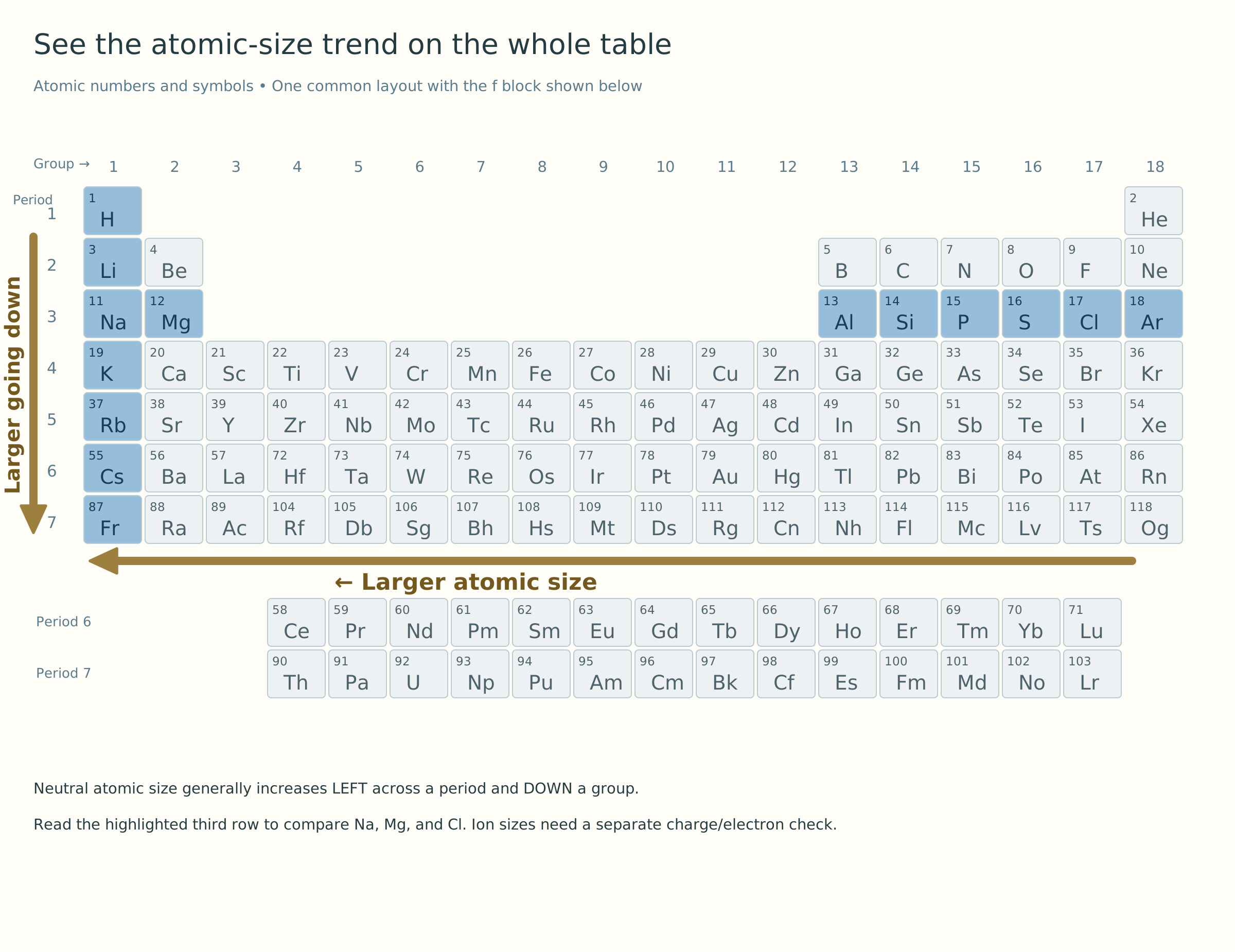
On the periodic table: Sodium (Na) and potassium (K) are both in Group 1. K is one row lower, in Period 4.
What does moving down a group add to an atom?
Hint 2 · the next move
"Neutral atom" and "larger" for two elements in the same group signal the down-a-group size trend.
Your path:
- Na and K are in one group
- Down a group adds a shell
- Lower atom is larger
Answer
Answer: K
Full worked solution
What you know: Na and K are neutral atoms in the same group. What you want: Which is generally larger.
- Same group, so use the down-a-group trend.
- Going down a group adds an occupied shell. The outer electrons sit farther from the nucleus, and inner electrons shield them.
- K is one row below Na, so K is larger.
Why it matters: Neutral atomic size grows down and to the left. K is lower, so it should be bigger.
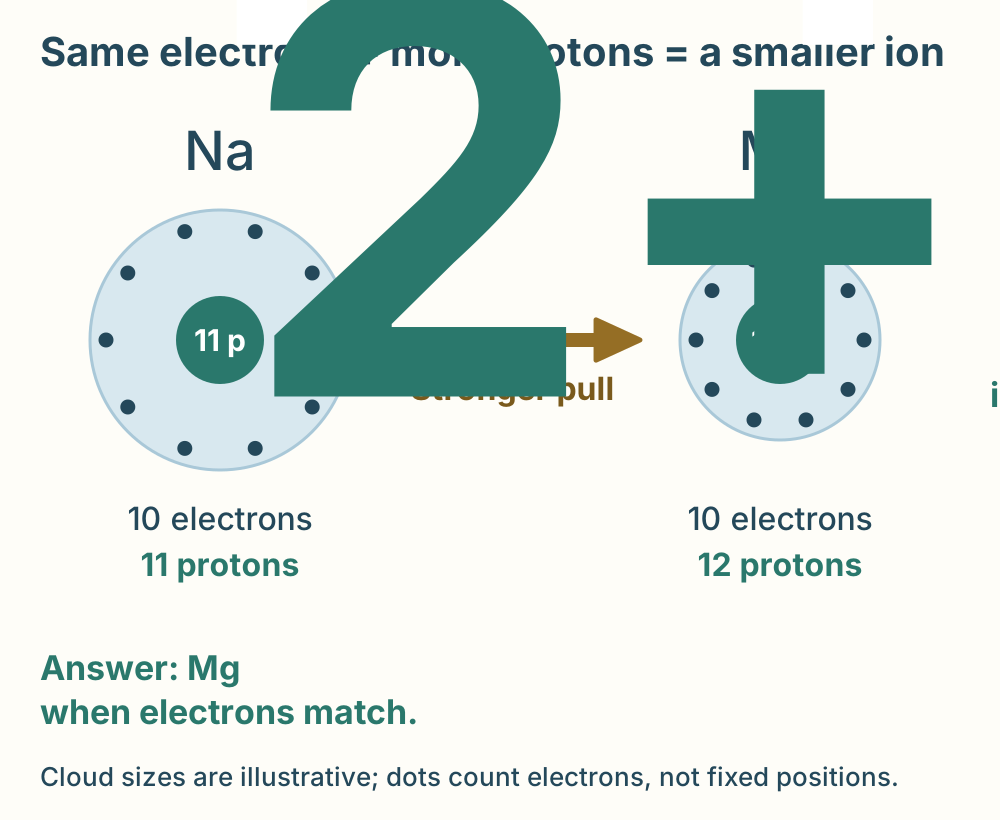
Watch out: K has more protons, but more protons does not make it smaller here. The extra shell wins down a group.
On the periodic table: Sodium (Na) is in Period 3 and potassium (K) is in Period 4, both in Group 1, so K has one more occupied shell.
Answer: K
YOUR PERIODIC-TABLE REFERENCE
Atomic number identifies proton count. The decimal mass is an average, not an isotope’s mass number. Use supplied rounded masses when a problem gives them.