ChemGem

How to Calculate Wavelength, Frequency and Photon Energy (Step-by-Step, with Practice)

Light travels as waves, and it also comes in packets of energy called photons. This lesson links a photon’s wavelength, frequency and energy, and shows how atoms absorb or give off light when an electron changes energy level.

Spot it, solve it, practice it: 4 steps, 1 worked example, 11 practice problems. Free, no account.

The route · 4 steps

  1. Convert the wavelength to meters (1 nm = 10−9 m).
  2. Find frequency: ν = c / λ.
  3. Find photon energy: E = hν.
  4. Check the units cancel and keep three significant figures.
Spot it

How to recognize light and photon energy questions

Look for wavelength (nm), frequency (Hz), photon energy, c = 3.00 × 10⁸ m/s, or the words absorbed and emitted.

Example wording, with the clue words marked:

Light has frequency 1.00 × 10¹⁴ Hz. Find wavelength using c = 3.00 × 10⁸ m/s.

Not sure it’s this type? Compare the neighbors:

Step-by-step

Worked example: light and photon energy

The idea

Wavelength and frequency trade off
Longer λ: lower frequency, lower photon energyλHalf the λ: twice the frequency, twice the photon energyλ
Wavelength (λ): distance from one peak to the next. Frequency (ν): wave cycles per second, in hertz (Hz = s−1). In vacuum, all light moves at the same speed, so a shorter wave means more cycles per second.
Wave speed = wavelength × frequency
c = λ × ν     so     ν = cλ
c = 2.998 × 10⁸ m/s; this chapter uses 3.00 × 10⁸ m/s. λ in meters; ν in s−1. Convert with 1 nm = 10−9 m.
Photon energy = Planck constant × frequency
E = h × ν = h × cλ
E is energy per photon, in J. h = 6.626 × 10⁻³⁴ J·s. Higher frequency, or shorter wavelength, means more energy.
Shorter wavelength, more energy per photon
Lightλ (nm)ν (s−1)E per photon (J)
Violet400.7.50 × 10144.97 × 10−19
Green500.6.00 × 10143.98 × 10−19
Red700.4.29 × 10142.84 × 10−19
Using c = 3.00 × 10⁸ m/s and h = 6.626 × 10⁻³⁴ J·s.
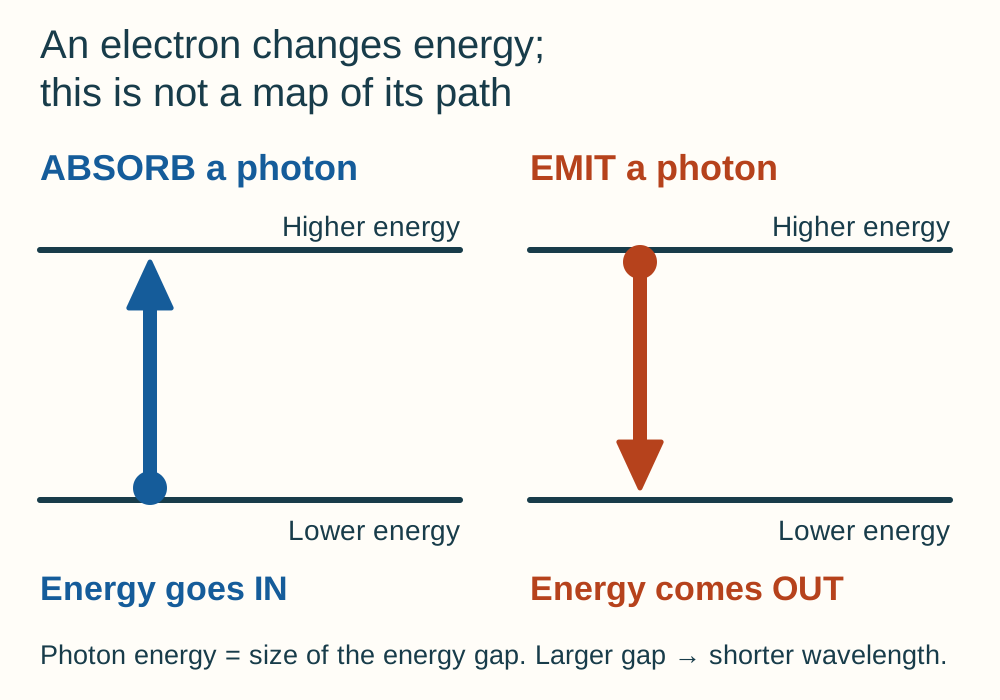
Absorption raises electron energy; emission lowers it. The photon carries the energy difference. These lines show energy levels, not spatial orbits.
The photon carries the energy difference between two levels. These lines are energy levels, not spatial orbits.
Absorption and emission are opposites
Absorption: electron moves up
The atom takes in a photon.
The photon’s energy must match an allowed energy gap.
An electron moves to a higher-energy state.
Emission: electron moves down
An electron moves to a lower-energy state.
The atom releases a photon.
Photon energy = the positive size of the gap.
  • Atomic energy levels are discrete: only certain values are allowed.
  • Higher-energy states are not fixed circular tracks. The diagram shows energy, not a literal orbit.

On the periodic table: Nothing in this lesson is read from the periodic table: c and h are constants supplied with the problem.

Worked example · 4 steps

Light has wavelength λ = 500. nm. Find its frequency and the energy of one photon.

  1. 1
    Convert to meters

    c is in m/s, so λ must be in meters.

    λ = 500. nm × 10−9 m1 nm = 5.00 × 10⁻⁷ m
  2. 2
    Find the frequency

    Meters cancel, leaving s−1 (Hz).

    ν = cλ = 3.00 × 10⁸ m/s5.00 × 10−7 m = 6.00 × 10¹⁴ Hz
  3. 3
    Find the photon energy

    Seconds cancel, leaving joules.

    E = hν = (6.626 × 10⁻³⁴ J·s)(6.00 × 10¹⁴ s−1) = 3.98 × 10⁻¹⁹ J
  4. 4
    Check with E = hc/λ

    The other form of the equation gives the same energy.

    E = (6.626 × 10⁻³⁴ J·s)(3.00 × 10⁸ m/s)5.00 × 10−7 m = 3.98 × 10⁻¹⁹ J
  5. ✓
    Answer

    ν = 6.00 × 10¹⁴ Hz; E = 3.98 × 10⁻¹⁹ J per photon

Your turn

Light and photon energy practice problems

Answer first, then check. Hints open one at a time; the answer and full solution open after you try.

Problem 1 of 11 · warm-up

Light has frequency 1.00 × 10¹⁴ Hz. Find wavelength using c = 3.00 × 10⁸ m/s.

Hint 1 · the clue

Rearrange c = λν for λ.

Hint 2 · the next move

Frequency in Hz is given and wavelength is asked, with c: that signals rearranging c = λν to λ = c ÷ ν.

Your path:

  1. Rearrange c = λν: λ = c ÷ ν
  2. Divide; units leave meters
  3. Convert meters to nm
Answer

Answer: 3.00 × 10³ nm

Full worked solution

What you know: ν = 1.00 × 10¹⁴ Hz (s−1) and c = 3.00 × 10⁸ m/s. What you want: Wavelength λ in nm.

  1. Rearrange c = λν to λ = c ÷ ν.
  2. λ = (3.00 × 10⁸ m/s) ÷ (1.00 × 10¹⁴ s−1) = 3.00 × 10⁻⁶ m. The s−1 and /s cancel, leaving meters.
  3. Convert to nm: 3.00 × 10−6 m × (1 nm / 10−9 m) = 3.00 × 10³ nm. Three significant figures, matching the data.

Check: Reverse it: 3000 × 10−9 m × 1.00 × 1014 s−1 should give 3.00 × 10⁸ m/s.

Watch out: Divide c by ν; don't multiply. And convert m to nm by dividing by 10−9 (multiplying by 109).

Answer: 3.00 × 10³ nm

Problem 2 of 11

Light has frequency 2.00 × 10¹⁴ Hz. Find wavelength using c = 3.00 × 10⁸ m/s.

Hint 1 · the clue

Rearrange c = λν for λ.

Hint 2 · the next move

Frequency in Hz is given and wavelength is asked, with c: that signals rearranging c = λν to λ = c ÷ ν.

Your path:

  1. Rearrange c = λν: λ = c ÷ ν
  2. Divide; units leave meters
  3. Convert meters to nm
Answer

Answer: 1.50 × 10³ nm

Full worked solution

What you know: ν = 2.00 × 10¹⁴ Hz (s−1) and c = 3.00 × 10⁸ m/s. What you want: Wavelength λ in nm.

  1. Rearrange c = λν to λ = c ÷ ν.
  2. λ = (3.00 × 10⁸ m/s) ÷ (2.00 × 10¹⁴ s−1) = 1.50 × 10⁻⁶ m. The s−1 and /s cancel, leaving meters.
  3. Convert to nm: 1.50 × 10−6 m × (1 nm / 10−9 m) = 1.50 × 10³ nm. Three significant figures, matching the data.

Check: Reverse it: 1500 × 10−9 m × 2.00 × 1014 s−1 should give 3.00 × 10⁸ m/s.

Watch out: Divide c by ν; don't multiply. And convert m to nm by dividing by 10−9 (multiplying by 109).

Answer: 1.50 × 10³ nm

Problem 3 of 11

Light has frequency 3.00 × 10¹⁴ Hz. Find wavelength using c = 3.00 × 10⁸ m/s.

Hint 1 · the clue

Rearrange c = λν for λ.

Hint 2 · the next move

Frequency in Hz is given and wavelength is asked, with c: that signals rearranging c = λν to λ = c ÷ ν.

Your path:

  1. Rearrange c = λν: λ = c ÷ ν
  2. Divide; units leave meters
  3. Convert meters to nm
Answer

Answer: 1.00 × 10³ nm

Full worked solution

What you know: ν = 3.00 × 10¹⁴ Hz (s−1) and c = 3.00 × 10⁸ m/s. What you want: Wavelength λ in nm.

  1. Rearrange c = λν to λ = c ÷ ν.
  2. λ = (3.00 × 10⁸ m/s) ÷ (3.00 × 10¹⁴ s−1) = 1.00 × 10⁻⁶ m. The s−1 and /s cancel, leaving meters.
  3. Convert to nm: 1.00 × 10−6 m × (1 nm / 10−9 m) = 1.00 × 10³ nm. Three significant figures, matching the data.

Check: Reverse it: 1000 × 10−9 m × 3.00 × 1014 s−1 should give 3.00 × 10⁸ m/s.

Watch out: Divide c by ν; don't multiply. And convert m to nm by dividing by 10−9 (multiplying by 109).

Answer: 1.00 × 10³ nm

Problem 4 of 11

Light has frequency 4.00 × 10¹⁴ Hz. Find wavelength using c = 3.00 × 10⁸ m/s.

Hint 1 · the clue

Rearrange c = λν for λ.

Hint 2 · the next move

Frequency in Hz is given and wavelength is asked, with c: that signals rearranging c = λν to λ = c ÷ ν.

Your path:

  1. Rearrange c = λν: λ = c ÷ ν
  2. Divide; units leave meters
  3. Convert meters to nm
Answer

Answer: 750. nm

Full worked solution

What you know: ν = 4.00 × 10¹⁴ Hz (s−1) and c = 3.00 × 10⁸ m/s. What you want: Wavelength λ in nm.

  1. Rearrange c = λν to λ = c ÷ ν.
  2. λ = (3.00 × 10⁸ m/s) ÷ (4.00 × 10¹⁴ s−1) = 7.50 × 10⁻⁷ m. The s−1 and /s cancel, leaving meters.
  3. Convert to nm: 7.50 × 10−7 m × (1 nm / 10−9 m) = 750. nm. Three significant figures, matching the data. The decimal point in 750. shows the zero counts.

Check: Reverse it: 750 × 10−9 m × 4.00 × 1014 s−1 should give 3.00 × 10⁸ m/s.

Watch out: Divide c by ν; don't multiply. And convert m to nm by dividing by 10−9 (multiplying by 109).

Answer: 750. nm

Problem 5 of 11

Light has frequency 5.00 × 10¹⁴ Hz. Find wavelength using c = 3.00 × 10⁸ m/s.

Hint 1 · the clue

Rearrange c = λν for λ.

Hint 2 · the next move

Frequency in Hz is given and wavelength is asked, with c: that signals rearranging c = λν to λ = c ÷ ν.

Your path:

  1. Rearrange c = λν: λ = c ÷ ν
  2. Divide; units leave meters
  3. Convert meters to nm
Answer

Answer: 600. nm

Full worked solution

What you know: ν = 5.00 × 10¹⁴ Hz (s−1) and c = 3.00 × 10⁸ m/s. What you want: Wavelength λ in nm.

  1. Rearrange c = λν to λ = c ÷ ν.
  2. λ = (3.00 × 10⁸ m/s) ÷ (5.00 × 10¹⁴ s−1) = 6.00 × 10⁻⁷ m. The s−1 and /s cancel, leaving meters.
  3. Convert to nm: 6.00 × 10−7 m × (1 nm / 10−9 m) = 600. nm. Three significant figures, matching the data. The decimal point in 600. shows both zeros count.

Check: Reverse it: 600 × 10−9 m × 5.00 × 1014 s−1 should give 3.00 × 10⁸ m/s.

Watch out: Divide c by ν; don't multiply. And convert m to nm by dividing by 10−9 (multiplying by 109).

Answer: 600. nm

Problem 6 of 11

Which photon has more energy: 400 nm or 700 nm?

Hint 1 · the clue

Use E = hc/λ. Is λ in the numerator or the denominator?

Hint 2 · the next move

"Which photon has more energy" with two wavelengths means use E = hc/λ: shorter wavelength, more energy.

Your path:

  1. E = hc/λ; h and c are constant
  2. λ is in the denominator
  3. Shorter wavelength → more energy
Answer

Answer: 400 nm

Full worked solution

What you know: Two photons: 400 nm and 700 nm. What you want: Which carries more energy.

  1. Use E = hc/λ. h and c are constants, so energy depends only on λ.
  2. λ is in the denominator, so a smaller wavelength gives a larger energy.
  3. 400 nm is shorter than 700 nm, so 400 nm has more energy.

Check: 700/400 = 1.75, so the 400 nm photon has 1.75 times the energy. Violet light (400 nm) is more energetic than red (700 nm).

Watch out: Bigger wavelength does not mean bigger energy. It is the opposite.

Answer: 400 nm

Problem 7 of 11

Does emission move an electron up or down in energy?

Hint 1 · the clue

In emission, does the photon carry energy into the atom or out of it?

Hint 2 · the next move

"Emission" means the atom gives off a photon, so the electron must lose energy.

Your path:

  1. Emitted photon carries energy away
  2. Electron ends with less energy
  3. So it moves down
Answer

Answer: Down

Full worked solution

What you know: In emission, an atom gives off a photon. What you want: Whether the electron moves up or down in energy.

  1. The photon carries energy away from the atom.
  2. Energy is conserved, so the electron must end with less energy than it started with.
  3. So emission moves the electron Down to a lower-energy state.

Why it matters: The photon's energy equals the size of the gap between the two levels.

Answer: Down

Problem 8 of 11

Does absorption move an electron up or down?

Hint 1 · the clue

Absorption takes in a photon’s energy.

Hint 2 · the next move

"Absorption" means the atom takes in a photon's energy, so the electron gains energy.

Your path:

  1. Absorbed photon adds energy
  2. Electron gains that energy
  3. So it moves up
Answer

Answer: Up

Full worked solution

What you know: In absorption, an atom takes in a photon. What you want: Whether the electron moves up or down.

  1. The photon's energy is added to the atom.
  2. It is absorbed only if it matches an allowed gap between levels.
  3. The electron gains that energy, so it moves Up to a higher-energy state.

Why it matters: Absorption and emission are opposites: absorption goes up, emission goes down.

Answer: Up

Problem 9 of 11

What unit must λ use with c in m/s?

Hint 1 · the clue

The length unit of λ must cancel the meters in c.

Hint 2 · the next move

"What unit" for λ "with c in m/s" asks you to match units on both sides of c = λν.

Your path:

  1. Write units: m/s = λ × s−1
  2. λ must be in meters to match
  3. Convert nm to m before using
Answer

Answer: Meters

Full worked solution

What you know: c = λν with c in m/s and ν in s−1. What you want: The unit λ must use.

  1. Write the units: m/s = λ × s−1.
  2. For the units to match on both sides, λ must be in meters.
  3. So λ must use Meters. Convert nm to m first (1 nm = 10−9 m).

Check: (m) × (s−1) = m/s, which matches c's units.

Watch out: Plugging 500 nm straight in as "500" makes the answer off by 109.

Answer: Meters

Problem 10 of 11

Double frequency: what happens to photon energy?

Hint 1 · the clue

E = hν, so photon energy is proportional to frequency.

Hint 2 · the next move

"Double frequency" and "photon energy" point to E = hν, where energy is directly proportional to frequency.

Your path:

  1. Use E = hν; h is constant
  2. E changes in step with ν
  3. Double ν → double E
Answer

Answer: It doubles

Full worked solution

What you know: E = hν, and h is a constant. What you want: What happens to E when ν doubles.

  1. E is directly proportional to ν: E = h × ν.
  2. Replace ν with 2ν: Enew = h × 2ν = 2 × (hν).
  3. The answer: It doubles.

Check: Try numbers. ν = 1.00 × 10¹⁴ s−1 gives E = 6.63 × 10⁻²⁰ J; ν = 2.00 × 10¹⁴ s−1 gives E = 1.33 × 10⁻¹⁹ J, twice as much.

Watch out: Don't confuse this with wavelength. Doubling λ would halve the energy.

Answer: It doubles

Problem 11 of 11

Light of wavelength 500. nm strikes an atom, and an electron moves up to a higher energy level. Find the light’s frequency and the energy of one photon. Is the photon absorbed or emitted? Use c = 3.00 × 10⁸ m/s and h = 6.626 × 10⁻³⁴ J·s.

Hint 1 · the clue

Convert nm to m first. Then ν = c ÷ λ and E = hν. Moving up a level takes energy in.

Hint 2 · the next move

Wavelength in nm, c, and h are given, with "frequency" and "energy of one photon" asked: use c = λν, then E = hν.

Your path:

  1. Convert nm to meters
  2. ν = c ÷ λ
  3. E = hν
  4. Moving up → photon absorbed
Answer

ν = 6.00 × 10¹⁴ Hz; E = 3.98 × 10⁻¹⁹ J per photon. The electron absorbs the photon and moves up to a higher energy level.

Full worked solution

What you know: λ = 500. nm, c = 3.00 × 10⁸ m/s, h = 6.626 × 10⁻³⁴ J·s. The electron moves up a level. What you want: ν, E, and whether light is absorbed or emitted.

  1. Convert λ to meters: 500. nm × (10−9 m / 1 nm) = 5.00 × 10⁻⁷ m.
  2. ν = c ÷ λ = (3.00 × 10⁸ m/s) ÷ (5.00 × 10⁻⁷ m) = 6.00 × 10¹⁴ s−1 (Hz).
  3. E = hν = (6.626 × 10⁻³⁴ J·s) × (6.00 × 10¹⁴ s−1) = 3.9756 × 10⁻¹⁹ J, which rounds to 3.98 × 10⁻¹⁹ J.
  4. Moving up needs energy, so the photon is absorbed. Its energy must match the gap between the two levels. So: ν = 6.00 × 10¹⁴ Hz; E = 3.98 × 10⁻¹⁹ J per photon. The electron absorbs the photon and moves up to a higher energy level.

Check: J·s × s−1: the s cancels, leaving J. A tiny energy makes sense for one photon.

Watch out: Leaving λ in nm gives a frequency 109 times too small. Moving down a level is emission, the reverse.

Answer: ν = 6.00 × 10¹⁴ Hz; E = 3.98 × 10⁻¹⁹ J per photon. The electron absorbs the photon and moves up to a higher energy level.

Watch out

Common light and photon energy mistakes