
Problem 1 of 9 · warm-up
An atom has successive ionization energies 590, 1145, and 4912 kJ/mol. How many valence electrons does the large jump suggest?
Hint 1 · the clue
Find the unusually large increase, not the largest absolute value alone.
Hint 2 · the next move
"Successive ionization energies" and "the large jump" mean find where the energy suddenly leaps; electrons before it are valence.
Your path:
- Compare each step to the one before
- Find the unusually large jump
- Electrons removed before the jump are valence
Answer
Answer: 2
Full worked solution
What you know: Successive ionization energies: 590, 1145, and 4912 kJ/mol. What you want: The number of valence electrons.
- Compare each step, not the raw numbers. 590 → 1145 is about 1.9 times larger.
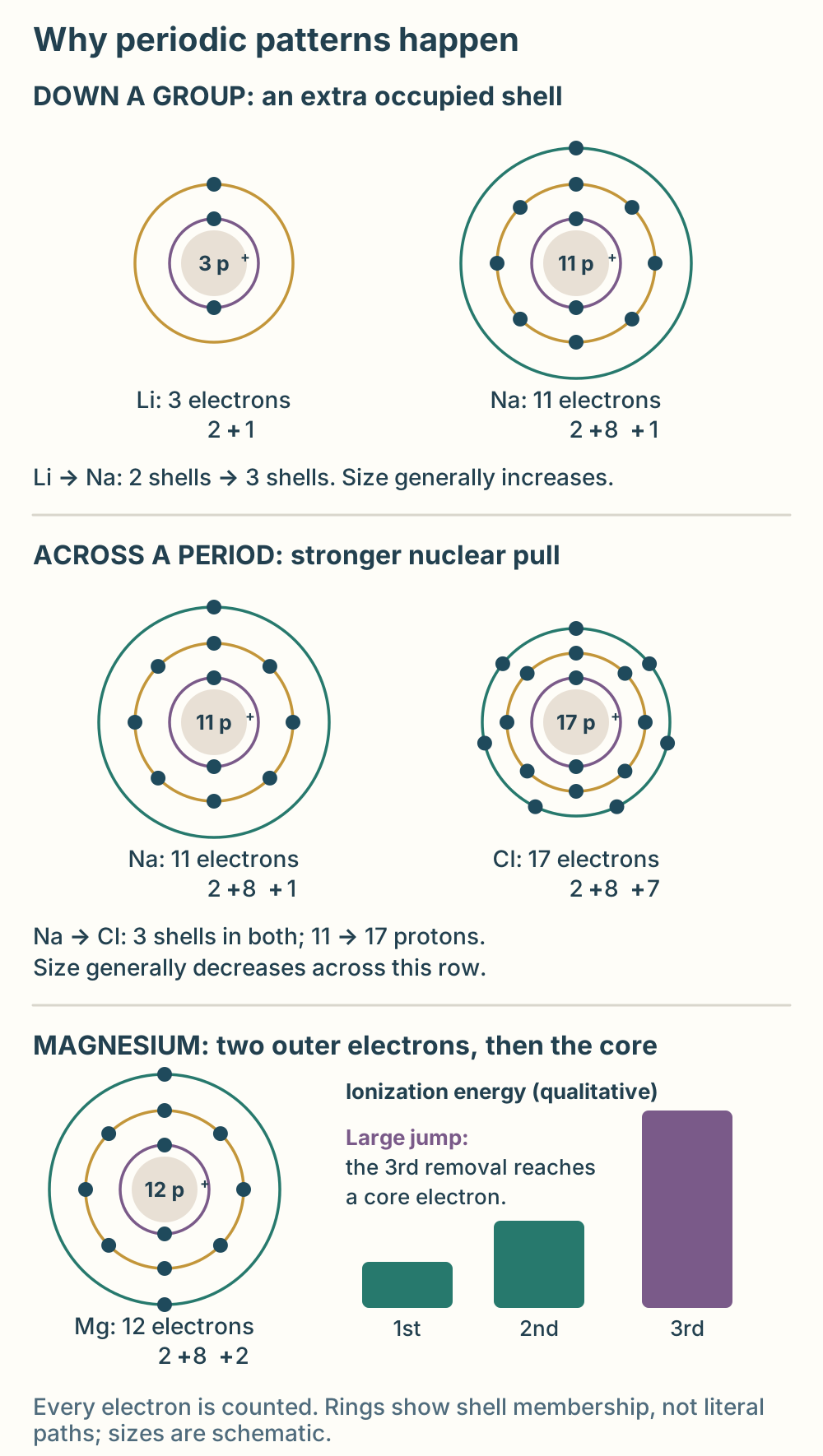
- 1145 → 4912 is about 4.3 times larger. That is the unusually large jump.
- The jump comes right before the third electron. That third electron must be a core electron, much closer to the nucleus.
- So the first two removed were valence electrons: 2.
Check: These are the measured values for calcium (Ca), a Group 2 atom, which shows exactly this pattern: a big jump between the second and third ionizations.
Watch out: Each ionization energy is always higher than the last, so a rise alone means nothing. Look for the rise that is much bigger than the others.
Answer: 2