ChemGem

How to Write Electron Configurations (Step-by-Step, with Practice)

An electron configuration shows which subshells hold an atom’s electrons, and how many. Count the electrons, fill subshells in energy order, then check that the superscripts add up.

Spot it, solve it, practice it: 4 steps, 1 worked example, 7 practice problems. Free, no account.

The route · 4 steps

  1. Count the electrons: the atomic number, plus one per negative charge, minus one per positive charge.
  2. Fill subshells in energy order: 1s, 2s, 2p, 3s, 3p, 4s, 3d, 4p.
  3. Stop when every electron is placed.
  4. Add the superscripts to check the total.
Spot it

How to recognize electron configuration questions

Look for "write the electron configuration" or "valence shell" with an element, ion charge, or electron count.

Example wording, with the clue words marked:

Neutral fluorine has 9 electrons. Write its ground-state electron configuration.

Not sure it’s this type? Compare the neighbors:

Step-by-step

Worked example: electron configuration

The idea

The rules for filling
  • Start with the electron count, then fill in energy order.
  • Superscripts count electrons: 2p6 is six electrons in 2p.
  • Pauli’s rule: at most two electrons per orbital, with opposite spins.
  • Hund’s rule: fill equal-energy orbitals singly before pairing.
  • Valence electrons (main group): those in the outermost shell, highest n. Core electrons: all the inner ones.
From orbitals to boxes (from 3.1)
SubshellOrbitals = boxesMaximum electrons
s12
p36
d510
Each orbital, one probability region, becomes one box holding up to two electrons.
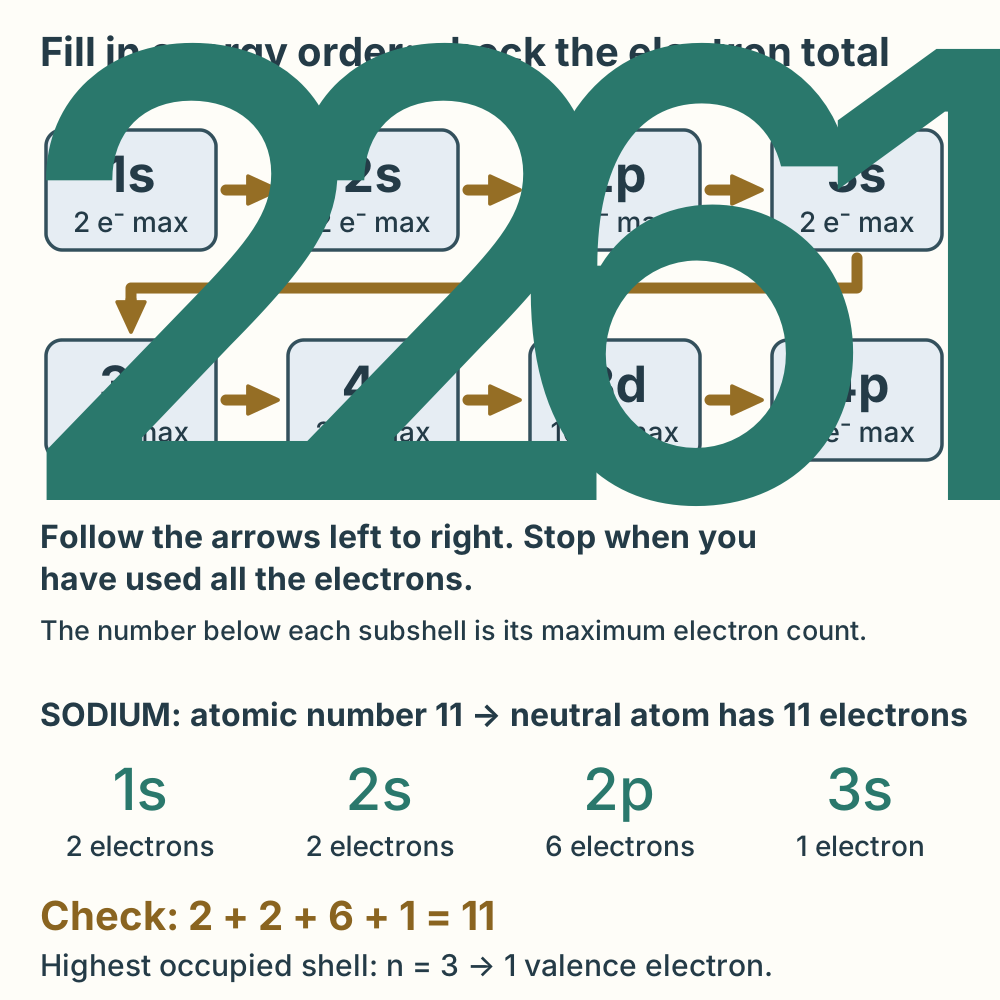
Filling order: 1s, 2s, 2p, 3s, 3p, 4s, 3d, 4p. Sodium has eleven electrons and stops at 3s¹.
Follow the arrows: 1s → 2s → 2p → 3s → 3p → 4s → 3d → 4p. Stop when every electron is placed.
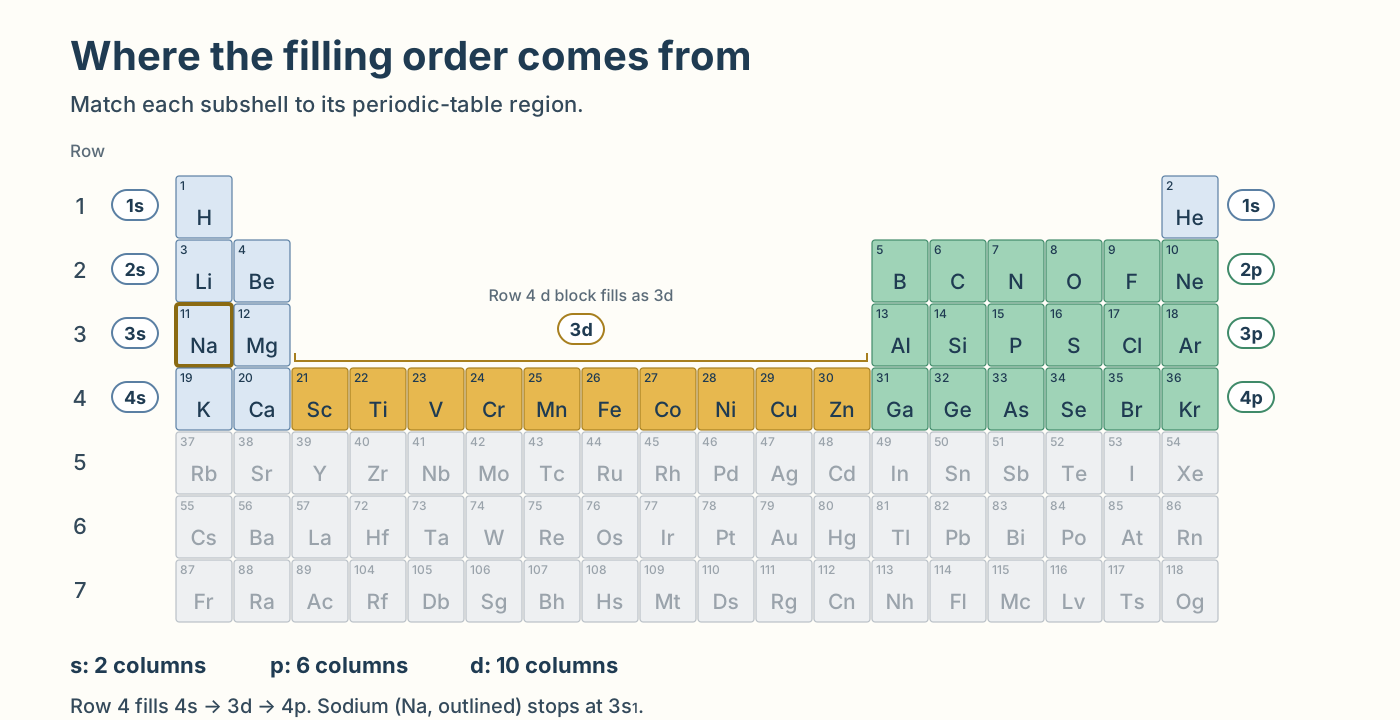
Periodic-table regions labeled 1s through 4p. s regions blue, p green, d gold. Sodium outlined in 3s; helium belongs to 1s.
The same order on the periodic table. Blue: s (sodium starts 3s; helium is 1s). Green: p, six places per row. Gold: d; period 4 runs 4s → 3d → 4p. Some atoms are exceptions.
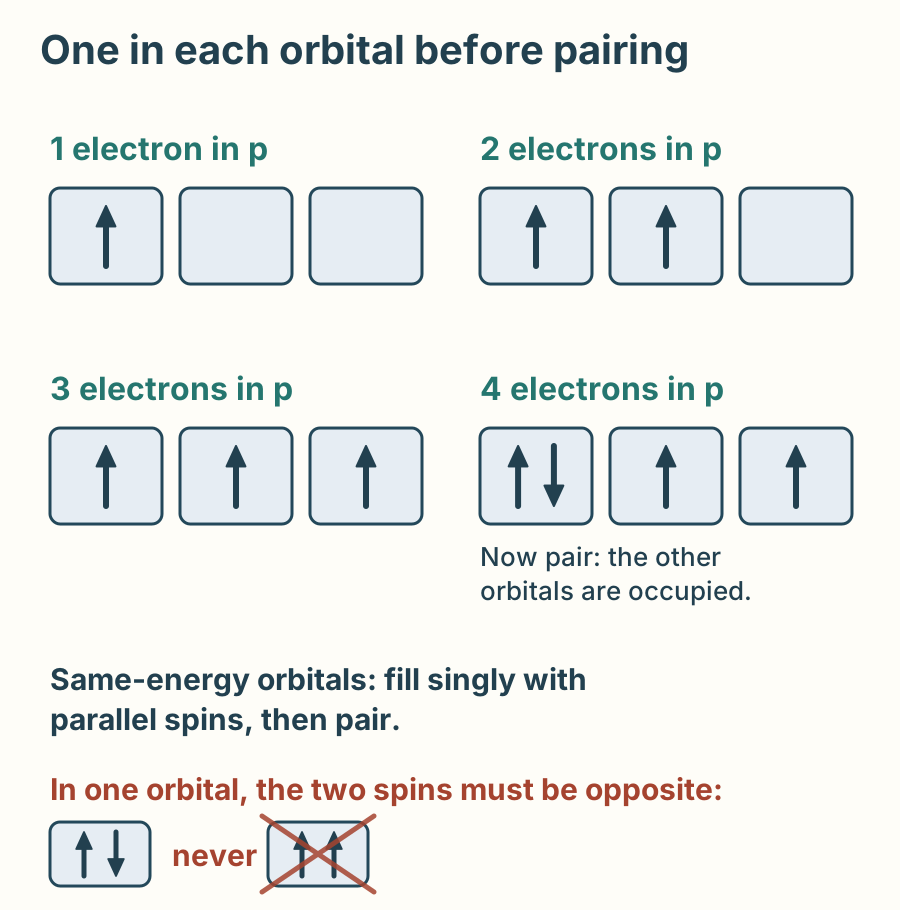
Four stages fill a p subshell singly with parallel spins before pairing. Pauli’s rule requires opposite spins in a paired orbital.
Fill a p subshell singly, with parallel spins, before pairing. A pair has opposite spins.
Shortcut: the noble-gas core
Na: 1s2 2s2 2p6 3s1 = [Ne] 3s1
Cl: [Ne] 3s2 3p5    Fe: [Ar] 4s2 3d6
Check: noble gas’s atomic number + electrons after it = total; Cl: 10 + 7 = 17
Core electrons match the noble gas ending the previous row. Write it in brackets, then add only the electrons after it.
Transition metals: why period 4 uses 3d
  • The middle of the table is the d block. Iron is a transition metal: its atom has a partly filled d subshell.
  • In the introductory route, 4s fills before 3d. The d label is one less than the period: period 4 → 3d, period 5 → 4d.
  • Transition metals often form more than one ion; iron commonly forms Fe2+ and Fe3+.
  • Exceptions such as chromium and copper need adjustments. Follow your course’s examples.
  • d block is not the same as transition metal: Zn and Zn2+ have full d subshells, so zinc is usually excluded.
Configurations for ions
IonRuleConfigurationSame as
Cl−Add 1 electron per negative charge[Ne] 3s2 3p6Ar
Na+Remove from the highest n first[Ne]Ne
Fe2+Remove 4s before 3d[Ar] 3d6—
Fe3+Then one 3d electron[Ar] 3d5—
Starting points: Cl [Ne] 3s2 3p5; Na [Ne] 3s1; Fe [Ar] 4s2 3d6.
Main-group ions reach a noble-gas configuration
  • A full outer shell is ns2np6, or 1s2 like helium for ions such as Li+.
  • This explains the column charges in 2.2: Group 1 loses 1, Group 2 loses 2, Group 16 gains 2, Group 17 gains 1.
  • Isoelectronic: having the same number of electrons (and so, here, the same configuration). Na+, Mg2+, F− and O2− all match neon.

On the periodic table: The atomic number in each box is the electron count of the neutral atom.

On the periodic table: The block shows which subshell is filling; the period gives the s and p shell number.

On the periodic table: The noble-gas core is the Group 18 element in the row above yours.

On the periodic table: Group number gives main-group valence electrons and ion charges.

Worked example · 5 steps

Write the ground-state electron configuration of neutral sodium, atomic number 11.

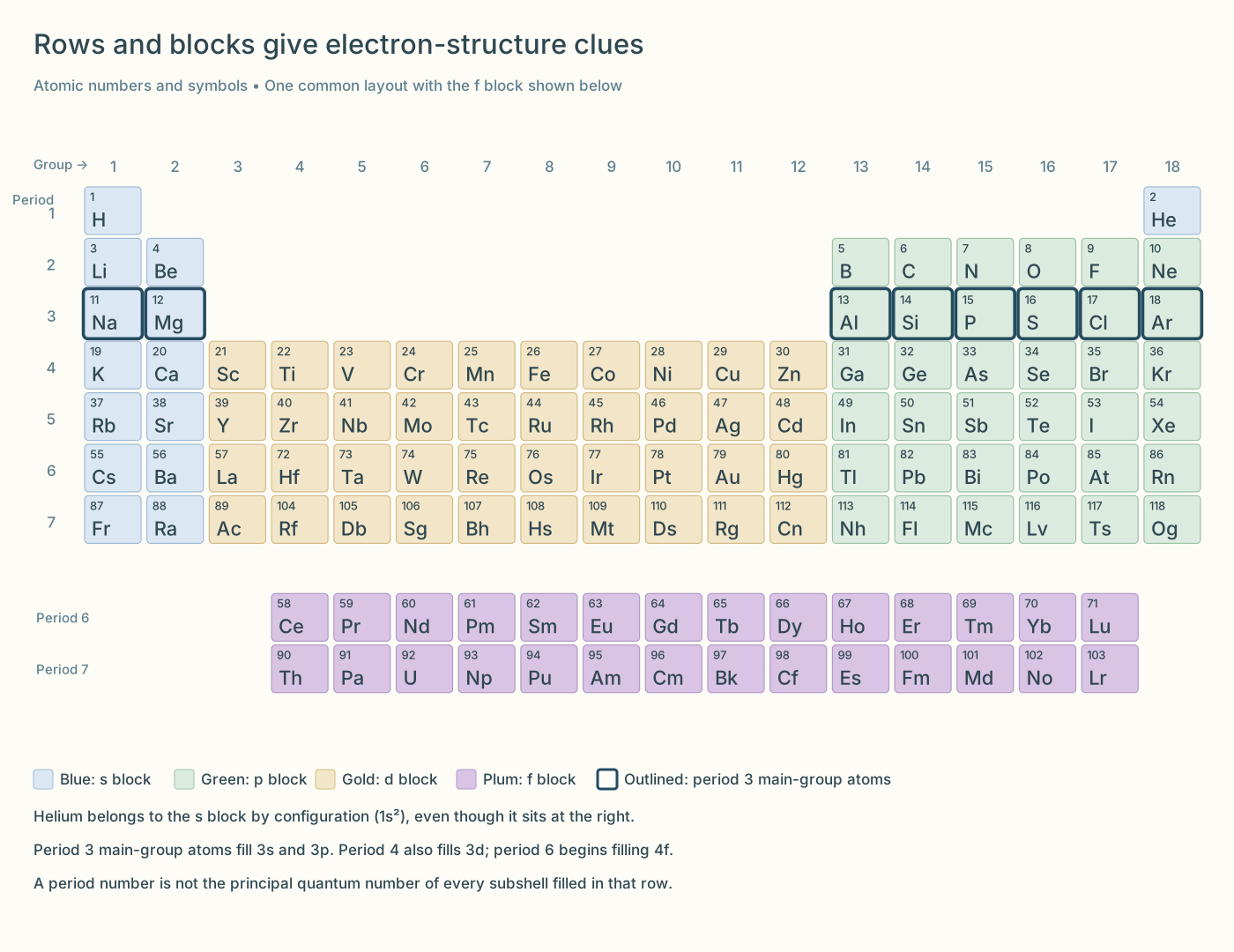
Periodic table colored by block: s block blue (groups 1 and 2, plus He), d block gold (groups 3 to 12), p block green (groups 13 to 18) and f block plum (the two rows below). The period 3 main-group atoms, Na, Mg and Al to Ar, are outlined.
The block tells you which subshell is filling. Period 3 fills 3s, then 3p.
  1. 1
    Set the electron total

    Neutral means equal protons and electrons. On the periodic table: Na is atomic number 11, Period 3.

    Neutral Na: 11 protons → 11 electrons
  2. 2
    Fill the first two s subshells

    Each s subshell holds two.

    SubshellElectrons addedRunning total
    1s22
    2s24
    11 − 4 = 7 electrons left
  3. 3
    Fill the next p subshell

    A p subshell holds six. One electron remains.

    1s2 2s2 2p6 → 10 used, 11 − 10 = 1 left
  4. 4
    Place the last electron

    The next subshell is 3s.

    Sodium in boxes
    filling order, lowest energy first →1s2s2p3svalence electron2 + 2 + 6 + 1 = 11 electrons
    Pairs point opposite ways; the single 3s electron is the valence electron.
  5. 5
    Check the total

    The highest shell, n = 3, holds one valence electron. On the periodic table: Na is Group 1 (1 valence electron) and Period 3 (shell 3).

    2 + 2 + 6 + 1 = 11
  6. ✓
    Answer

    1s2 2s2 2p6 3s1, exactly 11 electrons

Your turn

Electron configuration practice problems

Answer first, then check. Hints open one at a time; the answer and full solution open after you try.

Problem 1 of 7 · warm-up

Neutral fluorine has 9 electrons. Write its ground-state electron configuration.

Hint 1 · the clue

9F19.00On the periodic table: Fluorine (F) has atomic number 9, the whole number in its box.

Neutral atom and electron count are specified.

Hint 2 · the next move

"Ground-state electron configuration" with an electron count means fill subshells in energy order until all electrons are placed.

Your path:

  1. Neutral: electrons = atomic number
  2. Fill 1s, 2s, 2p in order
  3. Check superscripts add to the total
Answer

Answer: 1s2 2s2 2p5

Full worked solution

What you know: Neutral F has 9 electrons. What you want: The ground-state configuration.

  1. Neutral means electrons = protons = 9.
  2. Fill in energy order: 1s2 uses 2, 2s2 uses 2 more (4 used, 5 left).
  3. Put the last 5 in 2p: 1s2 2s2 2p5.

Check: Add the superscripts: 2 + 2 + 5 = 9. And 5 is under the p maximum of 6.

Watch out: Don't skip 2s or fill 2p before it. Also 2p5 is right; 2p6 would be the F− ion.

Your route: Count electrons → Fill in energy order → Check total.

9F19.00On the periodic table: Fluorine (F) has atomic number 9, the whole number in its box, so neutral F has 9 electrons. It sits in Period 2, in the fifth column of the p block, so its configuration ends in 2p5.

Answer: 1s2 2s2 2p5

Problem 2 of 7

For a main-group atom written [Ne] 3s2 3p6, how many electrons are in the valence shell?

Hint 1 · the clue

Valence electrons are requested.

Hint 2 · the next move

"Valence shell" with a noble-gas configuration means add electrons in the highest-numbered shell only.

Your path:

  1. Find the highest shell number
  2. [Ne] core electrons are not valence
  3. Add electrons in that shell's s and p
Answer

Answer: 8

Full worked solution

What you know: The configuration [Ne] 3s2 3p6. What you want: Electrons in the valence (outermost) shell.

  1. The highest shell number shown is 3, so shell 3 is the valence shell.
  2. [Ne] stands for the 10 core electrons in shells 1 and 2. They are not valence.
  3. Add the shell-3 electrons: 3s2 + 3p6 = 2 + 6 = 8.

Check: Total electrons = 10 + 8 = 18, which is argon, a noble gas with a full outer shell of 8.

Watch out: Count only the 6 in 3p and you miss the 2 in 3s. Both are in shell 3.

Your route: Identify the highest occupied shell → Add s and p electrons.

On the periodic table: [Ne] 3s2 3p6 is argon (Ar), atomic number 18, the noble gas in Group 18 at the end of Period 3. Group 18 atoms other than helium have 8 valence electrons.

Answer: 8

Problem 3 of 7

Write the ground-state electron configuration of a neutral magnesium atom with 12 electrons.

Hint 1 · the clue

12Mg24.31On the periodic table: Magnesium (Mg) has atomic number 12, the whole number in its box.

Neutral atom and electron count are specified.

Hint 2 · the next move

"Ground-state electron configuration" of a neutral atom with its electron count means fill subshells in energy order.

Your path:

  1. Neutral: use the given electron count
  2. Fill 1s, 2s, 2p, 3s in order
  3. Check superscripts add to the total
Answer

Answer: 1s2 2s2 2p6 3s2

Full worked solution

What you know: Neutral Mg has 12 electrons. What you want: The ground-state configuration.

  1. Neutral means 12 electrons.
  2. Fill in energy order: 1s2 (2), 2s2 (4 total), 2p6 (10 total). 12 − 10 = 2 left.
  3. The next subshell is 3s, which takes both: 1s2 2s2 2p6 3s2.

Check: 2 + 2 + 6 + 2 = 12. Mg is in Group 2, so 2 valence electrons in 3s fits.

Watch out: Don't put the last two in 3p. 3s fills before 3p.

Your route: Count electrons → Fill in energy order → Check total.

12Mg24.31On the periodic table: Magnesium (Mg) has atomic number 12, the whole number in its box. It sits in Period 3, in the second column of the s block, so its configuration ends in 3s2.

Answer: 1s2 2s2 2p6 3s2

Problem 4 of 7

Write the electron configuration of O2−.

Hint 1 · the clue

Oxygen has 8 electrons; a 2− charge adds 2.

Hint 2 · the next move

"Electron configuration" of a negative ion means add electrons for the charge, then fill in energy order.

Your path:

  1. Start with neutral O's electrons
  2. Negative charge → add electrons
  3. Fill subshells in energy order
Answer

Answer: 1s2 2s2 2p6 ([Ne])

Full worked solution

What you know: O has 8 electrons as a neutral atom. The ion has a 2− charge. What you want: The configuration of O2−.

  1. A negative charge means extra electrons: 8 + 2 = 10 electrons.
  2. Fill in energy order: 1s2 (2), 2s2 (4), then 6 in 2p.
  3. Result: 1s2 2s2 2p6 ([Ne]).

Check: 2 + 2 + 6 = 10, the same as neon. O2− is isoelectronic with Ne.

Watch out: A 2− charge adds electrons; don't subtract them.

Answer: 1s2 2s2 2p6 ([Ne])

Problem 5 of 7

Write the electron configuration of K+.

Hint 1 · the clue

Potassium has 19 electrons; a 1+ charge removes the 4s electron.

Hint 2 · the next move

"Electron configuration" of a positive ion means remove electrons for the charge, from the highest shell first.

Your path:

  1. Start from neutral K's configuration
  2. Positive charge → remove electrons
  3. Remove from the highest shell (4s) first
Answer

Answer: 1s2 2s2 2p6 3s2 3p6 ([Ar])

Full worked solution

What you know: K has 19 electrons as a neutral atom: [Ar] 4s1. The ion has a 1+ charge. What you want: The configuration of K+.

  1. A 1+ charge means one electron is removed: 19 − 1 = 18 electrons.
  2. Remove from the highest shell first. That is the single 4s electron.
  3. What remains is the argon core: 1s2 2s2 2p6 3s2 3p6 ([Ar]).

Check: 2 + 2 + 6 + 2 + 6 = 18 electrons, matching argon.

Watch out: Don't take the electron from 3p. The outermost shell (n = 4) loses electrons first.

Answer: 1s2 2s2 2p6 3s2 3p6 ([Ar])

Problem 6 of 7

Write the noble-gas configuration of Fe3+.

Hint 1 · the clue

Fe is [Ar] 4s2 3d6. Remove 4s electrons first.

Hint 2 · the next move

"Noble-gas configuration" of a transition-metal cation means remove 4s electrons before 3d electrons.

Your path:

  1. Write neutral Fe: [Ar] 4s2 3d6
  2. Remove 4s electrons first
  3. Remove remaining electrons from 3d
Answer

Answer: [Ar] 3d5

Full worked solution

What you know: Fe has 26 electrons: [Ar] 4s2 3d6. The ion has a 3+ charge. What you want: The noble-gas configuration of Fe3+.

  1. A 3+ charge removes 3 electrons: 26 − 3 = 23 electrons.
  2. Remove the 4s electrons first, since n = 4 is the highest shell: [Ar] 3d6 (that is Fe2+).
  3. Remove the third electron from 3d: [Ar] 3d5.

Check: 18 (argon core) + 5 = 23 electrons.

Watch out: Removing 3d electrons first gives [Ar] 4s2 3d3, which is wrong. 4s goes first.

Answer: [Ar] 3d5

Problem 7 of 7

Write neutral neon’s configuration (10 electrons).

Hint 1 · the clue

10Ne20.18On the periodic table: Neon (Ne) has atomic number 10, the whole number in its box.

Use the electron count to fill subshells in energy order. Check capacities and add the superscripts.

Hint 2 · the next move

"Configuration" with an electron count means fill subshells in energy order until all are placed.

Your path:

  1. Neutral: use the given electron count
  2. Fill 1s, 2s, 2p in order
  3. Check superscripts add to the total
Answer

1s2 2s2 2p6; total 10.

Full worked solution

What you know: Neutral Ne has 10 electrons. What you want: Its configuration.

  1. Neutral means 10 electrons.
  2. Fill in energy order: 1s2 (2 used), 2s2 (4 used), leaving 6.
  3. 2p holds up to 6, so it takes all of them: 1s2 2s2 2p6; total 10.

Check: 2 + 2 + 6 = 10. Ne is a noble gas, so ending with a completely full 2p makes sense.

Watch out: Don't write 2p8 or add a 3s. A p subshell holds only 6.

On the periodic table: Neon (Ne) has atomic number 10, so neutral Ne has 10 electrons. It is the noble gas at the end of Period 2, so its configuration ends with a full 2p6.

Answer: 1s2 2s2 2p6; total 10.

Watch out

Common electron configuration mistakes