
Chapter 2 · Free lesson
Compounds: formulas and names
The full lesson, free. For instant answer checking, hints and progress tracking, open the interactive version.
What you will study
- Recognize the two compound types
- Ion reference and predictable charges
- Ionic formulas in both directions; subscripts and parentheses
- Ionic names in both directions
- Molecular formulas and names
- Acids, strong bases, and mixed route practice
By the end, you can…
- Recognize ionic and molecular compounds and explain what holds each together.
- Use the ion reference and periodic table to identify common charges.
- Write a neutral ionic formula, identify its ions, and read subscripts and parentheses.
- Name an ionic compound and write its formula from a name.
- Read a molecular formula and use prefixes to connect formulas and names.
- Recognize aqueous acids and common strong bases, and choose the acid naming route.
These are the skills to check, not just pages to finish. Use the section goals while studying, then try the chapter checks without hints.
First: some elements come in pairs
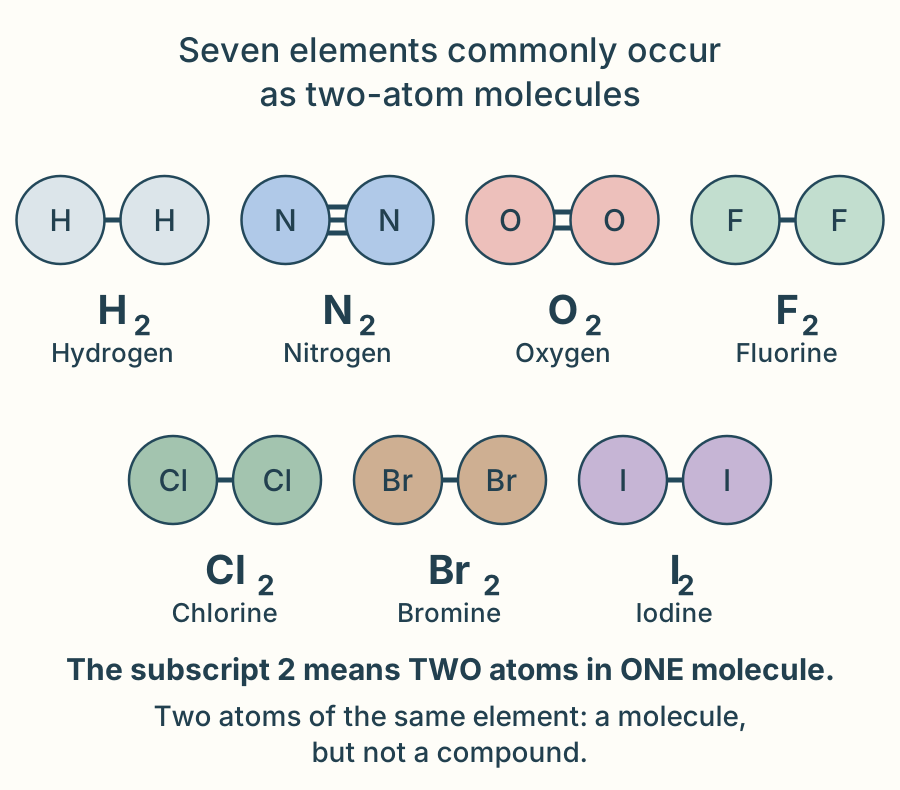
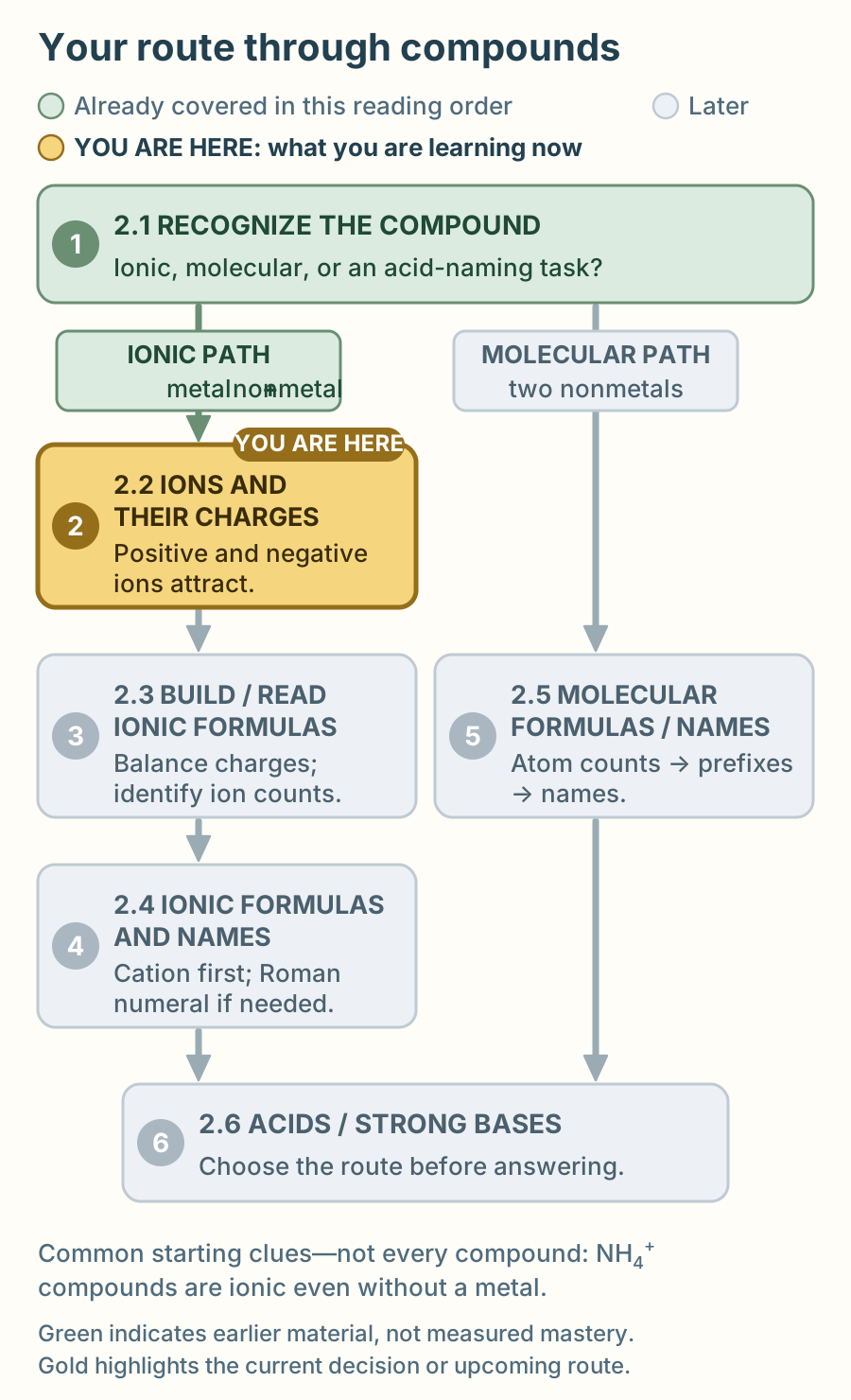
2.1 Recognize the compound: ionic or molecular?
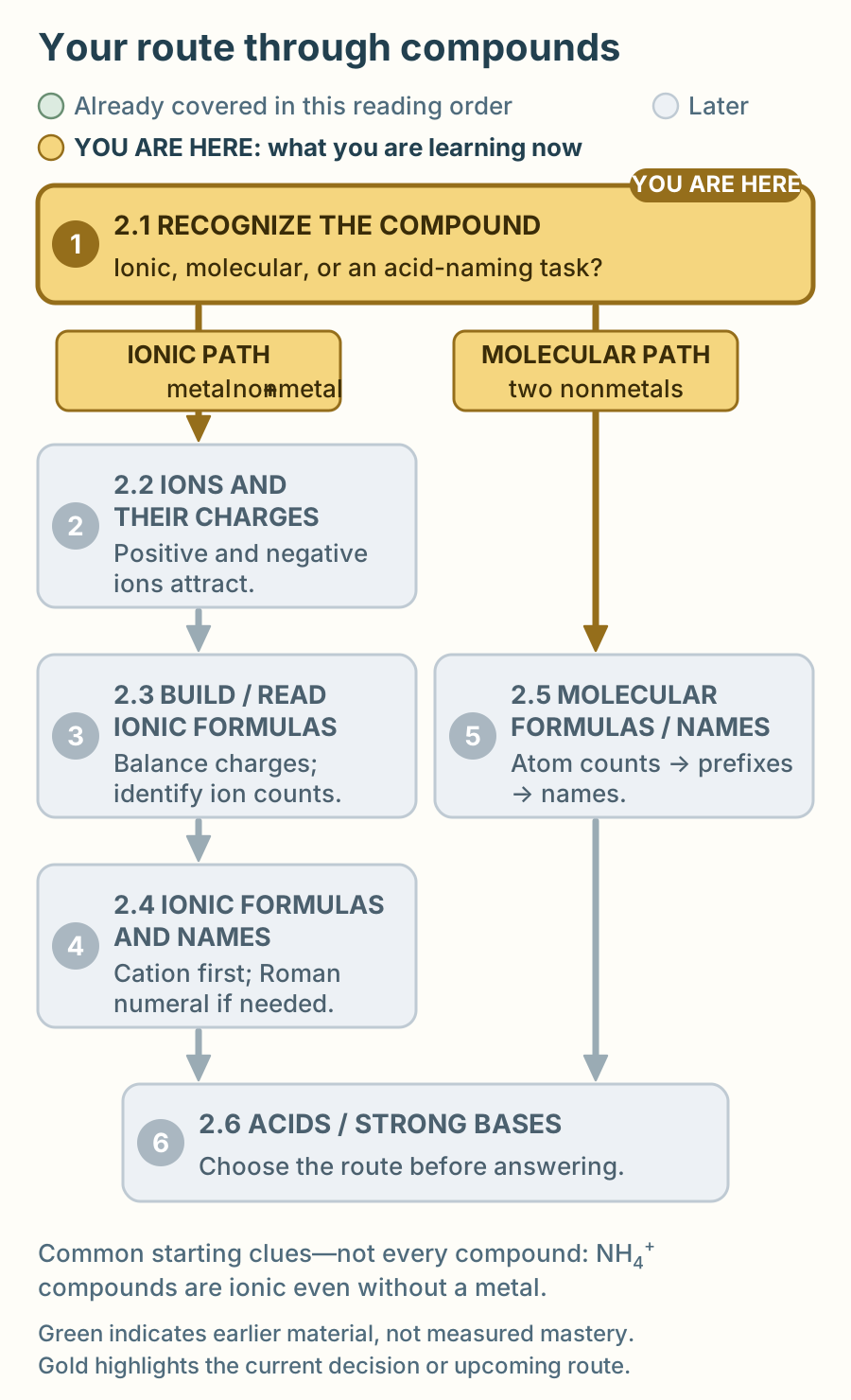
A compound is two or more elements chemically combined. Before you write or name one, decide whether it is ionic (held by attraction between ions) or molecular (held by shared electrons). That one choice sets the route for the rest of the chapter.
- Ions and their charges (1.3).
- Groups and periods on the periodic table (1.0).
Need a refresher? Open the table of contents and revisit that topic before starting.
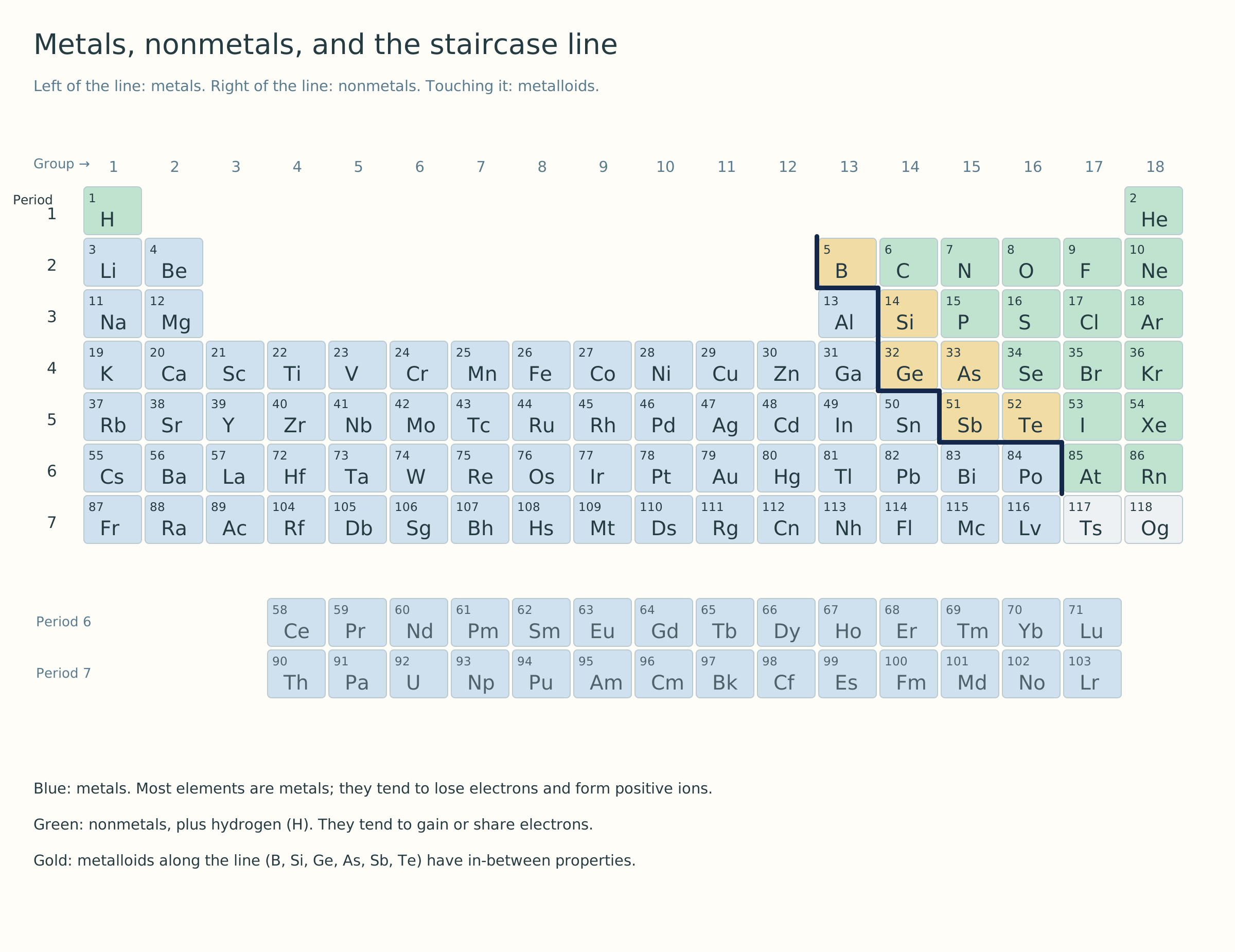
| Kind | Where on the table | Typical behavior |
|---|---|---|
| Metals | Left of the staircase line (most elements) | Lose electrons and form positive ions. |
| Nonmetals | Right of the line, plus hydrogen (H) at top left | Gain or share electrons. |
| Metalloids | Touching the line: B, Si, Ge, As, Sb, Te | Properties in between. |
| Compare | Ionic compounds | Molecular compounds |
|---|---|---|
| What holds it together | Attraction between positive and negative ions | Atoms sharing electrons in covalent bonds |
| First clue | A metal with a nonmetal, or recognizable ions. Ammonium compounds are ionic without a metal. | Nonmetals combined into molecules, such as CO2 or H2O |
| What the formula counts | Simplest whole-number ratio of ions: 1 Mg2+ to 2 Cl− in MgCl2 | Actual atoms in one molecule: 1 C and 2 O in CO2 |
| Formula route | Use ion charges: criss-cross, simplify, check neutral | Use given atom counts or naming prefixes; no criss-cross |
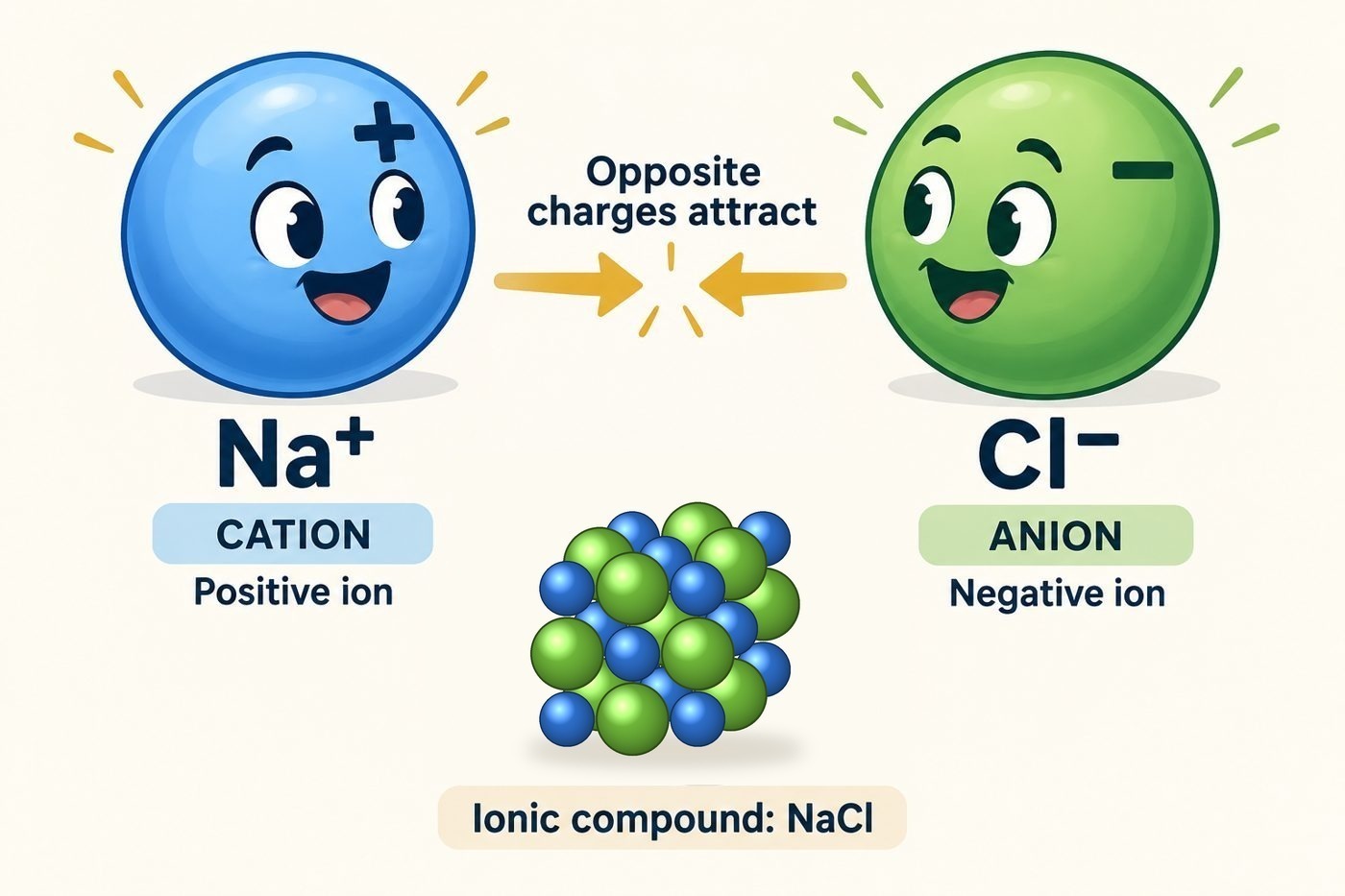
Na → Na+ (loses 1 electron).
Removing a negative charge leaves the ion more positive.
Cl → Cl− (gains 1 electron).
Adding a negative charge drives the total down.
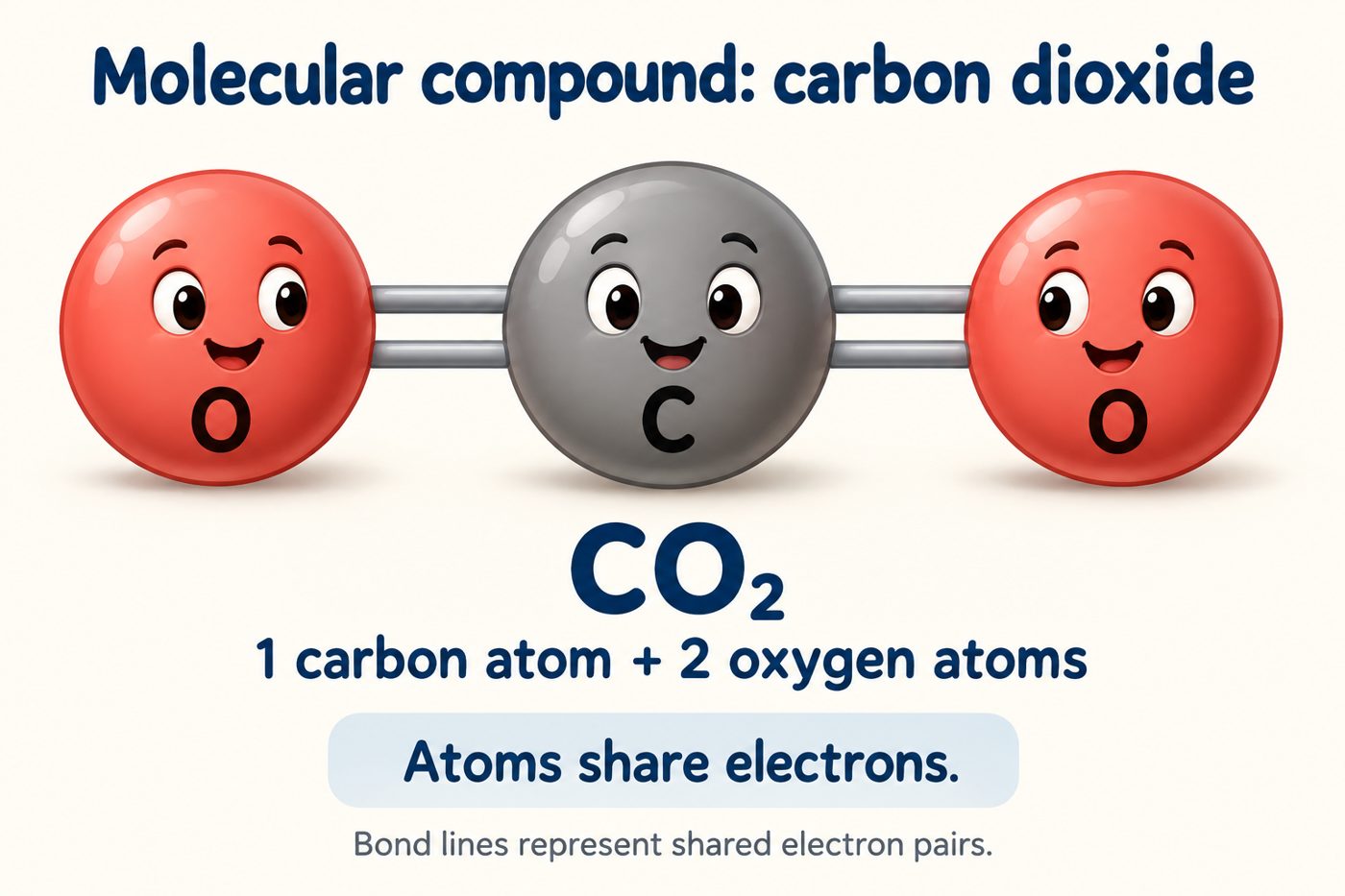
- Many nonmetal compounds are made of molecules: separate groups of atoms held by covalent bonds.
- Covalent means the atoms share electrons.
- CO2 is not a carbon cation balanced by oxide anions. On the periodic table: C and O are both right of the staircase, so both are nonmetals.
- Find each element on the periodic table: metal, nonmetal or metalloid.
- Metal + nonmetal, or a recognizable ion such as NH4+: treat it as ionic.
- Nonmetals only: treat it as molecular.
- Ionic: balance ion charges to zero. Molecular: count the actual atoms.
On the periodic table: Sodium (Na) is in Group 1; Group 1 atoms lose 1 electron, so sodium forms Na+.
On the periodic table: Chlorine (Cl) is in Group 17; Group 17 atoms gain 1 electron, so chlorine forms Cl−.
On the periodic table: Magnesium (Mg) is in Group 2, so it forms Mg2+.
On the periodic table: Carbon (C) and oxygen (O) are right of the staircase line, so both are nonmetals.
How many Cl− ions balance one Mg2+? Write the formula.
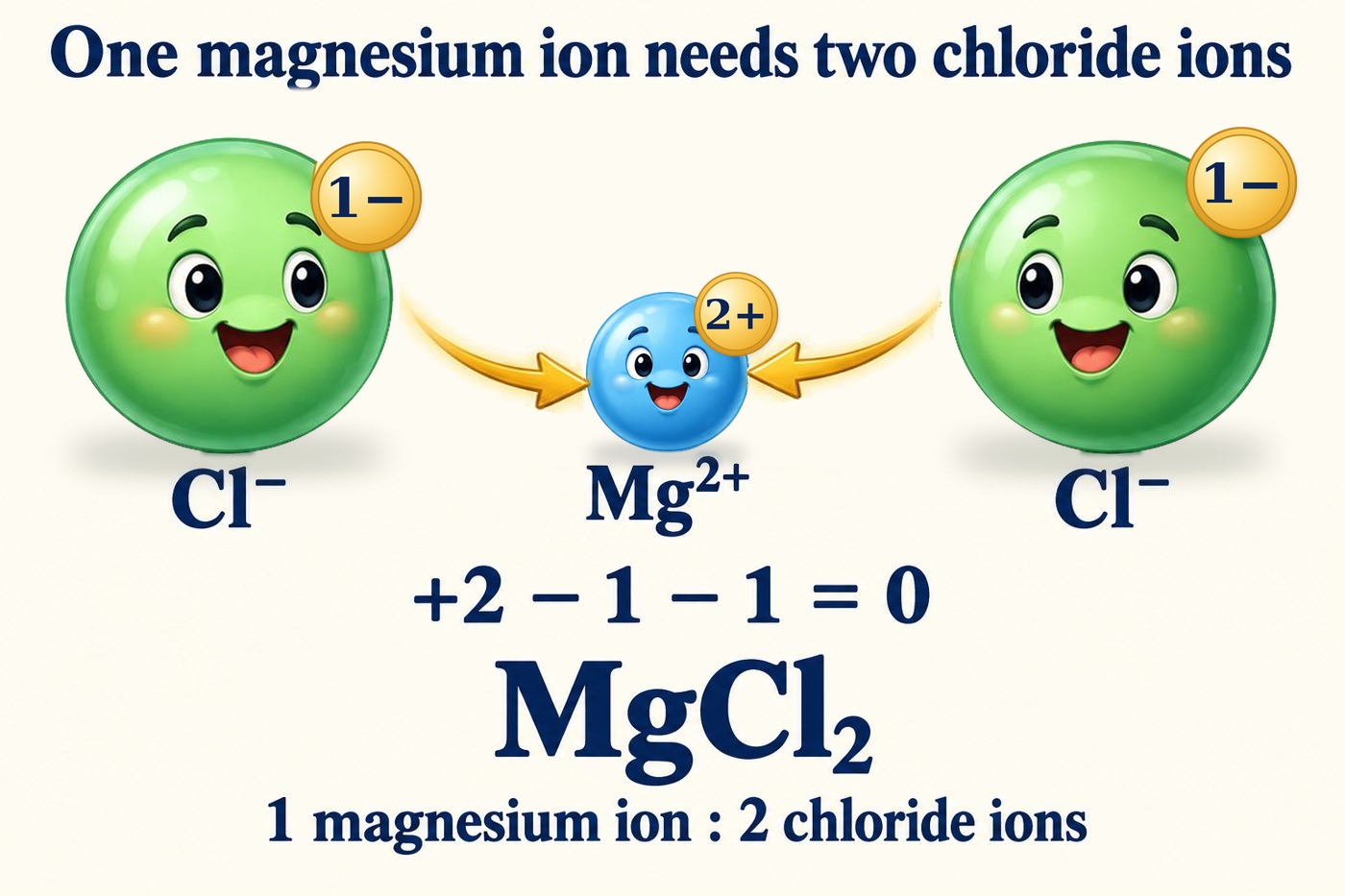
- 1Read the charges
On the periodic table: Mg is in Group 2, so it forms Mg2+. Cl is in Group 17, so it forms Cl−.
Ion Charge Mg2+ +2 Cl− −1 - 2Try one chloride
The total is still positive, so one chloride is not enough.
(+2) + (−1) = +1 - 3Add a second chloride
Now the charges balance.
(+2) + (−1) + (−1) = 0 - 4Write the formula
The unwritten 1 means one Mg2+; the small 2 means two Cl−.
Ion Count × Charge = Total Mg2+ 1 +2 +2 Cl− 2 −1 −2 Sum 0 - ✓Answer
MgCl2
2.2 Ions and their charges: your reference
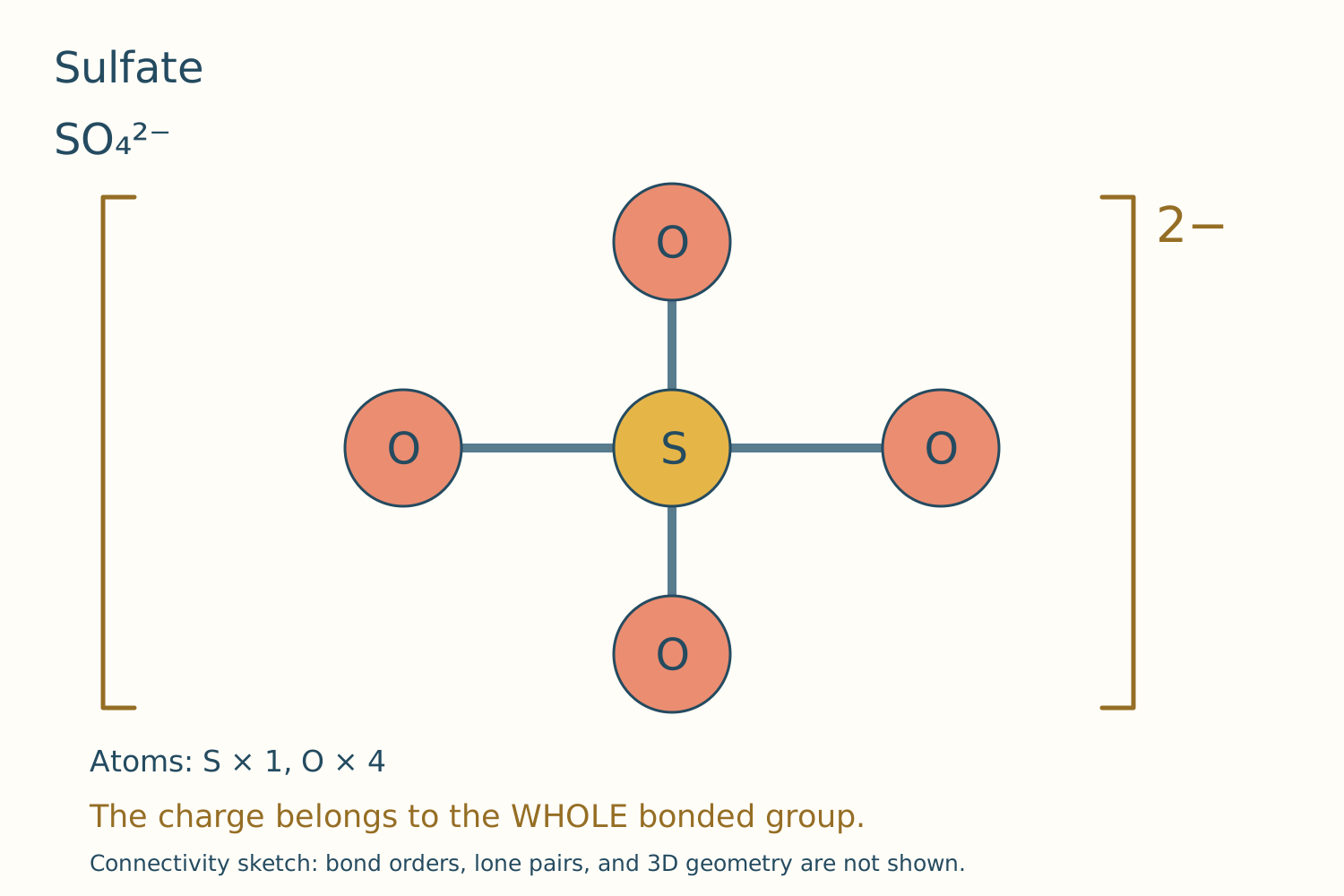
Every ionic formula starts with the ions’ charges. Many charges can be read straight from the periodic table; polyatomic ions come from a short reference list; a few metals need their charge read each time. This lesson is your charge reference.
| Ion formula | Name | Atoms | Charge |
|---|---|---|---|
| NH4+ | Ammonium (the cation to know) | 1 N, 4 H | +1 |
| OH− | Hydroxide | 1 O, 1 H | −1 |
| NO3− | Nitrate | 1 N, 3 O | −1 |
| NO2− | Nitrite | 1 N, 2 O | −1 |
| SO42− | Sulfate | 1 S, 4 O | −2 |
| SO32− | Sulfite | 1 S, 3 O | −2 |
| CO32− | Carbonate | 1 C, 3 O | −2 |
| HCO3− | Hydrogen carbonate (bicarbonate) | 1 H, 1 C, 3 O | −1 |
| PO43− | Phosphate | 1 P, 4 O | −3 |
| C2H3O2− | Acetate (also CH3COO−) | 2 C, 3 H, 2 O | −1 |
| CN− | Cyanide | 1 C, 1 N | −1 |
| MnO4− | Permanganate | 1 Mn, 4 O | −1 |
| CrO42− | Chromate | 1 Cr, 4 O | −2 |
| O22− | Peroxide | 2 O | −2 |
| ClO− | Hypochlorite | 1 Cl, 1 O | −1 |
| ClO2− | Chlorite | 1 Cl, 2 O | −1 |
| ClO3− | Chlorate | 1 Cl, 3 O | −1 |
| ClO4− | Perchlorate | 1 Cl, 4 O | −1 |
Practice the list as flashcards: formula → name and charge; name → formula and charge; ion pair → neutral formula.
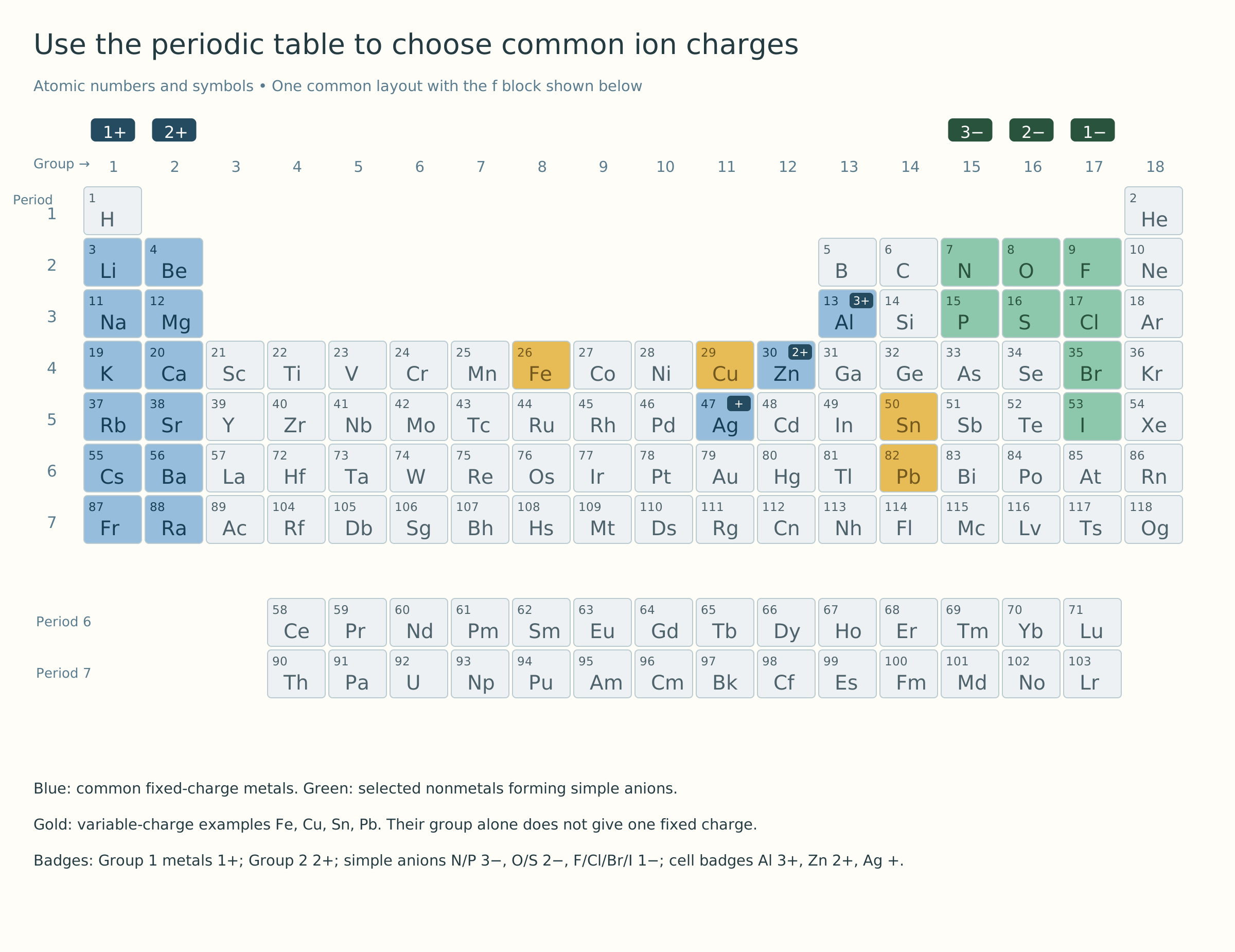
| Where to look | Usual ion charge | Examples |
|---|---|---|
| Group 1 metals | +1 | Li+, Na+, K+ |
| Group 2 metals | +2 | Mg2+, Ca2+, Ba2+ |
| Other fixed-charge metals | Al +3; Zn +2; Ag +1 | Al3+, Zn2+, Ag+ |
| Group 17 single-atom anions | −1 | F−, Cl−, Br−, I− |
| Group 16 single-atom anions | −2 | O2−, S2− |
| Group 15 single-atom anions | −3 | N3− (nitride), P3− (phosphide) |
- The rule gives the charge of the ion. A neutral Mg atom has zero charge; its usual ion is Mg2+.
- Hydrogen sits above Group 1 but is a nonmetal, so the +1 metal rule is not a general rule for H.
- These are single-atom ion charges, not rules for every compound containing the element. Polyatomic charges come from the reference list.
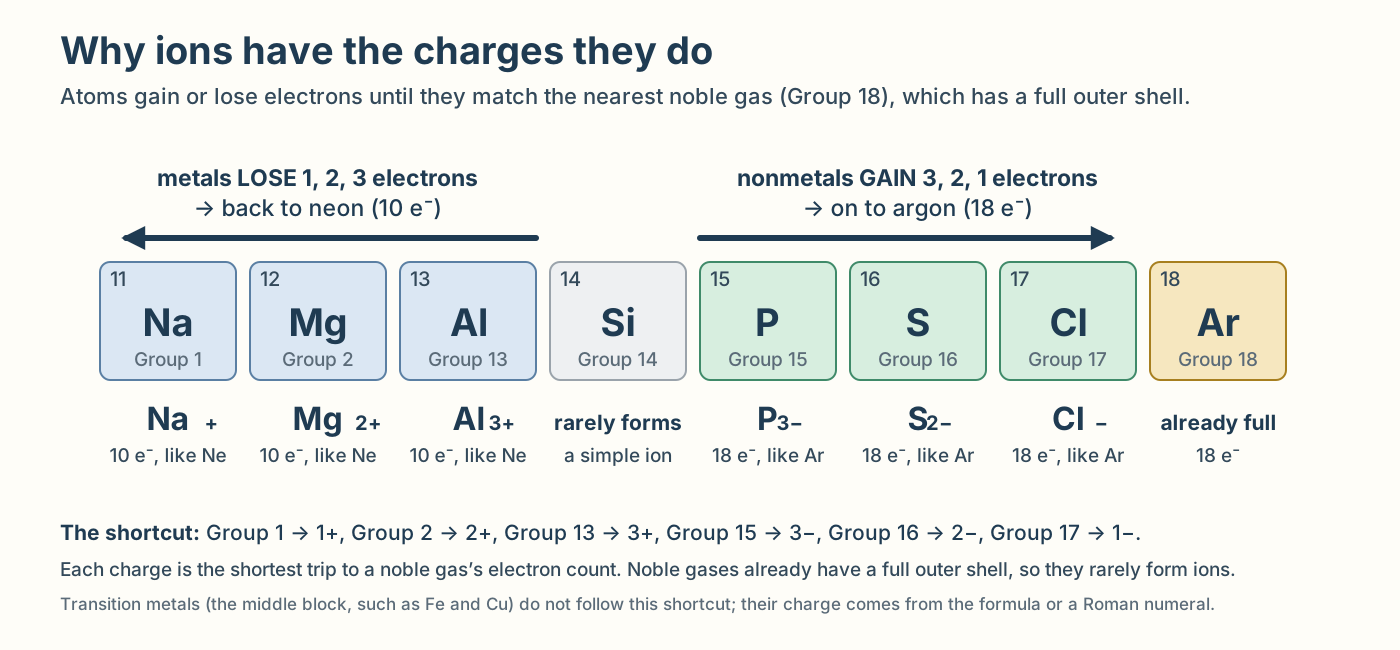
| Atom (electrons) | Change | Ion | Electrons now | Same as |
|---|---|---|---|---|
| Na (11) | loses 1 | Na+ | 10 | neon (Ne) |
| Mg (12) | loses 2 | Mg2+ | 10 | neon (Ne) |
| O (8) | gains 2 | O2− | 10 | neon (Ne) |
| Cl (17) | gains 1 | Cl− | 18 | argon (Ar) |
| Metal | Common ions | Formula check |
|---|---|---|
| Iron | Fe2+ iron(II); Fe3+ iron(III) | FeCl2: 2 Cl− require Fe2+. FeCl3: 3 Cl− require Fe3+. |
| Copper | Cu+ copper(I); Cu2+ copper(II) | CuCl: 1 Cl− requires Cu+. CuCl2: 2 Cl− require Cu2+. |
| Tin | Sn2+ tin(II); Sn4+ tin(IV) | SnCl2 uses Sn2+; SnCl4 uses Sn4+. |
| Lead | Pb2+ lead(II); Pb4+ lead(IV) | PbO uses Pb2+; PbO2 uses Pb4+, since each oxide is O2−. |
(+2) + 2(−1) = 0
(+2) + 2(−1) = 0
- Polyatomic group? Look up its charge in the reference list.
- Main-group element? Read the charge from its group.
- Variable-charge metal? Use the Roman numeral, or balance it against the known anions.
- Check: a main-group ion should have the same electron count as the nearest noble gas.
On the periodic table: Group 1 metals form +1 ions and Group 2 metals form +2 ions.
On the periodic table: Group 17 forms −1, Group 16 forms −2 and Group 15 forms −3 single-atom anions.
On the periodic table: Group 18 noble gases have full outer shells and almost never form ions.
On the periodic table: The table does not give polyatomic-ion charges or a single charge for Fe, Cu, Sn or Pb.
Why does sulfur form S2− rather than S6+?
- 1Compare the two trips
On the periodic table: sulfur (S) has 16 electrons. Argon is just after it; neon is well before it.
Option Electron change Electrons now Same as S2− gain 2 18 argon (Ar) S6+ lose 6 10 neon (Ne) - ✓Answer
Gaining 2 electrons to match argon is a much shorter trip than losing 6 to match neon, so sulfur forms S2−.
2.3 Build and read ionic formulas
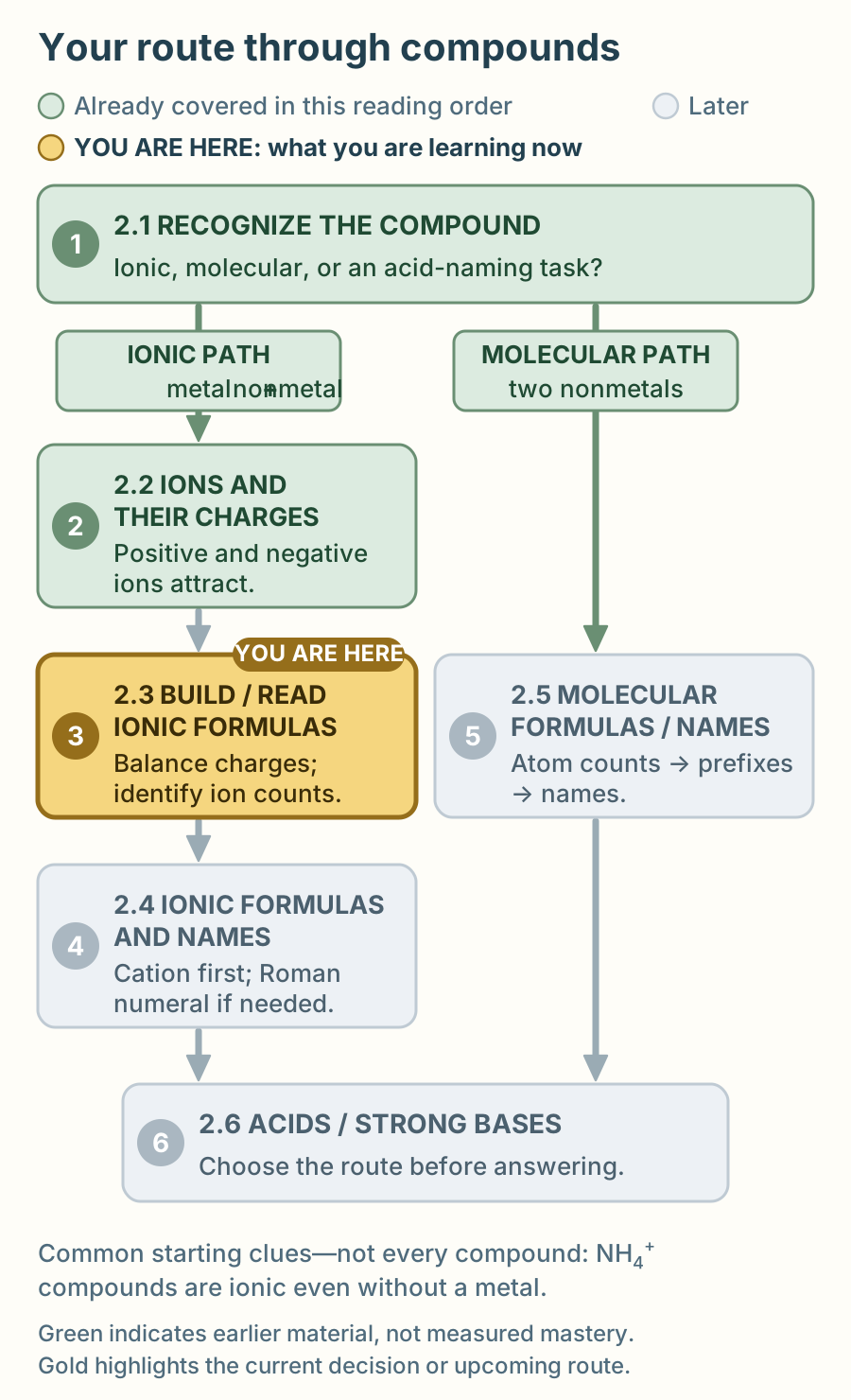
An ionic formula lists ions in the ratio that makes the total charge zero. This lesson builds formulas from charges, reads the ions back out of a formula, and counts atoms through subscripts and parentheses.
| Mark | Example | What it tells you |
|---|---|---|
| Subscript | H2O | Atoms of the element before it: 2 H, 1 O. No subscript means 1. |
| Subscript inside an ion | NO3− | 3 O atoms in one nitrate. The charge belongs to the whole ion. |
| Outside parentheses | Ca(NO3)2 | Two whole nitrate groups: 2 N and 6 O. Ca is outside, so it stays 1. |
| Coefficient in front | 2H2O | Multiplies the entire formula. |
| Superscript | Mg2+ | Electrical charge, not an atom count. |
- Learning layout: put every polyatomic group in parentheses, even with an outside 1, e.g. Na1(NO3)1.
- Finished formula: drop a single group’s parentheses and outside 1, giving NaNO3.
- Keep parentheses only when a group repeats: Ca(NO3)2.
- Reduce counts of whole groups, never the subscripts inside the group.
- Use criss-cross for ionic compounds only, not molecular ones such as CO2.
Mg2+ + O2− → Mg2O2 → MgO
Recognize a known ion, total its charge, then find the charge that balances it.
The examples identify the ions in each compound. They do not claim every compound dissolves in water.
- Read each ion’s charge.
- Cross the charge sizes, or find the smallest matching positive and negative totals.
- Reduce to the smallest whole-number ratio; keep polyatomic groups intact.
- Write the positive ion first; leave out 1s and use parentheses only for a repeated group.
- Check that the total charge is zero.
On the periodic table: Main-group charges come from the group: Group 1 forms 1+, Group 2 forms 2+, aluminum (Group 13) forms 3+.
On the periodic table: Group 16 forms 2− (O2−) and Group 17 forms 1− (Cl−).
On the periodic table: The table does not give polyatomic-ion charges or which iron ion is present; use the supplied charge.
On the periodic table: The table identifies elements; subscripts in the formula, not atomic numbers, give atom counts.
Write the neutral formula for Mg2+ and Cl−.
- 1Cross the charge sizes
Sizes 2 and 1: 1 goes to Mg, 2 goes to Cl. On the periodic table: Mg is Group 2 (Mg2+); Cl is Group 17 (Cl−).
Mg2+ Cl− → Mg1Cl2 - 2Simplify
Omit the 1.
Mg1Cl2 → MgCl2 - 3Check the charge
Positives and negatives must cancel.
Ion Count × Charge = Total Mg2+ 1 +2 +2 Cl− 2 −1 −2 Sum 0 - ✓Answer
MgCl2
Write the neutral formula for Al3+ and O2−.
- 1Cross the charge sizes
2 goes to Al and 3 goes to O. On the periodic table: Al is Group 13 (Al3+); O is Group 16 (O2−).
Al3+ O2− → Al2O3 - 2Simplify
The 2:3 ratio is already simplest.
Al2O3 → Al2O3 - 3Check the charge
Positives and negatives must cancel.
Ion Count × Charge = Total Al3+ 2 +3 +6 O2− 3 −2 −6 Sum 0 - ✓Answer
Al2O3
Write the neutral formula for Mg2+ and O2−.
- 1Cross the charge sizes
Both sizes are 2. On the periodic table: Mg is Group 2 (Mg2+); O is Group 16 (O2−).
Mg2+ O2− → Mg2O2 - 2Simplify
Both counts divide by 2: 2:2 reduces to 1:1.
Mg2O2 → MgO - 3Check the charge
Positives and negatives must cancel.
Ion Count × Charge = Total Mg2+ 1 +2 +2 O2− 1 −2 −2 Sum 0 - ✓Answer
MgO
Write the neutral formula for Na+ and NO3−.
- 1Cross the charge sizes
The outside 1 counts one whole nitrate group. On the periodic table: Na is Group 1 (Na+).
Na+ NO3− → Na1(NO3)1 - 2Simplify
Drop sodium’s 1 and the single group’s parentheses and outside 1. Keep nitrate’s inner 3.
Na1(NO3)1 → NaNO3 - 3Check the charge
Positives and negatives must cancel.
Ion Count × Charge = Total Na+ 1 +1 +1 NO3− 1 −1 −1 Sum 0 - ✓Answer
NaNO3
Write the neutral formula for Ca2+ and NO3−.
- 1Cross the charge sizes
1 goes to Ca; 2 goes to the whole nitrate group. On the periodic table: Ca is Group 2 (Ca2+).
Ca2+ NO3− → Ca1(NO3)2 - 2Simplify
Two nitrate groups keep their parentheses. The inner 3 stays; the outside 2 counts groups.
Ca1(NO3)2 → Ca(NO3)2 - 3Check the charge
Positives and negatives must cancel.
Ion Count × Charge = Total Ca2+ 1 +2 +2 NO3− 2 −1 −2 Sum 0 - ✓Answer
Ca(NO3)2
Write the neutral formula for Al3+ and SO42−.
- 1Cross the charge sizes
2 goes to Al; 3 goes to sulfate. On the periodic table: Al is Group 13 (Al3+).
Al3+ SO42− → Al2(SO4)3 - 2Simplify
Already simplest. Keep SO4 intact; three groups need parentheses.
Al2(SO4)3 → Al2(SO4)3 - 3Check the charge
Positives and negatives must cancel.
Ion Count × Charge = Total Al3+ 2 +3 +6 SO42− 3 −2 −6 Sum 0 - ✓Answer
Al2(SO4)3
Write the neutral formula for NH4+ and SO42−.
- 1Cross the charge sizes
2 goes to ammonium; 1 goes to sulfate. Both groups are shown in parentheses first.
NH4+ SO42− → (NH4)2(SO4)1 - 2Simplify
One sulfate group needs no parentheses or outside 1. Keep the 4 inside sulfate.
(NH4)2(SO4)1 → (NH4)2SO4 - 3Check the charge
Positives and negatives must cancel.
Ion Count × Charge = Total NH4+ 2 +1 +2 SO42− 1 −2 −2 Sum 0 - ✓Answer
(NH4)2SO4
Write the neutral formula for Fe3+ and Cl−.
- 1Cross the charge sizes
1 goes to Fe; 3 goes to Cl. On the periodic table: Cl is Group 17 (Cl−). The supplied Fe3+ tells you which iron ion.
Fe3+ Cl− → Fe1Cl3 - 2Simplify
Omit the 1.
Fe1Cl3 → FeCl3 - 3Check the charge
Positives and negatives must cancel.
Ion Count × Charge = Total Fe3+ 1 +3 +3 Cl− 3 −1 −3 Sum 0 - ✓Answer
FeCl3
Which ions make up MgCl2? Give each ion’s formula, charge and count.
- 1Spot the known ion
Chloride is Cl−. On the periodic table: Cl is Group 17.
2 Cl−: 2(−1) = −2 - 2Balance the other ion
One Mg must supply +2. On the periodic table: Mg is Group 2, so Mg2+ matches.
1 Mg = +2 → Mg2+ - 3List the ions
Counts come from the subscripts.
Ion Count × Charge = Total Mg2+ 1 +2 +2 Cl− 2 −1 −2 Sum 0 - ✓Answer
1 Mg2+ and 2 Cl−
Which ions make up Al2O3? Give each ion’s formula, charge and count.
- 1Spot the known ion
Oxide is O2−. On the periodic table: O is Group 16.
3 O2−: 3(−2) = −6 - 2Balance the other ion
Two Al ions share +6. On the periodic table: Al (Group 13) usually forms Al3+, which matches.
2 Al = +6each Al = +62 = +3 → Al3+ - 3List the ions
Two of one, three of the other.
Ion Count × Charge = Total Al3+ 2 +3 +6 O2− 3 −2 −6 Sum 0 - ✓Answer
2 Al3+ and 3 O2−
Which ions make up MgO? Give each ion’s formula, charge and count.
- 1Spot the known ion
No subscripts means one ion of each. On the periodic table: Mg is Group 2 (Mg2+); O is Group 16 (O2−).
1 O2−: 1(−2) = −2 - 2Balance the other ion
Read Mg’s +2 from its group. The unwritten 1 counts ions; it does not set their charge.
1 Mg = +2 → Mg2+ - 3List the ions
The 1:1 ratio hides the charge size of 2.
Ion Count × Charge = Total Mg2+ 1 +2 +2 O2− 1 −2 −2 Sum 0 - ✓Answer
1 Mg2+ and 1 O2−
Which ions make up NaNO3? Give each ion’s formula, charge and count.
- 1Spot the known ion
Recognize nitrate. With no parentheses or outside number, one group is understood.
1 NO3−: 1(−1) = −1 - 2Balance the other ion
One sodium supplies +1. On the periodic table: Na is Group 1, so Na+ matches.
1 Na = +1 → Na+ - 3List the ions
The 3 counts O atoms inside nitrate, not nitrate groups.
Ion Count × Charge = Total Na+ 1 +1 +1 NO3− 1 −1 −1 Sum 0 - ✓Answer
1 Na+ and 1 NO3−
Which ions make up Ca(NO3)2? Give each ion’s formula, charge and count.
- 1Spot the known ion
Recognize nitrate. The outside 2 means two nitrate ions.
2 NO3−: 2(−1) = −2 - 2Balance the other ion
One calcium supplies +2. On the periodic table: Ca is Group 2, so Ca2+ matches.
1 Ca = +2 → Ca2+ - 3List the ions
Do not split nitrate into separate N and O ions.
Ion Count × Charge = Total Ca2+ 1 +2 +2 NO3− 2 −1 −2 Sum 0 - ✓Answer
1 Ca2+ and 2 NO3−
Which ions make up Al2(SO4)3? Give each ion’s formula, charge and count.
- 1Spot the known ion
Sulfate is SO42−; the outside 3 means three of them.
3 SO42−: 3(−2) = −6 - 2Balance the other ion
Two Al ions share +6. On the periodic table: Al (Group 13) usually forms Al3+, which matches.
2 Al = +6each Al = +62 = +3 → Al3+ - 3List the ions
Sulfate stays one intact ion.
Ion Count × Charge = Total Al3+ 2 +3 +6 SO42− 3 −2 −6 Sum 0 - ✓Answer
2 Al3+ and 3 SO42−
Which ions make up (NH4)2SO4? Give each ion’s formula, charge and count.
- 1Spot the known ion
Recognize both groups: ammonium NH4+ and sulfate SO42−. Sulfate appears once.
1 SO42−: 1(−2) = −2 - 2Balance the other ion
The outside 2 means two ammonium ions.
2 NH4+: 2(+1) = +2 - 3List the ions
+2 − 2 = 0.
Ion Count × Charge = Total NH4+ 2 +1 +2 SO42− 1 −2 −2 Sum 0 - ✓Answer
2 NH4+ and 1 SO42−
Which ions make up FeCl3? Give each ion’s formula, charge and count.
- 1Spot the known ion
Each chloride is Cl−. On the periodic table: Cl is Group 17.
3 Cl−: 3(−1) = −3 - 2Balance the other ion
The one iron ion must supply +3. Iron’s charge comes from the balance, not its group.
1 Fe = +3 → Fe3+ - 3List the ions
This is iron(III) chloride, not iron(II) chloride.
Ion Count × Charge = Total Fe3+ 1 +3 +3 Cl− 3 −1 −3 Sum 0 - ✓Answer
1 Fe3+ and 3 Cl−
Write neutral formulas for K+ with S2−; Ca2+ with OH−; Mg2+ with PO43−; NH4+ with Cl−.
Work all four on paper first. Check each charge total, then reveal one answer at a time.
- 1K+ and S2−
Two K+ balance one S2−.
K2S: 2(+1) + (−2) = 0 - 2Ca2+ and OH−
Two hydroxide groups, so hydroxide needs parentheses.
Ca(OH)2: (+2) + 2(−1) = 0 - 3Mg2+ and PO43−
Charge sizes 2 and 3 cross to 3 Mg and 2 phosphate groups.
Mg3(PO4)2: 3(+2) + 2(−3) = 0 - 4NH4+ and Cl−
Learning layout (NH4)1Cl1; one ammonium group drops its parentheses and outside 1.
NH4Cl: (+1) + (−1) = 0 - ✓Answer
K2S, Ca(OH)2, Mg3(PO4)2 and NH4Cl
Count every kind of atom in Ca(NO3)2.
- Multiply each atom inside parentheses by the outside subscript.
- Leave atoms outside the parentheses unchanged.
- Apply any leading coefficient last.
- 1Read calcium
Calcium is outside the parentheses with no subscript.
Ca → 1 Ca atom - 2Read one nitrate group
The small 3 belongs only to oxygen, inside one group.
NO3 → 1 N and 3 O - 3Repeat the whole group
The outside 2 multiplies both N and O.
Atom In one group × outside 2 = Total N 1 × 2 2 O 3 × 2 6 - 4Check the whole formula
The group multiplier does not change calcium. On the periodic table: the table identifies Ca, N and O; the subscripts give the counts.
Ca N O 1 2 6 - ✓Answer
1 Ca, 2 N and 6 O
2.4 Ionic formulas and names
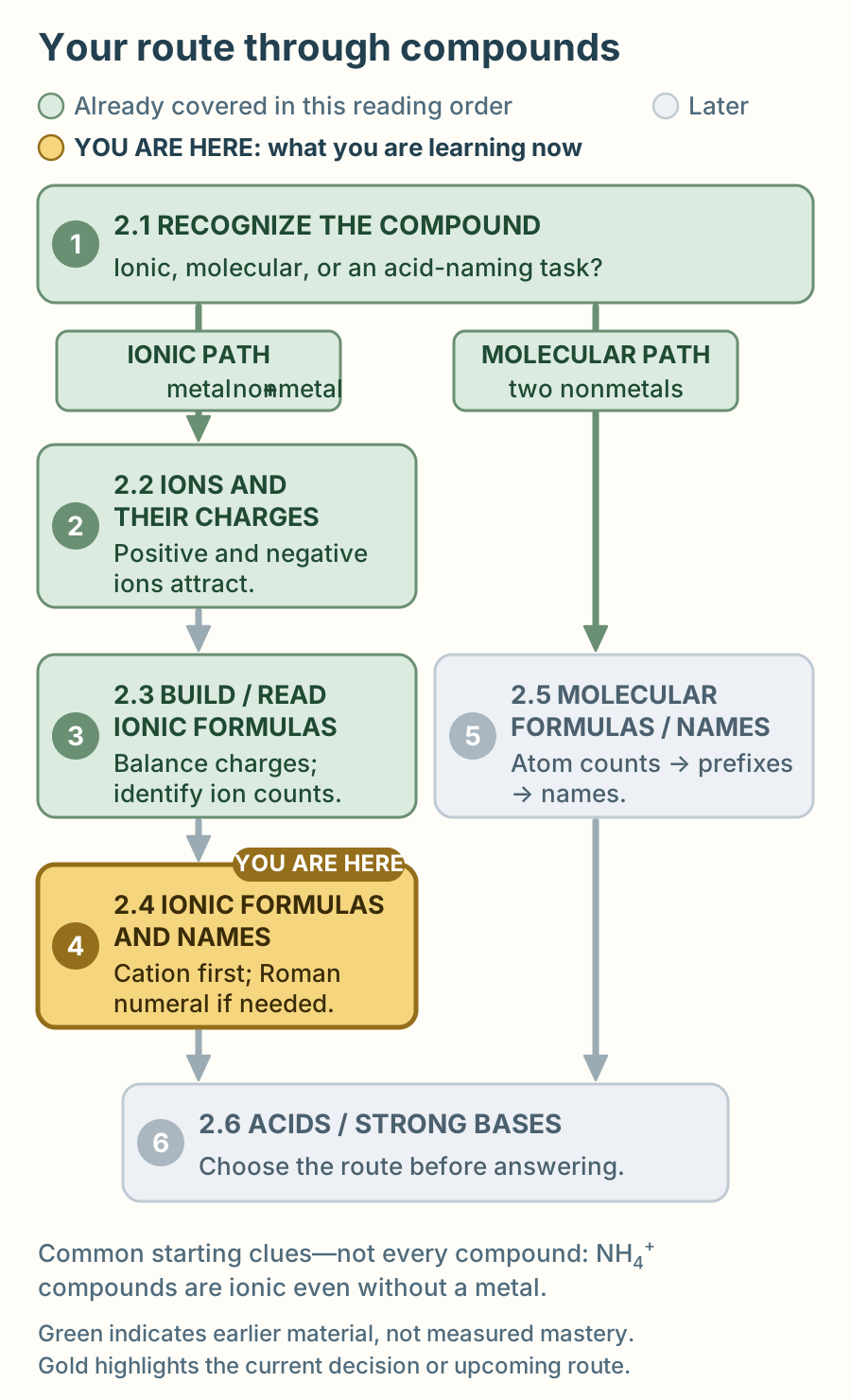
An ionic name is just its two ions, positive first. This lesson runs the route both ways: from a formula to its name, and from a name back to a balanced formula.
| Ion | Rule | Examples |
|---|---|---|
| Fixed-charge cation | Element name | Na+ sodium; Ca2+ calcium |
| Variable-charge cation | Element name + charge as a Roman numeral | Fe2+ iron(II); Fe3+ iron(III) |
| Polyatomic ion | Keep its own name | NH4+ ammonium; NO3− nitrate; SO42− sulfate |
| Single-atom anion | Element root + -ide | Cl− chloride; O2− oxide |
Identify the ions, then name them in order.
Variable metal: work out its charge first.
Turn each name into an ion, then balance the charges to zero.
- Identify the positive ion and the negative ion.
- Formula → name: name the cation, add a Roman numeral if its charge varies, then name the anion (-ide or polyatomic name).
- Name → formula: write each ion with its charge.
- Balance the charges to zero; keep polyatomic groups whole and use parentheses only for a repeated group.
On the periodic table: Sodium (Na) is in Group 1, so it forms Na+; calcium (Ca) is in Group 2, so it forms Ca2+.
On the periodic table: Chlorine (Cl) is in Group 17, so it forms Cl−; oxygen (O) is in Group 16, so oxide is O2−.
On the periodic table: The table gives iron’s symbol, Fe, but not its charge; read that from the formula or the Roman numeral.
Formula → name: NaCl
- 1Identify the ions
On the periodic table: Na (sodium) is in Group 1, so Na+. Cl (chlorine) is in Group 17, so Cl−.
Ion Charge Name Na+ +1 sodium Cl− −1 chloride - 2Name in order
Positive ion first. A one-element chlorine anion is chloride. No prefixes or Roman numeral needed.
sodium + chloride → sodium chloride - ✓Answer
sodium chloride
Formula → name: CaCl2
- 1Identify the ions
On the periodic table: Ca (calcium) is in Group 2, so Ca2+. Cl (chlorine) is in Group 17, so Cl−.
Ion Charge Name Ca2+ +2 calcium Cl− −1 chloride - 2Name in order
The subscript 2 does not make this “dichloride”.
calcium + chloride → calcium chloride - ✓Answer
calcium chloride
Formula → name: Ca(NO3)2
- 1Identify the ions
On the periodic table: the symbol Ca belongs to calcium. Recognize nitrate inside the parentheses.
Ion Charge Name Ca2+ +2 calcium NO3− −1 nitrate - 2Name in order
Keep nitrate’s name. The parentheses do not change the naming rule.
calcium + nitrate → calcium nitrate - ✓Answer
calcium nitrate
Formula → name: (NH4)2SO4
- 1Identify the ions
Both ions are polyatomic.
Ion Charge Name NH4+ +1 ammonium SO42− −2 sulfate - 2Name in order
Positive group first, then sulfate.
ammonium + sulfate → ammonium sulfate - ✓Answer
ammonium sulfate
Formula → name: FeO
- 1Identify the anion
On the periodic table: Fe is iron. Oxygen (O) is in Group 16, so oxide is O2−.
1 O2−: 1(−2) = −2 - 2Find iron’s charge
One O2− requires one Fe2+.
1 Fe = +2 → Fe2+ - 3Name with a Roman numeral
Roman numeral II shows iron’s +2 charge.
iron(II) + oxide → iron(II) oxide - ✓Answer
iron(II) oxide
Formula → name: Fe(NO3)3
- 1Total the anion charge
On the periodic table: Fe is iron. There are three nitrate ions, each −1.
3 NO3−: 3(−1) = −3 - 2Find iron’s charge
The total −3 requires one Fe3+.
1 Fe = +3 → Fe3+ - 3Name with a Roman numeral
Roman numeral III shows iron’s +3 charge.
iron(III) + nitrate → iron(III) nitrate - ✓Answer
iron(III) nitrate
Name → formula: sodium chloride
- 1Write the ions
On the periodic table: sodium (Na) is in Group 1, so Na+. Chlorine (Cl) is in Group 17, so Cl−.
sodium = Na+ chloride = Cl− - 2Balance the charges
One of each ion balances.
Ion Count × Charge = Total Na+ 1 +1 +1 Cl− 1 −1 −1 Sum 0 - ✓Answer
NaCl
Name → formula: calcium chloride
- 1Write the ions
On the periodic table: calcium (Ca) is in Group 2, so Ca2+. Chlorine (Cl) is in Group 17, so Cl−.
calcium = Ca2+ chloride = Cl− - 2Balance the charges
One calcium needs two chlorides.
(+2) + 2(−1) = 0 → CaCl2 - ✓Answer
CaCl2
Name → formula: calcium nitrate
- 1Write the ions
On the periodic table: calcium (Ca) is in Group 2, so Ca2+. Nitrate comes from the reference list.
calcium = Ca2+ nitrate = NO3− - 2Balance the charges
Use two complete nitrate groups; two groups need parentheses.
Ion Count × Charge = Total Ca2+ 1 +2 +2 NO3− 2 −1 −2 Sum 0 - ✓Answer
Ca(NO3)2
Name → formula: ammonium sulfate
- 1Write the ions
Both come from the reference list.
ammonium = NH4+ sulfate = SO42− - 2Balance the groups
Two ammoniums balance one sulfate.
2(+1) + 1(−2) = 0 → (NH4)2(SO4)1 - 3Tidy the formula
Drop the single sulfate group’s parentheses and outside 1; keep its inner 4.
(NH4)2(SO4)1 → (NH4)2SO4 - ✓Answer
(NH4)2SO4
Name → formula: iron(II) oxide
- 1Write the ions
Iron(II) means Fe2+. On the periodic table: iron’s symbol is Fe; oxygen (O) is in Group 16, so oxide is O2−.
iron(II) = Fe2+ oxide = O2− - 2Balance and reduce
A crossed 2:2 ratio reduces to 1:1: one of each.
Fe2O2 → FeO: (+2) + (−2) = 0 - ✓Answer
FeO
Name → formula: iron(III) nitrate
- 1Write the ions
Iron(III) means Fe3+. On the periodic table: iron’s symbol is Fe.
iron(III) = Fe3+ nitrate = NO3− - 2Balance the charges
Three nitrate groups balance one iron ion.
Ion Count × Charge = Total Fe3+ 1 +3 +3 NO3− 3 −1 −3 Sum 0 - ✓Answer
Fe(NO3)3
2.5 Molecular formulas and names
Molecular compounds are nonmetals sharing electrons (from 2.1). Their formulas count the actual atoms in one molecule, and their names use number prefixes instead of charges.
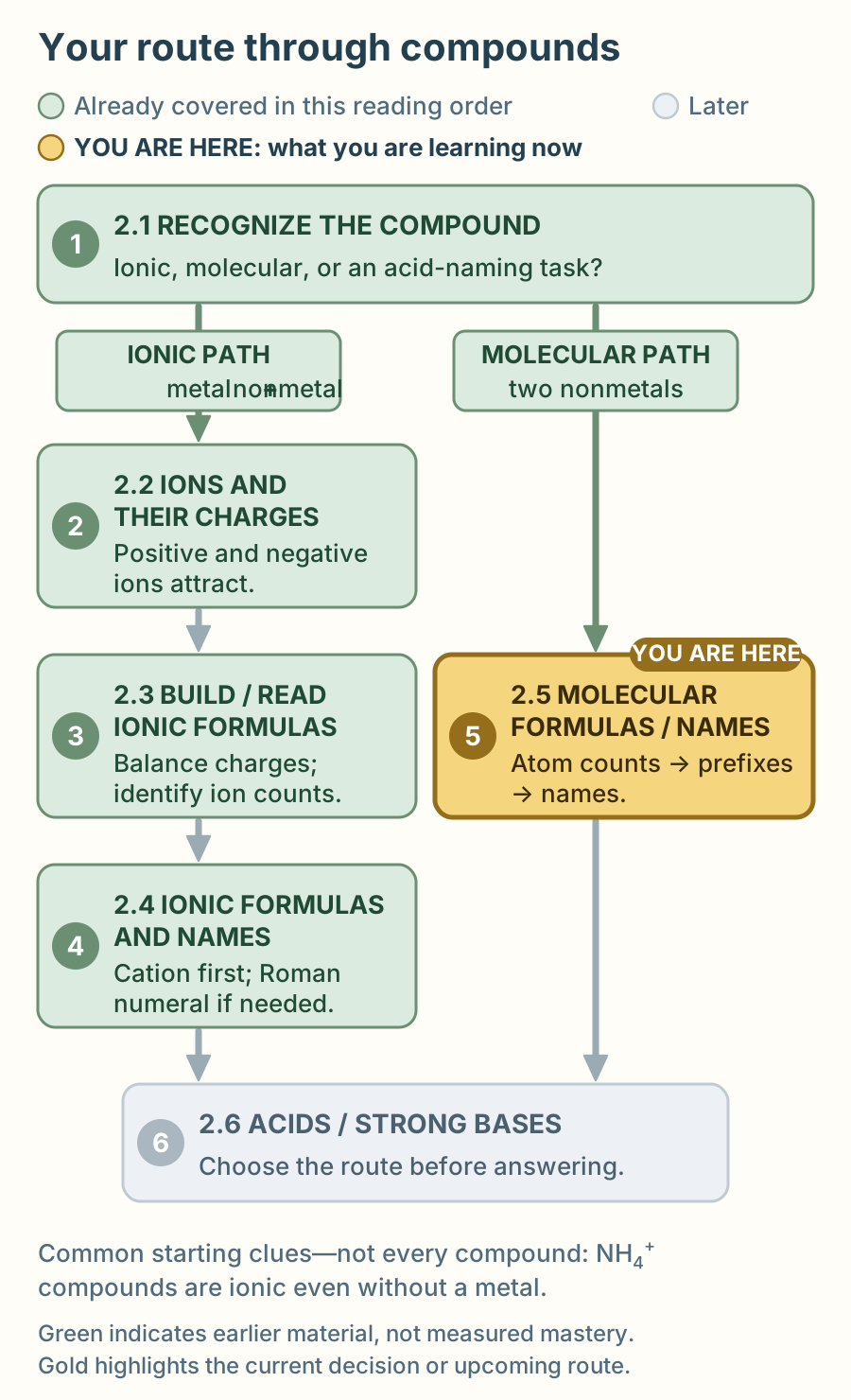
The formula is the simplest ion ratio, so reduce it.
The formula is one whole molecule, so never reduce it.
| mono | di | tri | tetra | penta | hexa | hepta | octa | nona | deca |
|---|---|---|---|---|---|---|---|---|---|
| 1 | 2 | 3 | 4 | 5 | 6 | 7 | 8 | 9 | 10 |
- Name the first element; usually omit mono on it.
- Name the second element with a prefix and an -ide ending.
- Familiar spellings drop a vowel before oxide: monoxide, tetroxide.
- Keep the actual counts. Do not criss-cross ion charges.
You cannot work out every molecular formula from the elements alone; you need given counts or a name. Chapter 8 explains covalent bonding in more detail.
- Confirm it is molecular: nonmetals only.
- Formula → counts: each subscript counts atoms; no subscript means 1.
- Formula → name: prefix + first element (omit mono), prefix + second element root + -ide.
- Name → formula: turn each prefix into a subscript and do not reduce.
On the periodic table: C is carbon, O is oxygen, N is nitrogen, H is hydrogen and S is sulfur.
On the periodic table: Carbon, nitrogen and oxygen are right of the staircase line, so all are nonmetals.
Formula → atom counts: CO2
- 1Read each symbol
No subscript on C means one carbon. The small 2 means two oxygens. On the periodic table: C is carbon and O is oxygen.
Atom C O Total Count 1 2 3 - 2Keep it molecular
Do not criss-cross or turn CO2 into C4+ and O2−. These atoms share electrons.
CO2 = 1 C + 2 O (shared electrons, no ions) - ✓Answer
1 carbon atom and 2 oxygen atoms per molecule
Atom counts → molecular formula: two N and four O
- 1Write the actual counts
Each count becomes a subscript.
2 N + 4 O → N2O4 - 2Do not reduce
Ionic formulas use the simplest ratio; molecular formulas keep the atoms in one molecule.
CorrectN2O4A different moleculeNO2 - ✓Answer
N2O4
Formula → atom counts: how many of each kind of atom are in one H2SO4 molecule?
- 1Read each subscript
H2 means 2 H. S has an understood 1. O4 means 4 O. On the periodic table: H is hydrogen, S is sulfur and O is oxygen.
Atom H S O Count 2 1 4 - 2Add the total
Sum the three counts.
2 + 1 + 4 = 7 atoms - ✓Answer
2 H, 1 S and 4 O: 7 atoms total
Formula → name: CO2
- 1Choose the rule
Two nonmetals: binary molecular. On the periodic table: carbon (C) and oxygen (O) are both right of the staircase line.
C + O: nonmetal + nonmetal → prefixes - 2Turn counts into prefixes
One carbon: omit mono on the first element. Two oxygens: di + oxide.
Element Count Name part C 1 carbon O 2 dioxide - ✓Answer
carbon dioxide
Formula → name: N2O4
- 1Choose the rule
Binary molecular. On the periodic table: N is nitrogen and O is oxygen, both nonmetals on the right side.
N + O: nonmetal + nonmetal → prefixes - 2Turn counts into prefixes
Two nitrogens give dinitrogen; four oxygens give tetroxide.
Element Count Name part N 2 dinitrogen O 4 tetroxide - ✓Answer
dinitrogen tetroxide
Name → formula: carbon dioxide
- 1Read the prefixes
No prefix on the first element means one C. Dioxide means two O. On the periodic table: carbon’s symbol is C and oxygen’s is O.
Name part Count Symbol carbon 1 C dioxide 2 O - 2Write the formula
Do not balance ion charges here.
C1O2 → CO2 - ✓Answer
CO2
Name → formula: dinitrogen tetroxide
- 1Read the prefixes
Di means 2 N; tetra in tetroxide means 4 O. On the periodic table: nitrogen’s symbol is N and oxygen’s is O.
Name part Count Symbol dinitrogen 2 N tetroxide 4 O - 2Write the formula
Prefixes give the real molecule’s atom counts. Do not reduce 2:4.
N2O4, not NO2 - ✓Answer
N2O4
2.6 Acids, strong bases, and mixed route practice
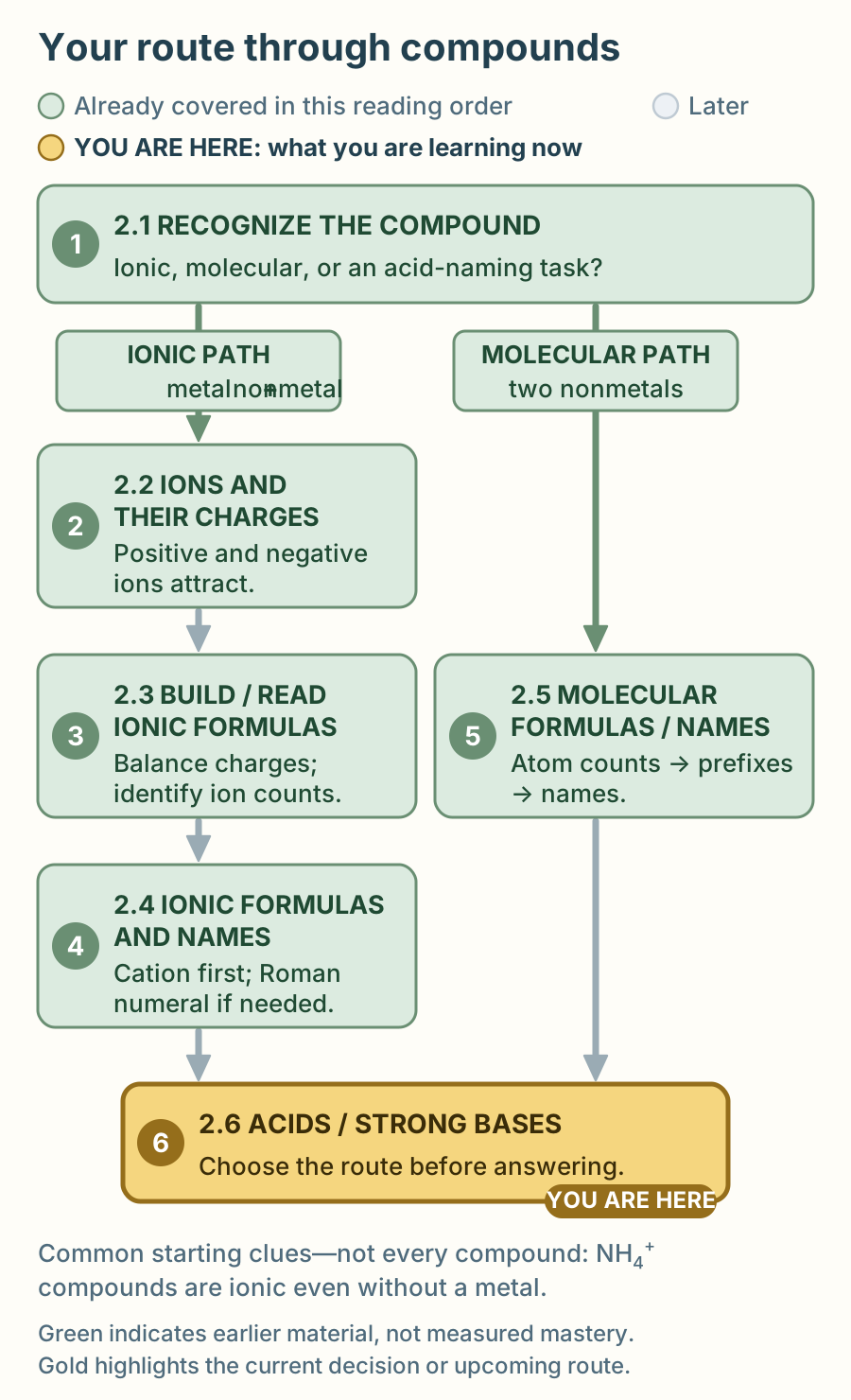
Acids and strong bases have their own recognition clues, and acids have their own naming route, separate from ionic and molecular names. This lesson shows how to spot them and move between acid formulas and names.
- Positive and negative ions, ionic formulas, and polyatomic ions (sections 2.2–2.4).
Need a refresher? Open the table of contents and revisit that topic before starting.
An acid donates H+ to water, forming H3O+ (hydronium).
Dissolving separates the ions; OH− stays together.
See the particles in action: Chapter 6.4: acid in water → base in water → make water.
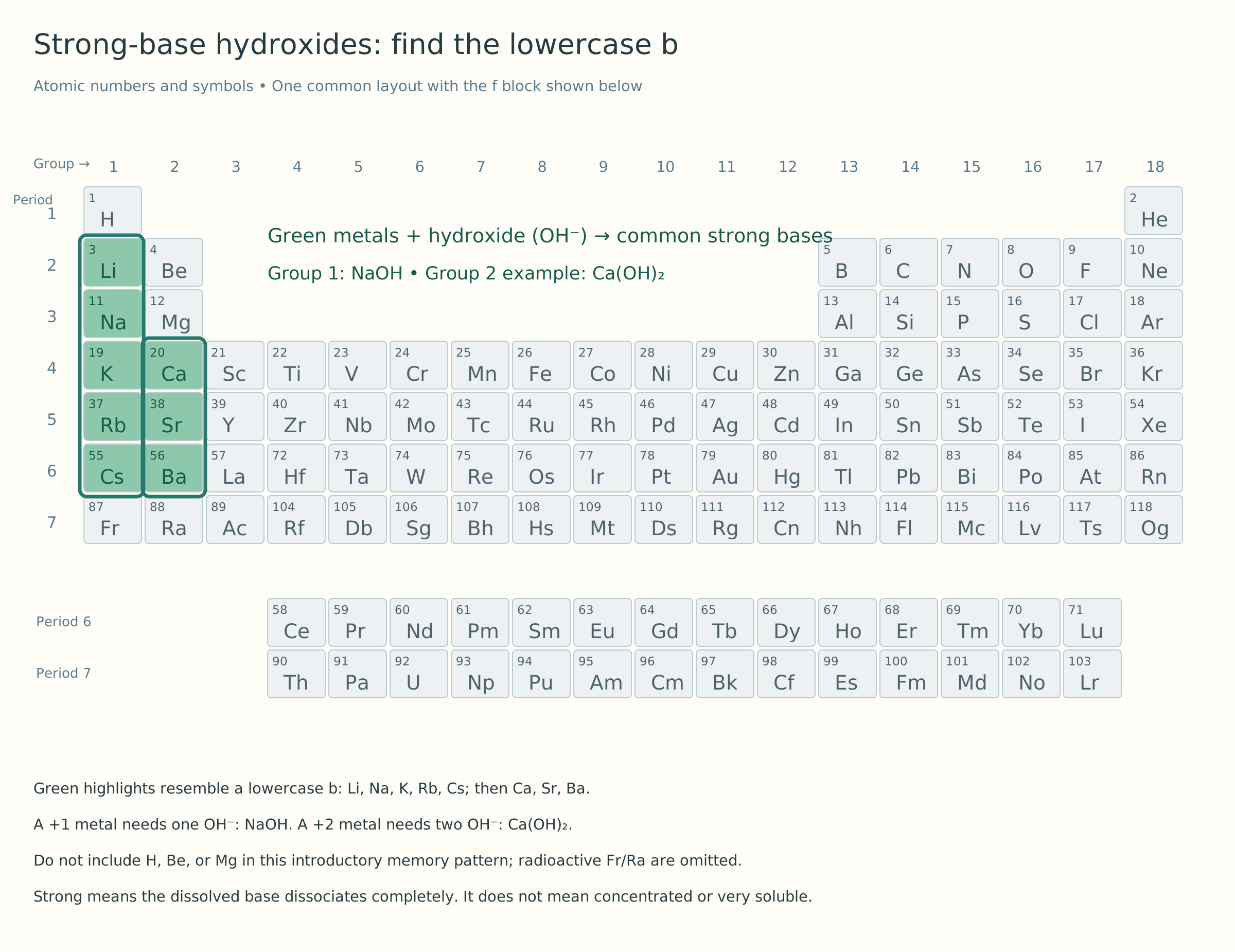
| Metals | Ion charge | Hydroxides | In water |
|---|---|---|---|
| Group 1: Li, Na, K, Rb, Cs | +1: one OH− | LiOH, NaOH, KOH, RbOH, CsOH | NaOH → Na+ + OH− |
| Group 2: Ca, Sr, Ba | +2: two whole OH− groups | Ca(OH)2, Sr(OH)2, Ba(OH)2 | Ca(OH)2 → Ca2+ + 2OH− |
- It covers common course examples, not every hydroxide.
- H is not a metal. Be and Mg are not on this introductory strong-base list. Radioactive Fr and Ra are left out.
- Strength is not concentration: a strong base can be dilute.
- Calcium hydroxide has limited solubility; the part that dissolves separates completely.
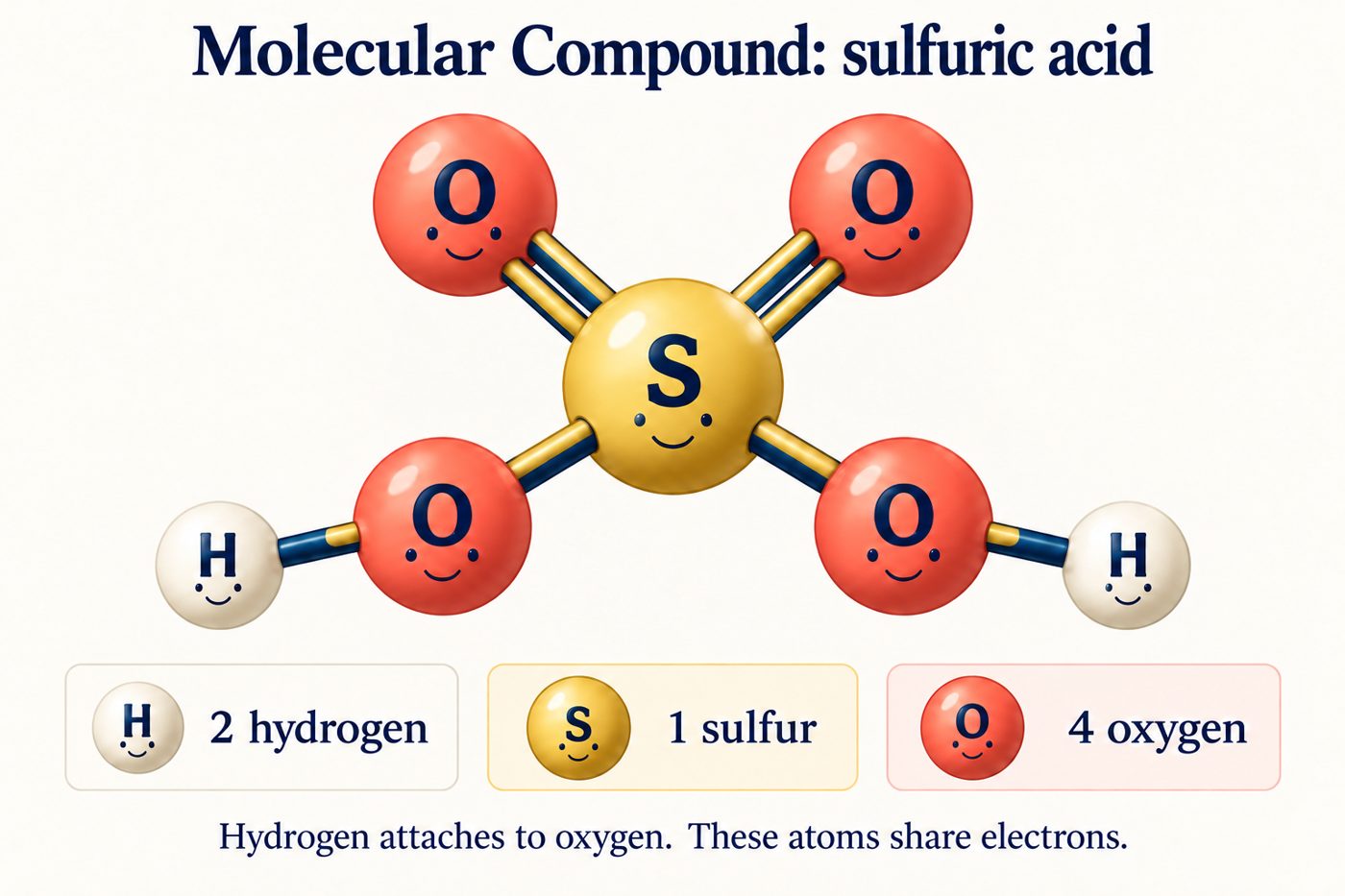
| Acid type | Rule | Example |
|---|---|---|
| Binary acid in water (no oxygen) | hydro- + root + -ic acid | HCl(aq): hydrochloric acid |
| Oxygen acid from an -ate ion | -ate → -ic acid | nitrate → nitric acid (HNO3) |
| Oxygen acid from an -ite ion | -ite → -ous acid | nitrite → nitrous acid (HNO2) |
| Ion with per- or hypo- | Keep the prefix | perchlorate → perchloric acid; hypochlorite → hypochlorous acid |
- Formula starts with H and is in water: use the acid route. Metal + OH−: a hydroxide base.
- Find the anion: single-atom (-ide) or polyatomic (-ate or -ite).
- Name it: -ide → hydro-…-ic acid; -ate → -ic acid; -ite → -ous acid.
- Name → formula: add enough H+ to balance the anion’s charge.
On the periodic table: Sodium (Na) is in Group 1, so it forms Na+; Group 1 hydroxides use one OH−.
On the periodic table: Barium (Ba) is in Group 2, so it forms Ba2+; Ca, Sr and Ba hydroxides use two OH−.
On the periodic table: Chlorine (Cl) is in Group 17, so it forms Cl− and gives the root chlor-.
Metal ion → strong-base formula: write the neutral hydroxide of Ba2+ and OH−.
- 1Read the charges
On the periodic table: barium (Ba) is in Group 2, so it forms Ba2+.
Ba2+ OH− - 2Balance the charges
One Ba2+ needs two OH− ions.
Ion Count × Charge = Total Ba2+ 1 +2 +2 OH− 2 −1 −2 Sum 0 - 3Write the formula
Put parentheses around the whole hydroxide group. Ba is on the strong-base list.
Ba(OH)2 = barium hydroxide - ✓Answer
Ba(OH)2, barium hydroxide, a strong base
Formula → name: HNO3
- 1Recognize the anion
HNO3 is an acid containing nitrate.
HNO3 = H+ + NO3− (nitrate) - 2Change the ending
Nitrate’s -ate becomes -ic acid. Do not add hydro-.
nitrate → nitric acid - ✓Answer
nitric acid
Formula → name: HCl(aq)
- 1Choose the rule
HCl(aq) is a binary acid in water.
H + Cl, in water, no oxygen → hydro-…-ic acid - 2Build the name
On the periodic table: Cl is chlorine, which gives the root chlor-.
hydro + chlor + ic acid → hydrochloric acid - ✓Answer
hydrochloric acid (HCl gas is hydrogen chloride)
Name → formula: nitric acid
- 1Trace back to the ion
-ic acid points back to an -ate ion: nitrate.
nitric acid → nitrate, NO3− - 2Balance with H+
One H+ balances one nitrate ion.
(+1) + (−1) = 0 → H1(NO3)1 - 3Tidy the formula
Drop the 1s and the parentheses around the single nitrate group.
H1(NO3)1 → HNO3 - ✓Answer
HNO3
Name → formula: hydrochloric acid
- 1Identify the ions
Hydrochloric acid is H+ with Cl− in water. On the periodic table: chlorine (Cl) is in Group 17, so it forms Cl−.
hydrochloric acid → H+ + Cl− - 2Balance and add the state
One of each balances. The (aq) marks it as the acid.
(+1) + (−1) = 0 → HCl(aq) - ✓Answer
HCl(aq)
Mixed chapter review: choose the route, then answer
Use the ion reference when needed. Write an answer before opening the dropdowns.
Mixed chapter review · 22 questions · tap to open
What this set is for: problems from every section of the chapter, mixed together and not labeled, the way a test asks them. Your job is to pick the right method yourself. Do this before the skill check.
Practice 1
Is MgCl2 ionic or molecular?
Give me a hint
First decide whether this asks for compound type, ion charge, formula, or name, then use the matching route.
Check the answer
Answer: Ionic
On the periodic table: Magnesium (Mg) is a Group 2 metal and chlorine (Cl) is a Group 17 nonmetal.
Explain the worked problem to me
What you know: The formula MgCl2. What you want: Whether it is ionic or molecular.
- Find each element on the periodic table. Mg is left of the staircase line, so it is a metal. Cl is right of it, so it is a nonmetal.
- Apply the first clue: metal + nonmetal → ionic.
- Confirm with charges. Mg forms Mg2+ and Cl forms Cl−. One Mg2+ and two Cl− give (+2) + 2(−1) = 0. The ions attract, so the compound is Ionic.
Check: The subscript 2 matches the two chloride ions needed to balance +2.
On the periodic table: Magnesium (Mg) is in Group 2 on the left side, so it is a metal. Chlorine (Cl) is in Group 17 on the right side, so it is a nonmetal.
That’s right: Ionic
YOUR PERIODIC-TABLE REFERENCE
Atomic number identifies proton count. The decimal mass is an average, not an isotope’s mass number. Use supplied rounded masses when a problem gives them.
Practice 2
Is CO2 ionic or molecular?
Give me a hint
First decide whether this asks for compound type, ion charge, formula, or name, then use the matching route.
Check the answer
Answer: Molecular
On the periodic table: Carbon (C) and oxygen (O) are both nonmetals on the right side of the table.
Explain the worked problem to me
What you know: The formula CO2. What you want: Whether it is ionic or molecular.
- Find each element. Carbon and oxygen are both right of the staircase line, so both are nonmetals.
- Apply the first clue: two nonmetals → molecular.
- Think about what holds it together. The atoms share electrons in covalent bonds. One molecule has 1 C and 2 O. So CO2 is Molecular.
Why it matters: The type decides the route. Molecular compounds use prefixes and actual atom counts, not ion charges.
Watch out: Do not crisscross CO2 into C4+ and O2−. These atoms are not separate simple ions.
On the periodic table: Carbon (C) and oxygen (O) are both to the right of the staircase line, so both are nonmetals.
That’s right: Molecular
YOUR PERIODIC-TABLE REFERENCE
Atomic number identifies proton count. The decimal mass is an average, not an isotope’s mass number. Use supplied rounded masses when a problem gives them.
Practice 3
Is NH4Cl ionic even though it has no metal?
Give me a hint
First decide whether this asks for compound type, ion charge, formula, or name, then use the matching route.
Check the answer
Answer: Yes
Explain the worked problem to me
What you know: NH4Cl contains only nonmetals. What you want: Whether it is still ionic.
- Look for a recognizable ion. NH4 is ammonium, NH4+, a common polyatomic cation.
- The rest is Cl, which forms the anion Cl−.
- A cation and an anion attract each other: (+1) + (−1) = 0. That attraction makes the compound ionic. So the answer is Yes.
Why it matters: "Metal + nonmetal" is a starting clue, not the full rule. Ammonium compounds are the common ionic exception without a metal.
Watch out: Seeing only nonmetals and calling it molecular. Check for NH4+ first.
On the periodic table: Nitrogen (N), hydrogen (H), and chlorine (Cl) are all nonmetals, so NH₄Cl has no metal. Chlorine is in Group 17, so it forms Cl⁻.
That’s right: Yes
YOUR PERIODIC-TABLE REFERENCE
Atomic number identifies proton count. The decimal mass is an average, not an isotope’s mass number. Use supplied rounded masses when a problem gives them.
Practice 4
What charge does the usual magnesium ion have?
Give me a hint
First decide whether this asks for compound type, ion charge, formula, or name, then use the matching route.
Check the answer
Answer: 2+
On the periodic table: Magnesium (Mg) is in Group 2, so its usual ion is Mg²⁺.
Explain the worked problem to me
What you know: The element magnesium. What you want: The charge of its usual ion.
- Find Mg on the periodic table. It is a metal in Group 2.
- Use the column rule: Group 2 metals lose 2 electrons. Losing two negative charges leaves the atom 2 units more positive.
- So the usual ion is Mg2+, with charge 2+.
Check: This matches MgCl2: one Mg2+ needs two Cl−.
Watch out: A neutral magnesium atom has zero charge. The 2+ belongs to its ion.
On the periodic table: Magnesium (Mg) is in Group 2. Group 2 atoms lose 2 electrons, so magnesium forms Mg²⁺.
That’s right: 2+
YOUR PERIODIC-TABLE REFERENCE
Atomic number identifies proton count. The decimal mass is an average, not an isotope’s mass number. Use supplied rounded masses when a problem gives them.
Practice 5
What charge does the usual potassium ion have?
Give me a hint
First decide whether this asks for compound type, ion charge, formula, or name, then use the matching route.
Check the answer
Answer: 1+
On the periodic table: Potassium (K) is in Group 1, so its usual ion is K⁺.
Explain the worked problem to me
What you know: The element potassium. What you want: The charge of its usual ion.
- Find K on the periodic table. It is a metal in Group 1.
- Use the column rule: Group 1 metals lose 1 electron. Losing one negative charge leaves the atom one unit more positive.
- So the usual ion is K+, with charge 1+.
Check: KCl balances 1:1, since (+1) + (−1) = 0.
Watch out: Metals lose electrons and become positive. Do not give potassium a negative charge.
On the periodic table: Potassium (K) is in Group 1. Group 1 atoms lose 1 electron, so potassium forms K⁺.
That’s right: 1+
YOUR PERIODIC-TABLE REFERENCE
Atomic number identifies proton count. The decimal mass is an average, not an isotope’s mass number. Use supplied rounded masses when a problem gives them.
Practice 6
Give the name and charge of SO42−.
Give me a hint
First decide whether this asks for compound type, ion charge, formula, or name, then use the matching route.
Check the answer
Answer: Sulfate; 2−
Explain the worked problem to me
What you know: The polyatomic ion SO42−. What you want: Its name and charge.
- Recognize the group: one S with four O is a common polyatomic ion.
- Recall its name: SO42− is sulfate. Its name ends in -ate, which is normal for many oxygen-containing anions.
- Read the charge from the superscript. It belongs to the whole group. Answer: Sulfate; 2−.
Check: Two Na+ balance one sulfate in Na2SO4: 2(+1) + (−2) = 0.
Watch out: Do not give each oxygen its own O2− charge, and do not call it "sulfide" (S2−).
That’s right: Sulfate; 2−
Practice 7
Write the formula from Ca2+ and Cl−.
Give me a hint
First decide whether this asks for compound type, ion charge, formula, or name, then use the matching route.
Check the answer
Answer: CaCl2
On the periodic table: Calcium (Ca) is in Group 2 (Ca²⁺) and chlorine (Cl) is in Group 17 (Cl⁻).
Explain the worked problem to me
What you know: Ions Ca2+ and Cl−. What you want: The neutral formula.
- Start with one Ca2+: +2. One Cl− gives (+2) + (−1) = +1, still positive.
- Add a second Cl−: (+2) + 2(−1) = 0. Now it balances.
- Write the cation first, then the anion, with counts as subscripts: CaCl2.
Check: Crisscross gives the same: Ca's 2 goes to Cl, Cl's 1 goes to Ca. 1:2 is already simplest.
Watch out: Writing CaCl leaves a net +1 charge.
On the periodic table: Calcium (Ca) is in Group 2, so it forms Ca²⁺. Chlorine (Cl) is in Group 17, so it forms Cl⁻.
That’s right: CaCl2
YOUR PERIODIC-TABLE REFERENCE
Atomic number identifies proton count. The decimal mass is an average, not an isotope’s mass number. Use supplied rounded masses when a problem gives them.
Practice 8
Write the formula from Al3+ and O2−.
Give me a hint
First decide whether this asks for compound type, ion charge, formula, or name, then use the matching route.
Check the answer
Answer: Al2O3
On the periodic table: Aluminum (Al) is in Group 13 (Al³⁺) and oxygen (O) is in Group 16 (O²⁻).
Explain the worked problem to me
What you know: Ions Al3+ and O2−. What you want: The neutral formula.
- Crisscross the charge sizes. Oxygen's 2 becomes aluminum's count; aluminum's 3 becomes oxygen's count.
- That gives 2 Al3+ and 3 O2−. The ratio 2:3 cannot be reduced.
- Check neutrality: 2(+3) + 3(−2) = +6 − 6 = 0. Formula: Al2O3.
Check: +6 and −6 is the smallest total both charges can reach together.
Watch out: AlO leaves +3 + (−2) = +1. The charges must cancel exactly.
On the periodic table: Aluminum (Al) is in Group 13 and forms Al³⁺. Oxygen (O) is in Group 16 and forms O²⁻.
That’s right: Al2O3
YOUR PERIODIC-TABLE REFERENCE
Atomic number identifies proton count. The decimal mass is an average, not an isotope’s mass number. Use supplied rounded masses when a problem gives them.
Practice 9
Write the formula from Mg2+ and NO3−.
Give me a hint
First decide whether this asks for compound type, ion charge, formula, or name, then use the matching route.
Check the answer
Answer: Mg(NO3)2
On the periodic table: Magnesium (Mg) is in Group 2, so it forms Mg²⁺.
Explain the worked problem to me
What you know: Ions Mg2+ and NO3− (nitrate). What you want: The neutral formula.
- One Mg2+ is +2. Each nitrate is −1, so you need two: (+2) + 2(−1) = 0.
- Put the whole nitrate group in parentheses and write 2 outside: (NO3)2. The 3 inside stays unchanged.
- Formula: Mg(NO3)2.
Check: Atoms: 1 Mg, 2 × 1 = 2 N, 2 × 3 = 6 O.
Watch out: MgNO32 or MgN2O6 loses the nitrate group. Parentheses show two whole NO3− units.
On the periodic table: Magnesium (Mg) is in Group 2, so it forms Mg²⁺.
That’s right: Mg(NO3)2
YOUR PERIODIC-TABLE REFERENCE
Atomic number identifies proton count. The decimal mass is an average, not an isotope’s mass number. Use supplied rounded masses when a problem gives them.
Practice 10
Write the formula from NH4+ and SO42−.
Give me a hint
First decide whether this asks for compound type, ion charge, formula, or name, then use the matching route.
Check the answer
Answer: (NH4)2SO4
Explain the worked problem to me
What you know: Ions NH4+ (ammonium) and SO42− (sulfate). What you want: The neutral formula.
- Sulfate is −2. Each ammonium is +1, so you need two: 2(+1) + (−2) = 0.
- Put ammonium in parentheses with a 2 outside: (NH4)2. Keep its internal 4 unchanged.
- One sulfate needs no parentheses or written 1. Cation first: (NH4)2SO4.
Check: Atoms: 2 N, 8 H, 1 S, 4 O.
Watch out: Writing NH42SO4 or changing the 4 inside ammonium. Count whole groups, not internal subscripts.
That’s right: (NH4)2SO4
YOUR PERIODIC-TABLE REFERENCE
Atomic number identifies proton count. The decimal mass is an average, not an isotope’s mass number. Use supplied rounded masses when a problem gives them.
Practice 11
Identify ions and counts in Ca(OH)2.
Give me a hint
First decide whether this asks for compound type, ion charge, formula, or name, then use the matching route.
Check the answer
Answer: 1 Ca2+ and 2 OH−
On the periodic table: Calcium (Ca) is in Group 2, so it forms Ca²⁺.
Explain the worked problem to me
What you know: The formula Ca(OH)2. What you want: Which ions, and how many of each.
- Recognize the ions. Ca is a Group 2 metal, so Ca2+. The group in parentheses, OH, is hydroxide, OH−.
- Read the counts. Ca has an understood 1. The 2 outside the parentheses counts whole OH− groups.
- So there are 1 Ca2+ and 2 OH−.
Check: (+2) + 2(−1) = 0. The formula is neutral.
Watch out: The outside 2 is not calcium's charge and does not mean O2. It multiplies both O and H.
On the periodic table: Calcium (Ca) is in Group 2, so it forms Ca²⁺.
That’s right: 1 Ca2+ and 2 OH−
YOUR PERIODIC-TABLE REFERENCE
Atomic number identifies proton count. The decimal mass is an average, not an isotope’s mass number. Use supplied rounded masses when a problem gives them.
Practice 12
Identify ions and counts in Al2O3.
Give me a hint
First decide whether this asks for compound type, ion charge, formula, or name, then use the matching route.
Check the answer
Answer: 2 Al3+ and 3 O2−
On the periodic table: Aluminum (Al) is in Group 13 and forms Al³⁺. Oxygen (O) is in Group 16 and forms O²⁻.
Explain the worked problem to me
What you know: The formula Al2O3. What you want: Which ions, and how many of each.
- Recognize the ions. Al is a fixed-charge metal: Al3+. O as a single-atom anion is oxide: O2−.
- Read the subscripts as counts: 2 aluminum ions and 3 oxide ions.
- Answer: 2 Al3+ and 3 O2−.
Check: 2(+3) + 3(−2) = +6 − 6 = 0.
Watch out: Subscripts are counts, not charges. The "2" on Al does not mean Al2+. Use the known ion charges.
On the periodic table: Aluminum (Al) is in Group 13 and forms Al³⁺. Oxygen (O) is in Group 16, so oxide is O²⁻.
That’s right: 2 Al3+ and 3 O2−
YOUR PERIODIC-TABLE REFERENCE
Atomic number identifies proton count. The decimal mass is an average, not an isotope’s mass number. Use supplied rounded masses when a problem gives them.
Practice 13
Name NaCl.
Give me a hint
First decide whether this asks for compound type, ion charge, formula, or name, then use the matching route.
Check the answer
Answer: Sodium chloride
On the periodic table: Na is sodium and Cl is chlorine.
Explain the worked problem to me
What you know: The formula NaCl. What you want: Its name.
- Choose the rule. Na is a metal and Cl is a nonmetal, so use ionic naming.
- Name the cation first. Sodium is a Group 1 fixed-charge metal (Na+), so no Roman numeral is needed.
- Name the single-atom anion with -ide: chlorine → chloride. Name: Sodium chloride.
Check: (+1) + (−1) = 0, matching the 1:1 formula.
Watch out: Do not add prefixes like "monosodium monochloride". Prefixes are only for molecular compounds.
On the periodic table: Na is sodium, in Group 1, so it forms Na⁺. Cl is chlorine, in Group 17, so it forms chloride, Cl⁻.
That’s right: Sodium chloride
YOUR PERIODIC-TABLE REFERENCE
Atomic number identifies proton count. The decimal mass is an average, not an isotope’s mass number. Use supplied rounded masses when a problem gives them.
Practice 14
Name FeCl3.
Give me a hint
First decide whether this asks for compound type, ion charge, formula, or name, then use the matching route.
Check the answer
Answer: Iron(III) chloride
Explain the worked problem to me
What you know: The formula FeCl3. What you want: Its name.
- Choose the rule. Fe is a metal and Cl a nonmetal, so use ionic naming. Iron is a variable-charge metal, so it needs a Roman numeral.
- Find iron's charge from the anions. Three Cl− give 3(−1) = −3, so iron must be +3 to reach zero.
- Write the charge as III, then name the anion with -ide: Iron(III) chloride.
Check: (+3) + 3(−1) = 0.
Watch out: The Roman numeral gives iron's charge, not the number of chlorides or iron atoms. Do not write "iron trichloride".
On the periodic table: Chlorine (Cl) is in Group 17, so each chloride is Cl⁻. Fe is the symbol for iron.
That’s right: Iron(III) chloride
YOUR PERIODIC-TABLE REFERENCE
Atomic number identifies proton count. The decimal mass is an average, not an isotope’s mass number. Use supplied rounded masses when a problem gives them.
Practice 15
Write the formula for copper(II) oxide.
Give me a hint
First decide whether this asks for compound type, ion charge, formula, or name, then use the matching route.
Check the answer
Answer: CuO
Explain the worked problem to me
What you know: The name copper(II) oxide. What you want: Its formula.
- Read the ions. The Roman numeral II means Cu2+. Oxide is O2−.
- Balance charges. One of each works: (+2) + (−2) = 0.
- Crisscross would give Cu2O2; reduce 2:2 to 1:1. Subscripts of 1 are not written: CuO.
Check: Reverse it: one O2− requires copper +2, which matches (II).
Watch out: Do not read II as "two copper atoms". Cu2O is copper(I) oxide.
On the periodic table: Copper’s symbol is Cu. Oxygen (O) is in Group 16, so oxide is O²⁻.
That’s right: CuO
YOUR PERIODIC-TABLE REFERENCE
Atomic number identifies proton count. The decimal mass is an average, not an isotope’s mass number. Use supplied rounded masses when a problem gives them.
Practice 16
Write the formula for calcium nitrate.
Give me a hint
First decide whether this asks for compound type, ion charge, formula, or name, then use the matching route.
Check the answer
Answer: Ca(NO3)2
Explain the worked problem to me
What you know: The name calcium nitrate. What you want: Its formula.
- Read the ions. Calcium is Group 2: Ca2+. Nitrate is the polyatomic ion NO3−.
- Balance charges. One Ca2+ needs two nitrates: (+2) + 2(−1) = 0.
- Put the nitrate group in parentheses with 2 outside, keeping its 3 inside: Ca(NO3)2.
Check: Atoms: 1 Ca, 2 N, 6 O.
Watch out: CaNO3 leaves a +1 charge. Without parentheses the 2 would not multiply the whole nitrate group.
On the periodic table: Calcium (Ca) is in Group 2, so it forms Ca²⁺.
That’s right: Ca(NO3)2
YOUR PERIODIC-TABLE REFERENCE
Atomic number identifies proton count. The decimal mass is an average, not an isotope’s mass number. Use supplied rounded masses when a problem gives them.
Practice 17
Name N2O4.
Give me a hint
First decide whether this asks for compound type, ion charge, formula, or name, then use the matching route.
Check the answer
Answer: Dinitrogen tetroxide
Explain the worked problem to me
What you know: The formula N2O4. What you want: Its name.
- Choose the rule. N and O are both nonmetals, so use molecular (prefix) naming.
- First element: 2 nitrogen atoms → di- + nitrogen = dinitrogen.
- Second element: 4 oxygen atoms → tetra- + oxide. The "a" drops before "o", giving tetroxide. Name: Dinitrogen tetroxide.
Check: Read the name back: di = 2 N, tetra = 4 O. That gives N2O4.
Watch out: Do not reduce N2O4 to NO2. That is a different molecule. Molecular formulas keep actual atom counts.
On the periodic table: N is nitrogen and O is oxygen.
That’s right: Dinitrogen tetroxide
YOUR PERIODIC-TABLE REFERENCE
Atomic number identifies proton count. The decimal mass is an average, not an isotope’s mass number. Use supplied rounded masses when a problem gives them.
Practice 18
Write the formula for sulfur dioxide.
Give me a hint
First decide whether this asks for compound type, ion charge, formula, or name, then use the matching route.
Check the answer
Answer: SO2
Explain the worked problem to me
What you know: The name sulfur dioxide. What you want: Its formula.
- Choose the rule. Sulfur and oxygen are nonmetals, so read the prefixes as atom counts.
- "Sulfur" has no prefix. On the first element that means one S.
- "Di" on oxide means 2 O. Formula: SO2.
Check: Name it back: 1 S (no mono-) and 2 O (dioxide). It matches.
Watch out: Do not crisscross charges here. Sulfur and oxygen share electrons; the prefixes alone give the formula.
On the periodic table: Sulfur’s symbol is S and oxygen’s symbol is O.
That’s right: SO2
YOUR PERIODIC-TABLE REFERENCE
Atomic number identifies proton count. The decimal mass is an average, not an isotope’s mass number. Use supplied rounded masses when a problem gives them.
Practice 19
Name HCl(aq).
Give me a hint
First decide whether this asks for compound type, ion charge, formula, or name, then use the matching route.
Check the answer
Answer: Hydrochloric acid
Explain the worked problem to me
What you know: HCl(aq), meaning HCl dissolved in water. What you want: Its acid name.
- Choose the rule. The (aq) and the H in front mean acid naming.
- Check for oxygen. HCl has only H and Cl, so it is a binary acid.
- Use hydro- + root + -ic acid: hydro- + chlor- + -ic acid = hydrochloric acid.
Why it matters: The same formula has two names. HCl gas is hydrogen chloride; HCl(aq) is hydrochloric acid.
Watch out: Do not call it "chloric acid". Without hydro- that name points to a different, oxygen-containing acid.
On the periodic table: Cl is the symbol for chlorine, which gives the root chlor-.
That’s right: Hydrochloric acid
Practice 20
Name HNO3(aq).
Give me a hint
First decide whether this asks for compound type, ion charge, formula, or name, then use the matching route.
Check the answer
Answer: Nitric acid
Explain the worked problem to me
What you know: HNO3(aq). What you want: Its acid name.
- Choose the rule. H in front plus (aq) means acid naming.
- Find the anion. After removing H+, NO3− remains. That is nitrate.
- Change the ending: -ate becomes -ic acid. nitrate → nitric acid.
Check: One H+ balances one NO3−: (+1) + (−1) = 0.
Watch out: Do not add hydro-. Hydro- is only for binary acids with no oxygen. Do not use -ous; that comes from -ite (nitrite → nitrous acid).
That’s right: Nitric acid
YOUR PERIODIC-TABLE REFERENCE
Atomic number identifies proton count. The decimal mass is an average, not an isotope’s mass number. Use supplied rounded masses when a problem gives them.
Practice 21
Write the strong-base hydroxide of Ba2+.
Give me a hint
First decide whether this asks for compound type, ion charge, formula, or name, then use the matching route.
Check the answer
Answer: Ba(OH)2
On the periodic table: Barium (Ba) is in Group 2, so it forms Ba²⁺.
Explain the worked problem to me
What you know: The cation Ba2+ and the hydroxide ion OH−. What you want: The neutral strong-base formula.
- Balance charges. One Ba2+ needs two OH−: (+2) + 2(−1) = 0.
- Put the whole hydroxide group in parentheses with 2 outside: Ba(OH)2.
- Confirm it is a strong base. Ba is in the Ca, Sr, Ba set on the "lowercase b" list.
Check: Atoms: 1 Ba, 2 O, 2 H. It dissociates as Ba(OH)2 → Ba2+ + 2OH−.
Watch out: BaOH2 means one O and two H. Parentheses are needed to show two whole OH groups.
On the periodic table: Barium (Ba) is in Group 2, so it forms Ba²⁺.
That’s right: Ba(OH)2
YOUR PERIODIC-TABLE REFERENCE
Atomic number identifies proton count. The decimal mass is an average, not an isotope’s mass number. Use supplied rounded masses when a problem gives them.
Practice 22
Does NaOH dissolved in water remain as neutral NaOH molecules?
Give me a hint
First decide whether this asks for compound type, ion charge, formula, or name, then use the matching route.
Check the answer
Answer: It dissociates into Na+ and OH− ions.
On the periodic table: Sodium (Na) is in Group 1, so it forms Na⁺.
Explain the worked problem to me
What you know: NaOH is dissolved in water. What you want: Whether it stays as neutral NaOH molecules.
- Decide the type. Na is a Group 1 metal (Na+), and OH− is the polyatomic hydroxide ion. So NaOH is ionic, not molecular.
- Ionic compounds separate into their ions when they dissolve. NaOH is a strong base, so it separates completely.
- The O and H inside hydroxide stay bonded together. So: It dissociates into Na+ and OH− ions.
Check: NaOH → Na+ + OH−. Charges: 0 = (+1) + (−1).
Watch out: Do not split hydroxide into O and H. OH− stays together.
On the periodic table: Sodium (Na) is a Group 1 metal, so it forms Na⁺ and NaOH is ionic.
That’s right: It dissociates into Na+ and OH− ions.
YOUR PERIODIC-TABLE REFERENCE
Atomic number identifies proton count. The decimal mass is an average, not an isotope’s mass number. Use supplied rounded masses when a problem gives them.
Skill check: the chapter’s key skills
Try each fresh question without the worked examples. Record your first answer and whether you used a hint. Explain the route as well as the answer.
Skill check · 6 questions · tap to open
What this set is for: one question on each key skill from this chapter. Try each on your own, without hints, then mark how it went in the tracker below. A miss tells you which section to review.
Skill 1: Recognize ionic and molecular compounds and explain what holds each together.
Compare NaCl and CO2: which is ionic and which is molecular? Why?
Give me a hint
Locate each element on the periodic table relative to the staircase line. Metal + nonmetal suggests ions held together by opposite charges; nonmetals only suggests a molecule held together by shared electrons.
Check the answer
NaCl is ionic: positive/negative ions attract. CO2 is molecular: atoms share electrons.
Explain the worked problem to me
What you know: The formulas NaCl and CO2. What you want: Which is ionic, which is molecular, and why.
- NaCl: Na is a metal (left of the staircase) and Cl is a nonmetal. Metal + nonmetal → ionic.
- What holds NaCl together: Na+ and Cl− attract because their charges are opposite. (+1) + (−1) = 0.
- CO2: C and O are both nonmetals. Two nonmetals → molecular. Its atoms share electrons in covalent bonds. So NaCl is ionic: positive/negative ions attract. CO2 is molecular: atoms share electrons.
Why it matters: NaCl's formula is an ion ratio. CO2's formula counts the actual atoms in one molecule.
That’s right: NaCl is ionic: positive/negative ions attract. CO2 is molecular: atoms share electrons.
On the periodic table: Sodium (Na) is a Group 1 metal and chlorine (Cl) is a nonmetal, so NaCl is ionic. Carbon (C) and oxygen (O) are both nonmetals, so CO₂ is molecular.
YOUR PERIODIC-TABLE REFERENCE
Atomic number identifies proton count. The decimal mass is an average, not an isotope’s mass number. Use supplied rounded masses when a problem gives them.
Skill 2: Use the ion reference and periodic table to identify common charges.
Give the usual ions of K, Mg, and Cl; name NO3−.
Give me a hint
Use each element’s group: Group 1 metals form +1 ions, Group 2 metals form +2 ions, and Group 17 nonmetals form −1 ions. Polyatomic ions such as NO3− come from the ion reference list.
Check the answer
K+, Mg2+, Cl−; nitrate, charge −1.
On the periodic table: Potassium (K) is in Group 1, magnesium (Mg) in Group 2, and chlorine (Cl) in Group 17, giving K⁺, Mg²⁺, and Cl⁻.
Explain the worked problem to me
What you know: The elements K, Mg, Cl and the ion NO3−. What you want: Usual ion charges and the name of NO3−.
- K is in Group 1. Group 1 metals lose 1 electron: K+.
- Mg is in Group 2. Group 2 metals lose 2 electrons: Mg2+.
- Cl is in Group 17. It gains 1 electron: Cl−.
- NO3− is a common polyatomic ion, nitrate. So: K+, Mg2+, Cl−; nitrate, charge −1.
Check: Each ion matches a noble-gas electron count: K+ has 19 − 1 = 18 (argon), Mg2+ has 12 − 2 = 10 (neon), and Cl− has 17 + 1 = 18 (argon).
Watch out: Nitrate's −1 belongs to the whole group, not to one atom.
That’s right: K+, Mg2+, Cl−; nitrate, charge −1.
On the periodic table: Potassium (K) is in Group 1 (K⁺), magnesium (Mg) is in Group 2 (Mg²⁺), and chlorine (Cl) is in Group 17 (Cl⁻). Nitrate’s −1 charge belongs to the whole NO₃⁻ group; the periodic table does not give it.
YOUR PERIODIC-TABLE REFERENCE
Atomic number identifies proton count. The decimal mass is an average, not an isotope’s mass number. Use supplied rounded masses when a problem gives them.
Skill 3: Write a neutral ionic formula, identify its ions, and read subscripts and parentheses.
Write the formula from Al3+ and OH−, then identify ions/counts and atom counts.
Give me a hint
Identify whether the compound is ionic or molecular. For ionic compounds, use known ion charges and require a zero total charge; keep polyatomic groups intact. For names, follow the rules for that compound type.
Check the answer
Al(OH)3: 1 Al3+ and 3 OH−; 1 Al, 3 O, 3 H. +3 + 3(−1) = 0.
On the periodic table: Aluminum (Al) is in Group 13 and forms Al³⁺.
Explain the worked problem to me
What you know: Ions Al3+ and OH−. What you want: The formula, the ion counts, and the atom counts.
- Balance charges. One Al3+ needs three OH−: (+3) + 3(−1) = 0.
- Put hydroxide in parentheses with 3 outside: Al(OH)3. That is 1 Al3+ and 3 OH−.
- Count atoms. The outside 3 multiplies both O and H: 3 × 1 O = 3 O, 3 × 1 H = 3 H. So Al(OH)3: 1 Al3+ and 3 OH−; 1 Al, 3 O, 3 H. +3 + 3(−1) = 0.
Check: 7 atoms total: 1 + 3 + 3.
Watch out: AlOH3 would mean 1 O and 3 H. Parentheses are required.
That’s right: Al(OH)3: 1 Al3+ and 3 OH−; 1 Al, 3 O, 3 H. +3 + 3(−1) = 0.
On the periodic table: Aluminum (Al) is in Group 13 and forms Al³⁺.
YOUR PERIODIC-TABLE REFERENCE
Atomic number identifies proton count. The decimal mass is an average, not an isotope’s mass number. Use supplied rounded masses when a problem gives them.
Skill 4: Name an ionic compound and write its formula from a name.
Name CuCl2, then write calcium carbonate.
Give me a hint
Identify whether the compound is ionic or molecular. For ionic compounds, use known ion charges and require a zero total charge; keep polyatomic groups intact. For names, follow the rules for that compound type.
Check the answer
Copper(II) chloride; CaCO3, from Ca2+ and CO32−.
On the periodic table: Calcium (Ca) is in Group 2, so it forms Ca²⁺.
Explain the worked problem to me
What you know: The formula CuCl2 and the name calcium carbonate. What you want: A name and a formula.
- CuCl2 is ionic. Copper has variable charge, so find it: two Cl− give −2, so copper is +2. Write it as (II).
- Name the anion with -ide: copper(II) chloride.
- Calcium carbonate: calcium is Group 2, Ca2+. Carbonate is CO32−. (+2) + (−2) = 0, so one of each, and a single group needs no parentheses. So: Copper(II) chloride; CaCO3, from Ca2+ and CO32−.
Check: CaCO3 has 1 Ca, 1 C, 3 O.
Watch out: The II is copper's charge, not a count. Do not write Ca2(CO3)2; reduce to 1:1.
That’s right: Copper(II) chloride; CaCO3, from Ca2+ and CO32−.
On the periodic table: Cu is the symbol for copper, and chlorine (Cl) is in Group 17, so chloride is Cl⁻. Calcium (Ca) is in Group 2, so it forms Ca²⁺.
YOUR PERIODIC-TABLE REFERENCE
Atomic number identifies proton count. The decimal mass is an average, not an isotope’s mass number. Use supplied rounded masses when a problem gives them.
Skill 5: Read a molecular formula and use prefixes to connect formulas and names.
Name N2O3, then write sulfur trioxide.
Give me a hint
Prefixes give the number of each atom: di- = 2, tri- = 3. The first element keeps its name; the second ends in -ide.
Check the answer
Dinitrogen trioxide; SO3. Prefixes give the actual atom counts.
Explain the worked problem to me
What you know: The formula N2O3 and the name sulfur trioxide. What you want: A name and a formula.
- Each compound contains only nonmetals (N and O; S and O), so use molecular prefixes. Prefixes give actual atom counts.
- N2O3: 2 N → dinitrogen; 3 O → trioxide. Name: dinitrogen trioxide.
- Sulfur trioxide: no prefix on sulfur means 1 S; tri- means 3 O. So: Dinitrogen trioxide; SO3. Prefixes give the actual atom counts.
Check: Read each back: di = 2, tri = 3, no prefix on the first element = 1.
Watch out: Do not crisscross charges for these molecules, and do not reduce counts.
That’s right: Dinitrogen trioxide; SO3. Prefixes give the actual atom counts.
On the periodic table: N is nitrogen, O is oxygen, and S is sulfur.
YOUR PERIODIC-TABLE REFERENCE
Atomic number identifies proton count. The decimal mass is an average, not an isotope’s mass number. Use supplied rounded masses when a problem gives them.
Skill 6: Recognize aqueous acids and common strong bases, and choose the acid naming route.
Trace the extra H in H3O+ from HCl; write the strong-base hydroxide of Ca2+; name HNO2 as an acid.
Give me a hint
An acid gives H+ to water. A common strong base pairs a Group 1 metal ion, or Ca2+, Sr2+ or Ba2+, with OH−. An -ite ion becomes an -ous acid.
Check the answer
HCl donates H+ to H2O, making H3O+ and Cl−. Ca(OH)2 is calcium hydroxide, a strong base. HNO2 is nitrous acid: nitrite → -ous acid.
On the periodic table: Chlorine (Cl) is in Group 17, so it forms Cl⁻. Calcium (Ca) is in Group 2, so it forms Ca²⁺.
Explain the worked problem to me
What you know: HCl in water, the ion Ca2+, and HNO2. What you want: Where H3O+ gets its extra H, a hydroxide formula, and an acid name.
- An acid donates H+ to water: HCl + H2O → H3O+ + Cl−. The third H came from HCl.
- Ca2+ needs two OH−: (+2) + 2(−1) = 0. Formula Ca(OH)2, calcium hydroxide, on the strong-base list.
- HNO2 contains NO2−, nitrite. The -ite ending becomes -ous acid. So: HCl donates H+ to H2O, making H3O+ and Cl−. Ca(OH)2 is calcium hydroxide, a strong base. HNO2 is nitrous acid: nitrite → -ous acid.
Check: Atoms: 1 H from HCl + 2 H from H2O = 3 H in H3O+. Charges: the reactants are neutral, and the products give (+1) + (−1) = 0.
Watch out: HNO2 is not nitric acid. Nitric acid is HNO3, from nitrate.
That’s right: HCl donates H+ to H2O, making H3O+ and Cl−. Ca(OH)2 is calcium hydroxide, a strong base. HNO2 is nitrous acid: nitrite → -ous acid.
On the periodic table: Chlorine (Cl) is in Group 17, so it forms Cl⁻. Calcium (Ca) is in Group 2, so it forms Ca²⁺.
YOUR PERIODIC-TABLE REFERENCE
Atomic number identifies proton count. The decimal mass is an average, not an isotope’s mass number. Use supplied rounded masses when a problem gives them.
What to do next
Mark each skill: “I can do it independently,” “I needed help,” or “I need another explanation.” Revisit the section with the same goal for any skill needing help, then try a different question. A successful first attempt is evidence of progress; one answer alone does not establish lasting mastery.
Final coming up?
Take the 70-question practice final
Modeled on standardized first-term general chemistry finals: 70 questions, 110 minutes. Timed or untimed. Full feedback on every question, plus your score by topic. The first 20 are free; the full final is $7.99 for 2 weeks.
Original ChemGem questions.