ChemGem

How to Write Ionic Formulas (Step-by-Step, with Practice)

An ionic formula lists ions in the ratio that makes the total charge zero. This lesson builds formulas from charges, reads the ions back out of a formula, and counts atoms through subscripts and parentheses.

Spot it, solve it, practice it: 5 steps, 1 worked example, 7 practice problems. Free, no account.

The route · 5 steps

  1. Read each ion’s charge.
  2. Cross the charge sizes, or find the smallest matching positive and negative totals.
  3. Reduce to the smallest whole-number ratio; keep polyatomic groups intact.
  4. Write the positive ion first; leave out 1s and use parentheses only for a repeated group.
  5. Check that the total charge is zero.
Spot it

How to recognize ionic formula questions

Look for two ions given with charges ("write the formula from") or a formula where you must "identify ions and counts".

Example wording, with the clue words marked:

Write the formula from Ca2+ and Cl−.

Not sure it’s this type? Compare the neighbors:

Step-by-step

Worked example: ionic formula

The idea

What each number in a formula means
MarkExampleWhat it tells you
SubscriptH2OAtoms of the element before it: 2 H, 1 O. No subscript means 1.
Subscript inside an ionNO3−3 O atoms in one nitrate. The charge belongs to the whole ion.
Outside parenthesesCa(NO3)2Two whole nitrate groups: 2 N and 6 O. Ca is outside, so it stays 1.
Coefficient in front2H2OMultiplies the entire formula.
SuperscriptMg2+Electrical charge, not an atom count.
Polyatomic ion: a bonded group of atoms with one charge, such as hydroxide OH− or nitrate NO3−.
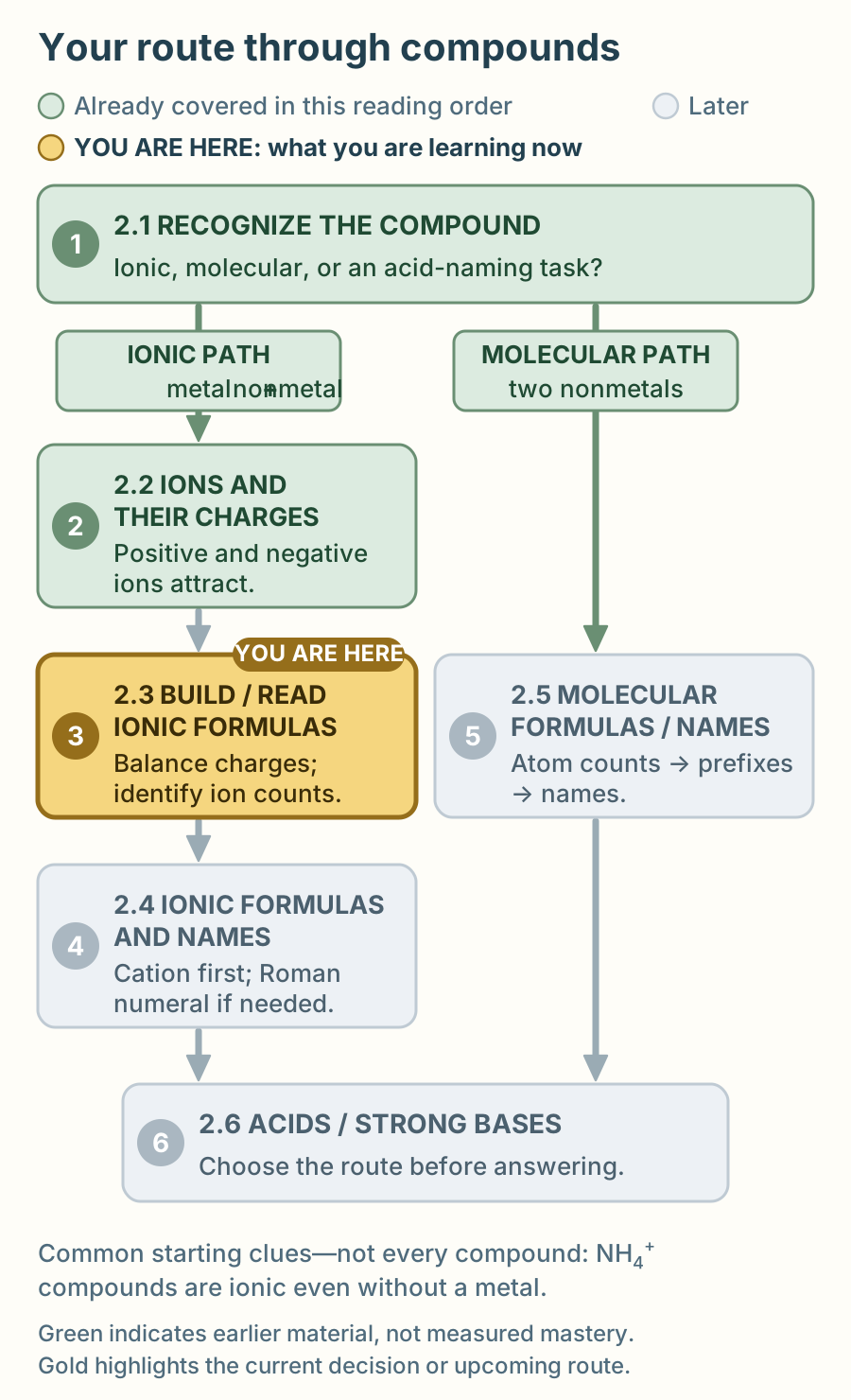
Chapter route map. Ionic path: metal plus nonmetal. Molecular path: two nonmetals. Ammonium compounds are also ionic without a metal. Green: earlier material. Gold: current decision or upcoming route. Gray: later material.
Metal + nonmetal → ionic; two nonmetals → molecular. Ammonium compounds are ionic without a metal. Green = earlier, gold = now, gray = later; colors do not measure mastery.
Neutral means zero total charge
(count × cation charge) + (count × anion charge) = 0
Use the smallest whole-number counts. Write the positive ion first.
Criss-cross: each charge size becomes the other ion’s count
IonsFormulaAl3+O2−Al2O3drop thesignsCheck: 2(+3) + 3(−2) = 0
Cross the sizes, drop the signs, then reduce to the smallest whole-number ratio.
Polyatomic groups in the formula
  • Learning layout: put every polyatomic group in parentheses, even with an outside 1, e.g. Na1(NO3)1.
  • Finished formula: drop a single group’s parentheses and outside 1, giving NaNO3.
  • Keep parentheses only when a group repeats: Ca(NO3)2.
  • Reduce counts of whole groups, never the subscripts inside the group.
  • Use criss-cross for ionic compounds only, not molecular ones such as CO2.
Can criss-cross run backward?
Ions → formula
Yes. Cross the charge sizes, then reduce.
Mg2+ + O2− → Mg2O2 → MgO
Formula → ions
Not directly. MgO is 1:1, yet its ions are Mg2+ and O2−.
Recognize a known ion, total its charge, then find the charge that balances it.

The examples identify the ions in each compound. They do not claim every compound dissolves in water.

On the periodic table: Main-group charges come from the group: Group 1 forms 1+, Group 2 forms 2+, aluminum (Group 13) forms 3+.

On the periodic table: Group 16 forms 2− (O2−) and Group 17 forms 1− (Cl−).

On the periodic table: The table does not give polyatomic-ion charges or which iron ion is present; use the supplied charge.

On the periodic table: The table identifies elements; subscripts in the formula, not atomic numbers, give atom counts.

Worked example · 3 steps

Write the neutral formula for Mg2+ and Cl−.

  1. 1
    Cross the charge sizes

    Sizes 2 and 1: 1 goes to Mg, 2 goes to Cl. On the periodic table: Mg is Group 2 (Mg2+); Cl is Group 17 (Cl−).

    Mg2+   Cl− → Mg1Cl2
  2. 2
    Simplify

    Omit the 1.

    Mg1Cl2 → MgCl2
  3. 3
    Check the charge

    Positives and negatives must cancel.

    IonCount× Charge= Total
    Mg2+1+2+2
    Cl−2−1−2
    Sum0
  4. ✓
    Answer

    MgCl2

Your turn

Ionic formula practice problems

Answer first, then check. Hints open one at a time; the answer and full solution open after you try.

Problem 1 of 7 · warm-up

Write the formula from Ca2+ and Cl−.

Hint 1 · the clue

First decide whether this asks for compound type, ion charge, formula, or name, then use the matching route.

Hint 2 · the next move

"Write the formula from" two ions with charges means: add ions until the total charge is zero.

Your path:

  1. Start with one Ca2+
  2. Add Cl− ions until charge is zero
  3. Write cation first, counts as subscripts
Answer

Answer: CaCl2

On the periodic table: Calcium (Ca) is in Group 2 (Ca²⁺) and chlorine (Cl) is in Group 17 (Cl⁻).

Full worked solution

What you know: Ions Ca2+ and Cl−. What you want: The neutral formula.

  1. Start with one Ca2+: +2. One Cl− gives (+2) + (−1) = +1, still positive.
  2. Add a second Cl−: (+2) + 2(−1) = 0. Now it balances.
  3. Write the cation first, then the anion, with counts as subscripts: CaCl2.

Check: Crisscross gives the same: Ca's 2 goes to Cl, Cl's 1 goes to Ca. 1:2 is already simplest.

Watch out: Writing CaCl leaves a net +1 charge.

On the periodic table: Calcium (Ca) is in Group 2, so it forms Ca²⁺. Chlorine (Cl) is in Group 17, so it forms Cl⁻.

Answer: CaCl2

YOUR PERIODIC-TABLE REFERENCE

20CaCalcium40.08Group 2 · Period 4

Atomic number identifies proton count. The decimal mass is an average, not an isotope’s mass number. Use supplied rounded masses when a problem gives them.

Problem 2 of 7

Write the formula from Al3+ and O2−.

Hint 1 · the clue

First decide whether this asks for compound type, ion charge, formula, or name, then use the matching route.

Hint 2 · the next move

"Write the formula from" a 3+ ion and a 2− ion signals a crisscross to balance the charges.

Your path:

  1. Crisscross the charge sizes into counts
  2. Reduce the ratio if possible
  3. Check total charge equals zero
Answer

Answer: Al2O3

On the periodic table: Aluminum (Al) is in Group 13 (Al³⁺) and oxygen (O) is in Group 16 (O²⁻).

Full worked solution

What you know: Ions Al3+ and O2−. What you want: The neutral formula.

  1. Crisscross the charge sizes. Oxygen's 2 becomes aluminum's count; aluminum's 3 becomes oxygen's count.
  2. That gives 2 Al3+ and 3 O2−. The ratio 2:3 cannot be reduced.
  3. Check neutrality: 2(+3) + 3(−2) = +6 − 6 = 0. Formula: Al2O3.

Check: +6 and −6 is the smallest total both charges can reach together.

Watch out: AlO leaves +3 + (−2) = +1. The charges must cancel exactly.

On the periodic table: Aluminum (Al) is in Group 13 and forms Al³⁺. Oxygen (O) is in Group 16 and forms O²⁻.

Answer: Al2O3

YOUR PERIODIC-TABLE REFERENCE

8OOxygen16.00Group 16 · Period 2
13AlAluminum26.98Group 13 · Period 3

Atomic number identifies proton count. The decimal mass is an average, not an isotope’s mass number. Use supplied rounded masses when a problem gives them.

Problem 3 of 7

Write the formula from Mg2+ and NO3−.

Hint 1 · the clue

First decide whether this asks for compound type, ion charge, formula, or name, then use the matching route.

Hint 2 · the next move

"Write the formula from" a metal ion and a polyatomic ion (nitrate) means balance charges and use parentheses for the group.

Your path:

  1. Each nitrate is −1; balance Mg2+
  2. Two nitrates needed
  3. Put NO3 in parentheses, count outside
Answer

Answer: Mg(NO3)2

On the periodic table: Magnesium (Mg) is in Group 2, so it forms Mg²⁺.

Full worked solution

What you know: Ions Mg2+ and NO3− (nitrate). What you want: The neutral formula.

  1. One Mg2+ is +2. Each nitrate is −1, so you need two: (+2) + 2(−1) = 0.
  2. Put the whole nitrate group in parentheses and write 2 outside: (NO3)2. The 3 inside stays unchanged.
  3. Formula: Mg(NO3)2.

Check: Atoms: 1 Mg, 2 × 1 = 2 N, 2 × 3 = 6 O.

Watch out: MgNO32 or MgN2O6 loses the nitrate group. Parentheses show two whole NO3− units.

On the periodic table: Magnesium (Mg) is in Group 2, so it forms Mg²⁺.

Answer: Mg(NO3)2

YOUR PERIODIC-TABLE REFERENCE

7NNitrogen14.01Group 15 · Period 2
12MgMagnesium24.31Group 2 · Period 3

Atomic number identifies proton count. The decimal mass is an average, not an isotope’s mass number. Use supplied rounded masses when a problem gives them.

Problem 4 of 7

Write the formula from NH4+ and SO42−.

Hint 1 · the clue

First decide whether this asks for compound type, ion charge, formula, or name, then use the matching route.

Hint 2 · the next move

"Write the formula from" two polyatomic ions means balance charges and keep each group whole.

Your path:

  1. Sulfate is −2; each ammonium is +1
  2. Two ammonium ions balance one sulfate
  3. Parentheses around NH4 with count outside
Answer

Answer: (NH4)2SO4

Full worked solution

What you know: Ions NH4+ (ammonium) and SO42− (sulfate). What you want: The neutral formula.

  1. Sulfate is −2. Each ammonium is +1, so you need two: 2(+1) + (−2) = 0.
  2. Put ammonium in parentheses with a 2 outside: (NH4)2. Keep its internal 4 unchanged.
  3. One sulfate needs no parentheses or written 1. Cation first: (NH4)2SO4.

Check: Atoms: 2 N, 8 H, 1 S, 4 O.

Watch out: Writing NH42SO4 or changing the 4 inside ammonium. Count whole groups, not internal subscripts.

Answer: (NH4)2SO4

YOUR PERIODIC-TABLE REFERENCE

7NNitrogen14.01Group 15 · Period 2
16SSulfur32.06Group 16 · Period 3

Atomic number identifies proton count. The decimal mass is an average, not an isotope’s mass number. Use supplied rounded masses when a problem gives them.

Problem 5 of 7

Identify ions and counts in Ca(OH)2.

Hint 1 · the clue

First decide whether this asks for compound type, ion charge, formula, or name, then use the matching route.

Hint 2 · the next move

"Identify ions and counts" with parentheses in the formula means the number outside counts whole hydroxide groups.

Your path:

  1. Recognize Ca2+ and hydroxide, OH−
  2. Outside subscript counts whole OH groups
  3. Check charges add to zero
Answer

Answer: 1 Ca2+ and 2 OH−

On the periodic table: Calcium (Ca) is in Group 2, so it forms Ca²⁺.

Full worked solution

What you know: The formula Ca(OH)2. What you want: Which ions, and how many of each.

  1. Recognize the ions. Ca is a Group 2 metal, so Ca2+. The group in parentheses, OH, is hydroxide, OH−.
  2. Read the counts. Ca has an understood 1. The 2 outside the parentheses counts whole OH− groups.
  3. So there are 1 Ca2+ and 2 OH−.

Check: (+2) + 2(−1) = 0. The formula is neutral.

Watch out: The outside 2 is not calcium's charge and does not mean O2. It multiplies both O and H.

On the periodic table: Calcium (Ca) is in Group 2, so it forms Ca²⁺.

Answer: 1 Ca2+ and 2 OH−

YOUR PERIODIC-TABLE REFERENCE

8OOxygen16.00Group 16 · Period 2
20CaCalcium40.08Group 2 · Period 4

Atomic number identifies proton count. The decimal mass is an average, not an isotope’s mass number. Use supplied rounded masses when a problem gives them.

Problem 6 of 7

Identify ions and counts in Al2O3.

Hint 1 · the clue

First decide whether this asks for compound type, ion charge, formula, or name, then use the matching route.

Hint 2 · the next move

"Identify ions and counts" with a metal–nonmetal formula means name each ion's charge, then read subscripts as ion counts.

Your path:

  1. Al is Group 13 → Al3+; O → O2−
  2. Subscripts give number of each ion
  3. Check total charge equals zero
Answer

Answer: 2 Al3+ and 3 O2−

Problem 7 of 7

Write the formula from Al3+ and OH−, then identify ions/counts and atom counts.

Hint 1 · the clue

Identify whether the compound is ionic or molecular. For ionic compounds, use known ion charges and require a zero total charge; keep polyatomic groups intact. For names, follow the rules for that compound type.

Hint 2 · the next move

"Write the formula from" two ions, then "ions/counts and atom counts": balance charges, then read the parentheses carefully.

Your path:

  1. Balance Al3+ with enough OH−
  2. Parentheses around OH, count outside
  3. Outside count multiplies both O and H
Answer

Al(OH)3: 1 Al3+ and 3 OH−; 1 Al, 3 O, 3 H. +3 + 3(−1) = 0.

On the periodic table: Aluminum (Al) is in Group 13 and forms Al³⁺.

Full worked solution

What you know: Ions Al3+ and OH−. What you want: The formula, the ion counts, and the atom counts.

  1. Balance charges. One Al3+ needs three OH−: (+3) + 3(−1) = 0.
  2. Put hydroxide in parentheses with 3 outside: Al(OH)3. That is 1 Al3+ and 3 OH−.
  3. Count atoms. The outside 3 multiplies both O and H: 3 × 1 O = 3 O, 3 × 1 H = 3 H. So Al(OH)3: 1 Al3+ and 3 OH−; 1 Al, 3 O, 3 H. +3 + 3(−1) = 0.

Check: 7 atoms total: 1 + 3 + 3.

Watch out: AlOH3 would mean 1 O and 3 H. Parentheses are required.

Answer: Al(OH)3: 1 Al3+ and 3 OH−; 1 Al, 3 O, 3 H. +3 + 3(−1) = 0.

On the periodic table: Aluminum (Al) is in Group 13 and forms Al³⁺.

YOUR PERIODIC-TABLE REFERENCE

1HHydrogen1.008Group 1 · Period 1
8OOxygen16.00Group 16 · Period 2
13AlAluminum26.98Group 13 · Period 3

Atomic number identifies proton count. The decimal mass is an average, not an isotope’s mass number. Use supplied rounded masses when a problem gives them.

Watch out

Common ionic formula mistakes