ChemGem

Naming Molecular Compounds (Step-by-Step, with Practice)

Molecular compounds (also called covalent compounds) are nonmetals sharing electrons (from 2.1). Their formulas count the actual atoms in one molecule, and their names use number prefixes instead of charges.

Spot it, solve it, practice it: 4 steps, 1 worked example, 3 practice problems. Free, no account.

The route · 4 steps

  1. Confirm it is molecular: nonmetals only.
  2. Formula → counts: each subscript counts atoms; no subscript means 1.
  3. Formula → name: prefix + first element (omit mono), prefix + second element root + -ide.
  4. Name → formula: turn each prefix into a subscript and do not reduce.
Spot it

How to recognize molecular naming questions

Look for a formula or name made of only nonmetals, often with prefixes like di-, tri-, or tetra-.

Example wording, with the clue words marked:

Name N2O4.

Not sure it’s this type? Compare the neighbors:

Step-by-step

Worked example: molecular naming

The idea

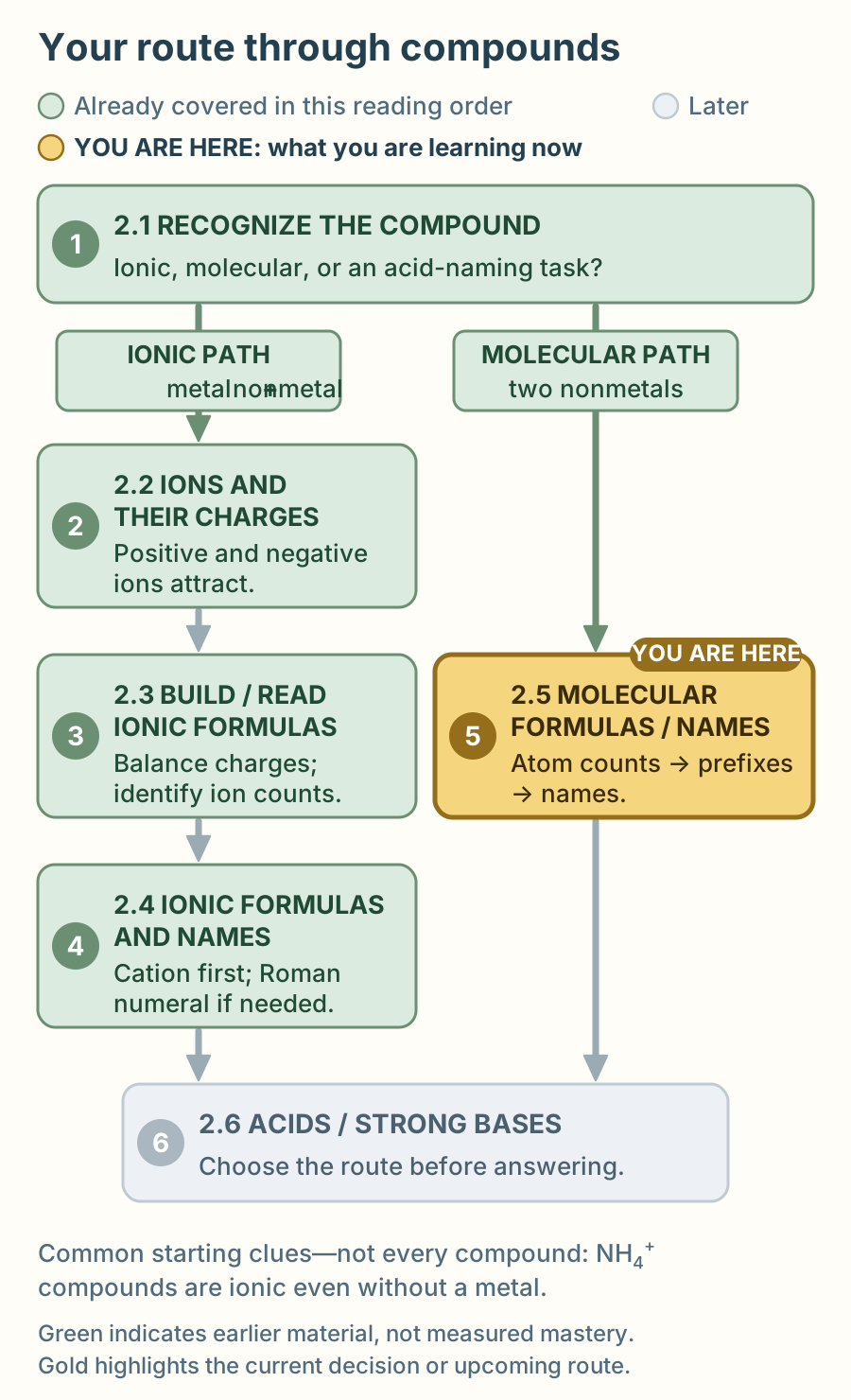
Chapter route map. Ionic path: metal plus nonmetal. Molecular path: two nonmetals. Both decision clues highlighted in section 2.1. Ammonium compounds are also ionic without a metal. Green: earlier material. Gold: current decision or upcoming route. Gray: later material. Follow ionic charges/formulas/names or molecular atom counts/prefixes, then acids, strong bases, and mixed practice.
Metal + nonmetal → ionic; two nonmetals → molecular. Ammonium compounds are ionic without a metal. Green = earlier, gold = now, gray = later; colors do not measure mastery.
Two different formula routes
Ionic
Identify the ions and balance charges.
The formula is the simplest ion ratio, so reduce it.
Molecular
Read actual atom counts from supplied information or prefixes.
The formula is one whole molecule, so never reduce it.
Prefixes count atoms
monoditritetrapentahexaheptaoctanonadeca
12345678910
Used for binary (two-element) molecular compounds.
Naming rules
  • Name the first element; usually omit mono on it.
  • Name the second element with a prefix and an -ide ending.
  • Familiar spellings drop a vowel before oxide: monoxide, tetroxide.
  • Keep the actual counts. Do not criss-cross ion charges.

You cannot work out every molecular formula from the elements alone; you need given counts or a name. Chapter 8 explains covalent bonding in more detail.

On the periodic table: C is carbon, O is oxygen, N is nitrogen, H is hydrogen and S is sulfur.

On the periodic table: Carbon, nitrogen and oxygen are right of the staircase line, so all are nonmetals.

Worked example · 2 steps

Formula → atom counts: CO2

  1. 1
    Read each symbol

    No subscript on C means one carbon. The small 2 means two oxygens. On the periodic table: C is carbon and O is oxygen.

    AtomCOTotal
    Count123
  2. 2
    Keep it molecular

    Do not criss-cross or turn CO2 into C4+ and O2−. These atoms share electrons.

    CO2 = 1 C + 2 O (shared electrons, no ions)
  3. ✓
    Answer

    1 carbon atom and 2 oxygen atoms per molecule

Your turn

Molecular naming practice problems

Answer first, then check. Hints open one at a time; the answer and full solution open after you try.

Problem 1 of 3 · warm-up

Name N2O4.

Hint 1 · the clue

First decide whether this asks for compound type, ion charge, formula, or name, then use the matching route.

Hint 2 · the next move

"Name" a formula of two nonmetals tells you to use prefixes that match the actual atom counts.

Your path:

  1. N and O are nonmetals → prefixes
  2. Prefix for each atom count
  3. Second element ends in -ide
Answer

Answer: Dinitrogen tetroxide

Full worked solution

What you know: The formula N2O4. What you want: Its name.

  1. Choose the rule. N and O are both nonmetals, so use molecular (prefix) naming.
  2. First element: 2 nitrogen atoms → di- + nitrogen = dinitrogen.
  3. Second element: 4 oxygen atoms → tetra- + oxide. The "a" drops before "o", giving tetroxide. Name: Dinitrogen tetroxide.

Check: Read the name back: di = 2 N, tetra = 4 O. That gives N2O4.

Watch out: Do not reduce N2O4 to NO2. That is a different molecule. Molecular formulas keep actual atom counts.

On the periodic table: N is nitrogen and O is oxygen.

Answer: Dinitrogen tetroxide

YOUR PERIODIC-TABLE REFERENCE

7NNitrogen14.01Group 15 · Period 2
8OOxygen16.00Group 16 · Period 2

Atomic number identifies proton count. The decimal mass is an average, not an isotope’s mass number. Use supplied rounded masses when a problem gives them.

Problem 2 of 3

Write the formula for sulfur dioxide.

Hint 1 · the clue

First decide whether this asks for compound type, ion charge, formula, or name, then use the matching route.

Hint 2 · the next move

"Write the formula for" a name with a prefix (di-) and two nonmetals means read the prefixes as atom counts.

Your path:

  1. Both nonmetals → read prefixes
  2. No prefix on first element = one atom
  3. di- = two atoms; no charge balancing
Answer

Answer: SO2

Full worked solution

What you know: The name sulfur dioxide. What you want: Its formula.

  1. Choose the rule. Sulfur and oxygen are nonmetals, so read the prefixes as atom counts.
  2. "Sulfur" has no prefix. On the first element that means one S.
  3. "Di" on oxide means 2 O. Formula: SO2.

Check: Name it back: 1 S (no mono-) and 2 O (dioxide). It matches.

Watch out: Do not crisscross charges here. Sulfur and oxygen share electrons; the prefixes alone give the formula.

On the periodic table: Sulfur’s symbol is S and oxygen’s symbol is O.

Answer: SO2

YOUR PERIODIC-TABLE REFERENCE

8OOxygen16.00Group 16 · Period 2
16SSulfur32.06Group 16 · Period 3

Atomic number identifies proton count. The decimal mass is an average, not an isotope’s mass number. Use supplied rounded masses when a problem gives them.

Problem 3 of 3

Name N2O3, then write sulfur trioxide.

Hint 1 · the clue

Prefixes give the number of each atom: di- = 2, tri- = 3. The first element keeps its name; the second ends in -ide.

Hint 2 · the next move

Only nonmetals plus a prefix name ("trioxide") tell you to use molecular prefix naming both ways.

Your path:

  1. Both are nonmetals → prefixes
  2. Prefixes match actual atom counts
  3. No prefix on first element = one atom
Answer

Dinitrogen trioxide; SO3. Prefixes give the actual atom counts.

Full worked solution

What you know: The formula N2O3 and the name sulfur trioxide. What you want: A name and a formula.

  1. Each compound contains only nonmetals (N and O; S and O), so use molecular prefixes. Prefixes give actual atom counts.
  2. N2O3: 2 N → dinitrogen; 3 O → trioxide. Name: dinitrogen trioxide.
  3. Sulfur trioxide: no prefix on sulfur means 1 S; tri- means 3 O. So: Dinitrogen trioxide; SO3. Prefixes give the actual atom counts.

Check: Read each back: di = 2, tri = 3, no prefix on the first element = 1.

Watch out: Do not crisscross charges for these molecules, and do not reduce counts.

Answer: Dinitrogen trioxide; SO3. Prefixes give the actual atom counts.

On the periodic table: N is nitrogen, O is oxygen, and S is sulfur.

YOUR PERIODIC-TABLE REFERENCE

16SSulfur32.06Group 16 · Period 3

Atomic number identifies proton count. The decimal mass is an average, not an isotope’s mass number. Use supplied rounded masses when a problem gives them.

Watch out

Common molecular naming mistakes