ChemGem

Naming Ionic Compounds (Step-by-Step, with Practice)

An ionic name is just its two ions, positive first. This lesson runs the route both ways: from a formula to its name, and from a name back to a balanced formula.

Spot it, solve it, practice it: 4 steps, 1 worked example, 5 practice problems. Free, no account.

The route · 4 steps

  1. Identify the positive ion and the negative ion.
  2. Formula → name: name the cation, add a Roman numeral if its charge varies, then name the anion (-ide or polyatomic name).
  3. Name → formula: write each ion with its charge.
  4. Balance the charges to zero; keep polyatomic groups whole and use parentheses only for a repeated group.
Spot it

How to recognize ionic naming questions

Look for "Name" plus a metal–nonmetal formula, or a name like "copper(II) oxide" that asks for the formula.

Example wording, with the clue words marked:

Name NaCl.

Not sure it’s this type? Compare the neighbors:

Step-by-step

Worked example: ionic naming

The idea

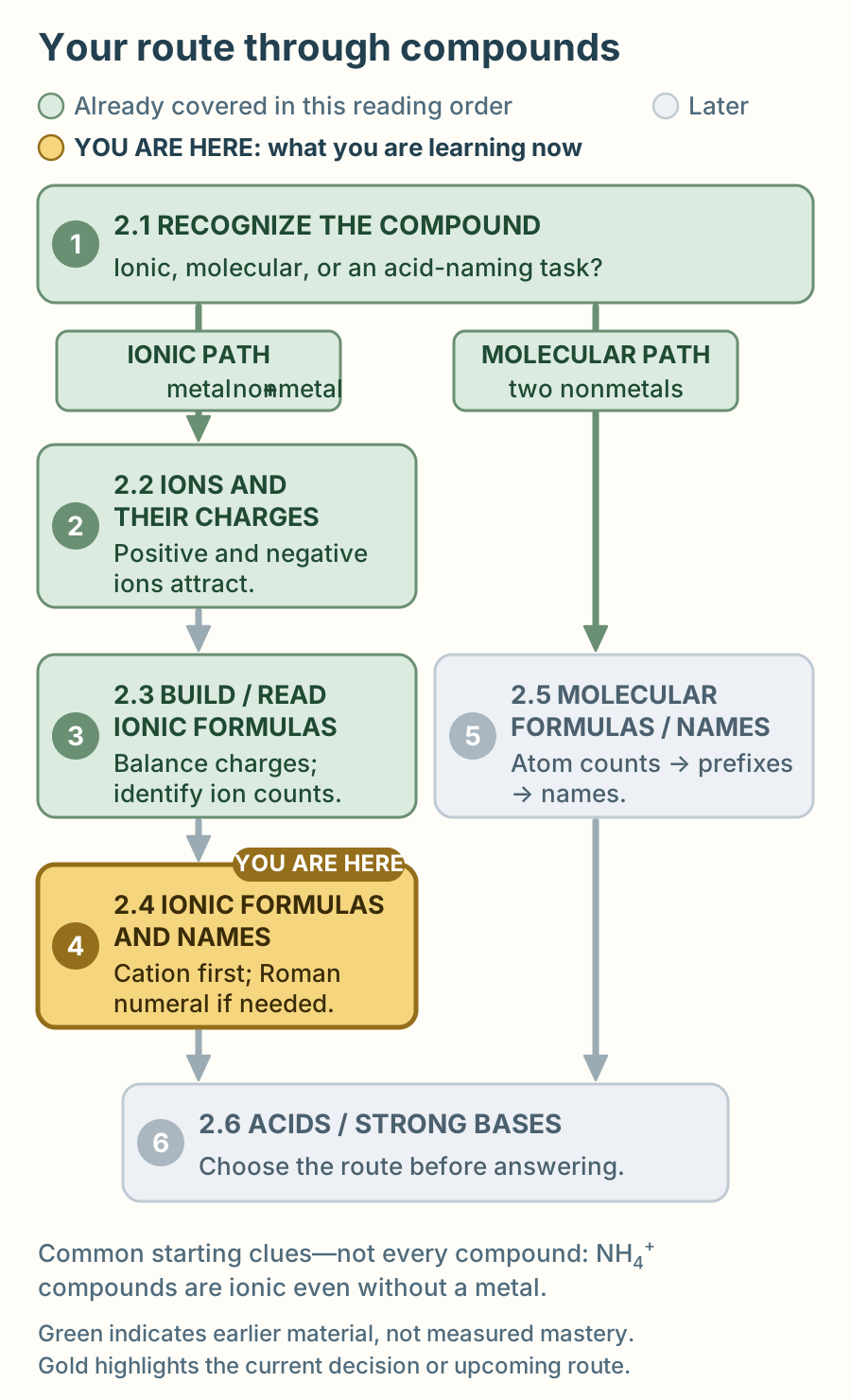
Chapter route map. Ionic path: metal plus nonmetal. Molecular path: two nonmetals. Both decision clues highlighted in section 2.1. Ammonium compounds are also ionic without a metal. Green: earlier material. Gold: current decision or upcoming route. Gray: later material. Follow ionic charges/formulas/names or molecular atom counts/prefixes, then acids, strong bases, and mixed practice.
Metal + nonmetal → ionic; two nonmetals → molecular. Ammonium compounds are ionic without a metal. Green = earlier, gold = now, gray = later; colors do not measure mastery.
How each ion is named
IonRuleExamples
Fixed-charge cationElement nameNa+ sodium; Ca2+ calcium
Variable-charge cationElement name + charge as a Roman numeralFe2+ iron(II); Fe3+ iron(III)
Polyatomic ionKeep its own nameNH4+ ammonium; NO3− nitrate; SO42− sulfate
Single-atom anionElement root + -ideCl− chloride; O2− oxide
Positive ion first, negative ion second.
Two directions
Formula → name
First choose the rule: ionic, molecular or acid.
Identify the ions, then name them in order.
Variable metal: work out its charge first.
Name → formula
Ionic names: use ion charges. Molecular names: use prefixes.
Turn each name into an ion, then balance the charges to zero.

On the periodic table: Sodium (Na) is in Group 1, so it forms Na+; calcium (Ca) is in Group 2, so it forms Ca2+.

On the periodic table: Chlorine (Cl) is in Group 17, so it forms Cl−; oxygen (O) is in Group 16, so oxide is O2−.

On the periodic table: The table gives iron’s symbol, Fe, but not its charge; read that from the formula or the Roman numeral.

Worked example · 2 steps

Formula → name: NaCl

  1. 1
    Identify the ions

    On the periodic table: Na (sodium) is in Group 1, so Na+. Cl (chlorine) is in Group 17, so Cl−.

    IonChargeName
    Na++1sodium
    Cl−−1chloride
  2. 2
    Name in order

    Positive ion first. A one-element chlorine anion is chloride. No prefixes or Roman numeral needed.

    sodium + chloride → sodium chloride
  3. ✓
    Answer

    sodium chloride

Your turn

Ionic naming practice problems

Answer first, then check. Hints open one at a time; the answer and full solution open after you try.

Problem 1 of 5 · warm-up

Name NaCl.

Hint 1 · the clue

First decide whether this asks for compound type, ion charge, formula, or name, then use the matching route.

Hint 2 · the next move

"Name" a metal–nonmetal formula means ionic naming; sodium has a fixed charge, so no Roman numeral.

Your path:

  1. Metal + nonmetal → ionic naming
  2. Name the cation: sodium (fixed charge)
  3. Anion gets -ide ending
Answer

Answer: Sodium chloride

On the periodic table: Na is sodium and Cl is chlorine.

Full worked solution

What you know: The formula NaCl. What you want: Its name.

  1. Choose the rule. Na is a metal and Cl is a nonmetal, so use ionic naming.
  2. Name the cation first. Sodium is a Group 1 fixed-charge metal (Na+), so no Roman numeral is needed.
  3. Name the single-atom anion with -ide: chlorine → chloride. Name: Sodium chloride.

Check: (+1) + (−1) = 0, matching the 1:1 formula.

Watch out: Do not add prefixes like "monosodium monochloride". Prefixes are only for molecular compounds.

On the periodic table: Na is sodium, in Group 1, so it forms Na⁺. Cl is chlorine, in Group 17, so it forms chloride, Cl⁻.

Answer: Sodium chloride

YOUR PERIODIC-TABLE REFERENCE

11NaSodium22.99Group 1 · Period 3

Atomic number identifies proton count. The decimal mass is an average, not an isotope’s mass number. Use supplied rounded masses when a problem gives them.

Problem 2 of 5

Name FeCl3.

Hint 1 · the clue

First decide whether this asks for compound type, ion charge, formula, or name, then use the matching route.

Hint 2 · the next move

"Name" an ionic formula with iron, a variable-charge metal, tells you to find iron's charge for a Roman numeral.

Your path:

  1. Ionic: iron plus chloride
  2. Use chloride charges to find iron's charge
  3. Write charge as Roman numeral; anion -ide
Answer

Answer: Iron(III) chloride

Full worked solution

What you know: The formula FeCl3. What you want: Its name.

  1. Choose the rule. Fe is a metal and Cl a nonmetal, so use ionic naming. Iron is a variable-charge metal, so it needs a Roman numeral.
  2. Find iron's charge from the anions. Three Cl− give 3(−1) = −3, so iron must be +3 to reach zero.
  3. Write the charge as III, then name the anion with -ide: Iron(III) chloride.

Check: (+3) + 3(−1) = 0.

Watch out: The Roman numeral gives iron's charge, not the number of chlorides or iron atoms. Do not write "iron trichloride".

On the periodic table: Chlorine (Cl) is in Group 17, so each chloride is Cl⁻. Fe is the symbol for iron.

Answer: Iron(III) chloride

YOUR PERIODIC-TABLE REFERENCE

26FeIron55.85Group 8 · Period 4
17ClChlorine35.45Group 17 · Period 3

Atomic number identifies proton count. The decimal mass is an average, not an isotope’s mass number. Use supplied rounded masses when a problem gives them.

Problem 3 of 5

Write the formula for copper(II) oxide.

Hint 1 · the clue

First decide whether this asks for compound type, ion charge, formula, or name, then use the matching route.

Hint 2 · the next move

"Write the formula for" a name with a Roman numeral tells you the metal ion's charge; then balance with the anion.

Your path:

  1. (II) means Cu2+; oxide is O2−
  2. Balance charges, reduce to simplest ratio
  3. Write formula; skip subscripts of 1
Answer

Answer: CuO

Full worked solution

What you know: The name copper(II) oxide. What you want: Its formula.

  1. Read the ions. The Roman numeral II means Cu2+. Oxide is O2−.
  2. Balance charges. One of each works: (+2) + (−2) = 0.
  3. Crisscross would give Cu2O2; reduce 2:2 to 1:1. Subscripts of 1 are not written: CuO.

Check: Reverse it: one O2− requires copper +2, which matches (II).

Watch out: Do not read II as "two copper atoms". Cu2O is copper(I) oxide.

On the periodic table: Copper’s symbol is Cu. Oxygen (O) is in Group 16, so oxide is O²⁻.

Answer: CuO

YOUR PERIODIC-TABLE REFERENCE

8OOxygen16.00Group 16 · Period 2
29CuCopper63.55Group 11 · Period 4

Atomic number identifies proton count. The decimal mass is an average, not an isotope’s mass number. Use supplied rounded masses when a problem gives them.

Problem 4 of 5

Write the formula for calcium nitrate.

Hint 1 · the clue

First decide whether this asks for compound type, ion charge, formula, or name, then use the matching route.

Hint 2 · the next move

"Write the formula for" a metal plus a polyatomic ion name (nitrate) means balance charges using parentheses.

Your path:

  1. Calcium → Ca2+; nitrate → NO3−
  2. Two nitrates balance one Ca2+
  3. Parentheses around NO3, count outside
Answer

Answer: Ca(NO3)2

Full worked solution

What you know: The name calcium nitrate. What you want: Its formula.

  1. Read the ions. Calcium is Group 2: Ca2+. Nitrate is the polyatomic ion NO3−.
  2. Balance charges. One Ca2+ needs two nitrates: (+2) + 2(−1) = 0.
  3. Put the nitrate group in parentheses with 2 outside, keeping its 3 inside: Ca(NO3)2.

Check: Atoms: 1 Ca, 2 N, 6 O.

Watch out: CaNO3 leaves a +1 charge. Without parentheses the 2 would not multiply the whole nitrate group.

On the periodic table: Calcium (Ca) is in Group 2, so it forms Ca²⁺.

Answer: Ca(NO3)2

YOUR PERIODIC-TABLE REFERENCE

7NNitrogen14.01Group 15 · Period 2
20CaCalcium40.08Group 2 · Period 4

Atomic number identifies proton count. The decimal mass is an average, not an isotope’s mass number. Use supplied rounded masses when a problem gives them.

Problem 5 of 5

Name CuCl2, then write calcium carbonate.

Hint 1 · the clue

Identify whether the compound is ionic or molecular. For ionic compounds, use known ion charges and require a zero total charge; keep polyatomic groups intact. For names, follow the rules for that compound type.

Hint 2 · the next move

"Name" a copper formula (variable charge) and "write" a metal–polyatomic name both use ionic naming rules.

Your path:

  1. Use chlorides to find copper's charge
  2. Name: copper(Roman numeral) chloride
  3. Ca2+ with CO32−; balance charges
Answer

Copper(II) chloride; CaCO3, from Ca2+ and CO32−.

On the periodic table: Calcium (Ca) is in Group 2, so it forms Ca²⁺.

Full worked solution

What you know: The formula CuCl2 and the name calcium carbonate. What you want: A name and a formula.

  1. CuCl2 is ionic. Copper has variable charge, so find it: two Cl− give −2, so copper is +2. Write it as (II).
  2. Name the anion with -ide: copper(II) chloride.
  3. Calcium carbonate: calcium is Group 2, Ca2+. Carbonate is CO32−. (+2) + (−2) = 0, so one of each, and a single group needs no parentheses. So: Copper(II) chloride; CaCO3, from Ca2+ and CO32−.

Check: CaCO3 has 1 Ca, 1 C, 3 O.

Watch out: The II is copper's charge, not a count. Do not write Ca2(CO3)2; reduce to 1:1.

Answer: Copper(II) chloride; CaCO3, from Ca2+ and CO32−.

On the periodic table: Cu is the symbol for copper, and chlorine (Cl) is in Group 17, so chloride is Cl⁻. Calcium (Ca) is in Group 2, so it forms Ca²⁺.

YOUR PERIODIC-TABLE REFERENCE

6CCarbon12.01Group 14 · Period 2
20CaCalcium40.08Group 2 · Period 4
29CuCopper63.55Group 11 · Period 4
17ClChlorine35.45Group 17 · Period 3

Atomic number identifies proton count. The decimal mass is an average, not an isotope’s mass number. Use supplied rounded masses when a problem gives them.

Watch out

Common ionic naming mistakes