ChemGem

Naming Acids and Bases (Step-by-Step, with Practice)

Acids and strong bases have their own recognition clues, and acids have their own naming route, separate from ionic and molecular names. This lesson shows how to spot them and move between acid formulas and names.

Spot it, solve it, practice it: 4 steps, 1 worked example, 5 practice problems. Free, no account.

The route · 4 steps

  1. Formula starts with H and is in water: use the acid route. Metal + OH−: a hydroxide base.
  2. Find the anion: single-atom (-ide) or polyatomic (-ate or -ite).
  3. Name it: -ide → hydro-…-ic acid; -ate → -ic acid; -ite → -ous acid.
  4. Name → formula: add enough H+ to balance the anion’s charge.
Spot it

How to recognize acid and base naming questions

Look for H written first with (aq), the word "acid", or "strong-base hydroxide" of a Group 1 metal ion or Ca2+, Sr2+, Ba2+.

Example wording, with the clue words marked:

Name HCl(aq).

Not sure it’s this type? Compare the neighbors:

Step-by-step

Worked example: acid and base naming

The idea

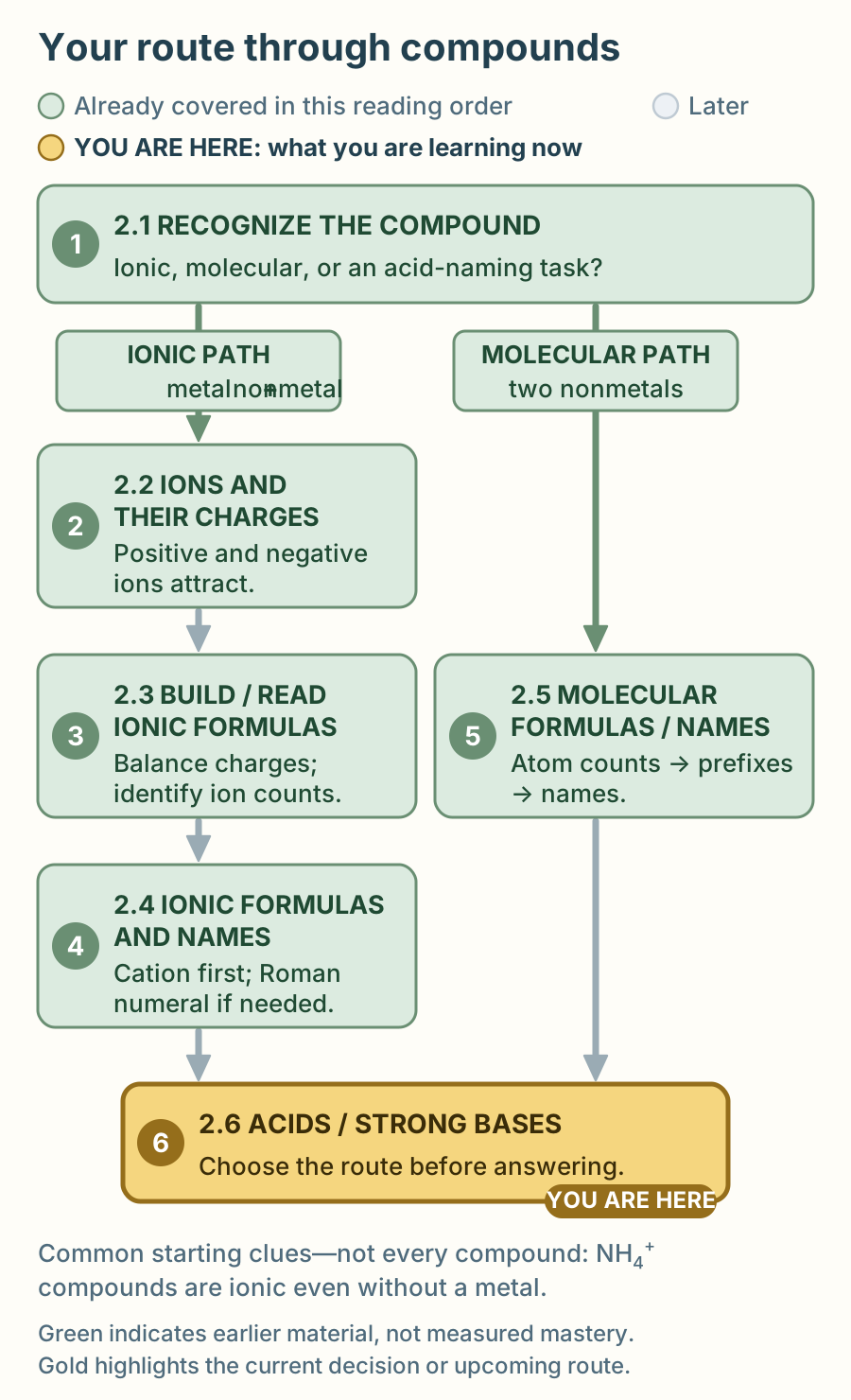
Chapter route map. Ionic path: metal plus nonmetal. Molecular path: two nonmetals. Both decision clues highlighted in section 2.1. Ammonium compounds are also ionic without a metal. Green: earlier material. Gold: current decision or upcoming route. Gray: later material. Follow ionic charges/formulas/names or molecular atom counts/prefixes, then acids, strong bases, and mixed practice.
Metal + nonmetal → ionic; two nonmetals → molecular. Ammonium compounds are ionic without a metal. Green = earlier, gold = now, gray = later; colors do not measure mastery.
Acid or hydroxide base?
Acid (in water)
(aq) means aqueous: dissolved in water.
An acid donates H+ to water, forming H3O+ (hydronium).
Hydroxide base
NaOH is ionic: Na+ and the polyatomic ion OH−.
Dissolving separates the ions; OH− stays together.

See the particles in action: Chapter 6.4: acid in water → base in water → make water.

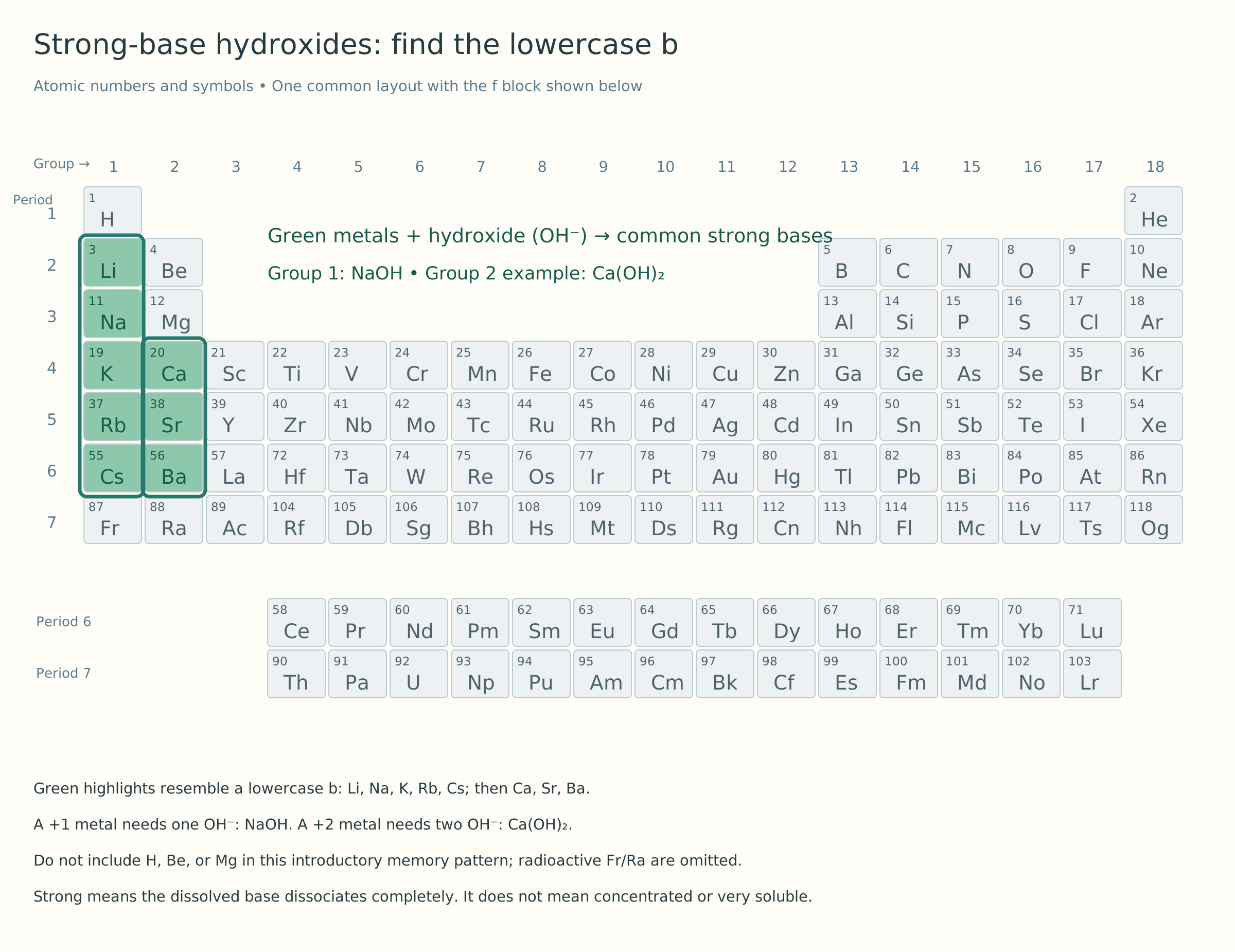
Strong-base hydroxides: find the lowercase b. Green highlights resemble a lowercase b: Li, Na, K, Rb, Cs; then Ca, Sr, Ba. A +1 metal needs one OH⁻: NaOH. A +2 metal needs two OH⁻: Ca(OH)₂. Do not include H, Be, or Mg in this introductory memory pattern; radioactive Fr/Ra are omitted. Strong means the dissolved base dissociates completely. It does not mean concentrated or very soluble.
Strong bases: look for the green lowercase b. Li, Na, K, Rb, Cs; then Ca, Sr, Ba.
Strong-base hydroxides
MetalsIon chargeHydroxidesIn water
Group 1: Li, Na, K, Rb, Cs+1: one OH−LiOH, NaOH, KOH, RbOH, CsOHNaOH → Na+ + OH−
Group 2: Ca, Sr, Ba+2: two whole OH− groupsCa(OH)2, Sr(OH)2, Ba(OH)2Ca(OH)2 → Ca2+ + 2OH−
Strong means the dissolved base separates completely into ions.
Limits of the memory aid
  • It covers common course examples, not every hydroxide.
  • H is not a metal. Be and Mg are not on this introductory strong-base list. Radioactive Fr and Ra are left out.
  • Strength is not concentration: a strong base can be dilute.
  • Calcium hydroxide has limited solubility; the part that dissolves separates completely.
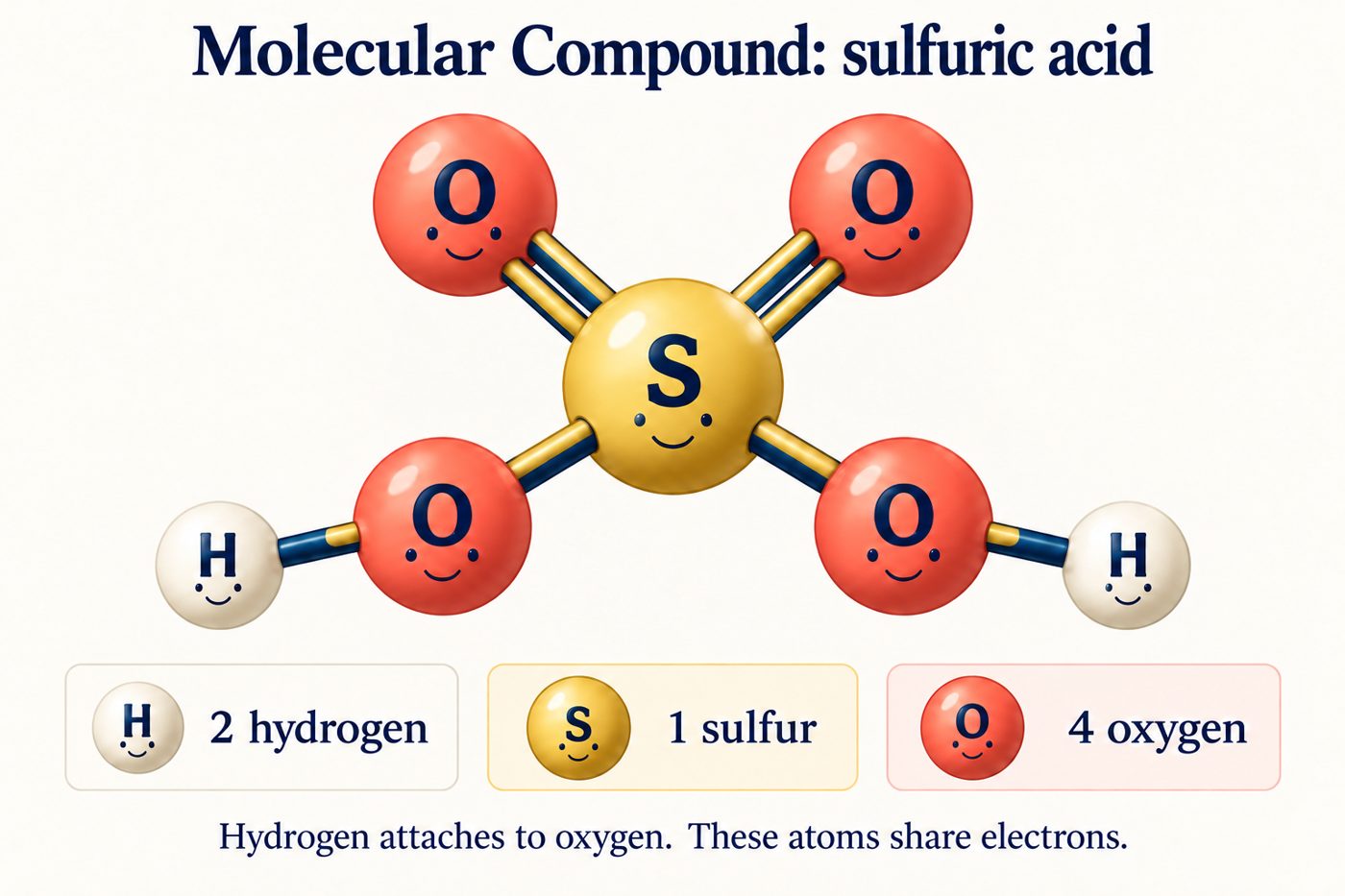
One H₂SO₄ molecule: one central sulfur, four oxygens, and two hydrogens attached to oxygens.
H2SO4 is a molecular compound. In water it acts as an acid, so use acid naming, not binary molecular prefixes.
The acid naming route
Acid typeRuleExample
Binary acid in water (no oxygen)hydro- + root + -ic acidHCl(aq): hydrochloric acid
Oxygen acid from an -ate ion-ate → -ic acidnitrate → nitric acid (HNO3)
Oxygen acid from an -ite ion-ite → -ous acidnitrite → nitrous acid (HNO2)
Ion with per- or hypo-Keep the prefixperchlorate → perchloric acid; hypochlorite → hypochlorous acid
First choose the rule: ionic, molecular or acid.

On the periodic table: Sodium (Na) is in Group 1, so it forms Na+; Group 1 hydroxides use one OH−.

On the periodic table: Barium (Ba) is in Group 2, so it forms Ba2+; Ca, Sr and Ba hydroxides use two OH−.

On the periodic table: Chlorine (Cl) is in Group 17, so it forms Cl− and gives the root chlor-.

Worked example · 3 steps

Metal ion → strong-base formula: write the neutral hydroxide of Ba2+ and OH−.

  1. 1
    Read the charges

    On the periodic table: barium (Ba) is in Group 2, so it forms Ba2+.

    Ba2+   OH−
  2. 2
    Balance the charges

    One Ba2+ needs two OH− ions.

    IonCount× Charge= Total
    Ba2+1+2+2
    OH−2−1−2
    Sum0
  3. 3
    Write the formula

    Put parentheses around the whole hydroxide group. Ba is on the strong-base list.

    Ba(OH)2 = barium hydroxide
  4. ✓
    Answer

    Ba(OH)2, barium hydroxide, a strong base

Your turn

Acid and base naming practice problems

Answer first, then check. Hints open one at a time; the answer and full solution open after you try.

Problem 1 of 5 · warm-up

Name HCl(aq).

Hint 1 · the clue

First decide whether this asks for compound type, ion charge, formula, or name, then use the matching route.

Hint 2 · the next move

"Name" a formula with H first and (aq), and no oxygen, signals a binary acid: hydro- + root + -ic acid.

Your path:

  1. H first + (aq) → acid naming
  2. No oxygen → binary acid
  3. hydro- + root + -ic acid
Answer

Answer: Hydrochloric acid

Full worked solution

What you know: HCl(aq), meaning HCl dissolved in water. What you want: Its acid name.

  1. Choose the rule. The (aq) and the H in front mean acid naming.
  2. Check for oxygen. HCl has only H and Cl, so it is a binary acid.
  3. Use hydro- + root + -ic acid: hydro- + chlor- + -ic acid = hydrochloric acid.

Why it matters: The same formula has two names. HCl gas is hydrogen chloride; HCl(aq) is hydrochloric acid.

Watch out: Do not call it "chloric acid". Without hydro- that name points to a different, oxygen-containing acid.

On the periodic table: Cl is the symbol for chlorine, which gives the root chlor-.

Answer: Hydrochloric acid

Problem 2 of 5

Name HNO3(aq).

Hint 1 · the clue

First decide whether this asks for compound type, ion charge, formula, or name, then use the matching route.

Hint 2 · the next move

H first with (aq) and an oxygen-containing anion (nitrate) means change the anion ending: -ate becomes -ic acid.

Your path:

  1. H first + (aq) → acid naming
  2. Remove H+: NO3− is nitrate
  3. -ate → -ic acid; no hydro-
Answer

Answer: Nitric acid

Full worked solution

What you know: HNO3(aq). What you want: Its acid name.

  1. Choose the rule. H in front plus (aq) means acid naming.
  2. Find the anion. After removing H+, NO3− remains. That is nitrate.
  3. Change the ending: -ate becomes -ic acid. nitrate → nitric acid.

Check: One H+ balances one NO3−: (+1) + (−1) = 0.

Watch out: Do not add hydro-. Hydro- is only for binary acids with no oxygen. Do not use -ous; that comes from -ite (nitrite → nitrous acid).

Answer: Nitric acid

YOUR PERIODIC-TABLE REFERENCE

8OOxygen16.00Group 16 · Period 2

Atomic number identifies proton count. The decimal mass is an average, not an isotope’s mass number. Use supplied rounded masses when a problem gives them.

Problem 3 of 5

Write the strong-base hydroxide of Ba2+.

Hint 1 · the clue

First decide whether this asks for compound type, ion charge, formula, or name, then use the matching route.

Hint 2 · the next move

"Strong-base hydroxide" of a metal ion means pair the ion with enough OH− to balance its charge.

Your path:

  1. Ba2+ needs two OH−
  2. Put OH in parentheses, count outside
  3. Confirm Ba is on the strong-base list
Answer

Answer: Ba(OH)2

On the periodic table: Barium (Ba) is in Group 2, so it forms Ba²⁺.

Full worked solution

What you know: The cation Ba2+ and the hydroxide ion OH−. What you want: The neutral strong-base formula.

  1. Balance charges. One Ba2+ needs two OH−: (+2) + 2(−1) = 0.
  2. Put the whole hydroxide group in parentheses with 2 outside: Ba(OH)2.
  3. Confirm it is a strong base. Ba is in the Ca, Sr, Ba set on the "lowercase b" list.

Check: Atoms: 1 Ba, 2 O, 2 H. It dissociates as Ba(OH)2 → Ba2+ + 2OH−.

Watch out: BaOH2 means one O and two H. Parentheses are needed to show two whole OH groups.

On the periodic table: Barium (Ba) is in Group 2, so it forms Ba²⁺.

Answer: Ba(OH)2

YOUR PERIODIC-TABLE REFERENCE

8OOxygen16.00Group 16 · Period 2
56BaBarium137.33Group 2 · Period 6

Atomic number identifies proton count. The decimal mass is an average, not an isotope’s mass number. Use supplied rounded masses when a problem gives them.

Problem 4 of 5

Does NaOH dissolved in water remain as neutral NaOH molecules?

Hint 1 · the clue

First decide whether this asks for compound type, ion charge, formula, or name, then use the matching route.

Hint 2 · the next move

"Dissolved in water" with an ionic strong base asks whether it stays together; ionic compounds split into their ions.

Your path:

  1. Na+ with OH− → ionic, not molecular
  2. Strong base separates completely in water
  3. OH− stays together as one ion
Answer

Answer: It dissociates into Na+ and OH− ions.

On the periodic table: Sodium (Na) is in Group 1, so it forms Na⁺.

Full worked solution

What you know: NaOH is dissolved in water. What you want: Whether it stays as neutral NaOH molecules.

  1. Decide the type. Na is a Group 1 metal (Na+), and OH− is the polyatomic hydroxide ion. So NaOH is ionic, not molecular.
  2. Ionic compounds separate into their ions when they dissolve. NaOH is a strong base, so it separates completely.
  3. The O and H inside hydroxide stay bonded together. So: It dissociates into Na+ and OH− ions.

Check: NaOH → Na+ + OH−. Charges: 0 = (+1) + (−1).

Watch out: Do not split hydroxide into O and H. OH− stays together.

On the periodic table: Sodium (Na) is a Group 1 metal, so it forms Na⁺ and NaOH is ionic.

Answer: It dissociates into Na+ and OH− ions.

YOUR PERIODIC-TABLE REFERENCE

1HHydrogen1.008Group 1 · Period 1
8OOxygen16.00Group 16 · Period 2
11NaSodium22.99Group 1 · Period 3

Atomic number identifies proton count. The decimal mass is an average, not an isotope’s mass number. Use supplied rounded masses when a problem gives them.

Problem 5 of 5

Trace the extra H in H3O+ from HCl; write the strong-base hydroxide of Ca2+; name HNO2 as an acid.

Hint 1 · the clue

An acid gives H+ to water. A common strong base pairs a Group 1 metal ion, or Ca2+, Sr2+ or Ba2+, with OH−. An -ite ion becomes an -ous acid.

Hint 2 · the next move

H3O+ from HCl, "strong-base hydroxide", and "as an acid" all point to acid and base rules from this section.

Your path:

  1. Acid donates H+ to water → H3O+
  2. Balance Ca2+ with two OH−
  3. NO2− is nitrite: -ite → -ous acid
Answer

HCl donates H+ to H2O, making H3O+ and Cl−. Ca(OH)2 is calcium hydroxide, a strong base. HNO2 is nitrous acid: nitrite → -ous acid.

On the periodic table: Chlorine (Cl) is in Group 17, so it forms Cl⁻. Calcium (Ca) is in Group 2, so it forms Ca²⁺.

Full worked solution

What you know: HCl in water, the ion Ca2+, and HNO2. What you want: Where H3O+ gets its extra H, a hydroxide formula, and an acid name.

  1. An acid donates H+ to water: HCl + H2O → H3O+ + Cl−. The third H came from HCl.
  2. Ca2+ needs two OH−: (+2) + 2(−1) = 0. Formula Ca(OH)2, calcium hydroxide, on the strong-base list.
  3. HNO2 contains NO2−, nitrite. The -ite ending becomes -ous acid. So: HCl donates H+ to H2O, making H3O+ and Cl−. Ca(OH)2 is calcium hydroxide, a strong base. HNO2 is nitrous acid: nitrite → -ous acid.

Check: Atoms: 1 H from HCl + 2 H from H2O = 3 H in H3O+. Charges: the reactants are neutral, and the products give (+1) + (−1) = 0.

Watch out: HNO2 is not nitric acid. Nitric acid is HNO3, from nitrate.

Answer: HCl donates H+ to H2O, making H3O+ and Cl−. Ca(OH)2 is calcium hydroxide, a strong base. HNO2 is nitrous acid: nitrite → -ous acid.

On the periodic table: Chlorine (Cl) is in Group 17, so it forms Cl⁻. Calcium (Ca) is in Group 2, so it forms Ca²⁺.

YOUR PERIODIC-TABLE REFERENCE

1HHydrogen1.008Group 1 · Period 1
8OOxygen16.00Group 16 · Period 2
17ClChlorine35.45Group 17 · Period 3
20CaCalcium40.08Group 2 · Period 4

Atomic number identifies proton count. The decimal mass is an average, not an isotope’s mass number. Use supplied rounded masses when a problem gives them.

Watch out

Common acid and base naming mistakes