ChemGem

How to Predict Ion Charges, Including Polyatomic Ions (Step-by-Step, with Practice)

Every ionic formula starts with the ions’ charges. Many charges can be read straight from the periodic table; polyatomic ions come from a short reference list; a few metals need their charge read each time. This lesson is your charge reference.

Spot it, solve it, practice it: 4 steps, 1 worked example, 4 practice problems. Free, no account.

The route · 4 steps

  1. Polyatomic group? Look up its charge in the reference list.
  2. Main-group element? Read the charge from its group.
  3. Variable-charge metal? Use the Roman numeral, or balance it against the known anions.
  4. Check: a main-group ion should have the same electron count as the nearest noble gas.
Spot it

How to recognize ion charge questions

Look for "what charge" or "usual ion" with an element name, or a polyatomic ion formula that needs its name and charge.

Example wording, with the clue words marked:

What charge does the usual magnesium ion have?

Not sure it’s this type? Compare the neighbors:

Step-by-step

Worked example: ion charge

The idea

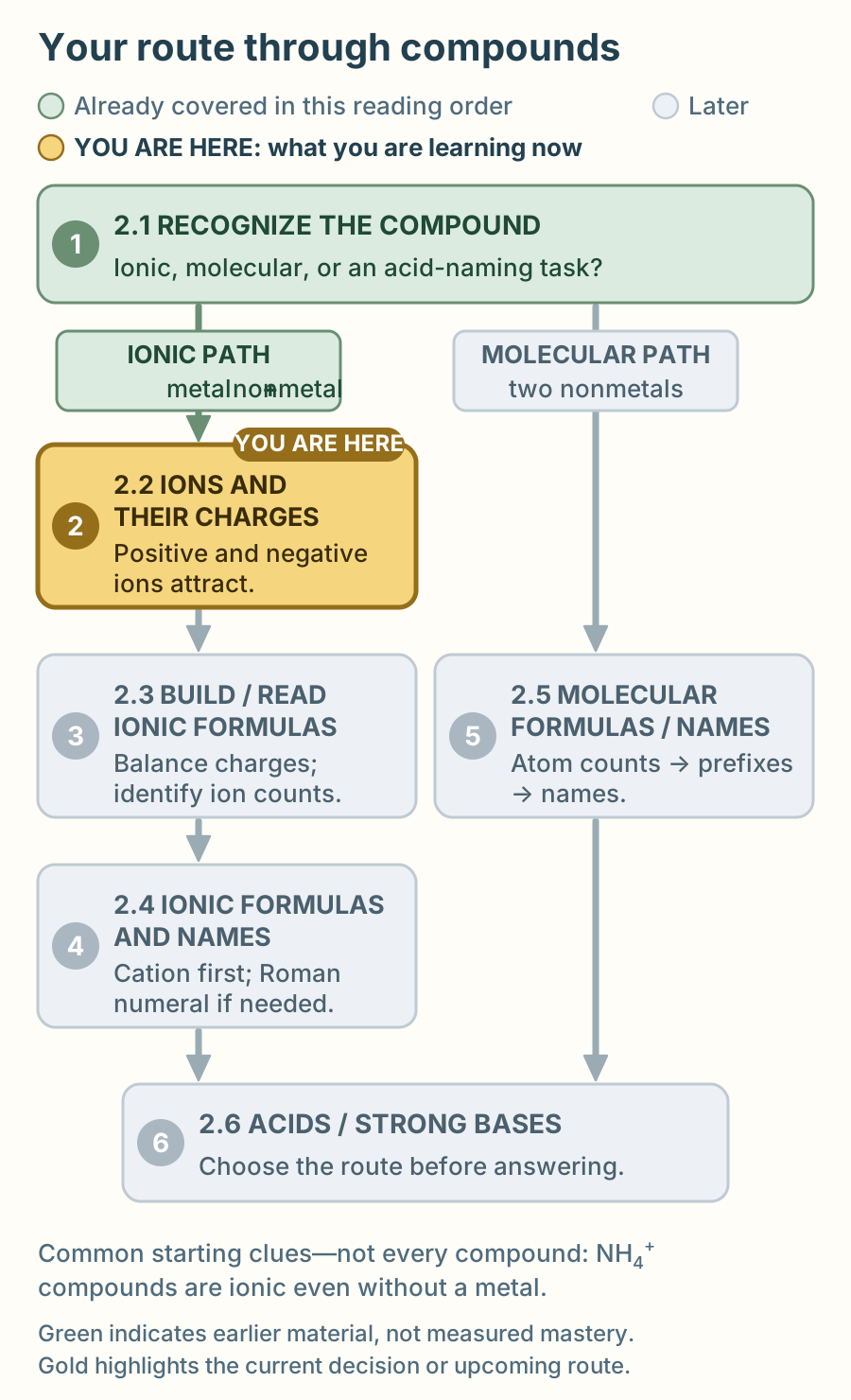
Chapter route map. Ionic path: metal plus nonmetal. Molecular path: two nonmetals. Both decision clues highlighted in section 2.1. Ammonium compounds are also ionic without a metal. Green: earlier material. Gold: current decision or upcoming route. Gray: later material. Follow ionic charges/formulas/names or molecular atom counts/prefixes, then acids, strong bases, and mixed practice.
Metal + nonmetal → ionic; two nonmetals → molecular. Ammonium compounds are ionic without a metal. Green = earlier, gold = now, gray = later; colors do not measure mastery.
Polyatomic ions: your reference
Ion formulaNameAtomsCharge
NH4+Ammonium (the cation to know)1 N, 4 H+1
OH−Hydroxide1 O, 1 H−1
NO3−Nitrate1 N, 3 O−1
NO2−Nitrite1 N, 2 O−1
SO42−Sulfate1 S, 4 O−2
SO32−Sulfite1 S, 3 O−2
CO32−Carbonate1 C, 3 O−2
HCO3−Hydrogen carbonate (bicarbonate)1 H, 1 C, 3 O−1
PO43−Phosphate1 P, 4 O−3
C2H3O2−Acetate (also CH3COO−)2 C, 3 H, 2 O−1
CN−Cyanide1 C, 1 N−1
MnO4−Permanganate1 Mn, 4 O−1
CrO42−Chromate1 Cr, 4 O−2
O22−Peroxide2 O−2
ClO−Hypochlorite1 Cl, 1 O−1
ClO2−Chlorite1 Cl, 2 O−1
ClO3−Chlorate1 Cl, 3 O−1
ClO4−Perchlorate1 Cl, 4 O−1
Polyatomic ion: a bonded group of atoms with one overall charge. Check this list against your instructor’s requirements; not every course needs every entry.
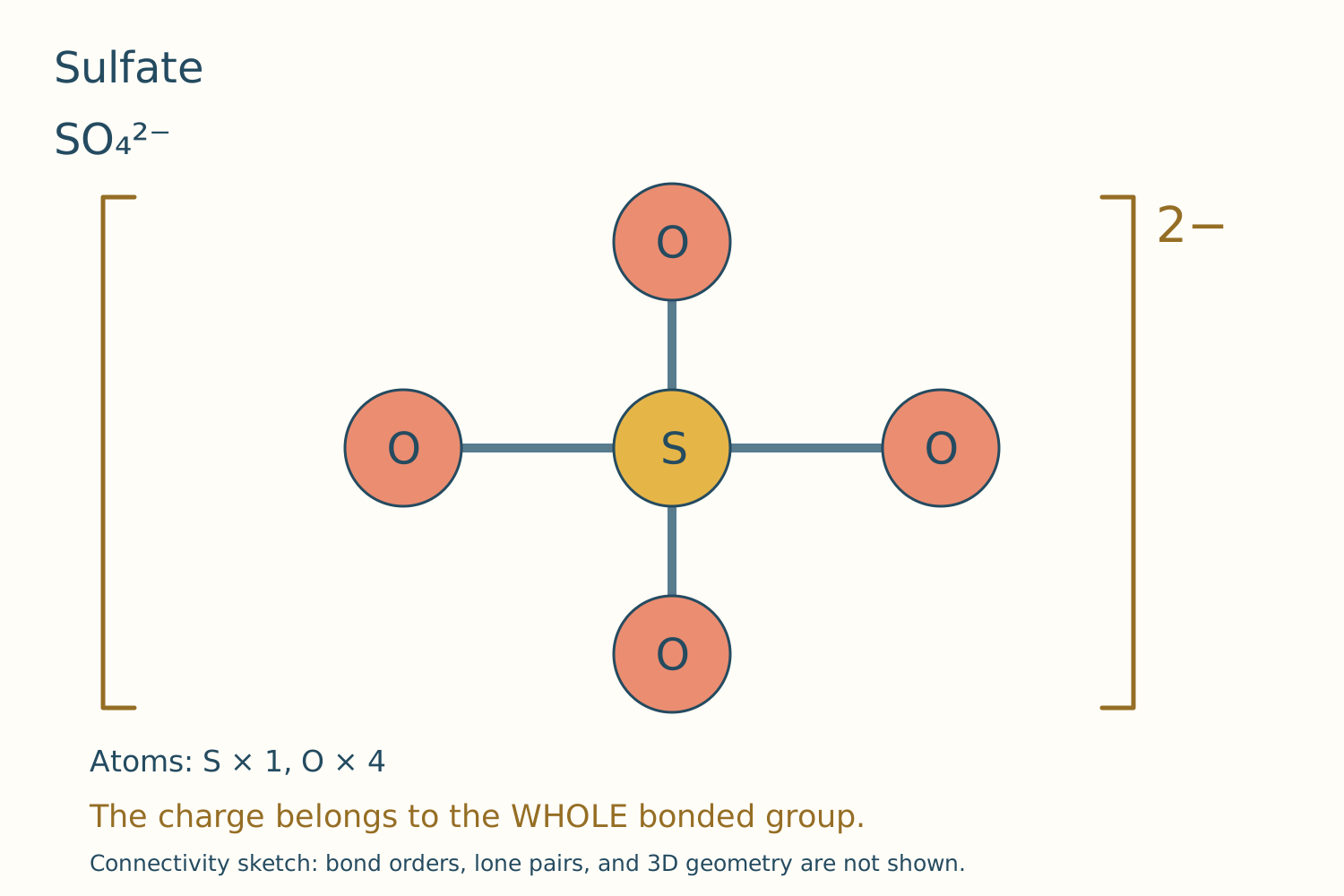
Sulfate: SO₄²⁻. Atom counts: 1 S, 4 O. Overall charge −2. Connectivity only; bond orders and geometry are not shown.
Sulfate as an atom-counting sketch: each sphere is one atom; the brackets and charge belong to the whole ion. Not a complete Lewis structure.

Practice the list as flashcards: formula → name and charge; name → formula and charge; ion pair → neutral formula.

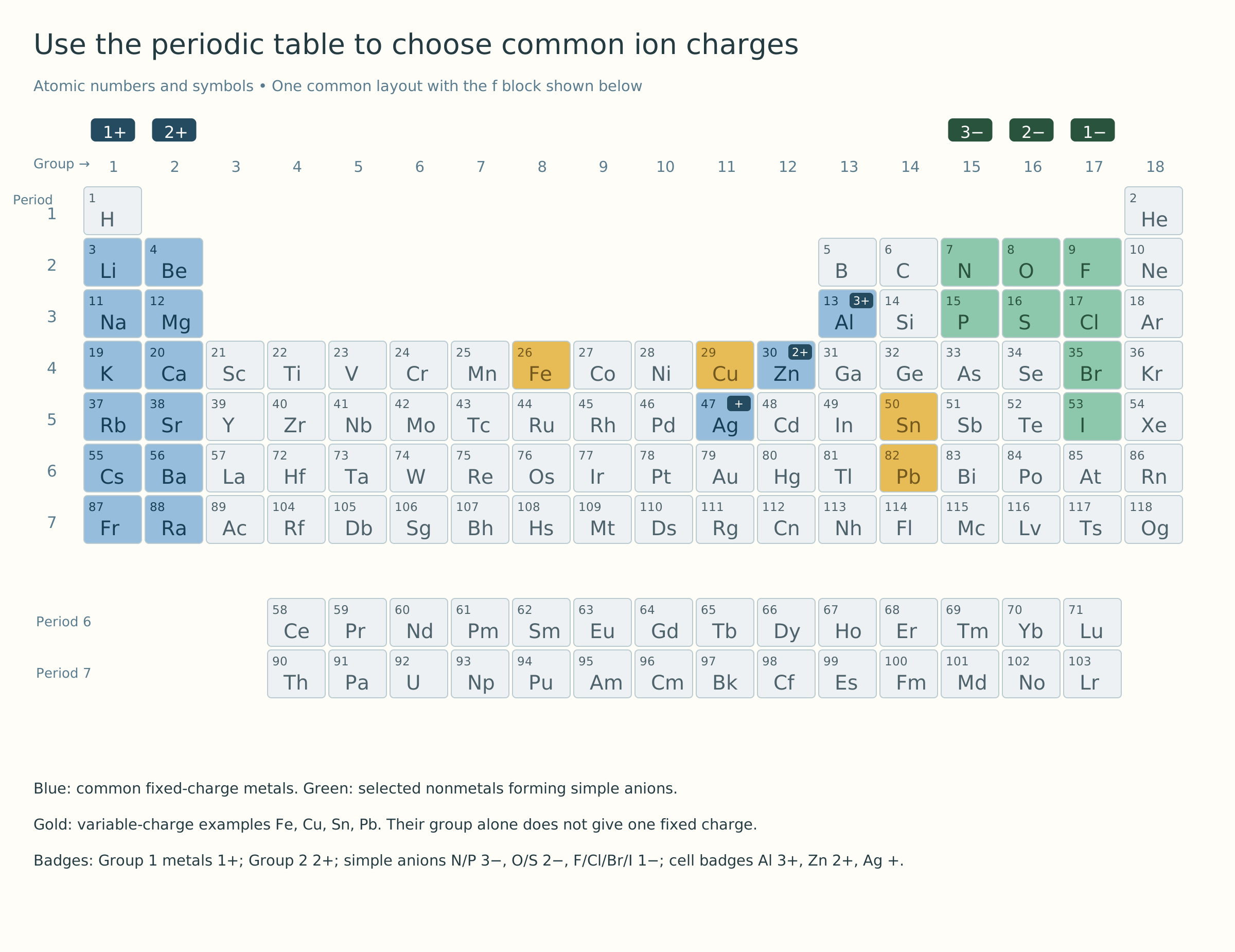
Use the periodic table to choose common ion charges. Blue: common fixed-charge metals. Green: selected nonmetals forming simple anions. Gold: variable-charge examples Fe, Cu, Sn, Pb. Their group alone does not give one fixed charge. Badges: Group 1 METALS +1; Group 2 +2; simple anions N/P −3, O/S −2, F/Cl/Br/I −1.
Blue: common fixed-charge metals. Green: nonmetals that form simple anions. Gold: variable-charge metals (Fe, Cu, Sn, Pb).
Predictable charges: read them from the table
Where to lookUsual ion chargeExamples
Group 1 metals+1Li+, Na+, K+
Group 2 metals+2Mg2+, Ca2+, Ba2+
Other fixed-charge metalsAl +3; Zn +2; Ag +1Al3+, Zn2+, Ag+
Group 17 single-atom anions−1F−, Cl−, Br−, I−
Group 16 single-atom anions−2O2−, S2−
Group 15 single-atom anions−3N3− (nitride), P3− (phosphide)
Choose the charge from the column before balancing. One, two or three gained electrons give −1, −2 or −3.
Limits of the column rule
  • The rule gives the charge of the ion. A neutral Mg atom has zero charge; its usual ion is Mg2+.
  • Hydrogen sits above Group 1 but is a nonmetal, so the +1 metal rule is not a general rule for H.
  • These are single-atom ion charges, not rules for every compound containing the element. Polyatomic charges come from the reference list.
Why these charges? The nearest noble gas
Atom (electrons)ChangeIonElectrons nowSame as
Na (11)loses 1Na+10neon (Ne)
Mg (12)loses 2Mg2+10neon (Ne)
O (8)gains 2O2−10neon (Ne)
Cl (17)gains 1Cl−18argon (Ar)
Noble gases (Group 18) have a full outer shell, a very stable arrangement, so they almost never react or form ions. Other main-group atoms take the shortest trip to a noble gas’s electron count.
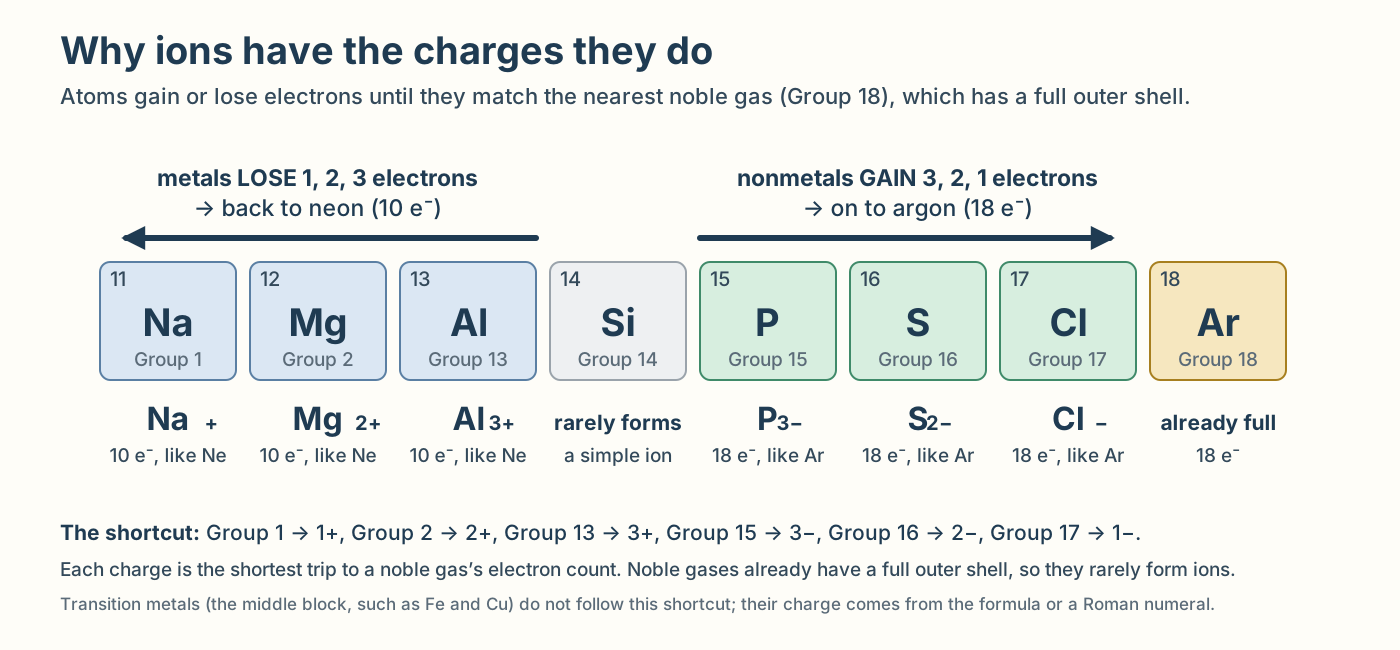
Row 3 of the periodic table. Na, Mg and Al lose 1, 2 and 3 electrons to have 10 electrons like neon, forming Na⁺, Mg²⁺ and Al³⁺. P, S and Cl gain 3, 2 and 1 electrons to have 18 electrons like argon, forming P³⁻, S²⁻ and Cl⁻. Silicon rarely forms a simple ion. Argon is a noble gas with a full outer shell.
Metals on the left are a few electrons past a noble gas, so they lose them. Nonmetals on the right are a few short, so they gain them. Transition metals such as Fe and Cu do not follow this shortcut. Chapter 3 shows the shells behind it.
Variable-charge metals: read the charge each time
MetalCommon ionsFormula check
IronFe2+ iron(II); Fe3+ iron(III)FeCl2: 2 Cl− require Fe2+. FeCl3: 3 Cl− require Fe3+.
CopperCu+ copper(I); Cu2+ copper(II)CuCl: 1 Cl− requires Cu+. CuCl2: 2 Cl− require Cu2+.
TinSn2+ tin(II); Sn4+ tin(IV)SnCl2 uses Sn2+; SnCl4 uses Sn4+.
LeadPb2+ lead(II); Pb4+ lead(IV)PbO uses Pb2+; PbO2 uses Pb4+, since each oxide is O2−.
A Roman numeral gives the positive charge, not a count of metal atoms. Given only a formula, use the known anion charges to work out the metal’s charge.
Same balance, different reason
MgCl2
Mg is in Group 2, so you already know Mg2+.
(+2) + 2(−1) = 0
FeCl2
Iron can vary. Two Cl− tell you this formula holds Fe2+.
(+2) + 2(−1) = 0

On the periodic table: Group 1 metals form +1 ions and Group 2 metals form +2 ions.

On the periodic table: Group 17 forms −1, Group 16 forms −2 and Group 15 forms −3 single-atom anions.

On the periodic table: Group 18 noble gases have full outer shells and almost never form ions.

On the periodic table: The table does not give polyatomic-ion charges or a single charge for Fe, Cu, Sn or Pb.

Try the route yourself · 1 step

Why does sulfur form S2− rather than S6+?

  1. 1
    Compare the two trips

    On the periodic table: sulfur (S) has 16 electrons. Argon is just after it; neon is well before it.

    OptionElectron changeElectrons nowSame as
    S2−gain 218argon (Ar)
    S6+lose 610neon (Ne)
  2. ✓
    Answer

    Gaining 2 electrons to match argon is a much shorter trip than losing 6 to match neon, so sulfur forms S2−.

Your turn

Ion charge practice problems

Answer first, then check. Hints open one at a time; the answer and full solution open after you try.

Problem 1 of 4 · warm-up

What charge does the usual magnesium ion have?

Hint 1 · the clue

First decide whether this asks for compound type, ion charge, formula, or name, then use the matching route.

Hint 2 · the next move

"What charge" and "usual" ion of an element tell you to use its group number on the periodic table.

Your path:

  1. Find Mg: Group 2 metal
  2. Group 2 metals lose 2 electrons
  3. Ion charge is 2+
Answer

Answer: 2+

On the periodic table: Magnesium (Mg) is in Group 2, so its usual ion is Mg²⁺.

Full worked solution

What you know: The element magnesium. What you want: The charge of its usual ion.

  1. Find Mg on the periodic table. It is a metal in Group 2.
  2. Use the column rule: Group 2 metals lose 2 electrons. Losing two negative charges leaves the atom 2 units more positive.
  3. So the usual ion is Mg2+, with charge 2+.

Check: This matches MgCl2: one Mg2+ needs two Cl−.

Watch out: A neutral magnesium atom has zero charge. The 2+ belongs to its ion.

On the periodic table: Magnesium (Mg) is in Group 2. Group 2 atoms lose 2 electrons, so magnesium forms Mg²⁺.

Answer: 2+

YOUR PERIODIC-TABLE REFERENCE

12MgMagnesium24.31Group 2 · Period 3

Atomic number identifies proton count. The decimal mass is an average, not an isotope’s mass number. Use supplied rounded masses when a problem gives them.

Problem 2 of 4

What charge does the usual potassium ion have?

Hint 1 · the clue

First decide whether this asks for compound type, ion charge, formula, or name, then use the matching route.

Hint 2 · the next move

"What charge" for the "usual" ion of an element means: find its group and apply the column rule.

Your path:

  1. Find K: Group 1 metal
  2. Group 1 metals lose 1 electron
  3. Ion charge is 1+
Answer

Answer: 1+

On the periodic table: Potassium (K) is in Group 1, so its usual ion is K⁺.

Full worked solution

What you know: The element potassium. What you want: The charge of its usual ion.

  1. Find K on the periodic table. It is a metal in Group 1.
  2. Use the column rule: Group 1 metals lose 1 electron. Losing one negative charge leaves the atom one unit more positive.
  3. So the usual ion is K+, with charge 1+.

Check: KCl balances 1:1, since (+1) + (−1) = 0.

Watch out: Metals lose electrons and become positive. Do not give potassium a negative charge.

On the periodic table: Potassium (K) is in Group 1. Group 1 atoms lose 1 electron, so potassium forms K⁺.

Answer: 1+

YOUR PERIODIC-TABLE REFERENCE

19KPotassium39.10Group 1 · Period 4

Atomic number identifies proton count. The decimal mass is an average, not an isotope’s mass number. Use supplied rounded masses when a problem gives them.

Problem 3 of 4

Give the name and charge of SO42−.

Hint 1 · the clue

First decide whether this asks for compound type, ion charge, formula, or name, then use the matching route.

Hint 2 · the next move

A polyatomic ion formula with "name and charge" asks you to recall it from the common-ion list.

Your path:

  1. Recognize one S with four O
  2. Recall its name from the ion list
  3. Read the superscript charge for the whole group
Answer

Answer: Sulfate; 2−

Full worked solution

What you know: The polyatomic ion SO42−. What you want: Its name and charge.

  1. Recognize the group: one S with four O is a common polyatomic ion.
  2. Recall its name: SO42− is sulfate. Its name ends in -ate, which is normal for many oxygen-containing anions.
  3. Read the charge from the superscript. It belongs to the whole group. Answer: Sulfate; 2−.

Check: Two Na+ balance one sulfate in Na2SO4: 2(+1) + (−2) = 0.

Watch out: Do not give each oxygen its own O2− charge, and do not call it "sulfide" (S2−).

Answer: Sulfate; 2−

Problem 4 of 4

Give the usual ions of K, Mg, and Cl; name NO3−.

Hint 1 · the clue

Use each element’s group: Group 1 metals form +1 ions, Group 2 metals form +2 ions, and Group 17 nonmetals form −1 ions. Polyatomic ions such as NO3− come from the ion reference list.

Hint 2 · the next move

"Usual ions" of elements means use group numbers; "name NO3−" means recall the polyatomic ion list.

Your path:

  1. Find each element's group
  2. Metals lose electrons; Cl gains one
  3. Recall NO3− name and its −1 charge
Answer

K+, Mg2+, Cl−; nitrate, charge −1.

On the periodic table: Potassium (K) is in Group 1, magnesium (Mg) in Group 2, and chlorine (Cl) in Group 17, giving K⁺, Mg²⁺, and Cl⁻.

Full worked solution

What you know: The elements K, Mg, Cl and the ion NO3−. What you want: Usual ion charges and the name of NO3−.

  1. K is in Group 1. Group 1 metals lose 1 electron: K+.
  2. Mg is in Group 2. Group 2 metals lose 2 electrons: Mg2+.
  3. Cl is in Group 17. It gains 1 electron: Cl−.
  4. NO3− is a common polyatomic ion, nitrate. So: K+, Mg2+, Cl−; nitrate, charge −1.

Check: Each ion matches a noble-gas electron count: K+ has 19 − 1 = 18 (argon), Mg2+ has 12 − 2 = 10 (neon), and Cl− has 17 + 1 = 18 (argon).

Watch out: Nitrate's −1 belongs to the whole group, not to one atom.

Answer: K+, Mg2+, Cl−; nitrate, charge −1.

On the periodic table: Potassium (K) is in Group 1 (K⁺), magnesium (Mg) is in Group 2 (Mg²⁺), and chlorine (Cl) is in Group 17 (Cl⁻). Nitrate’s −1 charge belongs to the whole NO₃⁻ group; the periodic table does not give it.

YOUR PERIODIC-TABLE REFERENCE

12MgMagnesium24.31Group 2 · Period 3
17ClChlorine35.45Group 17 · Period 3
19KPotassium39.10Group 1 · Period 4

Atomic number identifies proton count. The decimal mass is an average, not an isotope’s mass number. Use supplied rounded masses when a problem gives them.

Watch out

Common ion charge mistakes