
Chapter 1 · Free lesson
Atomic structure
The full lesson, free. For instant answer checking, hints and progress tracking, open the interactive version.
What you will study
- Start with the periodic table
- Three particles with three different jobs
- Mass number counts the nucleus
- Neutral atoms and charged ions
- Isotopes and weighted averages
By the end, you can…
- Read an element square and tell rows (periods) from columns (groups).
- Describe how the model of the atom changed over time.
- Identify an element from its proton count.
- Find neutrons from isotope mass number and atomic number.
- Calculate ion charge from protons and electrons.
- Calculate an isotope-weighted average mass.
These are the skills to check, not just pages to finish. Use the section goals while studying, then try the chapter checks without hints.
Read the idea first. Then notice the clue, follow the route, and make a choice you can explain. You can return to the worked example if a practice question feels unfamiliar.
1.0 Start with the periodic table
Each square on the periodic table is one element. Its atomic number counts its protons. Every later chapter reads rows, columns and squares.
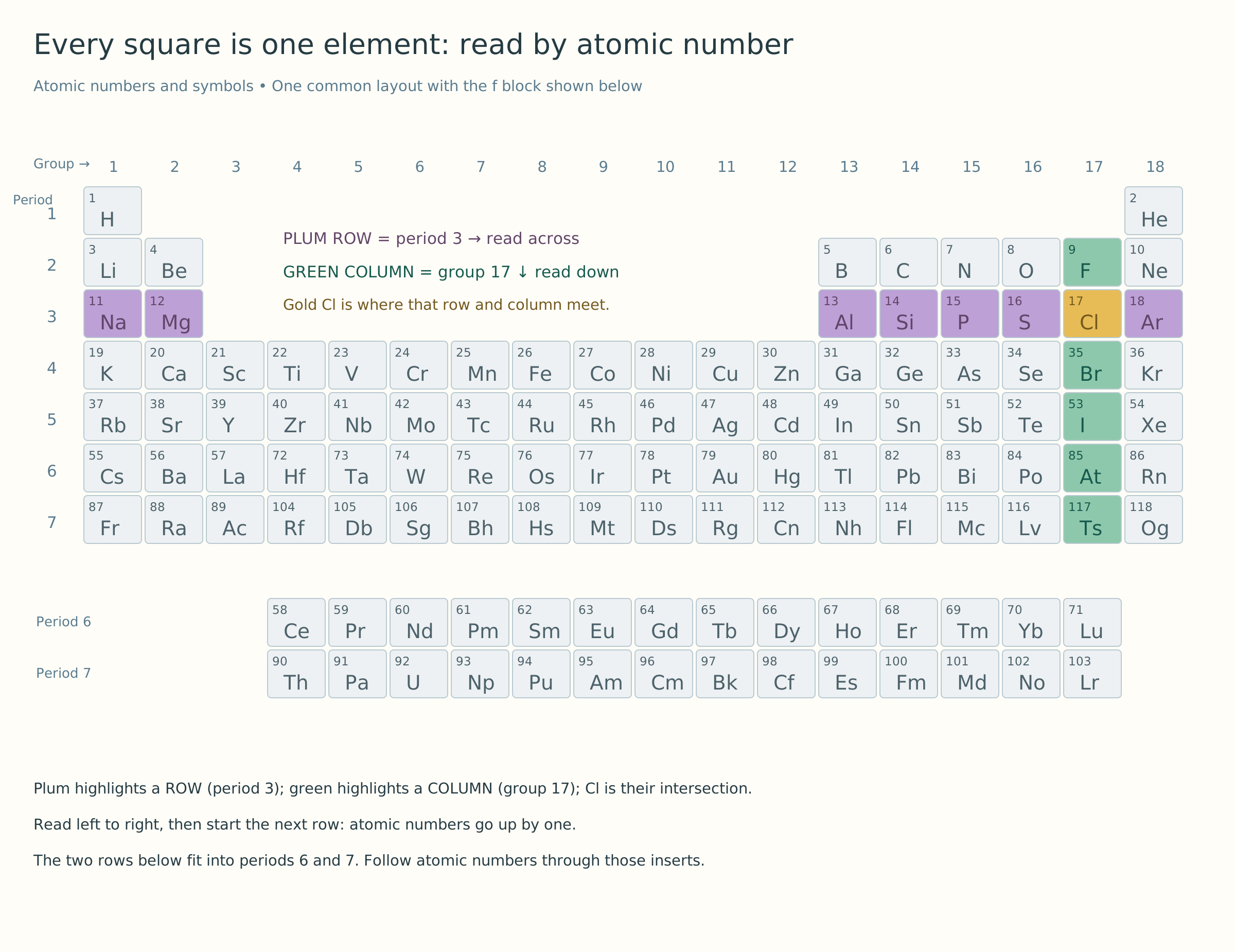
The two detached rows fit inside periods 6 and 7.
Chapter 3: what it says about electrons.
Elements in one group often behave alike.
Chapter 2: how it predicts an ion’s charge.
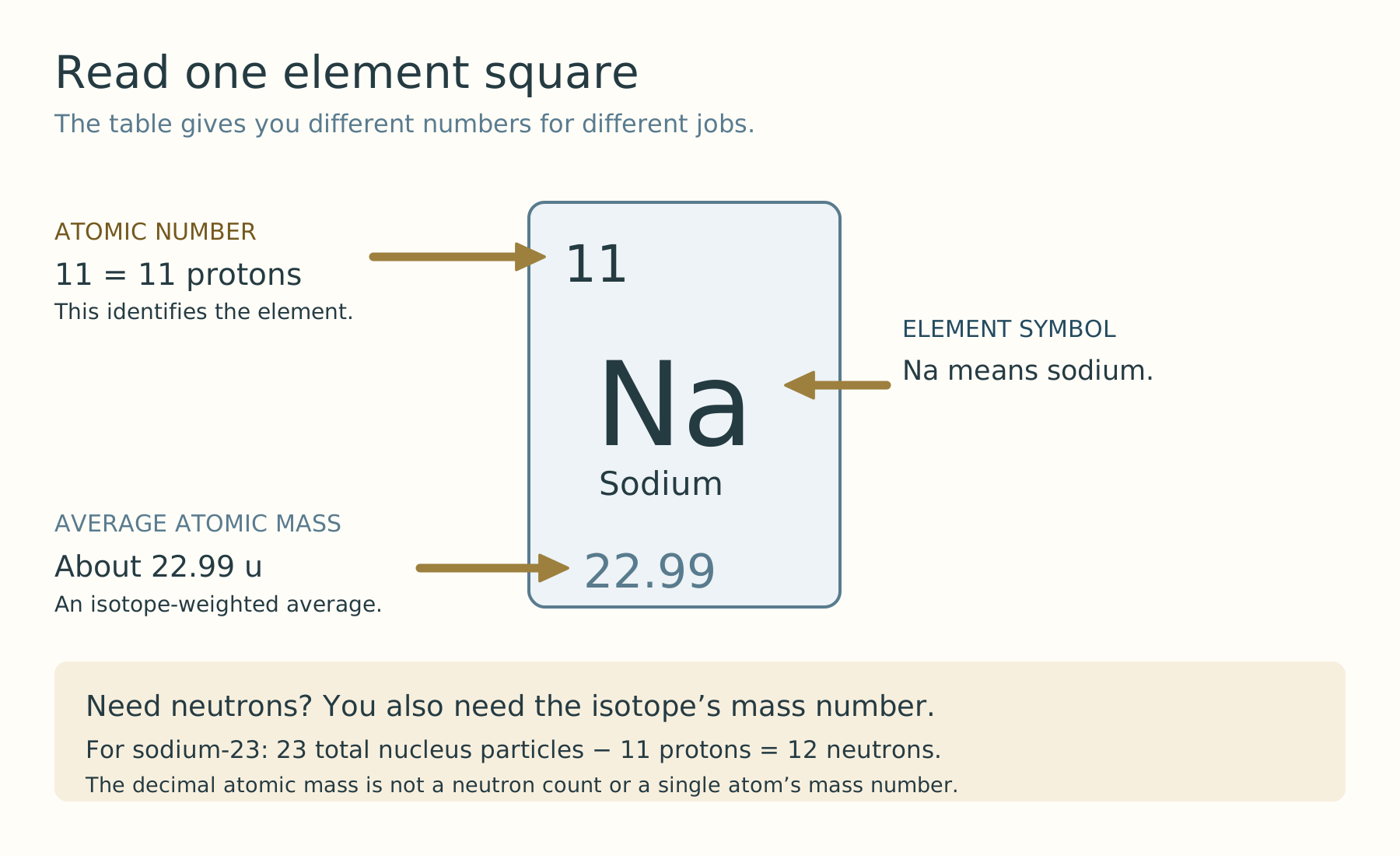
| On the square | Value | What it tells you |
|---|---|---|
| Atomic number | 11 | 11 protons |
| Symbol | Na | The element: sodium |
| Average atomic mass | 22.99 u | An average of its isotopes, not one atom |
| Sodium-23 (named isotope) | 23 − 11 = 12 | 12 neutrons |
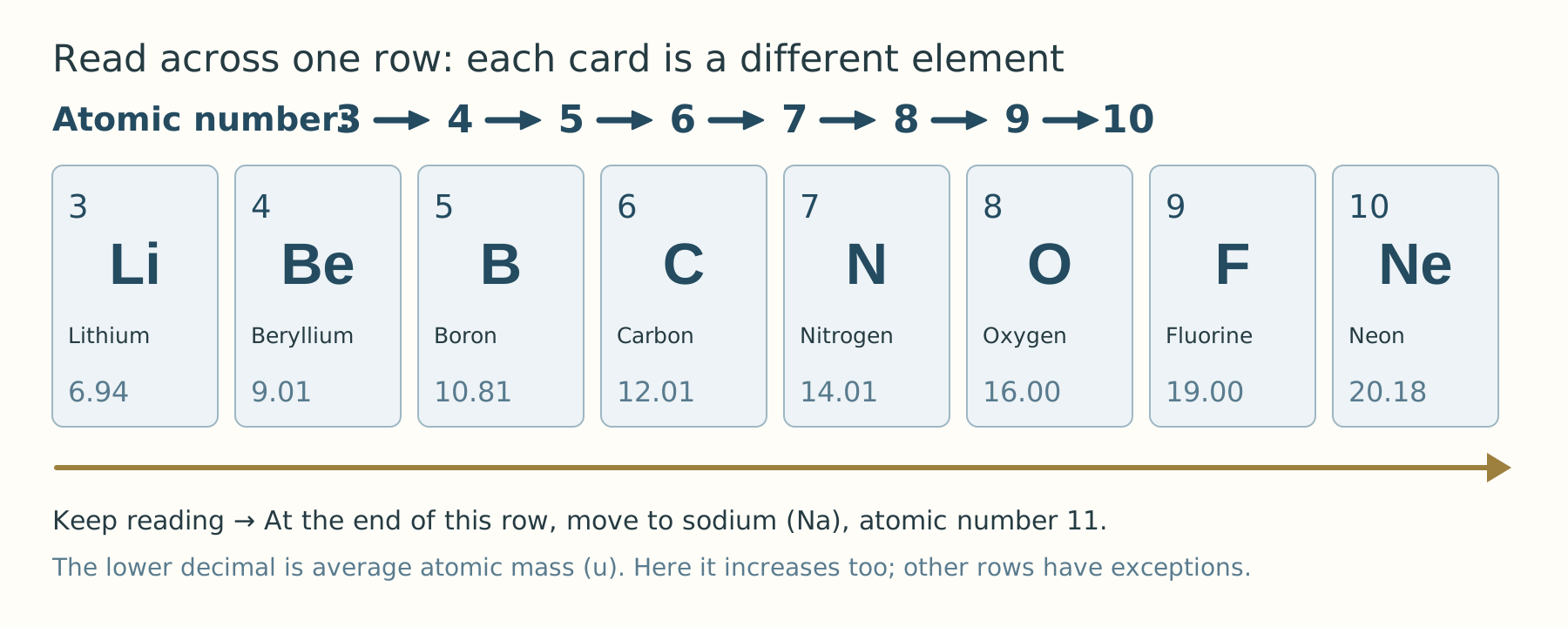
Quick check: after carbon (atomic number 6), what comes next? Answer: nitrogen, atomic number 7. One more proton means a different element.
- Find the element’s square by symbol or atomic number.
- Read the atomic number: that is the proton count.
- Read its row for the period (1–7) and its column for the group (1–18).
- Move on by atomic number: left to right, then the next row.
On the periodic table: Carbon (C) has atomic number 6 and nitrogen (N) has 7, the whole numbers in their squares. Nitrogen comes right after carbon in Period 2.
On the periodic table: Sodium (Na) has atomic number 11 and average atomic mass 22.99 u.
1.1 Three particles with three different jobs
Atoms are built from protons, neutrons and electrons, each with its own job. Protons decide the element; their count is the atomic number.
- Read the atomic number on an element square (1.0).
Need a refresher? Open the table of contents and revisit that topic before starting.
| Who and when | Finding |
|---|---|
| Dalton (early 1800s) | Matter is tiny atoms. One element’s atoms are alike. Compounds use whole-number ratios. |
| Thomson (1897, 1904) | Found the electron. “Plum pudding” model: negative electrons in a ball of positive charge. |
| Rutherford (1909–1911) | Gold foil: an atom is mostly empty space around a tiny, dense, positive nucleus. |
| Later (1919, 1932) | Proton found (1919), then neutron (1932). |
| Bohr and the quantum model | Describe where the electrons are (Chapter 3). |
Quick check: why did most alpha particles pass straight through, while a few were deflected or bounced back? Answer: an atom is mostly empty space, so most met nothing. Nearly all the mass and all the positive charge sit in a tiny nucleus. The few that came close were repelled (like charges repel).
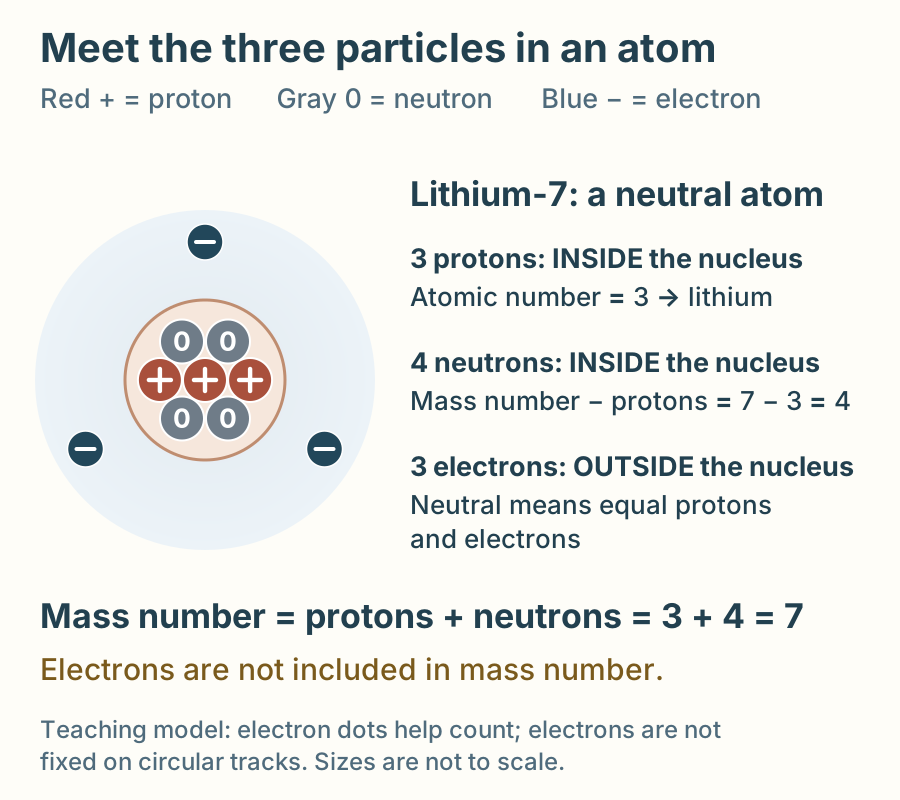
| Particle | Charge | Where it is | Its job |
|---|---|---|---|
| Proton | +1 | Nucleus | Identifies the element |
| Neutron | 0 | Nucleus | Sets the isotope (1.2) |
| Electron | −1 | Outside the nucleus | Sets the charge (1.3) |
- Find the proton count.
- That count is the atomic number.
- Find that atomic number on the periodic table to name the element.
On the periodic table: Oxygen (O) has atomic number 8, the whole number in its square, so every oxygen atom has 8 protons. Its square also shows 16.00, Group 16, Period 2.
On the periodic table: The decimal mass (16.00) is an average, not an isotope’s mass number. Use supplied rounded masses when a problem gives them.
Which element is this? An atom has 11 protons, 12 neutrons, and 10 electrons.
- 1Find the proton count
Protons identify the element. Start here, even though other numbers are given.
Protons Neutrons Electrons 11 12 10 - 2Read the atomic number
Atomic number is another name for the proton count.
Z = p = 11 - 3Match it to the table
Neutrons and electrons do not change identity. On the periodic table: sodium (Na) has atomic number 11, the whole number in its square.
Z = 11 → sodium (Na)Sodium’s square: 11, Na, 22.99, Group 1, Period 3. - ✓Answer
The element is sodium (Na).
1.2 Mass number counts the nucleus
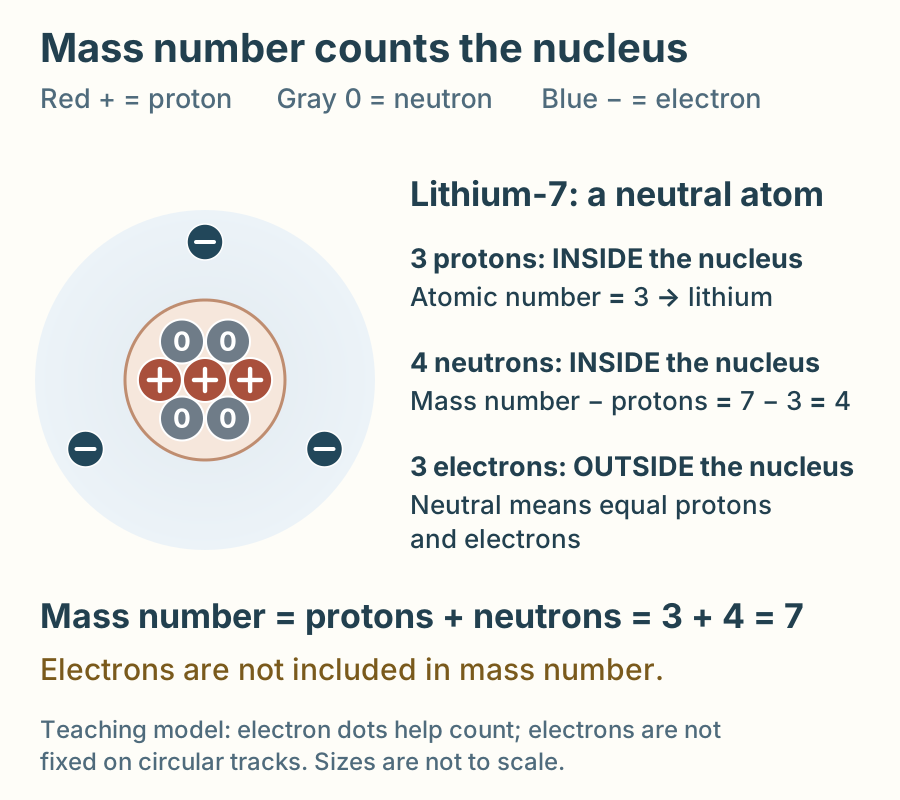
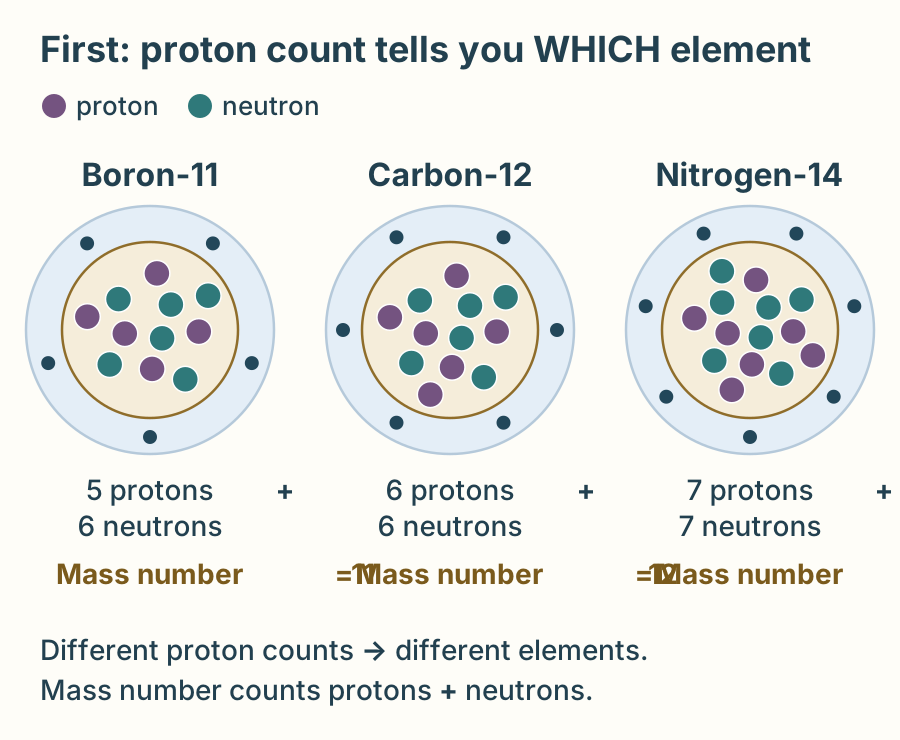
The mass number counts the particles in one atom’s nucleus: protons plus neutrons. Subtract the protons to get the neutrons.
- Atomic number counts protons (1.1).
Need a refresher? Open the table of contents and revisit that topic before starting.
| Isotope | Protons (Z) | Neutrons (A − Z) | Electrons | Mass number (A) |
|---|---|---|---|---|
| 73Li | 3 | 7 − 3 = 4 | 3 | 7 |
| 115B | 5 | 11 − 5 = 6 | 5 | 11 |
| 126C | 6 | 12 − 6 = 6 | 6 | 12 |
| 146C | 6 | 14 − 6 = 8 | 6 | 14 |
| 147N | 7 | 14 − 7 = 7 | 7 | 14 |
| 3416S | 16 | 34 − 16 = 18 | 16 | 34 |
- Find the mass number (A) in the isotope name or notation.
- Read the atomic number (Z), the proton count, from the periodic table.
- Subtract: neutrons = A − Z.
On the periodic table: The whole number in each box is the atomic number, the proton count: lithium (Li) 3, boron (B) 5, carbon (C) 6, nitrogen (N) 7, sulfur (S) 16.
On the periodic table: The mass number comes from the isotope name, not the table. Use supplied masses when a problem gives them.
Sulfur-34 has 16 protons. How many neutrons does it have?
- 1Name the total
The 34 counts all the protons and neutrons together.
Mass number, A = 34 - 2Take away the protons
Removing the protons leaves the neutrons. On the periodic table: sulfur (S) is number 16.
n = A − Zn = 34 − 16 - 3Do the subtraction
The result is the neutron count.
Protons + Neutrons = Mass number 16 18 34 - ✓Answer
Sulfur-34 has 18 neutrons.
1.3 Neutral atoms and charged ions
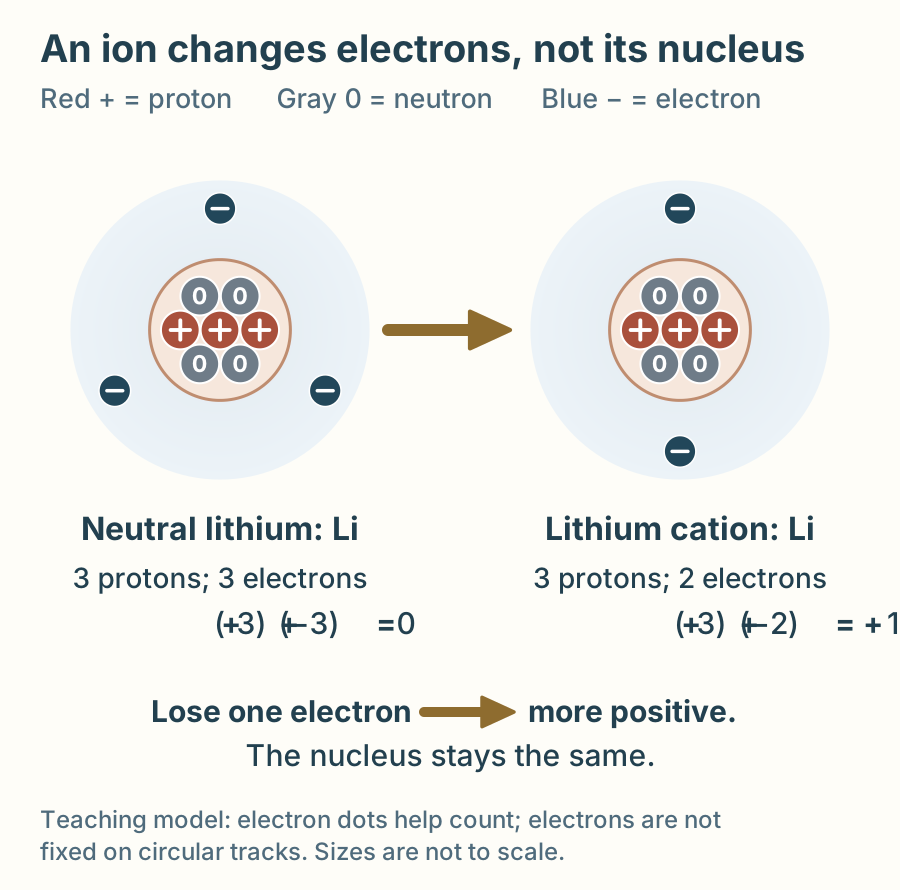
An atom that gains or loses electrons becomes an ion: its charges no longer cancel. Charge is protons minus electrons.
- Protons are positive and electrons are negative; use their counts (1.1).
Need a refresher? Open the table of contents and revisit that topic before starting.
- A neutral atom has equal protons and electrons, so the charges cancel.
- An ion is an atom or group of atoms with an overall charge.
- The proton count never changes here. Only electrons move.
| Particle | Protons | Electrons | Charge (p − e) |
|---|---|---|---|
| Li atom | 3 | 3 | 0 |
| Li+ (lost 1) | 3 | 2 | +1 |
| O atom | 8 | 8 | 0 |
| O− (gained 1) | 8 | 9 | −1 |
| O2− (gained 2) | 8 | 10 | −2 |
Positive ion (cation).
Example: Mg2+
Negative ion (anion).
Example: O2−
Why a particular number? Main-group atoms tend to match the electron count of the nearest noble gas (Group 18), which has a full outer shell. Section 2.2 shows how this sets each column’s charge.
- Count the protons: each adds +1.
- Count the electrons: each adds −1.
- Add the two: the result is the charge.
- Write it as a superscript, number before sign (Mg2+).
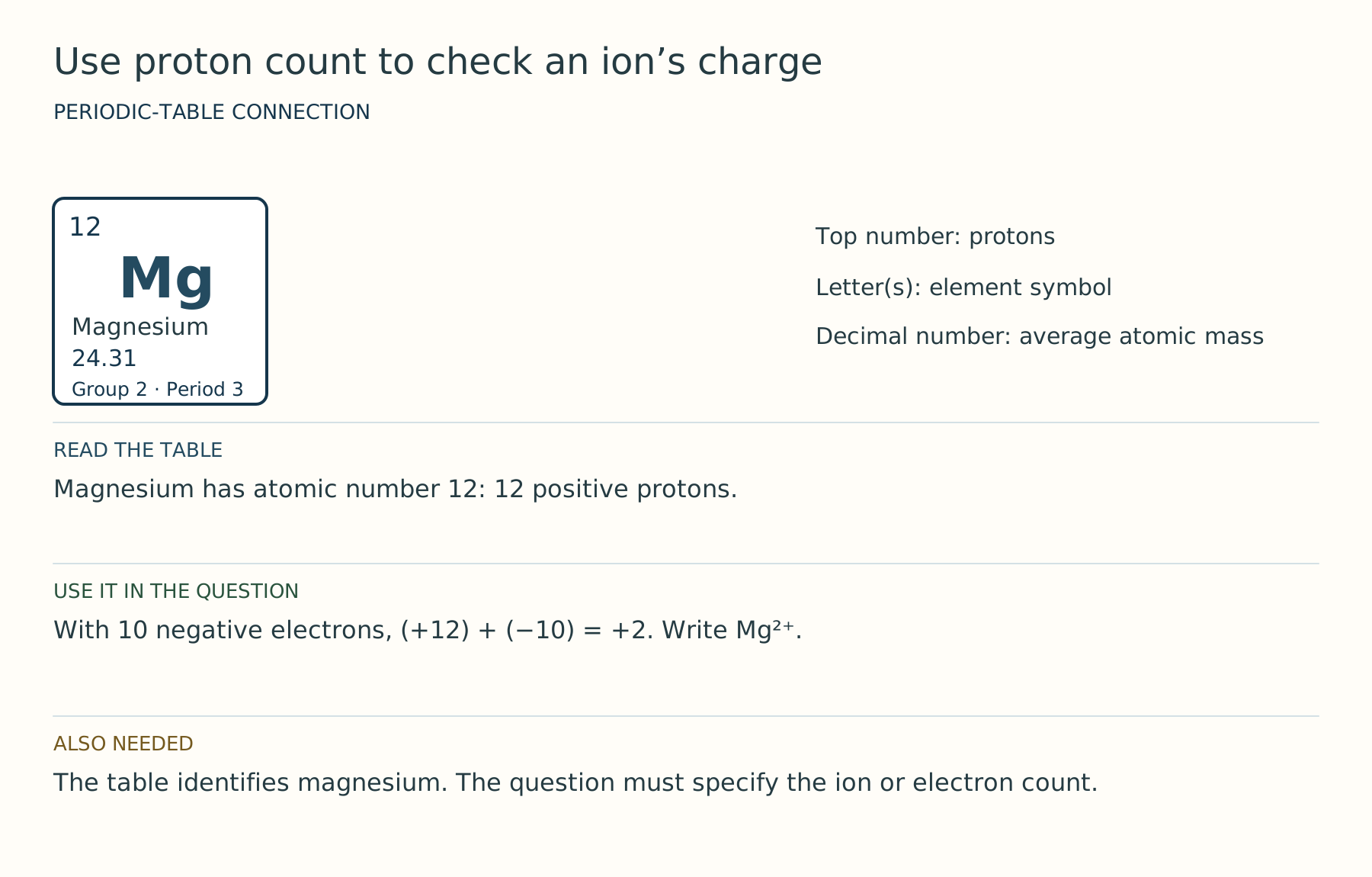
On the periodic table: The atomic number gives the proton count: magnesium (Mg) is 12, the whole number in its square.
On the periodic table: Magnesium is in Group 2. Group 2 atoms lose 2 electrons, so magnesium forms Mg2+.
A magnesium ion has 12 protons and 10 electrons. What is its charge?
- 1Count the positive charges
Each proton adds +1. On the periodic table: magnesium (Mg) has atomic number 12, so 12 protons.
12 protons → +12 - 2Count the negative charges
Each electron adds −1. Negative numbers drive the total down.
10 electrons → −10 - 3Add the two contributions
Ten negatives cancel ten positives. Two positives remain.
(+12) + (−10) = +2 - 4Write the ion
2+ means two more positive charges than negative. On the periodic table: Mg is in Group 2, and Group 2 atoms lose 2 electrons.
Mg2+ - ✓Answer
The charge is 2+: Mg2+.
1.4 Isotopes and weighted averages
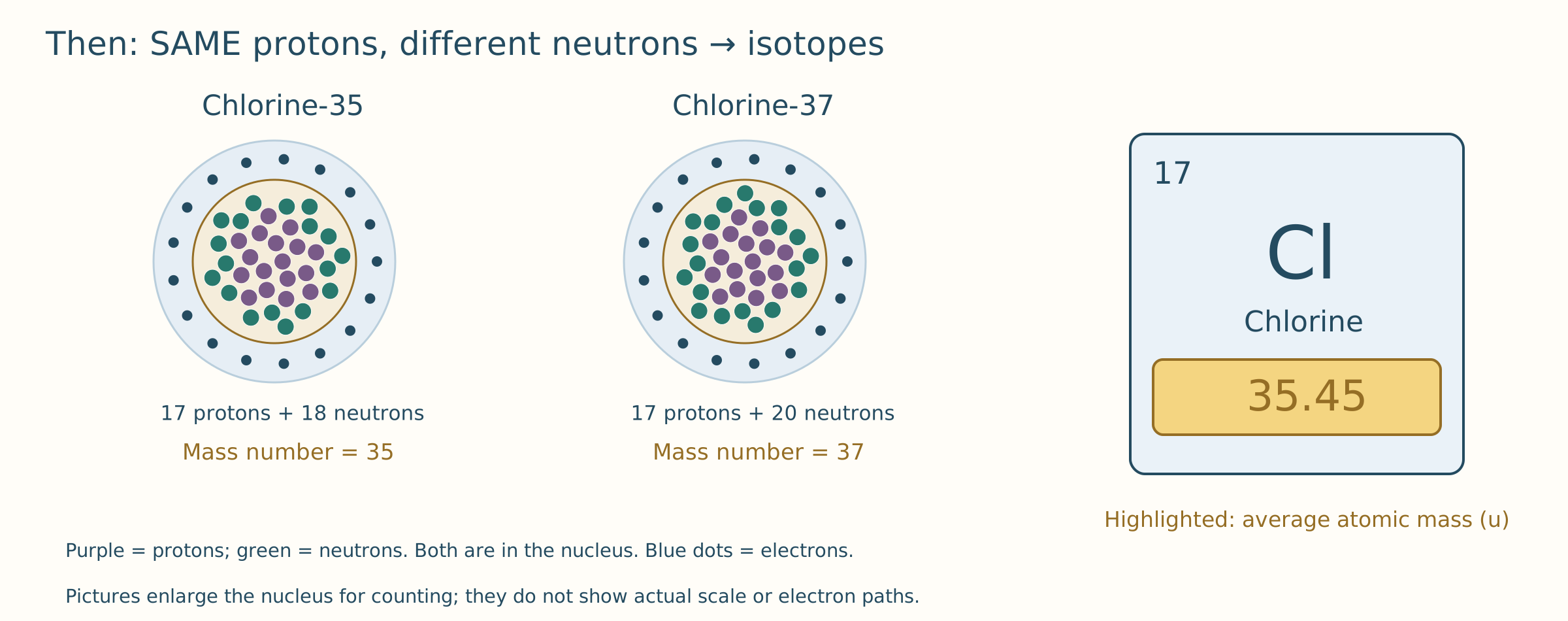
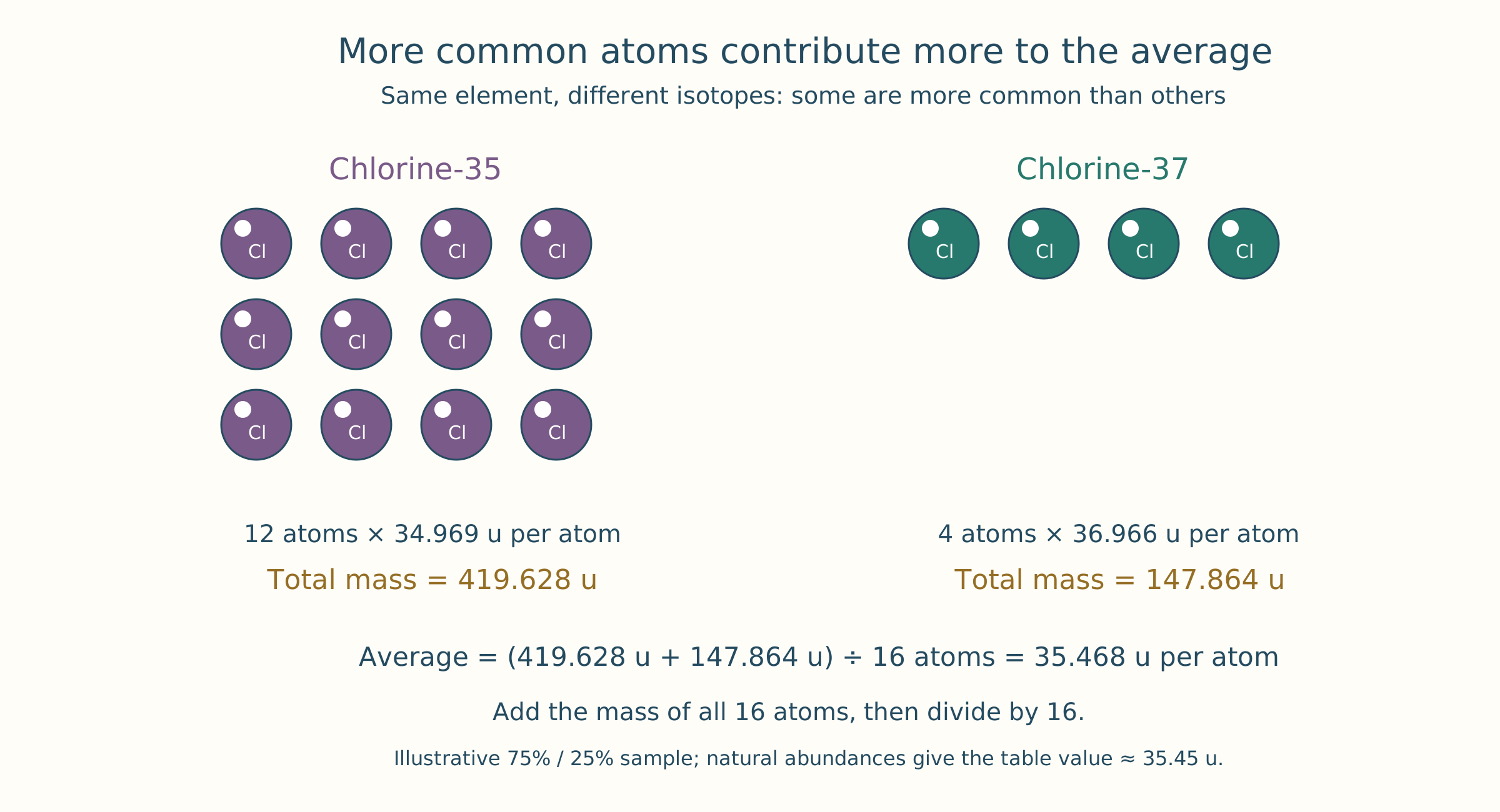
Most elements are a mix of isotopes. The periodic-table mass is their weighted average, so the more common isotope counts more.
- Mass number counts protons plus neutrons (1.2).
- Turn a percent into a decimal by dividing by 100: 75% = 0.75.
Need a refresher? Open the table of contents and revisit that topic before starting.
| Isotope | Protons | Neutrons | Isotope mass | Fraction of pile | Contribution |
|---|---|---|---|---|---|
| Chlorine-35 | 17 | 18 | 34.969 u | 12/16 = 0.75 | 26.23 u |
| Chlorine-37 | 17 | 20 | 36.966 u | 4/16 = 0.25 | 9.24 u |
| Average | 1.00 | 35.47 u |
- Turn each percentage into a decimal fraction.
- Multiply each isotope mass by its fraction.
- Add the contributions.
- Check: the answer lies closer to the most common mass.
On the periodic table: The decimal on each square is the weighted average atomic mass: chlorine (Cl) shows 35.45, with atomic number 17.
On the periodic table: Isotope masses and abundances are not on the table; the problem supplies them.
A fictional element has isotope masses 30 u at 70% and 32 u at 30%. Find the average mass.
| Isotope mass | Abundance |
|---|---|
| 30 u | 70% |
| 32 u | 30% |
- 1Turn percentages into fractions
Divide each by 100. The fractions add to 1.
70100 = 0.70 30100 = 0.30 - 2Weight the first isotope
It contributes more because it is more common.
30 u × 0.70 = 21.0 u - 3Weight the second isotope
Include the less common isotope too.
32 u × 0.30 = 9.6 u - 4Add the contributions
Together they give the average mass.
21.0 u + 9.6 u = 30.6 u - ✓Answer
Average mass = 30.6 u
Mixed chapter review
Answer in your notebook before revealing help. Keep your first attempt separate from an answer corrected with help.
Mixed chapter review · 14 questions · tap to open
What this set is for: problems from every section of the chapter, mixed together and not labeled, the way a test asks them. Your job is to pick the right method yourself. Do this before the skill check.
Practice 1
An atom has atomic number 13 and mass number 29. How many protons does it have?
Give me a hint
Atomic number is provided.
Check the answer
Answer: 13
Explain the worked problem to me
What you know: atomic number 13, mass number 29. What you want: the number of protons.
- Atomic number is defined as the number of protons. Every atom of an element has the same proton count.
- Read it straight off: atomic number 13 → 13 protons.
Check: The proton count can never be larger than the mass number, because mass number = protons + neutrons. 13 is less than 29, so it fits.
Watch out: Don't use the mass number (29). It counts protons and neutrons together.
Your route: Read atomic number → Use it as proton count
13Al26.98On the periodic table: Atomic number 13 belongs to aluminum (Al); it is the whole number in aluminum’s box, so an aluminum atom has 13 protons.
That’s right: 13
Practice 2
An atom has atomic number 14 and mass number 31. How many protons does it have?
Give me a hint
Atomic number is provided.
Check the answer
Answer: 14
Explain the worked problem to me
What you know: atomic number 14, mass number 31. What you want: the number of protons.
- Atomic number is defined as the number of protons. Every atom of an element has the same proton count.
- Read it straight off: atomic number 14 → 14 protons.
Check: The proton count can never be larger than the mass number, because mass number = protons + neutrons. 14 is less than 31, so it fits.
Watch out: Don't use the mass number (31). It counts protons and neutrons together.
Your route: Read atomic number → Use it as proton count
14Si28.09On the periodic table: Atomic number 14 belongs to silicon (Si); it is the whole number in silicon’s box, so a silicon atom has 14 protons.
That’s right: 14
Practice 3
An isotope has 13 protons and mass number 31. How many neutrons does it have?
Give me a hint
Both mass number and proton count are given.
Check the answer
Answer: 18
Explain the worked problem to me
What you know: 13 protons, mass number 31. What you want: the number of neutrons.
- Mass number counts protons plus neutrons in one isotope: 31 = 13 + neutrons.
- Take the protons away to leave only neutrons: neutrons = 31 − 13 = 18.
Check: Add back: 13 protons + 18 neutrons = 31, the mass number.
Watch out: Use the isotope's whole-number mass number from the problem, not the decimal average mass on the periodic table.
Your route: Mass number → Subtract protons
13Al26.98On the periodic table: An atom with 13 protons is aluminum (Al); you can also read aluminum’s atomic number, 13, from its box. The mass number 31 comes from the problem, not the table.
That’s right: 18
Practice 4
An isotope has 14 protons and mass number 33. How many neutrons does it have?
Give me a hint
Both mass number and proton count are given.
Check the answer
Answer: 19
Explain the worked problem to me
What you know: 14 protons, mass number 33. What you want: the number of neutrons.
- Mass number counts protons plus neutrons in one isotope: 33 = 14 + neutrons.
- Take the protons away to leave only neutrons: neutrons = 33 − 14 = 19.
Check: Add back: 14 protons + 19 neutrons = 33, the mass number.
Watch out: Use the isotope's whole-number mass number from the problem, not the decimal average mass on the periodic table.
Your route: Mass number → Subtract protons
14Si28.09On the periodic table: An atom with 14 protons is silicon (Si); you can also read silicon’s atomic number, 14, from its box. The mass number 33 comes from the problem, not the table.
That’s right: 19
Practice 5
A neutral atom has 15 protons and 18 neutrons. How many electrons does it have?
Give me a hint
The word neutral fixes the charge balance.
Check the answer
Answer: 15
Explain the worked problem to me
What you know: a neutral atom with 15 protons and 18 neutrons. What you want: the number of electrons.
- Neutral means the total charge is 0. Each proton is +1 and each electron is −1.
- 15 positive charges need 15 negative charges to cancel: (+15) + (−15) = 0. So there are 15 electrons.
Check: charge = protons − electrons = 15 − 15 = 0, which is neutral.
Watch out: The 18 neutrons have no charge, so they play no part. Don't match electrons to neutrons.
Your route: Neutral → Electrons equal protons
15P30.97On the periodic table: An atom with 15 protons is phosphorus (P), atomic number 15, the whole number in its box. A neutral phosphorus atom has 15 electrons.
That’s right: 15
Practice 6
A neutral atom has 16 protons and 19 neutrons. How many electrons does it have?
Give me a hint
The word neutral fixes the charge balance.
Check the answer
Answer: 16
Explain the worked problem to me
What you know: a neutral atom with 16 protons and 19 neutrons. What you want: the number of electrons.
- Neutral means the total charge is 0. Each proton is +1 and each electron is −1.
- 16 positive charges need 16 negative charges to cancel: (+16) + (−16) = 0. So there are 16 electrons.
Check: charge = protons − electrons = 16 − 16 = 0, which is neutral.
Watch out: The 19 neutrons have no charge, so they play no part. Don't match electrons to neutrons.
Your route: Neutral → Electrons equal protons
16S32.06On the periodic table: An atom with 16 protons is sulfur (S), atomic number 16, the whole number in its box. A neutral sulfur atom has 16 electrons.
That’s right: 16
Practice 7
A neutral atom with 15 protons gains 3 electrons. What charge does it acquire?
Give me a hint
The atom gains electrons.
Check the answer
Answer: 3−
Explain the worked problem to me
What you know: a neutral atom with 15 protons gains 3 electrons. What you want: its new charge.
- Neutral means it starts with 15 electrons and charge 0.
- After gaining 3, it has 15 + 3 = 18 electrons. The protons stay the same.
- Charge = protons − electrons = 15 − 18 = −3, written 3−.
Check: Electrons now outnumber protons, so the charge must be negative.
Watch out: Gaining electrons makes the charge negative, not positive. Electrons are the negative particles.
Your route: Gain negative electrons → Total charge decreases
15P30.97On the periodic table: An atom with 15 protons is phosphorus (P); you can also read phosphorus’s atomic number, 15, from its box. Phosphorus is in Group 15, so it forms P3− (see 2.2).
That’s right: 3−
Practice 8
A neutral atom with 17 protons gains 1 electron. What charge does it acquire?
Give me a hint
The atom gains electrons.
Check the answer
Answer: 1−
Explain the worked problem to me
What you know: a neutral atom with 17 protons gains 1 electron. What you want: its new charge.
- Neutral means it starts with 17 electrons and charge 0.
- After gaining 1, it has 17 + 1 = 18 electrons. The protons stay the same.
- Charge = protons − electrons = 17 − 18 = −1, written 1−.
Check: Electrons now outnumber protons, so the charge must be negative.
Watch out: Gaining electrons makes the charge negative, not positive. Electrons are the negative particles.
Your route: Gain negative electrons → Total charge decreases
17Cl35.45On the periodic table: An atom with 17 protons is chlorine (Cl); you can also read chlorine’s atomic number, 17, from its box. Chlorine is in Group 17, so it forms Cl−.
That’s right: 1−
Practice 9
An ion has 20 protons and charge 2+. How many electrons does it have?
Give me a hint
Proton count and positive ion charge are given.
Check the answer
Answer: 18
Explain the worked problem to me
What you know: 20 protons, charge 2+. What you want: the number of electrons.
- Charge = protons − electrons, so +2 = 20 − electrons.
- A 2+ ion has 2 more protons than electrons. Electrons = 20 − 2 = 18.
Check: 20 − 18 = +2, the given charge.
Watch out: Don't add the charge (20 + 2 = 22). A positive ion has lost electrons, so it has fewer than its protons.
Your route: Positive ion → Fewer electrons than protons
20Ca40.08On the periodic table: An atom with 20 protons is calcium (Ca); you can also read calcium’s atomic number, 20, from its box. Calcium is in Group 2, so it forms Ca2+.
That’s right: 18
Practice 10
An ion has 12 protons and charge 2+. How many electrons does it have?
Give me a hint
Proton count and positive ion charge are given.
Check the answer
Answer: 10
Explain the worked problem to me
What you know: 12 protons, charge 2+. What you want: the number of electrons.
- Charge = protons − electrons, so +2 = 12 − electrons.
- A 2+ ion has 2 more protons than electrons. Electrons = 12 − 2 = 10.
Check: 12 − 10 = +2, the given charge.
Watch out: Don't add the charge (12 + 2 = 14). A positive ion has lost electrons, so it has fewer than its protons.
Your route: Positive ion → Fewer electrons than protons
12Mg24.31On the periodic table: An atom with 12 protons is magnesium (Mg); you can also read magnesium’s atomic number, 12, from its box. Magnesium is in Group 2, so it forms Mg2+.
That’s right: 10
Practice 11
Two atoms both contain 11 protons. One has 12 neutrons and the other 13. Which classification fits?
Give me a hint
Proton counts match but neutron counts differ.
Check the answer
Answer: Different isotopes of one element
Explain the worked problem to me
What you know: both atoms have 11 protons; one has 12 neutrons and the other 13. What you want: how to classify them.
- Compare protons first. Protons identify the element. Both have 11, so both are the same element.
- Compare neutrons next. 12 and 13 differ, so their mass numbers differ: 11 + 12 = 23 and 11 + 13 = 24.
- Same protons with different neutrons is the definition of isotopes: Different isotopes of one element.
Why it matters: Isotopes behave almost the same chemically but have different masses, which is why the periodic table lists an average mass.
Watch out: Different neutron counts do not make different elements. Only a different proton count does.
Your route: Compare protons → Compare neutrons
11Na22.99On the periodic table: Sodium (Na) has atomic number 11, the whole number in its box, so both atoms are sodium.
That’s right: Different isotopes of one element
Practice 12
A fictional element has isotopes 28 u (70%) and 30 u (30%). What is the average mass?
Give me a hint
Masses and abundances appear together.
Check the answer
Answer: 28.6 u
Explain the worked problem to me
What you know: isotopes of 28 u (70%) and 30 u (30%). What you want: the weighted average mass.
- Change each percent to a fraction: 70% = 0.70 and 30% = 0.30. They add to 1.00.
- Weight each isotope: 28 u × 0.70 = 19.6 u and 30 u × 0.30 = 9.0 u.
- Add the contributions: 19.6 u + 9.0 u = 28.6 u.
Check: The average must sit between 28 and 30, and closer to 28 because that isotope is more common. 28.6 fits.
Watch out: Don't just take the plain middle (29 u). That ignores which isotope is more common.
Your route: Percent to fraction → Multiply each mass → Add
That’s right: 28.6 u
Practice 13
A fictional element has isotopes 50 u (60%) and 52 u (40%). What is the average mass?
Give me a hint
Masses and abundances appear together.
Check the answer
Answer: 50.8 u
Explain the worked problem to me
What you know: isotopes of 50 u (60%) and 52 u (40%). What you want: the weighted average mass.
- Change each percent to a fraction: 60% = 0.60 and 40% = 0.40. They add to 1.00.
- Weight each isotope: 50 u × 0.60 = 30.0 u and 52 u × 0.40 = 20.8 u.
- Add the contributions: 30.0 u + 20.8 u = 50.8 u.
Check: The average must sit between 50 and 52, and closer to 50 because that isotope is more common. 50.8 fits.
Watch out: Don't just take the plain middle (51 u). That ignores which isotope is more common.
Your route: Percent to fraction → Multiply each mass → Add
That’s right: 50.8 u
Practice 14
Which change would turn a sodium atom into an atom of another element?
Give me a hint
The question asks about a change of element.
Check the answer
Answer: A change in the number of protons
Explain the worked problem to me
What you know: a sodium atom. What you want: the change that makes it a different element.
- Notice the clue: "another element" asks about identity, not charge or mass.
- Protons identify the element. Atomic number is the proton count, and sodium's is 11.
- Changing electrons only makes an ion. Changing neutrons only makes another isotope. So the answer is A change in the number of protons.
Why it matters: An atom with 12 protons is no longer sodium; it is magnesium.
Watch out: Na+ has lost an electron but is still sodium.
Your route: Identify the defining particle → Protons
11Na22.99On the periodic table: Sodium (Na) has atomic number 11, the whole number in its box, so every sodium atom has 11 protons. An atom with a different proton count sits in a different box.
That’s right: A change in the number of protons
Skill check: the chapter’s key skills
Try each fresh question without the worked examples. Record your first answer and whether you used a hint. Explain the route as well as the answer.
Skill check · 6 questions · tap to open
What this set is for: one question on each key skill from this chapter. Try each on your own, without hints, then mark how it went in the tracker below. A miss tells you which section to review.
Skill 1: Identify an element from its proton count.
An atom has 9 protons. Which element?
Give me a hint
Find that proton count as an atomic number on the periodic table; read the element symbol.
Check the answer
Fluorine, atomic number 9.
On the periodic table: Fluorine (F) has atomic number 9, the whole number in its box.
Explain the worked problem to me
What you know: 9 protons. What you want: the element.
- The proton count equals the atomic number, so look for atomic number 9.
- On the periodic table, the box with whole number 9 is F. The answer is Fluorine, atomic number 9.
Check: Counting across period 2 (Li 3, Be 4, B 5, C 6, N 7, O 8, F 9) lands on fluorine.
Watch out: Match the whole-number atomic number, not the decimal atomic mass (about 19.00 for fluorine).
That’s right: Fluorine, atomic number 9.
YOUR PERIODIC-TABLE REFERENCE
Atomic number identifies proton count. The decimal mass is an average, not an isotope’s mass number. Use supplied rounded masses when a problem gives them.
Skill 2: Find neutrons from isotope mass number and atomic number.
Carbon-13 has 6 protons. Neutrons?
Give me a hint
Mass number includes protons and neutrons. Subtract the proton count from the mass number.
Check the answer
13 − 6 = 7.
Explain the worked problem to me
What you know: carbon-13, 6 protons. What you want: the number of neutrons.
- The 13 in carbon-13 is the mass number: protons + neutrons = 13.
- Subtract the protons: neutrons = 13 − 6 = 7.
Check: 6 protons + 7 neutrons = 13, the mass number.
Watch out: Use the 13 from the isotope name, not carbon's decimal mass (12.01) from the table.
6C12.01On the periodic table: Carbon (C) has atomic number 6, the whole number in its box, so it has 6 protons. The 13 comes from the isotope name, not the table.
That’s right: 13 − 6 = 7.
Skill 3: Calculate ion charge from protons and electrons.
An ion has 9 protons and 10 electrons. Charge?
Give me a hint
Count each proton as +1 and each electron as −1. Add those contributions to find the net charge.
Check the answer
+9 − 10 = −1.
Explain the worked problem to me
What you know: 9 protons, 10 electrons. What you want: the charge.
- Count the positive charges: 9 protons → +9.
- Count the negative charges: 10 electrons → −10.
- Add the two contributions: (+9) + (−10) = −1, so the ion is F−.
Check: There is one more electron than protons, so the charge must be negative by 1.
Watch out: Subtract in the order protons − electrons. Doing 10 − 9 gives +1, the wrong sign.
On the periodic table: An atom with 9 protons is fluorine (F), atomic number 9. Fluorine is in Group 17, and Group 17 atoms gain 1 electron (see 2.2), so fluorine forms F−, a −1 charge.
That’s right: +9 − 10 = −1.
Skill 4: Calculate an isotope-weighted average mass.
Isotopes of 10 u and 12 u are each 50%. Average?
Give me a hint
Turn each percentage into a fraction, multiply it by that isotope’s mass, and add the contributions.
Check the answer
10(0.50) + 12(0.50) = 11.0 u.
Explain the worked problem to me
What you know: isotopes of 10 u and 12 u, each 50%. What you want: the average mass.
- Change each percent to a fraction: 50% = 0.50.
- Weight each isotope: 10 u × 0.50 = 5.0 u and 12 u × 0.50 = 6.0 u.
- Add the contributions: 5.0 u + 6.0 u = 11.0 u.
Check: With equal amounts, the average lands exactly halfway between 10 and 12.
That’s right: 10(0.50) + 12(0.50) = 11.0 u.
Skill 5: Read an element square and tell rows (periods) from columns (groups).
Sulfur’s square shows 16, S, and 32.06. Sulfur sits in the third row from the top and the sixteenth column from the left. How many protons does a sulfur atom have, and what are its period and group?
Give me a hint
The whole number in the square is the atomic number. A row is a period and a column is a group, so count rows for the period and columns for the group.
Check the answer
16 protons; Period 3, Group 16.
Explain the worked problem to me
What you know: the square shows 16, S, 32.06; third row, sixteenth column. What you want: the proton count, the period, and the group.
- The whole number 16 is the atomic number, so sulfur has 16 protons.
- Rows run horizontally and are periods: the third row is Period 3.
- Columns run vertically and are groups: the sixteenth column is Group 16.
Check: Oxygen (8) sits directly above sulfur in the same column, so it is also Group 16, but one period higher (Period 2).
Watch out: Do not read 32.06 as the proton count; it is the decimal average atomic mass. And do not swap the terms: period means row, group means column.
16S32.06On the periodic table: Sulfur (S) has atomic number 16, the whole number in its box. Its box is in Period 3 (row) and Group 16 (column).
That’s right: 16 protons; Period 3, Group 16.
Skill 6: Describe how the model of the atom changed over time.
Put these models in time order: Rutherford’s nuclear atom, Dalton’s tiny atoms, Thomson’s plum pudding. Then explain what gold-foil result made Rutherford replace the plum pudding model.
Give me a hint
Each new model kept what still fit and changed what new evidence ruled out. Ask which model needed the discovery of the electron and which needed the gold-foil results. Then ask what a spread-out ball of positive charge could not do to a fast alpha particle.
Check the answer
Dalton → Thomson → Rutherford. A few alpha particles were deflected sharply or bounced straight back, so the positive charge and mass must sit in a tiny, dense nucleus.
Explain the worked problem to me
What you know: three models and the gold-foil results (most alpha particles passed through, a few deflected sharply, a very few bounced back). What you want: the time order and the reason for the change.
- Dalton (early 1800s): matter is made of tiny atoms; atoms of one element are alike.
- Thomson (1897 electron; 1904 model): negative electrons scattered through a ball of positive charge, the plum pudding.
- Rutherford (1909–1911): alpha particles fired at gold foil. Most passed straight through, so the atom is mostly empty space. A few were deflected sharply and a very few bounced almost straight back, which spread-out positive charge could not cause, so the positive charge and nearly all the mass are packed into a tiny, dense nucleus.
Check: Each model kept what still fit the evidence (atoms exist; atoms contain electrons) and changed only what the new evidence ruled out.
Watch out: Rutherford did not show where the electrons are; Bohr and the current quantum model describe that (Chapter 3).
That’s right: Dalton → Thomson → Rutherford. A few alpha particles were deflected sharply or bounced straight back, so the positive charge and mass must sit in a tiny, dense nucleus.
What to do next
Mark each skill: “I can do it independently,” “I needed help,” or “I need another explanation.” Revisit the section with the same goal for any skill needing help, then try a different question. A successful first attempt is evidence of progress; one answer alone does not establish lasting mastery.
Final coming up?
Take the 70-question practice final
Modeled on standardized first-term general chemistry finals: 70 questions, 110 minutes. Timed or untimed. Full feedback on every question, plus your score by topic. The first 20 are free; the full final is $7.99 for 2 weeks.
Original ChemGem questions.