
Problem 1 of 3 · warm-up
An isotope has 13 protons and mass number 31. How many neutrons does it have?
Hint 1 · the clue
Both mass number and proton count are given.
Hint 2 · the next move
Protons and mass number are given and neutrons are asked for: subtract protons from the mass number.
Your path:
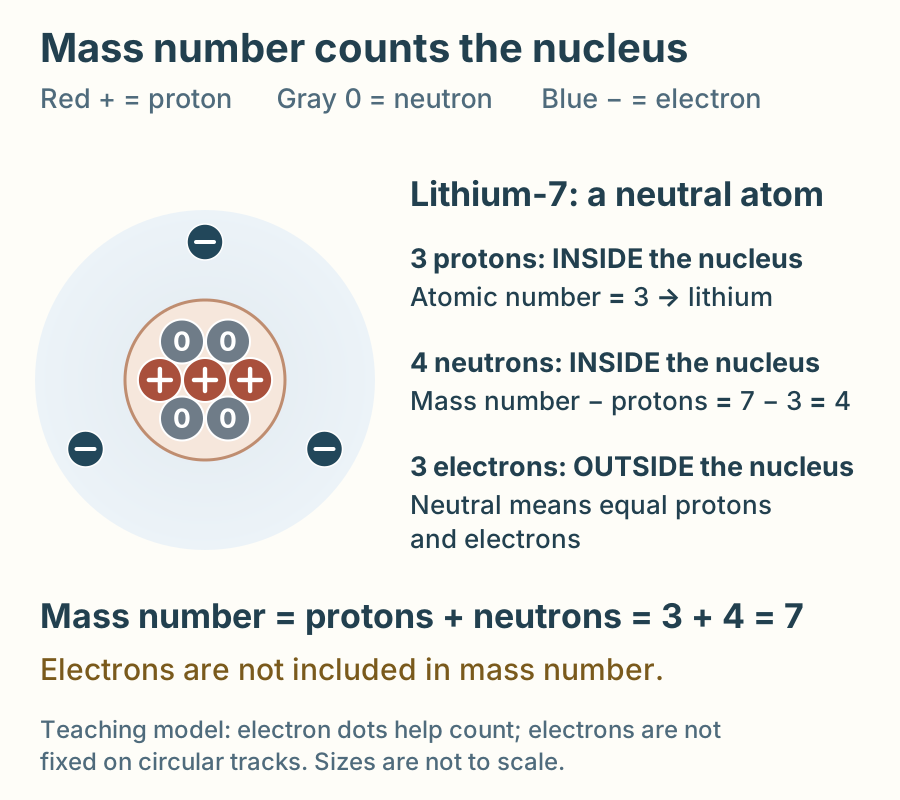
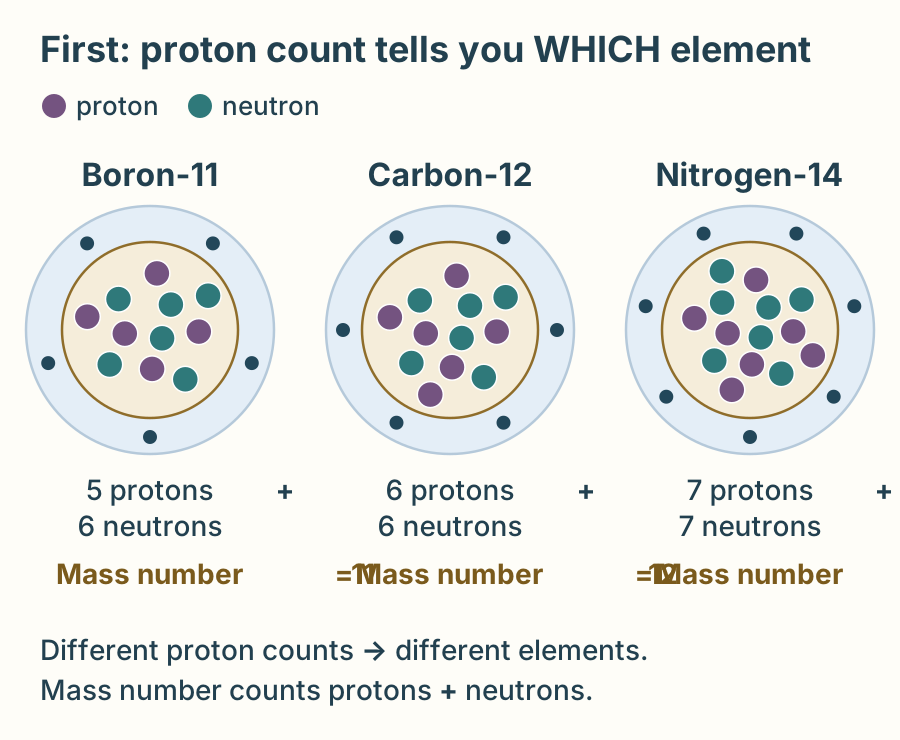
- Mass number = protons + neutrons
- Neutrons = mass number − protons
- Check by adding back
Answer
Answer: 18
Full worked solution
What you know: 13 protons, mass number 31. What you want: the number of neutrons.
- Mass number counts protons plus neutrons in one isotope: 31 = 13 + neutrons.
- Take the protons away to leave only neutrons: neutrons = 31 − 13 = 18.
Check: Add back: 13 protons + 18 neutrons = 31, the mass number.
Watch out: Use the isotope's whole-number mass number from the problem, not the decimal average mass on the periodic table.
Your route: Mass number → Subtract protons
13Al26.98On the periodic table: An atom with 13 protons is aluminum (Al); you can also read aluminum’s atomic number, 13, from its box. The mass number 31 comes from the problem, not the table.
Answer: 18