ChemGem

How to Read the Periodic Table (Step-by-Step, with Practice)

Each square on the periodic table is one element. Its atomic number counts its protons. Every later chapter reads rows, columns and squares.

Spot it, solve it, practice it: 4 steps, 1 practice problem. Free, no account.

The route · 4 steps

  1. Find the element’s square by symbol or atomic number.
  2. Read the atomic number: that is the proton count.
  3. Read its row for the period (1–7) and its column for the group (1–18).
  4. Move on by atomic number: left to right, then the next row.
Spot it

How to recognize periodic table questions

Look for an element's square, its atomic number, or a row and column: questions that ask which element, period, or group.

Example wording, with the clue words marked:

Sulfur’s square shows 16, S, and 32.06. Sulfur sits in the third row from the top and the sixteenth column from the left. How many protons does a sulfur atom have, and what are its period and group?

Not sure it’s this type? Compare the neighbors:

Step-by-step

The idea behind periodic table questions

The idea

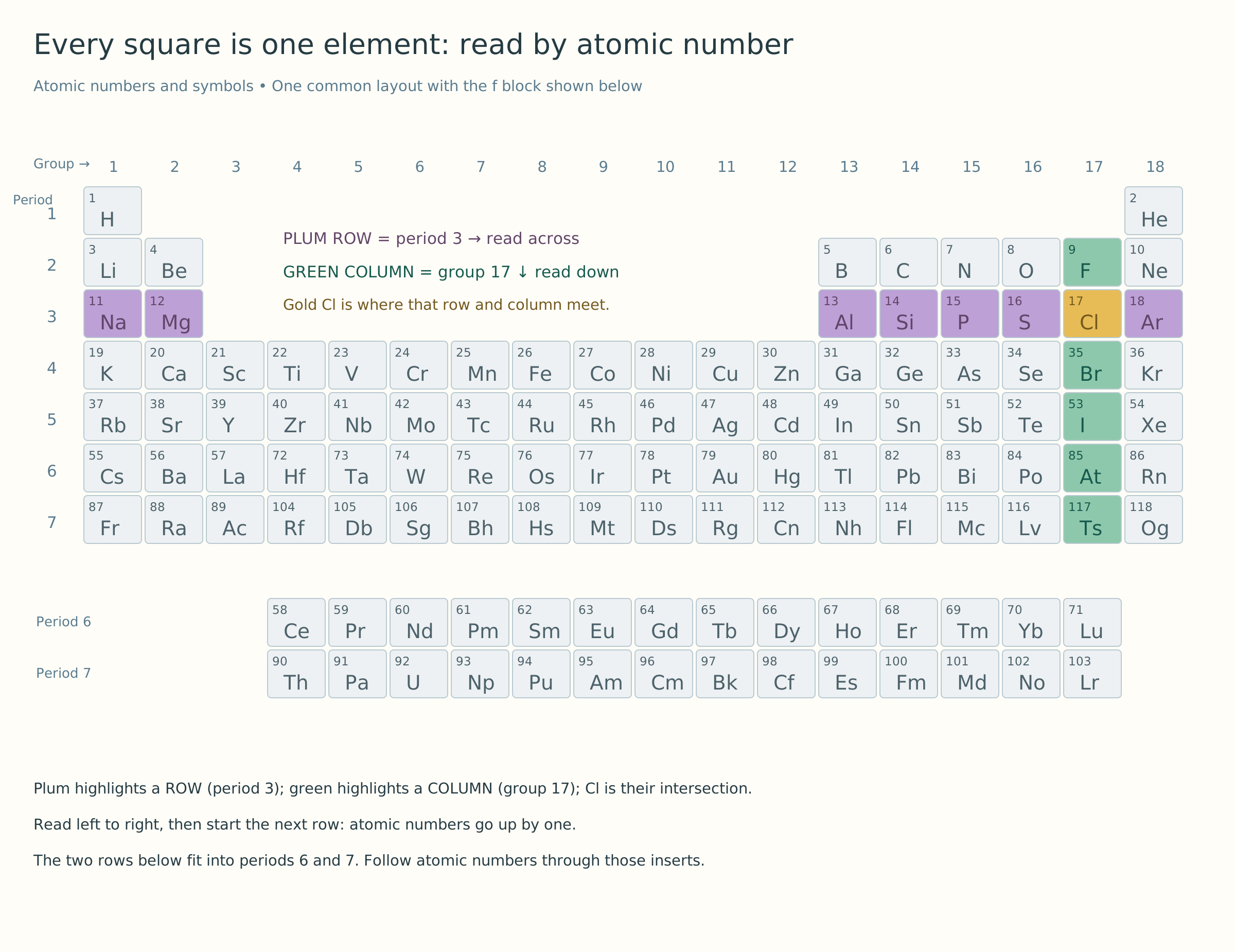
Every square is one element: read by atomic number. Plum highlights a ROW (period 3); green highlights a COLUMN (group 17); Cl is their intersection. Read left to right, then start the next row: atomic numbers go up by one. The two rows below fit into periods 6 and 7. Follow atomic numbers through those inserts.
Plum: a ROW (period 3). Green: a COLUMN (group 17). Chlorine (Cl) sits where they cross.
Rows and columns are different
Row = period
Read across. Numbered 1–7.
The two detached rows fit inside periods 6 and 7.
Chapter 3: what it says about electrons.
Column = group
Read down. Numbered 1–18.
Elements in one group often behave alike.
Chapter 2: how it predicts an ion’s charge.
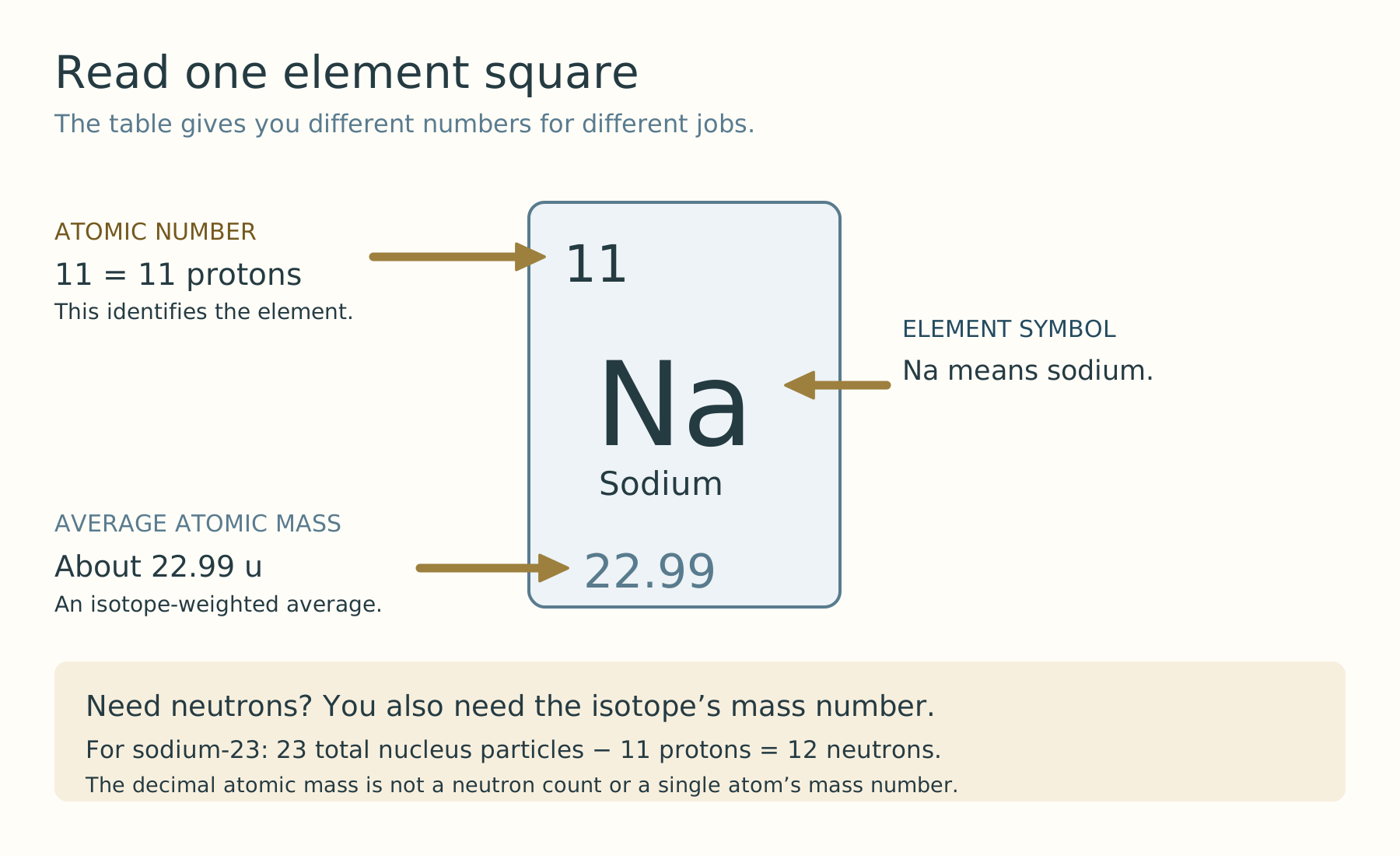
Sodium tile: atomic number 11 gives 11 protons; Na identifies sodium; average atomic mass about 22.99 u. Sodium-23 has 23 minus 11 equals 12 neutrons.
Atomic number gives protons. A named isotope’s mass number gives neutrons.
Reading one square: sodium
On the squareValueWhat it tells you
Atomic number1111 protons
SymbolNaThe element: sodium
Average atomic mass22.99 uAn average of its isotopes, not one atom
Sodium-23 (named isotope)23 − 11 = 1212 neutrons
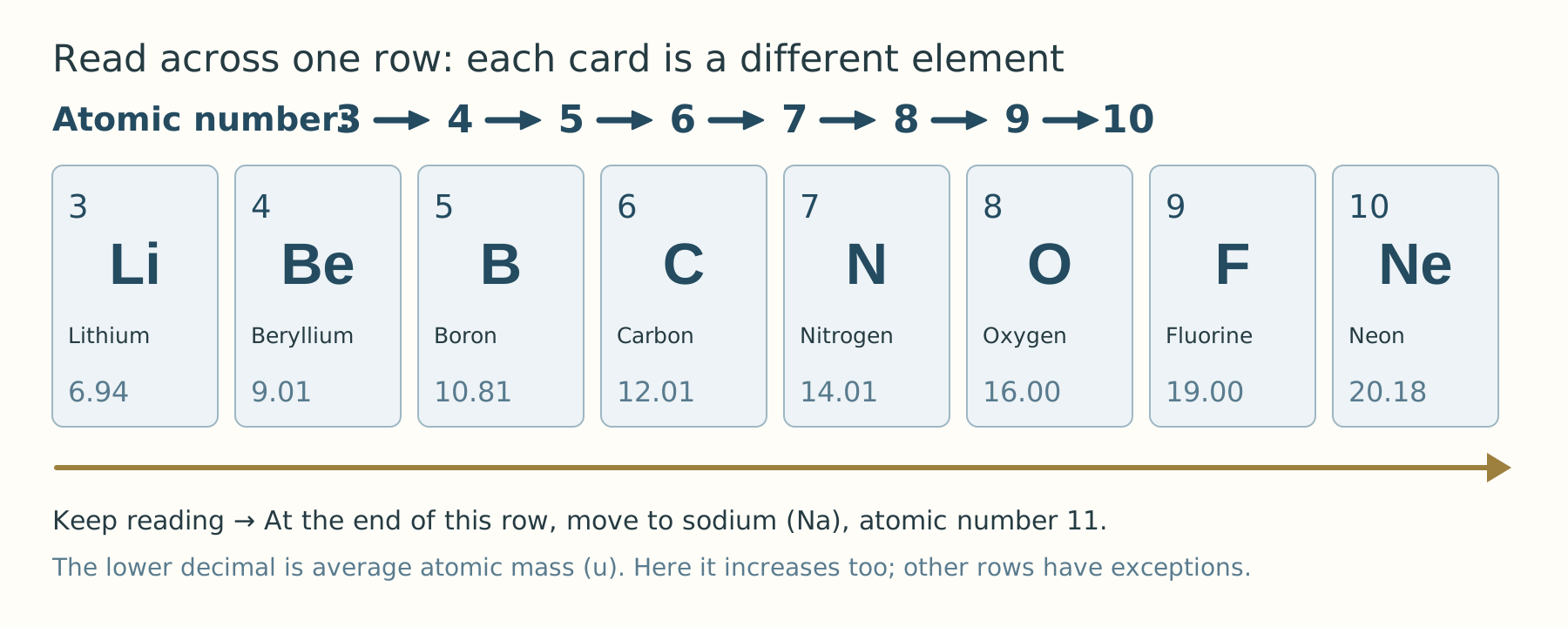
Period two: lithium 3, beryllium 4, boron 5, carbon 6, nitrogen 7, oxygen 8, fluorine 9, neon 10. Each tile shows its average atomic mass below its name.
Read across the row, then start the next row. Atomic numbers rise by one each step.

Quick check: after carbon (atomic number 6), what comes next? Answer: nitrogen, atomic number 7. One more proton means a different element.

On the periodic table: Carbon (C) has atomic number 6 and nitrogen (N) has 7, the whole numbers in their squares. Nitrogen comes right after carbon in Period 2.

On the periodic table: Sodium (Na) has atomic number 11 and average atomic mass 22.99 u.

Your turn

Periodic table practice problems

Answer first, then check. Hints open one at a time; the answer and full solution open after you try.

Problem 1 of 1

Sulfur’s square shows 16, S, and 32.06. Sulfur sits in the third row from the top and the sixteenth column from the left. How many protons does a sulfur atom have, and what are its period and group?

Hint 1 · the clue

The whole number in the square is the atomic number. A row is a period and a column is a group, so count rows for the period and columns for the group.

Hint 2 · the next move

An element's square plus its row and column: the whole number gives protons, the row gives period, the column gives group.

Your path:

  1. Whole number in square = protons
  2. Row number = period
  3. Column number = group
Answer

16 protons; Period 3, Group 16.

Full worked solution

What you know: the square shows 16, S, 32.06; third row, sixteenth column. What you want: the proton count, the period, and the group.

  1. The whole number 16 is the atomic number, so sulfur has 16 protons.
  2. Rows run horizontally and are periods: the third row is Period 3.
  3. Columns run vertically and are groups: the sixteenth column is Group 16.

Check: Oxygen (8) sits directly above sulfur in the same column, so it is also Group 16, but one period higher (Period 2).

Watch out: Do not read 32.06 as the proton count; it is the decimal average atomic mass. And do not swap the terms: period means row, group means column.

16S32.06On the periodic table: Sulfur (S) has atomic number 16, the whole number in its box. Its box is in Period 3 (row) and Group 16 (column).

Answer: 16 protons; Period 3, Group 16.

Watch out

Common periodic table mistakes