
Problem 1 of 7 · warm-up
An atom has atomic number 13 and mass number 29. How many protons does it have?
Hint 1 · the clue
Atomic number is provided.
Hint 2 · the next move
Atomic number is given and protons are asked for: the atomic number is the proton count, so read it straight off.
Your path:
- Atomic number = number of protons
- Ignore the mass number here
Answer
Answer: 13
Full worked solution
What you know: atomic number 13, mass number 29. What you want: the number of protons.
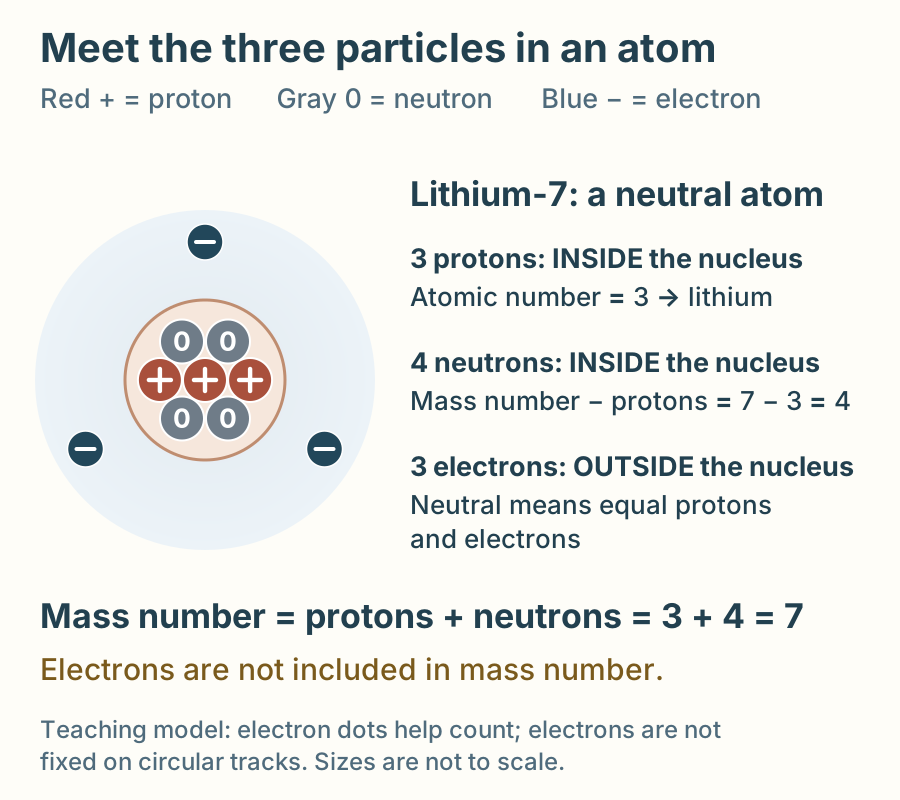
- Atomic number is defined as the number of protons. Every atom of an element has the same proton count.
- Read it straight off: atomic number 13 → 13 protons.
Check: The proton count can never be larger than the mass number, because mass number = protons + neutrons. 13 is less than 29, so it fits.
Watch out: Don't use the mass number (29). It counts protons and neutrons together.
Your route: Read atomic number → Use it as proton count
13Al26.98On the periodic table: Atomic number 13 belongs to aluminum (Al); it is the whole number in aluminum’s box, so an aluminum atom has 13 protons.
Answer: 13