
Problem 1 of 5 · warm-up
A neutral atom with 15 protons gains 3 electrons. What charge does it acquire?
Hint 1 · the clue
The atom gains electrons.
Hint 2 · the next move
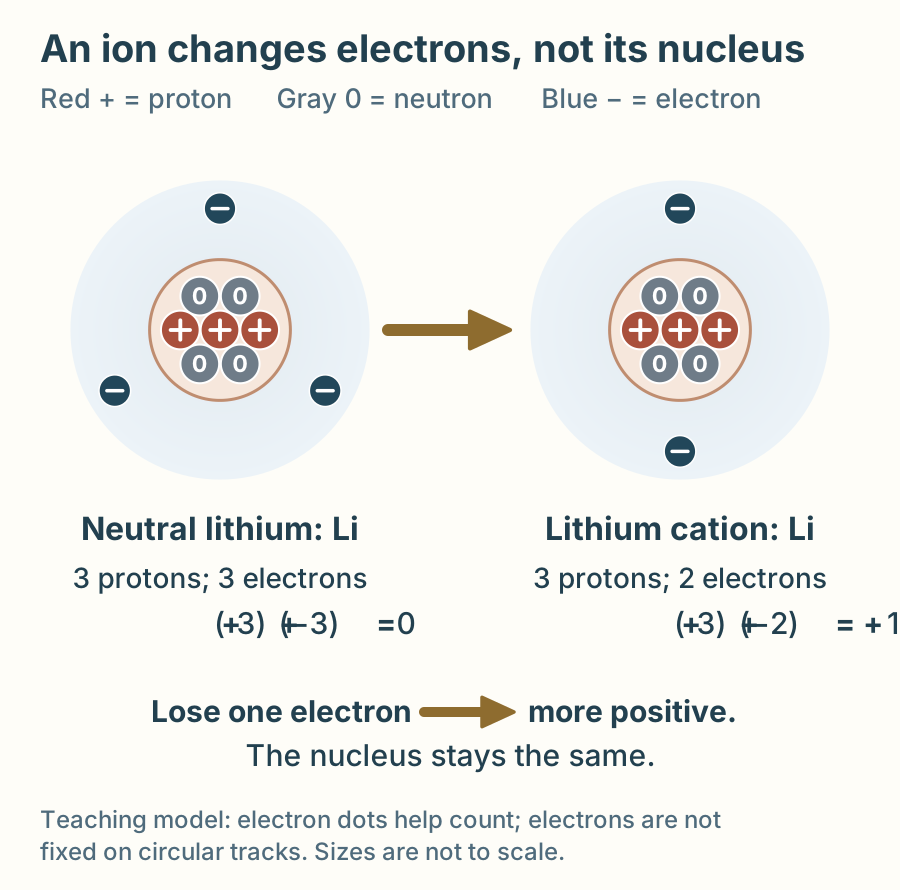
A neutral atom "gains" electrons and its charge is asked: gaining electrons makes a negative ion.
Your path:
- Neutral start: electrons = protons
- Add the gained electrons
- Charge = protons − electrons
Answer
Answer: 3−
Full worked solution
What you know: a neutral atom with 15 protons gains 3 electrons. What you want: its new charge.
- Neutral means it starts with 15 electrons and charge 0.
- After gaining 3, it has 15 + 3 = 18 electrons. The protons stay the same.
- Charge = protons − electrons = 15 − 18 = −3, written 3−.
Check: Electrons now outnumber protons, so the charge must be negative.
Watch out: Gaining electrons makes the charge negative, not positive. Electrons are the negative particles.
Your route: Gain negative electrons → Total charge decreases
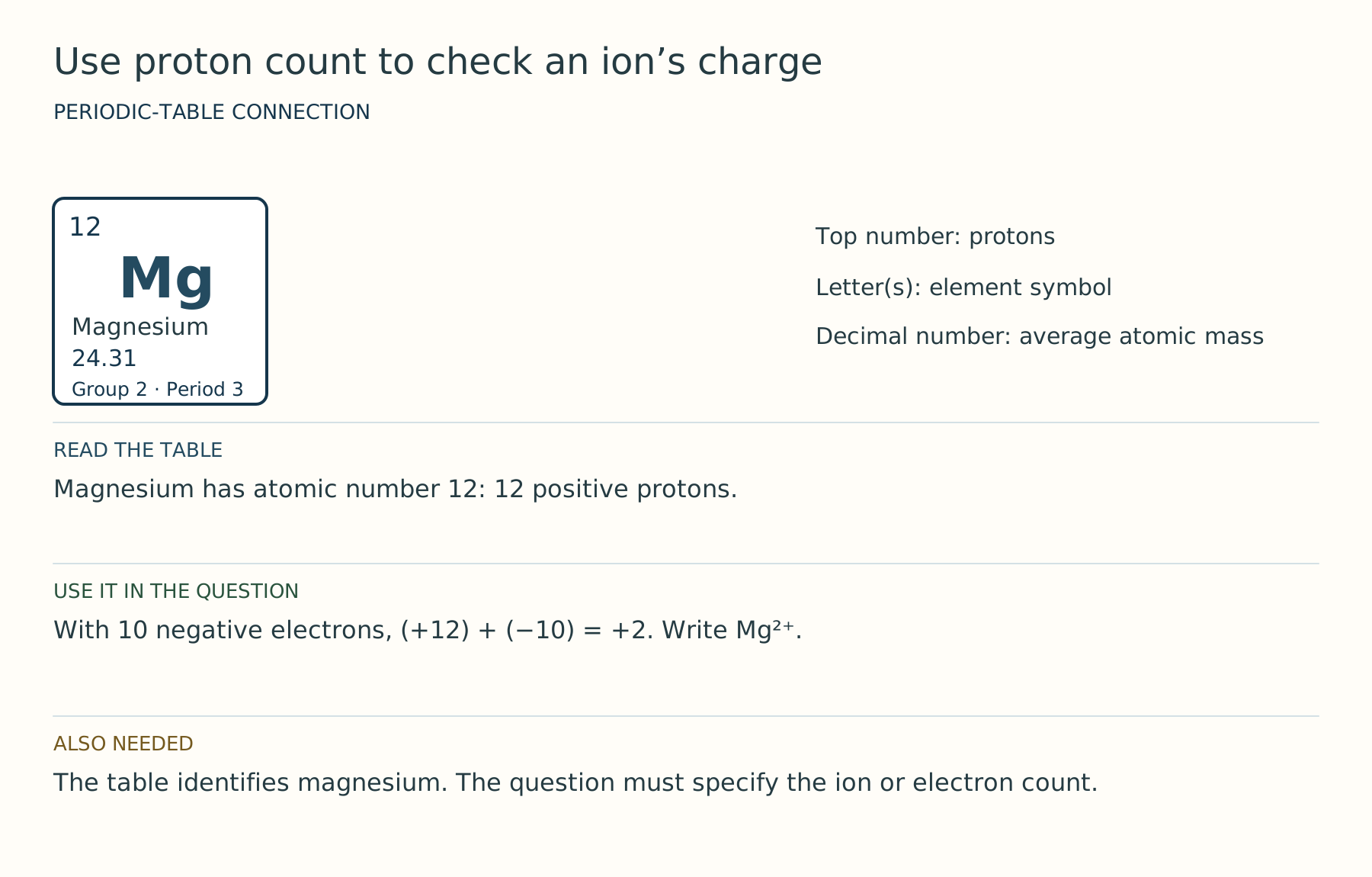
15P30.97On the periodic table: An atom with 15 protons is phosphorus (P); you can also read phosphorus’s atomic number, 15, from its box. Phosphorus is in Group 15, so it forms P3− (see 2.2).
Answer: 3−