ChemGemTM

How to Find the Mass Number of an Atom (Step-by-Step, with Practice)

Mass number (A) = protons + neutrons. Always a whole number. Electrons don’t count.

3 steps, 1 worked example, 4 practice problems. About 10 minutes. Free.

The route · 3 steps

  1. Protons: atomic number (Z) on the periodic table.
  2. Neutrons: given in the problem.
  3. Add: A = protons + neutrons.
Start here

Periodic table

Protons come from here. Tap any element.

Tap an element to see its protons.

57–7189–103

Swipe sideways for the full table.

Spot it

How to recognize a mass number question

Asked for "mass number" or "nucleons," with the element (or protons) and neutrons given.

Clue words marked:

An atom of sodium has 12 neutrons. What is its mass number?

Not this type?

Step-by-step

Worked example: mass number of a sodium atom

The idea

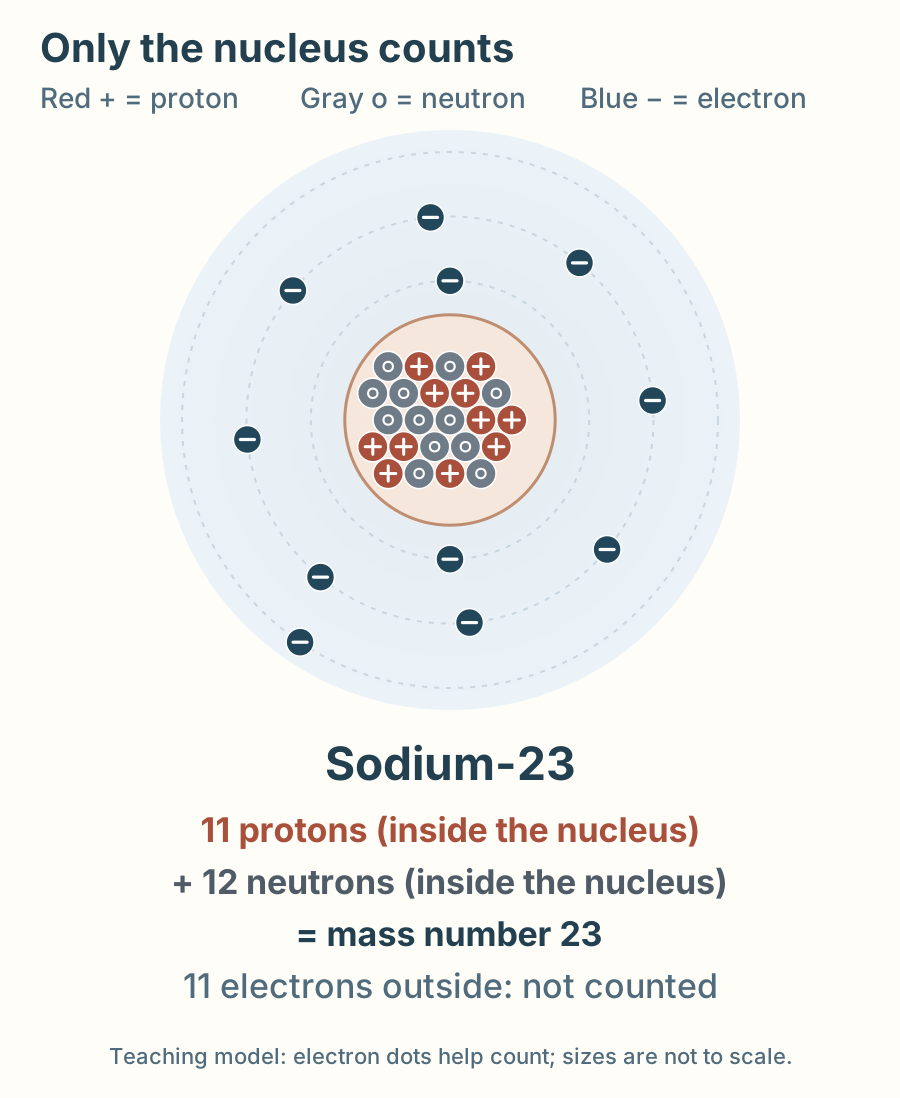
Only the nucleus counts
11 p⁺ 12 N 11 electrons: not counted 11 protons + 12 neutrons A = 23 sodium-23
Protons + neutrons = nucleons. Mass number counts only these. Not to scale.
Mass number = protons + neutrons
A = Z + N
Z = protons, N = neutrons.
Three ways a question shows the mass number
What you seeExampleMass number
Isotope namecarbon-14after the dash: 14
Isotope symbol146Ctop number: 14
Particle counts6 protons, 8 neutrons6 + 8 = 14
Name or symbol? Read it off. Particles? Add.
Adding up the nucleus
AtomProtons (Z)NeutronsMass number
lithium347
carbon6612
carbon6814
oxygen81018
chlorine172037
Carbon-12 and carbon-14: same element, different neutrons. These are isotopes.
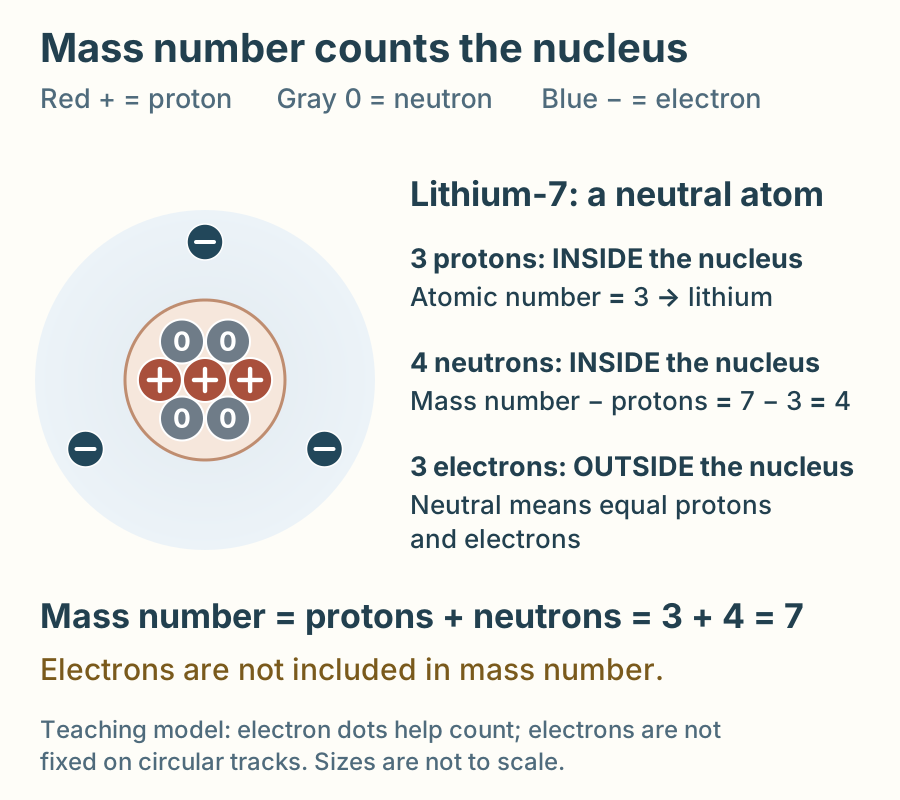
A lithium-7 atom: 3 protons and 4 neutrons in the nucleus, 3 electrons outside. Mass number = protons + neutrons = 3 + 4 = 7. Electrons are not included.
Lithium-7: 3 + 4 = 7.

Mass number (A)

One isotope. Whole number.

Chlorine-37: A = 37

Average atomic mass on the table

Average of isotopes. Decimal.

Chlorine: 35.45

On the periodic table: Li 3, C 6, O 8, Na 11, Cl 17 protons. Neutrons aren’t on the table.

Worked example · 3 steps

An atom of sodium has 12 neutrons. What is its mass number?

  1. 1
    Find the protons

    11Na22.99On the periodic table: sodium (Na) is 11, so 11 protons.

    Z = 11
  2. 2
    Find the neutrons

    Given.

    N = 12
  3. 3
    Add them
    A = Z + N
    A = 11 + 12 = 23
    Protons+ Neutrons= Mass number
    111223
  4. ✓
    Answer

    23: sodium-23, 2311Na.

    A sodium-23 atom: 11 protons and 12 neutrons in the nucleus give mass number 23. Its 11 electrons, arranged 2, 8, 1, are outside the nucleus and not counted.
    Count only the nucleus: 11 + 12 = 23.
Your turn

Mass number practice problems

Try first, then check. Hints if you need them.

Problem 1 of 4 · warm-up

An atom has 8 protons and 9 neutrons. What is its mass number?

Hint 1 · the clue

Both nucleus counts are given.

Hint 2 · the next move

Add the protons and the neutrons.

Your path:

  1. Protons = 8
  2. Neutrons = 9
  3. A = protons + neutrons
Answer

Answer: 17

Full worked solution

What you know: 8 protons, 9 neutrons. What you want: the mass number.

  1. A = 8 + 9 = 17.

8O16.00On the periodic table: oxygen (O) = 8 protons. Oxygen-17.
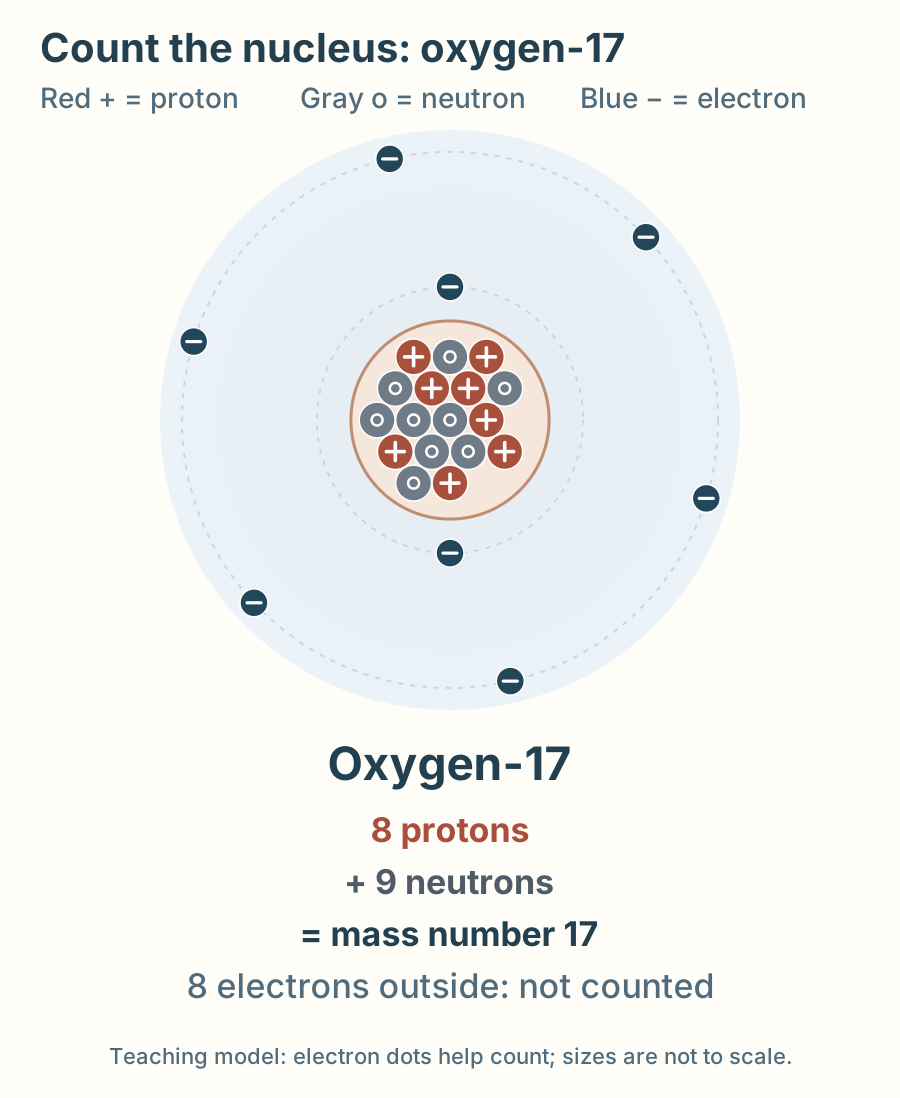
An oxygen-17 atom: 8 protons and 9 neutrons in the nucleus give mass number 17. Its 8 electrons are outside and not counted.
Oxygen-17: 8 + 9 = 17.

Answer: 17

Problem 2 of 4

An atom of chlorine has 20 neutrons. What is its mass number?

Hint 1 · the clue

Protons aren’t given. The periodic table has them.

Hint 2 · the next move

Chlorine’s atomic number from the periodic table, plus 20.

Your path:

  1. Protons = chlorine’s atomic number
  2. Neutrons = 20
  3. A = protons + neutrons
Answer

Answer: 37

Full worked solution

What you know: chlorine, 20 neutrons. What you want: the mass number.

  1. Chlorine: 17 protons.
  2. A = 17 + 20 = 37.

Watch out: 35.45 is an average, not this atom’s mass number.

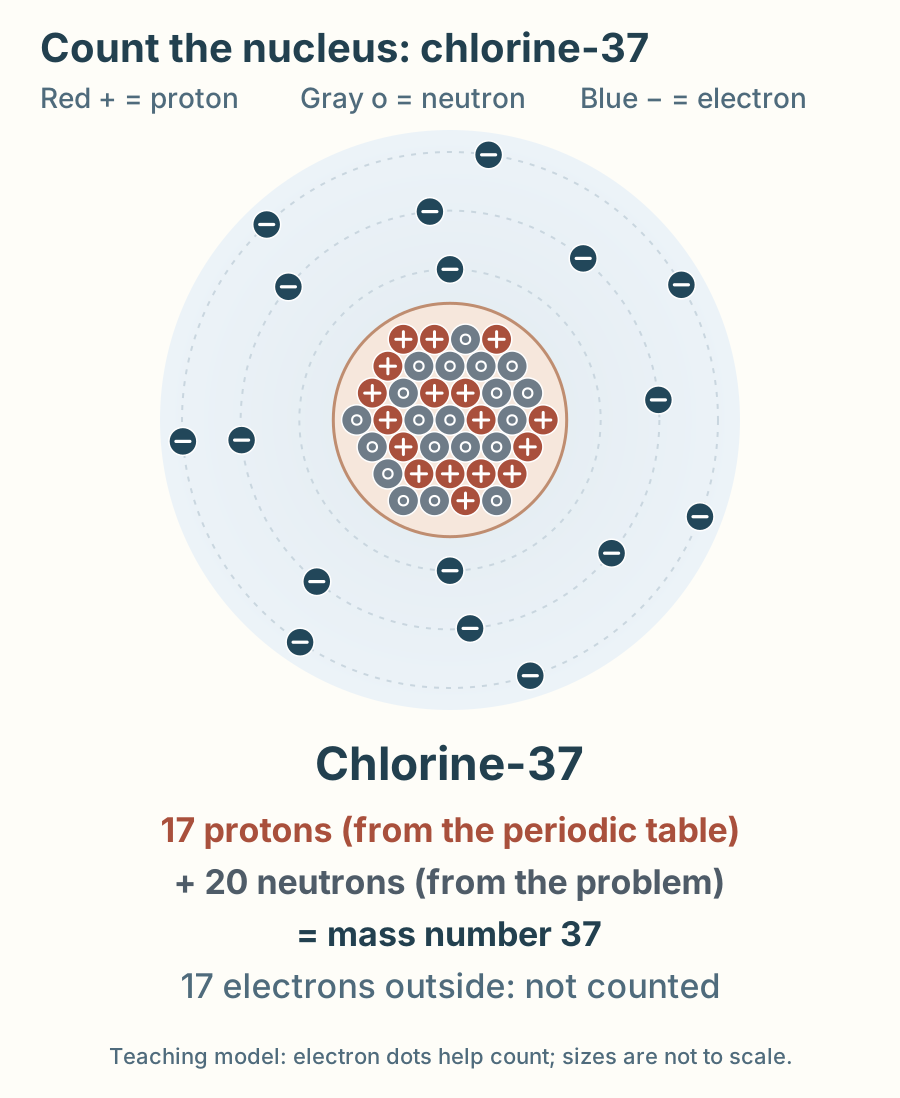
17Cl35.45On the periodic table: chlorine (Cl) = 17 protons.

A chlorine-37 atom: 17 protons and 20 neutrons give mass number 37. Its 17 electrons are outside and not counted.
Chlorine-37: 17 + 20 = 37.

Answer: 37

Problem 3 of 4 · exam-style wording

A neutral atom contains 26 electrons and 30 neutrons. How many nucleons does it have (what is its mass number)?

Hint 1 · the clue

Nucleons = protons + neutrons. Neutral: electrons = protons.

Hint 2 · the next move

26 protons + 30 neutrons.

Your path:

  1. Neutral: protons = electrons = 26
  2. Neutrons = 30
  3. A = protons + neutrons
Answer

Answer: 56

Full worked solution

What you know: neutral atom, 26 electrons, 30 neutrons. What you want: the mass number.

  1. Neutral, so protons = electrons = 26.
  2. A = 26 + 30 = 56.

Watch out: don’t add the electrons too (82).

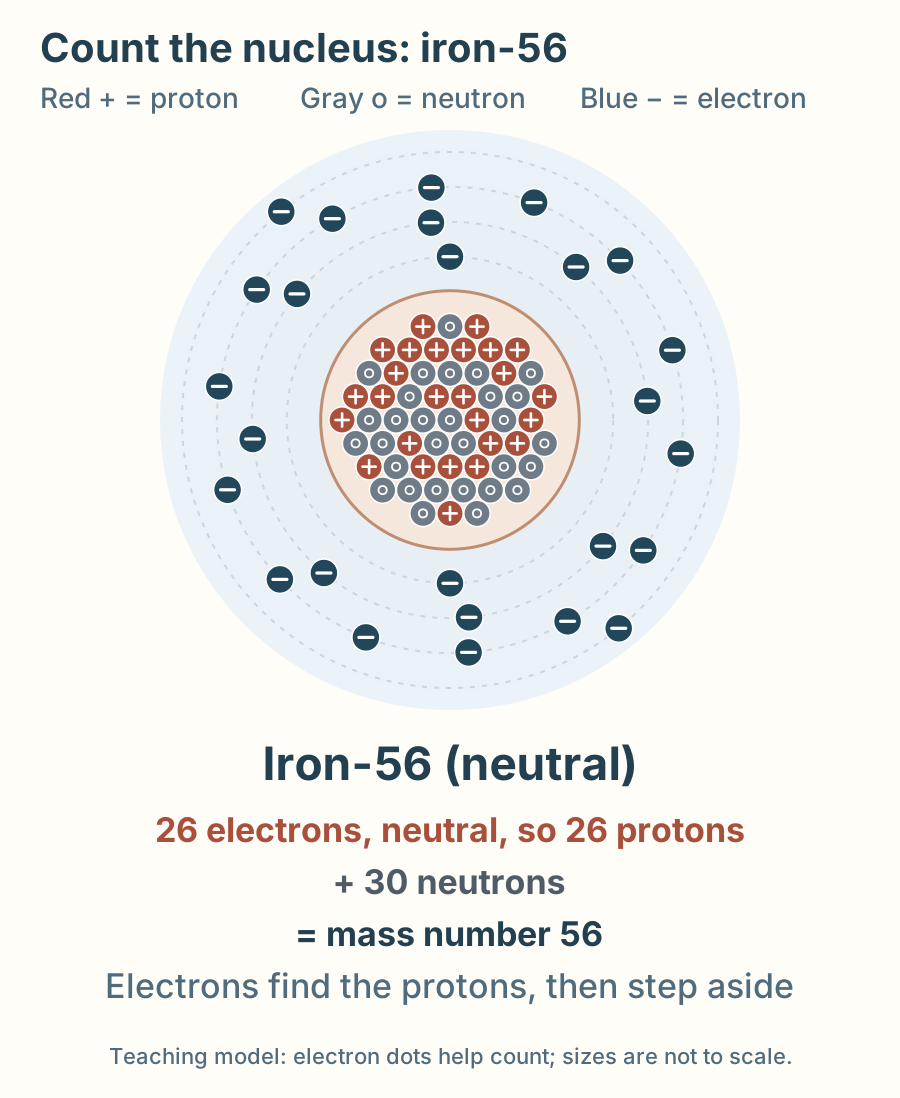
26Fe55.85On the periodic table: 26 is iron (Fe). Iron-56.

A neutral iron-56 atom: 26 protons and 30 neutrons give mass number 56. Its 26 electrons equal the protons but are not added.
Iron-56: the 26 electrons tell you the protons; only 26 + 30 is added.

Answer: 56

Problem 4 of 4 · watch for the trap

A magnesium ion, Mg2+, has 10 electrons and 12 neutrons. What is its mass number?

Hint 1 · the clue

It’s an ion: electrons ≠ protons. Use the element.

Hint 2 · the next move

Magnesium’s atomic number from the periodic table, plus 12. Ignore the electrons.

Your path:

  1. Protons = magnesium’s atomic number
  2. Neutrons = 12
  3. A = protons + neutrons
Answer

Answer: 24

Full worked solution

What you know: Mg2+, 10 electrons, 12 neutrons. What you want: the mass number.

  1. Magnesium: 12 protons, ion or not.
  2. A = 12 + 12 = 24.

Watch out: electrons aren’t protons here (22 is wrong).

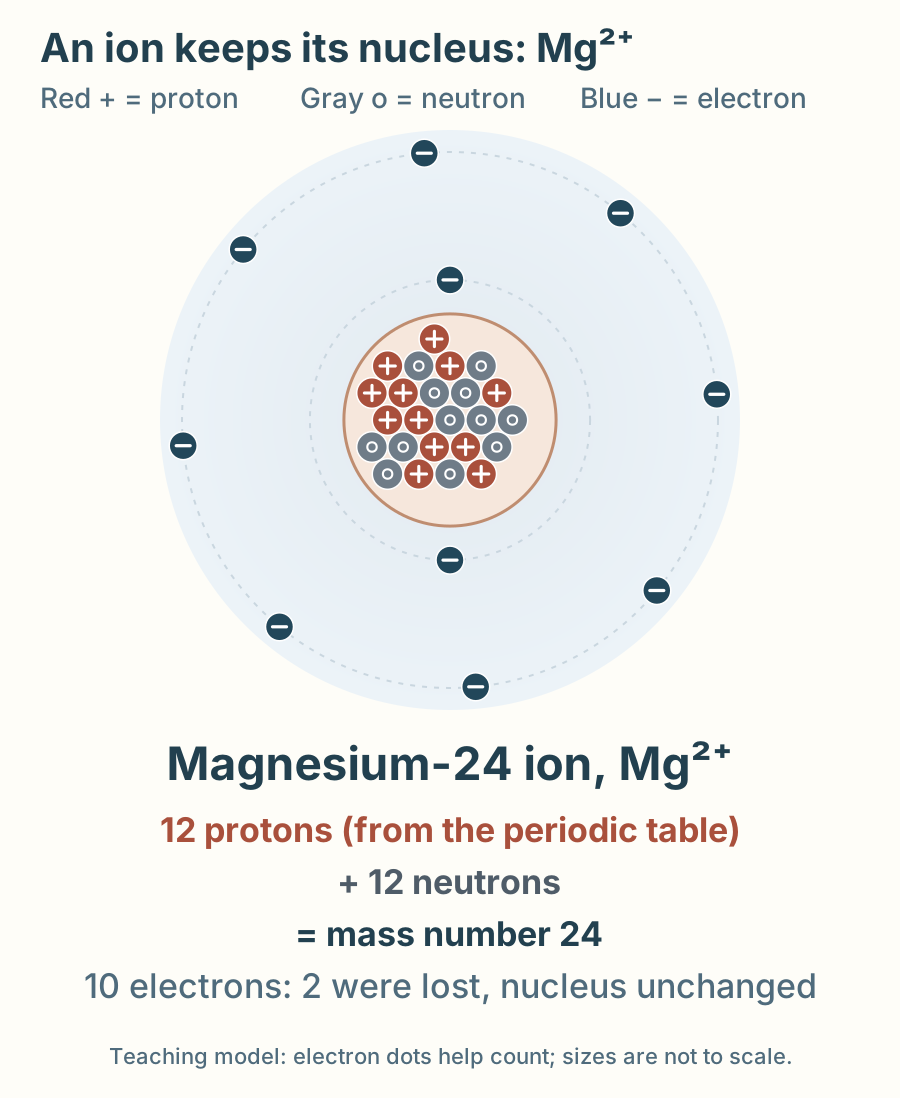
12Mg24.31On the periodic table: magnesium (Mg) = 12 protons.

A magnesium-24 ion, Mg2+: 12 protons and 12 neutrons give mass number 24. It has 10 electrons because it lost 2.
Mg²⁺: losing 2 electrons leaves the nucleus, and the mass number, unchanged.

Answer: 24

Watch out

Common mass number mistakes