ChemGem

How to Find an Empirical Formula from Percent Composition (Step-by-Step, with Practice)

Mass percent (also called percent composition) tells how much of a compound’s mass comes from each element. Working backward, percentages give the simplest atom ratio: the empirical formula.

Spot it, solve it, practice it: 5 steps, 1 worked example, 5 practice problems. Free, no account.

The route · 5 steps

  1. Assume a 100 g sample, so percent becomes grams.
  2. Convert each element’s grams to moles.
  3. Divide every mole amount by the smallest.
  4. Clear any .5, .33 or .67 by multiplying all ratios.
  5. Write the ratios as subscripts.
Spot it

How to recognize empirical formula questions

Look for “mass percent,” percent of an element, or element amounts asking for the simplest whole-number formula (empirical formula).

Example wording, with the clue words marked:

Use C = 12 g/mol, H = 1 g/mol, O = 16 g/mol, S = 32 g/mol. What is sulfur’s mass percent in SO2, nearest whole percent?

Not sure it’s this type? Compare the neighbors:

Step-by-step

Worked example: empirical formula

The idea

Mass percent = part ÷ total × 100%
mass percent = mass of componenttotal mass × 100%
Use the same mass unit on top and bottom.
Water, H2O, by mass
Oxygen88.8%Hydrogen11.2%
Two H per O, yet O is most of the mass. The parts add to 100%.
Two ways to describe a compound
Mass percent
Share of the mass from each element.
Water: 88.8% O.
Empirical formula
Simplest whole-number atom ratio.
Water: H2O.
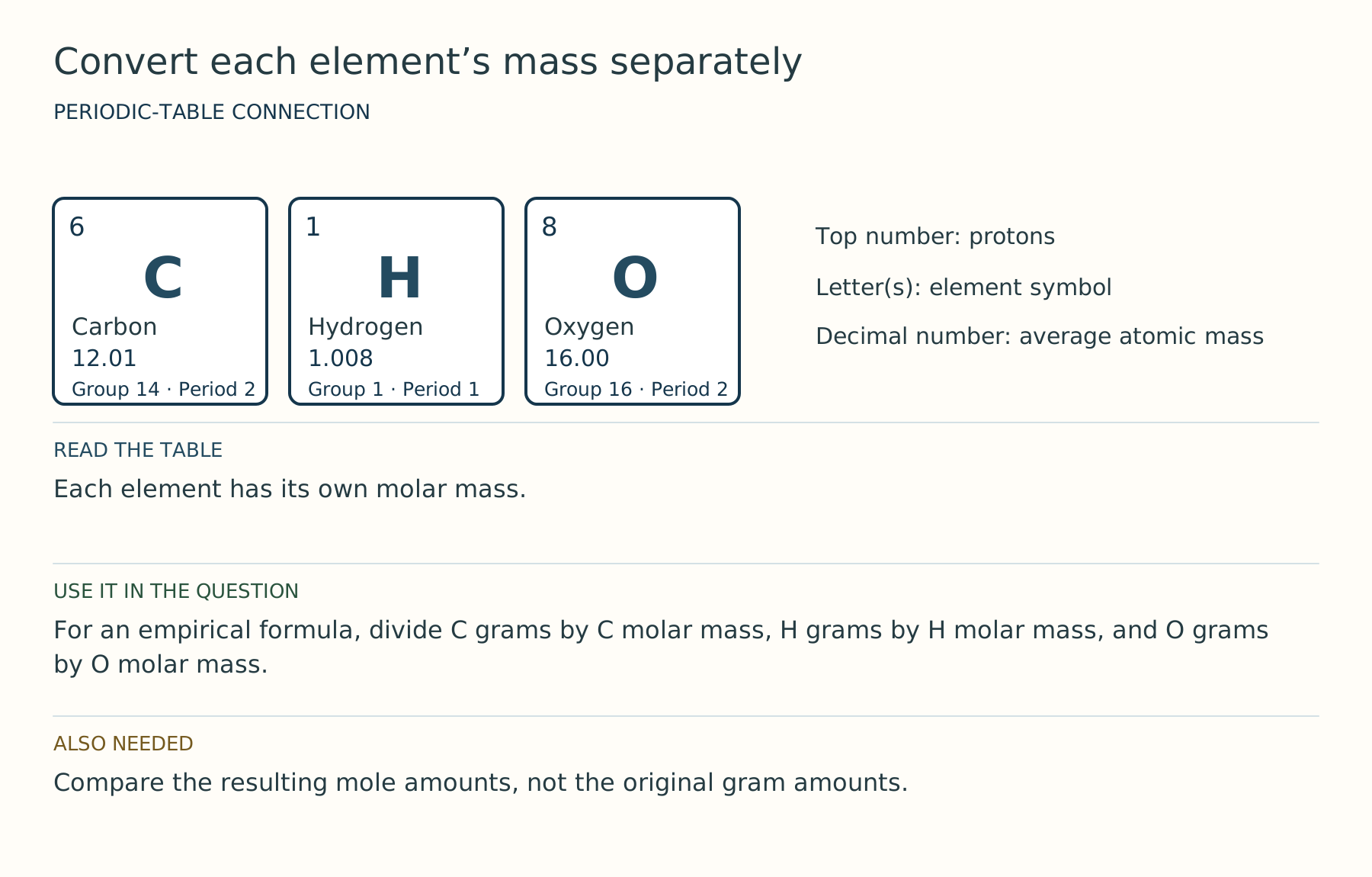
Convert each element’s mass separately. Each element has its own molar mass. For an empirical formula, divide C grams by C molar mass, H grams by H molar mass, and O grams by O molar mass. Compare the resulting mole amounts, not the original gram amounts.
Compare mole amounts, not gram amounts.
When a ratio is not a whole number
Ratio ends nearMultiply all ratios byExample
.521 : 1.5 → 2 : 3
.33 or .6731 : 1.33 → 3 : 4   or   1 : 1.67 → 3 : 5

On the periodic table: Molar masses are the decimal number in each box: C 12.01, H 1.008, O 16.00 g/mol; rounded, 12, 1 and 16.

On the periodic table: Use the masses the problem gives.

Worked example · 4 steps

What is the mass percent of oxygen in water, H2O? Use H = 1.008 g/mol and O = 16.00 g/mol.

  1. 1
    Find the molar mass of the whole

    The whole is one mole of water.

    AtomHow many× mass (g/mol)= contribution
    H21.0082.016
    O116.0016.00
    Total18.02 g/mol
  2. 2
    Find the mass of the part

    One O atom per H2O.

    oxygen in 1 mol H2O = 16.00 g
  3. 3
    Divide part by total

    Grams cancel, leaving a percent.

    16.00 g18.02 g × 100% = 88.8% O
  4. 4
    Check the total

    The parts must add to 100%.

    ElementCalculationMass percent
    H2.016 ÷ 18.02 × 100%11.2%
    O16.00 ÷ 18.02 × 100%88.8%
    Total100.0%
  5. ✓
    Answer

    Water is 88.8% oxygen by mass.

Your turn

Empirical formula practice problems

Answer first, then check. Hints open one at a time; the answer and full solution open after you try.

Problem 1 of 5 · warm-up

Use C = 12 g/mol, H = 1 g/mol, O = 16 g/mol, S = 32 g/mol. What is sulfur’s mass percent in SO2, nearest whole percent?

Hint 1 · the clue

Mass percent is requested.

Hint 2 · the next move

“Mass percent” of one element in a formula is asked: divide that element’s mass by the compound’s molar mass.

Your path:

  1. Find the molar mass of SO2
  2. Find sulfur’s mass in one mole
  3. Part ÷ total × 100
Answer

Answer: 50%

Full worked solution

What you know: The formula SO2, with S = 32 g/mol and O = 16 g/mol. What you want: sulfur’s mass percent.

  1. Find the formula mass: 1 S + 2 O = 32 + 2(16) = 64 g/mol.
  2. Sulfur’s part of that mass is 32 g/mol (one S atom).
  3. Mass percent = part ÷ total × 100: (32 g/mol ÷ 64 g/mol) × 100 = 50. The units cancel. The answer is 50%.

Check: Oxygen’s share is 32 ÷ 64 × 100 = 50%. The two percents add to 100%.

Watch out: Do not count atoms instead of mass. S is 1 of 3 atoms, but 1/3 (33%) is not the mass percent.

Your route: Component mass ÷ Formula mass × 100.

On the periodic table: Sulfur (S) has an average atomic mass of 32.06 g/mol and oxygen (O) has 16.00 g/mol, the decimal numbers in their boxes; the problem rounds them to 32 and 16.

Answer: 50%

YOUR PERIODIC-TABLE REFERENCE

16SSulfur32.06Group 16 · Period 3

Atomic number identifies proton count. The decimal mass is an average, not an isotope’s mass number. Use supplied rounded masses when a problem gives them.

Problem 2 of 5

An analysis gives 6 mol C, 6 mol H, and 3 mol O. Which is the simplest whole-number formula?

Hint 1 · the clue

Element amounts are already in moles.

Hint 2 · the next move

Moles of each element are given and the simplest whole-number formula is asked: that signals an empirical formula.

Your path:

  1. Amounts are already moles
  2. Divide each by the smallest amount
  3. Use the ratios as subscripts
Answer

Answer: C2H2O

Full worked solution

What you know: 6 mol C, 6 mol H, 3 mol O. What you want: the simplest whole-number formula (empirical formula).

  1. The amounts are already in moles, so no gram conversion is needed. Find the smallest amount: 3 mol (O).
  2. Divide every amount by 3: C: 6 ÷ 3 = 2. H: 6 ÷ 3 = 2. O: 3 ÷ 3 = 1.
  3. All are whole numbers, so they become subscripts: C2H2O.

Check: 2 : 2 : 1 is the same ratio as 6 : 6 : 3, and no whole number larger than 1 divides all of 2, 2 and 1.

Watch out: C6H6O3 keeps the right ratio but is not the simplest. Always divide by the smallest.

Your route: Mole amounts → Divide by smallest → Whole-number ratio.

Answer: C2H2O

YOUR PERIODIC-TABLE REFERENCE

1HHydrogen1.008Group 1 · Period 1
6CCarbon12.01Group 14 · Period 2
8OOxygen16.00Group 16 · Period 2

Atomic number identifies proton count. The decimal mass is an average, not an isotope’s mass number. Use supplied rounded masses when a problem gives them.

Problem 3 of 5

The mole ratio C:H:O is 1:1.5:0.5. Which empirical formula keeps that ratio using whole numbers?

Hint 1 · the clue

The ratio includes a half.

Hint 2 · the next move

A mole ratio with decimals like halves needs whole numbers: multiply the whole ratio to clear the fractions.

Your path:

  1. Spot the halves in the ratio
  2. Multiply every part by 2
  3. Use the whole numbers as subscripts
Answer

Answer: C2H3O

Full worked solution

What you know: The mole ratio C : H : O = 1 : 1.5 : 0.5. What you want: the empirical formula with whole numbers.

  1. Notice the halves (1.5 and 0.5). Subscripts must be whole numbers, and you cannot just round 1.5 or 0.5.
  2. Multiply every part of the ratio by 2, the smallest number that clears a half: C: 1 × 2 = 2. H: 1.5 × 2 = 3. O: 0.5 × 2 = 1.
  3. Use 2 : 3 : 1 as subscripts: C2H3O.

Check: Divide 2 : 3 : 1 by 2 and you get back 1 : 1.5 : 0.5.

Watch out: Multiply all three numbers, not just the fractions. Doubling only H and O would change the ratio.

Your route: Fractional ratio → Multiply all ratios to whole numbers.

Answer: C2H3O

YOUR PERIODIC-TABLE REFERENCE

1HHydrogen1.008Group 1 · Period 1
6CCarbon12.01Group 14 · Period 2
8OOxygen16.00Group 16 · Period 2

Atomic number identifies proton count. The decimal mass is an average, not an isotope’s mass number. Use supplied rounded masses when a problem gives them.

Problem 4 of 5

A sample contains 2 mol C and 6 mol H. Empirical formula?

Hint 1 · the clue

Divide each mole amount by the smallest to find the simplest whole-number atom ratio.

Hint 2 · the next move

Moles of each element are given and an empirical formula is asked: divide every amount by the smallest.

Your path:

  1. Find the smallest mole amount
  2. Divide each amount by it
  3. Use the ratio as subscripts
Answer

CH3, the simplest 1:3 ratio.

Full worked solution

What you know: 2 mol C and 6 mol H. What you want: the empirical formula.

  1. The amounts are already in moles. Find the smallest: 2 mol (C).
  2. Divide each amount by 2: C: 2 ÷ 2 = 1. H: 6 ÷ 2 = 3.
  3. Use 1 : 3 as subscripts (a 1 is not written): CH3.

Check: 1 : 3 is the same ratio as 2 : 6, and it cannot be reduced further.

Watch out: C2H6 has the right ratio but is not the simplest. The empirical formula always uses the smallest whole numbers.

Answer: CH3, the simplest 1:3 ratio.

YOUR PERIODIC-TABLE REFERENCE

1HHydrogen1.008Group 1 · Period 1
6CCarbon12.01Group 14 · Period 2

Atomic number identifies proton count. The decimal mass is an average, not an isotope’s mass number. Use supplied rounded masses when a problem gives them.

Problem 5 of 5

What is the mass percent of carbon in carbon dioxide, CO2? Use C = 12.01 g/mol and O = 16.00 g/mol. Give the answer to the nearest 0.1%.

Hint 1 · the clue

First add up the molar mass of CO2 (one C and two O). Then divide the mass of the one C by that total and multiply by 100%.

Hint 2 · the next move

“Mass percent” of carbon in a formula is asked: divide carbon’s mass by the compound’s molar mass.

Your path:

  1. Find the molar mass of CO2
  2. Find carbon’s mass in one mole
  3. Part ÷ total × 100%
Answer

27.3% C

Full worked solution

What you know: CO2 has 1 C and 2 O; C = 12.01 g/mol, O = 16.00 g/mol. What you want: the mass percent of C.

  1. Find the molar mass of CO2: 12.01 + 2 × 16.00 = 12.01 + 32.00 = 44.01 g/mol.
  2. Mass of C in one mole: 1 × 12.01 = 12.01 g.
  3. Divide part by total: 12.01 g ÷ 44.01 g = 0.2729.
  4. Multiply by 100%: 0.2729 × 100% = 27.29%, which rounds to 27.3%.

Check: Oxygen should be the rest: 32.00 ÷ 44.01 × 100% = 72.7%, and 27.3% + 72.7% = 100.0%.

Watch out: Count both O atoms in the total. Using 12.01 + 16.00 = 28.01 g/mol would give 42.9%, which is wrong.

Answer: 27.3% C

On the periodic table: carbon (C) is 12.01 g/mol and oxygen (O) is 16.00 g/mol, the same values given in the question.

YOUR PERIODIC-TABLE REFERENCE

6CCarbon12.01Group 14 · Period 2
8OOxygen16.00Group 16 · Period 2

Atomic number identifies proton count. The decimal mass is an average, not an isotope’s mass number. Use supplied rounded masses when a problem gives them.

Watch out

Common empirical formula mistakes