ChemGem

How to Find the Molecular Formula (Step-by-Step, with Practice)

An empirical formula gives only the simplest atom ratio. The molar mass tells how many of those units make one molecule: the molecular formula.

Spot it, solve it, practice it: 4 steps, 1 worked example, 3 practice problems. Free, no account.

The route · 4 steps

  1. Find the empirical formula’s molar mass.
  2. Divide the molecular molar mass by it.
  3. Round to the nearest whole number.
  4. Multiply every subscript by that number.
Spot it

How to recognize molecular formula questions

Look for an empirical formula plus a molecular molar mass, asking for the molecular (actual) formula.

Example wording, with the clue words marked:

An empirical formula is CH2O with mass 30 g/mol. Molecular molar mass is 210 g/mol. What is the molecular formula?

Not sure it’s this type? Compare the neighbors:

Step-by-step

Worked example: molecular formula

The idea

Two formulas, same ratio
Empirical formula
Simplest atom ratio.
CH2O (1 : 2 : 1)
Molecular formula
Actual atom counts in one molecule.
C6H12O6 (still 1 : 2 : 1)
Formula multiplier = molecular mass ÷ empirical-formula mass
multiplier = molecular molar massempirical-formula molar mass
Both masses in g/mol.
Six empirical units make one molecule
CH2OCH2OCH2OCH2OCH2OCH2O303030303030× 6C6H12O66 × 30 = 180 g/mol
With C = 12, H = 1, O = 16 g/mol.
One empirical formula, several molecules
Molecular molar mass (g/mol)MultiplierMolecular formula
3030 ÷ 30 = 1CH2O
6060 ÷ 30 = 2C2H4O2
180180 ÷ 30 = 6C6H12O6
Same empirical formula, CH2O, in every row.
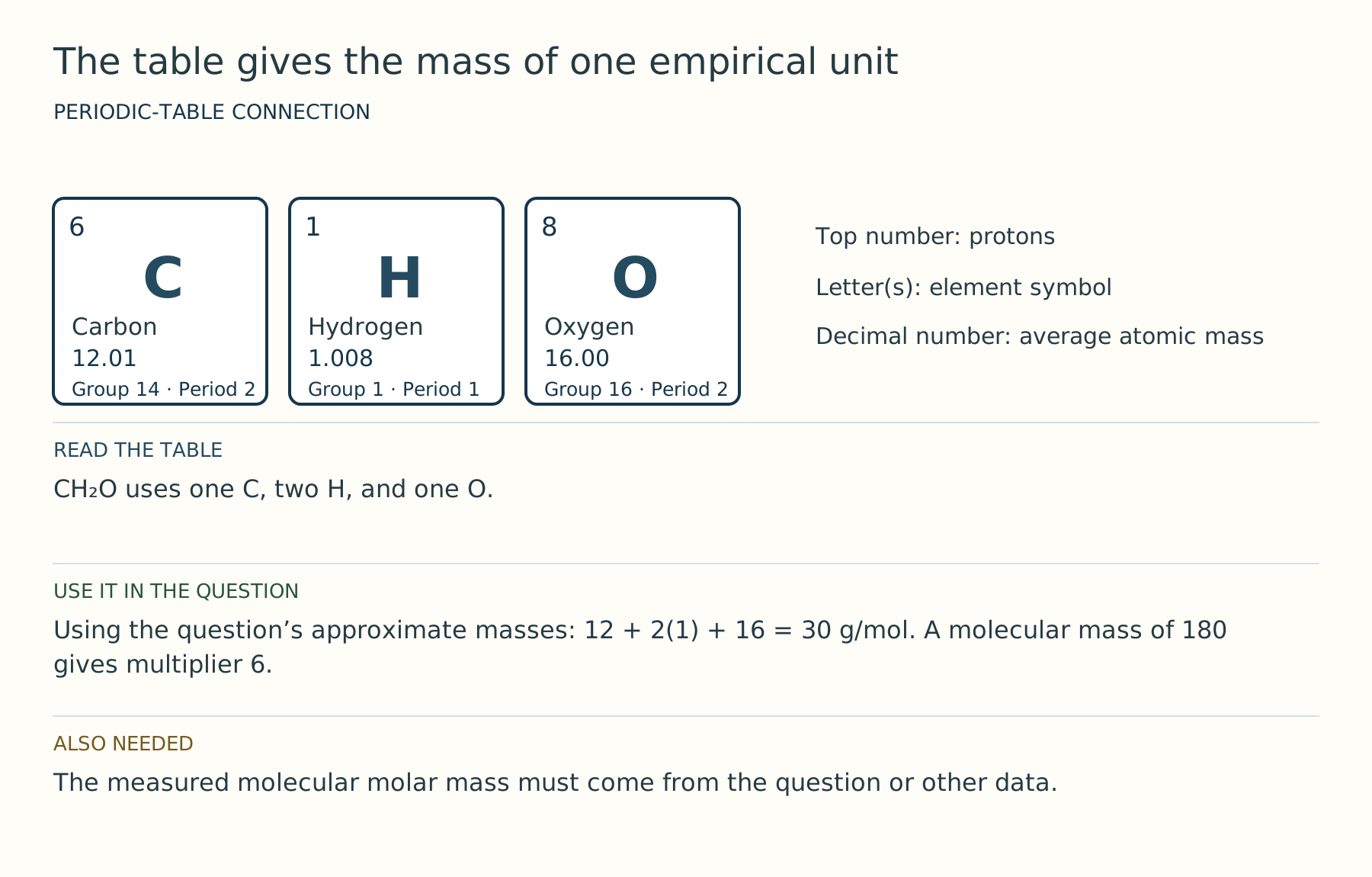
The table gives the mass of one empirical unit. CH₂O uses one C, two H, and one O. Using the question’s approximate masses: 12 + 2(1) + 16 = 30 g/mol. A molecular mass of 180 gives multiplier 6. The measured molecular molar mass must come from the question or other data.
The periodic table gives only the empirical-unit mass.

On the periodic table: Molar masses are the decimal numbers in each box: C 12.01, H 1.008, O 16.00 g/mol; this problem rounds them to 12, 1 and 16.

On the periodic table: The molecular molar mass is not on the periodic table; it comes from the question or an experiment.

Worked example · 3 steps

The empirical formula is CH2O and the molecular molar mass is 180 g/mol. Find the molecular formula. Use C = 12 g/mol, H = 1 g/mol, O = 16 g/mol.

  1. 1
    Find one empirical unit’s mass

    Add the atom contributions for CH2O.

    AtomHow many× mass (g/mol)= contribution
    C11212
    H212
    O11616
    Total30 g/mol
  2. 2
    Find the multiplier

    The molecule contains six empirical units.

    multiplier = 180 g/mol30 g/mol = 6
  3. 3
    Multiply every subscript

    One multiplier for every element keeps the ratio 1 : 2 : 1.

    C1×6H2×6O1×6 → C6H12O6
  4. ✓
    Answer

    C6H12O6

Your turn

Molecular formula practice problems

Answer first, then check. Hints open one at a time; the answer and full solution open after you try.

Problem 1 of 3 · warm-up

An empirical formula is CH2O with mass 30 g/mol. Molecular molar mass is 210 g/mol. What is the molecular formula?

Hint 1 · the clue

An empirical formula and actual molar mass are given.

Hint 2 · the next move

An empirical formula with its mass plus a molecular molar mass are given: find the multiplier for the molecular formula.

Your path:

  1. Molecular mass ÷ empirical mass = factor
  2. Multiply each subscript in CH2O by it
Answer

Answer: C7H14O7

Full worked solution

What you know: Empirical formula CH2O at 30 g/mol; molecular molar mass 210 g/mol. What you want: the molecular formula.

  1. Find how many empirical units fit in one molecule: 210 g/mol ÷ 30 g/mol = 7. The g/mol units cancel, leaving a pure number.
  2. Multiply every subscript in CH2O (1 : 2 : 1) by 7: C: 1 × 7 = 7. H: 2 × 7 = 14. O: 1 × 7 = 7. The answer is C7H14O7.

Check: 7(12) + 14(1) + 7(16) = 84 + 14 + 112 = 210 g/mol. It matches.

Watch out: Multiply every subscript, including the unwritten 1s on C and O. C1H14O1 is a common slip.

Your route: Molecular mass ÷ Empirical mass → Multiply subscripts.

On the periodic table: You can also build the 30 g/mol from the table: carbon (C) is 12.01, hydrogen (H) is 1.008, and oxygen (O) is 16.00 g/mol, so CH2O is 12.01 + 2 × 1.008 + 16.00 ≈ 30 g/mol.

Answer: C7H14O7

YOUR PERIODIC-TABLE REFERENCE

1HHydrogen1.008Group 1 · Period 1
6CCarbon12.01Group 14 · Period 2
8OOxygen16.00Group 16 · Period 2

Atomic number identifies proton count. The decimal mass is an average, not an isotope’s mass number. Use supplied rounded masses when a problem gives them.

Problem 2 of 3

An empirical formula is CH2O with mass 30 g/mol. Molecular molar mass is 240 g/mol. What is the molecular formula?

Hint 1 · the clue

An empirical formula and actual molar mass are given.

Hint 2 · the next move

An empirical formula with its mass plus a molecular molar mass are given: find the multiplier for the molecular formula.

Your path:

  1. Molecular mass ÷ empirical mass = factor
  2. Multiply each subscript in CH2O by it
Answer

Answer: C8H16O8

Full worked solution

What you know: Empirical formula CH2O at 30 g/mol; molecular molar mass 240 g/mol. What you want: the molecular formula.

  1. Find the multiplier: 240 g/mol ÷ 30 g/mol = 8. The molecule holds 8 empirical units.
  2. Multiply every subscript in CH2O by 8: C: 1 × 8 = 8. H: 2 × 8 = 16. O: 1 × 8 = 8. The answer is C8H16O8.

Check: 8(12) + 16(1) + 8(16) = 96 + 16 + 128 = 240 g/mol. It matches.

Watch out: Divide molecular mass by empirical mass, not the other way. 30 ÷ 240 = 0.125 is not a useful multiplier.

Your route: Molecular mass ÷ Empirical mass → Multiply subscripts.

On the periodic table: You can also build the 30 g/mol from the table: carbon (C) is 12.01, hydrogen (H) is 1.008, and oxygen (O) is 16.00 g/mol, so CH2O is 12.01 + 2 × 1.008 + 16.00 ≈ 30 g/mol.

Answer: C8H16O8

YOUR PERIODIC-TABLE REFERENCE

1HHydrogen1.008Group 1 · Period 1
6CCarbon12.01Group 14 · Period 2
8OOxygen16.00Group 16 · Period 2

Atomic number identifies proton count. The decimal mass is an average, not an isotope’s mass number. Use supplied rounded masses when a problem gives them.

Problem 3 of 3

Empirical formula CH2 has mass 14 g/mol; molecular mass is 42 g/mol. Formula?

Hint 1 · the clue

Divide the molecular molar mass by the empirical-formula molar mass, then multiply every subscript by that whole number.

Hint 2 · the next move

An empirical formula with its mass plus a molecular mass are given: find the multiplier for the molecular formula.

Your path:

  1. Molecular mass ÷ empirical mass = factor
  2. Multiply each subscript in CH2 by it
Answer

42/14 = 3; C3H6.

Full worked solution

What you know: Empirical formula CH2 at 14 g/mol; molecular molar mass 42 g/mol. What you want: the molecular formula.

  1. Find the multiplier: 42 g/mol ÷ 14 g/mol = 3. The units cancel, so one molecule holds 3 empirical units.
  2. Multiply every subscript in CH2 by 3: C: 1 × 3 = 3. H: 2 × 3 = 6. The answer is C3H6.

Check: 3(12) + 6(1) = 36 + 6 = 42 g/mol. It matches.

Watch out: Remember C has an unwritten subscript of 1. It must be multiplied too, giving C3, not C1.

Answer: 42/14 = 3; C3H6.

On the periodic table: You can also build the 14 g/mol from the table: carbon (C) is 12.01 and hydrogen (H) is 1.008 g/mol, so CH2 is 12.01 + 2 × 1.008 ≈ 14 g/mol.

YOUR PERIODIC-TABLE REFERENCE

1HHydrogen1.008Group 1 · Period 1
6CCarbon12.01Group 14 · Period 2

Atomic number identifies proton count. The decimal mass is an average, not an isotope’s mass number. Use supplied rounded masses when a problem gives them.

Watch out

Common molecular formula mistakes