ChemGem

How to Convert Moles to Atoms and Molecules (Step-by-Step, with Practice)

A mole (Avogadro’s number of particles) is a counting unit, like a dozen but far bigger. Here you convert between moles and particles; every later mole calculation builds on this.

Spot it, solve it, practice it: 4 steps, 1 worked example, 6 practice problems. Free, no account.

The route · 4 steps

  1. Start with the amount in moles.
  2. Multiply by 6.022 × 10²³ particles / 1 mol so mol cancels.
  3. Keep extra digits while you calculate.
  4. Round to the significant figures of the data and name the particle.
Spot it

How to recognize moles-to-particles questions

Look for moles paired with molecules, atoms, or formula units, or Avogadro’s number (6.022 × 10²³ per mole).

Example wording, with the clue words marked:

Using 6.022 × 10²³ particles/mol, how many molecules are in 0.600 mol?

Not sure it’s this type? Compare the neighbors:

Step-by-step

Worked example: moles-to-particles

The idea

Counting units: a fixed number of items
UnitAlways meansTells you the mass?
1 dozen12 itemsNo
1 mole6.022 × 1023 itemsNo
Exact value: 6.02214076 × 10²³. We round to 6.022 × 10²³.
Particles = moles × particles per mole
N = n × NA
n = NNA
N: number of particles. n: moles. NA = 6.022 × 10²³ particles/mol.
The moles ⇄ particles bridge
Molesn (mol)Particlesatoms, molecules,or formula units× 6.022 × 10²³÷ 6.022 × 10²³Same bridge for any substance
Multiply one way, divide the other.
Words to know
  • Avogadro’s number: 6.022 × 10²³, the count in one mole.
  • Avogadro constant (NA): that number with units, 6.022 × 10²³ mol−1.
  • Formula unit: the simplest ion ratio in an ionic compound, e.g. one Na+ per Cl− in NaCl.
  • Always name what you count: atoms, molecules or formula units.
Same count, different mass
1 mol He atoms
6.022 × 10²³ atoms
about 4.003 g
1 mol H2O molecules
6.022 × 10²³ molecules
about 18.02 g
Subscripts count atoms inside each item: CO2
CO2 moleculesC atomsO atoms
In 1 molecule112
In 1 mole1 mol1 mol2 mol
Count in 1 mole6.022 × 10236.022 × 10231.204 × 1024
One mole of CO2 holds one mole of C atoms and two moles of O atoms.
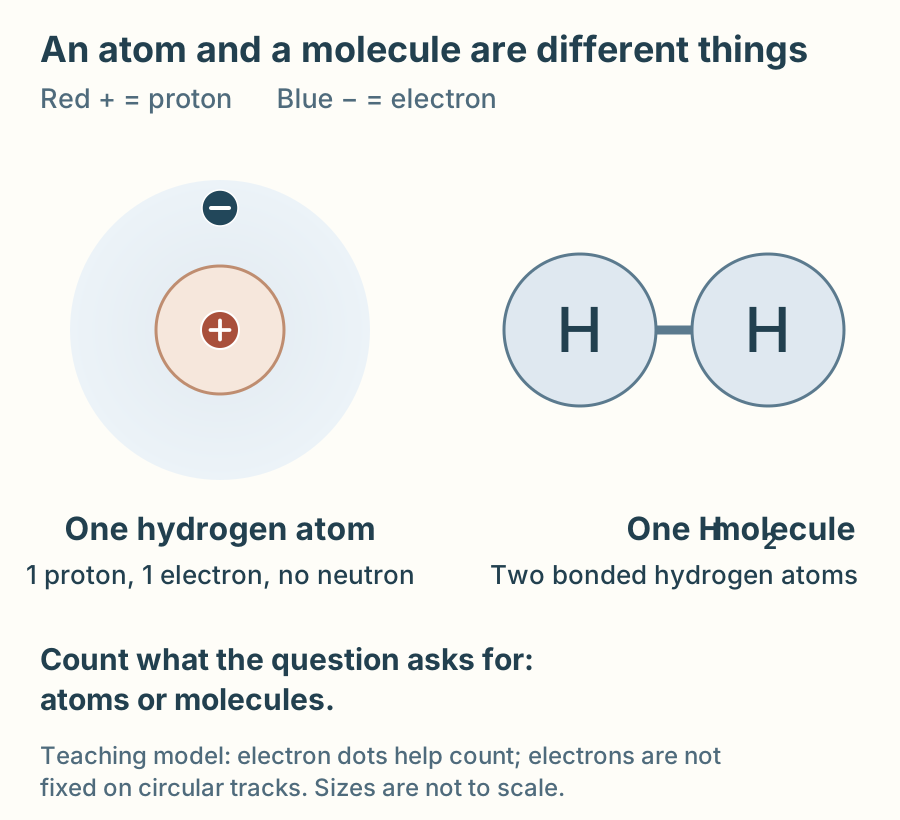
One H atom is different from one H₂ molecule. Each H₂ molecule contains two hydrogen atoms.
Each H2 molecule holds two H atoms. Electrons and nucleus are schematic.
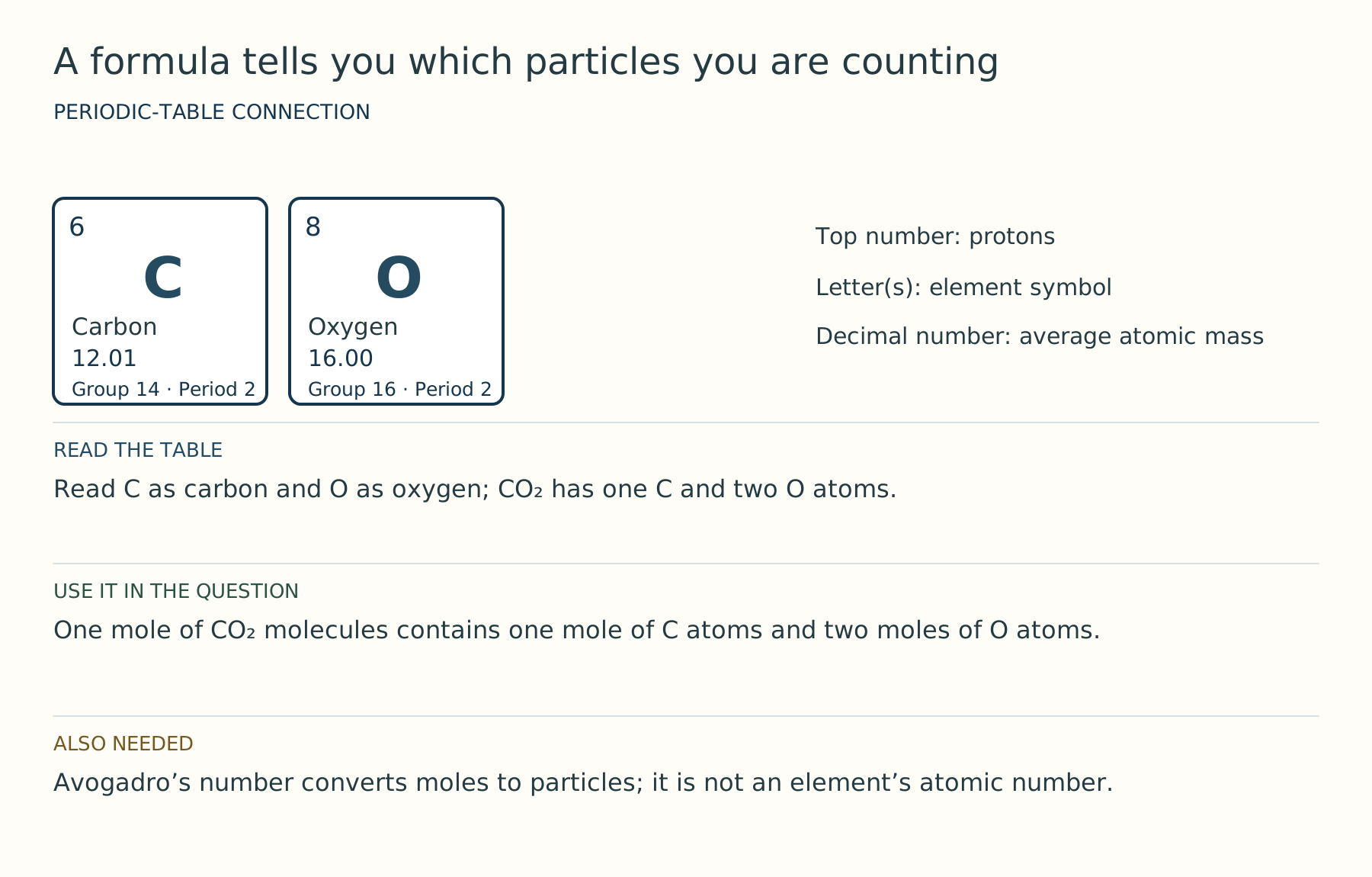
A formula tells you which particles you are counting. Read C as carbon and O as oxygen; CO₂ has one C and two O atoms. One mole of CO₂ molecules contains one mole of C atoms and two moles of O atoms. Avogadro’s number converts moles to particles; it is not an element’s atomic number.
Read the element boxes, then the formula.

On the periodic table: Each box shows the symbol and name: C carbon, O oxygen, He helium.

On the periodic table: The whole number is the atomic number (proton count): C 6, O 8, He 2.

On the periodic table: The decimal is the average atomic mass, not a mass number: C 12.01, O 16.00, He 4.003. Use rounded masses when a problem supplies them.

Worked example · 4 steps

How many molecules are in 0.25 mol? Use 6.022 × 10²³ molecules per mole.

  1. 1
    Start with the amount

    A quarter mole, so expect fewer than a mole’s worth. No element mass is needed.

    0.25 mol
  2. 2
    Choose the counting conversion

    Multiply to go from moles to molecules. Mol cancels.

    0.25 mol × 6.022 × 1023 molecules1 mol
  3. 3
    Calculate

    Keep extra digits until the final rounding.

    0.25 × 6.022 × 1023 = 1.5055 × 10²³ molecules
  4. 4
    Round

    0.25 has two significant figures, so report two.

    1.5055 × 10²³ ≈ 1.5 × 10²³ molecules
  5. ✓
    Answer

    about 1.5 × 10²³ molecules

Your turn

Moles-to-particles practice problems

Answer first, then check. Hints open one at a time; the answer and full solution open after you try.

Problem 1 of 6 · warm-up

Using 6.022 × 10²³ particles/mol, how many molecules are in 0.600 mol?

Hint 1 · the clue

A molecule count is requested from moles.

Hint 2 · the next move

Moles are given and molecules are asked, with particles/mol: that signals multiplying by Avogadro’s number.

Your path:

  1. Write the moles given
  2. Multiply by 6.022 × 10²³ per mol
  3. Moles cancel, leaving molecules
Answer

Answer: 3.61 × 10²³ molecules

Full worked solution

What you know: 0.600 mol, and 1 mol = 6.022 × 10²³ molecules. What you want: the number of molecules.

  1. Avogadro’s number is a counting factor, like 12 per dozen. Multiply so moles cancel: 0.600 mol × (6.022 × 1023 molecules / 1 mol).
  2. Multiply the front numbers and keep the power of ten: 0.600 × 6.022 = 3.6132.
  3. Round to 3 significant figures, because 0.600 mol has 3: 3.61 × 10²³ molecules.

Check: 0.6 mol is a bit more than half a mole, and 3.6 × 10²³ is a bit more than half of 6.0 × 10²³.

Watch out: Do not multiply the exponent by 0.6. Only the 6.022 part gets multiplied.

Your route: Moles → Multiply by Avogadro’s number.

Answer: 3.61 × 10²³ molecules

Problem 2 of 6

Using 6.022 × 10²³ particles/mol, how many molecules are in 0.700 mol?

Hint 1 · the clue

A molecule count is requested from moles.

Hint 2 · the next move

Moles are given and molecules are asked, with particles/mol: that signals multiplying by Avogadro’s number.

Your path:

  1. Write the moles given
  2. Multiply by 6.022 × 10²³ per mol
  3. Moles cancel, leaving molecules
Answer

Answer: 4.22 × 10²³ molecules

Full worked solution

What you know: 0.700 mol, and 1 mol = 6.022 × 10²³ molecules. What you want: the number of molecules.

  1. Avogadro’s number tells how many particles are in one mole. Multiply so moles cancel: 0.700 mol × (6.022 × 1023 molecules / 1 mol).
  2. Multiply the front numbers and keep 1023: 0.700 × 6.022 = 4.2154.
  3. Round to 3 significant figures, because 0.700 mol has 3: 4.22 × 10²³ molecules.

Check: 0.7 mol is less than 1 mol, so the count must be less than 6.022 × 10²³. 4.2 × 10²³ is.

Watch out: Dividing 0.7 by 6.022 × 1023 gives a tiny number. Going from moles to particles always means multiplying.

Your route: Moles → Multiply by Avogadro’s number.

Answer: 4.22 × 10²³ molecules

Problem 3 of 6

How many oxygen atoms are represented by 8 formula units of Ca(NO3)2?

Hint 1 · the clue

The formula contains parentheses.

Hint 2 · the next move

Formula units are given and oxygen atoms are asked: count O in one formula unit, then scale up.

Your path:

  1. Count O inside NO3
  2. Multiply by the subscript outside parentheses
  3. Multiply by the number of formula units
Answer

Answer: 48

Full worked solution

What you know: 8 formula units of Ca(NO3)2. What you want: the total number of oxygen atoms.

  1. Read the inner subscript: each NO3 group has 3 oxygen atoms.
  2. Apply the parentheses: the 2 outside means two NO3 groups, so one formula unit has 3 × 2 = 6 O atoms.
  3. Multiply by the number of formula units: 8 × 6 = 48 oxygen atoms.

Check: Write it out: one unit is CaN2O6. Eight of those give 8 × 6 = 48 O.

Watch out: Forgetting the outside 2 gives 3 O per unit and 24 total. The subscript after a parenthesis multiplies everything inside.

Your route: Read inner subscript → Apply parentheses → Multiply formula units.

On the periodic table: Oxygen’s symbol is O, shown in its box, so count every O in the formula.

Answer: 48

YOUR PERIODIC-TABLE REFERENCE

8OOxygen16.00Group 16 · Period 2

Atomic number identifies proton count. The decimal mass is an average, not an isotope’s mass number. Use supplied rounded masses when a problem gives them.

Problem 4 of 6

How many oxygen atoms are represented by 9 formula units of Ca(NO3)2?

Hint 1 · the clue

The formula contains parentheses.

Hint 2 · the next move

Formula units are given and oxygen atoms are asked: count O in one formula unit, then scale up.

Your path:

  1. Count O inside NO3
  2. Multiply by the subscript outside parentheses
  3. Multiply by the number of formula units
Answer

Answer: 54

Full worked solution

What you know: 9 formula units of Ca(NO3)2. What you want: the total number of oxygen atoms.

  1. Read the inner subscript: each NO3 group has 3 O atoms.
  2. Apply the parentheses: the outside 2 doubles the group, so each formula unit has 3 × 2 = 6 O atoms.
  3. Multiply by the number of formula units: 9 × 6 = 54 oxygen atoms.

Check: 54 ÷ 9 = 6 O per unit, which matches CaN2O6.

Watch out: A common slip is 9 × 3 = 27, which ignores the 2 outside the parentheses.

Your route: Read inner subscript → Apply parentheses → Multiply formula units.

On the periodic table: Oxygen’s symbol is O, shown in its box, so count every O in the formula.

Answer: 54

YOUR PERIODIC-TABLE REFERENCE

8OOxygen16.00Group 16 · Period 2

Atomic number identifies proton count. The decimal mass is an average, not an isotope’s mass number. Use supplied rounded masses when a problem gives them.

Problem 5 of 6

How many oxygen atoms are in 0.500 mol of CO2? Use 6.022 × 10²³ molecules/mol.

Hint 1 · the clue

Moles → molecules with Avogadro’s number, then multiply by the 2 O atoms in each CO2 molecule.

Hint 2 · the next move

Moles of a compound are given and atoms of one element are asked: go to molecules, then multiply by that element’s subscript.

Your path:

  1. Moles → molecules: multiply by 6.022 × 10²³
  2. Molecules → O atoms: multiply by 2 (CO2 has 2 O)
  3. Round to the data’s significant figures
Answer

Answer: 6.02 × 10²³ O atoms

Full worked solution

What you know: 0.500 mol CO2, and 1 mol = 6.022 × 10²³ molecules. Each CO2 molecule holds 1 C atom and 2 O atoms. What you want: the number of O atoms.

  1. Moles to molecules: multiply by Avogadro’s number so mol cancels. 0.500 mol × (6.022 × 1023 molecules / 1 mol) = 3.011 × 10²³ CO2 molecules.
  2. Molecules to atoms: the subscript 2 means 2 O atoms per molecule. 3.011 × 10²³ molecules × (2 O atoms / 1 molecule) = 6.022 × 10²³ O atoms.
  3. 0.500 has 3 significant figures, so round to 3. The answer is 6.02 × 10²³ O atoms.

Check: 0.500 mol CO2 holds 2 × 0.500 = 1.00 mol of O atoms, and 1.00 mol is 6.022 × 10²³. It matches.

Watch out: Do not stop at 3.01 × 10²³. That counts CO2 molecules, but the question asks for oxygen atoms.

Answer: 6.02 × 10²³ O atoms

Problem 6 of 6

Find molecules in 2.0 mol, using 6.022 × 10²³ molecules/mol.

Hint 1 · the clue

Multiply moles by Avogadro’s number in molecules per mole. The mole units cancel.

Hint 2 · the next move

Moles are given and molecules are asked: multiply by Avogadro’s number, then fix scientific notation.

Your path:

  1. Write the moles given
  2. Multiply by 6.022 × 10²³ per mol
  3. Rewrite in proper scientific notation
Answer

1.2 × 1024 molecules (two significant figures).

Full worked solution

What you know: 2.0 mol, and 1 mol = 6.022 × 10²³ molecules. What you want: the number of molecules.

  1. Multiply by Avogadro’s number so moles cancel: 2.0 mol × (6.022 × 1023 molecules / 1 mol) = 12.044 × 10²³ molecules.
  2. Rewrite in scientific notation: 12.044 × 1023 = 1.2044 × 1024. Moving the decimal one place left raises the exponent by 1.
  3. 2.0 has 2 significant figures, so round to 2. The answer is 1.2 × 1024 molecules.

Check: Two moles should be about twice 6 × 10²³, which is 12 × 1023 = 1.2 × 1024.

Watch out: Keeping 1023 after moving the decimal gives 1.2 × 10²³, which is ten times too small.

Answer: 1.2 × 1024 molecules (two significant figures).

Watch out

Common moles-to-particles mistakes