ChemGem

How to Convert Grams to Moles (Step-by-Step, with Practice)

Balances measure grams; chemists count in moles. Molar mass (grams per mole) bridges grams and moles, Avogadro’s number bridges moles and particles, and the formula’s subscripts bridge particles and atoms. Only the unit changes, never the substance.

Spot it, solve it, practice it: 4 steps, 1 worked example, 8 practice problems. Free, no account.

The route · 4 steps

  1. Write the starting amount with unit and formula.
  2. Find the bridge: molar mass for grams, 6.022 × 10²³ for particles, subscripts for atoms.
  3. Write it as a fraction, unit to cancel on the bottom.
  4. Multiply, cancel units, round at the end.
Spot it

How to recognize grams-to-moles questions

Look for grams, moles, particles or atoms in the same question: a molar mass in g/mol, 6.022 × 10²³, or “how many atoms” of one element in a formula.

Example wording, with the clue words marked:

Using molar mass 18.0 g/mol, how many moles are in 126 g of water?

Not sure it’s this type? Compare the neighbors:

Step-by-step

Worked example: grams-to-moles

The idea

The grams ⇄ moles ⇄ particles ⇄ atoms map
This lesson · every trip passes through molesGramsmass (g)Molesamount (mol)ParticlesmoleculesAtomsby element÷ molar mass× molar mass(g/mol, from the table)× 6.022 × 10²³÷ 6.022 × 10²³(Avogadro’s number)× atoms per formula÷ atoms per formula(from the subscripts)Preview · gases come in Chapter 9Gramsmass (g)Molesamount (mol)Litersvolume (L)same bridgemolar volume← gas at STPChapter 9
Every trip from grams to particles or atoms passes through moles. Toward moles, divide; away from moles, multiply. The bottom row previews the gas route of Chapter 9.
Moles = mass ÷ molar mass
n = mass (g)molar mass (g/mol)
mass = n × molar mass
Molar mass: the mass of one mole, in g/mol.
Building a molar mass: Ca(OH)2
AtomHow many× mass from table (g/mol)= contribution
Ca140.0840.08
O216.0032.00
H21.0082.016
Total74.10 g/mol
The 2 outside the parentheses doubles O and H. Keep extra digits until the end.
Which way does the fraction go?
Grams → moles
× 1 molmolar mass g
g on the bottom cancels g.
Moles → grams
× molar mass g1 mol
Flipped: mol on the bottom cancels mol.
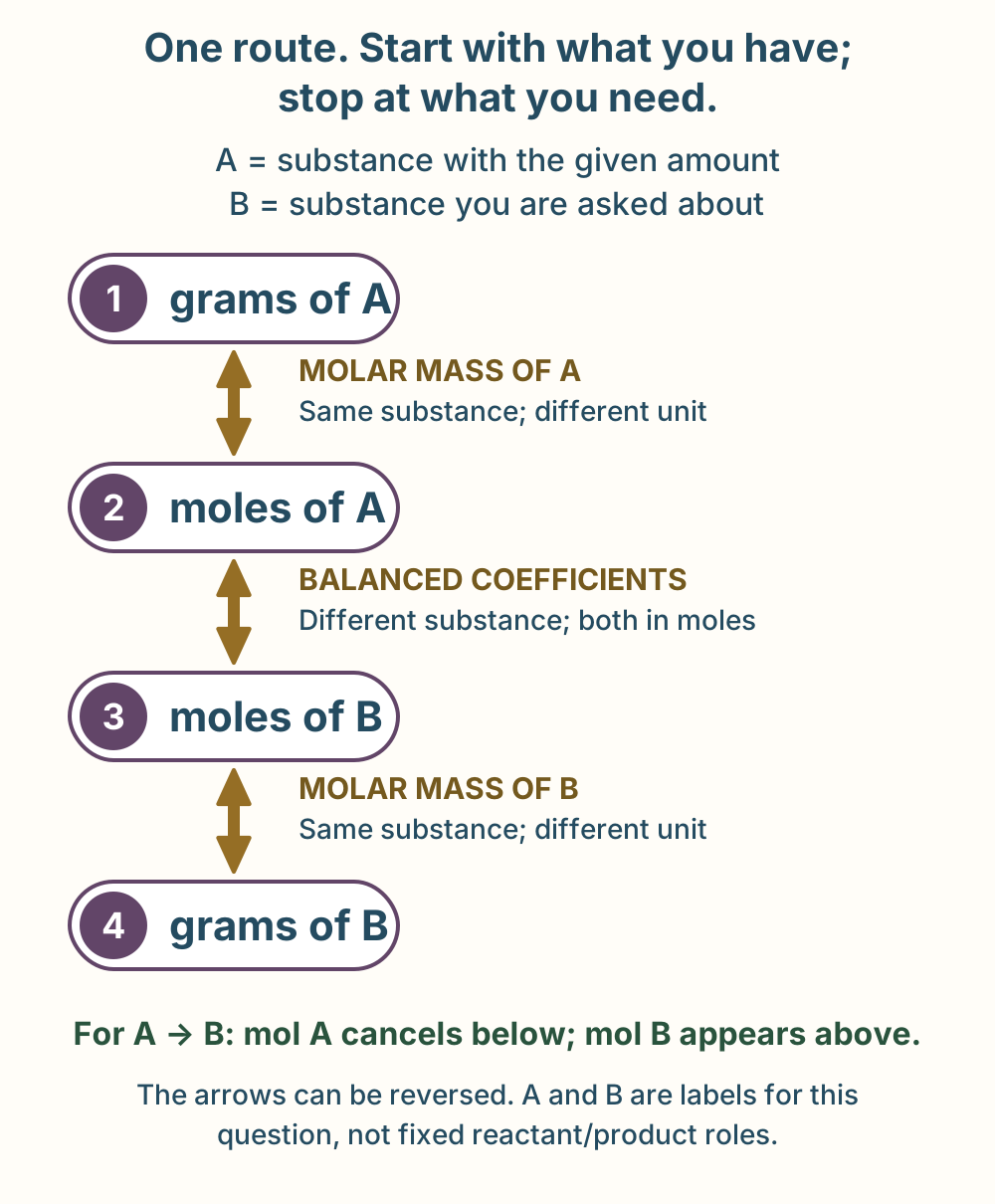
Grams of A connects to moles of A through molar mass of A. Moles of A connects to moles of B through balanced coefficients. Moles of B connects to grams of B through molar mass of B. Each connection can be reversed.
This lesson covers the grams ⇄ moles bridges. Chapter 5 adds the middle one.
Particles → atoms: read the subscripts
atoms = particles × atoms of that element per formula
1 H2O molecule = 2 H atoms + 1 O atom
Count atoms of that element in one particle: multiply through any parentheses. No subscript means 1.

On the periodic table: Molar mass comes from the periodic table: add each atom’s decimal mass once per atom in the formula.

On the periodic table: Here: H 1.008, C 12.01, O 16.00, Ca 40.08 g/mol. Use supplied masses when given.

On the periodic table: H2O = 2(1.008) + 16.00 = 18.016 ≈ 18.02 g/mol.

Worked example · 3 steps

How many moles are in 22.005 g CO2? Use molar mass 44.01 g/mol.

Molar mass of CO2
AtomHow many× mass (g/mol)= contribution
C112.0112.01
O216.0032.00
Total44.01 g/mol
On the periodic table: C 12.01, O 16.00.
  1. 1
    Label the starting mass

    The question asks for moles, so grams must cancel.

    22.005 g CO2
  2. 2
    Set up the conversion

    Grams go on the bottom.

    22.005 g CO2 × 1 mol CO244.01 g CO2
  3. 3
    Divide

    Moles remain. Four significant figures, like 44.01.

    22.00544.01 mol = 0.5000 mol CO2
  4. ✓
    Answer

    0.5000 mol CO2

Your turn

Grams-to-moles practice problems

Answer first, then check. Hints open one at a time; the answer and full solution open after you try.

Problem 1 of 8 · warm-up

Using molar mass 18.0 g/mol, how many moles are in 126 g of water?

Hint 1 · the clue

Mass and molar mass are given.

Hint 2 · the next move

Grams of water and a molar mass are given, and moles are asked: that signals a grams-to-moles conversion.

Your path:

  1. Write grams of water
  2. Multiply by 1 mol / molar mass
  3. Grams cancel, leaving moles
Answer

Answer: 7.00 mol

Full worked solution

What you know: 126 g of water, molar mass 18.0 g/mol. What you want: moles of water.

  1. Molar mass says 1 mol of water has a mass of 18.0 g. To turn grams into moles, divide by it so grams cancel: 126 g × (1 mol / 18.0 g).
  2. Grams cancel, leaving mol. Do the arithmetic: 126 ÷ 18.0 = 7. Keep 3 significant figures: 7.00 mol.

Check: Reverse it: 7.00 mol × 18.0 g/mol = 126 g. That matches the starting mass.

Watch out: Do not multiply 126 × 18.0. That gives 2268, with units of g²/mol, which makes no sense.

Your route: Grams → Divide by molar mass.

On the periodic table: You can also build this from the table: hydrogen (H) is 1.008 and oxygen (O) is 16.00 g/mol, so water (H2O) is 2 × 1.008 + 16.00 = 18.02 g/mol, which rounds to 18.0 g/mol.

Answer: 7.00 mol

Problem 2 of 8

Using molar mass 18.0 g/mol, how many moles are in 144 g of water?

Hint 1 · the clue

Mass and molar mass are given.

Hint 2 · the next move

Grams of water and a molar mass are given, and moles are asked: that signals a grams-to-moles conversion.

Your path:

  1. Write grams of water
  2. Multiply by 1 mol / molar mass
  3. Grams cancel, leaving moles
Answer

Answer: 8.00 mol

Full worked solution

What you know: 144 g of water, molar mass 18.0 g/mol. What you want: moles of water.

  1. Each mole of water weighs 18.0 g. Divide by molar mass so grams cancel: 144 g × (1 mol / 18.0 g).
  2. Grams cancel, leaving mol: 144 ÷ 18.0 = 8. Both values have 3 significant figures, so the answer is 8.00 mol.

Check: 8.00 mol × 18.0 g/mol = 144 g. That is the mass you started with.

Watch out: Going from grams to moles always means dividing by molar mass. Multiplying would give a huge number with the wrong units.

Your route: Grams → Divide by molar mass.

On the periodic table: You can also build this from the table: hydrogen (H) is 1.008 and oxygen (O) is 16.00 g/mol, so water (H2O) is 2 × 1.008 + 16.00 = 18.02 g/mol, which rounds to 18.0 g/mol.

Answer: 8.00 mol

Problem 3 of 8

A substance has molar mass 40.0 g/mol. What mass is 0.900 mol?

Hint 1 · the clue

Moles and molar mass are given.

Hint 2 · the next move

Moles and a molar mass are given, and a mass is asked: that signals a moles-to-grams conversion.

Your path:

  1. Write the moles given
  2. Multiply by molar mass (g / 1 mol)
  3. Moles cancel, leaving grams
Answer

Answer: 36.0 g

Full worked solution

What you know: 0.900 mol of a substance, molar mass 40.0 g/mol. What you want: its mass in grams.

  1. Molar mass says 1 mol has a mass of 40.0 g. To go from moles to grams, multiply so moles cancel: 0.900 mol × (40.0 g / 1 mol).
  2. Mol cancels, leaving g: 0.900 × 40.0 = 36. Both values have 3 significant figures, so the answer is 36.0 g.

Check: Less than 1 mol should weigh less than 40 g. 36.0 g is a bit under 40 g, as expected.

Watch out: Dividing (0.900 ÷ 40.0 = 0.0225) is the grams → moles direction. Here you start with moles, so multiply.

Your route: Moles → Multiply by molar mass.

Answer: 36.0 g

Problem 4 of 8

A substance has molar mass 40.0 g/mol. What mass is 1.05 mol?

Hint 1 · the clue

Moles and molar mass are given.

Hint 2 · the next move

Moles and a molar mass are given, and a mass is asked: that signals a moles-to-grams conversion.

Your path:

  1. Write the moles given
  2. Multiply by molar mass (g / 1 mol)
  3. Moles cancel, leaving grams
Answer

Answer: 42.0 g

Full worked solution

What you know: 1.05 mol of a substance, molar mass 40.0 g/mol. What you want: its mass in grams.

  1. Each mole has a mass of 40.0 g. Multiply so moles cancel: 1.05 mol × (40.0 g / 1 mol).
  2. Mol cancels, leaving g: 1.05 × 40.0 = 42. Both values have 3 significant figures, so the answer is 42.0 g.

Check: A little more than 1 mol should weigh a little more than 40 g. 42.0 g fits.

Watch out: Starting from moles means multiply by molar mass. Dividing would give about 0.026, which is far too small.

Your route: Moles → Multiply by molar mass.

Answer: 42.0 g

Problem 5 of 8

Using S = 32 g/mol and O = 16 g/mol, what is the molar mass of SO3?

Hint 1 · the clue

A formula and atomic masses are supplied.

Hint 2 · the next move

Atomic masses and a formula are given, and molar mass is asked: add up every atom’s mass contribution.

Your path:

  1. Count each kind of atom
  2. Multiply each count by its atomic mass
  3. Add the contributions for g/mol
Answer

Answer: 80 g/mol

Full worked solution

What you know: The formula SO3, with S = 32 g/mol and O = 16 g/mol. What you want: the molar mass of SO3.

  1. Count every atom: SO3 has 1 S and 3 O.
  2. Multiply each count by its atomic mass: S: 1 × 32 = 32 g/mol. O: 3 × 16 = 48 g/mol.
  3. Add the contributions: 32 + 48 = 80 g/mol.

Check: With the table values, 32.06 + 3(16.00) = 80.06 g/mol, which rounds to 80 g/mol. It matches.

Watch out: The subscript 3 belongs to O only. Writing 3 × (32 + 16) = 144 is wrong.

Your route: Count every atom → Add atomic masses.

16S32.068O16.00On the periodic table: Sulfur (S) has an average atomic mass of 32.06 g/mol and oxygen (O) has 16.00 g/mol, the decimal numbers in their boxes; the problem rounds them to 32 and 16.

Answer: 80 g/mol

Problem 6 of 8

How many hydrogen atoms are in 3.60 g of H2O? Use 18.0 g/mol and 6.022 × 10²³ molecules/mol.

Hint 1 · the clue

Go grams → moles → molecules, then multiply by the 2 H atoms in each H2O molecule.

Hint 2 · the next move

Grams of a compound are given and atoms of one element are asked: go grams → moles → molecules → atoms.

Your path:

  1. Grams → moles: divide by molar mass
  2. Moles → molecules: multiply by 6.022 × 10²³
  3. Molecules → H atoms: multiply by 2
Answer

Answer: 2.41 × 10²³ H atoms

Full worked solution

What you know: 3.60 g of H2O, molar mass 18.0 g/mol, and 1 mol = 6.022 × 10²³ molecules. Each H2O molecule holds 2 H atoms. What you want: the number of H atoms.

  1. Grams to moles: divide by molar mass so grams cancel. 3.60 g × (1 mol / 18.0 g) = 0.200 mol H2O.
  2. Moles to molecules: multiply by Avogadro’s number so mol cancels. 0.200 mol × (6.022 × 1023 molecules / 1 mol) = 1.2044 × 10²³ molecules.
  3. Molecules to atoms: 1.2044 × 10²³ molecules × (2 H atoms / 1 molecule) = 2.4088 × 10²³ H atoms.
  4. The data have 3 significant figures (3.60 and 18.0), so round to 3. The answer is 2.41 × 10²³ H atoms.

Check: 3.60 g is one fifth of 18.0 g, so 0.200 mol of water. That holds 2 × 0.200 = 0.400 mol of H atoms, and 0.400 × 6.022 × 1023 = 2.4088 × 10²³. It matches.

Watch out: Do not double the molar mass for the two H atoms. 18.0 g/mol already covers the whole molecule; the 2 is used only in the last step.

Answer: 2.41 × 10²³ H atoms

On the periodic table: H is 1.008 and O is 16.00, so H2O is 2(1.008) + 16.00 = 18.016 g/mol, rounded here to 18.0 g/mol.

Problem 7 of 8

Find moles in 8.0 g using 16 g/mol.

Hint 1 · the clue

Divide grams by grams per mole. The gram units cancel, leaving moles.

Hint 2 · the next move

Grams and a molar mass in g/mol are given, and moles are asked: that signals a grams-to-moles conversion.

Your path:

  1. Write the grams given
  2. Divide by molar mass so grams cancel
Answer

8.0/16 = 0.50 mol.

Full worked solution

What you know: 8.0 g of a substance, molar mass 16 g/mol. What you want: moles.

  1. Molar mass says 1 mol weighs 16 g. Divide so grams cancel: 8.0 g × (1 mol / 16 g).
  2. Grams cancel, leaving mol: 8.0 ÷ 16 = 0.50. Both values have 2 significant figures, so the answer is 0.50 mol.

Check: 8.0 g is half of 16 g, so it should be half a mole. Reverse it: 0.50 mol × 16 g/mol = 8.0 g.

Watch out: Multiplying gives 128 g²/mol, which is not a mole amount. Grams to moles means divide.

Answer: 8.0/16 = 0.50 mol.

Problem 8 of 8

How many hydrogen atoms are in 8.00 g of CH4? Use 16.0 g/mol and 6.022 × 10²³ molecules/mol.

Hint 1 · the clue

Grams → moles (divide by 16.0 g/mol), moles → molecules (multiply by Avogadro’s number), then multiply by the 4 H atoms in each CH4.

Hint 2 · the next move

Grams of a compound are given and atoms of one element are asked: chain grams → moles → molecules, then use the subscript.

Your path:

  1. Grams → moles: divide by 16.0 g/mol
  2. Moles → molecules: multiply by 6.022 × 10²³
  3. Molecules → H atoms: multiply by 4
Answer

1.20 × 1024 H atoms

Full worked solution

What you know: 8.00 g of CH4, molar mass 16.0 g/mol, 1 mol = 6.022 × 10²³ molecules. Each CH4 molecule holds 1 C atom and 4 H atoms. What you want: the number of H atoms.

  1. Grams to moles: 8.00 g × (1 mol / 16.0 g) = 0.500 mol CH4.
  2. Moles to molecules: 0.500 mol × (6.022 × 1023 molecules / 1 mol) = 3.011 × 10²³ molecules.
  3. Molecules to atoms: 3.011 × 10²³ molecules × (4 H atoms / 1 molecule) = 12.044 × 1023 = 1.2044 × 1024 H atoms.
  4. Keep 3 significant figures, matching 8.00 g and 16.0 g/mol: 1.20 × 1024 H atoms.

Check: 0.500 mol CH4 holds 4 × 0.500 = 2.00 mol of H atoms, and 2.00 × 6.022 × 1023 = 1.2044 × 1024. It matches.

Watch out: Use the subscript of the element you are asked about. Multiplying by 1 (for C) would count carbon atoms, 3.01 × 10²³, not hydrogen atoms.

Answer: 1.20 × 1024 H atoms

On the periodic table: C is 12.01 and H is 1.008, so CH4 is 12.01 + 4(1.008) = 16.042 g/mol, rounded here to 16.0 g/mol.

YOUR PERIODIC-TABLE REFERENCE

6CCarbon12.01Group 14 · Period 2
1HHydrogen1.008Group 1 · Period 1

Atomic number identifies proton count. The decimal mass is an average, not an isotope’s mass number. Use supplied rounded masses when a problem gives them.

Watch out

Common grams-to-moles mistakes