ChemGemTM

How to Draw a Bohr Model (Step-by-Step, with Practice)

A Bohr model puts protons and neutrons in the center and electrons on rings. For the first 20 elements, fill rings 2, 8, 8, 2.

3 steps, 1 worked example, 4 practice problems. About 10 minutes. Free.

The route · 3 steps

  1. Protons = atomic number (periodic table). Neutral: electrons = protons.
  2. Neutrons = mass number − protons (for the nucleus).
  3. Fill rings from the inside: 2, then 8, then 8, then 2.
Start here

Periodic table

Protons and electrons come from here. Tap any element (1–20) to see its rings.

Tap an element.

123456789101112131415161718Row11 shell22 shells33 shells44 shells55 shells66 shells77 shells57–7189–103

Swipe sideways for the full table.

Spot it

How to recognize a Bohr model question

Asked to “draw a Bohr model / Bohr diagram,” or for “electrons in each shell / energy level.”

Clue words marked:

Draw a Bohr model for aluminum-27.

Not this type?

Step-by-step

Worked example: Bohr model of aluminum

The idea

Fill rings from the inside
Ring 1: up to 2 Ring 2: up to 8 Ring 3: 8 (first 20) Ring 4 (not drawn): starts at K
Fill ring 1 before ring 2, ring 2 before ring 3.
Examples
ElementElectronsRings
H11
He22
C62, 4
Na112, 8, 1
Ar182, 8, 8
Ca202, 8, 8, 2
Each new period starts a new ring.
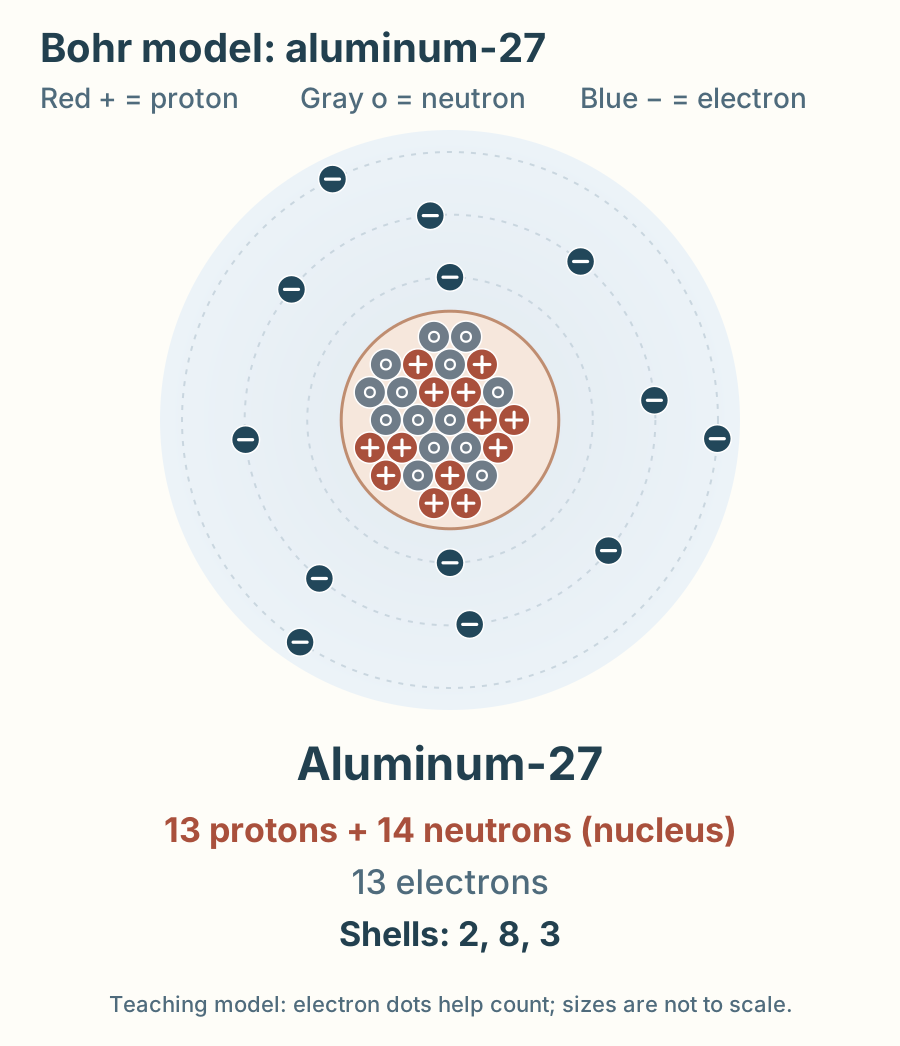
Bohr model of aluminum-27: 13 protons and 14 neutrons; electrons on rings of 2, 8 and 3.
Aluminum-27: rings 2, 8, 3.

On the periodic table: the atomic number is the electron count for a neutral atom: H 1, He 2, C 6, Na 11, Ar 18, Ca 20.

Worked example · 3 steps

Draw a Bohr model for aluminum-27. How many electrons go in each ring?

  1. 1
    Protons and electrons

    13Al26.98On the periodic table: aluminum (Al) is 13: 13 protons, 13 electrons (neutral).

  2. 2
    Neutrons
    n = 27 − 13 = 14
  3. 3
    Fill the rings
    Ring123
    Electrons283

    2 + 8 = 10 used; 13 − 10 = 3 left for ring 3.

  4. ✓
    Answer

    Nucleus: 13 p, 14 n. Rings: 2, 8, 3.

    Bohr model of aluminum-27 with rings of 2, 8 and 3 electrons.
    Count the dots: 2 + 8 + 3 = 13.
Your turn

Bohr model practice problems

Try first, then check. Hints if you need them.

Problem 1 of 4 · warm-up

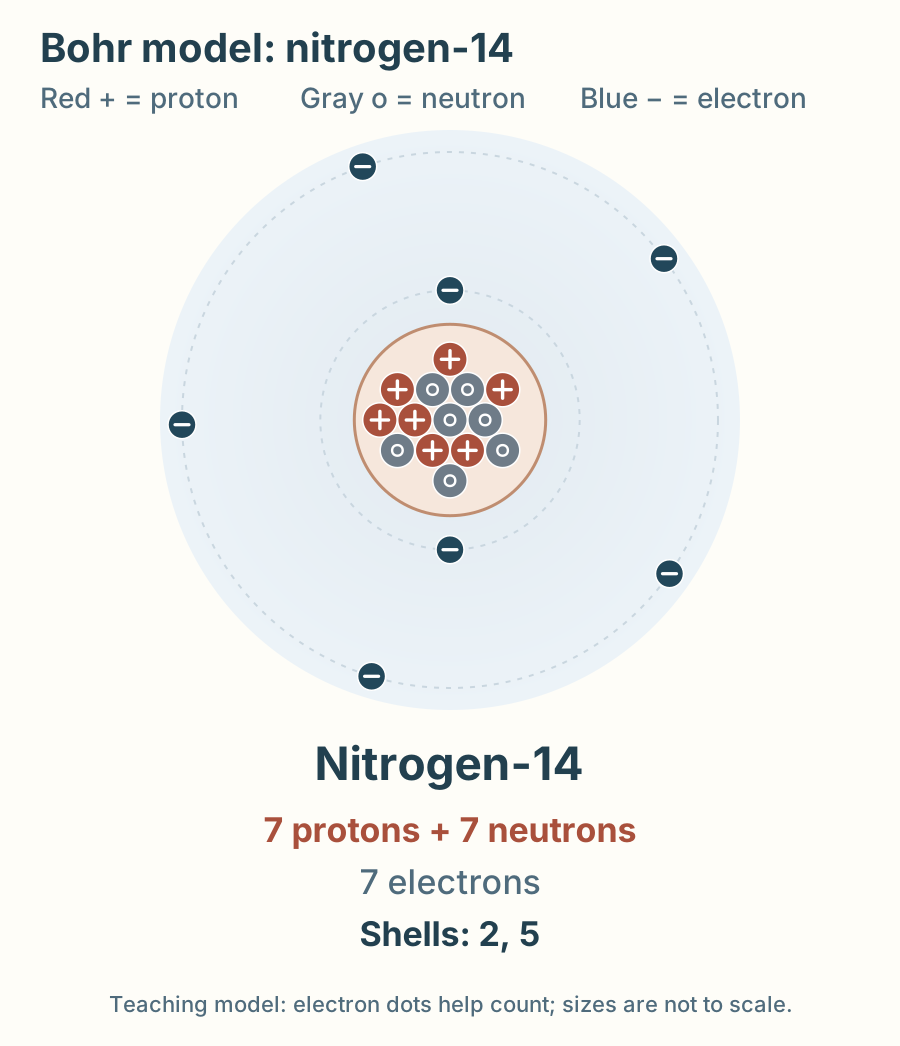
Draw a Bohr model for nitrogen-14. How many electrons go in each ring?

Hint 1 · the clue

Nitrogen’s atomic number on the periodic table = electrons.

Hint 2 · the next move

7 electrons: 2 in ring 1, the rest in ring 2.

Your path:

  1. 7 electrons
  2. Ring 1: 2
  3. Ring 2: the rest
Answer

Answer: 2, 5

Full worked solution

What you know: nitrogen-14, neutral.

  1. Nitrogen has 7 protons and 7 electrons; 14 − 7 = 7 neutrons.
  2. Rings: 2, then 7 − 2 = 5 → 2, 5.
Bohr model of nitrogen-14: rings of 2 and 5.
Nitrogen-14: 2, 5.

7N14.01On the periodic table: nitrogen (N) is 7.

Answer: 2, 5
Problem 2 of 4

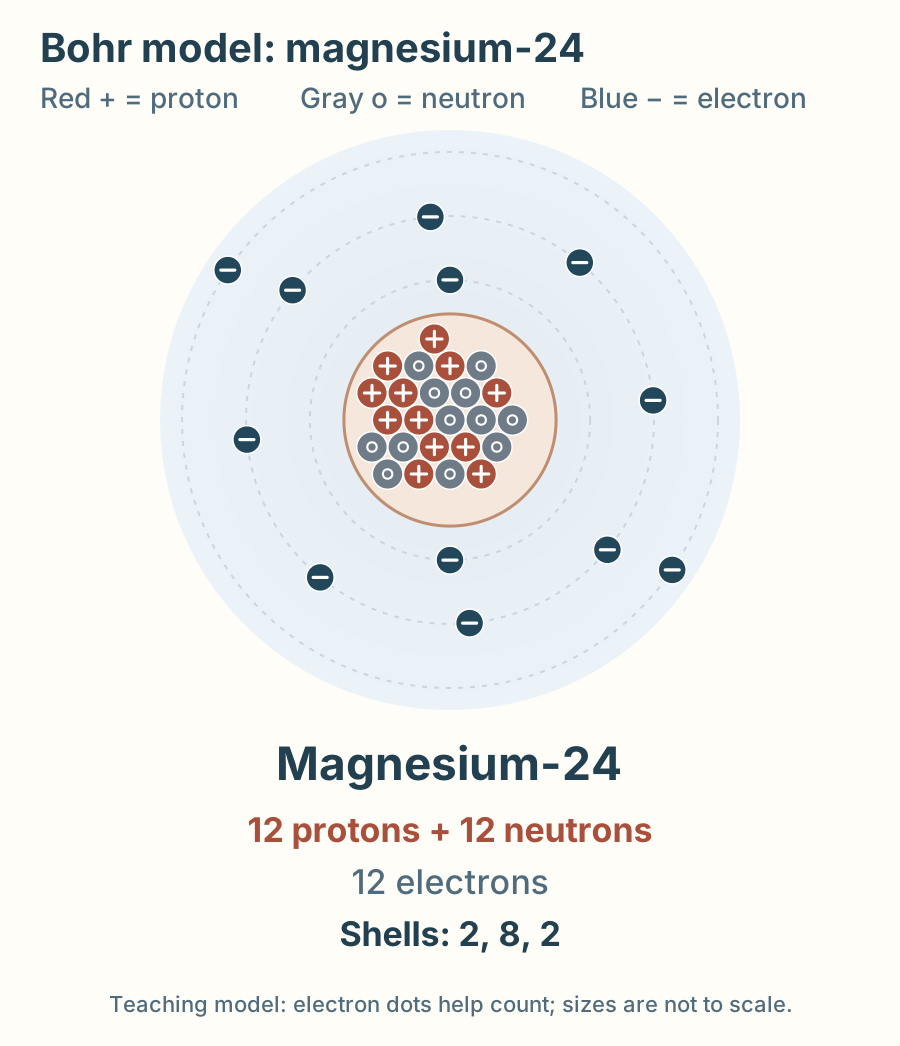
Draw a Bohr model for magnesium-24. How many electrons go in each ring?

Hint 1 · the clue

Magnesium’s atomic number on the periodic table: 12 electrons.

Hint 2 · the next move

2, then 8, then what’s left.

Your path:

  1. 12 electrons
  2. 2 + 8 = 10
  3. 12 − 10 = 2
Answer

Answer: 2, 8, 2

Full worked solution

What you know: magnesium-24, neutral.

  1. 12 protons, 12 electrons; 24 − 12 = 12 neutrons.
  2. Rings: 2, 8, 2.
Bohr model of magnesium-24: rings of 2, 8 and 2.
Magnesium-24: 2, 8, 2.

12Mg24.31On the periodic table: magnesium (Mg) is 12.

Answer: 2, 8, 2

Problem 3 of 4

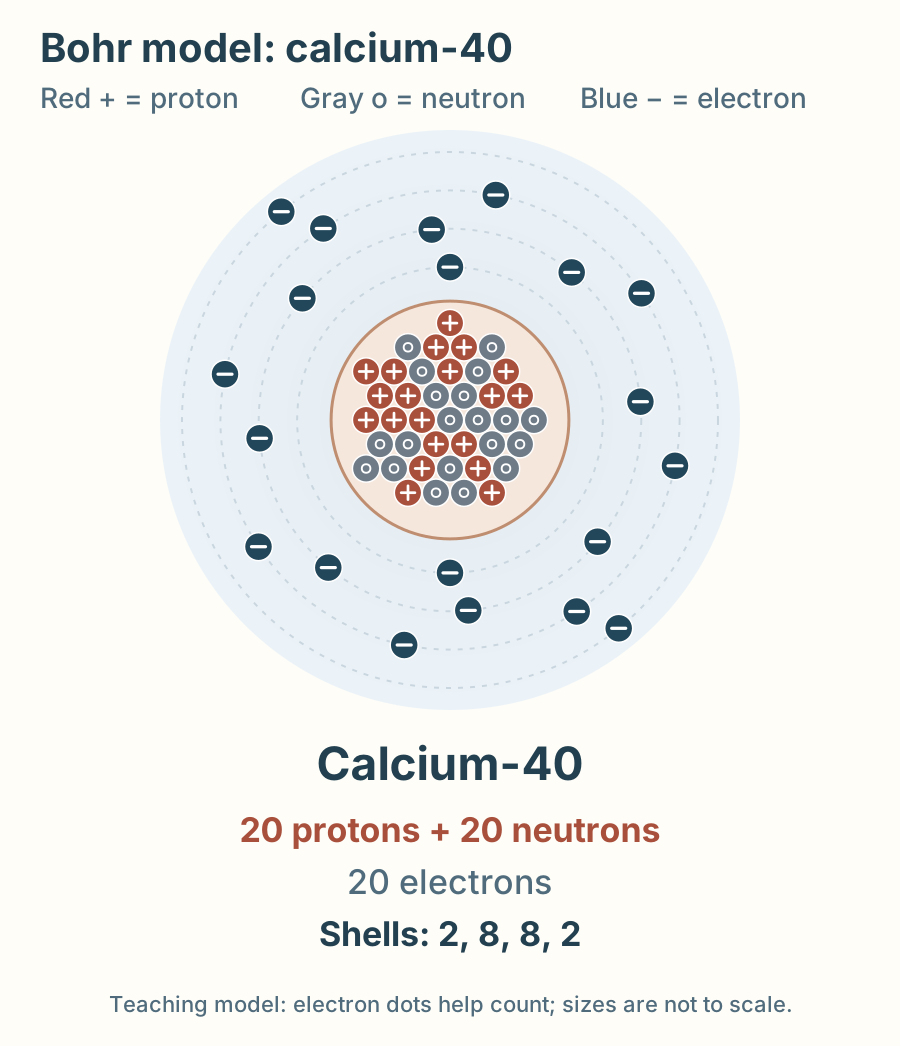
Draw a Bohr model for calcium-40. How many electrons go in each ring?

Hint 1 · the clue

20 electrons (periodic table). Ring 3 stops at 8 here.

Hint 2 · the next move

2, 8, 8, then the rest.

Your path:

  1. 20 electrons
  2. 2 + 8 + 8 = 18
  3. 20 − 18 = 2
Answer

Answer: 2, 8, 8, 2

Full worked solution

What you know: calcium-40, neutral.

  1. 20 protons, 20 electrons; 40 − 20 = 20 neutrons.
  2. Rings: 2, 8, 8, 2.
Bohr model of calcium-40: rings of 2, 8, 8 and 2.
Calcium-40: 2, 8, 8, 2.

20Ca40.08On the periodic table: calcium (Ca) is 20, the last element of the simple pattern.

Answer: 2, 8, 8, 2

Problem 4 of 4 · watch for the trap

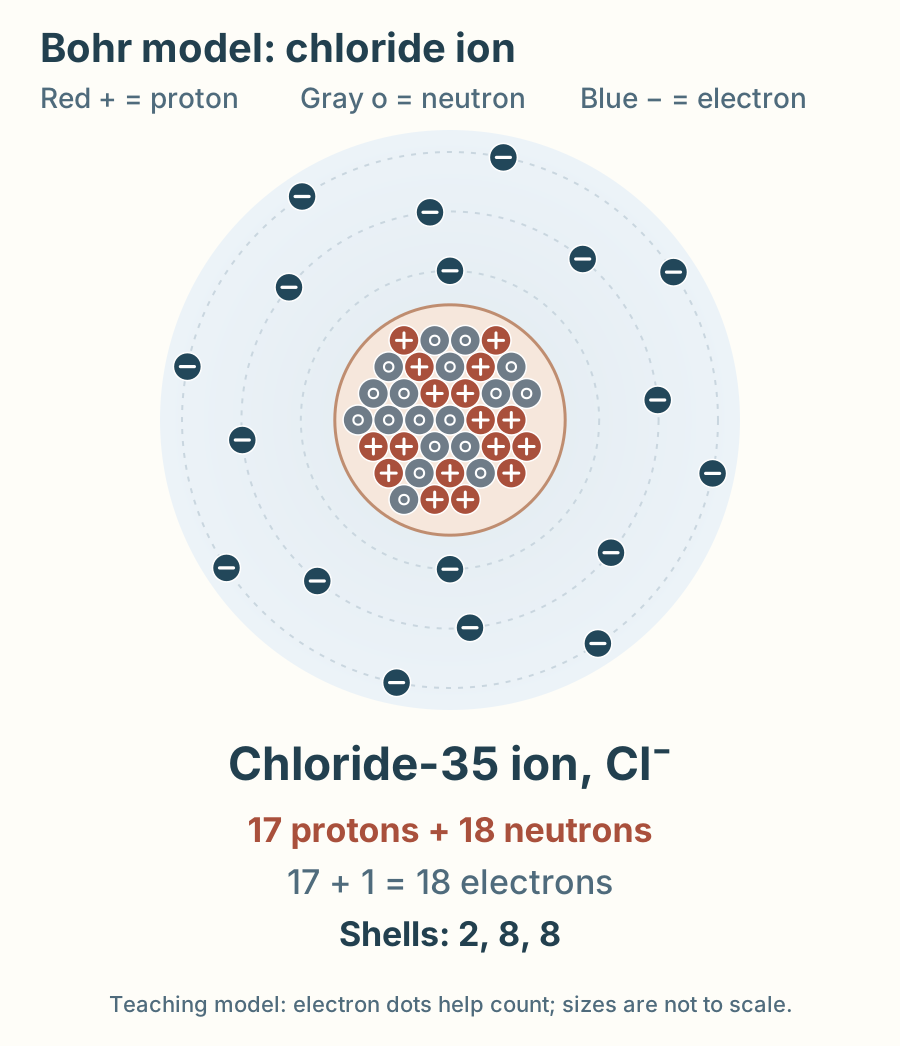
Draw a Bohr model for the chloride ion, ³⁵Cl⁻. How many electrons go in each ring?

Hint 1 · the clue

The 1− charge means one extra electron.

Hint 2 · the next move

Chlorine’s 17 (periodic table) + 1 = 18 electrons.

Your path:

  1. 17 + 1 = 18 electrons
  2. 2, 8, …
  3. 18 − 10 = 8
Answer

Answer: 2, 8, 8

Full worked solution

What you know: ³⁵Cl⁻.

  1. 17 protons; 35 − 17 = 18 neutrons; 17 + 1 = 18 electrons.
  2. Rings: 2, 8, 8.

Watch out: 2, 8, 7 is neutral chlorine, not the ion.

Bohr model of the chloride-35 ion: rings of 2, 8 and 8.
Cl⁻: 2, 8, 8.

17Cl35.45On the periodic table: chlorine (Cl) is 17.

Answer: 2, 8, 8

Watch out

Common Bohr model mistakes