ChemGem

How to Calculate Heat for Phase Changes (Step-by-Step, with Practice)

Heat either warms a substance or changes its phase (solid, liquid, gas). Each job has its own equation.

Spot it, solve it, practice it: 4 steps, 1 worked example, 3 practice problems. Free, no account.

The route · 4 steps

  1. Decide: temperature change in one phase, or a phase change?
  2. One phase: q = mcΔT. Phase change: q = nΔH.
  3. Convert grams to moles if ΔH is per mole.
  4. For several stages, calculate each q and add them; check the sign.
Spot it

How to recognize phase change questions

Look for melting "at its melting point" or boiling "at its boiling point," moles of substance, and an enthalpy in kJ/mol.

Example wording, with the clue words marked:

Melting a solid takes 6.0 kJ/mol. How much heat is needed to melt 7 mol at its melting point?

Not sure it’s this type? Compare the neighbors:

Step-by-step

Worked example: phase change

The idea

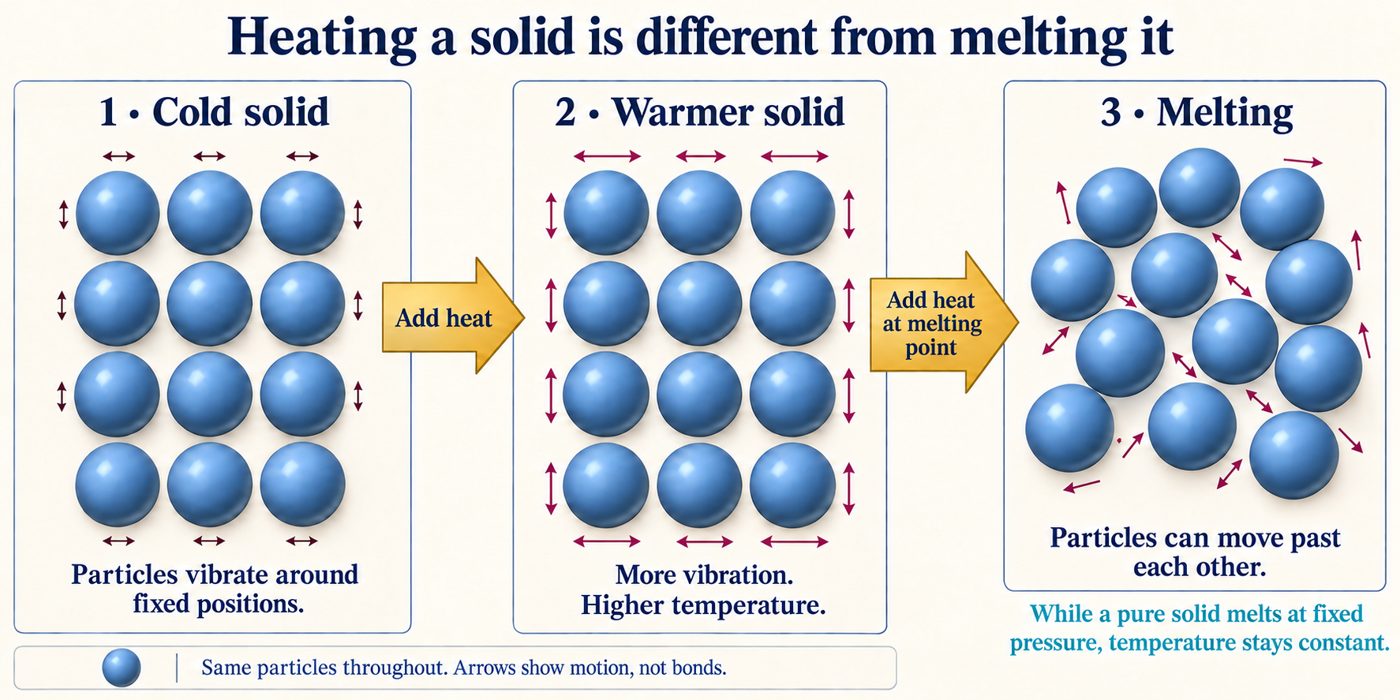
Three stages: a cold solid with particles vibrating around fixed positions; a warmer solid with stronger vibration in the same lattice; melting with closely packed particles moving past one another. Heating within the solid raises temperature. During melting of a pure substance at fixed pressure, temperature stays constant.
Warming speeds particles up. Melting rearranges them at constant temperature. The spheres are a model; particles are conserved.
Phase-change heat = moles × heat per mole
q = n × ΔHphase
q heat, n moles, ΔHphase the molar enthalpy of melting (fusion) or vaporization. Match J or kJ.
Which equation?
Temperature change, one phase
q = m × c × ΔT
Temperature rises or falls.
Phase change
q = n × ΔH (per mole)
q = m × heat per gram (per mass, e.g. J/g or kJ/kg)
Temperature stays constant.
A heating curve: slopes and flat steps
meltingq = nΔHboilingq = nΔHsolidliquidgasHeat added →Temperature →
Slopes: one phase warming, q = mcΔT. Flat steps: a pure substance changing phase at fixed pressure, q = nΔH. Schematic.
Direction of heat in each phase change
ChangeFrom → toHeatSign of q
Melting (fusion)solid → liquidabsorbed+
Vaporizationliquid → gasabsorbed+
Freezingliquid → solidreleased−
Condensationgas → liquidreleased−
Both warming and a phase change? Calculate each part separately, then add the q values.

On the periodic table: H is atomic number 1, mass 1.008; O is 16.00.

On the periodic table: Ice, water and vapor are all H2O: 2 × 1.008 + 16.00 = 18.02 g/mol, to turn grams of water into moles.

On the periodic table: Fusion and vaporization enthalpies come from phase-change data, not from the periodic table.

Worked example · 4 steps

Melt 2.0 mol of a solid at its melting point. Its fusion enthalpy is 6.0 kJ/mol. Find the heat required.

  1. 1
    Identify the kind of change

    Solid → liquid at the melting point: a phase change, not a temperature rise. Use the fusion enthalpy.

    GivenValue
    Changesolid → liquid (melting)
    n2.0 mol
    ΔHfusion6.0 kJ/mol
    q?
    The substance is unspecified, so no periodic-table mass is needed.
  2. 2
    Write the phase-change relationship

    Multiply the amount by the energy needed per mole.

    q = n × ΔHfusion
  3. 3
    Calculate

    Moles cancel, leaving kilojoules.

    q = 2.0 mol × 6.0 kJ1 mol = 12 kJ
  4. 4
    Check the sign

    Heat enters the melting solid, so q is positive, even though temperature stays constant.

    melting absorbs heat  ⇒  q = +12 kJ
  5. ✓
    Answer

    q = +12 kJ

Your turn

Phase change practice problems

Answer first, then check. Hints open one at a time; the answer and full solution open after you try.

Problem 1 of 3 · warm-up

Melting a solid takes 6.0 kJ/mol. How much heat is needed to melt 7 mol at its melting point?

Hint 1 · the clue

Amount and fusion enthalpy are given.

Hint 2 · the next move

Heat to melt "at its melting point" with kJ/mol and moles given: temperature stays fixed, so use q = n × ΔHfusion.

Your path:

  1. Phase change: temperature stays constant
  2. Use q = n × ΔHfusion
  3. mol cancels, leaving kJ
Answer

Answer: 42 kJ

Full worked solution

What you know: ΔHfusion = 6.0 kJ/mol and n = 7 mol, at the melting point. What you want: heat q.

  1. At the melting point, temperature stays constant while the solid melts. All the heat goes into the phase change, so use q = n × ΔHfusion.
  2. Substitute: q = 7 mol × 6.0 kJ/mol. The mol units cancel, leaving kJ.
  3. Multiply: q = 42 kJ. The value is positive because melting absorbs heat.

Check: 6.0 kJ for each mole, and 7 moles: 7 × 6 = 42.

Your route: Phase change at fixed temperature → q = nΔH.

Answer: 42 kJ

Problem 2 of 3

Melting a solid takes 6.0 kJ/mol. How much heat is needed to melt 8 mol at its melting point?

Hint 1 · the clue

Amount and fusion enthalpy are given.

Hint 2 · the next move

Heat to melt "at its melting point" with kJ/mol and moles given: temperature stays fixed, so use q = n × ΔHfusion.

Your path:

  1. Phase change: temperature stays constant
  2. Use q = n × ΔHfusion
  3. mol cancels, leaving kJ
Answer

Answer: 48 kJ

Full worked solution

What you know: ΔHfusion = 6.0 kJ/mol and n = 8 mol, at the melting point. What you want: heat q.

  1. Melting at the melting point happens at fixed temperature, so use q = n × ΔHfusion. No temperature change is involved.
  2. Substitute: q = 8 mol × 6.0 kJ/mol. The mol units cancel, leaving kJ.
  3. Multiply: q = 48 kJ, positive because the solid absorbs heat to melt.

Check: 6.0 kJ for each mole, and 8 moles: 8 × 6.0 = 48 kJ.

Watch out: Don’t use a heat-capacity formula here. There is no temperature change during melting.

Your route: Phase change at fixed temperature → q = nΔH.

Answer: 48 kJ

Problem 3 of 3

Melt 3.0 mol with fusion enthalpy 5.0 kJ/mol. Heat?

Hint 1 · the clue

Identify the requested heat quantity and the appropriate relation. Keep units consistent and check whether energy enters or leaves the stated system.

Hint 2 · the next move

"Melt" with moles and "fusion enthalpy" in kJ/mol: a phase change, so multiply moles by the enthalpy.

Your path:

  1. Melting happens at fixed temperature
  2. Use q = n × ΔHfusion
  3. Melting absorbs heat: q is positive
Answer

3.0 × 5.0 = +15 kJ; melting absorbs heat.

Full worked solution

What you know: n = 3.0 mol and ΔHfusion = 5.0 kJ/mol. What you want: heat q for melting.

  1. Melting is a phase change at fixed temperature, so use q = n × ΔHfusion.
  2. Substitute: q = 3.0 mol × 5.0 kJ/mol. The mol units cancel, leaving kJ.
  3. Multiply: 3.0 × 5.0 = 15. The sign is positive because the solid takes in heat: +15 kJ; melting absorbs heat.

Check: 5.0 kJ per mole, three moles: 15 kJ. Two significant figures in each input, two in the answer.

Watch out: Freezing the same amount would release heat, giving −15 kJ. Check the direction before writing the sign.

Answer: 3.0 × 5.0 = +15 kJ; melting absorbs heat.

Watch out

Common phase change mistakes