ChemGem

How to Find Partial Pressure with Dalton’s Law (Step-by-Step, with Practice)

Each gas in a mixture adds its own partial pressure to the total (this is Dalton’s law). Its share of the moles is its share of the pressure.

Spot it, solve it, practice it: 4 steps, 1 worked example, 17 practice problems. Free, no account.

The route · 4 steps

  1. Convert each gas to moles if masses are given.
  2. Add the moles to get ntotal.
  3. Find each mole fraction: nA ÷ ntotal.
  4. Multiply by Ptotal; check the parts add to the total.
Spot it

How to recognize partial pressure questions

Look for a gas mixture, "partial pressure," "total pressure," "mole fraction," or gas "collected over water."

Example wording, with the clue words marked:

Gas A contributes 0.40 atm and gas B contributes 0.60 atm. Find total pressure.

Not sure it’s this type? Compare the neighbors:

Step-by-step

Worked example: partial pressure

The idea

Dalton’s law: add every gas’s contribution
Ptotal = PA + PB + …
All partial pressures in the same unit.
Partial pressure = mole fraction × total pressure
xA = nAntotal    PA = xA × Ptotal
Mole fraction, x: a gas’s moles divided by all gas moles. All the mole fractions add up to 1.
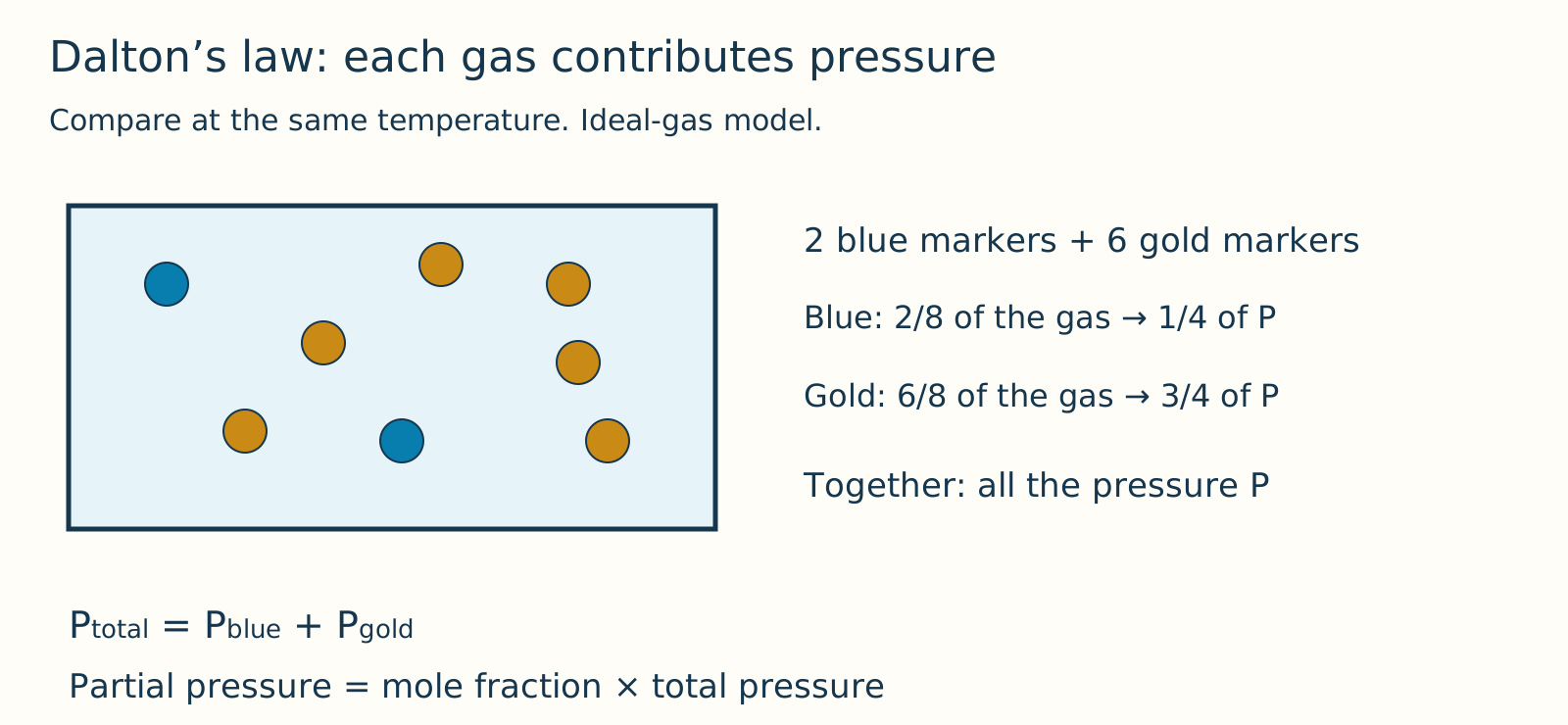
One box holds 2 blue markers and 6 gold markers. Labels show blue is 2/8 of the gas and gives 1/4 of the pressure P, and gold is 6/8 of the gas and gives 3/4 of P.
2 of 8 particles gives 1/4 of P. Together: Ptotal = Pblue + Pgold.
Quick checks before you calculate
Never larger than the total
A partial pressure cannot exceed the total pressure.
More moles, more pressure
At the same T and V, the gas with more moles contributes more.
Gas collected over water
PgasPwaterMeasured PtotalPgas = Ptotal − PwaterWater’s vapor pressure depends only on temperature; problems supply it.
Gas bubbled into an upside-down bottle of water picks up water vapor; subtract it.
Separate idea: particle speed and effusion
  • At the same temperature, all gases have the same average translational kinetic energy, so lighter particles move faster on average.
  • Effusion means escaping through a tiny opening.
  • Predict first: the lighter gas escapes faster. This is a different question from finding a partial pressure.
Graham’s law (same temperature)
rate Arate B = √(molar mass Bmolar mass A)
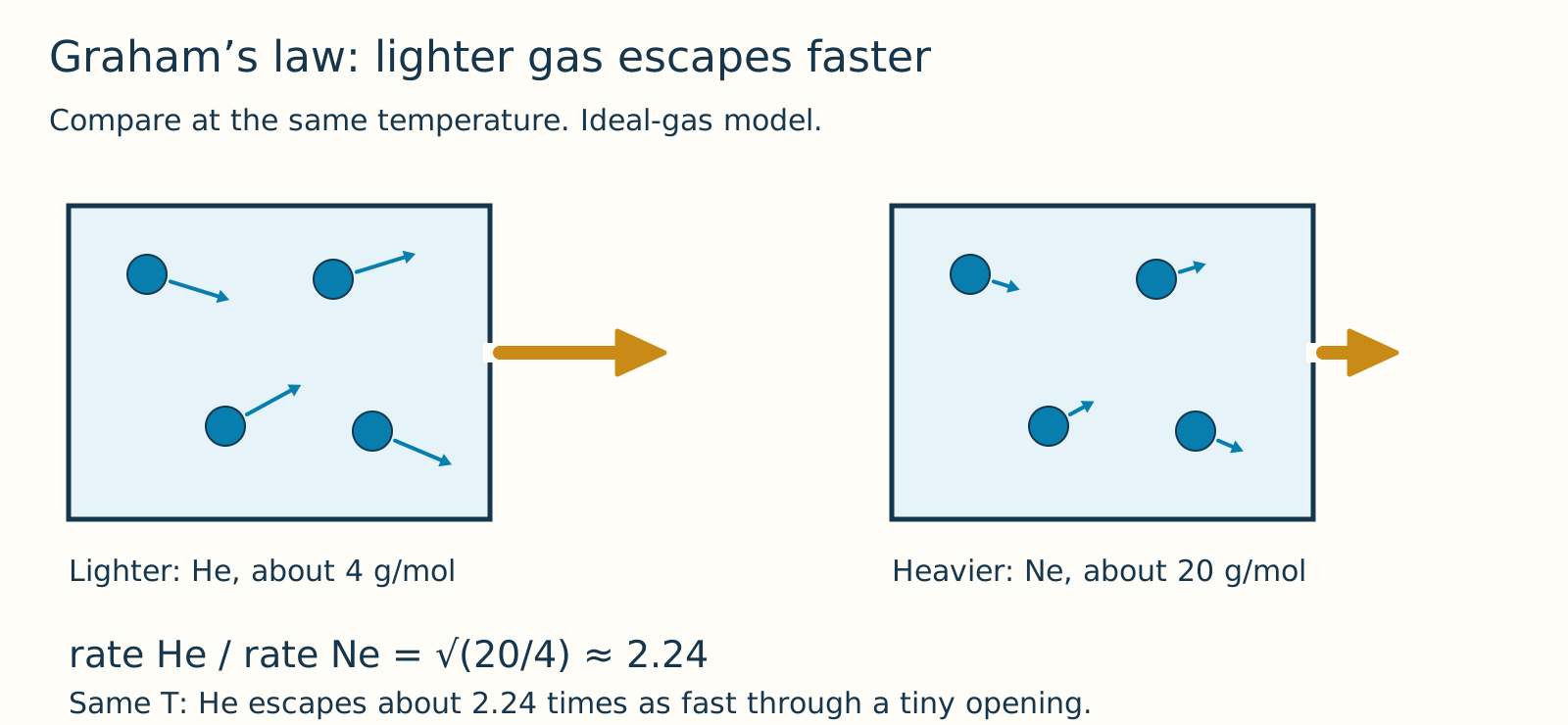
Helium and neon in separate containers effuse through tiny openings at the same temperature. The helium rate is about 2.24 times the neon rate using rounded molar masses 4 and 20 grams per mole. Arrow lengths indicate comparative rates, not measured trajectories.
Helium (about 4 g/mol) escapes about √(20 ÷ 4) ≈ 2.24 times as fast as neon (about 20 g/mol). Arrow lengths compare rates only.

On the periodic table: On the periodic table, N is 14.01 and O is 16.00: N2 ≈ 28.02 g/mol, O2 ≈ 32.00 g/mol.

On the periodic table: Given masses? Divide each gas’s grams by its molar mass. Use supplied masses when given.

On the periodic table: Read each gas’s molar mass from the decimal numbers in the element boxes: helium (He) is about 4 g/mol and neon (Ne) about 20 g/mol, so helium escapes faster.

Worked example · 3 steps

A mixture has 2.0 mol gas A and 6.0 mol gas B at 4.0 atm total. Find each partial pressure.

  1. 1
    Find total moles

    Add both gases.

    ntotal = 2.0 mol + 6.0 mol = 8.0 mol
  2. 2
    Find each partial pressure

    Multiply each mole fraction by the total pressure.

    PA = 2.0 mol8.0 mol × 4.0 atm = 1.0 atm
    PB = 6.0 mol8.0 mol × 4.0 atm = 3.0 atm
  3. 3
    Check the sum

    The parts add back to the total.

    1.0 atm + 3.0 atm = 4.0 atm ✓
  4. ✓
    Answer

    PA = 1.0 atm, PB = 3.0 atm

Your turn

Partial pressure practice problems

Answer first, then check. Hints open one at a time; the answer and full solution open after you try.

Problem 1 of 17 · warm-up

Gas A contributes 0.40 atm and gas B contributes 0.60 atm. Find total pressure.

Hint 1 · the clue

Add partial pressures.

Hint 2 · the next move

Each gas's pressure is given and total pressure is asked: Dalton's law says add the partial pressures.

Your path:

  1. Check all pressures share one unit
  2. Add the partial pressures
Answer

Answer: 1.00 atm

Full worked solution

What you know: PA = 0.40 atm and PB = 0.60 atm. What you want: the total pressure.

  1. Each gas pushes on the walls on its own. Dalton’s law says the total is the sum of the partial pressures.
  2. Both values are in atm, so add them directly: Ptotal = 0.40 atm + 0.60 atm = 1.00 atm. Both values have two decimal places, so the sum keeps two: 1.00.

Check: The total must be bigger than either part. 1.00 atm is bigger than 0.60 atm.

Answer: 1.00 atm

Problem 2 of 17

Total pressure is 1.50 atm. A contributes 0.35 atm. Find B’s pressure.

Hint 1 · the clue

Subtract the known contribution from the total.

Hint 2 · the next move

Total pressure and one gas's share are given and the other's is asked: subtract, using Dalton's law.

Your path:

  1. Ptotal = PA + PB
  2. Rearrange: PB = Ptotal − PA
Answer

Answer: 1.15 atm

Full worked solution

What you know: Ptotal = 1.50 atm and PA = 0.35 atm. What you want: PB.

  1. Dalton’s law: Ptotal = PA + PB.
  2. Rearrange to isolate B: PB = Ptotal − PA.
  3. Substitute: PB = 1.50 atm − 0.35 atm = 1.15 atm.

Check: Add the parts back: 0.35 atm + 1.15 atm = 1.50 atm, the total.

Answer: 1.15 atm

Problem 3 of 17

A mixture has 1.0 mol A and 3.0 mol B at 2.0 atm. Find A’s pressure.

Hint 1 · the clue

Use A’s fraction of all the moles.

Hint 2 · the next move

Moles of each gas and total pressure are given and one gas's pressure asked: use mole fraction × total pressure.

Your path:

  1. Add moles for total moles
  2. Mole fraction = A's moles ÷ total
  3. Partial pressure = mole fraction × total
Answer

Answer: 0.50 atm

Full worked solution

What you know: nA = 1.0 mol, nB = 3.0 mol, Ptotal = 2.0 atm. What you want: PA.

  1. Find total moles: 1.0 mol + 3.0 mol = 4.0 mol.
  2. Find A’s mole fraction: xA = 1.0 mol ÷ 4.0 mol = 0.25. The mol units cancel, so xA has no unit.
  3. Partial pressure = mole fraction × total pressure: PA = 0.25 × 2.0 atm = 0.50 atm.

Check: A is one quarter of the particles, and 0.50 atm is one quarter of 2.0 atm.

Watch out: Divide by the total moles (4.0), not by B’s moles (3.0).

Answer: 0.50 atm

Problem 4 of 17

A mixture has 1.0 mol A and 3.0 mol B at 2.0 atm. Find B’s pressure.

Hint 1 · the clue

B has three quarters of the moles.

Hint 2 · the next move

Moles of each gas and total pressure are given and one gas's pressure asked: use mole fraction × total pressure.

Your path:

  1. Add moles for total moles
  2. Mole fraction = B's moles ÷ total
  3. Partial pressure = mole fraction × total
Answer

Answer: 1.5 atm

Full worked solution

What you know: nA = 1.0 mol, nB = 3.0 mol, Ptotal = 2.0 atm. What you want: PB.

  1. Total moles = 1.0 mol + 3.0 mol = 4.0 mol.
  2. B’s mole fraction: xB = 3.0 mol ÷ 4.0 mol = 0.75.
  3. PB = xB × Ptotal = 0.75 × 2.0 atm = 1.5 atm. The 2.0 atm has two significant figures, so the answer has two.

Check: A has the other 0.25 of the moles, so PA = 0.25 × 2.0 atm = 0.50 atm. Dalton’s law: PA + PB = 0.50 atm + 1.5 atm = 2.0 atm, the total. You could also find PB by subtraction: 2.0 − 0.50 = 1.5 atm.

Answer: 1.5 atm

Problem 5 of 17

A mixture has 2.0 mol A and 2.0 mol B at 3.0 atm. Find each partial pressure.

Hint 1 · the clue

Equal mole counts give equal pressure contributions.

Hint 2 · the next move

Moles of each gas and total pressure are given and each partial pressure asked: find each mole fraction, then multiply.

Your path:

  1. Add moles for total moles
  2. Find each gas's mole fraction
  3. Partial pressure = mole fraction × total
Answer

Answer: 1.5 atm each

Full worked solution

What you know: nA = 2.0 mol, nB = 2.0 mol, Ptotal = 3.0 atm. What you want: PA and PB.

  1. Total moles = 2.0 mol + 2.0 mol = 4.0 mol.
  2. Each mole fraction: x = 2.0 mol ÷ 4.0 mol = 0.50. Equal moles mean equal shares of the particles.
  3. Each partial pressure: P = 0.50 × 3.0 atm = 1.5 atm each.

Check: 1.5 atm + 1.5 atm = 3.0 atm, the total.

Answer: 1.5 atm each

Problem 6 of 17

A gas has mole fraction 0.20. Total pressure is 5.0 atm. Find its partial pressure.

Hint 1 · the clue

Multiply the fraction by total pressure.

Hint 2 · the next move

Mole fraction and total pressure are given: multiply them directly to get the partial pressure.

Your path:

  1. Mole fraction given; skip counting moles
  2. Partial pressure = mole fraction × total
Answer

Answer: 1.0 atm

Full worked solution

What you know: x = 0.20 and Ptotal = 5.0 atm. What you want: the gas’s partial pressure.

  1. The mole fraction is already given, so skip counting moles.
  2. Partial pressure = mole fraction × total pressure: P = 0.20 × 5.0 atm = 1.0 atm. Both values have two significant figures, so the answer has two.

Check: 0.20 is one fifth, and one fifth of 5.0 atm is 1.0 atm.

Answer: 1.0 atm

Problem 7 of 17

A gas contributes 0.75 atm to a total of 3.0 atm. Find its mole fraction.

Hint 1 · the clue

Divide its pressure by total pressure.

Hint 2 · the next move

A gas's pressure and the total are given and mole fraction is asked: divide the gas's pressure by the total.

Your path:

  1. Start from Pgas = x × Ptotal
  2. Rearrange: x = Pgas ÷ Ptotal
  3. Units cancel; answer has no unit
Answer

Answer: 0.25

Full worked solution

What you know: Pgas = 0.75 atm and Ptotal = 3.0 atm. What you want: the mole fraction x.

  1. Start from Pgas = x × Ptotal. Divide both sides by Ptotal to isolate x: x = Pgas ÷ Ptotal.
  2. Substitute: x = 0.75 atm ÷ 3.0 atm = 0.25. The atm units cancel, so the answer has no unit.

Check: 0.25 × 3.0 atm = 0.75 atm. Also, a mole fraction must be between 0 and 1, and 0.25 is.

Watch out: Don’t write a pressure unit on a mole fraction. It is a pure fraction.

Answer: 0.25

Problem 8 of 17

A, B, and C contribute 120, 230, and 150 kPa. Find total pressure.

Hint 1 · the clue

Add all three contributions.

Hint 2 · the next move

Three gases' pressures are given and total pressure is asked: Dalton's law works for any number of gases, so add them.

Your path:

  1. Check all pressures share one unit
  2. Add every partial pressure
Answer

Answer: 500 kPa

Full worked solution

What you know: PA = 120 kPa, PB = 230 kPa, PC = 150 kPa. What you want: Ptotal.

  1. Dalton’s law works for any number of gases: add every partial pressure.
  2. All three are already in kPa, so add directly: 120 kPa + 230 kPa + 150 kPa = 500 kPa.

Check: Group easy pairs: 120 + 230 = 350, then 350 + 150 = 500.

Watch out: If the parts were in different units (say atm and kPa), you would convert first. Here they match.

Answer: 500 kPa

Problem 9 of 17

In an ideal mixture, A has 2 mol and B has 6 mol. Which contributes more pressure?

Hint 1 · the clue

Compare moles, not grams or molecular mass.

Hint 2 · the next move

Moles of two gases in one ideal mixture are compared: pressure share follows mole share, so more moles means more pressure.

Your path:

  1. Partial pressure = mole fraction × total
  2. Compare mole fractions
  3. Larger mole share → larger pressure
Answer

Answer: B

Full worked solution

What you know: nA = 2 mol and nB = 6 mol in the same ideal mixture. What you want: which gas contributes more pressure.

  1. In an ideal mixture, partial pressure = mole fraction × total pressure. So pressure share follows mole share.
  2. Total moles = 8 mol. xA = 2/8 = 0.25 and xB = 6/8 = 0.75.
  3. B has three times the moles, so it pushes with three times A’s pressure. The answer is B.

Why it matters: Pressure comes from the number of particles hitting the walls, not their mass.

Watch out: Don’t pick the heavier gas. Compare moles, not grams or molar mass.

Answer: B

Problem 10 of 17

Gas is collected over water. Total pressure is 100.0 kPa; water vapor contributes 3.2 kPa. Find dry-gas pressure.

Hint 1 · the clue

Subtract the water-vapor contribution.

Hint 2 · the next move

"Collected over water" means the total includes water vapor: subtract water's pressure to get the dry gas.

Your path:

  1. Ptotal = Pgas + Pwater
  2. Rearrange: Pgas = Ptotal − Pwater
Answer

Answer: 96.8 kPa

Full worked solution

What you know: Ptotal = 100.0 kPa and Pwater = 3.2 kPa. What you want: the dry-gas pressure.

  1. Gas collected over water picks up water vapor. The measured total is gas plus water vapor: Ptotal = Pgas + Pwater.
  2. Rearrange: Pgas = Ptotal − Pwater.
  3. Substitute: Pgas = 100.0 kPa − 3.2 kPa = 96.8 kPa. Both values have one decimal place, so the answer keeps one.

Check: 96.8 kPa + 3.2 kPa = 100.0 kPa.

Watch out: Don’t add the water vapor. It is already inside the measured total.

Answer: 96.8 kPa

Problem 11 of 17

Two gases have partial pressures 1.8 atm and 4.2 atm. What is total pressure?

Hint 1 · the clue

Partial pressures are listed.

Hint 2 · the next move

Two partial pressures are given and total pressure is asked: Dalton's law says add them.

Your path:

  1. Check both pressures share one unit
  2. Add the partial pressures
Answer

Answer: 6.0 atm

Full worked solution

What you know: partial pressures 1.8 atm and 4.2 atm. What you want: Ptotal.

  1. For a gas mixture, Dalton’s law says the total pressure is the sum of the partial pressures.
  2. Both are in atm, so add: Ptotal = 1.8 atm + 4.2 atm = 6.0 atm. Both have one decimal place, so keep one: 6.0, not 6.

Check: 6.0 − 1.8 = 4.2, the other part.

Your route: Mixture → Add partial pressures.

Answer: 6.0 atm

Problem 12 of 17

Two gases have partial pressures 2.1 atm and 4.9 atm. What is total pressure?

Hint 1 · the clue

Partial pressures are listed.

Hint 2 · the next move

Two partial pressures are given and total pressure is asked: Dalton's law says add them.

Your path:

  1. Check both pressures share one unit
  2. Add the partial pressures
Answer

Answer: 7.0 atm

Full worked solution

What you know: partial pressures 2.1 atm and 4.9 atm. What you want: Ptotal.

  1. For a gas mixture, Dalton’s law says add the partial pressures.
  2. Both are in atm: Ptotal = 2.1 atm + 4.9 atm = 7.0 atm. One decimal place in each, so keep one: 7.0.

Check: The total is larger than either part, and 7.0 − 2.1 = 4.9.

Your route: Mixture → Add partial pressures.

Answer: 7.0 atm

Problem 13 of 17

A mixture contains 6 mol gas A and 18 mol gas B at 4.0 atm total. What is A’s partial pressure?

Hint 1 · the clue

Mixture mole amounts and total pressure are given.

Hint 2 · the next move

Moles of each gas and total pressure are given, and one partial pressure is asked: use mole fraction × total pressure.

Your path:

  1. Add moles for total moles
  2. Mole fraction = A's moles ÷ total
  3. Partial pressure = mole fraction × total
Answer

Answer: 1.0 atm

Full worked solution

What you know: nA = 6 mol, nB = 18 mol, Ptotal = 4.0 atm. What you want: PA.

  1. Total moles = 6 mol + 18 mol = 24 mol.
  2. A’s mole fraction: xA = 6 mol ÷ 24 mol = 0.25. The mol units cancel.
  3. PA = xA × Ptotal = 0.25 × 4.0 atm = 1.0 atm.

Check: B’s pressure is 0.75 × 4.0 = 3.0 atm, and 1.0 + 3.0 = 4.0 atm, the total.

Watch out: Use the total moles (24), not B’s moles (18), on the bottom of the fraction.

Your route: Mole fraction → Multiply total pressure.

Answer: 1.0 atm

Problem 14 of 17

A mixture contains 7 mol gas A and 21 mol gas B at 4.0 atm total. What is A’s partial pressure?

Hint 1 · the clue

Mixture mole amounts and total pressure are given.

Hint 2 · the next move

Moles of each gas and total pressure are given, and one partial pressure is asked: use mole fraction × total pressure.

Your path:

  1. Add moles for total moles
  2. Mole fraction = A's moles ÷ total
  3. Partial pressure = mole fraction × total
Answer

Answer: 1.0 atm

Full worked solution

What you know: nA = 7 mol, nB = 21 mol, Ptotal = 4.0 atm. What you want: PA.

  1. Total moles = 7 mol + 21 mol = 28 mol.
  2. A’s mole fraction: xA = 7 mol ÷ 28 mol = 0.25.
  3. PA = xA × Ptotal = 0.25 × 4.0 atm = 1.0 atm.

Check: B has three times A’s moles, so B should have three times A’s pressure: 3.0 atm. 1.0 + 3.0 = 4.0 atm.

Your route: Mole fraction → Multiply total pressure.

Answer: 1.0 atm

Problem 15 of 17

For equal-temperature ideal effusion, gas A has molar mass 4 and gas B 100 g/mol. What is rate A/rate B?

Hint 1 · the clue

Molar masses and effusion rates are compared.

Hint 2 · the next move

"Effusion" with two molar masses and a rate ratio asked signals Graham's law: lighter gases escape faster.

Your path:

  1. Predict: lighter gas has larger rate
  2. Graham's law: rateA/rateB = √(MB/MA)
  3. Put B's molar mass on top
Answer

Answer: 5

Full worked solution

What you know: MA = 4 g/mol, MB = 100 g/mol, same temperature. What you want: rate A ÷ rate B.

  1. Effusion at the same temperature uses Graham’s law: rate A/rate B = √(MB/MA). B’s molar mass goes on top, so the lighter gas has the larger rate.
  2. Substitute: rate A/rate B = √(100 g/mol ÷ 4 g/mol). The g/mol units cancel.
  3. 100 ÷ 4 = 25, and √25 = 5.

Check: A is the lighter gas, so it should escape faster. A ratio bigger than 1 agrees.

Watch out: Don’t forget the square root. A 25-fold mass difference gives only a 5-fold speed difference.

Your route: Lighter gas faster → Square root of inverse mass ratio.

Answer: 5

Problem 16 of 17

Gas A is 1 of 5 total moles; total pressure 3.0 atm. A’s pressure?

Hint 1 · the clue

Find A’s mole fraction, then multiply it by the total pressure.

Hint 2 · the next move

A gas's share of total moles and the total pressure are given: find the mole fraction, then multiply by total pressure.

Your path:

  1. Mole fraction = A's moles ÷ total
  2. Partial pressure = mole fraction × total
Answer

(1/5) × 3.0 = 0.60 atm.

Full worked solution

What you know: nA = 1 mol out of 5 mol total; Ptotal = 3.0 atm. What you want: PA.

  1. A’s mole fraction: xA = 1 mol ÷ 5 mol = 0.20. The mol units cancel.
  2. Partial pressure = mole fraction × total pressure: PA = (1/5) × 3.0 atm = 0.20 × 3.0 atm.
  3. Multiply: PA = 0.60 atm.

Check: The other gases hold 4/5 of the moles, so 0.80 × 3.0 = 2.4 atm. 0.60 + 2.4 = 3.0 atm, the total.

Watch out: The 5 mol is already the total. Don’t add 1 to it again.

Answer: (1/5) × 3.0 = 0.60 atm.

Problem 17 of 17

Helium (M = 4.00 g/mol) and oxygen gas, O2 (M = 32.00 g/mol), effuse through the same tiny opening at the same temperature. How many times as fast as O2 does He effuse?

Hint 1 · the clue

Lighter gases escape faster. Use rate(He)/rate(O2) = √(M(O2)/M(He)), with the heavier molar mass on top.

Hint 2 · the next move

"Effuse" with two molar masses and "how many times as fast" signals Graham's law: the lighter gas escapes faster.

Your path:

  1. Predict: lighter He should be faster
  2. Graham's law: rateA/rateB = √(MB/MA)
  3. Put O2's molar mass on top
Answer

rate(He)/rate(O2) = √(32.00/4.00) = 2.83; helium effuses about 2.83 times as fast.

Full worked solution

What you know: M(He) = 4.00 g/mol, M(O2) = 32.00 g/mol, same temperature. What you want: rate(He) ÷ rate(O2).

  1. Predict first: helium is lighter, so it should escape faster. The ratio should be greater than 1.
  2. Use Graham’s law: rateA/rateB = √(MB/MA), with A = He and B = O2. The other gas’s molar mass goes on top.
  3. Substitute: rate(He)/rate(O2) = √(32.00 g/mol ÷ 4.00 g/mol). The g/mol units cancel, leaving √8.00.
  4. √8.00 = 2.828…, which rounds to three significant figures as 2.83.

Check: The answer is greater than 1, matching the prediction that the lighter gas escapes faster.

Watch out: Don’t skip the square root. An 8-fold mass difference gives only about a 2.83-fold rate difference, not 8. If you got 0.354, you put the molar masses upside down.

Answer: rate(He)/rate(O2) = √(32.00/4.00) = 2.83; helium effuses about 2.83 times as fast.

Watch out

Common partial pressure mistakes